WAEC Biology 2011 past questions and answers

40 questions. Try each one, then open the answer to check yourself and read the explanation.

Question 1

Characteristics and Classification of Living Things

The branch of biology that deals with the principles of classification of organisms is known as

  1. A.biological index.
  2. B.nomenclature.
  3. C.taxonomy.
  4. D.ecology
Show the answer and explanation

Answer: C (taxonomy.)

Explanation

Taxonomy is the science of classifying and naming organisms; nomenclature is only the naming part.

Open this question

Question 2

Cell Structure and Organisation

Which of the following structures is a tissue?

  1. A.Vessel element
  2. B.Blood
  3. C.Sieve tube element
  4. D.Erythrocyte
Show the answer and explanation

Answer: B (Blood)

Explanation

A tissue is a group of cells working together; blood is a tissue, while the other options are single cells.

Open this question

Question 3

Cell Structure and Organisation

Which of the following cells are not regarded as specialized?

  1. A.Sperm cells
  2. B.Root tip cells
  3. C.Muscle cells
  4. D.Somatic cells
Show the answer and explanation

Answer: B (Root tip cells)

Explanation

Cells at the root tip (the meristem) keep dividing and have not yet taken on a particular job, so they are unspecialised. Sperm and muscle cells are specialised, and somatic cells just means body cells in general.

Open this question

Question 4

Cell Structure and Organisation

Which of the following pairs of cells carry out the same function?

  1. A.Cheek cell and red blood cell
  2. B.Spermatozoan and ovum
  3. C.Palisade cell and epidermal cell
  4. D.Root tip cell and guard cell
Show the answer and explanation

Answer: B (Spermatozoan and ovum)

Explanation

Sperm and ovum are both gametes; their shared function is sexual reproduction.

Open this question

Question 5

Cell and Its Environment

If Amoeba is placed in a salt solution, the contractile vacuoles would

  1. A.be bursting more frequently.
  2. B.be more numerous.
  3. C.be formed less frequently.
  4. D.grow bigger before they burst.
Show the answer and explanation

Answer: C (be formed less frequently.)

Explanation

In a salt solution less water enters Amoeba by osmosis, so there is less water to pump out and the vacuole fills and empties less often.

Open this question

Question 6

Habitats and Biomes

In which of the following habitats is Paramecium not found?

  1. A.Pond
  2. B.Aquarium
  3. C.Lake
  4. D.Puddle
Show the answer and explanation

Answer: B (Aquarium)

Explanation

Paramecium lives naturally in fresh water rich in decaying matter such as ponds, lakes and puddles; a clean aquarium is not its natural habitat.

Open this question

Question 7

Transport in Plants

The following processes are involved in water movement in the endodermis except

  1. A.osmosis.
  2. B.vacuolar pathway.
  3. C.diffusion.
  4. D.active transport.
Show the answer and explanation

Answer: C (diffusion.)

Explanation

Water crosses the endodermis by osmosis through the cells (vacuolar pathway), helped by active pumping of salts; simple diffusion is not the mechanism here.

Open this question

Question 8

Cell Structure and Organisation

Cells that utilise a lot of energy are characterized by the presence of a large number of

  1. A.vacuoles.
  2. B.mitochondria.
  3. C.endoplasmic reticulum.
  4. D.ribosomes.
Show the answer and explanation

Answer: B (mitochondria.)

Explanation

Mitochondria release energy by respiration, so very active cells contain many of them.

Open this question

Question 9

Cell Division

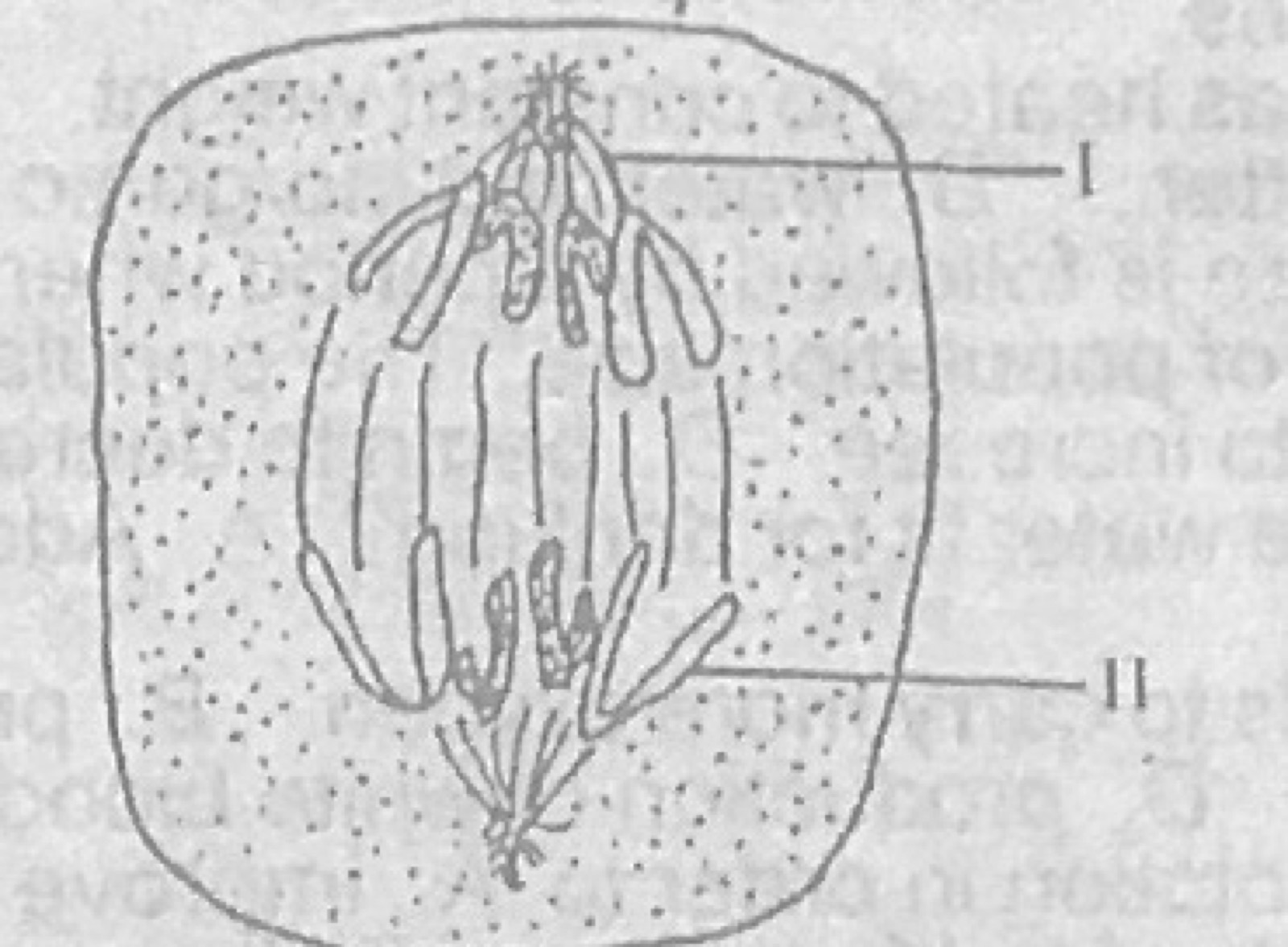
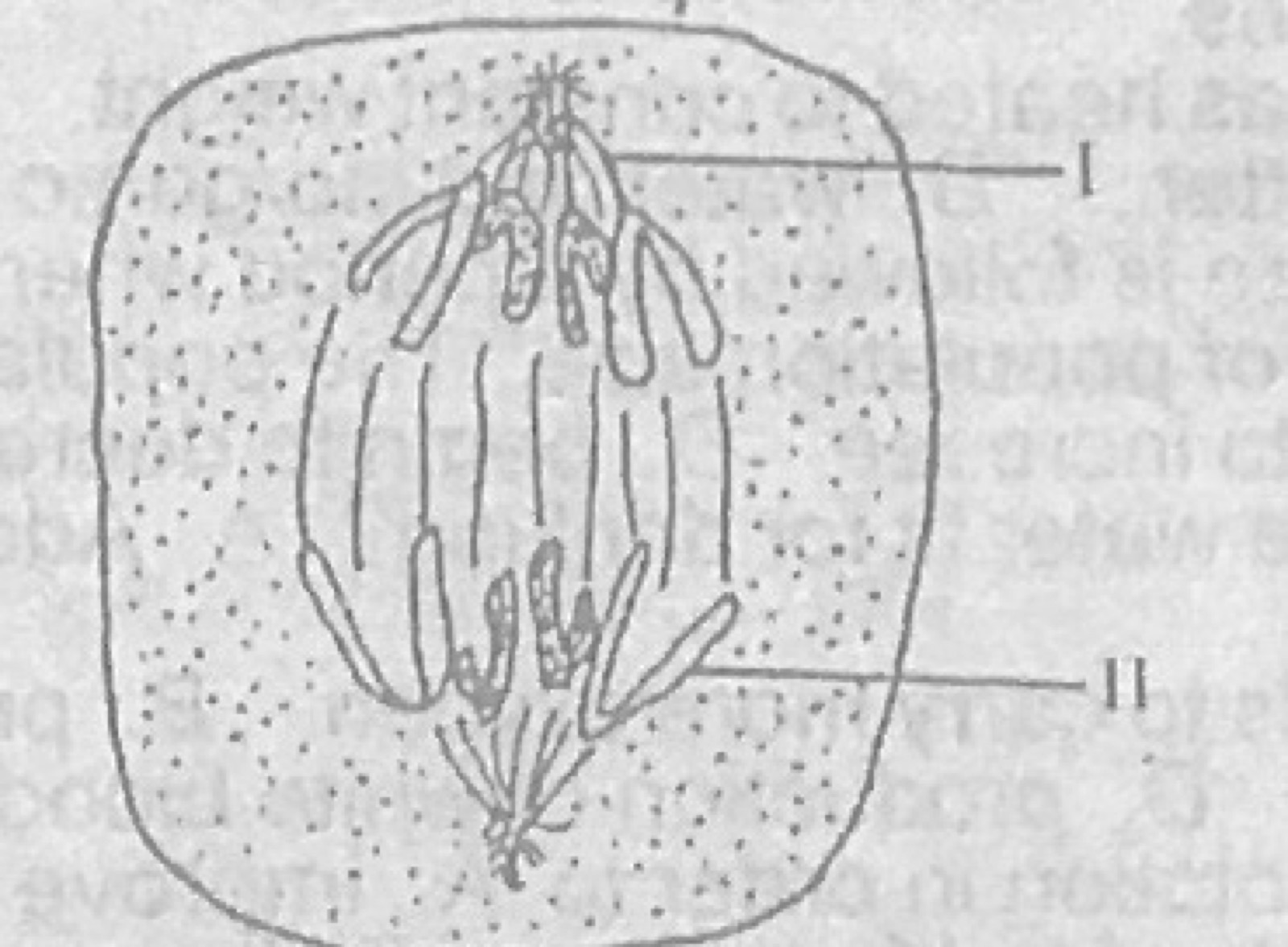
The diagram represents the phenomenon of growth in a meristematic cell of a plant.
The part labelled II in the diagram is

Diagram for this question
  1. A.centriole.
  2. B.chloroplast.
  3. C.chromatid.
  4. D.tonoplast.
Show the answer and explanation

Answer: C (chromatid.)

Explanation

The cell is in anaphase of mitosis; II points to one of the chromatids being pulled to the poles.

Open this question

Question 10

Cell Division

The diagram represents the phenomenon of growth in a meristematic cell of a plant.
The part labelled I is called the

Diagram for this question
  1. A.nucleolus.
  2. B.centromere.
  3. C.centriole.
  4. D.spindle.
Show the answer and explanation

Answer: D (spindle.)

Explanation

The lines running from pole to pole in a dividing cell are the spindle fibres, which pull the chromatids apart.

Open this question

Question 11

Growth and Development

Secondary growth is brought about by the activities of the

  1. A.phellogen and phelloderm.
  2. B.phellogen and procambium.
  3. C.vascular cambium and phelloderm.
  4. D.vascular cambium and phellogen.
Show the answer and explanation

Answer: D (vascular cambium and phellogen.)

Explanation

Secondary thickening comes from two meristems: the vascular cambium (new xylem and phloem) and the phellogen or cork cambium (new bark).

Open this question

Question 12

Structure of Flowering Plants

A monocot root is different from a dicot root by having

  1. A.endodermis.
  2. B.cambium.
  3. C.wide pith.
  4. D.root hair.
Show the answer and explanation

Answer: C (wide pith.)

Explanation

A monocot root has many vascular bundles in a ring around a large central pith; a dicot root has little or no pith.

Open this question

Question 13

Transport in Animals

Which of the following statements best describes haemoglobin? It is

  1. A.yellowish in colour.
  2. B.a red blood cell.
  3. C.an oxygen carrying pigment.
  4. D.needed for blood clotting.
Show the answer and explanation

Answer: C (an oxygen carrying pigment.)

Explanation

Haemoglobin is the red, iron-containing pigment inside red blood cells that carries oxygen.

Open this question

Question 14

Respiration

Inhaled air is made warm and moist in the

  1. A.epiglottis
  2. B.nasal cavity.
  3. C.trachea.
  4. D.mouth.
Show the answer and explanation

Answer: B (nasal cavity.)

Explanation

The nasal cavity has a moist lining and a rich blood supply that warm and moisten air on its way in.

Open this question

Question 15

Respiration

Which of the following structures is not involved in respiration?

  1. A.Lung books
  2. B.Mouth
  3. C.Stomach
  4. D.Trachea
Show the answer and explanation

Answer: C (Stomach)

Explanation

Lung books (spiders), mouth and trachea are breathing structures; the stomach is for digestion.

Open this question

Question 16

Excretion

Filtrate in the Bowman's capsule contains vitamins because

  1. A.only a little amount is required by the body.
  2. B.they can be reabsorbed into the blood.
  3. C.they have low molecular weight
  4. D.most of them are fat soluble.
Show the answer and explanation

Answer: C (they have low molecular weight)

Explanation

Ultrafiltration lets small molecules through the glomerulus; vitamins are small, so they pass into the filtrate.

Open this question

Question 17

Excretion

More sweat is produced during muscular exercise because

  1. A.the contracting muscles produce water.
  2. B.fermentation occurs in muscles.
  3. C.the temperature of the body rises
  4. D.the muscle fatigues.
Show the answer and explanation

Answer: C (the temperature of the body rises)

Explanation

Exercise increases respiration, which releases heat; the body sweats more so evaporation can cool it.

Open this question

Question 18

Nervous Coordination

Which of the following neurons may not have myelin sheath?

  1. A.Effector cells
  2. B.Intermediate neurons
  3. C.Motor neurons
  4. D.Sensory neurons
Show the answer and explanation

Answer: B (Intermediate neurons)

Explanation

Sensory and motor neurons carry impulses over long distances and are myelinated. Relay (intermediate) neurons are short and lie inside the central nervous system, and many have no myelin sheath.

Open this question

Question 19

Sense Organs

Which of the following is an effector organ?

  1. A.Tongue
  2. B.Skin
  3. C.Nose bridge
  4. D.Ear glands
Show the answer and explanation

Answer: D (Ear glands)

Explanation

Effectors are muscles and glands that respond to impulses; glands are effectors, while tongue and skin act here as sense organs.

Open this question

Question 20

Reproduction in Animals

During sexual reproduction in Paramecium, how many times does the zygote divide to produce eight nuclei?

  1. A.1
  2. B.2
  3. C.3
  4. D.4
Show the answer and explanation

Answer: C (3)

Explanation

One nucleus divides into 2, then 4, then 8: three divisions (23 = 8).

Open this question

Question 21

Reproduction in Animals

The testes in male mammals descend into the scrotal sac because

  1. A.there is congestion in the lower abdomen.
  2. B.they run the risk of being destroyed.
  3. C.they need special support.
  4. D.they require a relatively low temperature.
Show the answer and explanation

Answer: D (they require a relatively low temperature.)

Explanation

Sperm production needs a temperature a little below normal body temperature; the scrotum keeps the testes cooler.

Open this question

Question 22

Reproduction in Animals

Some animals return to water bodies to reproduce because

  1. A.natural enemies destroy their eggs on land.
  2. B.water nourishes their embryos and their young ones.
  3. C.they are close to their ancestors and imitate them.
  4. D.the temperature on land is not suitable for the development of their embryos.
Show the answer and explanation

Answer: D (the temperature on land is not suitable for the development of their embryos.)

Explanation

Animals like frogs lay eggs without shells that would dry out on land; their eggs and young need the conditions found in water to develop.

Open this question

Question 23

Reproduction in Plants

Which of the following methods is appropriate for the cultivation of cassava?

  1. A.Budding
  2. B.Fragmentation
  3. C.Root cutting
  4. D.Stem cutting
Show the answer and explanation

Answer: D (Stem cutting)

Explanation

Cassava is planted from pieces of the stem (stem cuttings).

Open this question

Question 24

Chromosomes, DNA and Sex Linkage

What will be the chromosome number of the hybrid of two varieties of a plant with 36 chromosomes in the endosperm cell?

  1. A.12
  2. B.24
  3. C.36
  4. D.48
Show the answer and explanation

Answer: B (24)

Explanation

Endosperm cells have three sets of chromosomes: 3n = 36, so n = 12. A hybrid plant body is diploid, 2n = 24.

Open this question

Question 25

Respiration

Kreb's cycle occurs in the

  1. A.mitochondria.
  2. B.cytoplasm.
  3. C.nucleus.
  4. D.ribosomes.
Show the answer and explanation

Answer: A (mitochondria.)

Explanation

The Krebs cycle takes place in the matrix of the mitochondria; glycolysis happens in the cytoplasm.

Open this question

Question 26

Photosynthesis and Plant Nutrition

The process whereby electrons are emitted from chlorophyll and returned to it unchanged is known as

  1. A.non-cyclic phosphorylation.
  2. B.photochemical reaction.
  3. C.photophosphorylation.
  4. D.cyclic photophosphorylation.
Show the answer and explanation

Answer: D (cyclic photophosphorylation.)

Explanation

In cyclic photophosphorylation the excited electrons travel a loop and come back to the same chlorophyll, making ATP on the way.

Open this question

Question 27

Photosynthesis and Plant Nutrition

Which of the following statements about photosynthesis is not true?

  1. A.Plants can photosynthesize without an increase in dry weight
  2. B.Carbon dioxide is absorbed by the leaves in bright light
  3. C.Oxygen is produced during photosynthesis from the breakdown of water
  4. D.Photosynthesis occurs in green plants
Show the answer and explanation

Answer: A (Plants can photosynthesize without an increase in dry weight)

Explanation

Photosynthesis makes new organic matter, so active photosynthesis increases dry weight.

Open this question

Question 28

Respiration

The equation below represents the process of glycolysis
Glucose + ATP —(heterokinase)→ X + ADP
X in the equation represents

  1. A.glucose diphosphate
  2. B.glucose phosphate
  3. C.glucose triphosphate
  4. D.fructose phosphate
Show the answer and explanation

Answer: B (glucose phosphate)

Explanation

The enzyme moves one phosphate from ATP onto glucose, giving glucose phosphate and ADP.

Open this question

Question 29

Transport in Plants

The removal of all the phloem tissues of the stem of a plant close to the root system for a long period of time is likely to

  1. A.provide more energy to the roots.
  2. B.accumulate more starch in the roots
  3. C.cause the underground roots to develop buds
  4. D.cause the plant to wither and die.
Show the answer and explanation

Answer: D (cause the plant to wither and die.)

Explanation

Without phloem, food made in the leaves cannot reach the roots; the roots starve and die, and then the whole plant dies.

Open this question

Question 30

Photosynthesis and Plant Nutrition

The conversion of glucose to starch in the leaf during the day principally

  1. A.enables photosynthesis.
  2. B.prevents osmotic problems.
  3. C.enables the leaf to store the starch.
  4. D.enables glucose to be used up.
Show the answer and explanation

Answer: B (prevents osmotic problems.)

Explanation

Glucose is soluble and would draw water into the cells; starch is insoluble, so storing it as starch avoids osmotic problems.

Open this question

Question 32

Food Substances and Enzymes

A purple colour was obtained when sodium hydroxide solution and a drop of copper sulphate solution were added to a food substance. The food substance is likely to be a

  1. A.carbohydrate.
  2. B.fat.
  3. C.protein.
  4. D.sugar.
Show the answer and explanation

Answer: C (protein.)

Explanation

This is the biuret test; a purple (violet) colour shows protein.

Open this question

Question 34

Feeding Relationships and Energy Flow

The following organisms are producers except

  1. A.Hibiscus.
  2. B.Mushroom.
  3. C.Cactus.
  4. D.Spirogyra.
Show the answer and explanation

Answer: B (Mushroom.)

Explanation

Producers make food by photosynthesis; a mushroom is a fungus with no chlorophyll, so it is a decomposer.

Open this question

Question 59

Evolution

A vestigial structure in humans is

  1. A.earlobe.
  2. B.toe bone.
  3. C.tail bone.
  4. D.spleen.
Show the answer and explanation

Answer: C (tail bone.)

Explanation

The tail bone (coccyx) is a reduced remnant of a tail that has no real function in humans: a vestigial structure.

Open this question

Question 60

Chromosomes, DNA and Sex Linkage

Adenine pairs with thymine because

  1. A.the two occur in the same nucleic acid.
  2. B.one is a strong base and the other a weak base.
  3. C.two purine bases easily pair up.
  4. D.one is a purine base and the other a pyrimidine.
Show the answer and explanation

Answer: D (one is a purine base and the other a pyrimidine.)

Explanation

In DNA a purine (adenine) always pairs with a pyrimidine (thymine), which keeps the width of the double helix constant.

Open this question

Theory question 101

Plant Responses and Hormones

(a)(i) What is the effect of gravity on plant growth?
(ii) Describe an experiment to demonstrate the effect of gravity on the roots of plants.
(b) Explain how bitter taste is detected in humans.
(c) Copy and complete the table below on endocrine glands and their functions.
SN | Endocrine Glands | Hormone Produced | Function
1. | Thyroid | ________ | ________
2. | ________ | Insulin | ________
3. | ________ | ________ | Development of secondary sexual characters of females

Show the model answer
Model answer

(a)(i) Roots grow towards gravity (positively geotropic); shoots grow away from it (negatively geotropic).
(ii) Pin three germinating bean seedlings on moist cotton wool/blotting paper: one with the radicle horizontal, one pointing up, one pointing down (control); keep moist and dark; after 2–3 days the horizontal and upward radicles have curved downwards; this shows positive geotropism. (Or: use a clinostat — on a rotating clinostat a horizontal radicle grows straight, on a stationary one it bends down.)
(b) A bitter substance dissolves in saliva; it stimulates taste buds for bitterness, found mainly at the back of the tongue; sensory cells send impulses along the sensory nerve to the brain; the brain interprets the taste as bitter.
(c) 1. Thyroid — thyroxine — controls metabolic rate, growth and development.
2. Pancreas (islets of Langerhans) — insulin — lowers blood sugar by converting glucose to glycogen.
3. Ovary — oestrogen — development of female secondary sexual characters. (Spellings must be correct.)

Explanation

In (a)(ii) always include a control seedling.

Open this question

Theory question 102

Animal Nutrition

(a) Make a diagram 8 – 10cm long to show the relative position of the following organs in the mammalian gut: (i) stomach; (ii) pancreas; (iii) liver; (iv) gall bladder; (v) duodenum and label fully.
(b)(i) List two diseases of the liver. (ii) State five effects of the diseases in 2(b)(i) on the human body.
(c) State the deficiency symptoms of the following vitamins:
(i) vitamin A; (ii) vitamin C; (iii) vitamin K.

Show the model answer
Model answer

(a) Diagram of correct size, with title, showing oesophagus leading into the stomach; liver above/right of the stomach with the gall bladder beneath it; bile duct joining the duodenum; duodenum as the U-shaped loop after the stomach; pancreas lying in the loop of the duodenum with the pancreatic duct; all organs labelled.
(b)(i) Any two: hepatitis; cirrhosis; liver cancer; jaundice; liver fluke infection.
(ii) Any five: jaundice (yellow skin and eyes); weakness and tiredness; loss of appetite and weight; poor fat digestion (less bile); swelling of the abdomen (fluid build-up); poor blood clotting/bleeding; build-up of poisons in the blood; possible death.
(c)(i) Vitamin A: night blindness, dry skin, xerophthalmia (dry eyes).
(ii) Vitamin C: scurvy — bleeding/swollen gums, slow healing of wounds.
(iii) Vitamin K: slow or failed blood clotting, excessive bleeding.

Explanation

Draw organs in their true positions; labels must be ruled and not cross.

Open this question

Theory question 103

Feeding Relationships and Energy Flow

(a)(i) State the second law of thermodynamics.
(ii) Use the second law of thermodynamics to explain the flow of energy across different trophic levels in a food chain.
(b)(i) State three factors that can likely limit the size of human populations.
(ii) Outline two ways each by which humans can overcome the factors named in 3(b)(i).

Show the model answer
Model answer

(a)(i) Whenever energy is changed from one form to another, some of it is lost (degraded) as heat, so no transfer is 100% efficient.
(ii) Producers trap light energy and store part of it as chemical energy; when a herbivore eats the plant only part of that energy is passed on, the rest being lost as heat in respiration, movement and waste; the same happens at each higher level; so energy decreases along the chain (about 10% passes on), energy flow is one-way, and food chains are short.
(b)(i) Any three: food shortage/famine; disease; shortage of water; lack of space/housing; war; natural disasters.
(ii) e.g. Food shortage — mechanised farming, use of fertilisers and improved varieties, irrigation, food storage. Disease — vaccination, good hygiene and sanitation, better health care. Space — building high-rise houses, planning towns, family planning. Water — boreholes, dams and water treatment.

Explanation

Link the law directly to heat loss at each trophic level.

Open this question

Theory question 104

Mendelian Inheritance

(a)(i) What is the difference between the genotype and phenotype of an individual?
(ii) State two factors each which determine each of the terms in 4(a)(i).
(b) In a breeding experiment, a homozygous black dog (BB) was crossed with a homozygous white dog (bb) to produce black puppies in the first filial generation (F1).
The second filial generation produced a total of two hundred and forty (240) black and white puppies. With the aid of a genetic diagram, determine:
(i) the number of white puppies; (ii) the number of black puppies in the second filial generation.

Show the model answer
Model answer

(a)(i) Genotype is the genetic make-up (the alleles) of an individual; phenotype is its observable characteristics.
(ii) Genotype: the genes/alleles inherited from the parents; mutation; (crossing over/independent assortment). Phenotype: the genotype; the environment (e.g. nutrition, climate); interaction of dominant and recessive alleles.
(b) Parents BB × bb → gametes B and b → F1 all Bb (black).
F1 cross Bb × Bb → gametes B, b × B, b → F2: BB, Bb, Bb, bb → 3 black : 1 white.
(i) White = ¼ × 240 = 60 puppies.
(ii) Black = ¾ × 240 = 180 puppies.

Explanation

The F2 of a monohybrid cross gives a 3 : 1 ratio.

Open this question

Theory question 107

Nutrient Cycling

(For candidates in Nigeria only)
(a) Explain the following terms:
(i) putrefaction; (ii) nitrogen fixation; (iii) nitrification; (iv) denitrification
(b) State three differences between nitrogen fixation and denitrification.
(c) Explain how nitrogen from urine gets to the roots of plants.

Show the model answer
Model answer

(a)(i) Putrefaction: breakdown of dead organisms and wastes by bacteria and fungi, releasing ammonia/ammonium compounds.
(ii) Nitrogen fixation: conversion of free atmospheric nitrogen into nitrogen compounds (ammonia, nitrates) by bacteria such as Rhizobium, Azotobacter, or by lightning.
(iii) Nitrification: oxidation of ammonium compounds to nitrites (Nitrosomonas) and then to nitrates (Nitrobacter).
(iv) Denitrification: conversion of nitrates back to free nitrogen gas by denitrifying bacteria (e.g. Pseudomonas).
(b) Fixation adds nitrogen compounds to the soil / denitrification removes them; fixation turns N2 into compounds / denitrification turns nitrates into N2; fixation is done by nitrogen-fixing bacteria (and lightning) / denitrification by denitrifying bacteria; fixation favoured by aerated soil / denitrification by waterlogged, poorly aerated soil; fixation increases soil fertility / denitrification reduces it.
(c) Urea in urine is broken down by bacteria into ammonia/ammonium compounds; nitrifying bacteria convert ammonium to nitrites then nitrates; nitrates dissolve in soil water; roots absorb them by active transport.

Explanation

Name the bacteria involved at each step.

Open this question

Theory question 108

Microorganisms and Health

(For candidates in Nigeria only)
(a)(i) What is immunity? (ii) Explain two ways by which a person becomes immune to yellow fever.
(iii) Name four diseases for which babies are immunised.
(b) What is translocation?
(c) State: (i) three differences; (ii) three similarities between the transport systems in flowering plants and mammals.

Show the model answer
Model answer

(a)(i) Immunity is the ability of the body to resist infection by a disease-causing organism, through antibodies and white blood cells.
(ii) Natural (active) immunity: surviving an attack of yellow fever, the body makes antibodies and memory cells. Artificial (active) immunity: vaccination with yellow fever vaccine (weakened virus) makes the body produce antibodies. (Also passive: antibodies passed from mother to baby.)
(iii) Any four: tuberculosis (BCG); polio; measles; diphtheria; whooping cough (pertussis); tetanus; hepatitis B; yellow fever.
(b) Translocation is the movement of manufactured food (sugars, amino acids) through the phloem from the leaves to other parts of the plant.
(c)(i) Differences: mammals have a heart/pump, plants have none; mammals have blood in vessels (arteries, veins, capillaries), plants have xylem and phloem; mammals have a circulatory (closed loop) system, plants do not circulate; mammal blood carries respiratory gases, plants exchange gases by diffusion; plants carry water in dead xylem, mammals' vessels are living.
(ii) Similarities: both use tubes/vessels; both carry dissolved food; both carry water and mineral salts; both transport hormones; both carry waste products; both use a liquid medium.

Explanation

Give differences as matching pairs (plant vs mammal).
Open this question