WAEC Biology 2008 past questions and answers

63 questions. Try each one, then open the answer to check yourself and read the explanation.

Question 1

Characteristics and Classification of Living Things

In the binomial system of naming organisms, the second name is called the

  1. A.scientific name
  2. B.common name
  3. C.generic name
  4. D.specific name
Show the answer and explanation

Answer: D (specific name)

Explanation

In binomial naming the first name is the genus (generic name) and the second is the species (specific name), e.g. Homo sapiens.

Open this question

Question 2

Cell Structure and Organisation

Which of the following features does not necessarily place Paramecium at a higher level of organization over Amoeba?

  1. A.Presence of cilia
  2. B.Absence of pseudopodia
  3. C.Presence of micro and meganuclei
  4. D.Presence of more than one food vacuole
Show the answer and explanation

Answer: D (Presence of more than one food vacuole)

Explanation

Amoeba can also have several food vacuoles, so this feature does not show that Paramecium is more advanced; cilia and two kinds of nuclei do.

Open this question

Question 3

Cell Structure and Organisation

The living material of the cell consists of

  1. A.nucleus and cytoplasm
  2. B.cytoplasm and vacuole
  3. C.cytoplasm and cell membrane
  4. D.nucleus and cell membrane
Show the answer and explanation

Answer: A (nucleus and cytoplasm)

Explanation

Protoplasm, the living substance of a cell, is the nucleus together with the cytoplasm.

Open this question

Question 4

Cell and Its Environment

A pupil accidentally "watered" a potted plant with concentrated salt solution. After sometime the plant began to wilt.
The wilting of the plant is due to the fact that

  1. A.the root hairs die off and can no longer absorb water
  2. B.the salt solution causes faster rate of transpiration leading to the death of the plant cells
  3. C.the salt solution has caused water to be lost from the plant cells leading to loss of turgor
  4. D.the plant tissue has been poisoned by the salt which is absorbed by the plant.
Show the answer and explanation

Answer: C (the salt solution has caused water to be lost from the plant cells leading to loss of turgor)

Explanation

The salt solution is more concentrated than the cell sap, so water leaves the root cells by osmosis and the cells lose turgor.

Open this question

Question 5

Cell and Its Environment

A pupil accidentally "watered" a potted plant with concentrated salt solution. After sometime the plant began to wilt.
Which of the following activities would revive the plant?

  1. A.Covering the plant with dark paper to prevent further water loss from its surfaces
  2. B.Leaving the plant to adapt to the condition
  3. C.Exposing the plant to high concentration of oxygen
  4. D.Adding more water to the soil.
Show the answer and explanation

Answer: D (Adding more water to the soil.)

Explanation

Adding plenty of water dilutes the salt in the soil, so water can again enter the root cells by osmosis and the cells regain turgor.

Open this question

Question 6

Growth and Development

Primary growth in plants is brought about by the activity of the

  1. A.meristem
  2. B.endodermis
  3. C.epidermis
  4. D.mesophyll.
Show the answer and explanation

Answer: A (meristem)

Explanation

Apical meristems at root and shoot tips divide to give primary growth in length.

Open this question

Question 7

Support and Movement

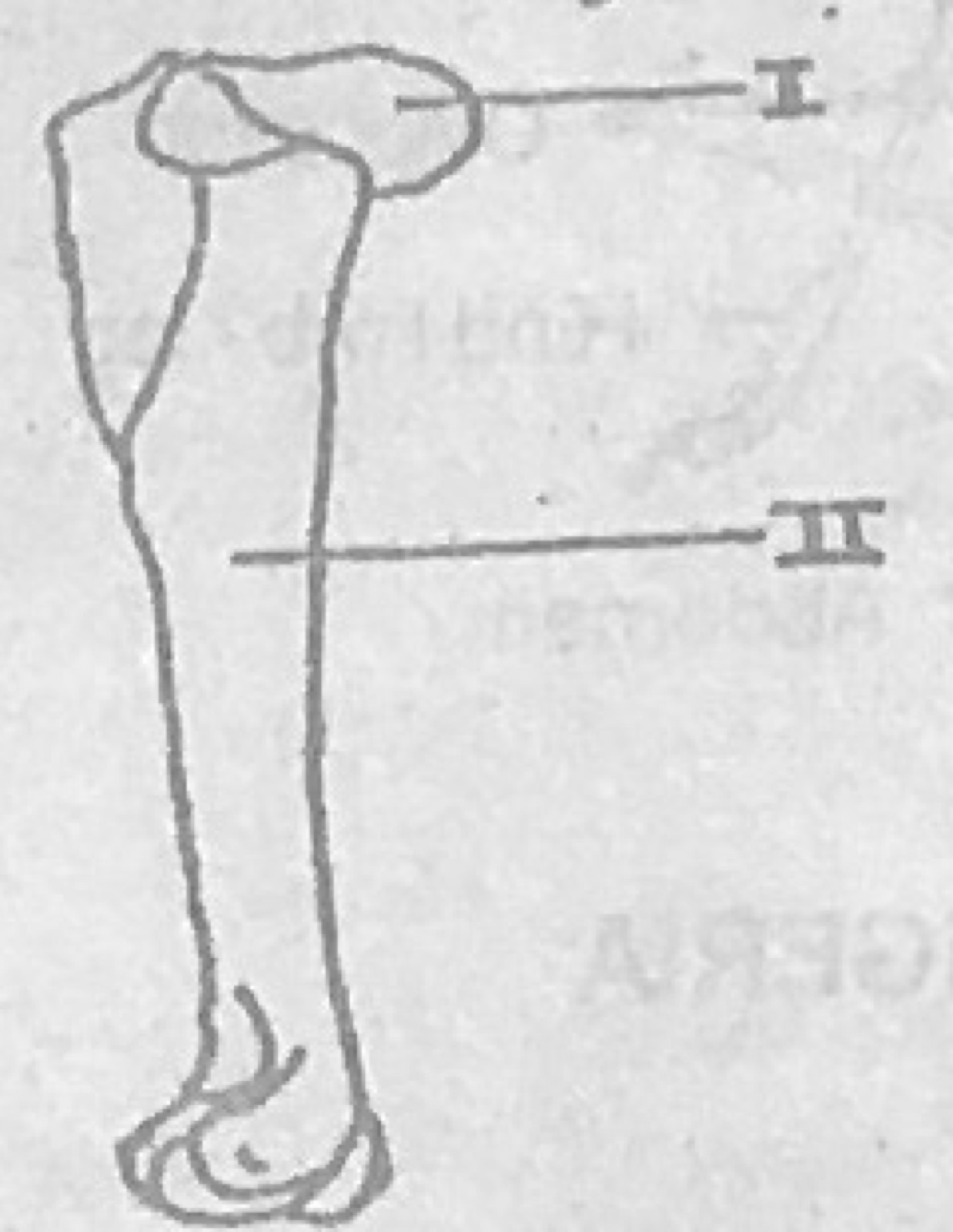
Study the diagram and use it to answer the question.
To form a ball and socket joint, the structure labelled I fits into another structure in the scapula called the

Diagram for this question
  1. A.blade
  2. B.glenoid cavity
  3. C.olecranon fossa
  4. D.patella.
Show the answer and explanation

Answer: B (glenoid cavity)

Explanation

The bone is the humerus; its rounded head (I) fits into the glenoid cavity of the scapula to form the shoulder joint.

Open this question

Question 8

Support and Movement

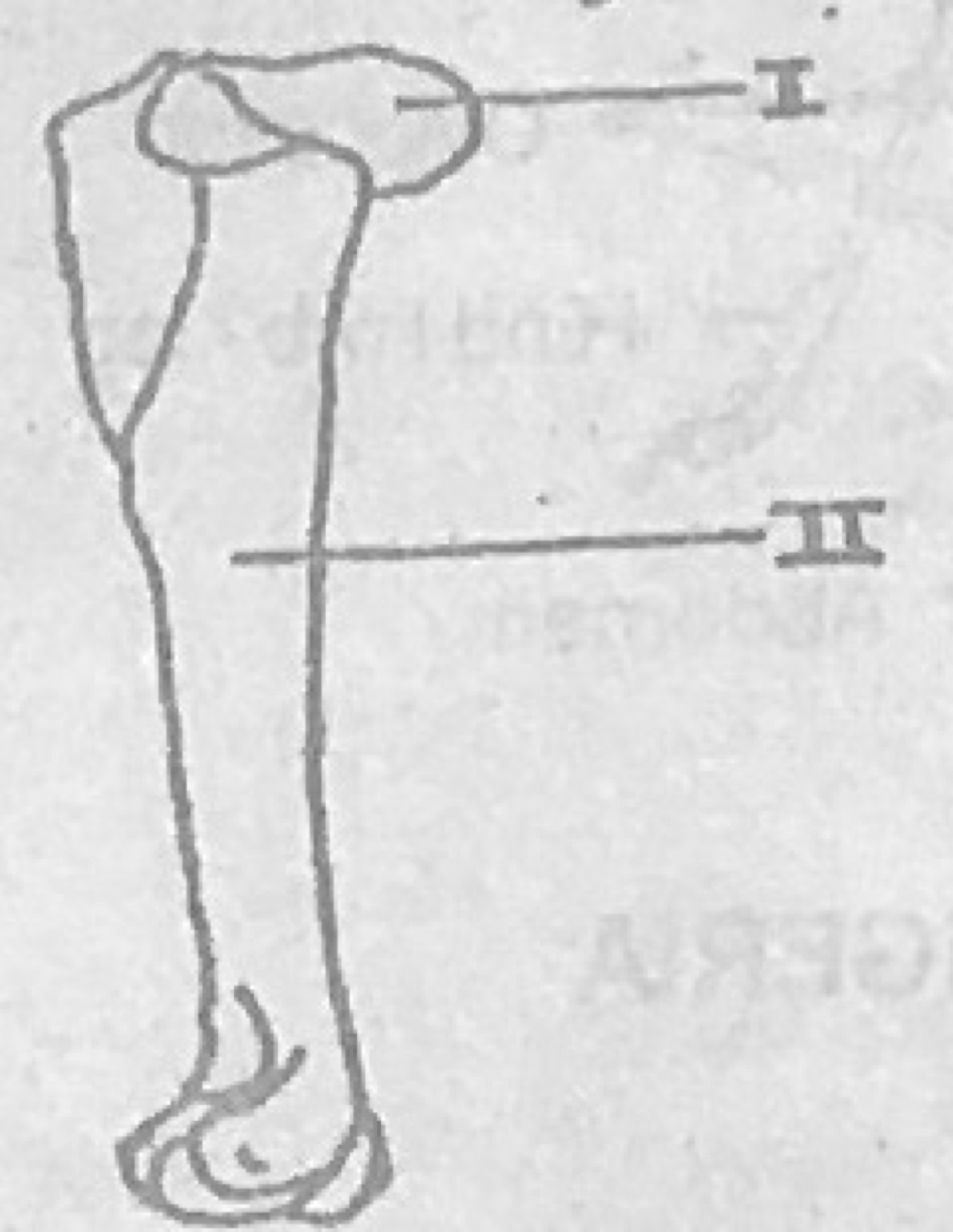
Study the diagram and use it to answer the question.
The structure labelled II is called

Diagram for this question
  1. A.deltoid ridge
  2. B.trochanter
  3. C.shaft
  4. D.trochlea.
Show the answer and explanation

Answer: C (shaft)

Explanation

II points to the long middle part of the humerus, which is the shaft.

Open this question

Question 9

Support and Movement

Which of the following parts of the skeleton does not have a protective function?

  1. A.Ribs
  2. B.Carpals
  3. C.Skull
  4. D.Pelvis.
Show the answer and explanation

Answer: B (Carpals)

Explanation

Carpals are wrist bones that allow movement; ribs, skull and pelvis protect organs.

Open this question

Question 10

Transport in Animals

Carbon dioxide is carried in the plasma

  1. A.in combination with haemoglobin
  2. B.in combination with antibodies
  3. C.by capillary action
  4. D.as bicarbonate ion.
Show the answer and explanation

Answer: D (as bicarbonate ion.)

Explanation

Most carbon dioxide is carried in the plasma as hydrogencarbonate (bicarbonate) ions; haemoglobin is in the red cells, not the plasma.

Open this question

Question 12

Homeostasis

The process of regulating the amount of water and solutes in the body fluids is called

  1. A.osmosis
  2. B.diffusion
  3. C.osmoregulation
  4. D.homeostasis.
Show the answer and explanation

Answer: C (osmoregulation)

Explanation

Osmoregulation is the control of water and salt balance in the body.

Open this question

Question 13

Hormonal Coordination

The presence of glucose in the urine of a patient is an indication of malfunctioning of the

  1. A.pancreas
  2. B.gall bladder
  3. C.liver
  4. D.spleen.
Show the answer and explanation

Answer: A (pancreas)

Explanation

Glucose in urine is a sign of diabetes, caused by the pancreas making too little insulin.

Open this question

Question 14

Hormonal Coordination

Which of the following statements is not true about hormones?

  1. A.Hormones are manufactured in ductless glands and poured straight into the blood stream
  2. B.Hormones are carried by the blood plasma to the required target organs
  3. C.Hormonal responses are usually swift, instant and electrical
  4. D.Once the effects of hormones are over, they are inactivated and excreted from the body.
Show the answer and explanation

Answer: C (Hormonal responses are usually swift, instant and electrical)

Explanation

Hormones are chemical messages and their effects are usually slow and long-lasting; swift electrical responses are nervous.

Open this question

Question 16

Plant Responses and Hormones

Plant hormones include the following except

  1. A.insulin
  2. B.auxin
  3. C.cytokinin
  4. D.gibberelin.
Show the answer and explanation

Answer: A (insulin)

Explanation

Insulin is an animal hormone from the pancreas; auxins, cytokinins and gibberellins are plant hormones.

Open this question

Question 17

Nervous Coordination

The passage of nerve impulse across a synapse is facilitated by the secretion of

  1. A.acetylcholine
  2. B.thyroxine
  3. C.insulin
  4. D.progesterone.
Show the answer and explanation

Answer: A (acetylcholine)

Explanation

The nerve ending releases acetylcholine, which crosses the synaptic gap and starts an impulse in the next neurone.

Open this question

Question 18

Nervous Coordination

The part of the brain which controls and coordinates body posture is the

  1. A.cerebellum
  2. B.hypothalamus
  3. C.medulla oblongata
  4. D.pons varolii.
Show the answer and explanation

Answer: A (cerebellum)

Explanation

The cerebellum controls balance, posture and muscle co-ordination.

Open this question

Question 19

Nervous Coordination

Which of the following processes is not an example of a reflex action?

  1. A.Blinking of the eye
  2. B.Reading
  3. C.Beating of the heart
  4. D.Sneezing.
Show the answer and explanation

Answer: B (Reading)

Explanation

Reading is learned and done under conscious control, so it is a voluntary action, not a reflex.

Open this question

Question 20

Sense Organs

The eyes can properly focus images of objects of various distances on the retina by a process called

  1. A.refraction
  2. B.reflection
  3. C.accommodation
  4. D.correction.
Show the answer and explanation

Answer: C (accommodation)

Explanation

Accommodation is the change in the shape of the lens that keeps near and far objects in focus on the retina.

Open this question

Question 21

Homeostasis

Which of the following sensations may not be detected by the skin?

  1. A.Touch
  2. B.Pressure
  3. C.Stress
  4. D.Pain.
Show the answer and explanation

Answer: C (Stress)

Explanation

The skin has receptors for touch, pressure, pain, heat and cold, but not for 'stress'.

Open this question

Question 22

Reproduction in Plants

The process by which flowers produce fruit without the process of fertilization is called

  1. A.viviparity
  2. B.parthenocarpy
  3. C.propagation
  4. D.metamorphosis.
Show the answer and explanation

Answer: B (parthenocarpy)

Explanation

Parthenocarpy is fruit formation without fertilization, which gives seedless fruits such as some bananas.

Open this question

Question 23

Structure of Flowering Plants

The part of the young root that pushes its way through the soil is the

  1. A.root hair
  2. B.tap root
  3. C.root cap
  4. D.lateral root.
Show the answer and explanation

Answer: C (root cap)

Explanation

The root cap covers and protects the root tip as it pushes through the soil.

Open this question

Question 24

Reproduction in Plants

An example of a dehiscent fruit is

  1. A.crotolaria
  2. B.tomato
  3. C.mango
  4. D.orange.
Show the answer and explanation

Answer: A (crotolaria)

Explanation

Crotalaria pods split open when dry to release their seeds; tomato, mango and orange are fleshy fruits that do not split.

Open this question

Question 25

Food Substances and Enzymes

Which of the following food substances gives the least amount of calories?

  1. A.Rice
  2. B.Groundnuts
  3. C.Cabbage
  4. D.Egg yolk.
Show the answer and explanation

Answer: C (Cabbage)

Explanation

Cabbage is mostly water and fibre, so it gives very little energy compared with rice, groundnuts or egg yolk.

Open this question

Question 26

Animal Nutrition

Analysis of the gut content of an animal showed that it contained small pieces of bone, seeds, roughage and insects. The animal is likely to be a/an.

  1. A.carnivore
  2. B.herbivore
  3. C.insectivore
  4. D.omnivore.
Show the answer and explanation

Answer: D (omnivore.)

Explanation

It eats both animal food (bones, insects) and plant food (seeds, roughage), so it is an omnivore.

Open this question

Question 27

Photosynthesis and Plant Nutrition

Filaments of Spirogyra placed in a beaker of tap water in a dark cupboard died because

  1. A.the filaments could not photosynthesize
  2. B.conjugation could not take place
  3. C.the temperature was too high
  4. D.the plant was overflooded.
Show the answer and explanation

Answer: A (the filaments could not photosynthesize)

Explanation

Without light Spirogyra cannot photosynthesise, so it runs out of food and dies.

Open this question

Question 28

Photosynthesis and Plant Nutrition

The importance of the concentration of chloroplast in the palisade layer of the leaf is for maximum exposure to

  1. A.carbon dioxide
  2. B.light
  3. C.water
  4. D.oxygen.
Show the answer and explanation

Answer: B (light)

Explanation

The palisade layer lies just under the upper surface, so its many chloroplasts receive the most sunlight.

Open this question

Question 29

Ecosystem and Ecological Factors

A community is best defined as

  1. A.living things in a habitat interacting with the non-living part of the environment
  2. B.the total number of individuals of one species of organisms living in a particular habitat
  3. C.populations of different species living together and interacting with each other in one habitat
  4. D.the individuals of a particular group living together in an area and sharing the same resources.
Show the answer and explanation

Answer: C (populations of different species living together and interacting with each other in one habitat)

Explanation

A community is made up of the populations of different species living and interacting in one habitat; A describes an ecosystem.

Open this question

Question 30

Habitats and Biomes

Which of the following physical factors is likely to affect the distribution of plants in a pond?

  1. A.Light
  2. B.Humidity
  3. C.Wind
  4. D.Temperature.
Show the answer and explanation

Answer: A (Light)

Explanation

Light gets weaker with depth, so plants that need light are found mainly near the surface and edges of a pond.

Open this question

Question 31

Ecosystem and Ecological Factors

Which of the following instruments is used to measure wind speed?

  1. A.Thermometer
  2. B.Barometer
  3. C.Hygrometer
  4. D.Anemometer.
Show the answer and explanation

Answer: D (Anemometer.)

Explanation

An anemometer measures wind speed.

Open this question

Question 32

Feeding Relationships and Energy Flow

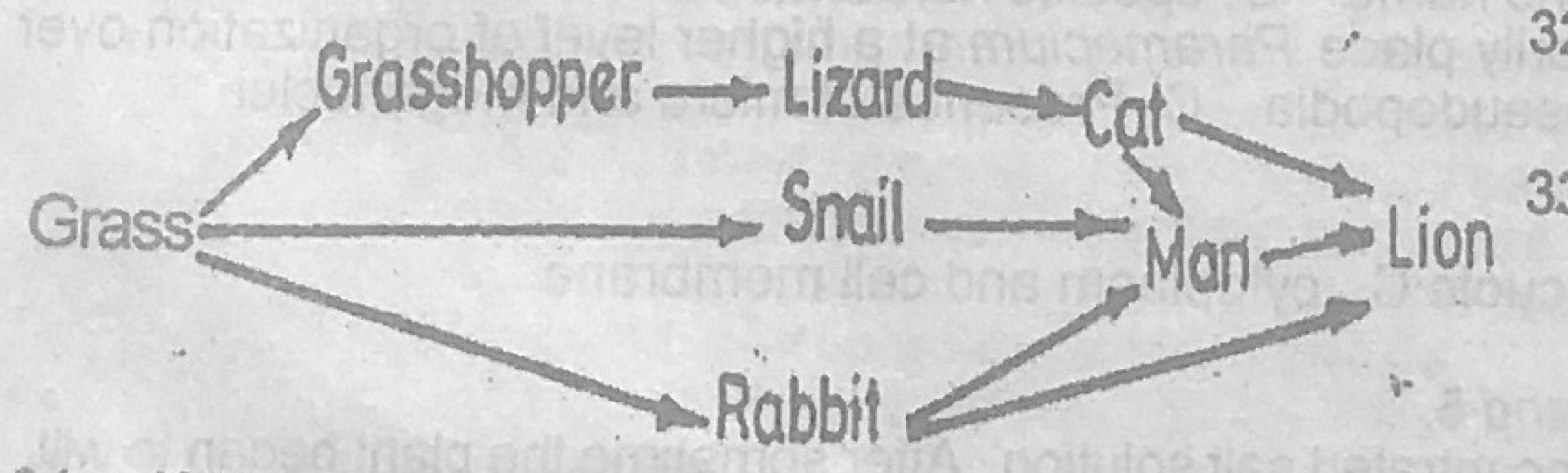
Study the food web and use it to answer the question.
Tertiary consumers within the web are

Diagram for this question
  1. A.cat and lion only
  2. B.man and lion only
  3. C.man and cat only
  4. D.man, cat and lion.
Show the answer and explanation

Answer: A (cat and lion only)

Explanation

Tertiary consumers eat secondary consumers. The cat eats the lizard (a secondary consumer), and the lion eats man, who is a secondary consumer when he eats rabbits or snails. Man himself eats only primary consumers or the cat, so he is not a tertiary consumer.

Open this question

Question 33

Feeding Relationships and Energy Flow

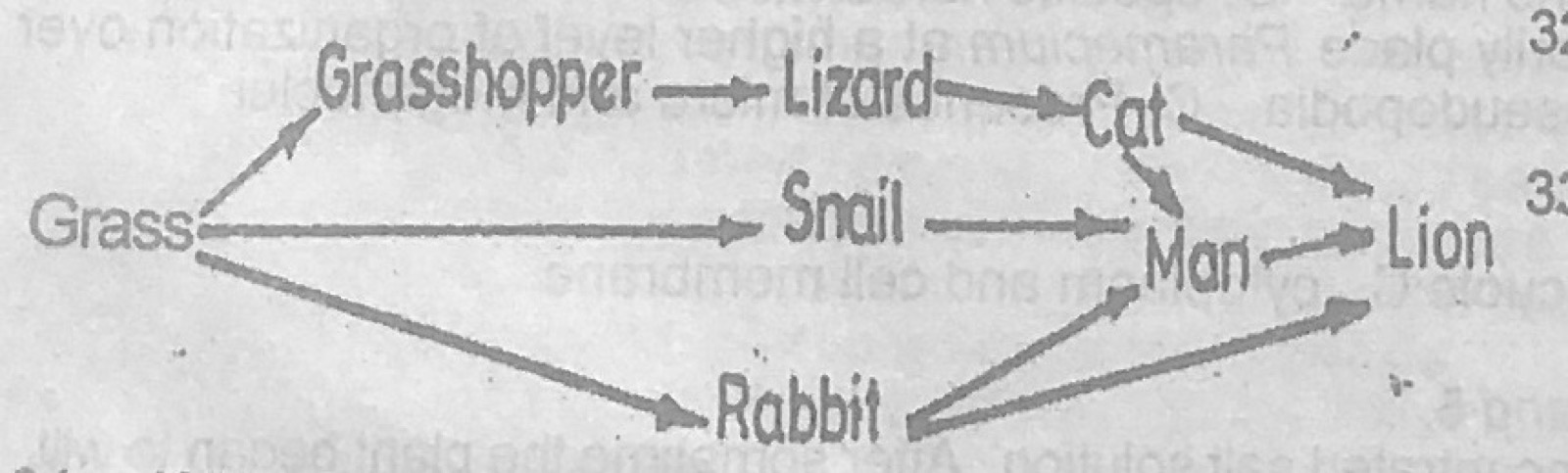
Study the food web and use it to answer the question.
What would be the effect of taking the lion out of the web?

Diagram for this question
  1. A.The number of organisms at each trophic level would increase
  2. B.Man would occupy the apex of the web
  3. C.There would be more rabbits in the web
  4. D.The energy reaching the remaining trophic levels would increase.
Show the answer and explanation

Answer: B (Man would occupy the apex of the web)

Explanation

Nothing in the web eats man except the lion, so without the lion man becomes the top (apex) consumer.

Open this question

Question 34

Feeding Relationships and Energy Flow

Which of the following statements about the transfer of energy in an ecosystem is correct?

  1. A.Energy increases at higher trophic levels
  2. B.More organisms can be supported at higher levels
  3. C.There are fewer organisms at lower trophic levels
  4. D.Energy is lost at each trophic level.
Show the answer and explanation

Answer: D (Energy is lost at each trophic level.)

Explanation

At every step energy is lost as heat in respiration and in uneaten or undigested parts, so less passes on.

Open this question

Question 35

Adaptation

Pond weeds normally lack thick layers of cuticle because

  1. A.their system of photosynthesis is not efficient
  2. B.there is no danger of becoming desiccated
  3. C.their leaves are either dissected or ribbon-shaped
  4. D.there are numerous stomata on their upper epidermis.
Show the answer and explanation

Answer: B (there is no danger of becoming desiccated)

Explanation

Plants living in water never risk drying out, so they do not need a thick waxy cuticle to save water.

Open this question

Question 36

Population Ecology

Shrubs do not survive on newly weathered soils because

  1. A.the top soil is shallow
  2. B.drainage on such soil is poor
  3. C.humus is absent from the soil
  4. D.the soil tends to be sandy.
Show the answer and explanation

Answer: C (humus is absent from the soil)

Explanation

Newly weathered soil is just broken rock with no humus, so it holds little water and nutrients; pioneer plants must add humus before shrubs can grow.

Open this question

Question 37

Habitats and Biomes

The speed of the flow of water in a river is faster in the middle than along the banks due to

  1. A.differences in turbidity at different parts of the river
  2. B.the abundance of fishes and other organisms along the bank
  3. C.reduced force of gravity in the middle portion of the river
  4. D.resistance offered by the wall of the banks.
Show the answer and explanation

Answer: D (resistance offered by the wall of the banks.)

Explanation

Water along the banks is slowed by friction with the banks and bed, while water in the middle meets little resistance.

Open this question

Question 38

Conservation of Natural Resources

The effects of environmental degradation caused by human activities can be controlled by the following measures except

  1. A.reclaiming the land
  2. B.converting mining pits into fish ponds
  3. C.resettling indigenous inhabitants
  4. D.educating people.
Show the answer and explanation

Answer: C (resettling indigenous inhabitants)

Explanation

Moving local people elsewhere does not repair damaged land, while turning mining pits into fish ponds is a form of land reclamation.

Open this question

Question 39

Population Ecology

The following observations concerning succession are true except that the

  1. A.pioneer community has fewer species
  2. B.middle stages communities are most diverse
  3. C.climax community has the greatest number of species
  4. D.total biomass of the community increases as succession progresses.
Show the answer and explanation

Answer: C (climax community has the greatest number of species)

Explanation

Species diversity usually peaks in the middle stages and falls slightly at the climax, so the climax does not have the most species.

Open this question

Question 40

Microorganisms and Health

A vaccine is introduced into a person's body to

  1. A.destroy all disease-causing organisms in the body
  2. B.stimulate the body to produce antibodies
  3. C.enhance the production of red blood cells
  4. D.isolate disease-causing pathogens from the blood.
Show the answer and explanation

Answer: B (stimulate the body to produce antibodies)

Explanation

A vaccine contains weakened or dead germs (or their parts) that make the body produce antibodies, giving immunity.

Open this question

Question 41

Ecological Associations

Which of the following activities constitutes biological control?

  1. A.A small bony fish transported on the back of a shark
  2. B.Adding manure to crops in a garden
  3. C.Tilapia feeding on the larvae and pupae of mosquito
  4. D.A vulture feeding on the carcass of a goat.
Show the answer and explanation

Answer: C (Tilapia feeding on the larvae and pupae of mosquito)

Explanation

Using a living predator such as tilapia to reduce mosquito numbers is biological control.

Open this question

Question 42

Microorganisms and Health

Many diseases caused by bacteria can be treated and cured by using

  1. A.antiseptics
  2. B.antibiotics
  3. C.antigens
  4. D.antibodies.
Show the answer and explanation

Answer: B (antibiotics)

Explanation

Antibiotics, such as penicillin, kill bacteria or stop them multiplying inside the body.

Open this question

Question 43

Conservation of Natural Resources

To avoid over-fishing in a lake, the following measures may be helpful except

  1. A.limiting fishing periods
  2. B.regulating the size of nets
  3. C.fishing throughout the year
  4. D.fish breeding exercise.
Show the answer and explanation

Answer: C (fishing throughout the year)

Explanation

Fishing all year round gives fish no chance to breed and recover, so it leads to over-fishing.

Open this question

Question 44

Conservation of Natural Resources

Conservation may be promoted by

  1. A.encouraging tree planting
  2. B.systematic deforestation
  3. C.overgrazing of pastures
  4. D.unabated bush burning.
Show the answer and explanation

Answer: A (encouraging tree planting)

Explanation

Planting trees (afforestation) replaces cut forests and protects soil and wildlife.

Open this question

Question 45

Nutrient Cycling

Which of the following substances is not recycled in an ecosystem?

  1. A.Carbon
  2. B.Energy
  3. C.Water
  4. D.Nitrogen.
Show the answer and explanation

Answer: B (Energy)

Explanation

Matter such as carbon, water and nitrogen is recycled, but energy flows one way and is lost as heat.

Open this question

Question 46

Variation

Which of the following statements about phenylthiocarbamide (PTC) is not correct?

  1. A.Some people find the taste of PTC to be bitter
  2. B.Others find this substance to be tasteless
  3. C.Ability to taste this chemical is heritable
  4. D.Ability to taste the chemical is not heritable.
Show the answer and explanation

Answer: D (Ability to taste the chemical is not heritable.)

Explanation

PTC tasting is controlled by a gene and is inherited, so saying it is not heritable is wrong.

Open this question

Question 47

Variation

Which of the following characters is not an example of discontinuous variation?

  1. A.Skin colour
  2. B.Fingerprint
  3. C.Ability to roll tongue
  4. D.Sex type.
Show the answer and explanation

Answer: A (Skin colour)

Explanation

Skin colour shows a smooth range of shades, so it is continuous variation; the others fall into distinct groups.

Open this question

Question 48

Variation

Which of the following human traits in a class of school children may give an approximate normal distribution curve when the variation is plotted?

  1. A.Blood groups
  2. B.Ear shapes
  3. C.Sex distribution
  4. D.Heights.
Show the answer and explanation

Answer: D (Heights.)

Explanation

Height varies continuously, so a plot gives a bell-shaped normal curve.

Open this question

Question 49

Mendelian Inheritance

The observable characteristics of an individual usually resulting from the interaction between the gene composition and the environment is referred to as

  1. A.allele
  2. B.genotype
  3. C.phenotype
  4. D.chromosome.
Show the answer and explanation

Answer: C (phenotype)

Explanation

The phenotype is what an organism looks like or how it functions, produced by its genes acting together with its environment.

Open this question

Question 50

Chromosomes, DNA and Sex Linkage

The sudden change in a gene structure or chromosome number in an organism likely to cause an inheritable change in the phenotype is known as

  1. A.migration
  2. B.mutation
  3. C.mitosis
  4. D.meiosis.
Show the answer and explanation

Answer: B (mutation)

Explanation

A mutation is a sudden heritable change in a gene or in chromosome number.

Open this question

Question 51

Mendelian Inheritance

The defective cells involved in sickle-cell anaemia disease are

  1. A.phagocytes
  2. B.lymphocytes
  3. C.erythrocytes
  4. D.thrombocytes.
Show the answer and explanation

Answer: C (erythrocytes)

Explanation

Sickle-cell anaemia affects haemoglobin, so the red blood cells (erythrocytes) become sickle-shaped.

Open this question

Question 52

Chromosomes, DNA and Sex Linkage

What does the chemical composition of the genetic material of all living organisms consist of?

  1. A.Deoxyribonucleic acid
  2. B.Adenosine diphosphate
  3. C.Adenosine triphosphate
  4. D.Follicle stimulating hormone.
Show the answer and explanation

Answer: A (Deoxyribonucleic acid)

Explanation

Genes are made of DNA, deoxyribonucleic acid.

Open this question

Question 53

Cell Division

What of the following occurrences is not a feature of meiosis?

  1. A.Formation of four haploid cells
  2. B.Two successive nuclear cell divisions
  3. C.Pairing of homologous chromosomes at prophase
  4. D.Formation of two diploid cells.
Show the answer and explanation

Answer: D (Formation of two diploid cells.)

Explanation

Two diploid daughter cells are the result of mitosis; meiosis gives four haploid cells.

Open this question

Question 54

Chromosomes, DNA and Sex Linkage

Which of the following diseases is commonly observed in human males and is sex-linked?

  1. A.Beriberi
  2. B.Down's syndrome
  3. C.Sickle-cell anaemia
  4. D.Colour blindness.
Show the answer and explanation

Answer: D (Colour blindness.)

Explanation

The gene for colour blindness is on the X chromosome, so males, with one X, show it more often.

Open this question

Question 55

Mendelian Inheritance

If red is dominant to white and homozygous red pea-plants are crossed with homozygous white pea-plants, the first filial generation will have

  1. A.2 red flowers, 2 white flowers
  2. B.4 red flowers
  3. C.4 white flowers
  4. D.4 pink flowers.
Show the answer and explanation

Answer: B (4 red flowers)

Explanation

RR × rr gives only Rr offspring, and red is dominant, so all are red.

Open this question

Question 56

Adaptation

The resemblance of a palatable insect to a poisonous insect is an example of

  1. A.a chemical deterrent to a predator
  2. B.an escape from the predator by camouflage
  3. C.an escape from the predator by mimicry
  4. D.a defence against the predator by warning colouration
Show the answer and explanation

Answer: C (an escape from the predator by mimicry)

Explanation

A harmless insect that copies the look of a harmful one is showing mimicry, so predators avoid it.

Open this question

Question 57

Behaviour

Which of the following statements in not true of the worker termites? They

  1. A.build and repair the nest
  2. B.produce enzymes to digest cellulose
  3. C.search for food to feed the colony
  4. D.look after the nymph.
Show the answer and explanation

Answer: B (produce enzymes to digest cellulose)

Explanation

Termites digest wood with the help of protozoa (and bacteria) living in their gut that make the cellulose-digesting enzyme; the termite itself does not.

Open this question

Question 59

Evolution

The accepted concepts for the theory of Natural Selection does not include

  1. A.tendency for organisms to overproduce
  2. B.struggle for existence
  3. C.survival of the fittest
  4. D.use and disuse of body parts.
Show the answer and explanation

Answer: D (use and disuse of body parts.)

Explanation

Use and disuse was Lamarck's idea; overproduction, struggle for existence and survival of the fittest are parts of Darwin's natural selection.

Open this question

Question 60

Evolution

The order of evolutionary trend in plants is

  1. A.Bryophyta, Thallophyta, Pteridophyta and Spermatophyta
  2. B.Thallophyta, Bryophyta, Pteridophyta and Spermatophyta
  3. C.Spermatophyta, Pteridophyta, Bryophyta and Thallophyta
  4. D.Bryophyta, Pteridophyta, Spermatophyta and Thallophyta.
Show the answer and explanation

Answer: B (Thallophyta, Bryophyta, Pteridophyta and Spermatophyta)

Explanation

Plants evolved from simple thallophytes (algae) to bryophytes (mosses), then pteridophytes (ferns), then seed plants.

Open this question

Theory question 101

Transport in Animals

(a) State one function of each of the following structures: (i) Arteries; (ii) Capillaries; (iii) Veins; (iv) Xylem; (v) Phloem
(b) Describe the changes that take place in the composition of human blood as it passes through the:
(i) Lungs; (ii) Liver; (iii) Kidneys; (iv) Small intestine. (c) List the cellular components of blood.

Show the model answer
Model answer

(a)(i) Arteries carry blood away from the heart (oxygenated, except the pulmonary artery).
(ii) Capillaries allow exchange of materials between blood and tissues; link arteries and veins.
(iii) Veins carry blood back to the heart (deoxygenated, except the pulmonary vein).
(iv) Xylem carries water and mineral salts from roots upwards; gives support.
(v) Phloem carries manufactured food (sugars) from leaves to other parts.
(b)(i) Lungs: oxygen added; carbon(IV) oxide and some water removed.
(ii) Liver: excess glucose removed (stored as glycogen) or added when low; amino acids removed and urea added; worn-out red cells and toxins removed; plasma proteins added.
(iii) Kidneys: urea, excess water and salts removed; blood leaving is purer.
(iv) Small intestine: digested food added – glucose, amino acids, vitamins, minerals and water (fats into lacteals); oxygen used up.
(c) Red blood cells (erythrocytes); white blood cells (leucocytes); platelets (thrombocytes).

Explanation

One function per vessel/tissue in (a).

Open this question

Theory question 102

Transport in Plants

(a) What is transpiration?
(b) (i) Name two types of transpiration (ii) List four factors which affect the rate of transpiration
(c) Describe the mechanisms of opening and closing of the stomata. (d) State:
(i) two similarities and (ii) two differences between transpiration and sweating

Show the model answer
Model answer

(a) Transpiration is the loss of water in the form of vapour from the aerial parts of a plant, mainly through the stomata of the leaves.
(b)(i) Any two: stomatal; cuticular; lenticular.
(ii) Any four: light intensity; temperature; humidity; wind; availability of soil water; leaf surface area; thickness of cuticle; number/position of stomata (sunken, hairy leaves).
(c) Opening: in light the guard cells photosynthesise (and take in K+ ions/convert starch to sugar), so their solute concentration rises; water enters them from neighbouring cells by osmosis; they become turgid; the thin outer walls stretch more than the thick inner walls, so the cells curve apart and the pore opens.
Closing: in darkness or water shortage the solute concentration of the guard cells falls; water leaves by osmosis; the guard cells become flaccid and straighten, closing the pore.
(d)(i) Both lose water from the body; both cool the organism; water passes out through pores.
(ii) Transpiration occurs in plants through stomata/lenticels vs sweating occurs in mammals through sweat pores; transpiration loses only water vs sweat contains water, salts and urea; water lost as vapour vs lost as liquid; transpiration mainly by day vs sweating day and night.

Explanation

Explain stomatal movement through osmosis and turgor.

Open this question

Theory question 103

Pollution

(a) Explain the following terms:
(i) Population; (ii) Competition; (iii) Succession. (b)(i) State three sources of noise pollution
(ii) List two ways by which noise pollution can be reduced. (c) State three effects each of the following pollutants on humans: (i) smoke; (ii) sewage.

Show the model answer
Model answer

(a)(i) Population: a group of organisms of the same species living in a particular area at a particular time.
(ii) Competition: the struggle between organisms of the same species (intraspecific) or different species (interspecific) for resources in short supply, such as food, light, water, space or mates.
(iii) Succession: the gradual, orderly replacement of one community by another in an area over time, from pioneer to a stable climax community.
(b)(i) Any three: generators; motor vehicles; aircraft; loudspeakers/music systems; factory machines; sirens; gunfire/explosions; construction and quarry work.
(ii) Any two: laws to control noise; siting airports, factories and military bases away from homes; using silencers and soundproof or low-noise machines; public education.
(c)(i) Smoke: breathing difficulties and respiratory diseases (bronchitis, asthma); irritates and damages eyes; carbon monoxide poisoning; reduces visibility, causing accidents; may cause lung cancer.
(ii) Sewage: spreads water-borne diseases (cholera, typhoid, dysentery); makes water unsafe for drinking and domestic use; offensive smell; kills fish by using up oxygen, reducing food for man; breeding site for flies and mosquitoes.

Explanation

Give three effects each for smoke and sewage.

Open this question

Theory question 104

Cell Division

(a) Describe the main stages of mitotic division. (b) State four ways in which mitosis is important to living organisms.

Show the model answer
Model answer

(a) Interphase (preparation): chromosomes replicate.
Prophase: chromosomes shorten and thicken and become visible as two chromatids joined at a centromere; nuclear membrane and nucleolus disappear; spindle forms.
Metaphase: chromosomes line up on the equator of the spindle, attached by their centromeres.
Anaphase: centromeres split and the chromatids are pulled to opposite poles.
Telophase: chromosomes reach the poles; nuclear membranes re-form round each set; cytoplasm divides (cleavage furrow in animals, cell plate in plants), giving two identical daughter cells.
(b) Any four: growth of the organism; repair of damaged tissues and replacement of worn-out cells; asexual reproduction; keeps chromosome number constant; daughter cells are genetically identical, maintaining characteristics; regeneration of lost parts.

Explanation

Name the stages in order: prophase, metaphase, anaphase, telophase.

Open this question

Theory question 107

Hormonal Coordination

(a) What are hormones?
(b) In a tabular form, state four differences between nervous coordination and hormonal coordination in humans.
(c) State three effects each of: (i) Over-secretion; (ii) Under-secretion of thyroxin on mammals. (d) Make a diagram 10-12 cm long of the reflex arc and label fully.

Show the model answer
Model answer

(a) Hormones are chemical messengers produced by ductless (endocrine) glands and carried in the blood to target organs, where they bring about responses.
(b) Nervous vs hormonal: electrical impulses vs chemical substances; carried by neurones vs carried in blood; fast vs slow; short-lived vs long-lasting effect; localised vs widespread effect; can be voluntary vs always involuntary.
(c)(i) Over-secretion (hyperthyroidism): high metabolic rate; weight loss; nervousness and restlessness; fast heartbeat; protruding eyes (exophthalmic goitre); sweating and intolerance of heat.
(ii) Under-secretion: in children – cretinism (stunted growth, mental retardation); in adults – myxoedema (low metabolism, weight gain, sluggishness, puffy skin); goitre; feeling cold.
(d) Diagram 10–12 cm, title, labels: receptor (e.g. skin), sensory neurone, dorsal root and dorsal root ganglion, spinal cord with grey and white matter, relay neurone, motor neurone, ventral root, effector (muscle); arrows showing the direction of the impulse.

Explanation

Label the direction of the impulse on the reflex arc.

Open this question

Theory question 108

Photosynthesis and Plant Nutrition

(a) Explain the following modes of nutrition which occur in plants: (i) Autotrophic; (ii) Chemosynthetic; (iii) Carnivorous
(b) Give one example each of a plant which undergoes the modes of nutrition listed in 8(a) above.
(c) (i) Describe three ways by which nitrogen is added to the soil for plant use.
(ii) State two ways by which nitrogen is lost from the soil.

Show the model answer
Model answer

(a)(i) Autotrophic: the organism makes its own organic food from simple inorganic substances (carbon(IV) oxide and water) using light energy trapped by chlorophyll (photosynthesis).
(ii) Chemosynthetic: the organism makes its own food using energy from oxidising inorganic chemicals (e.g. ammonia, nitrites, iron or sulphur compounds) instead of light.
(iii) Carnivorous: green plants that photosynthesise but also trap and digest insects to obtain nitrogen, usually because they grow in nitrogen-poor soil.
(b) Autotrophic – any green plant, e.g. maize, hibiscus; chemosynthetic – nitrifying bacteria such as Nitrosomonas or Nitrobacter (sulphur bacteria); carnivorous – sundew (Drosera), pitcher plant (Nepenthes), bladderwort (Utricularia), Venus flytrap.
(c)(i) Any three: Rhizobium in root nodules of legumes fixes atmospheric nitrogen; free-living bacteria (Azotobacter, Clostridium) and blue-green algae fix nitrogen; lightning makes nitrogen oxides that dissolve in rain to form nitrates; decay of dead organisms and wastes releases ammonia, which nitrifying bacteria change to nitrates; adding fertilizers and manure.
(ii) Any two: denitrification by bacteria; leaching of nitrates by rain; uptake by crops that are then harvested; soil erosion; burning of vegetation.
Explanation

Chemosynthesis uses chemical energy, not light.

Open this question