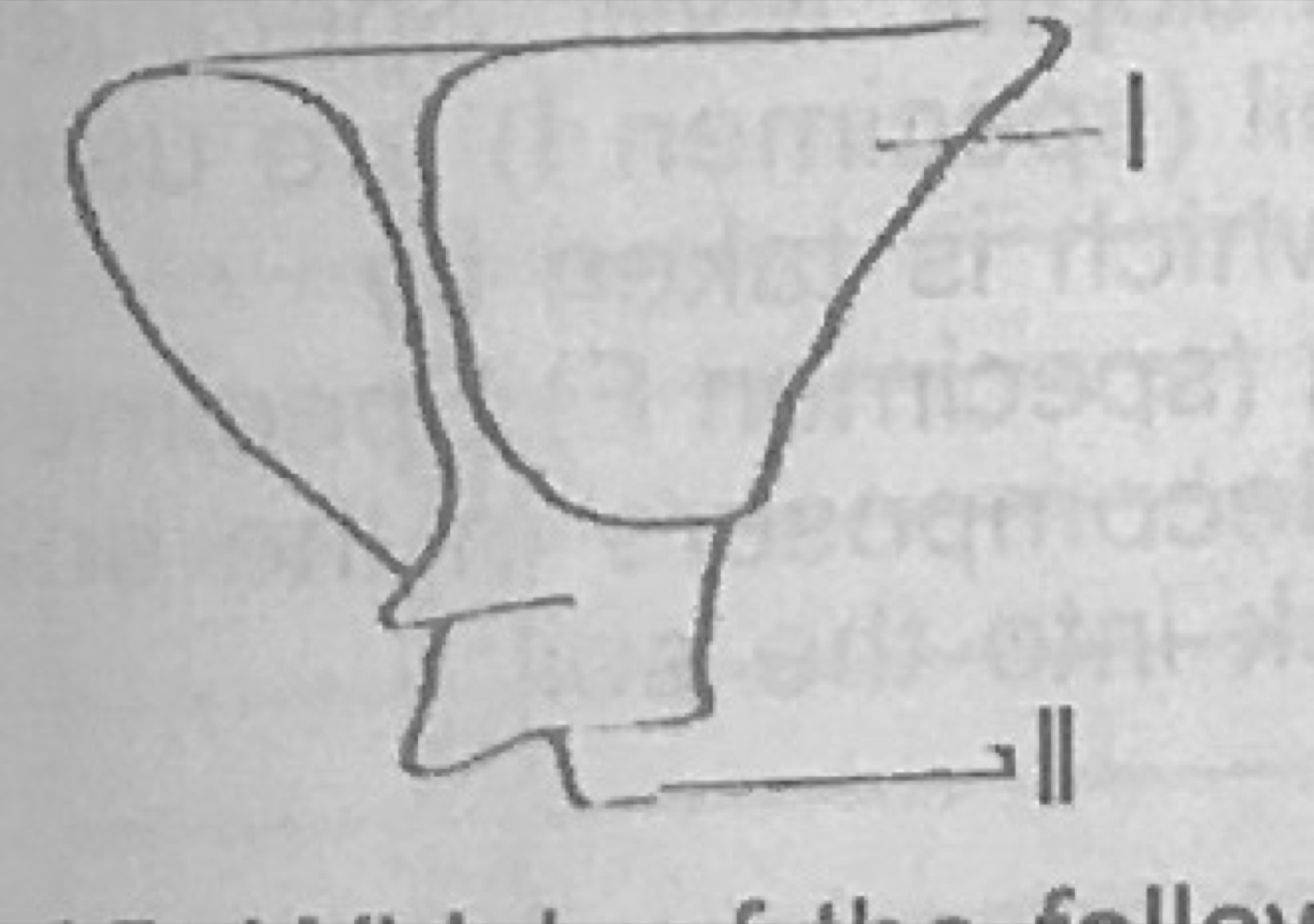
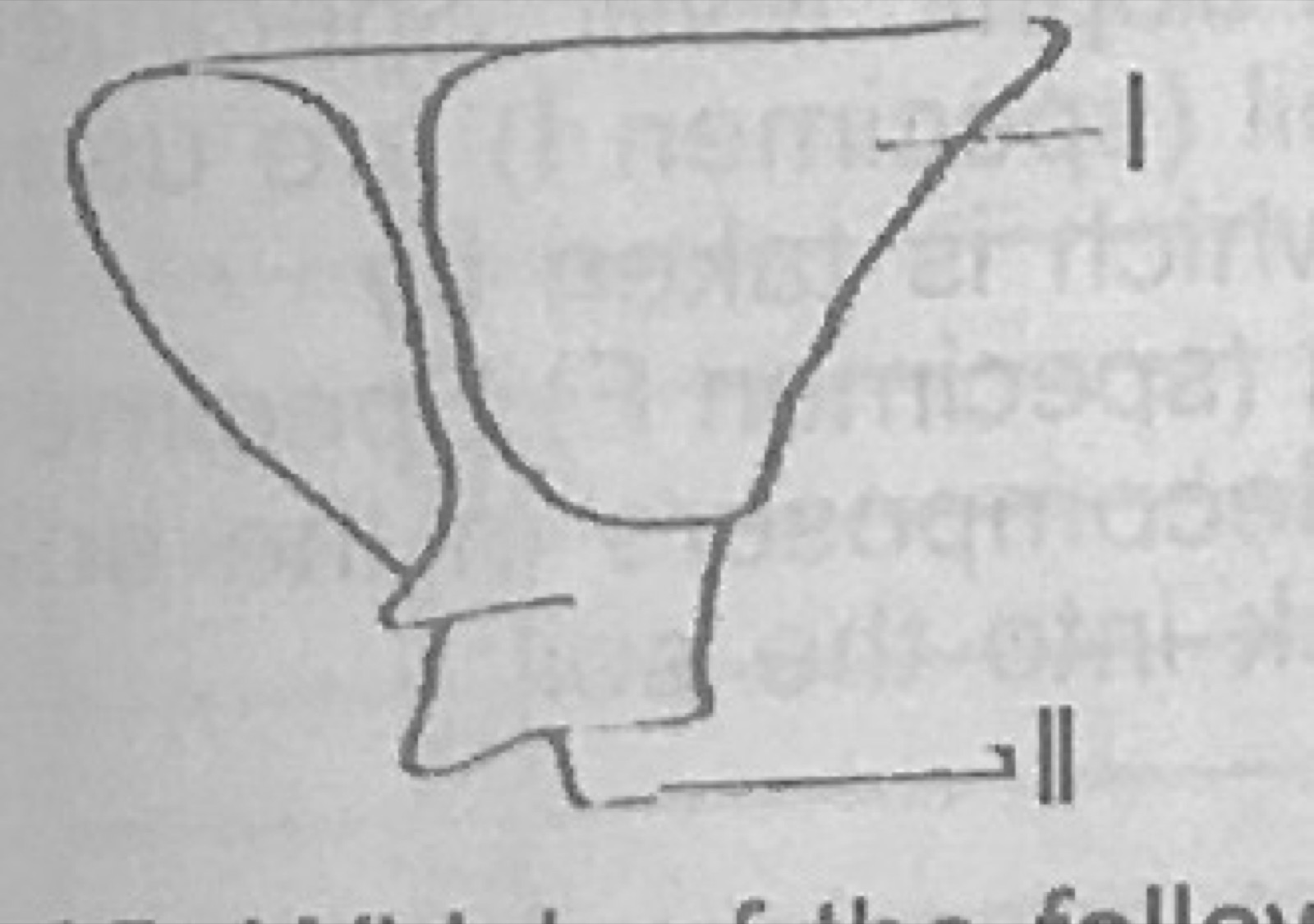
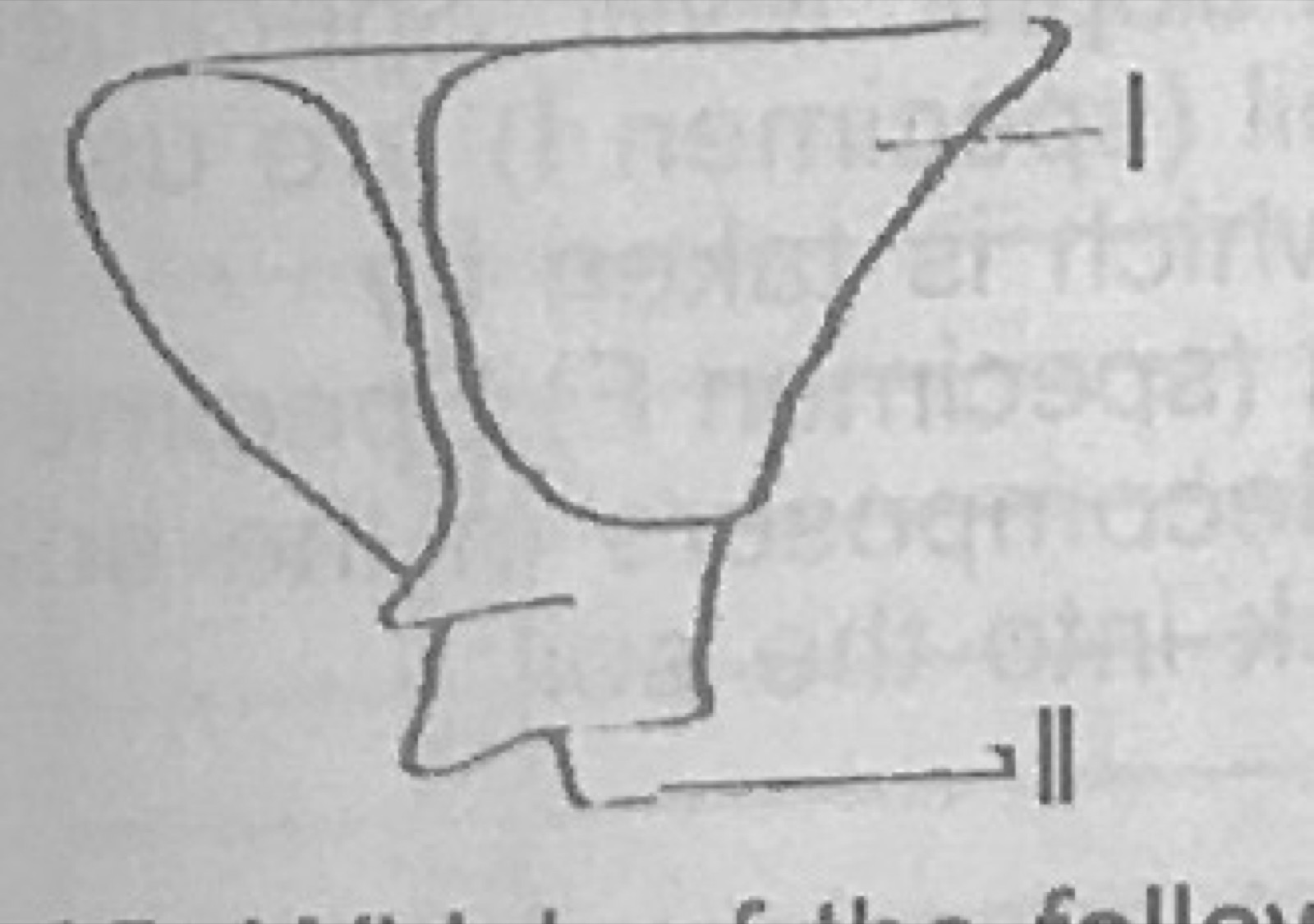
Use the information on the stages involved in conjugation to answer this question. I. Transfer of one cell content into the adjacent cell II. Formation of a conjugation tube III. Secretion of thick wall to form a zygospore IV. Formation of a protuberance V. Germination of a filament Which of the following organisms exhibits the stages listed above during conjugation?
A.Chlamydomonas
B.Euglena
C.Spirogyra
D.Volvox
Show the answer and explanation
Answer: C (Spirogyra)
Explanation
Spirogyra filaments lying side by side join by conjugation tubes, and the contents of one cell pass into the other to form a zygospore.
Use the information on the stages involved in conjugation to answer this question. I. Transfer of one cell content into the adjacent cell II. Formation of a conjugation tube III. Secretion of thick wall to form a zygospore IV. Formation of a protuberance V. Germination of a filament Which of the following arrangements is the correct sequence of the process?
A.II, I, IV, V and III
B.IV, II, I, III and V
C.IV, I, II, V and III
D.V, II, III, IV and I
Show the answer and explanation
Answer: B (IV, II, I, III and V)
Explanation
Bumps grow out first (IV), join into a tube (II), the contents pass across (I), the zygote forms a thick-walled zygospore (III) and later germinates into a new filament (V).
Use the information below on factors required during photosynthesis to answer this question. I. CO2 II. Chlorophyll III. Water IV. ATP V. NADPH2 The factors required for the dark phase of photosynthesis are
A.III and IV only
B.III and V only
C.III, IV and V only
D.IV and V only
Show the answer and explanation
Answer: D (IV and V only)
Explanation
The dark stage uses ATP and NADPH2 from the light stage (with CO2) to make sugar; water is used only in the light stage.
(a) (i) Name four similarities found in plant and animal cells (ii) In a tabular list four different cells found in man and give a function for each of the cells. (b) (i) Name the two types of cell divisions (ii) Give two examples each of life processes involved in each type of the cell divisions (c) Name the two types of reproduction usually associated with organisms.
Show the model answer
Model answer
(a)(i) Any four: both have a cell membrane; cytoplasm; a nucleus; mitochondria; endoplasmic reticulum, ribosomes, Golgi bodies. (ii) Any four cells with function: red blood cell – carries oxygen; white blood cell – fights infection; nerve cell (neurone) – carries impulses; muscle cell – contraction/movement; sperm – fertilises the ovum; ovum – female gamete; epithelial cell – covers and protects; bone cell – forms bone. (b)(i) Mitosis and meiosis. (ii) Mitosis: growth; repair of worn-out tissues/healing; asexual reproduction. Meiosis: formation of gametes (sperm, ova, pollen) for sexual reproduction; formation of spores; brings about variation. (c) Sexual reproduction and asexual reproduction.
Explanation
Mitosis makes body cells for growth and repair; meiosis makes gametes.
(a) (i) Define the term metamorphosis (ii) Name the two types of metamorphosis that organisms undergo and mention two organisms that undergo each type (b) (i) State four economic importance of insects and name an example of each of the insects involved. (ii) List four peculiar features of social insects
Show the model answer
Model answer
(a)(i) Metamorphosis is the series of changes in form that an organism goes through from the egg to the adult. (ii) Complete metamorphosis (egg → larva → pupa → adult): butterfly, housefly, mosquito, beetle, bee. Incomplete metamorphosis (egg → nymph → adult): cockroach, grasshopper, termite, locust. (b)(i) Any four with an example: pollinate flowers – bee/butterfly; produce honey and wax – honeybee; produce silk – silkworm; used as food – termite/locust; carry diseases – mosquito (malaria), housefly (cholera/typhoid), tsetse fly (sleeping sickness); destroy crops and stored produce – locust, weevil; destroy wood and buildings – termite; help decay of dead matter – termites/beetles. (ii) Any four: live together in large colonies; division of labour among castes; castes differ in structure (polymorphism); one or few reproductive members (queen and king/drones); build a common nest; communicate and cooperate (e.g. bee dance); care for the young together.
Explanation
Complete metamorphosis has a pupa stage; incomplete does not.
(a)(i) What is Pollution? (ii) Name two pollutants each of air and water (b) (i) State four effects of water pollution on organisms (ii) Mention four ways of preventing water pollution in an environment (c) (i) Name three sources of noise pollution (ii) State three effects of noise pollution on man
Show the model answer
Model answer
(a)(i) Pollution is the release into the environment of harmful substances or energy (pollutants), in amounts that damage living things. (ii) Air: carbon monoxide, sulphur dioxide, oxides of nitrogen, smoke/soot, dust. Water: sewage, crude oil, fertilisers, pesticides, industrial chemicals/heavy metals, refuse. (b)(i) Any four: death of fish and other aquatic organisms; less dissolved oxygen (eutrophication from sewage and fertilisers); spread of water-borne diseases (cholera, typhoid); poisoning of organisms and accumulation along food chains; oil coats birds' feathers and fish gills; water becomes unfit for drinking. (ii) Any four: treat sewage before discharge; proper disposal of refuse; treat industrial waste before release; avoid excessive use of fertilisers and pesticides; prevent oil spills and clean them up; laws and fines against polluters; public education. (c)(i) Any three: aircraft/airports; motor vehicles and horns; factory machines and generators; loudspeakers/music; blasting, building work. (ii) Any three: loss of hearing/deafness; headache; stress, irritability and lack of sleep; high blood pressure; poor concentration.
Explanation
Name actual substances as pollutants, not just 'smoke'.
(a) (i) Define the law of independent assortment (ii) State the findings from Mendel's experiment involving white- flowered and red-flowered pea plants (iii) Illustrate these findings by means of simple diagrams (b) Explain why blood groups A and B in man can exist both in heterozygous and homozygous conditions while blood group O can only exist in homozygous state.
Show the model answer
Model answer
(a)(i) Law of independent assortment (Mendel's second law): when two or more pairs of characters are inherited together, each pair of alleles separates into the gametes independently of the other pairs. (ii) Crossing pure red-flowered with pure white-flowered plants gave all red-flowered plants in the F1 (red is dominant). Selfing the F1 gave red and white plants in the F2 in a ratio of 3 red : 1 white; the factors for colour separate in gamete formation. (iii) Let R = red, r = white. Parents RR × rr; gametes R and r; F1 all Rr (red). F1 Rr × Rr; gametes R, r × R, r; F2 RR, Rr, Rr, rr = 3 red : 1 white (genotypes 1 : 2 : 1). (Diagram or Punnett square showing these.) (b) The alleles A and B are both dominant over O (O is recessive). Group A can be AA or AO, and group B can be BB or BO, because one dominant allele is enough to show. Group O shows only when no dominant allele is present, so the person must be OO (homozygous).
Explanation
Show parents, gametes, F1 and F2 clearly in the genetic diagram.
State the principles involved in the following methods of food preservation: (a) (i) Salting (ii) Refrigeration (iii) Drying (iv) Smoking (v) Chemicals (b) State four problems that may be caused by human overpopulation (c) Explain three ways by which the government may increase food production
Show the model answer
Model answer
(a)(i) Salting draws water out of the food and microorganisms by osmosis, so they cannot grow. (ii) Refrigeration: low temperature slows down or stops the growth of microorganisms and enzyme action. (iii) Drying removes water that microorganisms need to grow. (iv) Smoking dries the food and coats it with chemicals from the smoke that kill or keep off microorganisms. (v) Chemicals (preservatives such as sodium benzoate, vinegar, sugar) kill microorganisms or stop their growth. (b) Any four: shortage of food/famine; overcrowding and poor housing (slums); spread of diseases; unemployment; pollution and poor sanitation; pressure on social amenities (schools, hospitals, water); crime; deforestation and loss of farmland. (c) Any three, explained: give farmers loans/credit and subsidised fertilisers and tools; mechanise farming; provide improved seeds and livestock through research; provide irrigation; good storage, processing and roads to reduce waste; agricultural extension services to teach farmers; land reform to make land available.
Explanation
For each preservation method, say how it stops microorganisms.
(a) (i) Define the term hydrosphere (ii) Give three examples of hydrosphere (b) (i) State the two laws of thermodynamics (ii) Use the second law of thermodynamics to explain the energy flow across trophic levels (c) (i) Name two local biotic communities in Nigeria and associate each type with a particular state in Nigeria (ii) List three factors that affect organisms in the marine habitat (iii) State three adaptive features of sea weeds.
Show the model answer
Model answer
(a)(i) The hydrosphere is the water part of the earth's surface. (ii) Any three: oceans/seas, rivers, lakes, ponds, streams, lagoons. (b)(i) First law: energy can neither be created nor destroyed, but can be changed from one form to another. Second law: whenever energy is changed from one form to another, some of it is lost as heat, so no transfer is 100% efficient. (ii) At each trophic level much of the energy taken in is lost as heat in respiration (and in waste), so only a small part (about 10%) passes to the next level; energy therefore decreases up the food chain, which limits the number of trophic levels. (c)(i) Any two with a matching state: tropical rainforest – e.g. Ondo/Cross River/Edo; mangrove swamp – e.g. Rivers/Bayelsa/Lagos; Guinea savanna – e.g. Kwara/Niger/Kaduna; Sudan savanna – e.g. Kano/Sokoto; Sahel savanna – e.g. Borno; montane forest – e.g. Plateau/Taraba. (ii) Any three: salinity; temperature; light/turbidity; waves and tides; dissolved oxygen; pressure/depth; ocean currents. (iii) Any three: holdfasts to anchor them to rocks; air bladders to float near the light; slimy/mucilaginous covering to resist drying at low tide; tough flexible body that resists wave action; extra pigments to absorb light under water.
Explanation
Second law: energy is lost as heat at every transfer.