Home › Past questions › WAEC › Biology › 1998 63 questions. Try each one, then open the answer to check yourself and read the explanation.
Sign up free to answer these questions on a CBT screen with a timer, then see your score and every answer explained.
Start practising free
Question 1 Viruses, Monera, Protista and Fungi Which of the following organisms exhibits both plant and animal characteristics?
A. Amoeba B. Spirogyra C. Mucor D. Euglena E. Moss Show the answer and explanation Answer: D (Euglena )
Explanation Euglena has chloroplasts and makes its own food like a plant, but it also moves with a flagellum and can feed like an animal.
Open this question
Question 2 Cell Structure and Organisation Which of the following is not an organ?
A. Hair B. Tongue C. Rhizome D. Corn E. Heart Show the answer and explanation Answer: A (Hair )
Explanation An organ is made of several tissues working together. A hair is just a dead outgrowth of the skin, not an organ.
Open this question
Question 3 Cell and Its Environment One major difference between osmosis and diffusion is that diffusion
A. does not need a semipermeable membrane B. does not take place in living tissues C. takes place only in a liquid medium D. takes place only in a gaseous medium E. cannot be demonstrated experimentally Show the answer and explanation Answer: A (does not need a semipermeable membrane )
Explanation Osmosis is the movement of water through a semipermeable membrane, while diffusion can happen with or without any membrane.
Open this question
Question 4 Cell Division Which of the following is a difference between mitosis and meiosis?
A. Alignment of chromosomes along the equatorial plane B. Replication of the chromosomes and the cell organelles C. Pairing of homologous chromosomes D. Formation of spindle fibres E. Thickening of chromatin threads at prophase Show the answer and explanation Answer: C (Pairing of homologous chromosomes )
Explanation Homologous chromosomes pair up only in meiosis (prophase I); the other events happen in both kinds of division.
Open this question
Question 5 Reproduction in Plants Which of the following can be used for vegetative propagation?
A. Ginger stem B. Yam leaf C. Plantain roots D. Sweet potato tuber E. Carrot root Show the answer and explanation Answer: A (Ginger stem )
Explanation Ginger is grown from pieces of its underground stem (rhizome), which carry buds that sprout into new plants.
Open this question
Question 6 Reproduction in Plants Which of the following is a method of artificial vegetative propagation?
A. Creeping stem B. Layering C. Corm D. Rhizome E. Bulbil Show the answer and explanation Answer: B (Layering )
Explanation Layering is done by people: a branch is bent and covered with soil until it roots. The others are natural organs of propagation.
Open this question
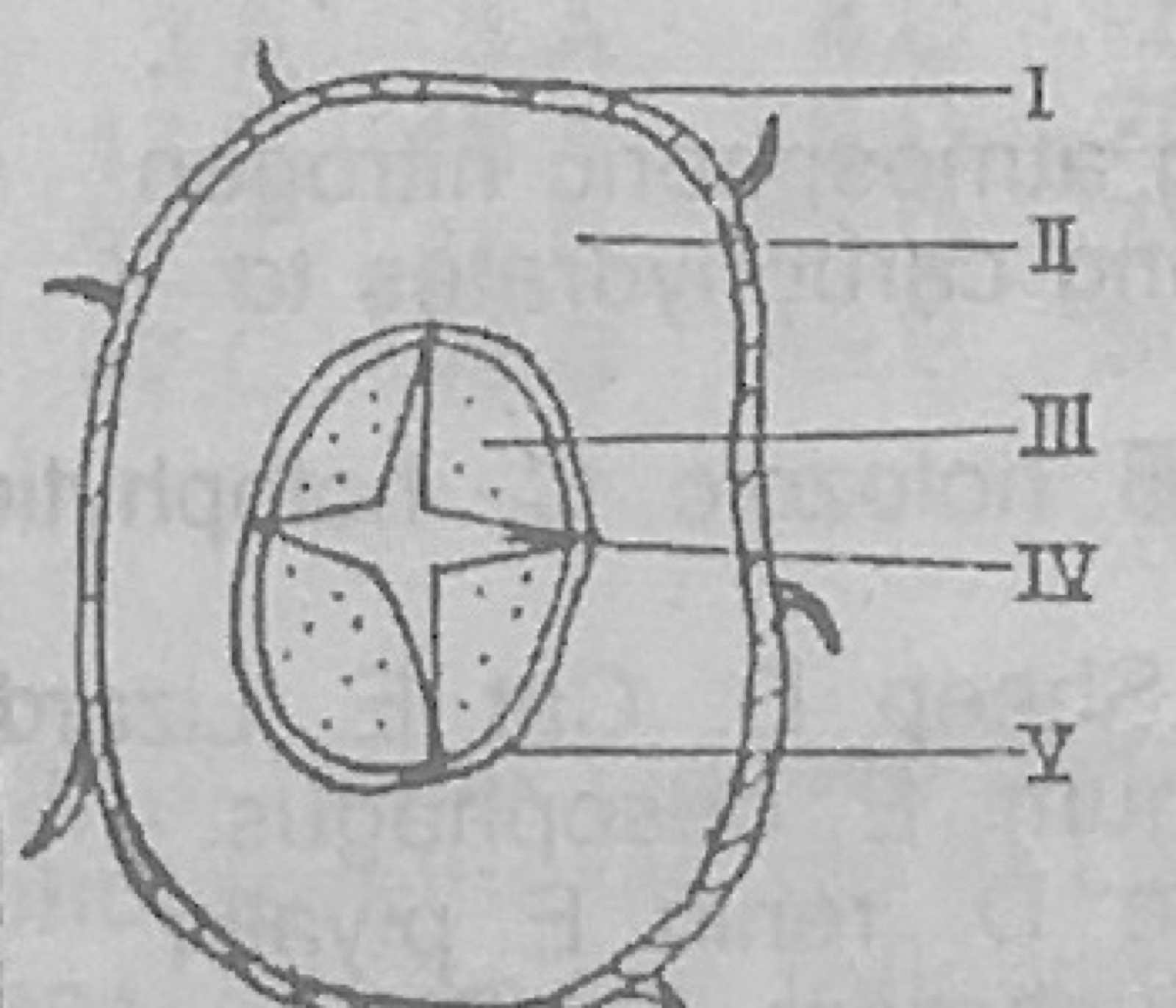
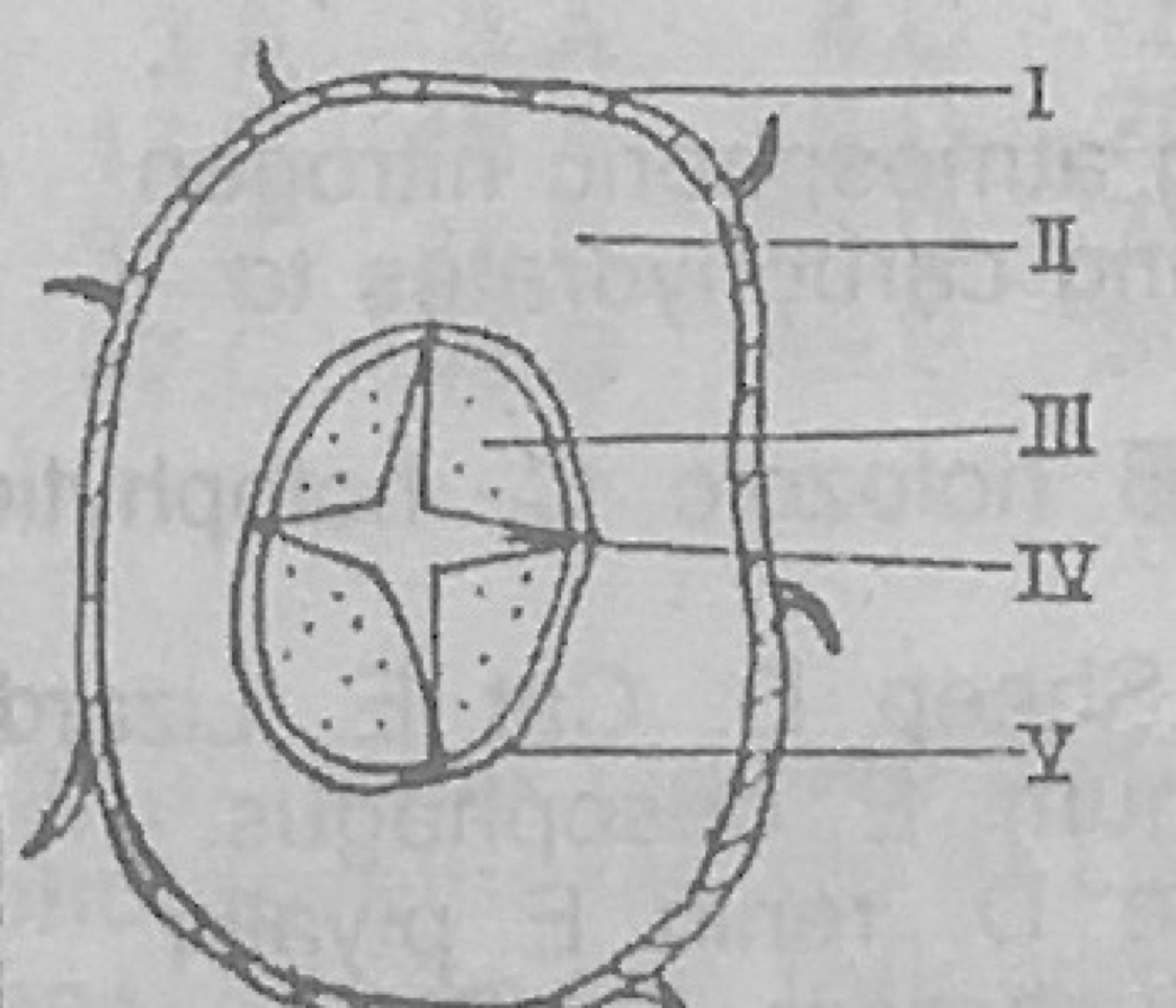
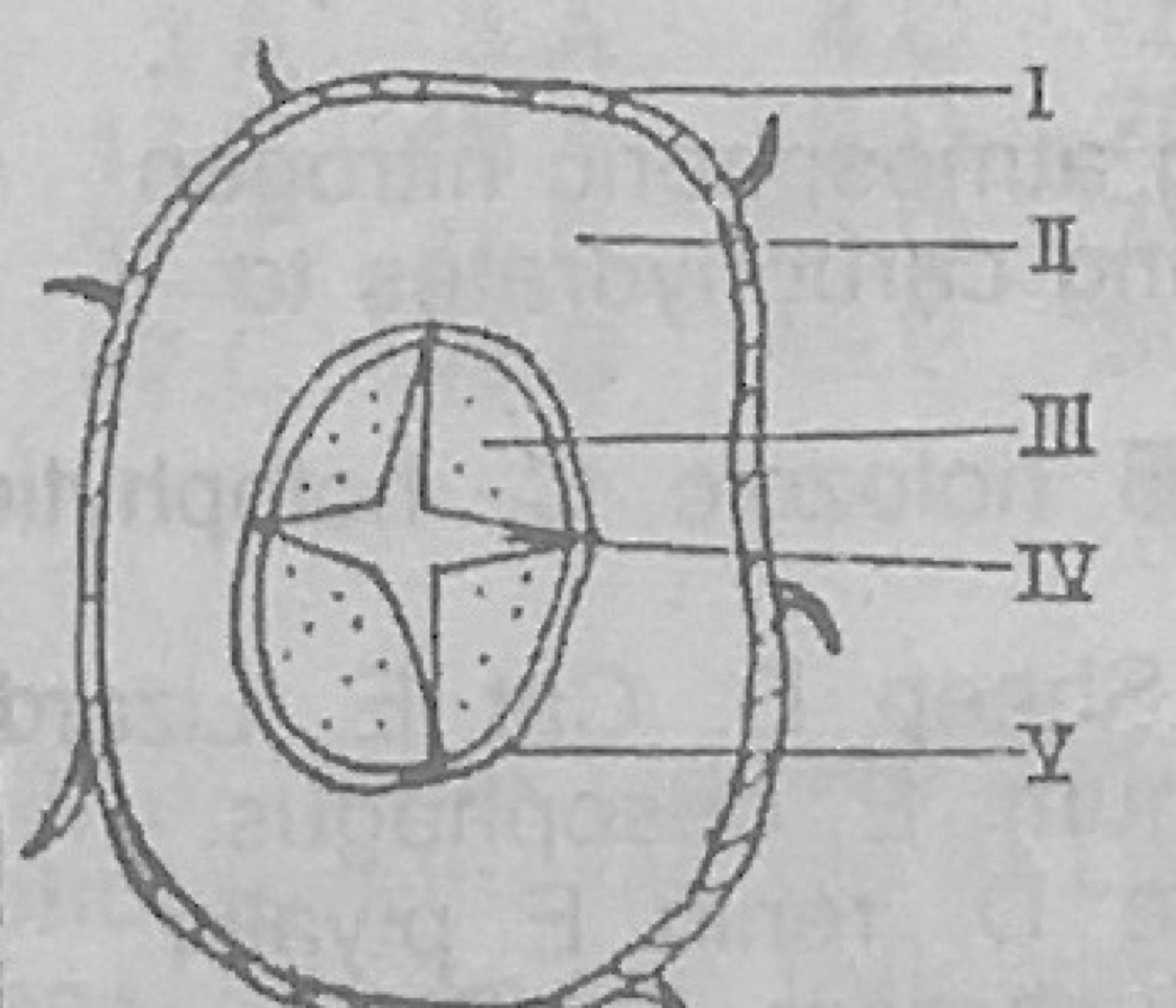
Question 7 Structure of Flowering Plants The above diagram represents a
A. longitudinal section of a stem B. longitudinal section of a root C. cross section of a root D. transverse section of stem E. longitudinal section of a leaf Show the answer and explanation Answer: C (cross section of a root )
Explanation The xylem forms a star in the centre with phloem between its arms, and root hairs grow from the outer layer: this is a cross section of a root.
Open this question
Question 8 Structure of Flowering Plants The part labelled II in the diagram is the
A. epidermis B. cortex C. phloem D. xylem E. cuticle Show the answer and explanation Answer: B (cortex )
Explanation II is the wide region of packing cells between the outer layer and the central stele, which is the cortex.
Open this question
Question 9 Structure of Flowering Plants The part labelled IV in the diagram is the
A. phloem B. pericycle C. cortex D. xylem E. epidermis Show the answer and explanation Answer: D (xylem )
Explanation IV points to the star-shaped arms in the centre of the root, which are the xylem.
Open this question
Question 10 Transport in Animals Which of the following is not a function of the blood?
A. Maintenance of body temperature B. Formation of clot C. Distribution of bile D. Transportation of excretory materials E. Distribution of hormones Show the answer and explanation Answer: C (Distribution of bile )
Explanation Bile is made in the liver and carried to the duodenum by the bile duct, not by the blood.
Open this question
Question 11 Transport in Animals Which of the following statements about the circulation of blood is not correct?
A. Deoxygenated blood flows in the heart through the vena cavae B. Blood is pumped out of the heart through the aorta C. Oxygenated blood from the lungs is carried to the left auricle D. The oxygenated blood enters the lungs through the pulmonary vein E. Ventricles contract to pump blood into the aorta Show the answer and explanation Answer: D (The oxygenated blood enters the lungs through the pulmonary vein )
Explanation The pulmonary vein carries oxygenated blood from the lungs to the heart; blood enters the lungs (deoxygenated) through the pulmonary artery.
Open this question
Question 12 Transport in Animals A difference between the auricle and the ventricle of the mammalian heart is that the
A. ventricles carry deoxygenated blood B. ventricles do not have outlets C. auricles have no valves D. walls of the ventricles are less muscular than that of the auricles E. Walls of the ventricles are more muscular than that of the auricles Show the answer and explanation Answer: E (Walls of the ventricles are more muscular than that of the auricles )
Explanation Ventricles pump blood out to the lungs and the whole body, so their walls are thicker and more muscular than the auricles'.
Open this question
Question 13 Respiration Which of the following organisms respires through the body surface?
A. Man B. Fish C. Tridax D. Amoeba E. Hibiscus Show the answer and explanation Answer: D (Amoeba )
Explanation Amoeba is a single cell with a large surface compared with its volume, so oxygen simply diffuses in through its cell membrane.
Open this question
Question 14 Respiration The stomata of a leaf performs the same function as
A. spiracles of insects B. trachea of toads C. pharynx of man D. liver of man E. scales of fish Show the answer and explanation Answer: A (spiracles of insects )
Explanation Stomata and spiracles are both small openings through which gases pass in and out of the organism.
Open this question
Question 15 Respiration Which of the following does not happen during inspiration?
A. Intercostal muscles contract B. Ribs move forward C. Thoracic cavity increases D. Diaphragm relaxes E. Internal air pressure decreases Show the answer and explanation Answer: D (Diaphragm relaxes )
Explanation During inspiration the diaphragm contracts and flattens; it relaxes during expiration.
Open this question
Question 16 Excretion Which of these is not an excretory product of plant?
A. Tannin B. Gum C. Alkaloid D. Sweat E. Anthocyanin Show the answer and explanation Answer: D (Sweat )
Explanation Sweat is made by the sweat glands of mammals; plants do not sweat.
Open this question
Question 17 Excretion Which of these is not a function of the kidney?
A. Production of urine B. Maintenance of acid-base balance in the body C. Osmo-regulation D. Removal of urea E. Production of bile Show the answer and explanation Answer: E (Production of bile )
Explanation Bile is produced by the liver, not by the kidney.
Open this question
Question 18 Excretion In which part of the kidney does ultrafiltration take place?
A. Bowman's capsule B. Distal convoluted tubule C. Proximal convoluted tubule D. Collecting duct E. Afferent arteriole Show the answer and explanation Answer: A (Bowman's capsule )
Explanation Blood under high pressure in the glomerulus is filtered into the Bowman's capsule; this is ultrafiltration.
Open this question
Question 19 Excretion Which of the following organs is concerned with detoxication of harmful compounds?
A. Kidney B. Lungs C. Gall bladder D. Liver E. Pancreas Show the answer and explanation Answer: D (Liver )
Explanation The liver breaks down or changes poisons such as alcohol and drugs into harmless substances.
Open this question
Question 20 Hormonal Coordination The hormone that promotes secondary sexual characteristics in females is
A. insulin B. thyroxin C. testosterone D. oxytocin E. oestrogen Show the answer and explanation Answer: E (oestrogen )
Explanation Oestrogen from the ovaries causes female features such as breast growth and widening of the hips.
Open this question
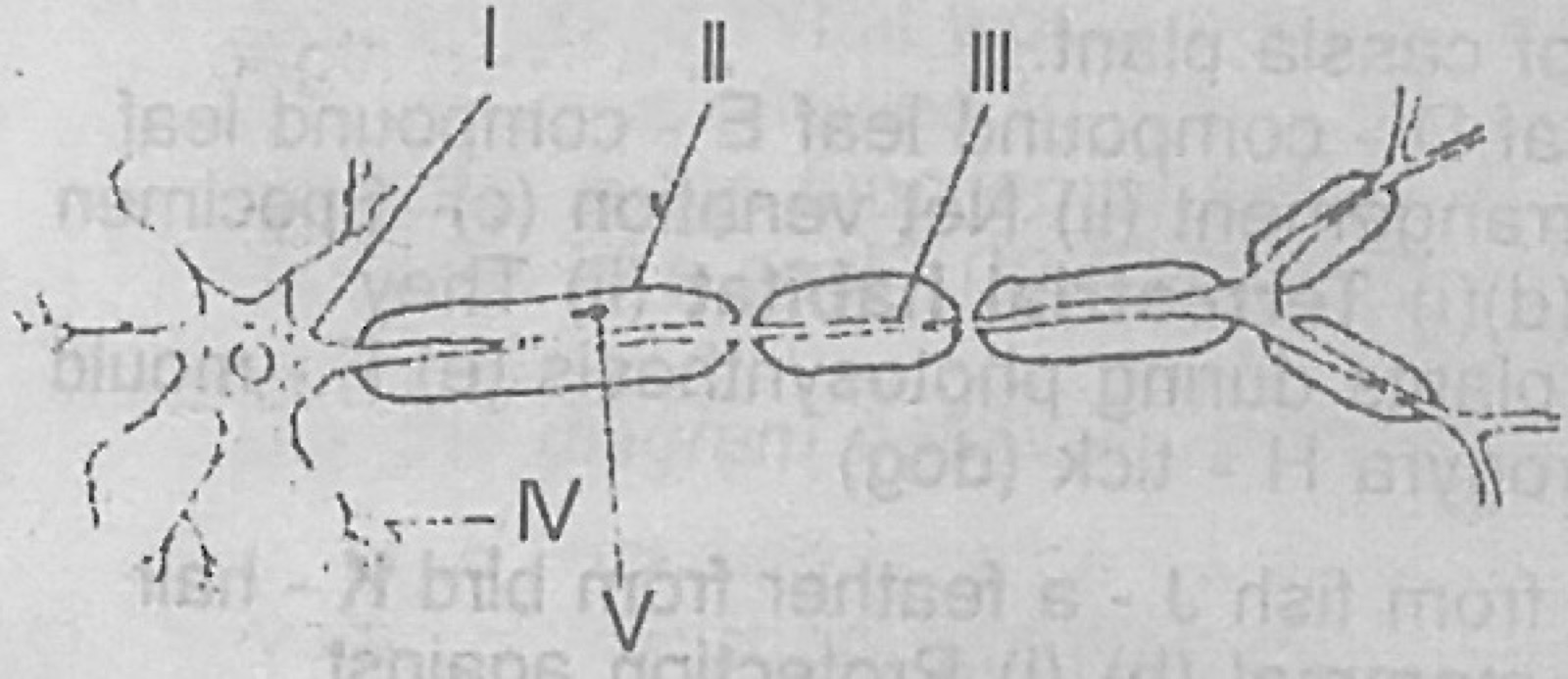
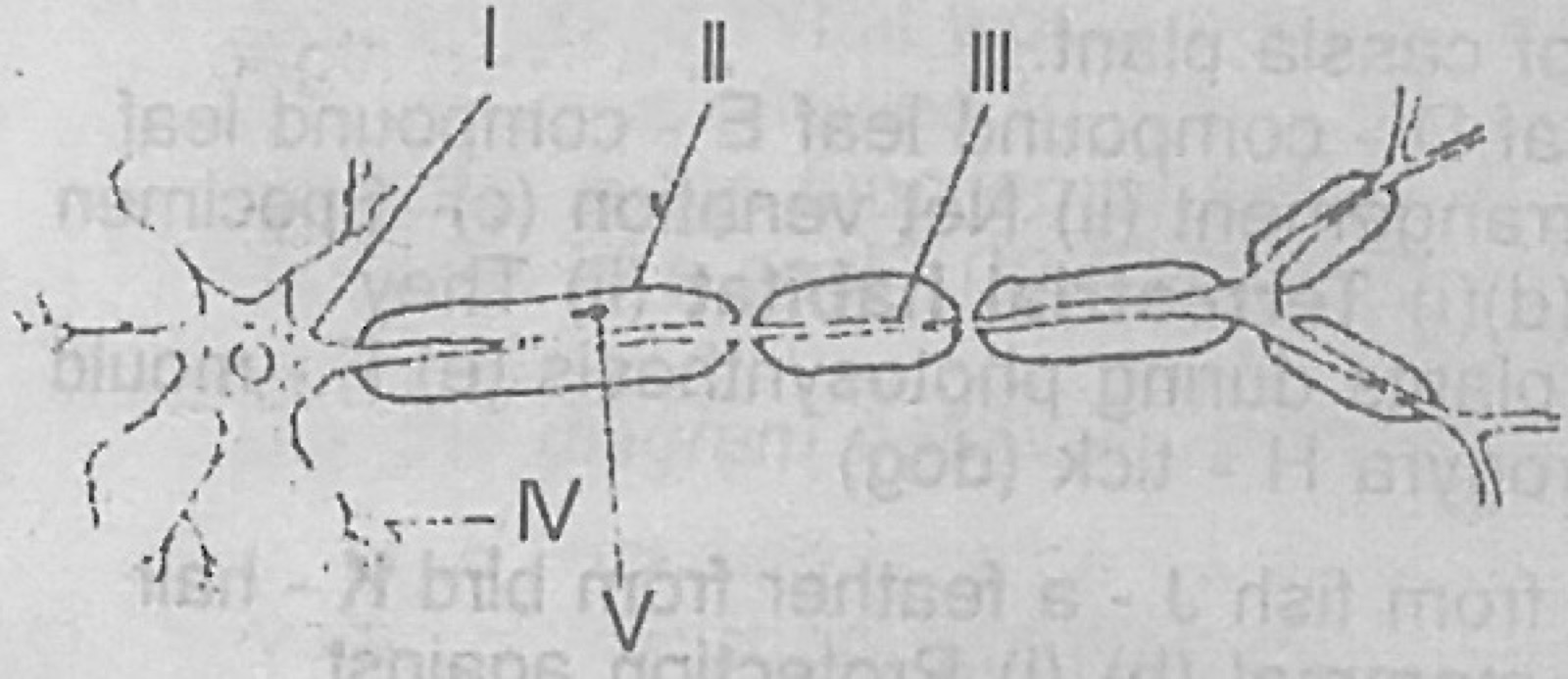
Question 21 Nervous Coordination The cell body in the diagram is labelled
A. I B. II C. III D. IV E. V Show the answer and explanation Answer: A (I )
Explanation I points to the rounded part containing the nucleus, from which the dendrites branch: the cell body.
Open this question
Question 22 Nervous Coordination The function of the part labelled II in the diagram is to
A. transmit impulse from one end of the cell to the other B. manufacture food for the cell C. protect the axon D. produce energy for the cell E. detect electrical impulses Show the answer and explanation Answer: C (protect the axon )
Explanation II is the myelin sheath, the fatty covering that insulates and protects the axon and speeds up impulses.
Open this question
Question 23 Sense Organs The organ responsible for equalising air pressure in the ear is the
A. sacculus B. utriculus C. Eustachian tube D. ampulla E. air ossicle Show the answer and explanation Answer: C (Eustachian tube )
Explanation The Eustachian tube joins the middle ear to the throat, so air pressure on both sides of the eardrum stays equal.
Open this question
Question 24 Reproduction in Animals Which of the following organisms lacks a reproductive organ?
A. Chlamydomonas B. Toad C. Pride of barbados D. Cockroach E. Man Show the answer and explanation Answer: A (Chlamydomonas )
Explanation Chlamydomonas is a single-celled alga; the whole cell divides or acts as a gamete, so it has no reproductive organ.
Open this question
Question 25 Reproduction in Animals Which of the following mammalian features acts as a shock-absorber to the developing embryo?
A. Amniotic fluid B. Umbilical cord C. Placenta D. Amnion E. Chorion Show the answer and explanation Answer: A (Amniotic fluid )
Explanation The embryo floats in amniotic fluid, which cushions it against knocks and jolts.
Open this question
Question 26 Reproduction in Plants The collective name for the female parts of the flower is
A. gynoecium B. androecium C. ovary D. stigma E. style Show the answer and explanation Answer: A (gynoecium )
Explanation The gynoecium (pistil) is all the carpels together: stigma, style and ovary. The androecium is the male part.
Open this question
Question 27 Reproduction in Plants If the petals of a flowering plant are removed, which of the following processes is likely to be affected?
A. Transpiration B. Pollination C. Germination D. Photosynthesis E. Dispersal Show the answer and explanation Answer: B (Pollination )
Explanation Bright petals attract insects that carry pollen, so without them pollination suffers.
Open this question
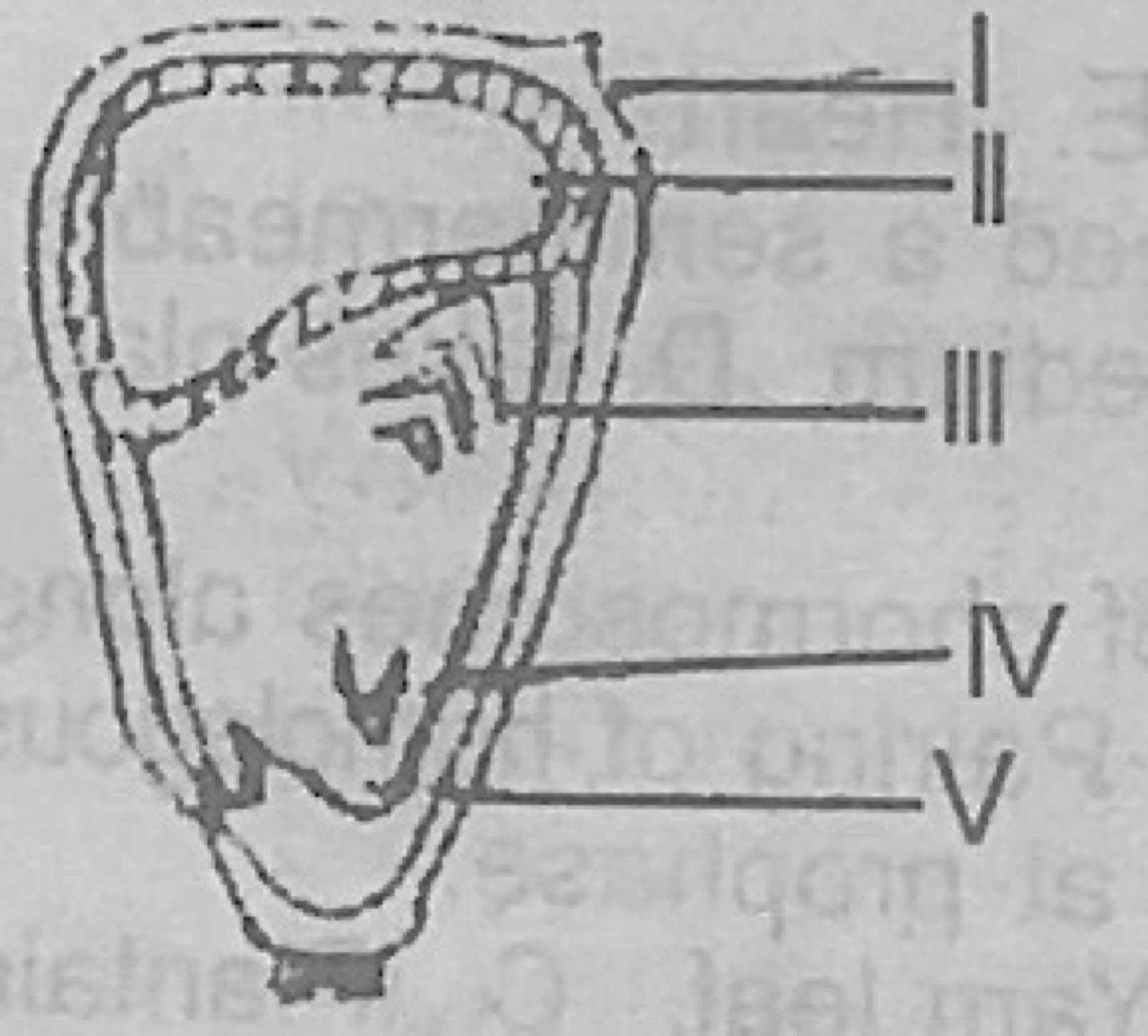
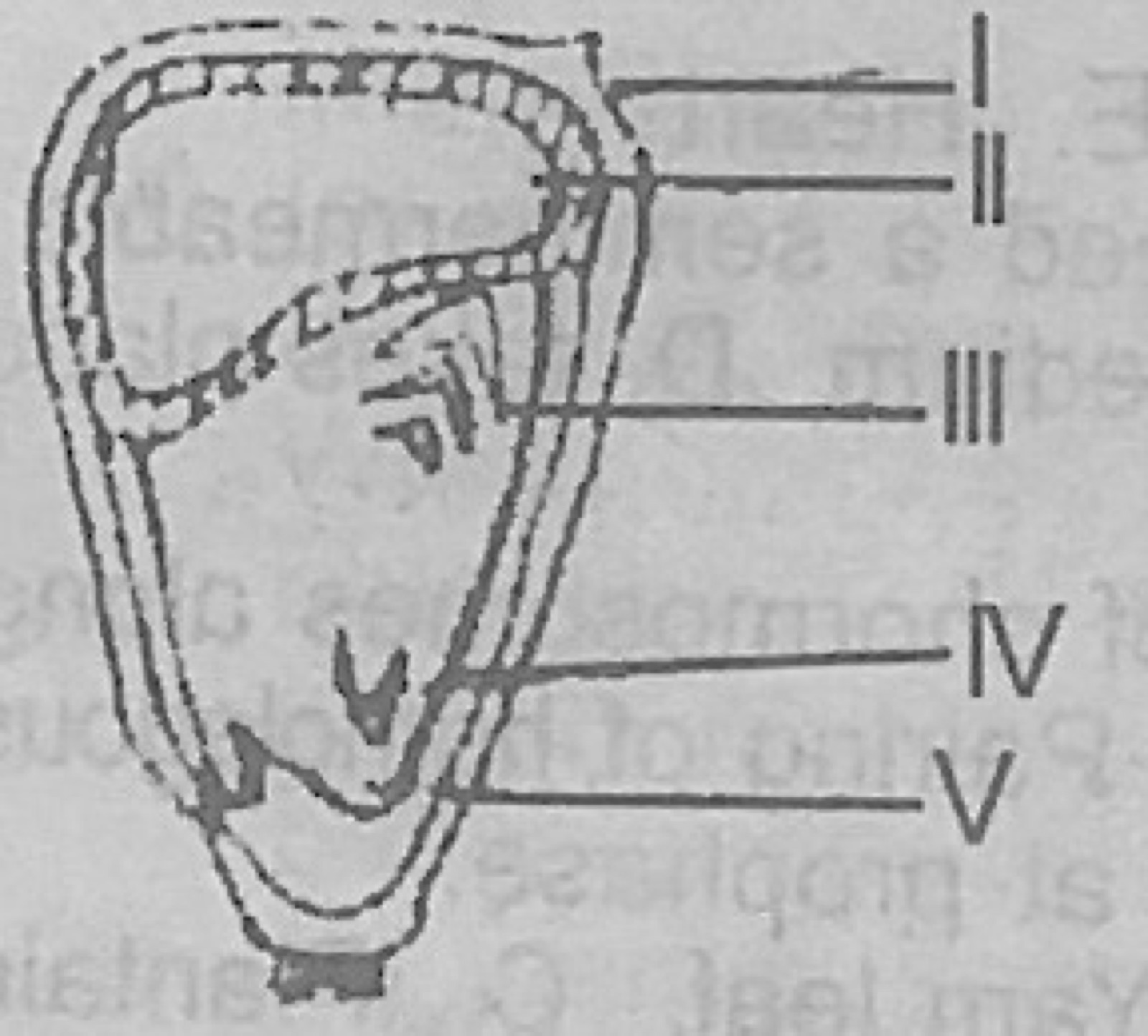
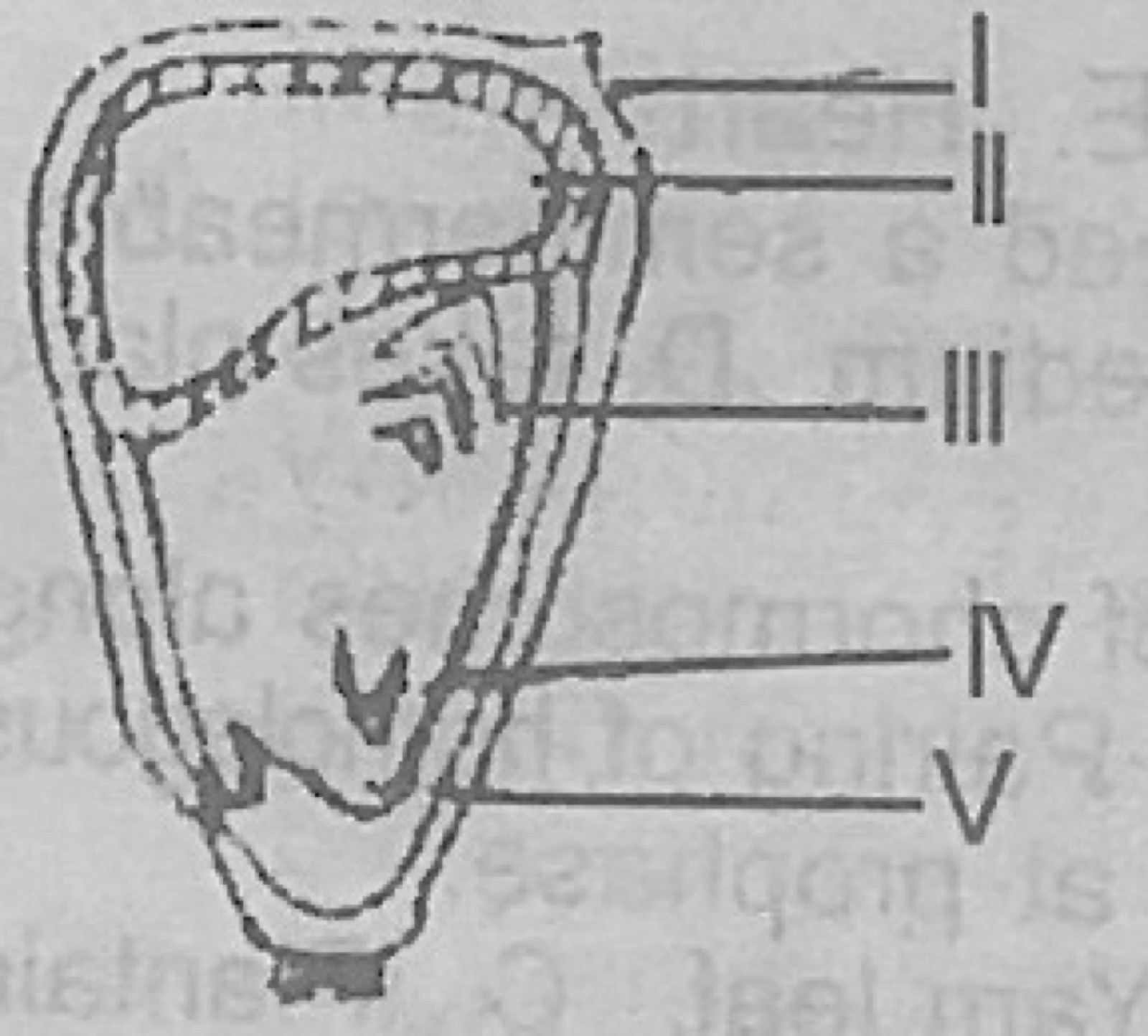
Question 28 Reproduction in Plants The part labelled II in the diagram is the
A. plumule B. endosperm C. radicle D. coleorhiza E. pericarp Show the answer and explanation Answer: B (endosperm )
Explanation II lies just inside the fused fruit wall and fills most of the maize grain: the endosperm, the food store.
Open this question
Question 29 Reproduction in Plants The part labelled IV in the diagram is the
A. plumule B. endosperm C. radicle D. coleoptile E. pericarp Show the answer and explanation Answer: C (radicle )
Explanation IV is the lower end of the embryo axis, which grows into the first root: the radicle.
Open this question
Question 30 Reproduction in Plants The function of the part labelled V in the diagram is the
A. manufacture of food B. storage of food C. secretion of digestive enzymes D. protection of the radicle E. absorption of mineral salts Show the answer and explanation Answer: D (protection of the radicle )
Explanation V is the coleorhiza, a sheath that covers and protects the radicle as it pushes out of the grain.
Open this question
Question 31 Reproduction in Plants Which of the following is a feature of wind pollinated flowers?
A. Large and brightly coloured petals B. Possession of sweet scent C. Presence of nectar D. Presence of pollen guides E. Smooth, light and numerous pollen grains Show the answer and explanation Answer: E (Smooth, light and numerous pollen grains )
Explanation Wind-pollinated flowers make many small, light, smooth pollen grains that are easily blown about; the other features attract insects.
Open this question
Question 32 Photosynthesis and Plant Nutrition In testing for starch in a leaf the function of alcohol is to
A. kill the cells of the leaf B. soften the veins of the leaf C. aid iodine to penetrate the cells D. be a component of the heating bath E. extract the chlorophyll from the leaf Show the answer and explanation Answer: E (extract the chlorophyll from the leaf )
Explanation Hot alcohol dissolves the green chlorophyll out of the leaf so the blue-black iodine colour can be seen clearly.
Open this question
Question 33 Nutrient Cycling Which of the following processes removes CO2 from the atmosphere?
A. Respiration B. Photosynthesis C. Transpiration D. Excretion E. Combustion Show the answer and explanation Answer: B (Photosynthesis )
Explanation Green plants take in carbon dioxide and use it to make sugar in photosynthesis; respiration and combustion release it.
Open this question
Question 34 Nutrient Cycling The role of bacteria in the nitrogen cycle includes the following except
A. fixing atmospheric nitrogen B. converting ammonia to nitrites C. converting nitrites to nitrates D. converting carbohydrates to carbondioxide E. causing the decay of dead organisms Show the answer and explanation Answer: D (converting carbohydrates to carbondioxide )
Explanation Breaking carbohydrates down to carbon dioxide belongs to the carbon cycle; the other processes move nitrogen compounds.
Open this question
Question 35 Animal Nutrition The mode of nutrition which describes feeding habit in animals is
A. autotrophic B. holozoic C. holophytic D. saprophytic E. photosynthetic Show the answer and explanation Answer: B (holozoic )
Explanation Holozoic nutrition means taking in solid food and digesting it inside the body, as most animals do.
Open this question
Question 36 Animal Nutrition Which of the following organisms has homodont dentition?
A. Rabbit B. Man C. Sheep D. Cat E. Lizard Show the answer and explanation Answer: E (Lizard )
Explanation Homodont means all the teeth are alike, as in reptiles such as the lizard; mammals have different kinds of teeth (heterodont).
Open this question
Question 37 Animal Nutrition The pancreatic duct opens into the
A. caecum B. colon C. ileum D. duodenum E. oesophagus Show the answer and explanation Answer: D (duodenum )
Explanation Pancreatic juice enters the duodenum, the first part of the small intestine, through the pancreatic duct.
Open this question
Question 38 Animal Nutrition The enzyme that acts on milk in the stomach is
A. invertase B. trypsin C. diastase D. renin E. ptyalin Show the answer and explanation Answer: D (renin )
Explanation Rennin, made in the stomach of young mammals, curdles milk protein (caseinogen).
Open this question
Question 39 Photosynthesis and Plant Nutrition Which of the following plants is a carnivore?
A. Desmodium B. Sundew C. Mushroom D. Platycerium E. Liverwort Show the answer and explanation Answer: B (Sundew )
Explanation The sundew traps insects on sticky hairs and digests them to get nitrogen.
Open this question
Question 40 Animal Nutrition Hydra feeds by
A. digesting its food extra cellularly B. absorbing food digested by other organisms C. symbiotic association D. masticating the food particles E. synthesising its food chemically Show the answer and explanation Answer: A (digesting its food extra cellularly )
Explanation Hydra catches small animals with its tentacles and starts digesting them with enzymes released into its body cavity, outside the cells.
Open this question
Question 42 Ecosystem and Ecological Factors Which of the following instruments can be used to measure relative humidity?
A. Anemometer B. Hygrometer C. Wind gauge D. Barometer E. Thermometer Show the answer and explanation Answer: B (Hygrometer )
Explanation A hygrometer measures how much water vapour is in the air (relative humidity).
Open this question
Question 43 Feeding Relationships and Energy Flow In a food chain, each stage in the chain is a
A. chain level B. web level C. consumption level D. trophic level E. product level Show the answer and explanation Answer: D (trophic level )
Explanation Each feeding step in a food chain (producer, primary consumer and so on) is called a trophic level.
Open this question
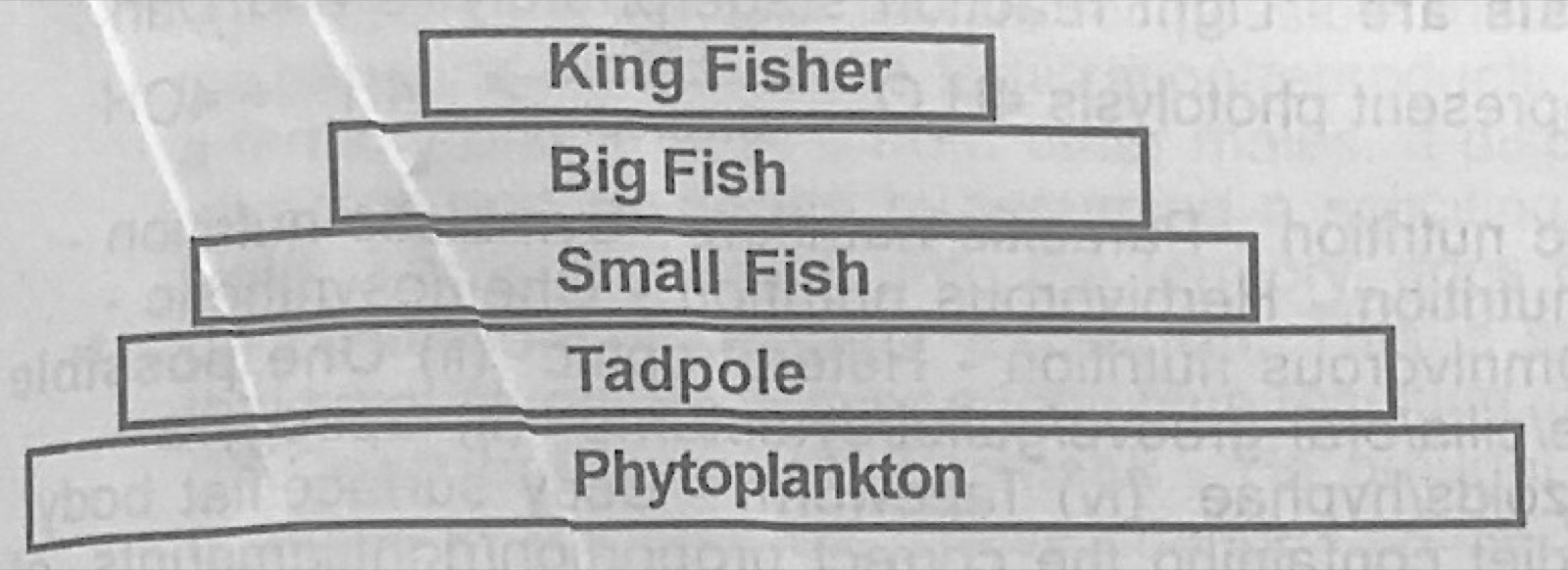
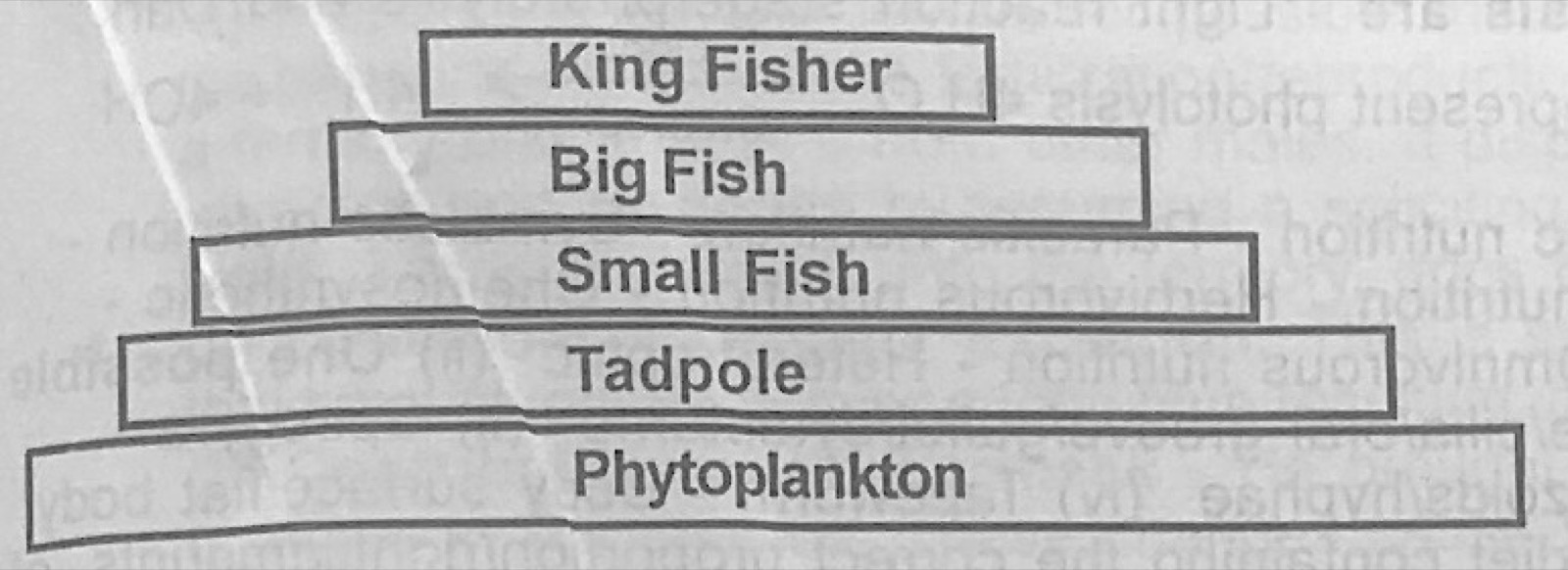
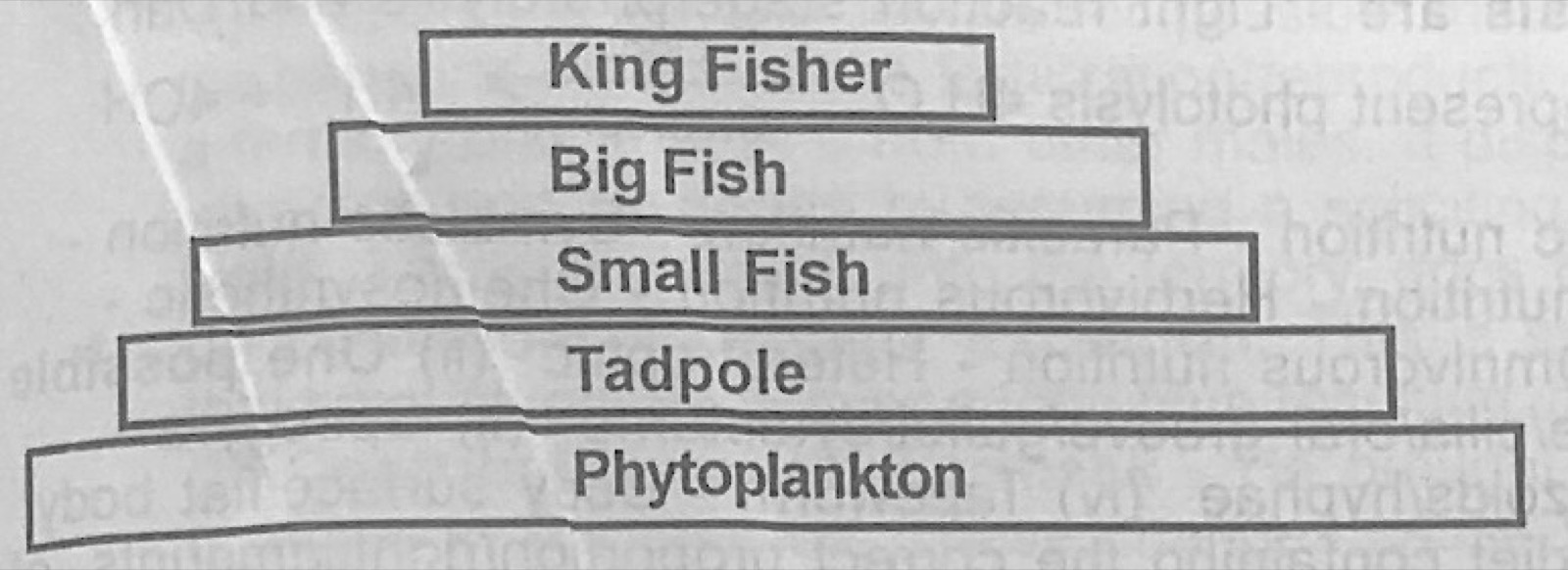
Question 44 Feeding Relationships and Energy Flow The diagram above illustrates
A. the size of various organisms B. types of organisms in a habitat C. the flow of energy in a habitat D. the hierarchy of organisms in a habitat E. the food chain Show the answer and explanation Answer: E (the food chain )
Explanation The diagram stacks the organisms by who eats whom, from phytoplankton up to the king fisher, which shows a food chain.
Open this question
Question 45 Feeding Relationships and Energy Flow Which of these organisms occupies the 3rd trophic level?
A. King fisher B. Small fish C. Phytoplankton D. Big fish E. Tadpole Show the answer and explanation Answer: B (Small fish )
Explanation Phytoplankton are the 1st level, tadpoles the 2nd and small fish the 3rd.
Open this question
Question 46 Feeding Relationships and Energy Flow Which of these organisms is a herbivore?
A. Tadpole B. Phytoplankton C. King fisher D. Small fish E. Big fish Show the answer and explanation Answer: A (Tadpole )
Explanation The tadpole feeds directly on the phytoplankton (plants), so it is the herbivore.
Open this question
Question 47 Habitats and Biomes The presence of stilt and breathing roots are features of plants found in the
A. trophical rain forests B. fresh water swamp forests C. mangrove forests D. southern guinea savanna E. northern guinea savanna Show the answer and explanation Answer: C (mangrove forests )
Explanation Mangroves grow in soft, airless mud, so they have stilt roots for support and breathing roots (pneumatophores) for air.
Open this question
Question 48 Transport in Plants Excessive loss of water from the leaf is prevented by the
A. vascular bundle B. cuticle C. midrib D. parenchyma E. mesophyll Show the answer and explanation Answer: B (cuticle )
Explanation The waxy, waterproof cuticle covering the leaf cuts down water loss.
Open this question
Question 49 Population Ecology Which of the following organisms will be a colonizing species of a heap of moist sub soil?
A. Green algae B. Ferns C. White mangrove D. Snails E. Tadpole Show the answer and explanation Answer: A (Green algae )
Explanation Simple green algae are the first (pioneer) organisms to grow on fresh moist soil; ferns come later when there is humus.
Open this question
Question 50 Soil The earthworm is important because
A. its body is always moist B. each of its segments has chaetae C. it has a clitellum D. it aerates the soil E. it reproduces fast Show the answer and explanation Answer: D (it aerates the soil )
Explanation Earthworms burrow through the soil, letting air and water in and mixing in humus.
Open this question
Question 51 Cell Structure and Organisation Which of the following plant parts is not a storage organ?
A. Carrot root B. Sugarcane stem C. Onion leaf D. Banana stem E. Cassava root Show the answer and explanation Answer: D (Banana stem )
Explanation The banana 'stem' is a pseudostem made of rolled leaf bases; it does not store food like the others.
Open this question
Question 52 Microorganisms and Health Which of the following statements about poliomyelitis is not correct. It
A. is a bacterial disease B. is capable of paralysing the limbs C. can be prevented by immunization D. is an infant disease E. may cause wasting of the limb muscles Show the answer and explanation Answer: A (is a bacterial disease )
Explanation Polio is caused by a virus, not a bacterium.
Open this question
Question 53 Microorganisms and Health Oil is sprayed over stagnant water in which mosquitoes breed in order to
A. provide landing surface for the adult B. prevent larva or pupa from attaching itself to the surface C. prevent the water from overheating D. lubricate the larva for easy movement E. provide surface for laying their eggs Show the answer and explanation Answer: B (prevent larva or pupa from attaching itself to the surface )
Explanation Larvae and pupae hang from the water surface to breathe; the oil film stops them attaching, so they suffocate.
Open this question
Question 54 Cell Structure and Organisation In animals the main protective covering is found in the
A. adipose tissues B. epithelial tissues C. bone tissues D. connective tissues E. vascular tissues Show the answer and explanation Answer: B (epithelial tissues )
Explanation Epithelial tissue covers the body surface (skin) and lines its organs, protecting the tissues beneath.
Open this question
Question 55 Cell Division How many chromosomes will be present in a gamete if the somatic cell has eight(8) chromosomes?
A. 4 B. 6 C. 8 D. 10 E. 16 Show the answer and explanation Answer: A (4 )
Explanation Gametes are made by meiosis, which halves the chromosome number: 8 ÷ 2 = 4.
Open this question
Question 56 Mendelian Inheritance In a plant of genotype Tt, what is the probability that a gamete will contain gene t?
A. 1/2 B. 3/4 C. 1/8 D. 1/6 E. 1/4 Show the answer and explanation Answer: A (1/2 )
Explanation The two alleles separate into different gametes, so half the gametes carry T and half carry t.
Open this question
Question 57 Mendelian Inheritance In a cross involving a heterozygous red flowered plant (Rr) and a white flowered plant (rr), what is the probability that the offspring will be Rr?
A. 1 B. 1/2 C. 1/4 D. 3/4 E. 2 Show the answer and explanation Answer: B (1/2 )
Explanation Rr × rr gives Rr, Rr, rr, rr, so 2 out of 4 offspring (1/2) are Rr.
Open this question
Question 58 Behaviour Termites are called social insects because
A. the nests are built by the nasute soldiers B. they live together in communities C. the queen allocates duties to the workers D. the king and queen do mate E. the function of the workers and soldiers are very important Show the answer and explanation Answer: B (they live together in communities )
Explanation Social insects live together in organised colonies where different castes share the work.
Open this question
Question 59 Behaviour Which of the following makes up the bee caste?
A. Soldiers and Queen B. Drones, soldiers and workers C. Queen, workers and soldiers D. Queen, drones and workers E. Soldiers, Queen and drones Show the answer and explanation Answer: D (Queen, drones and workers )
Explanation A honeybee colony has a queen, drones (males) and workers; bees have no soldier caste.
Open this question
Question 60 Adaptation Which of the following examples best describes camouflagic colouration in organisms?
A. A butterfly which has a red colouration on the wing B. A green snake in a green grass C. A zebra with vertical stripes on the body D. Certain tree frogs with bright colour patterns E. A flower whose petals and sepals are of the same colour Show the answer and explanation Answer: B (A green snake in a green grass )
Explanation Camouflage is colouring that blends with the surroundings, like a green snake hidden in green grass.
Open this question
Theory question 101 Photosynthesis and Plant Nutrition (a) (i) Name the two stages involved in photosynthesis (ii) Write an equation to represent the first stage of photosynthesissix modes of nutrition in organisms (ii) Name one feature that makes feeding possible in the following organisms I. Paramecium II. Spirogyra III. Rhizopus IV Tapewormthree characteristics of enzymes. (ii) In a tabular form indicate the source, substrate acted upon and the product of the following enzymes: ptyalin, pepsin
Show the model answer Model answer (a)(i) Light stage (light-dependent stage/photolysis); dark stage (light-independent stage/carbon dioxide fixation).2 O → 4H+ + 4e− + O2 (or 4H2 O → 4H+ + 4OH− ).
Explanation Learn each enzyme as a set: where it is made, what it acts on and what it makes.
Open this question
Theory question 102 Reproduction in Plants (a) List four floral parts of a flowerfive differences between wind and insect pollinated flowers (ii) Give one example of eachthree agents of fruit and seed dispersal (ii) Give an example of fruits or seeds dispersed by each agentone plant hormone (iii) State two effects of plant hormones.
Show the model answer Model answer (a) Any four: calyx (sepals); corolla (petals); androecium (stamens); gynoecium (pistil/carpels); also receptacle, pedicel, epicalyx.
Explanation Put the wind/insect differences in matching pairs across a two-column table.
Open this question
Theory question 103 Behaviour (a) Mention four castes found among the termite nestsone role of each caste to the two types of courtship behaviour in lower animals (ii) State two importance of courtship behaviour in the reproduction of lower animals
Show the model answer Model answer (a) Queen; king; workers; soldiers (also winged reproductives/alates).
Explanation Termite castes: queen and king reproduce, workers work, soldiers defend.
Open this question
Theory question 104 Evolution (a) Define the term "Organic Evolution"three evidences of organic evolution
Show the model answer Model answer (a) Organic evolution is the gradual change in living organisms over a very long time, by which complex forms developed from simpler ancestors.
Explanation Lamarck = use and disuse; Darwin = natural selection.
Open this question Sign up free for every WAEC Biology year, practice by topic and timed mocks.
Start practising free