Home › Past questions › WAEC › Biology › 1991 August 62 questions. Try each one, then open the answer to check yourself and read the explanation.
Sign up free to answer these questions on a CBT screen with a timer, then see your score and every answer explained.
Start practising free
Question 1 Cell Structure and Organisation The cell is a functional unit of living organisms because
A. multicellular organisms are made up of cells B. all the cells in a multicellular organism function as a single cell C. the function of a multicellular organisation is the sum total of the functions of its constituent cells D. the function of a single cell is superior to that of the multicellular organism E. the cells of a multicellular organism are similar in structure Show the answer and explanation Answer: C (the function of a multicellular organisation is the sum total of the functions of its constituent cells )
Explanation Everything a multicellular organism does is the combined work of its cells, which is why the cell is called the unit of function.
Open this question
Question 2 Cell Structure and Organisation The organelle which eliminates water from the body of protozoa is
A. plasma membrane B. contractile vacuole C. cell wall D. protoplasm E. nucleus Show the answer and explanation Answer: B (contractile vacuole )
Explanation The contractile vacuole collects excess water and pumps it out of freshwater protozoa such as Amoeba.
Open this question
Question 3 Cell Structure and Organisation Spirogyra is regarded as a multicellular plant because
A. its cells are linked together by cytoplasmic strands B. its cells are joined to form organs C. the cylindrical cells are linked end to end D. the filaments consist of one cell only E. it is an alga containing large vacuoles Show the answer and explanation Answer: C (the cylindrical cells are linked end to end )
Explanation A Spirogyra filament is a chain of many cylindrical cells joined end to end.
Open this question
Question 4 Respiration The mechanism of gaseous exchange in living organisms is essentially by
A. osmosis B. inhalation C. diffusion D. exhalation E. breathing Show the answer and explanation Answer: C (diffusion )
Explanation Oxygen and carbon dioxide pass across respiratory surfaces by diffusion, from high to low concentration.
Open this question
Question 5 Cell and Its Environment Which of the following statements is correct about diffusion?
A. It involves the movement of water molecules only B. Molecules move from a region of higher concentration to a region of lower concentration C. Differentially permeable membrane must be present for diffusion to occur D. It involves the movement of only solute molecules into the Bowman's capsule E. It occurs when a solute can no longer dissolve in a solvent Show the answer and explanation Answer: B (Molecules move from a region of higher concentration to a region of lower concentration )
Explanation Diffusion is the spreading of particles from where they are more concentrated to where they are less concentrated; no membrane is needed.
Open this question
Question 6 Respiration The process of anaerobic respiration of yeast in sugar solution is known as
A. oxidation B. fermentation C. tissue respiration D. alcohol production E. decomposition Show the answer and explanation Answer: B (fermentation )
Explanation Yeast breaks sugar down without oxygen into alcohol and carbon dioxide: fermentation.
Open this question
Question 7 Support and Movement The following are functions of the skeleton except
A. providing support for the body B. protection of delicate internal organs C. maintenance of the shape of the body D. providing attachment for muscles E. controlling growth rate in animals Show the answer and explanation Answer: E (controlling growth rate in animals )
Explanation Growth rate is controlled by hormones (e.g. growth hormone), not by the skeleton.
Open this question
Question 8 Support and Movement Muscles are attached to bones by means of
A. ligament B. cartilage C. synovial membrane D. tendons E. connective tissue Show the answer and explanation Answer: D (tendons )
Explanation Tendons join muscles to bones; ligaments join bone to bone.
Open this question
Question 9 Structure of Flowering Plants Which of the following tissues is not found in the stem and root of monocotyledons?
A. Xylem B. Cambium C. Pith D. Cortex E. Pericycle Show the answer and explanation Answer: B (Cambium )
Explanation Monocots have no cambium, which is why they do not undergo secondary thickening.
Open this question
Question 11 Respiration The upper part of the trachea in mammals is called
A. palate B. epiglottis C. larynx D. glottis E. bronchus Show the answer and explanation Answer: C (larynx )
Explanation The larynx (voice box) is the top part of the trachea.
Open this question
Question 12 Excretion Which of the following parts of the mammalian skin is directly involved in excretion?
A. Sebaceous gland B. Sweat gland C. Hormy layer D. Hair folicle E. Malphigian layer Show the answer and explanation Answer: B (Sweat gland )
Explanation Sweat glands remove water, salts and a little urea from the body.
Open this question
Question 13 Excretion Kidney stone is a disease of the kidney that results in the
A. blockage of the tubules by solid particles B. passing out useful materials of the body fluid with urine C. presence of large quantity of water in urine D. passing out hormones in urine E. prevention of urine production Show the answer and explanation Answer: A (blockage of the tubules by solid particles )
Explanation Kidney stones are hard deposits of salts that block the kidney tubules and urinary passages.
Open this question
Question 14 Excretion The following are the activities of the liver except
A. production of heat B. manufacture of bile C. detoxication of alcohol and drugs D. maintenance of osmotic balance E. deamination of excess nitrogenous substances Show the answer and explanation Answer: D (maintenance of osmotic balance )
Explanation The liver produces heat, makes bile, detoxifies and deaminates; keeping the osmotic (water–salt) balance is the work of the kidneys.
Open this question
Question 15 Microorganisms and Health Infective hepatitis is a disease of the
A. heart B. kidney C. liver D. stomach E. pancreas Show the answer and explanation Answer: C (liver )
Explanation Hepatitis means inflammation of the liver.
Open this question
Question 16 Hormonal Coordination The pituitary is regarded as the master gland because
A. it is located in the brain B. its secretions are the most numerous C. its secretions control other endocrine glands D. it is the biggest endocrine gland E. it controls the activities of the brain Show the answer and explanation Answer: C (its secretions control other endocrine glands )
Explanation Pituitary hormones control the thyroid, adrenal glands and gonads.
Open this question
Question 17 Plant Responses and Hormones Growing radicles of seddlings are
A. negatively phototropic B. positively phototropic C. negatively geotropic D. negatively hydrotropic E. positively phototactic Show the answer and explanation Answer: A (negatively phototropic )
Explanation Roots grow away from light (negatively phototropic) and towards gravity and water.
Open this question
Question 18 Hormonal Coordination Over-secretion of thyroxin is likely to lead to
A. thinness of body B. sluggishness C. cretinism in infants D. reduced metabolism E. dwarfism Show the answer and explanation Answer: A (thinness of body )
Explanation Too much thyroxin speeds up metabolism, so food is burnt quickly and the person becomes thin and restless.
Open this question
Question 19 Plant Responses and Hormones If a germinating seed is attached horizontally on a revolving klinostat, what will be the effect on the seedling after three days? The
A. plumule will curve vertically upwards while the radicle will curve towards the ground B. plumule and radicle will not show any curvature C. radicle will curve towards the ground while the plumule will not show any curvature D. plumule will curve vertically upwards while the radicle will not show any curvature E. plumule and the radicle will curve towards the ground Show the answer and explanation Answer: B (plumule and radicle will not show any curvature )
Explanation The rotation spreads the pull of gravity evenly on all sides, so both shoot and root grow straight.
Open this question
Question 20 Sense Organs The human skin is regarded as a sense organ because it
A. separates the body from the outside world B. protects the body from cold and heat C. regulates the water content of the body D. has an outer layer of dead cells E. has nerve endings Show the answer and explanation Answer: E (has nerve endings )
Explanation The skin contains nerve endings (receptors) for touch, pain, pressure, heat and cold.
Open this question
Question 21 Nervous Coordination The part of the brain responsible for the control of voluntary movement and interpretation of sensations is the
A. cerebrum B. cerebellum C. optic lobe D. medulla oblongata E. olfactory lobe Show the answer and explanation Answer: A (cerebrum )
Explanation The cerebrum controls voluntary actions and interprets sensations.
Open this question
Question 22 Sense Organs Which part of the ear is responsible for the maintenance of balance?
A. Ossicles B. Tympanic membrane C. Eustachian tube D. Semicircular canals E. Cochlea Show the answer and explanation Answer: D (Semicircular canals )
Explanation The semicircular canals detect movements of the head and help keep balance.
Open this question
Question 23 Reproduction in Animals Which of the following is not part of the female reproductive system?
A. Ovary B. Seminal vesicle C. Uterus D. Vagina E. Fallopian tube Show the answer and explanation Answer: B (Seminal vesicle )
Explanation The seminal vesicle is part of the male reproductive system.
Open this question
Question 24 Reproduction in Animals Which of the following substances from the mother's blood diffuse through the placenta into the blood vessels of the foetus?
A. Carbon dioxide and oxygen B. Glycogen and starch C. Urea and carbon dioxide D. Glucose and oxygen E. Digested food and carbon dioxide Show the answer and explanation Answer: D (Glucose and oxygen )
Explanation The foetus receives oxygen and food such as glucose from the mother; carbon dioxide and urea go the other way.
Open this question
Question 25 Structure of Flowering Plants Which of the following is not seen in the transverse section of a young monocotyledonous stem?
A. Parenchyma B. Phloem C. Xylem D. Cambium E. Sclerenchyma Show the answer and explanation Answer: D (Cambium )
Explanation Monocot vascular bundles have no cambium (they are 'closed').
Open this question
Question 26 Transport in Animals The bicuspid valve is located between
A. left auricle and left ventricle B. right auricle and right ventricle C. left and right ventricles D. left and right auricles E. left auricle and right ventricle Show the answer and explanation Answer: A (left auricle and left ventricle )
Explanation The bicuspid valve separates the left auricle from the left ventricle.
Open this question
Question 27 Photosynthesis and Plant Nutrition During which of the following processes is food for animals produced?
A. Photosynthesis B. Respiration C. Nutrition D. Digestion E. Transpiration Show the answer and explanation Answer: A (Photosynthesis )
Explanation All animal food comes ultimately from the food green plants make in photosynthesis.
Open this question
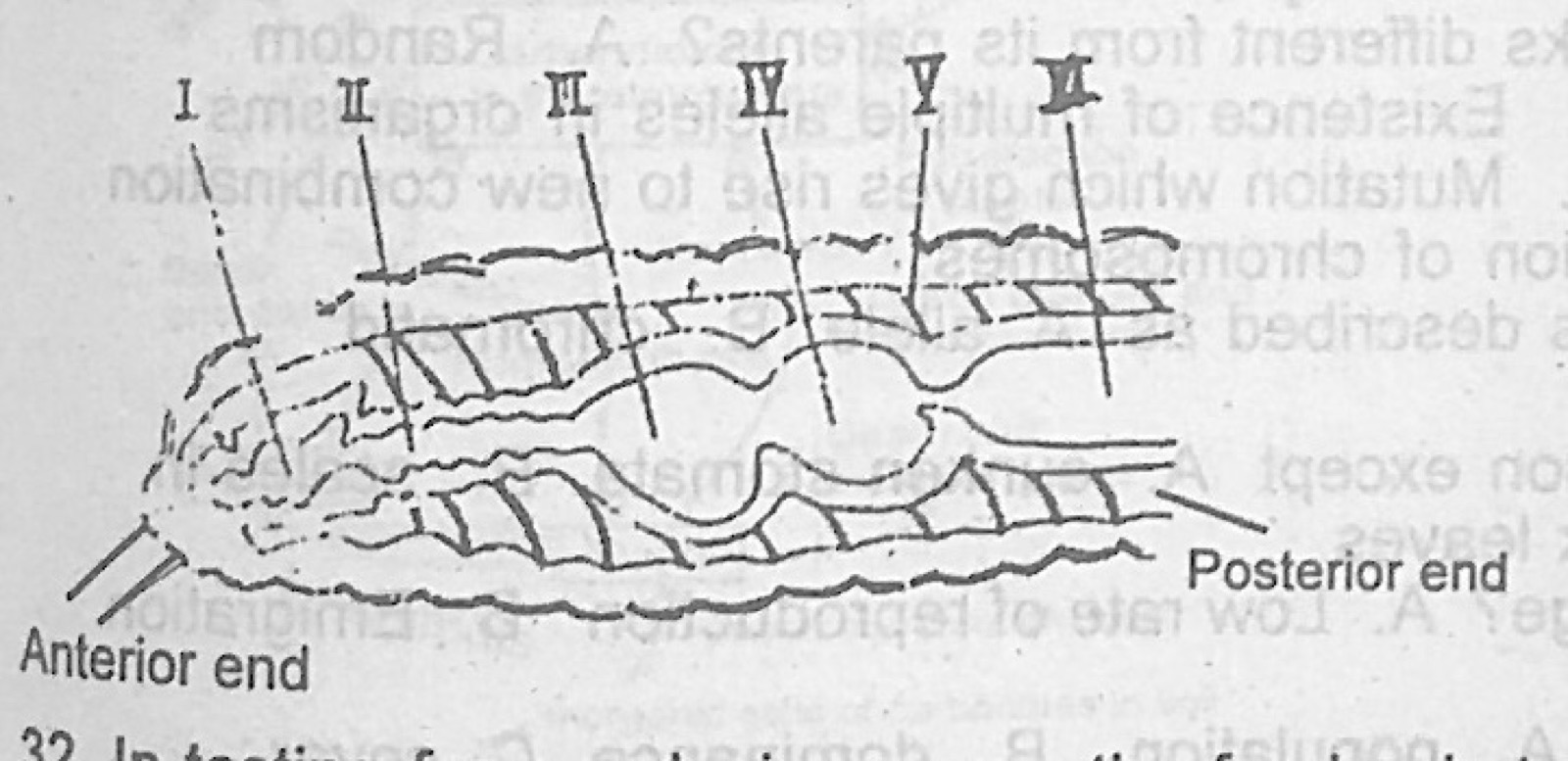
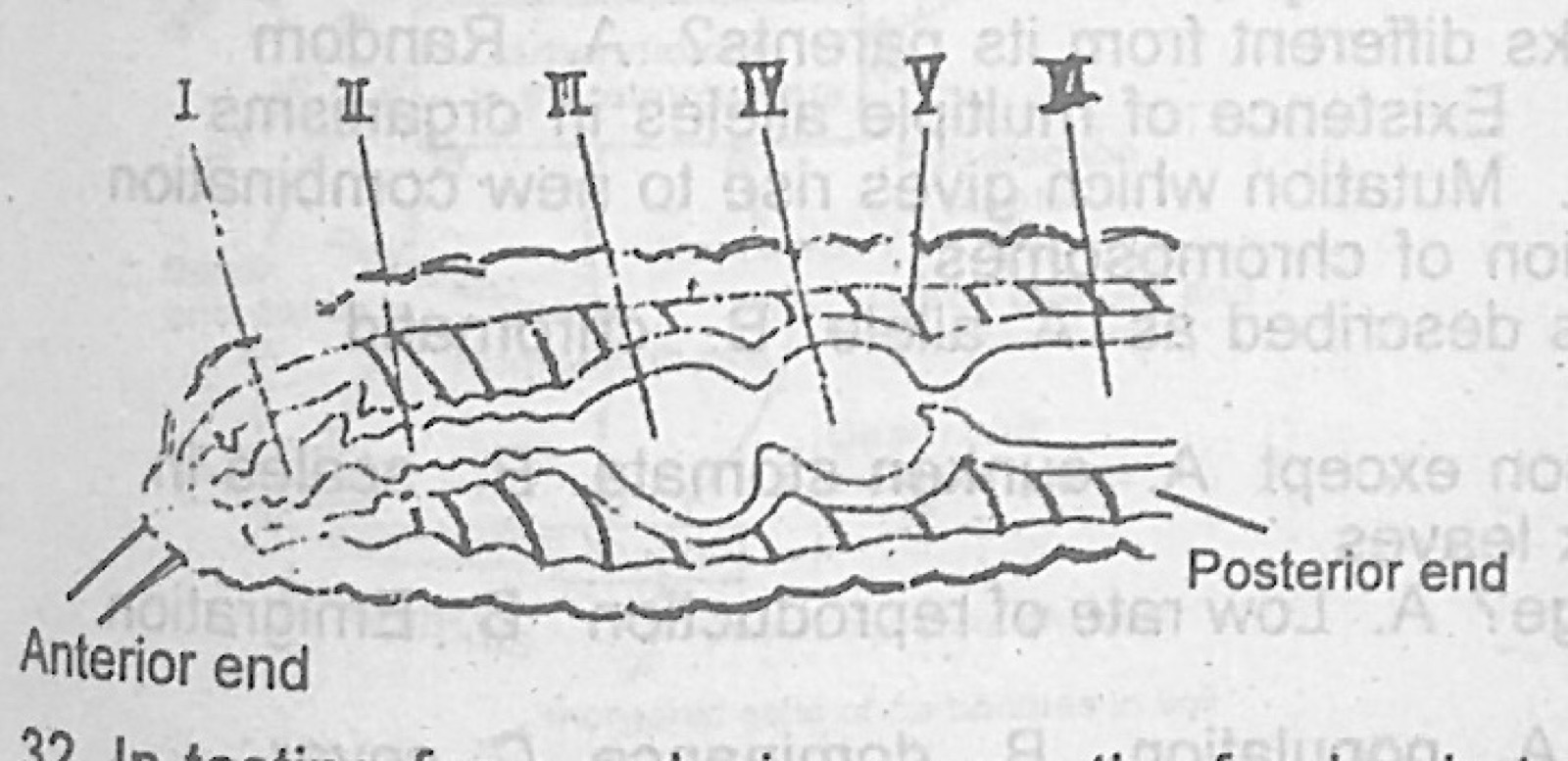
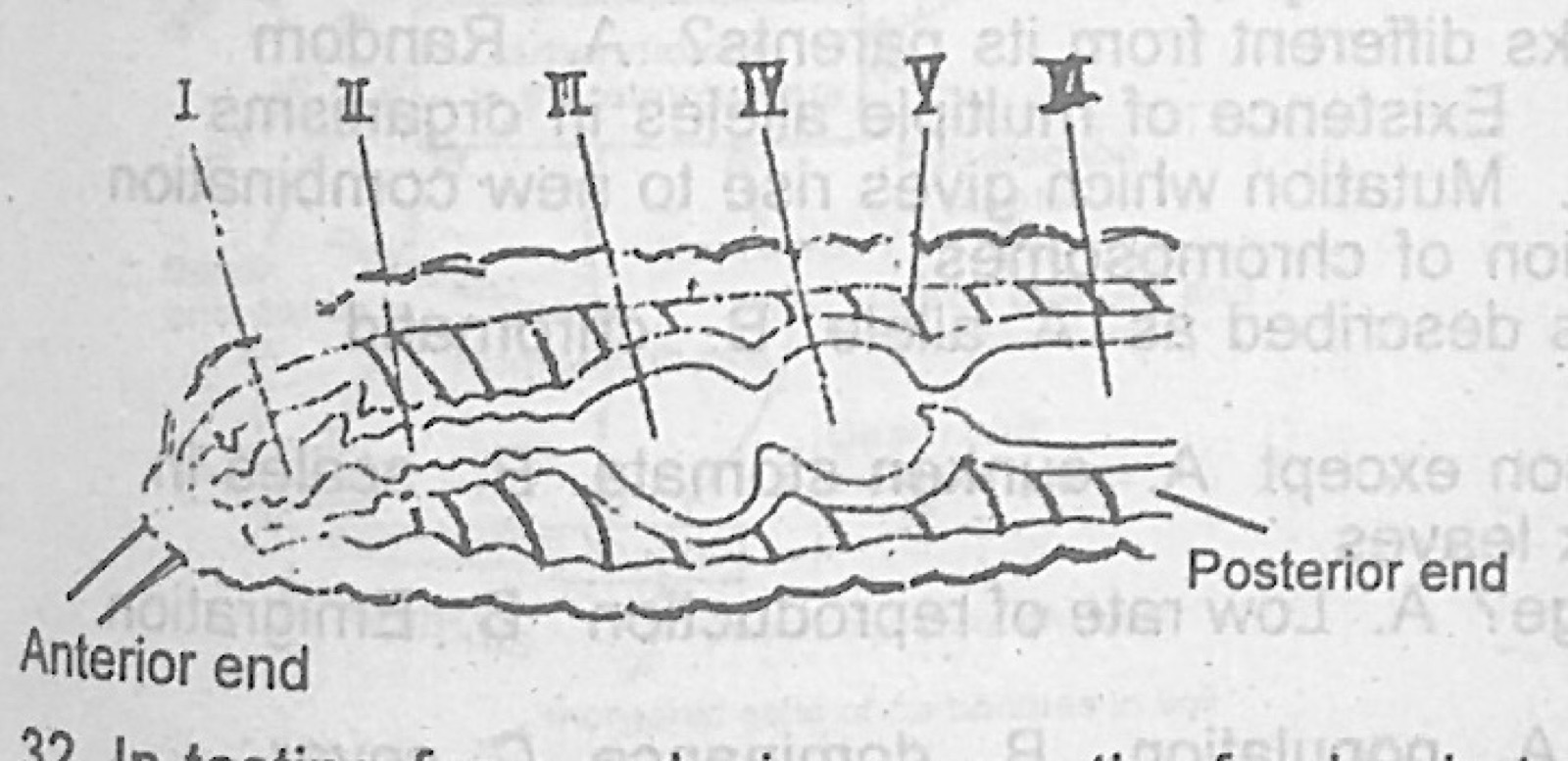
Question 28 Animal Nutrition Use the diagram below to answer questions 28 to 30.
A. Oesophagus B. Nephridium C. Pharynx D. Intestine E. Crop Show the answer and explanation Answer: C (Pharynx )
Explanation Just behind the mouth at the front end is the muscular pharynx.
Open this question
Question 29 Animal Nutrition The diagram below represents a section through the earthworm showing its alimentary system (parts labelled I to VI).
A. Gizzard B. Crop C. Heart D. Seminal vesicle E. Coelom Show the answer and explanation Answer: B (Crop )
Explanation The thin-walled swelling after the oesophagus is the crop, which stores food.
Open this question
Question 30 Animal Nutrition The diagram below represents a section through the earthworm showing its alimentary system (parts labelled I to VI).
A. Production of sperm B. Temporary storage of food C. Mechanical grinding of food D. Pumping blood all over the body E. Producing cocoon for the eggs Show the answer and explanation Answer: C (Mechanical grinding of food )
Explanation IV is the thick muscular gizzard, which grinds food with the help of soil particles.
Open this question
Question 31 Food Substances and Enzymes Pellagra can be prevented by taking food rich in
A. vitamin A B. vitamin B C. vitamin D D. calcium E. iodine Show the answer and explanation Answer: B (vitamin B )
Explanation Pellagra is caused by lack of niacin, one of the vitamin B group.
Open this question
Question 32 Food Substances and Enzymes In testing for a reducing sugar, the food substance is usually warmed with
A. Sulphuric acid B. Millon's reagent C. Sudan III D. Benedicts's solution Show the answer and explanation Answer: D (Benedicts's solution )
Explanation Reducing sugar heated with Benedict's solution gives a brick-red/orange precipitate.
Open this question
Question 33 Transport in Animals Which of the following adapts the aorta to the high pressure of the blood from the heart?
A. Thin walls B. Fragile membrane C. Thick elastic walls D. Stiff walls E. Narrow lumen Show the answer and explanation Answer: C (Thick elastic walls )
Explanation Thick, elastic walls let the aorta stretch and recoil with each heartbeat without bursting.
Open this question
Question 34 Animal Nutrition The part of the alimentary system of a bird where grinding of maize occurs is the
A. crop B. stomach C. gizzard D. cloaca E. rectum Show the answer and explanation Answer: C (gizzard )
Explanation A bird has no teeth; its muscular gizzard, with small stones, grinds grain.
Open this question
Question 35 Population Ecology Natality is a fatcr affecting population density because it involves
A. increase in population due to immigration B. increase in population due to emigration C. the number of mature females in the population D. the number of females in the population E. the number of all the yong ones produced in the population Show the answer and explanation Answer: E (the number of all the yong ones produced in the population )
Explanation Natality is the birth rate: the number of young produced, which adds to the population.
Open this question
Question 36 Reproduction in Plants The female part of a flower consists of the
A. stigma, style and ovary B. petals, sepals and anthers C. stigma, sepals, and anthers D. filaments, style and pollen grains E. sepals, stigma and pollen grains Show the answer and explanation Answer: A (stigma, style and ovary )
Explanation The pistil (carpel) is made up of the stigma, style and ovary.
Open this question
Question 37 Habitats and Biomes Puddles, ponds, rivers, lakes, seas and oceans are grouped together as
A. ecosystem B. biosphere C. terrestrial habitat D. marine habitat E. aquatic habitat Show the answer and explanation Answer: E (aquatic habitat )
Explanation All bodies of water, fresh or salt, are aquatic habitats.
Open this question
Question 38 Feeding Relationships and Energy Flow Which of the following would be the primary producer in a food chain?
A. Saprophytes B. Herbivores C. Carnivores D. Green plants E. Parasites Show the answer and explanation Answer: D (Green plants )
Explanation Green plants make food by photosynthesis and begin every food chain.
Open this question
Question 39 Habitats and Biomes Fewer number of trees is characteristic of the Savanna zones of Nigeria because
A. there is too much sunlight B. there is limited amount of rainfall C. they are usually exposed to grazing animals D. they are covered by high mountains E. the farmers always engage in bush-burning Show the answer and explanation Answer: B (there is limited amount of rainfall )
Explanation Low rainfall and a long dry season cannot support dense forest.
Open this question
Question 40 Population Ecology The number of individuals in a habitat in relation to the unit space available to each organism is referred to as the
A. birth rate B. density C. mortality D. frequency E. dispersion Show the answer and explanation Answer: B (density )
Explanation Population density is the number of individuals per unit area.
Open this question
Question 41 Soil Which of the following will be the effect of waterlogged top soil on the roots of plants?
A. The waterlogged soil will stimulate rapid growth of roots B. There will be abundant supply of air for the growth of roots C. The roots will absorb water rapidly D. There will be an accumulation of plant nutrients E. The roots will be starved of air Show the answer and explanation Answer: E (The roots will be starved of air )
Explanation Water fills the air spaces in the soil, so roots cannot get oxygen for respiration.
Open this question
Question 42 Chromosomes, DNA and Sex Linkage Which of the following is the unit of transmission of hereditary traits in living organisms
A. Nucleus B. Nucleolus C. Gametes D. Genes E. Chromosomes Show the answer and explanation Answer: D (Genes )
Explanation Genes are the units that carry hereditary characters from parents to offspring.
Open this question
Question 43 Soil The role of dead organic matter in the soil is to
A. make the soil black B. increase the mineral salt content C. provide food for all living organisms D. increase the acidity of soil E. make the soil more porous Show the answer and explanation Answer: B (increase the mineral salt content )
Explanation Decomposers break down dead organic matter (humus), releasing mineral salts into the soil.
Open this question
Question 44 Evolution Species do not change in order to survive. The environment determines which organism survives to reproduce. These statements
A. explain the theory of acquired characters B. support Jean Lamarck's theory of use and disuse C. support the idea of survival of the fittest D. are refuted by fossil records E. imply that organisms modify their environment in order to survive Show the answer and explanation Answer: C (support the idea of survival of the fittest )
Explanation The environment 'selects' the best-suited organisms to survive and breed: Darwin's survival of the fittest.
Open this question
Question 45 Pollution Which of the following may not contribute to environmental pollution?
A. Solar energy radiation B. Industrial wastes C. Waste disposal D. Smoke E. Nuclear power plant Show the answer and explanation Answer: A (Solar energy radiation )
Explanation Sunlight is natural and clean energy; industrial waste, poor waste disposal, smoke and nuclear plants can all pollute.
Open this question
Question 46 Population Ecology Succession is best described as
A. a process whereby different organisms systematically colonize a barren habitat until a stable community is formed B. a process whereby plants occupy a barren habitat until a suitable habitat is formed C. a process whereby animals occupy a barren habitat until a suitable habitat is formed D. the subsequent taking over of the land through emigration or dispersal of seeds E. the replacement of weaker plants and animals by the stronger ones Show the answer and explanation Answer: A (a process whereby different organisms systematically colonize a barren habitat until a stable community is formed )
Explanation Succession is the orderly series of communities (plants and animals) that colonise an area until a stable climax forms.
Open this question
Question 47 Ecological Associations Predators are beneficial in pest control because they
A. are natural enemies of small mammals B. devour farm animals C. feed on pests of crops D. prey on game animals E. compete for food with the pests Show the answer and explanation Answer: C (feed on pests of crops )
Explanation Predators eat crop pests and so keep their numbers down (biological control).
Open this question
Question 48 Microorganisms and Health Below is a list of microorganisms which are of economic importance to man.
A. I and II only B. II and V only C. III and IV only D. II and IV only E. III and V only Show the answer and explanation Answer: D (II and IV only )
Explanation Houseflies carry germs from faeces to food; cholera (II) and polio (IV) spread this way.
Open this question
Question 49 Microorganisms and Health The practice of warming soup regularly as it concerns food preservation is essentially to
A. retain the taste B. help to break down the cellulose C. remove the excess water D. kill the bacteria in it E. raise the temperature Show the answer and explanation Answer: D (kill the bacteria in it )
Explanation Heating kills the bacteria that would make the soup go bad.
Open this question
Question 50 Transport in Animals Agglutination occurs in blood transfusion when the
A. donor and the recipient belong to the same blood group B. same antibodies from donor and recipient fuse together C. donor and the recipient belong to different races D. recipient is not a universal recipient E. antigen and antibody in the donor and the recipient react Show the answer and explanation Answer: E (antigen and antibody in the donor and the recipient react )
Explanation Clumping happens when the donor's antigens react with matching antibodies in the recipient's plasma.
Open this question
Question 51 Conservation of Natural Resources Which of the following is not a way of conserving natural resources?
A. Controlling farming practices B. Establishing forest reserves C. Establishing of parks and gardens D. Encouraging poaching in game reserves E. Protecting the endangered species Show the answer and explanation Answer: D (Encouraging poaching in game reserves )
Explanation Poaching (illegal hunting) destroys wildlife.
Open this question
Question 52 Habitats and Biomes Which of the following limiting resources is competed for by organisms in the desert?
A. Light B. Temperature C. Oxygen D. Water E. Carbondioxide Show the answer and explanation Answer: D (Water )
Explanation Water is scarce in the desert, so organisms compete for it.
Open this question
Question 53 Adaptation The adaptations for water conservation in organisms include the following except
A. scales in fishes B. scales on leaves C. thick leaves D. spine in plants E. succulent stems Show the answer and explanation Answer: A (scales in fishes )
Explanation Fish live in water and their scales are for protection, not for saving water.
Open this question
Question 54 Adaptation Which of the following structures is a protective adaptive feature of the Agama lizard to terrestrial habitat?
A. Claws B. Gular fold C. Scaly skin D. Nuchal crest E. Tail Show the answer and explanation Answer: C (Scaly skin )
Explanation The dry scaly skin prevents water loss and protects the lizard on land.
Open this question
Question 55 Adaptation Which of the following statements best explains the term aestivation?
A. A device for survival during the period of extreme food and water shortage B. A method of survival adopted by plants during the dry season C. Movement of animals over long distances D. A method of survival adopted by animals under favourable condition E. A device for rapid multiplication during abudance of food Show the answer and explanation Answer: A (A device for survival during the period of extreme food and water shortage )
Explanation Aestivation is a dormant state some animals enter to survive hot, dry periods when food and water are short.
Open this question
Question 56 Evolution The phenomenon whereby some organisms with certain features get established in an environment is known as
A. partial selection B. artificial selection C. natural selection D. mutation E. colonization Show the answer and explanation Answer: C (natural selection )
Explanation Natural selection lets organisms with favourable features survive and become established.
Open this question
Question 57 Evolution Who formulated the theory of natural selection in evolution?
A. Louis Pasteur B. Robert Hooke C. Jean Lamarck D. Mathias Schleiden E. Charles Darwin Show the answer and explanation Answer: E (Charles Darwin )
Explanation Charles Darwin (with Wallace) proposed evolution by natural selection.
Open this question
Question 59 Mendelian Inheritance In an individual who is heterozygous for a particular character, the hereditary factor that is always expressed is described as
A. allele B. sickle-cell gene C. dominant gene D. chromosome E. sex-linked character Show the answer and explanation Answer: C (dominant gene )
Explanation In a heterozygote the dominant gene shows and hides the recessive one.
Open this question
Question 60 Chromosomes, DNA and Sex Linkage Which of the following statements best explains the meaning of homologous chromosomes?
A. Product of division of chromosomes B. Two identical chromosomes from each parent C. Chromosomes arranged on spindle fibre during cell division D. Chromosomes arranged on the equatorial plate of the cell E. Daughter chromatids in the first meiotic division Show the answer and explanation Answer: B (Two identical chromosomes from each parent )
Explanation Homologous chromosomes are a matching pair, one from each parent.
Open this question
Theory question 101 Cell Structure and Organisation (a) (i) Explain briefly the cell theory (ii) Name two scientists who contributed to the development of the cell theory
Show the model answer Model answer (a)(i) All living things are made of cells; the cell is the basic unit of structure and function; new cells come only from existing cells
Explanation Each difference must compare both organisms.
Open this question
Theory question 102 Sense Organs (a) Make a labelled diagram to show the internal structure of the mammalian ear
Show the model answer Model answer (a) Labels: pinna, external auditory canal, tympanic membrane (eardrum), malleus, incus, stapes, oval window, round window, semicircular canals, cochlea, auditory nerve, Eustachian tube
Explanation Follow the sound from the pinna to the brain step by step.
Open this question
Theory question 103 Ecosystem and Ecological Factors (a) (i) List three components of an ecosystem (ii) Describe briefly the interaction among the components named in (a) (i).
Show the model answer Model answer (a)(i) Producers, consumers, decomposers (and/or the non-living environment: soil, water, air, light)
Explanation In (c) give both the importance and the effect on population size for each factor.
Open this question
Theory question 104 Excretion (a) (i) List five excretory organs found in living organisms (ii) Give one example of an organism in which each type is found
Show the model answer Model answer (a) Kidney – mammals (man); lungs – mammals; skin – man; contractile vacuole – Amoeba/Paramecium; nephridia – earthworm; flame cells – flatworm (Planaria); Malpighian tubules – insects; stomata/lenticels – plants
Explanation Match each excretory organ with one named organism.
Open this question Sign up free for every WAEC Biology year, practice by topic and timed mocks.
Start practising free