Home › Past questions › WAEC › Biology › 1988 59 questions. Try each one, then open the answer to check yourself and read the explanation.
Sign up free to answer these questions on a CBT screen with a timer, then see your score and every answer explained.
Start practising free
Question 1 Viruses, Monera, Protista and Fungi Euglena moves by the
A. whipping action of its flagellum B. beating of its cilia C. rotating action of the flagella D. pushing out a jet of water from an organelle E. beating the pseudopodia and cilia simultaneously Show the answer and explanation Answer: A (whipping action of its flagellum )
Explanation Euglena has a single long flagellum which lashes (whips) to pull it through the water.
Open this question
Question 3 Cell Structure and Organisation Which of the following is not present in the nucleus of a cell?
A. Chromosomes B. Nucleolus C. Mitochondrion D. Genes E. Chromatin Show the answer and explanation Answer: C (Mitochondrion )
Explanation Mitochondria are found in the cytoplasm; chromosomes, genes, chromatin and the nucleolus are inside the nucleus.
Open this question
Question 4 Cell Structure and Organisation The network of double membrane that helps to convey materials through the cytoplasm is the
A. plasma membrane B. vacuolar membrane C. nuclear membrane D. endoplasmic reticulum E. mitochondrion Show the answer and explanation Answer: D (endoplasmic reticulum )
Explanation The endoplasmic reticulum is a system of membrane channels running through the cytoplasm that carries materials around the cell.
Open this question
Question 5 Respiration In aerobic respiration, oxidative phosphorylation takes place in the
A. cytoplasm B. mitochondria C. lysosome D. vacuoles E. ribosomes Show the answer and explanation Answer: B (mitochondria )
Explanation Oxidative phosphorylation, which makes most of the ATP in aerobic respiration, happens on the inner membranes of the mitochondria.
Open this question
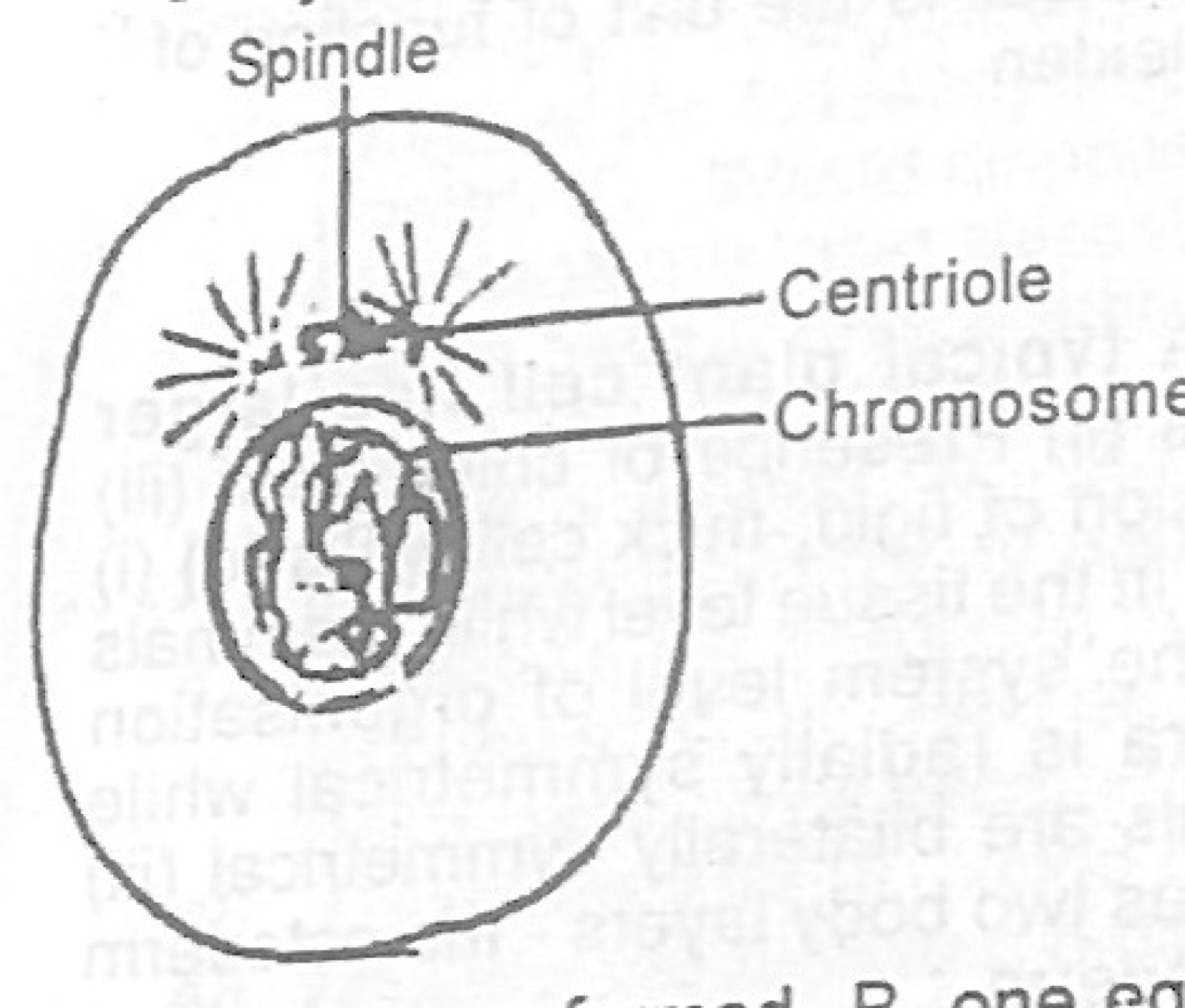
Question 6 Cell Division Study the diagram below and use it to answer Questions 6 and 7.
A. Prophase B. Telophase C. Anaphase D. Metaphase E. Interphase Show the answer and explanation Answer: A (Prophase )
Explanation The chromosomes have become visible inside a nucleus that is still intact while centrioles and spindle fibres are forming: this is prophase.
Open this question
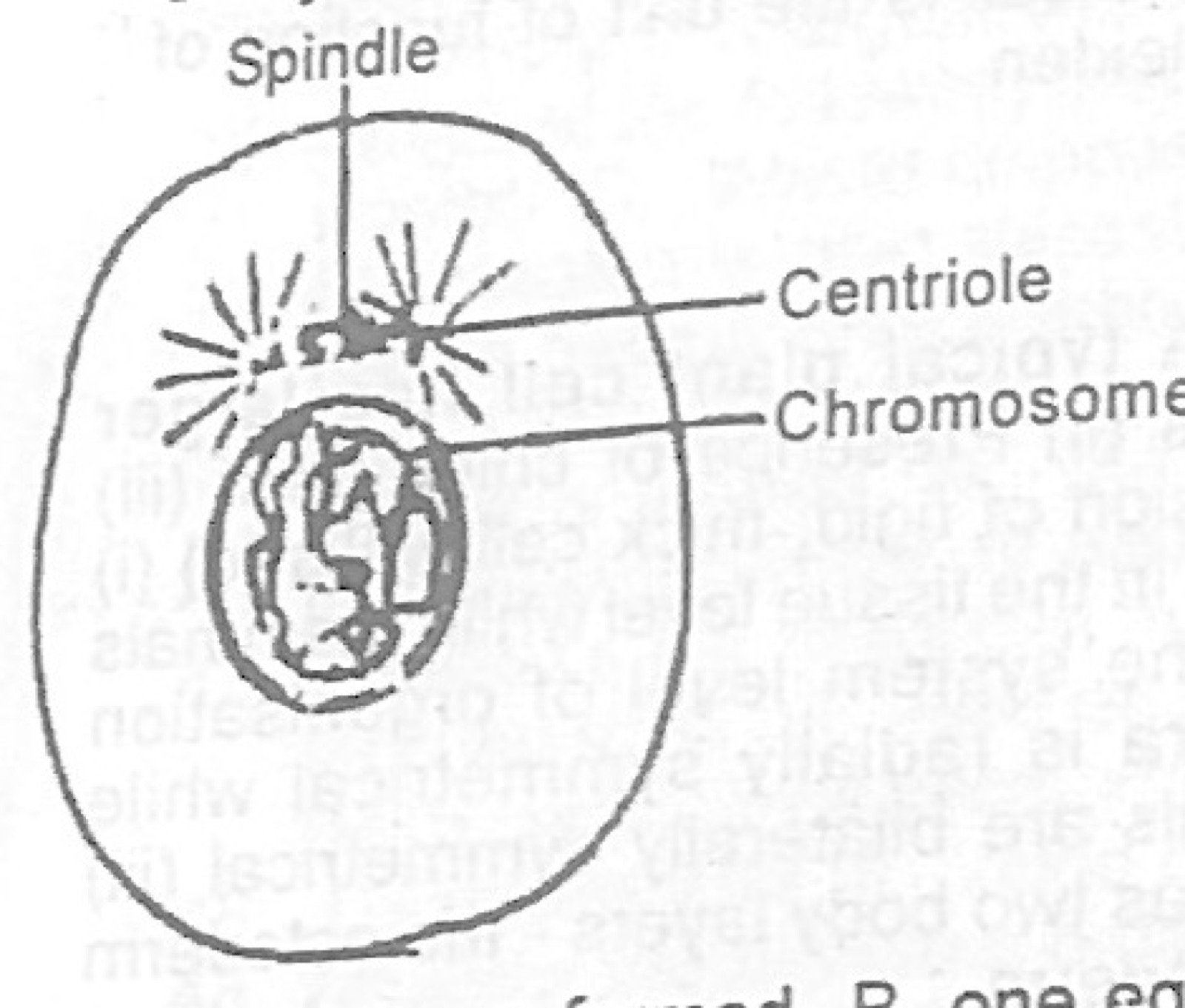
Question 7 Cell Division Study the diagram of a cell in mitosis (Questions 6 and 7).
A. movement of the chromosomes to the poles B. arrangement of chromosomes on the equitorial plate C. centromeres moving apart along the spindle D. interaction of the spindles with the chromosomes E. condensation of chromosomes and formation of spindles Show the answer and explanation Answer: E (condensation of chromosomes and formation of spindles )
Explanation In prophase the chromosomes shorten and thicken (condense) and the spindle begins to form.
Open this question
Question 8 Homeostasis The ability of organisms to maintain a constant internal environment is known as
A. diuresis B. endosmosis C. plasmolysis D. dialysis E. homeostasis Show the answer and explanation Answer: E (homeostasis )
Explanation Homeostasis means keeping conditions inside the body (temperature, water, sugar level) steady.
Open this question
Question 9 Reproduction in Plants Double fertilization is said to occur in flowering plants because
A. two embryos are formed B. one egg is fertilized twice C. two sperms fertilize each egg D. one embryo and an endosperm nucleus are formed E. two sperms and two pollen grains are involved Show the answer and explanation Answer: D (one embryo and an endosperm nucleus are formed )
Explanation One male nucleus fuses with the egg to form the embryo and the other fuses with the polar nuclei to form the endosperm nucleus: two fusions.
Open this question
Question 10 Transport in Animals The bicuspid valve is located between the
A. left auricle and left ventricle B. aorta and the left ventricle C. superior vena cava and the inferior vena cava D. right auricle and the superior vena cava E. right auricle and the right ventricle Show the answer and explanation Answer: A (left auricle and left ventricle )
Explanation The bicuspid (mitral) valve guards the opening between the left auricle and the left ventricle; the tricuspid is on the right side.
Open this question
Question 11 Transport in Animals The pulmonary artery carries
A. deoxygenated blood from the right ventricle to the lungs B. oxygenated blood from the right ventricle to the lungs C. oxygenated blood from the left ventricle to the right auricle D. deoxygenated blood from the left ventricle to the right auricle E. oxygenated blood from the lungs to the right auricle Show the answer and explanation Answer: A (deoxygenated blood from the right ventricle to the lungs )
Explanation The pulmonary artery is the only artery carrying deoxygenated blood; it goes from the right ventricle to the lungs.
Open this question
Question 12 Transport in Animals Which of the following blood components has the greatest affinity for oxygen and carbondioxide?
A. Blood plasma B. Leucocytes C. Thrombocytes D. Erythrocytes E. Lymphocytes Show the answer and explanation Answer: D (Erythrocytes )
Explanation Red blood cells (erythrocytes) contain haemoglobin, which combines readily with oxygen and also carries some carbon dioxide.
Open this question
Question 13 Respiration The thoracic cavity is separated from the abdominal cavity by a sheet of muscle called
A. pleural membrane B. intercostal muscle C. diaphragm D. pericardium E. epiglottis Show the answer and explanation Answer: C (diaphragm )
Explanation The diaphragm is the dome-shaped sheet of muscle between the chest and the abdomen.
Open this question
Question 14 Homeostasis Which of the following organs is responsible for controlling the body temperature regulation and water balance in mammals?
A. Kidney B. Hypothalamus C. Parathyroid D. Adrenal E. Thymus Show the answer and explanation Answer: B (Hypothalamus )
Explanation The hypothalamus in the brain senses blood temperature and water content and starts the responses that correct them.
Open this question
Question 15 Excretion Deamination is the process during which
A. excess amino acid is broken down into ammonia and a keto-acid B. fats and oils are converted into an emulsion for absorption C. excess glucose is converted and stored as glycogen in the liver D. glycogen is reconverted into glucose through the action of glucagon E. excess amino acid is converted into proteins Show the answer and explanation Answer: A (excess amino acid is broken down into ammonia and a keto-acid )
Explanation In the liver the amino group is removed from excess amino acids, forming ammonia (made into urea) and a keto-acid.
Open this question
Question 16 Excretion Which of the following statements on urine production is not correct?
A. Concentrated urine is produced under the control of antidiuretic hormone B. The total volume of urine produced depends on the need for water excretion C. if there is an excess intake of water, dilute urine is excreted D. if there is a shortage of water in the body the volume of urine produced decreases E. in the presence of antidiuretic hormone dilute urine is produced Show the answer and explanation Answer: E (in the presence of antidiuretic hormone dilute urine is produced )
Explanation Antidiuretic hormone makes the kidney tubules reabsorb more water, so it produces small amounts of concentrated urine, not dilute urine.
Open this question
Question 17 Homeostasis The pigment in the malphigian layer responsible for skin colouration is known as
A. haemoglobin B. haemocyanin C. chlorocruorin D. haemoerythrin E. melanin Show the answer and explanation Answer: E (melanin )
Explanation Cells of the Malpighian layer of the skin make melanin, the dark pigment that gives skin its colour.
Open this question
Question 18 Nervous Coordination Co-ordination is achieved in the body of mammals through the action of the
A. endocrine and nervous systems B. skeletal and nervous systems C. muscular and nervous systems D. circulatory and nervous systems E. skeletal, muscular and nervous system Show the answer and explanation Answer: A (endocrine and nervous systems )
Explanation Mammals coordinate body activities by nerves (fast) and by hormones from endocrine glands (slower).
Open this question
Question 19 Hormonal Coordination Which of the following statements is correct of hormones? Hormones are
A. secreted into blood through ducts B. secreted directly into the blood stream C. inactive chemical substances in the blood stream D. non-specific in their mode of action E. secreted at the site of the target organs Show the answer and explanation Answer: B (secreted directly into the blood stream )
Explanation Endocrine glands are ductless, so hormones pass directly into the blood, which carries them to their target organs.
Open this question
Question 20 Hormonal Coordination The pituitary is called 'master gland' because
A. it is located in the brain B. its secretions are more numerous than those of any other gland C. its secretion controls other glands D. it is the only organ that produces hormone E. It regulates muscular movements Show the answer and explanation Answer: C (its secretion controls other glands )
Explanation Several pituitary hormones (e.g. TSH, ACTH, FSH) control the activity of other endocrine glands.
Open this question
Question 21 Plant Responses and Hormones Auxins are produced in the
A. petiole of leaves B. parenchyma of roots and shoots C. epidermis of roots and shoots D. apical regions of roots and shoots E. sclerenchyma tissues of roots and shoots Show the answer and explanation Answer: D (apical regions of roots and shoots )
Explanation Auxins are made in the growing tips (apices) of shoots and roots and move back from there.
Open this question
Question 23 Nervous Coordination Which of the following specialized structures are stimulated by touch, pressure, pain, heat and cold?
A. Receptors B. Synapse C. Cell bodies D. Myelin sheath E. Relay neurones Show the answer and explanation Answer: A (Receptors )
Explanation Sense receptors in the skin detect touch, pressure, pain, heat and cold.
Open this question
Question 24 Reproduction in Plants Which of the following is not correct about a fruit? It
A. may contain many seeds B. is a mature ovary C. is covered by the pericarp D. may develop from the receptacle E. possesses only one scar Show the answer and explanation Answer: E (possesses only one scar )
Explanation A fruit has two scars (one where the stalk was attached and one where the style was), so 'only one scar' is wrong; false fruits such as cashew do develop from the receptacle.
Open this question
Question 25 Reproduction in Plants Which structure in the maize grain stores food?
A. Radicle B. Embryo C. Cytoplasm D. Seed coat E. Endosperm Show the answer and explanation Answer: E (Endosperm )
Explanation Maize is an endospermous grain: its food is stored in the endosperm.
Open this question
Question 26 Photosynthesis and Plant Nutrition Which of the following does not occur during photosynthesis?
A. Energy from sunlight is absorbed B. Carbondioxide is evolved C. Glucose is synthesized D. Oxygen is given off E. water is split Show the answer and explanation Answer: B (Carbondioxide is evolved )
Explanation Photosynthesis takes in carbon dioxide; it gives off oxygen, not carbon dioxide.
Open this question
Question 27 Photosynthesis and Plant Nutrition Even though some flowering plants contain accessory pigments which give them colours they still contain the pigment
A. melanin B. chlorophyll C. xanthrophyll D. carotene E. chlorocruorin Show the answer and explanation Answer: B (chlorophyll )
Explanation All green plants need chlorophyll for photosynthesis, even when other pigments hide its colour.
Open this question
Question 28 Photosynthesis and Plant Nutrition Which of the following is not regarded as a micro-nutrient or trace element for plant growth?
A. Phosphorus B. Zinc C. Boron D. Silicon E. Molybdenum Show the answer and explanation Answer: A (Phosphorus )
Explanation Phosphorus is needed in large amounts, so it is a macronutrient, not a trace element.
Open this question
Question 29 Photosynthesis and Plant Nutrition In a water culture experiment a plant showed poor growth and yellowing of the leaves. These symptoms were probably due to the absence of
A. calcium B. phosphorus C. iron D. zinc E. copper Show the answer and explanation Answer: C (iron )
Explanation Iron is needed to make chlorophyll; without it leaves turn yellow (chlorosis) and growth is poor.
Open this question
Question 30 Ecological Associations The relationship between a herbivore and the bacteria which live in its caecum is known as
A. parasitism B. symbiosis C. commensalism D. saprophytism E. predation Show the answer and explanation Answer: B (symbiosis )
Explanation Both gain: the bacteria get food and shelter, and they digest cellulose for the herbivore. That is symbiosis (mutualism).
Open this question
Question 31 Photosynthesis and Plant Nutrition Autotropic nutrition may be defined in terms of food obtained
A. from other organisms in exchange for some products B. by the breakdown of complex substances C. by an organism utilizing its own store of energy D. by synthesizing simple substances using energy from an external source E. in a synthesized form from other living organism Show the answer and explanation Answer: D (by synthesizing simple substances using energy from an external source )
Explanation Autotrophs build their own food from simple substances (CO₂, water) using energy from outside, such as sunlight.
Open this question
Question 32 Habitats and Biomes Which of the following is not classified as a terrestrial habitat?
A. Forest B. Guinea Savannah C. Afro Alpine D. Littoral zone E. Desert Show the answer and explanation Answer: D (Littoral zone )
Explanation The littoral zone is the shore region of a sea or lake, an aquatic habitat.
Open this question
Question 33 Feeding Relationships and Energy Flow Which of the following does not contribute to the biomass in an ecosystem?
A. Producers B. Food chains C. Consumers D. Micro-organisms E. Saprophytes Show the answer and explanation Answer: B (Food chains )
Explanation Biomass is the mass of living organisms; a food chain is a feeding relationship, not an organism.
Open this question
Question 34 Habitats and Biomes Which of the following is not a characteristic feature of tropical rainforest habitat?
A. Trees with longer boles than those in savannah B. Fewer canopy strata than the savannah C. Many more trees and climbers than savannah D. Plenty of leaf litter on the ground E. More diverse communities than the savannah Show the answer and explanation Answer: B (Fewer canopy strata than the savannah )
Explanation A rainforest has more canopy layers (usually three) than the savannah, not fewer.
Open this question
Question 36 Homeostasis Terrestrial organisms which are capable of maintaining their body temperature constant within fairly close limits are referred to as
A. thermoclines B. homotherms C. poikilotherms D. eurytherms E. stenotherms Show the answer and explanation Answer: B (homotherms )
Explanation Homotherms (warm-blooded animals such as birds and mammals) keep a constant body temperature.
Open this question
Question 37 Population Ecology Which of the following statements is not true of a climax vegetation? It
A. is an ecological phenomenon B. is a stable community C. eliminates competition D. results from succession E. involves the colonization of a habitat Show the answer and explanation Answer: C (eliminates competition )
Explanation A climax community is stable, but competition among its members still goes on.
Open this question
Question 38 Microorganisms and Health The causative organism of sleeping sickness is the
A. Trypanosome B. Plasmodium C. Vibrio bacterium D. penicillin E. tsetse fly Show the answer and explanation Answer: A (Trypanosome )
Explanation Sleeping sickness is caused by the protozoan Trypanosoma; the tsetse fly only carries it.
Open this question
Question 39 Microorganisms and Health Which of the following are not causative organisms of plant diseases?
A. Fungi B. Viruses C. Bacteria D. Nematodes E. Cercariae Show the answer and explanation Answer: E (Cercariae )
Explanation Cercariae are larvae of flukes that infect animals; fungi, viruses, bacteria and nematodes all cause plant diseases.
Open this question
Question 41 Pollution A constituent of the exhaust gases of motor vehicles which causes serious air pollution is
A. water vapour B. carbondioxide C. carbon monoxide D. oxygen E. ozone Show the answer and explanation Answer: C (carbon monoxide )
Explanation Carbon monoxide from car exhaust is poisonous: it combines with haemoglobin and stops it carrying oxygen.
Open this question
Question 42 Conservation of Natural Resources Which of the following steps would not be taken to protect or conserve fishing grounds from over-exploitation?
A. Use of nets with all sizes of mesh B. Use of nets with a particular mesh size C. Ban on harvesting of some species D. Regulating the size of ships allowed into fishing grounds E. Limiting the period of fishing in the waters Show the answer and explanation Answer: A (Use of nets with all sizes of mesh )
Explanation Small-mesh nets catch young fish before they can breed, so allowing all mesh sizes would deplete the stock.
Open this question
Question 43 Conservation of Natural Resources Which of the following is not part of the objectives of conservation of natural resources?
A. To eliminate wild animals in order to enable other plants and animals survive B. To use our resources on sustained yield basis C. To guard against indiscriminate killing of plants and animals D. To guard against the extinction and exhaustion of natural resources E. To protect the environment Show the answer and explanation Answer: A (To eliminate wild animals in order to enable other plants and animals survive )
Explanation Conservation aims to protect wildlife, not to eliminate it.
Open this question
Question 44 Transport in Animals During blood transfusion, agglutination may occur as a result of the reaction between
A. similar antigens and antibodies B. contrasting antigens and antibodies C. two different antigens D. two different antibodies E. white blood cells from the two individuals Show the answer and explanation Answer: A (similar antigens and antibodies )
Explanation Clumping happens when an antigen meets its matching antibody, e.g. antigen A with anti-A.
Open this question
Question 45 Mendelian Inheritance Which of the following major ideas were proved by Gregor Mendel?
A. There is a tendency among organisms to increase rapidly in number if conditions are favourable B. There is a struggle for existence among a very large number of offspring C. Nature selects organisms which will survive to produce their kind D. All species exhibit structural and functional variations E. Characteristics of an organism are controlled by genes occurring in pairs Show the answer and explanation Answer: E (Characteristics of an organism are controlled by genes occurring in pairs )
Explanation Mendel's breeding experiments showed that characters are controlled by paired factors (genes); A–D are Darwin's ideas.
Open this question
Question 46 Mendelian Inheritance Assuming that 'A' is gene for normal skin and it is dominant, while 'a' is gene for albinism and it is recessive, what is the likely genotype of a couple which had 50% normal and 50% albinos?
A. AA,Aa B. AA,aa C. Aa, Aa D. Aa, aa E. AA,AA Show the answer and explanation Answer: D (Aa, aa )
Explanation Aa × aa gives Aa and aa in equal numbers: half normal, half albino.
Open this question
Question 47 Chromosomes, DNA and Sex Linkage Which of the following is not a constituent of DNA?
A. Purine B. Phosphate C. Cystocine D. Deoxyribose E. Uracil Show the answer and explanation Answer: E (Uracil )
Explanation Uracil is found in RNA; DNA uses thymine instead.
Open this question
Question 48 Chromosomes, DNA and Sex Linkage Which of the following best describes the homologous chromosomes? They are
A. a product of the division of a chromosome B. two identical chromosomes from each parent C. chromosomes arranged on spindle fibres during cell division D. daughter chromatides formed during meiotic division E. chromosomes during telophase of mitotic division Show the answer and explanation Answer: B (two identical chromosomes from each parent )
Explanation Homologous chromosomes are a matching pair, one from the mother and one from the father, carrying genes for the same characters.
Open this question
Question 49 Chromosomes, DNA and Sex Linkage The haploid number of chromosomes in man is
A. 48 B. 46 C. 42 D. 24 E. 23 Show the answer and explanation Answer: E (23 )
Explanation Human body cells have 46 chromosomes (diploid), so gametes have half: 23.
Open this question
Question 50 Mendelian Inheritance If a cross is made between a pure-breeding red flowered plant and a pure-breeding white flowered plant where R is dominant for red flower and r is recessive for white, the most likely result of F1 generation will be
A. 75% red flowers and 25% white flowers B. all red flowers C. 75% white flowers and 25% red flowers D. 50% red flowers and 50% white flowers E. all white flowers Show the answer and explanation Answer: B (all red flowers )
Explanation RR × rr gives only Rr offspring, and R is dominant, so all are red.
Open this question
Question 51 Mendelian Inheritance A man with blood group A (IA p) married a woman with blood group O (pp). Which of the following is the probable ratio of the blood groups of the offspring?
A. 1:1 B. 3:1 C. 2:1:1 D. 1:2:1 E. 4:1 Show the answer and explanation Answer: A (1:1 )
Explanation The man gives either the A allele or the O allele, the woman only O, so children are group A or group O in a 1 : 1 ratio.
Open this question
Question 52 Evolution Increasing specialization of structure and function among animals of the same class or order for survival in new and different environments is called
A. adaptive radiation B. phylogeny C. homology D. analogy E. ontogeny Show the answer and explanation Answer: A (adaptive radiation )
Explanation Adaptive radiation is when related animals spread into different environments and become specialised for each one.
Open this question
Question 53 Ecological Associations When large numbers of organisms share limited space and resources the result is
A. immigration B. commensalism C. symbiosis D. extinction E. competition Show the answer and explanation Answer: E (competition )
Explanation When needs are greater than the supply of space and resources, organisms compete for them.
Open this question
Question 54 Adaptation The change in colour of the chameleon serves as a means of
A. attraction to the opposite sex B. repulsion of the enemy C. a camouflage from a predator D. regulation of body temperature E. production of a variety of skin pigments Show the answer and explanation Answer: C (a camouflage from a predator )
Explanation By matching its surroundings the chameleon hides from predators (and prey): camouflage.
Open this question
Question 55 Characteristics and Classification of Living Things Species can be defined as the group of organisms that
A. resemble each other and live in the same habitat B. are of common origin and are always found together C. resemble each other and can interbreed freely D. resemble each other and occupy the same niche E. are of common origin but cannot interbreed freely Show the answer and explanation Answer: C (resemble each other and can interbreed freely )
Explanation A species is a group of similar organisms that can interbreed to produce fertile offspring.
Open this question
Question 56 Evolution Which of the following is not an evidence of evolution?
A. Fossil B. Anatomy C. Embryology D. Genetics E. Behaviour Show the answer and explanation Answer: E (Behaviour )
Explanation Fossils, comparative anatomy, embryology and genetics are the standard evidences of evolution; behaviour is not one of them.
Open this question
Question 57 Chromosomes, DNA and Sex Linkage Which of the following is not true about gene mutation? It
A. introduces new traits into a population B. causes changes in the DNA C. may have unnoticeable effect on the phenotype D. always affects the chromosome number E. is a source of new genes Show the answer and explanation Answer: D (always affects the chromosome number )
Explanation A gene mutation changes the DNA of one gene; it does not change the number of chromosomes.
Open this question
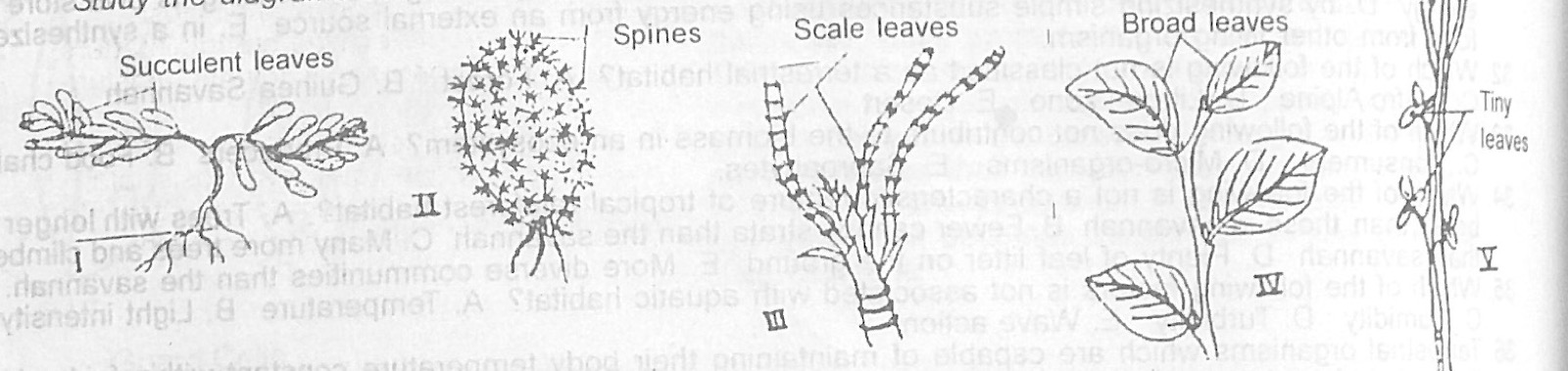
Question 58 Adaptation Study the diagrams below carefully. Use them to answer Questions 58 and 59.
A. I and IV only B. II and IV only C. III and IV only D. IV and V only E. I, II, III and V Show the answer and explanation Answer: E (I, II, III and V )
Explanation Succulent leaves, spines, scale leaves and tiny leaves all reduce water loss; only IV with broad leaves is not a desert plant.
Open this question
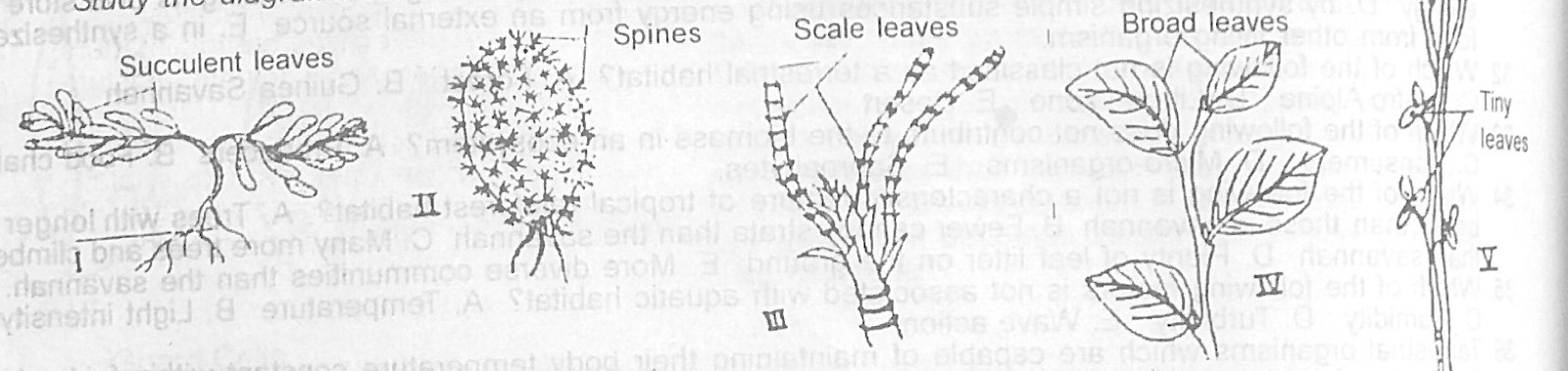
Question 59 Transport in Plants Study the diagrams of plants I to V (succulent leaves, spines, scale leaves, broad leaves, tiny leaves).
A. I B. II C. III D. IV E. V Show the answer and explanation Answer: D (IV )
Explanation Broad leaves have the largest surface and most stomata, so plant IV loses the most water.
Open this question
Theory question 101 Cell Structure and Organisation (a)(i) Make a labelled drawing of a typical plant cell to show its essential features (ii) Give the functions of two labelled organelles
Show the model answer Model answer (a)(i) Drawing with title and labels: cellulose cell wall, cell membrane, cytoplasm, large central vacuole with tonoplast, nucleus (nuclear membrane, nucleolus), chloroplasts, mitochondria
Explanation Label lines must be straight and must not cross; give the diagram a title.
Open this question
Theory question 102 Photosynthesis and Plant Nutrition (a) State four modes of nutrition in plants
Show the model answer Model answer (a) Any four: autotrophic/photosynthetic (green plants), chemosynthetic, parasitic (e.g. dodder, Cassytha), saprophytic, insectivorous/carnivorous (e.g. bladderwort), symbiotic (legume root nodules)
Explanation Keep the light stage (needs light, splits water) and the dark stage (fixes CO₂) clearly separate.
Open this question
Theory question 103 Population Ecology (a) (i) Define the term population (ii) List two biotic and abiotic factors each that affect population growth.
Show the model answer Model answer (a)(i) A population is the total number of organisms of the same species living in a given area at a given time
Explanation For each preservation method say why microbes can no longer spoil the food.
Open this question
Theory question 104 Conservation of Natural Resources (a) What is conservation of natural resources?
Show the model answer Model answer (a) The planned management and wise use of natural resources so that they last and continue to be available for future generations
Explanation Pair each resource with one clear benefit of conserving it.
Open this question Sign up free for every WAEC Biology year, practice by topic and timed mocks.
Start practising free