Theory question 104
Crop Husbandry(a) Discuss the cultivation of ginger under the following headings: (i) soil requirement; (ii) land preparation; (iii) planting material; (iv) spacing; (v) method of harvesting; (vi) two processing methods
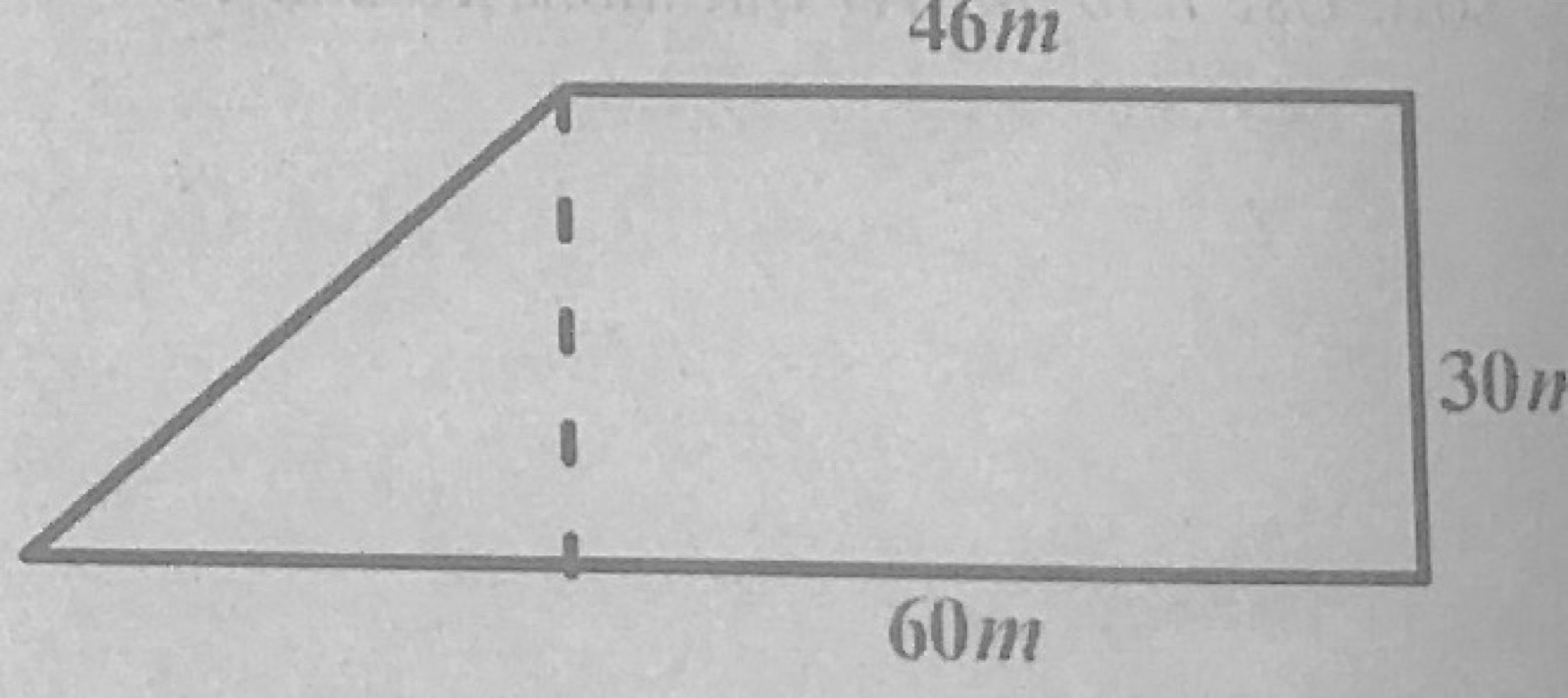
(b) The diagram below shows the survey plan of a farmland. Use it to answer questions 4(b). (i) Calculate the area of the farmland. (ii) If a farmer sows two seeds of maize per hole on the farmland at a spacing of 30cm by 30cm, determine the expected number of maize stands on the farmland.
(c) A farmland intended for organic farming has an abundance of living organisms in the soil. Enumerate three organisms that could be found in the soil of the farmland.
Show the model answer
(a)(i) Well-drained, fertile, loose sandy loam or loamy soil rich in organic matter.
(ii) Clear, plough and harrow, then make raised beds or ridges.
(iii) Rhizome pieces (setts) with one or two buds.
(iv) About 20–25 cm × 20–30 cm (e.g. 25 cm × 25 cm).
(v) Dig up the rhizomes with a hoe or fork when the leaves turn yellow and dry (about 8–10 months).
(vi) Any two: washing and peeling; splitting/slicing; sun drying; grinding into powder; making ginger oil/paste.
(b)(i) The plan is a trapezium: area = ½ × (46 + 60) × 30 = 1,590 m².
(ii) Area per hole = 0.3 × 0.3 = 0.09 m²; holes (stands) = 1,590 ÷ 0.09 ≈ 17,667 stands (about 35,333 seeds/plants at two per hole).
(c) Any three: earthworms; termites; ants; millipedes; bacteria; fungi; nematodes; protozoa.
Parallel sides 46 m and 60 m, height 30 m.