Theory question 103
Crop Husbandry(a) Discuss the cultivation of cassava under the following headings: (i) Soil requirements. (ii) Land preparation. (iii) Propagation. (iv) Spacing. (v) Weed control. (vi) Fertilizer requirement. (vii) Harvesting. (viii) Storage.
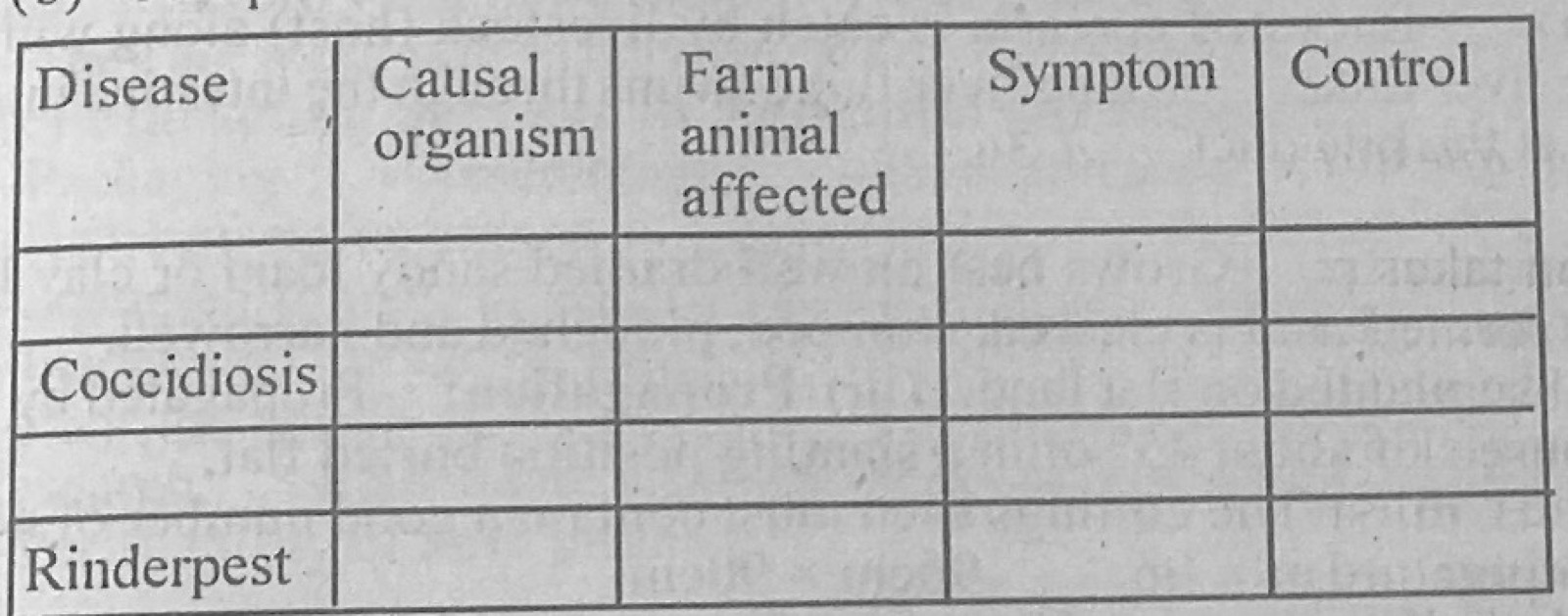
(b) Complete the table below on diseases of farm animals: for Coccidiosis and Rinderpest, give the causal organism, farm animal affected, symptom and control.
Show the model answer
(a)(i) Deep, loose, well-drained loamy/sandy-loam soil.
(ii) Clear the bush, plough or make mounds/ridges.
(iii) Stem cuttings 20–30 cm long with several nodes, planted slanting or vertically.
(iv) About 1 m × 1 m.
(v) Hand weeding/hoeing 2–3 times, or pre-emergence herbicides; cover crops.
(vi) NPK (e.g. 15:15:15) or organic manure; potassium is important for tuber formation.
(vii) 6–18 months after planting by uprooting/lifting the tubers with a cutlass or hoe.
(viii) Leave in the ground until needed; process into garri, flour or chips; or keep peeled tubers in cold storage.
(b) Coccidiosis: causal organism – protozoan (Eimeria spp.); animals – poultry, rabbits (also sheep, goats); symptoms – bloody diarrhoea, droopiness, ruffled feathers, emaciation; control – coccidiostats in feed/water, dry clean litter, hygiene.
Rinderpest: causal organism – virus; animals – cattle, sheep, goats; symptoms – high fever, eye and nose discharge, mouth sores, bloody diarrhoea, high mortality; control – vaccination, quarantine, slaughter and burn infected animals.
One clear point per heading for cassava.