WAEC Agricultural Science 2007 past questions and answers

65 questions. Try each one, then open the answer to check yourself and read the explanation.

Question 1

Processing and Storage of Farm Produce

Which of the following agricultural raw materials would a glue-processing industry require?

  1. A.Cotton
  2. B.Coconut
  3. C.Cassava
  4. D.Kola.
Show the answer and explanation

Answer: C (Cassava)

Explanation

Cassava starch is used to make glue and adhesives.

Open this question

Question 2

Processing and Storage of Farm Produce

Perishability of farm produce can be minimized through

  1. A.modification of the crop genetic composition
  2. B.adoption of continuous cropping system
  3. C.reducing water supply to growing crops
  4. D.use of machines to harvest crops.
Show the answer and explanation

Answer: A (modification of the crop genetic composition)

Explanation

Breeding can give varieties that keep longer after harvest.

Open this question

Question 3

Land Use and Land Tenure

In which of the following activities is land not used for agricultural purposes?

  1. A.Afforestation
  2. B.Mining
  3. C.Ranching
  4. D.Fish farming.
Show the answer and explanation

Answer: B (Mining)

Explanation

Mining is not farming; ranching, fish farming and afforestation are.

Open this question

Question 4

Agricultural Development

Which of the following statements about farm settlement schemes is false? They are set up

  1. A.to encourage young people to take up farming
  2. B.to provide employment for young school leavers
  3. C.to develop rural infrastructure
  4. D.for research and publicity.
Show the answer and explanation

Answer: D (for research and publicity.)

Explanation

Settlements were for training and employing young farmers, not research.

Open this question

Question 5

Irrigation and Drainage

Water-logged soils impede good crop growth and development because

  1. A.the fibrous roots are destroyed
  2. B.crop roots are deprived of sufficient oxygen
  3. C.excessive water stops root growth
  4. D.soil around roots become too cold for root growth.
Show the answer and explanation

Answer: B (crop roots are deprived of sufficient oxygen)

Explanation

Water fills the pores and roots cannot get oxygen.

Open this question

Question 6

Soil Properties

The relative proportion of each fraction of soil in a soil sample determines its

  1. A.texture
  2. B.structure
  3. C.profile
  4. D.catena.
Show the answer and explanation

Answer: A (texture)

Explanation

Texture is the proportion of sand, silt and clay.

Open this question

Question 7

Soil Fertility and Plant Nutrition

Which of the following materials cannot be used for liming?

  1. A.Gypsum
  2. B.Basic slag
  3. C.Chalk
  4. D.Urea.
Show the answer and explanation

Answer: D (Urea.)

Explanation

Urea is a nitrogen fertilizer and makes soil more acidic.

Open this question

Question 8

Soil Properties

Which of the following statements about soil water is true?

  1. A.Crops wilt when gravitational water has drained off
  2. B.Capillary water drains off after rainfall
  3. C.A soil with high water table is best for farming
  4. D.Crops utilize capillary water in the soil.
Show the answer and explanation

Answer: D (Crops utilize capillary water in the soil.)

Explanation

Capillary water is the water plants use.

Open this question

Question 9

Soil Fertility and Plant Nutrition

Which of the following soil elements becomes readily available at pH values above 8?

  1. A.Molybdenum
  2. B.Manganese
  3. C.Zinc
  4. D.Aluminium.
Show the answer and explanation

Answer: A (Molybdenum)

Explanation

Molybdenum is the micronutrient that is more available in alkaline soil.

Open this question

Question 11

Soil Fertility and Plant Nutrition

Chlorosis with characteristic parallel white or yellow streaks observed along the veins of leaves is a deficiency symptom of

  1. A.potassium
  2. B.magnesium
  3. C.phosphorus
  4. D.sulphur.
Show the answer and explanation

Answer: B (magnesium)

Explanation

Magnesium shortage gives yellow stripes between the veins, especially in cereal leaves.

Open this question

Question 12

Soil Fertility and Plant Nutrition

Use the information: I Allowing land to fallow; II Applying organic fertilizer; III Practising monoculture; IV Growing legumes. Which of the following combinations will help to improve soil fertility status?

  1. A.I, III and IV only
  2. B.II, III and IV only
  3. C.I, II and III only
  4. D.I, II and IV only.
Show the answer and explanation

Answer: D (I, II and IV only.)

Explanation

Fallowing, manuring and legumes build fertility; monoculture exhausts soil.

Open this question

Question 13

Crop Diseases

Use the information: I Allowing land to fallow; II Applying organic fertilizer; III Practising monoculture; IV Growing legumes. The spread of diseases and pests can be checked by

  1. A.I
  2. B.II
  3. C.III
  4. D.IV.
Show the answer and explanation

Answer: A (I)

Explanation

Fallowing removes host crops, so pests and diseases die out.

Open this question

Question 14

Irrigation and Drainage

Which of the following statements is not an advantage of drainage? It

  1. A.removes excess water
  2. B.supplies moisture for plant growth
  3. C.reclaims water-logged land and swamps
  4. D.improves soil structure.
Show the answer and explanation

Answer: B (supplies moisture for plant growth)

Explanation

Drainage takes water away; irrigation supplies it.

Open this question

Question 15

Irrigation and Drainage

The problems associated with farm irrigation do not include

  1. A.high cost of irrigation equipment
  2. B.increase in soil pH
  3. C.continuous supply of irrigation water
  4. D.build up of pests on farms.
Show the answer and explanation

Answer: C (continuous supply of irrigation water)

Explanation

A steady water supply is the benefit, not a problem.

Open this question

Question 16

Land Preparation and Cultural Practices

Use the information: I. Burning of trash; II. Slashing of undergrowth; III. Seed bed preparation; IV. Soil tillage. Which of the following options gives the correct sequence of land preparation for planting yam?

  1. A.IV, II, III and I
  2. B.II, I, IV and III
  3. C.II, III, I and IV
  4. D.I, II, III, and IV.
Show the answer and explanation

Answer: B (II, I, IV and III)

Explanation

Slash, burn the trash, till, then make the seed bed (mounds).

Open this question

Question 17

Soil Erosion and Conservation

Use the information: I. Burning of trash; II. Slashing of undergrowth; III. Seed bed preparation; IV. Soil tillage. Which of the following practices will enhance loss of soil water?

  1. A.I and II
  2. B.II and III
  3. C.III and IV
  4. D.I and IV.
Show the answer and explanation

Answer: A (I and II)

Explanation

Burning and slashing remove plant cover, exposing soil to sun and drying.

Open this question

Question 18

Farm Power

The most versatile source of farm power in West Africa is

  1. A.biogas
  2. B.animal
  3. C.wind
  4. D.water.
Show the answer and explanation

Answer: B (animal)

Explanation

Work animals can plough, ridge and carry loads almost anywhere.

Open this question

Question 19

Processing and Storage of Farm Produce

Silos ensure good storage because

  1. A.they are made of stainless steel
  2. B.of the air-tight environment created
  3. C.a lot of produce can be stored at a time
  4. D.they have high relative humidity.
Show the answer and explanation

Answer: B (of the air-tight environment created)

Explanation

Airtight silos keep out moisture, insects and air.

Open this question

Question 20

Farm Machinery and Mechanisation

Which of the following statements about the advantages of farm mechanization is not true? It

  1. A.saves labour
  2. B.improves soil structure
  3. C.reduces drudgery
  4. D.increases output.
Show the answer and explanation

Answer: B (improves soil structure)

Explanation

Heavy machines compact and damage soil structure.

Open this question

Question 21

Farm Surveying and Planning

The standard length of a Gunter's chain is approximately

  1. A.20 m
  2. B.25 m
  3. C.35 m
  4. D.40 m.
Show the answer and explanation

Answer: A (20 m)

Explanation

A Gunter's chain is 20.12 m (66 ft).

Open this question

Question 22

Farm Surveying and Planning

A farmstead is best described as

  1. A.animal pens
  2. B.crop production centre
  3. C.farm equipment and storage facilities
  4. D.farmer's abode.
Show the answer and explanation

Answer: D (farmer's abode.)

Explanation

The key takes the farmstead as the farmer's home with its buildings.

Open this question

Question 23

Agricultural Ecology

Which of the following processes in plants are directly affected by high temperature? I. Water absorption II. Photosynthesis III. Respiration IV. Photoperiodism

  1. A.I and II only
  2. B.I, II and III only
  3. C.I and IV only
  4. D.II, III and IV only.
Show the answer and explanation

Answer: B (I, II and III only)

Explanation

Temperature changes the rate of water uptake and enzyme processes; day-length responses depend on light.

Open this question

Question 24

Crop Propagation

Layering is advantageous because

  1. A.offspring perform better than their parents
  2. B.pollination agents abound to ensure its success
  3. C.possible failure of fertilization is avoided
  4. D.variability arises in propagates.
Show the answer and explanation

Answer: C (possible failure of fertilization is avoided)

Explanation

Layering is vegetative, so it does not depend on pollination and fertilisation.

Open this question

Question 25

Processing and Storage of Farm Produce

Drying of harvested crops is necessary because it

  1. A.shortens the length of seed dormancy
  2. B.reduces moisture content and stores better
  3. C.cannot be sold to consumers when it is wet
  4. D.decreases the viability of the crops.
Show the answer and explanation

Answer: B (reduces moisture content and stores better)

Explanation

Dry produce resists moulds and insects.

Open this question

Question 26

Agricultural Ecology

Which of the following factors will not influence the yield of crops?

  1. A.Soil depth and structure
  2. B.Soil slope and texture
  3. C.Atmospheric and soil temperature
  4. D.Wind direction and speed
Show the answer and explanation

Answer: D (Wind direction and speed)

Explanation

Of the options, wind direction has least effect on yield.

Open this question

Question 28

Crop Husbandry

Delayed harvesting of maize may result in

  1. A.improvement in the quantity of grains
  2. B.high incidence of pest infestation
  3. C.low seed viability
  4. D.yellow colouration of grains.
Show the answer and explanation

Answer: B (high incidence of pest infestation)

Explanation

Maize left in the field is attacked by weevils, birds and rodents.

Open this question

Question 29

Land Preparation and Cultural Practices

Tomato plants are primarily staked to

  1. A.prevent birds from feeding on the fruits
  2. B.accelerate fruits maturity
  3. C.raise fruits from the ground
  4. D.increase crop growth.
Show the answer and explanation

Answer: C (raise fruits from the ground)

Explanation

Stakes keep fruits off the soil so they do not rot.

Open this question

Question 30

Crop Propagation

Which of the following crops does not require nursery?

  1. A.Lycopersicon esculentum
  2. B.Abelmuscus esculentus
  3. C.Theobroma cacao
  4. D.Hevea braziliensis.
Show the answer and explanation

Answer: B (Abelmuscus esculentus)

Explanation

Okra (Abelmoschus) is sown directly.

Open this question

Question 31

Pasture and Forage Crops

An erect tropical perennial grass, which grows to 3 – 6 metres tall and has broad hairy leaves is the

  1. A.elephant grass
  2. B.gaint star grass
  3. C.spear grass
  4. D.gamba grass.
Show the answer and explanation

Answer: A (elephant grass)

Explanation

Elephant grass grows very tall with broad hairy leaves.

Open this question

Question 32

Forestry and Wildlife

Deforestation will eventually lead to

  1. A.improvement in soil fertility
  2. B.improvement of soil texture
  3. C.loss of soil organic matter
  4. D.increase in soil pH.
Show the answer and explanation

Answer: C (loss of soil organic matter)

Explanation

Without trees, leaf litter stops and exposed soil loses organic matter.

Open this question

Question 34

Crop Pests

The eradication of mealy bugs is an effective control of

  1. A.corn smut
  2. B.swollen shoot of cocoa
  3. C.groundnut rosette
  4. D.rice blast.
Show the answer and explanation

Answer: B (swollen shoot of cocoa)

Explanation

Mealybugs carry cocoa swollen shoot virus.

Open this question

Question 36

Weeds and Weed Control

Biological methods of weed control do not include

  1. A.introducing insects to control weeds
  2. B.planting crops to compete with the weeds
  3. C.planting leguminous cover crops
  4. D.uprooting the weeds.
Show the answer and explanation

Answer: D (uprooting the weeds.)

Explanation

Uprooting is a mechanical method.

Open this question

Question 37

Basic Genetics

Assuming that in sheep, the allele for black coat colour is dominant over that for brown coat colour. What percentage of the F1 generation will have black colour when two heterozygotes are crossed?

  1. A.100%
  2. B.75%
  3. C.50%
  4. D.25%
Show the answer and explanation

Answer: B (75%)

Explanation

Bb × Bb gives 3 black : 1 brown, so 75% black.

Open this question

Question 38

Basic Genetics

Assuming that in sheep, the allele for black coat colour is dominant over that for brown coat colour. Crossing a heterozygote black with a homozygote brown will produce

  1. A.100% brown coat coloured offspring
  2. B.75% brown coat coloured offspring
  3. C.50% brown coat coloured offspring
  4. D.25% brown coat coloured offspring.
Show the answer and explanation

Answer: C (50% brown coat coloured offspring)

Explanation

Bb × bb gives half Bb (black) and half bb (brown).

Open this question

Question 39

Animal Anatomy and Physiology

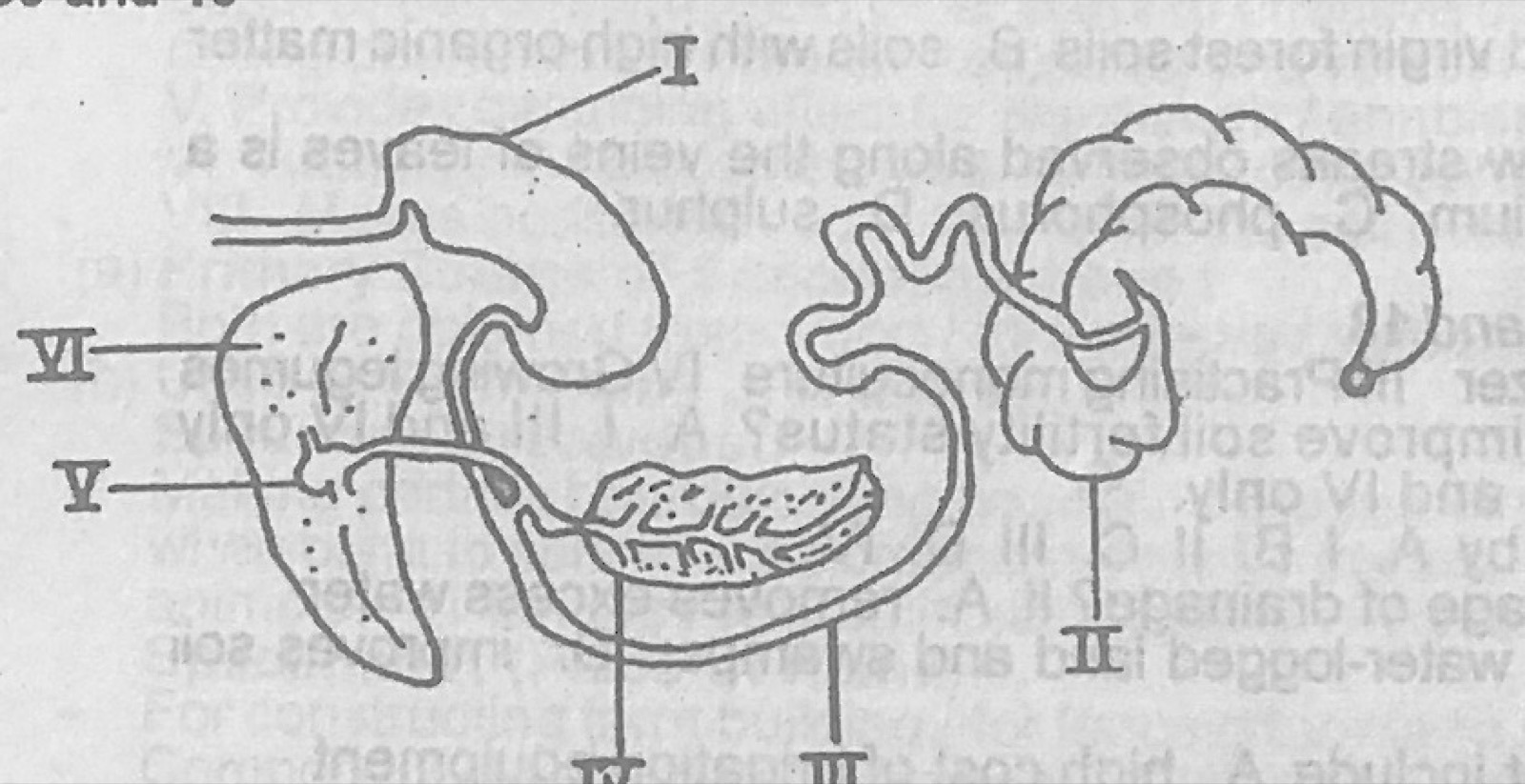
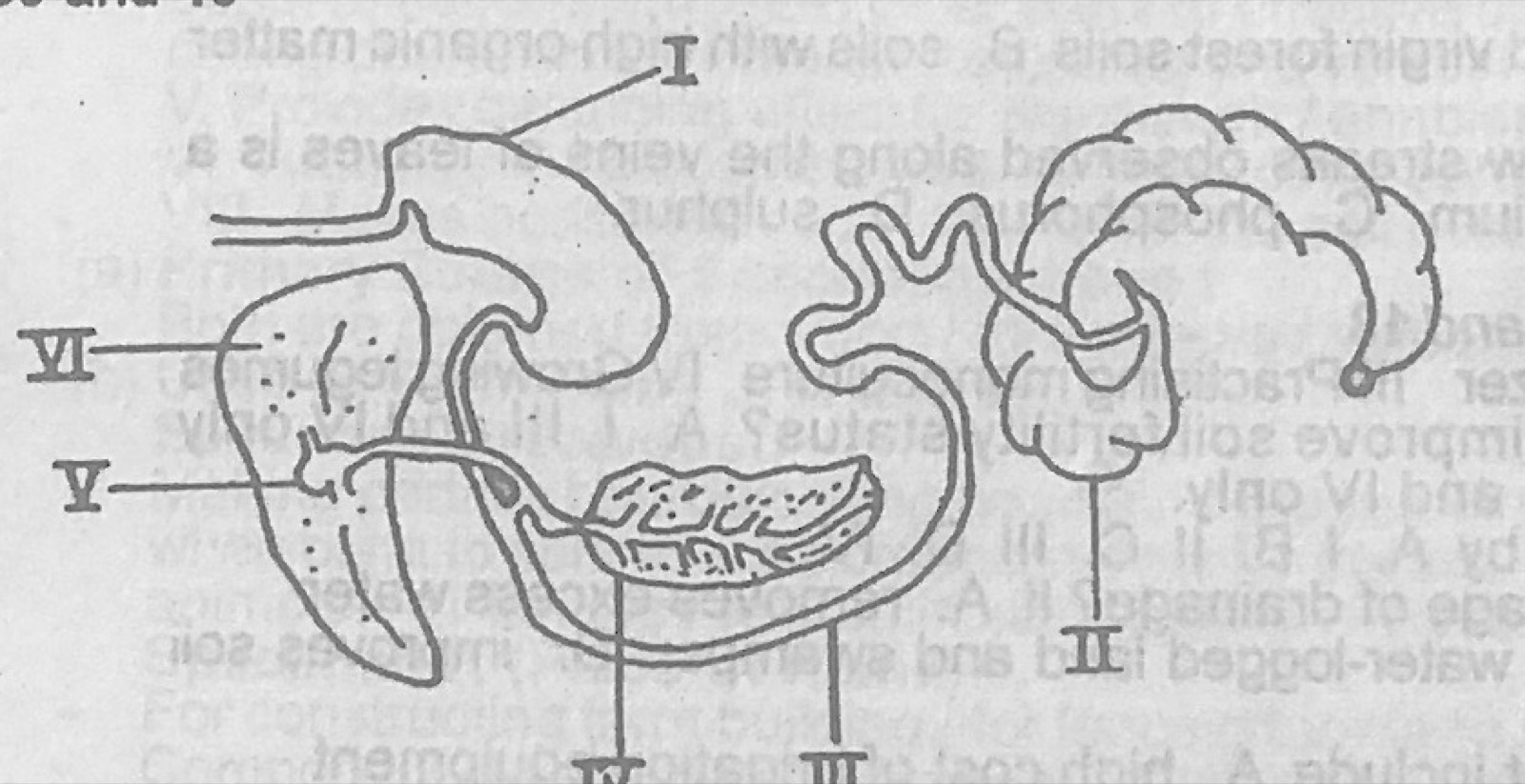
The diagram shows the alimentary canal of a monogastric animal (parts labelled I to VI). Bile is synthesized in the part labelled

Diagram for this question
  1. A.II
  2. B.III
  3. C.IV
  4. D.VI.
Show the answer and explanation

Answer: D (VI.)

Explanation

Bile is made in the liver, the lobed organ labelled VI.

Open this question

Question 40

Animal Anatomy and Physiology

The diagram shows the alimentary canal of a monogastric animal (parts labelled I to VI). Absorption of water takes place in the part labelled

Diagram for this question
  1. A.I
  2. B.II
  3. C.IV
  4. D.V.
Show the answer and explanation

Answer: B (II)

Explanation

II is the large intestine (colon), where water is absorbed.

Open this question

Question 41

Animal Reproduction

Which of the following structures is not connected to the urethra of a bull?

  1. A.Bladder
  2. B.Epididymis
  3. C.Testis
  4. D.Rectum.
Show the answer and explanation

Answer: D (Rectum.)

Explanation

The rectum belongs to the digestive system.

Open this question

Question 42

Animal Nutrition

Ruminants do not normally show deficiency symptoms of vitamin B complex because

  1. A.the grasses they consume are very rich in the vitamins
  2. B.they do not need the vitamins
  3. C.they tolerate the deficiency of these vitamins
  4. D.the bacteria in their rumen synthesize the vitamins.
Show the answer and explanation

Answer: D (the bacteria in their rumen synthesize the vitamins.)

Explanation

Rumen microbes make B vitamins.

Open this question

Question 43

Animal Reproduction

Fluids from the cowpers' and prostate glands help in the following except

  1. A.clearing the urethra of urine traces
  2. B.provision of nutrients for spermatozoa survival
  3. C.mixing with spermatozoa to form sperm on ejaculation
  4. D.maintaining the proper functioning of the testes.
Show the answer and explanation

Answer: D (maintaining the proper functioning of the testes.)

Explanation

Accessory gland fluids act in the urethra and semen, not in the testes.

Open this question

Question 44

Livestock Management

The gestation period of ewe is

  1. A.90 days
  2. B.115 days
  3. C.131 days
  4. D.149 days.
Show the answer and explanation

Answer: D (149 days.)

Explanation

Sheep carry their lambs for about 5 months (about 147–150 days).

Open this question

Question 45

Animal Reproduction

The hormone that influences the movement of the pelvic ligaments during parturition in farm animals is known as

  1. A.relaxin
  2. B.prolactin
  3. C.progesterone
  4. D.oestrogen.
Show the answer and explanation

Answer: A (relaxin)

Explanation

Relaxin loosens the pelvic ligaments for birth.

Open this question

Question 46

Livestock Management

In order to prevent bulls from eating crops during work, they should be

  1. A.branded
  2. B.dehorned
  3. C.tethered
  4. D.muzzled.
Show the answer and explanation

Answer: D (muzzled.)

Explanation

A muzzle covers the mouth.

Open this question

Question 47

Poultry Production

In which of the following systems of poultry management can the spread of diseases be kept to a minimum?

  1. A.Battery cage
  2. B.Deep litter
  3. C.Fold
  4. D.Free range.
Show the answer and explanation

Answer: A (Battery cage)

Explanation

Caged birds do not contact droppings or many other birds.

Open this question

Question 48

Livestock Management

A wallow is usually constructed in piggeries to

  1. A.serve as points for providing drinking water
  2. B.make draining of pens easier
  3. C.provide baths for pigs
  4. D.reduce piglet's mortality during birth.
Show the answer and explanation

Answer: C (provide baths for pigs)

Explanation

Pigs bathe in wallows to keep cool.

Open this question

Question 49

Animal Nutrition

Which of the following groups of macro-nutrients is a constituent of protein?

  1. A.Nitrogen, phosphorus and sulphur
  2. B.Calcium, magnesium and potassium
  3. C.Magnesium, calcium and phosphorus
  4. D.Sulphur, magnesium and potassium.
Show the answer and explanation

Answer: A (Nitrogen, phosphorus and sulphur)

Explanation

Proteins contain nitrogen and sulphur (some also phosphorus).

Open this question

Question 50

Animal Health

Which of the following livestock diseases affects the reproductive system?

  1. A.Mastitis
  2. B.Brucellosis
  3. C.Rinderpest
  4. D.Anthrax.
Show the answer and explanation

Answer: B (Brucellosis)

Explanation

Brucellosis causes abortion and infertility.

Open this question

Question 51

Animal Health

If in a poultry flock, the birds keep passing out green, foul-smelling faeces with nervous symptoms, it shows that the farmer

  1. A.has not administered Newcastle disease vaccine
  2. B.neglected to treat chicks against gumboro disease
  3. C.is giving the birds protein-deficient diet
  4. D.is feeding a diet high in calcium.
Show the answer and explanation

Answer: A (has not administered Newcastle disease vaccine)

Explanation

Green droppings plus nervous signs point to Newcastle disease.

Open this question

Question 52

Animal Health

When a farmer tries to eradicate snails from his pastures, he is attempting to control

  1. A.ticks
  2. B.tapeworms
  3. C.trypanosomiasis
  4. D.liver flukes.
Show the answer and explanation

Answer: D (liver flukes.)

Explanation

Snails are the intermediate host of liver flukes.

Open this question

Question 53

Fisheries and Aquaculture

Cropping in fish farming refers to

  1. A.stocking fish
  2. B.processing fish
  3. C.harvesting fish
  4. D.feeding fish.
Show the answer and explanation

Answer: C (harvesting fish)

Explanation

Cropping a pond means harvesting fish from it.

Open this question

Question 54

Fisheries and Aquaculture

Fertilizing a fish pond with compost manure would most likely

  1. A.decrease phytoplankton population and decrease fish yield
  2. B.decrease phytoplankton population and increase fish yield
  3. C.increase phytoplankton population and decrease fish yield
  4. D.increase phytoplankton population and increase fish yield.
Show the answer and explanation

Answer: D (increase phytoplankton population and increase fish yield.)

Explanation

Manure feeds plankton, which feed the fish.

Open this question

Question 55

Basic Agricultural Economics

A farmer sold all his harvested maize totalling 260 kg at ₦5.50/kg thereby making a profit of ₦430.00. Calculate the production cost of maize per kg.

  1. A.₦4.05
  2. B.₦3.85
  3. C.₦3.75
  4. D.₦3.65.
Show the answer and explanation

Answer: B (₦3.85)

Explanation

Sales = 260 × 5.50 = ₦1,430; cost = 1,430 − 430 = ₦1,000; 1,000 ÷ 260 ≈ ₦3.85 per kg.

Open this question

Question 56

Basic Agricultural Economics

A farmer sold all his harvested maize totalling 260 kg at ₦5.50/kg thereby making a profit of ₦430.00. Determine the percentage profit per kg of maize sold.

  1. A.35%
  2. B.40%
  3. C.43%
  4. D.52%.
Show the answer and explanation

Answer: C (43%)

Explanation

Profit = 430 on cost 1,000, i.e. 43%.

Open this question

Question 58

Agricultural Finance

Agricultural credits should be put to the following uses except

  1. A.purchase of inputs
  2. B.meeting family needs
  3. C.improvement of structures
  4. D.adoption of innovations.
Show the answer and explanation

Answer: B (meeting family needs)

Explanation

Farm credit is for production, not household spending.

Open this question

Question 59

Farm Management and Records

Which of the following statements is not true about the profit and loss account of a farm?

  1. A.It is prepared at the end of business period usually a year
  2. B.All expenses and purchases are listed on the right-hand side
  3. C.All expenses and purchases are listed on the left-hand side
  4. D.All receipts and sales are listed on the right-hand side.
Show the answer and explanation

Answer: B (All expenses and purchases are listed on the right-hand side)

Explanation

Expenses go on the left (debit) side.

Open this question

Question 60

Agricultural Extension

Agricultural education programmes for rural youth will reduce the

  1. A.rate of adoption of innovations
  2. B.population of youth in rural areas
  3. C.age at which youth will venture into family life
  4. D.dependency of youth on parents.
Show the answer and explanation

Answer: D (dependency of youth on parents.)

Explanation

Skilled youths can earn their own living.

Open this question

Theory question 101

Farming Systems

(a) Give eight characteristics of agricultural systems in West Africa.
(b) Explain four ways in which land tenure systems affect agricultural production in your country.

Show the model answer
Model answer

(a) Any eight: mostly small-scale/subsistence farming; small, scattered holdings; use of simple tools (hoe, cutlass); family labour; low use of inputs (fertilizer, improved seed); low yields; dependence on rainfall; mixed cropping and shifting cultivation/bush fallow; little mechanisation; poor storage and processing; poor record keeping; nomadic livestock rearing
(b) Any four, explained: fragmentation into small plots prevents mechanisation and large-scale farming; insecure tenure (communal, rent) discourages permanent crops and land improvement; land cannot be used as collateral for loans; land disputes and litigation waste time and money; strangers/landless people cannot easily get land; freehold/Land Use Act allows easier acquisition and investment

Explanation

Eight features; explain the effect of each tenure point.

Open this question

Theory question 102

Farm Machinery and Mechanisation

(a) Explain the following terms: (i) primary tillage implement; (ii) secondary tillage implement.
(b)(i) State three reasons why disc ploughs are better suited for soils in West Africa than the mouldboard ploughs. (ii) List six major parts of a disc plough.
(c) Give three reasons why secondary tillage is necessary before sowing of seeds
(d) State three precautions a farmer should take when spraying chemicals.

Show the model answer
Model answer

(a)(i) Implement used for the first, deep breaking and turning of the soil after clearing, e.g. plough
(ii) Implement used after ploughing to break clods into a fine tilth and shape the seedbed, e.g. harrow, ridger, cultivator
(b)(i) Any three: rolls over stumps, roots and stones without breaking; works in hard, dry and sticky soils; cuts deeper; less clogging (scraper); less draught/needs less pull
(ii) Any six: discs; frame/beam; scrapers; furrow (rear) wheel; hitch/three-point linkage; disc bearings/hubs; axle; levelling lever/adjusting handle
(c) Any three: breaks clods into fine tilth for good seed–soil contact; levels the soil; makes ridges/beds for planting; controls weeds; improves aeration and water intake
(d) Any three: wear protective clothing, gloves, mask and boots; spray with the wind, not against it; do not eat, drink or smoke while spraying; follow the manufacturer's instructions on dose; do not blow blocked nozzles with the mouth; avoid spraying near water bodies; wash body and equipment afterwards

Explanation

Define each term with an example.

Open this question

Theory question 103

Soil Fertility and Plant Nutrition

(a) State three ways by which nitrogen is added to soil in the Nitrogen cycle.
(b) List five ways by which nitrogen is lost from the soil.
(c) State the importance of the Nitrogen cycle.
(d) Explain three processes leading to the formation of nitrate from organic matter in the Nitrogen cycle

Show the model answer
Model answer

(a) Any three: lightning fixation; symbiotic fixation by Rhizobium in legume nodules; free-living bacteria (Azotobacter, Clostridium) and blue-green algae; decay of organic matter; nitrogen fertilizers and manure; rainfall
(b) Any five: leaching; erosion; crop removal; denitrification; volatilisation (as ammonia); burning
(c) Keeps nitrogen circulating between air, soil, plants and animals; supplies nitrogen for plant proteins; maintains soil fertility; keeps nitrogen balance in the atmosphere
(d) Decomposition/aminization: micro-organisms break down proteins in dead plants and animals into amino compounds; ammonification: amino compounds are changed to ammonia/ammonium; nitrification: Nitrosomonas oxidises ammonium to nitrite and Nitrobacter oxidises nitrite to nitrate

Explanation

Name each process and the organisms involved.

Open this question

Theory question 104

Rocks and Soil Formation

(a) Enumerate four economic importance of rocks: (i) to man; (ii) in agriculture.
(b) State two characteristics of each of the following: (i) igneous rock; (ii) metamorphic rock.
(c) Describe the mode of formation of sedimentary rocks.

Show the model answer
Model answer

(a)(i) To man (any four): building materials (granite, marble, sandstone); road construction (gravel, laterite); source of minerals and metals; fuels (coal); cement from limestone; ornaments and monuments; tourism
(ii) In agriculture (any four): parent material of soil; source of plant nutrients; lime from limestone/chalk; rock phosphate fertilizer; gypsum; materials for farm buildings and roads; water storage (aquifers)
(b)(i) Igneous (any two): formed from cooled magma; crystalline; hard and compact; no layers or fossils
(ii) Metamorphic (any two): formed from other rocks by heat and pressure; hard, often banded or foliated; recrystallised; no fossils
(c) Rocks are weathered into particles which are carried by water, wind or ice and deposited in layers in seas, lakes and rivers; remains of plants and animals may also accumulate; over long periods the layers are compacted by the weight above and cemented together, forming layered (stratified) rocks such as sandstone, shale and limestone

Explanation

Four uses each for man and agriculture.

Open this question

Theory question 105

Forestry and Wildlife

(a) Explain the following terms as used in crop production: (i) floriculture (ii) taungya farming (iii) ley farming.
(b) State eight uses of ornamental plants to man.
(c) Mention four fibre crops grown in your country.

Show the model answer
Model answer

(a)(i) Floriculture: growing of flowers and ornamental plants, for beauty or sale
(ii) Taungya: growing food crops between young forest trees on forest land
(iii) Ley farming: alternating arable crops with grass/legume pasture on the same land
(b) Any eight: beautify homes and surroundings; shade; windbreaks; hedges and fences; control erosion; source of income; medicinal uses; reduce noise and dust; recreation/parks; decoration at ceremonies; attract tourists; improve the air
(c) Any four: cotton; jute; kenaf; sisal; raphia; roselle; sunn hemp; coconut (coir)

Explanation

Short definitions, then lists.

Open this question

Theory question 106

Pasture and Forage Crops

(a) Define pasture.
(b) List three features of natural pastures.
(c) A piece of land to be used to establish a pasture of Stylosanthes gracilis was surveyed to be circular. (i) If the radius of the land is 200 m and the spacing of the pasture legume is 1 m by 50 cm, what is the population of the legume at one seed per stand? (ii) If the germination percentage is 75, calculate the expected plant population. (iii) Give two ways in which Stylosanthes gracilis is important in agricultural production.

Show the model answer
Model answer

(a) A pasture is an area of land covered with grasses and/or legumes on which livestock graze
(b) Any three: grows naturally without planting; mixture of many species, some unpalatable; low yield and quality; seasonal growth; weeds and shrubs present; low carrying capacity
(c)(i) Area = πr² = 22/7 × 200 × 200 ≈ 125,714 m² (125,600 m² with π = 3.14); area per stand = 1 m × 0.5 m = 0.5 m²; population ≈ 251,429 stands (251,200 with π = 3.14)
(ii) Expected plants = 75% of 251,429 ≈ 188,571 (188,400 with π = 3.14)
(iii) Any two: protein-rich forage for livestock; fixes nitrogen and improves soil fertility; cover crop controlling erosion and weeds; can be made into hay; drought tolerant

Explanation

Find the circle's area, divide by area per stand, then take 75%.

Open this question

Theory question 107

Livestock Management

(a) Explain four of the following management practices to animal production: (i) steaming up; (ii) culling; (iii) candling; (iv) weaning; (v) tatooing; (vi) creep feeding;
(b) List five signs of heat in animals.
(c) Mention three reasons for castrating farm animals.

Show the model answer
Model answer

(a) Any four: steaming up – extra feeding of a pregnant animal in the last weeks before birth to build reserves for the young and milk; culling – removing unproductive, old or sick animals; candling – examining eggs against light to check fertility and cracks; weaning – stopping the young from suckling; tattooing – marking ink numbers on the ear for identification; creep feeding – giving extra feed to young suckling animals in an area the mother cannot enter
(b) Any five: restlessness; mounting other animals/standing to be mounted; frequent urination; swollen red vulva; mucus discharge from the vulva; bellowing/grunting; loss of appetite; drop in milk yield; raised tail
(c) Any three: prevents unwanted breeding; makes animals docile; improves meat quality and fattening; removes the male smell from meat (boar taint); allows males and females to be kept together

Explanation

Explain any four practices.

Open this question

Theory question 108

Livestock Management

Discuss the effects of temperature on: (a) brooding of chicks; (b) reproduction in livestock; (c) milk production; (d) egg production.

Show the model answer
Model answer

(a) Chicks cannot control body heat well; low temperature makes them huddle, chill and die; high temperature makes them pant, crowd away from heat, drink more and eat less; correct brooding temperature (about 32–35 °C first week, reduced weekly) gives even spreading and good growth
(b) High temperature lowers fertility, sperm quality and libido, shortens or hides heat periods, increases embryo loss and abortion; very low temperature also reduces breeding
(c) Heat stress reduces feed intake, so milk yield and butterfat fall; temperate dairy breeds are most affected
(d) High temperature lowers feed intake, egg number, egg size and shell thickness; very low temperature raises feed needs and may also reduce laying

Explanation

Give the effect and the reason for each.

Open this question

Theory question 109

Basic Agricultural Economics

(a)(i) Explain the law of diminishing returns. (ii) State how the law of diminishing returns affect agricultural production.
(b) Discuss how each of the following factors affect the supply of agricultural produce: (i) price; (ii) technology; (iii) weather; (iv) subsidy; (v) government policy;

Show the model answer
Model answer

(a)(i) When more and more units of a variable input are added to a fixed input (e.g. land), the extra output from each additional unit eventually falls
(ii) Helps the farmer decide the best (most profitable) amount of input to use, e.g. fertilizer, labour or seed; using inputs beyond that point wastes money and may reduce output
(b)(i) Price: higher prices encourage farmers to supply more, lower prices less
(ii) Technology: improved varieties, machines and methods increase output and supply
(iii) Weather: good rainfall raises supply; drought, floods and storms reduce it
(iv) Subsidy: lowers production costs, so supply increases
(v) Government policy: support (credit, guaranteed prices, input supply) raises supply; heavy taxes, import of cheap produce or bans may reduce it

Explanation

Explain the law, then the effect of each factor on supply.

Open this question

Theory question 110

Agricultural Extension

(a) List the three main extension teaching methods.
(b) For each method listed in 10(a), state three types.
(c) Give four qualities of a good extension agent.

Show the model answer
Model answer

(a) Individual method; group method; mass method
(b) Individual (any three): farm and home visits; office calls; telephone calls; personal letters; result demonstration on one farm. Group (any three): method demonstrations; result demonstrations; meetings; field days; tours/excursions; farmers' clubs. Mass (any three): radio; television; newspapers and magazines; posters and leaflets; films; agricultural shows; internet
(c) Any four: knowledgeable and well trained; good communicator, speaks the local language; patient and friendly; honest and trustworthy; hardworking and dedicated; respects farmers' culture; practical skills; good organiser
Explanation

Three types under each method.

Open this question