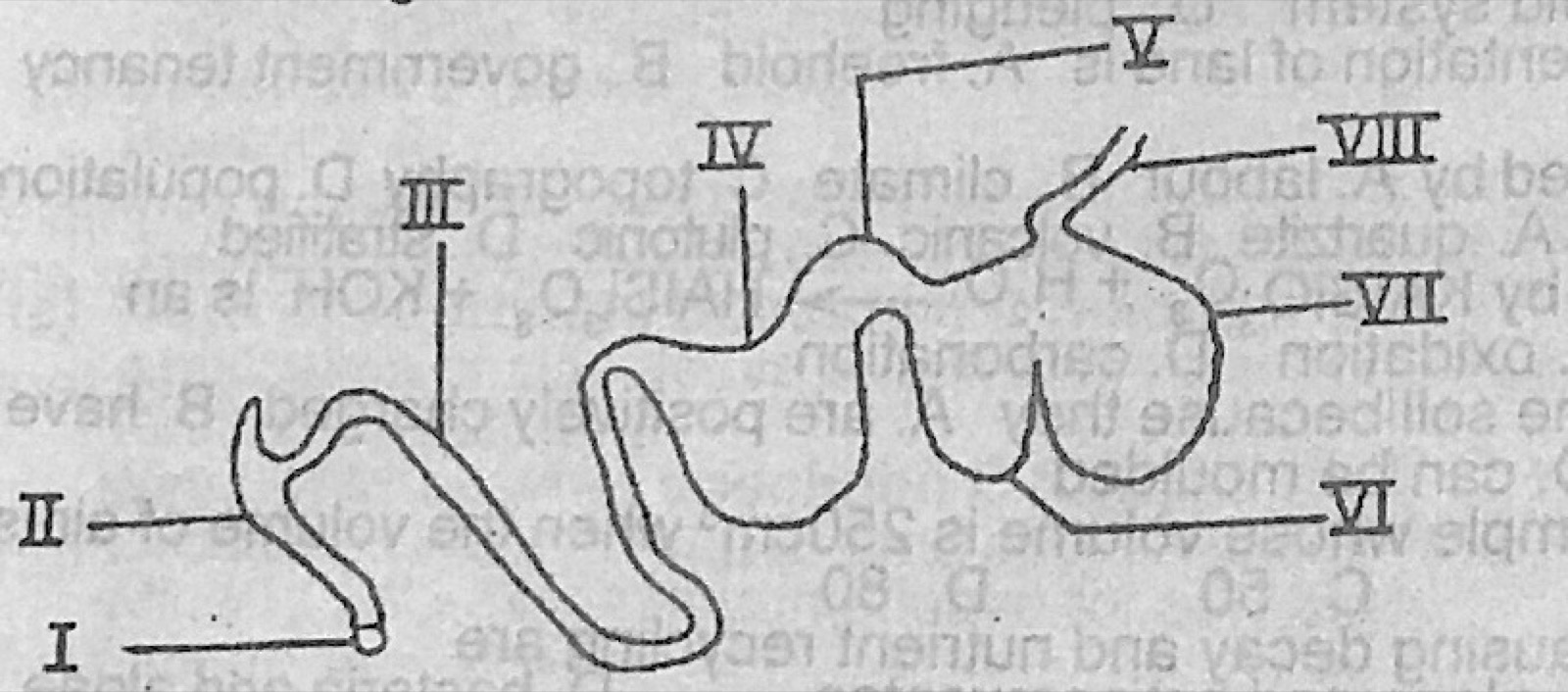
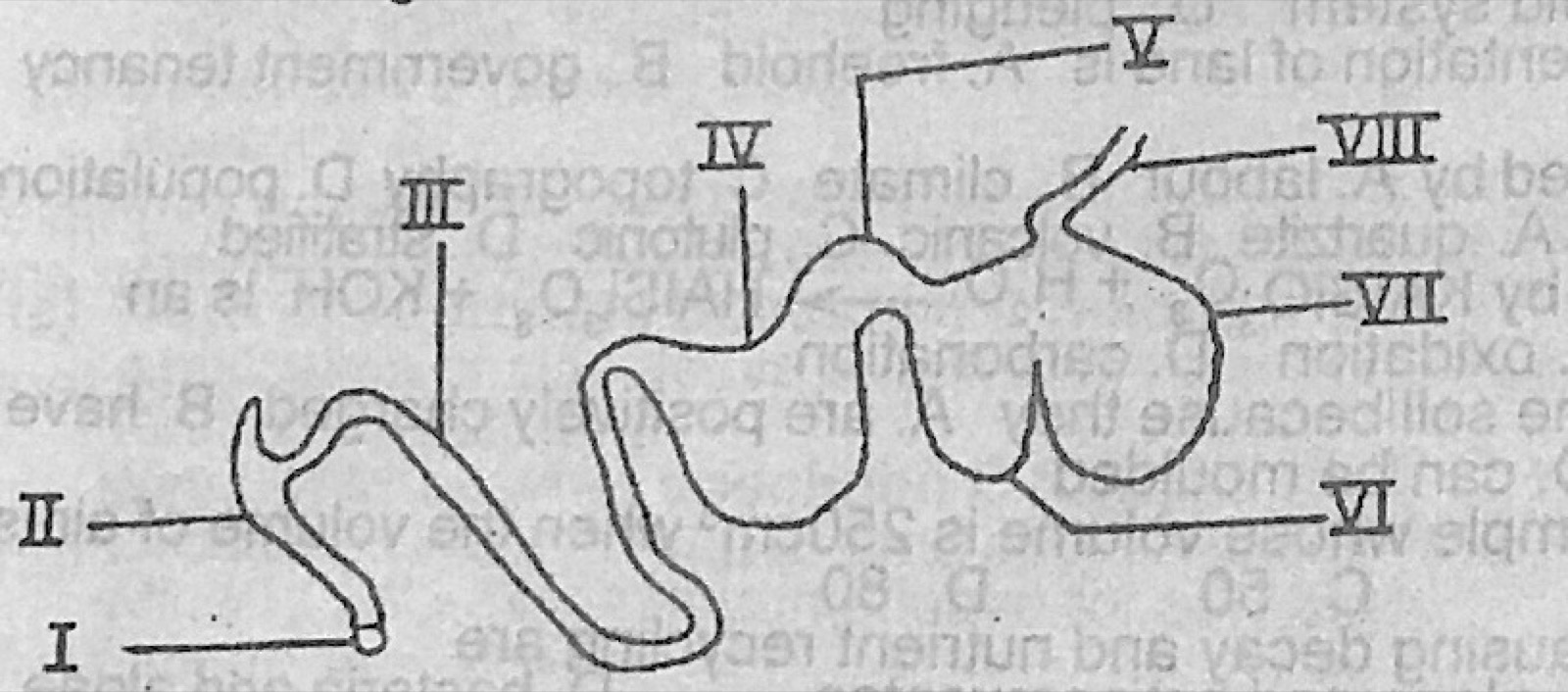
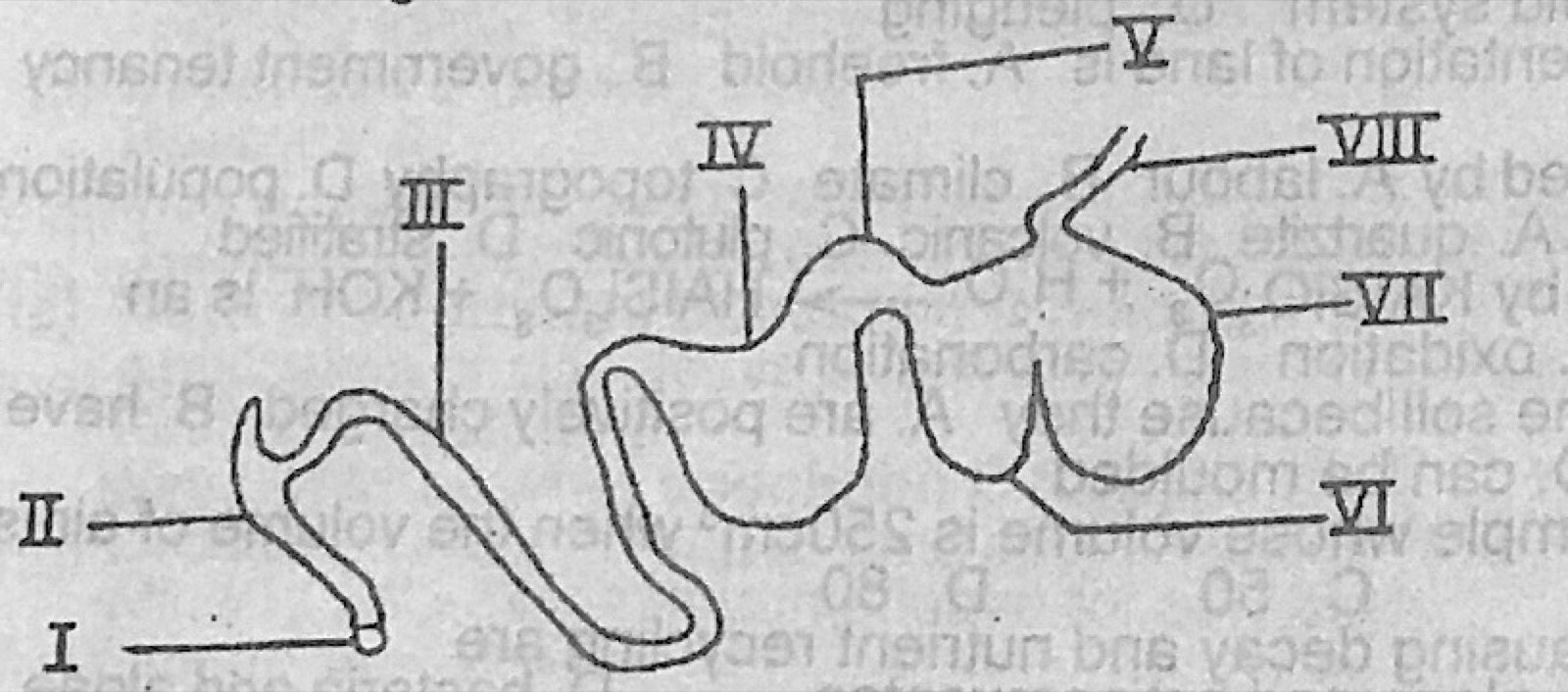
The diagram represents the digestive tract of a farm animal (parts labelled I to VIII). Which of the following animals possesses the illustrated digestive tract?
A.sheep
B.fowl
C.pig
D.duck
Show the answer and explanation
Answer: A (sheep)
Explanation
The tract has a stomach with several chambers, as in a ruminant such as the sheep.
(a) State four effects of feed shortage on animal production. (b) List four areas of specialization in agriculture and state two contributions of each to agricultural development.
Show the model answer
Model answer
(a) Any four: low birth weight and slow growth; poor production of milk, eggs and meat; delayed puberty and maturity; poor fertility/reproduction; greater susceptibility to diseases; loss of weight and death; low income (b) Any four with two contributions each: crop production (agronomy) – food, raw materials, improved varieties; animal production – meat, milk, eggs, hides; soil science – fertility management, soil conservation; agricultural economics and farm management – planning, records, marketing, credit; agricultural extension – teaches farmers new methods, links research and farmers; agricultural engineering – machines, irrigation, processing equipment; forestry – timber, environmental protection; fisheries – fish protein, income; crop protection – pest and disease control
(a) State eight reasons why agriculture has not been fully mechanized in West Africa. (b) List four characteristics of each of (i) subsistence agriculture; (ii) commercial agriculture
Show the model answer
Model answer
(a) Any eight: small, scattered holdings; land tenure problems; high cost of machines and spare parts; lack of capital/credit; lack of skilled operators and mechanics; poor maintenance facilities; unsuitable topography and tree stumps; illiteracy; poor roads/infrastructure; seasonality leaving machines idle; high fuel costs; cheap available labour (b)(i) Subsistence: small farm size; family labour; simple tools; low yields; produces mainly for family; low capital and inputs; mixed cropping (ii) Commercial: large farms; hired labour; mechanised; high capital and input use; produces for sale/profit; often specialised (monoculture); high yields
Explanation
Eight reasons, then four contrasting characteristics.
(a) Define land. (b) State two major classifications of land based on uses and give two examples in each case. (c) List six factors that influence the availability of land for agricultural production and explain two of the factors.
Show the model answer
Model answer
(a) Land is the earth's surface and all natural resources on and beneath it (soil, water, minerals, vegetation); a natural factor of production (b) Agricultural uses – crop farming, livestock/grazing, forestry, fish farming, wildlife; non-agricultural uses – housing, industry, roads, mining, schools, recreation (c) Any six: population pressure; land tenure system; topography; soil type/fertility; climate; government policy (e.g. Land Use Act, reserves); urbanisation and industrialisation; erosion/degradation; cost of land Two explained, e.g. population pressure – more people need land for houses and roads, leaving less for farming; topography – steep, rocky or swampy land is hard to farm
Explanation
Two classes with examples; six factors, two explained.
(a) State three methods of irrigating a small nursery. (b) Enumerate three factors to be considered in the choice of each of (i) surface irrigation method; (ii) subsurface irrigation method (c) State two advantages of subsurface irrigation (d) Enumerate five ways by which the build-up of diseases could be reduced on an irrigated farm.
Show the model answer
Model answer
(a) Any three: watering can; hose pipe; small sprinklers/overhead mist; drip; bucket and cup; furrow/basin (b)(i) Surface (any three): level or gently sloping land; soil that is not too sandy (moderate infiltration); plentiful water supply; crop type; cost of land levelling (ii) Subsurface (any three): soil with good capillarity and an impermeable layer below; high-quality water (low salts); capital for pipes; type of crop/rooting depth; water table level (c) Any two: little water lost to evaporation; soil surface stays dry, reducing weeds and diseases; does not interfere with field operations; no erosion (d) Any five: good drainage to prevent waterlogging; avoid over-irrigation; crop rotation; resistant varieties; clean water free of pathogens; sanitation (remove infected plants); control weeds that host pests; spray fungicides/pesticides; correct spacing for air movement; control snails and mosquitoes (bilharzia, malaria)
Discuss the following practices in crop production: (a) transplanting (b) shading; (c) supplying/filling-in; (d) nursery.
Show the model answer
Model answer
(a) Transplanting: moving seedlings from nursery to field; water the nursery before lifting, lift with a ball of soil, transplant in the evening or on cool days, plant at the same depth, water and shade after (b) Shading: providing shade for young or shade-loving crops (cocoa, nursery seedlings) using palm fronds, shade trees or plantain/cocoyam; reduces heat, water loss and scorching (c) Supplying/filling-in: replanting missing stands where seeds failed or seedlings died, soon after germination, to keep the correct plant population (d) Nursery: a small specially prepared area where seedlings are raised before transplanting; gives care (watering, shading, weeding, pest control) and only healthy, vigorous seedlings are transplanted; types: beds, boxes, polythene bags
Explanation
Explain what each practice is, how and why it is done.
(a) Define the terms budding and grafting (b) List four materials required for budding. (c) Give two reasons why the improvement of crops by selection may not produce the desired results. (d) State four disadvantages of asexual reproduction and four advantages of sexual reproduction in crop plants.
Show the model answer
Model answer
(a) Budding: inserting a bud from a desired plant (scion) under the bark of a rootstock so they unite and grow as one plant. Grafting: joining a shoot/stem piece (scion) of a desired plant onto a rooted stock so they grow together (b) Any four: budding knife; budwood (scion) from the desired plant; rootstock seedling; budding tape/polythene strip/raffia; grafting wax; secateurs; sharpening stone (c) Any two: selection only uses existing variation and cannot create new characters; the desired trait may be due to environment, not genes; traits may not be passed on (heterozygous plants segregate); it is slow (d) Asexual disadvantages (any four): no new variation; diseases carried in planting material; bulky planting materials hard to store and transport; overcrowding near the parent; plants may be less vigorous; needs skill (budding/grafting) Sexual advantages (any four): variation for breeding new varieties; seeds easy to store and transport; seeds can stay dormant; hybrid vigour; seeds are usually disease-free; large numbers produced
(a) Enumerate three major organs in each of the thoracic and abdominal cavities of farm animals. (b) State two functions of the nervous and one function of the reproductive systems. (c) Explain the importance of the following systems in farm animals: (i) circulatory system; (ii) respiratory system; (iii) digestive system
Show the model answer
Model answer
(a) Thoracic: heart, lungs, trachea, oesophagus, thymus; abdominal: stomach, liver, intestines, kidneys, spleen, pancreas, uterus/ovaries, bladder (b) Nervous (any two): coordinates body activities; receives stimuli and responds; controls movement; controls involuntary activities (heartbeat, breathing); memory/learning. Reproductive (any one): produces gametes (sperm/ova); produces hormones; carries the developing young; ensures continuity of the species (c)(i) Circulatory: transports nutrients, oxygen, hormones and antibodies to cells and removes wastes; regulates temperature (ii) Respiratory: takes in oxygen and removes carbon dioxide; helps cooling (panting) in animals (iii) Digestive: breaks down food into absorbable nutrients; absorbs nutrients into the blood; removes undigested waste
Explanation
Three organs in each cavity; one importance per system at least.
(a) Describe the construction of a fish pond (b) State eight measures necessary for the efficient operation of an egg incubator.
Show the model answer
Model answer
(a) Choose a suitable site (water supply, clay soil, gentle slope); clear and survey/peg the site; dig the pond to the required depth (about 1–1.5 m), sloping the bottom towards the outlet; build strong dykes (embankments) with compacted clay; install inlet and outlet pipes/monk with screens; make a spillway; plant grass on dykes to prevent erosion; lime and fertilise, then fill with water before stocking (b) Any eight: keep temperature at about 37.5–38 °C; keep relative humidity at about 60–70% (higher at hatching); good ventilation; turn eggs several times a day (stop 3 days before hatch); use clean, fertile eggs of good size and shell; candle eggs to remove infertile ones; clean and fumigate the incubator; reliable power supply/stand-by; place in a draught-free room; keep records
Explanation
Describe the pond construction step by step; eight incubator measures.
(a) Discuss the effects of rural-urban migration on agricultural production (b) Explain how: (i) demand affects agricultural production given that supply is constant; (ii) supply affects agricultural production when demand is constant (c) State two effects of (i) demand on farmers' income when price is constant. (ii) supply on farmers' income when demand is constant. (d) State five roles expected of a farm manager in a farm enterprise
Show the model answer
Model answer
(a) Shortage and high cost of farm labour; ageing farming population; less food produced/food shortage and higher prices; abandoned farms; slower adoption of innovations; but remittances may fund farms, and fewer people share land (b)(i) When demand rises with supply fixed, prices rise, encouraging farmers to produce more; when demand falls, prices fall and production is discouraged (ii) When supply rises with demand fixed, prices fall, which may discourage production; when supply falls, prices rise (c)(i) At constant price, higher demand means more is sold so income rises; lower demand means less sold and income falls (ii) With constant demand, an increase in supply lowers prices and can reduce farmers' income (glut); a fall in supply raises prices and may raise income (d) Any five: planning; organising resources; decision making; coordinating and supervising workers; record keeping; marketing produce and buying inputs; controlling and evaluating; risk bearing
(a) State two methods of calculating depreciation of farm machines (b) List four roles of capital in agricultural production (c) Explain five major roles played by middlemen in the marketing of agricultural produce
Show the model answer
Model answer
(a) Any two: straight-line method; reducing (declining) balance method; sum-of-the-years'-digits method; revaluation method (b) Any four: buys land and inputs (seeds, fertilizer, feed); buys machines and equipment; pays wages; builds farm structures; makes expansion possible; allows adoption of new technology (c) Any five: buy produce in bulk from scattered farmers (assembling); transport produce to markets; store produce till needed; grade, process and package; give credit/advance payment to farmers; provide market information; bear risks of price changes and losses; distribute to retailers and consumers