(a) Mention three ways in which each of the following factors affect agricultural development: (i) poor tools and implements; (ii) poor storage facilities. (b) Suggest one solution to the problem of poor tools and implements. (c) State three objectives each of: (i) Land Use Act; (ii) quarantine programme; (iii) government agricultural loan and subsidy schemes.
Show the model answer
Model answer
(a)(i) Poor tools (any three): only small areas can be farmed; hard, tiring work (drudgery) discourages youths; operations are slow and late; low output and income; poor quality work (ii) Poor storage (any three): heavy losses to pests, rot and moulds; farmers forced to sell cheaply at harvest; scarcity and high prices later; low income discourages production; less raw material for industries (b) Any one: tractor hiring units; local fabrication of improved tools; subsidies/credit to buy machines; training in the use of machines (c)(i) Land Use Act (any three): make land easier to obtain for farming and development; reduce land disputes; prevent speculation and hoarding of land; give secure title (certificate of occupancy) (ii) Quarantine (any three): keep out foreign pests and diseases; stop spread of diseases within the country; maintain healthy crops and animals; protect export quality (iii) Loans and subsidies (any three): help farmers buy inputs; reduce cost of production; encourage adoption of new technology; increase output and farm income; make farming attractive
Explanation
Three effects for each factor, then three objectives for each scheme.
(a) List six sources of farm power. (b) Explain how five of the sources of farm power listed in 2 (a) are utilised on the farm. (c) Give two disadvantages each, of any four sources of farm power listed in 2 (a).
Show the model answer
Model answer
(a) Human; animal; mechanical (engines/tractors); electricity; wind; water; solar; biogas (b) Any five: human – planting, weeding, harvesting with hand tools; animal – pulling ploughs, ridgers, carts; mechanical – tractors pull ploughs, harrows, planters, combines, and run processing machines; electricity – incubators, milking machines, grinding mills, refrigerators, pumps, lighting; wind – windmills pump water and grind grain, winnowing; water – turbines for hydro-electricity, water wheels; solar – drying crops, solar panels for pumps and lights (c) Any four with two each: human – slow, tires, low output; animal – needs feed and care, slow, can fall sick; mechanical – expensive, needs fuel and skilled operators, compacts soil; electricity – costly to install, unreliable supply, risk of shock and fire; wind – unreliable, low power; water – only near rivers, expensive dams; solar – not at night or in cloudy weather, costly panels
(a) What is land? (b) Mention six uses of land (c) State four ways through which an agricultural land may appreciate in value (d) State five benefits derived from soil organisms in agriculture.
Show the model answer
Model answer
(a) Land is the surface of the earth and all the natural resources on and below it (soil, water, minerals, vegetation) used for production; a natural factor of production (b) Any six: crop farming; livestock grazing; forestry; wildlife reserves; housing; industry; roads and transport; mining; recreation; schools (c) Any four: development such as roads, electricity or water nearby; improvements such as irrigation, drainage, fencing, buildings; increased soil fertility through manuring; rising demand for land/population growth; planting tree crops; secure title (d) Any five: decompose organic matter releasing nutrients; fix nitrogen; improve soil structure; burrows improve aeration and drainage; mix soil layers; form humus; some control pests (predators)
(a) State four functions of each of the following macro-nutrients in plant nutrition: (i) nitrogen; (ii) phosphorus; (iii) potassium (b) List four factors that affect the availability of nutrients to crops.
Show the model answer
Model answer
(a)(i) Nitrogen (any four): forms proteins and protoplasm; part of chlorophyll; promotes leafy growth; gives dark green colour; increases protein in grain; helps use of other nutrients (ii) Phosphorus (any four): root development; flowering, fruiting and seed formation; early maturity; energy transfer (ATP); cell division; strengthens straw (iii) Potassium (any four): formation and movement of sugars and starch; strengthens stems against lodging; disease resistance; controls opening of stomata/water balance; improves fruit quality; activates enzymes (b) Any four: soil pH; soil texture; organic matter content; soil moisture; leaching; soil temperature and aeration; activity of micro-organisms; cation exchange capacity; nutrient fixation
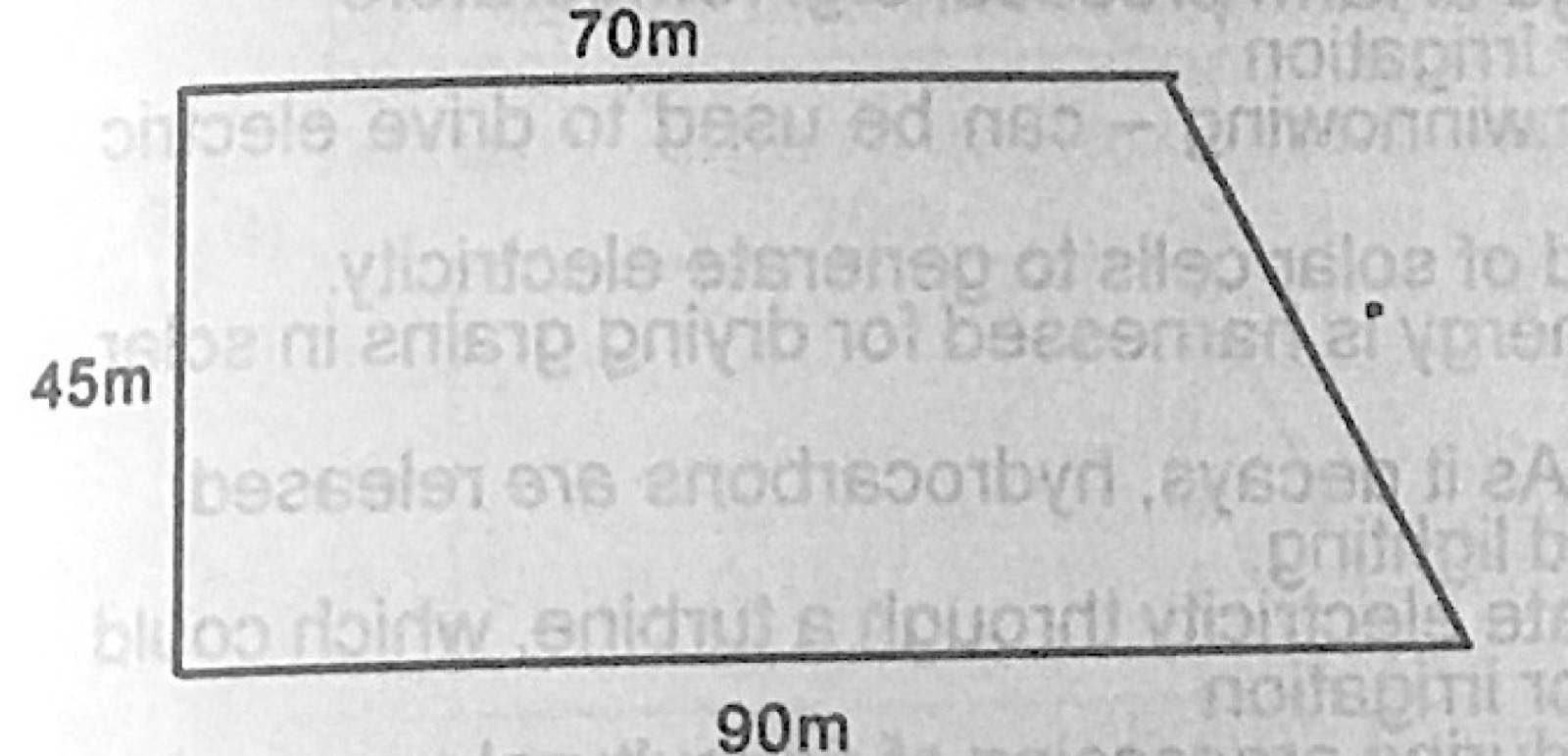
The plan shows the survey of a school farm: a trapezium with parallel sides 70 m and 90 m and perpendicular height 45 m. (a) Calculate the area of the land in hectares (b) If the school plans to cultivate plantain at a spacing of 4m x 4m on 80% of the land and pineapple at a spacing of 2m x 2.5m on 20% of the land, calculate the number of plantain and pineapple planting materials that would be required for the farm.
Show the model answer
Model answer
(a) Area = ½ × (70 + 90) × 45 = ½ × 160 × 45 = 3,600 m²; 3,600 ÷ 10,000 = 0.36 hectares (b) Plantain: 80% of 3,600 = 2,880 m²; area per plant = 4 × 4 = 16 m²; 2,880 ÷ 16 = 180 suckers Pineapple: 20% of 3,600 = 720 m²; area per plant = 2 × 2.5 = 5 m²; 720 ÷ 5 = 144 suckers/slips
Explanation
Use the trapezium formula, then divide each area by the space one plant needs.
(a) Outline the life cycle of the bean beetle (b)(i) Describe briefly four damages done by cotton stainer to cotton plants on the field (ii) Name four alternate hosts of cotton stainer.
Show the model answer
Model answer
(a) Bean beetle (Callosobruchus maculatus) has complete metamorphosis: female lays eggs on the seed/pod surface; larva hatches and bores into the seed, feeding inside; it pupates inside the seed; adult emerges through a round hole; the cycle takes about 3–4 weeks and repeats in store (b)(i) Any four: sucks sap from developing bolls and seeds; seeds shrivel and lose viability/oil; stains the lint yellow/brown, lowering quality; introduces fungi that cause internal boll rot; causes boll shedding (ii) Any four: okra; kenaf; baobab; silk cotton tree (kapok); hibiscus/roselle; Sida and other wild Malvaceae
(a) Mention four factors that should be considered when siting a fish pond (b) Explain six ways of maintaining a fish pond.
Show the model answer
Model answer
(a) Any four: reliable water supply; soil that holds water (clay/clay loam); gentle slope for filling and draining; water quality free from pollution; accessibility/market; security; flood-free site; availability of fingerlings (b) Any six: control water level and inflow/outflow; remove weeds (deweeding); desilt the pond; repair dykes, screens and monks; lime to correct acidity; fertilise to encourage plankton; supplementary feeding; control predators; control diseases; regular harvesting/correct stocking
Discuss each of rinderpest and Newcastle diseases under the following headings: (i) host organism (ii) causal organism (iii) mode of transmission (iv) symptoms (v) control.
Show the model answer
Model answer
Rinderpest: (i) cattle, also sheep, goats, buffalo; (ii) virus (morbillivirus); (iii) contact with sick animals and their discharges, contaminated feed and water; (iv) high fever, discharge from eyes and nose, mouth ulcers, bloody diarrhoea, dehydration, death; (v) vaccination, quarantine, isolation and slaughter of infected animals, disinfection, control of animal movement Newcastle disease: (i) poultry – chickens, turkeys, guinea fowl; (ii) virus (paramyxovirus); (iii) contact, droplets in air, contaminated feed, water, equipment and people; (iv) gasping and coughing, greenish diarrhoea, twisted neck and paralysis, drop in egg production, sudden death; (v) vaccination (e.g. Lasota, Komarov), sanitation, isolation, burning dead birds
(a) Name and explain three factors of production in agriculture. (b) Mention four functions of a farm manager.
Show the model answer
Model answer
(a) Any three: land – all natural resources used in farming (soil, water, minerals); fixed in supply; reward is rent; labour – human physical and mental effort, family or hired, skilled or unskilled; reward is wages; capital – man-made assets used to produce more (tools, machines, buildings, money); reward is interest; management/entrepreneur – organises the other factors, takes decisions and bears risks; reward is profit (b) Any four: planning; organising; decision making; coordinating and supervising workers; controlling/evaluating; record keeping; marketing and buying inputs; staffing
Explanation
Explain each factor with an example and its reward.
(a) List four marketing agents. (b) State (i) four characteristic features and (ii) four advantages of co-operative societies in agriculture. (c)(i) Give three merits of individual contact in extension methods. (ii) List three Agricultural Extension Programmes in your country.
Show the model answer
Model answer
(a) Any four: producers/farmers; wholesalers; retailers; middlemen/brokers/commission agents; cooperative societies; commodity boards/marketing agencies; processors; exporters (b)(i) Any four features: voluntary and open membership; democratic control (one member, one vote); members pool resources/buy shares; limited interest on capital; surplus shared according to patronage; registered with government; education of members (ii) Any four advantages: bulk buying of inputs at lower cost; better prices through collective marketing; easier access to credit; shared storage, processing and transport; training of members; spreads risk; bargaining power (c)(i) Any three: personal attention to the farmer's own problem; builds trust and confidence; farmer can ask questions directly; advice suits the farmer's own farm; quick feedback (ii) Any three: Agricultural Development Projects (ADPs); Fadama project; National Accelerated Food Production Programme (NAFPP); Operation Feed the Nation; Green Revolution; National Special Programme for Food Security; Root and Tuber Expansion Programme; Agricultural Transformation Agenda