WAEC Agricultural Science 1998 past questions and answers

69 questions. Try each one, then open the answer to check yourself and read the explanation.

Question 1

Land Use and Land Tenure

Customary land tenure system in Nigeria encourages

  1. A.ownership of large farmlands
  2. B.fragmentation of lands
  3. C.shifting cultivation
  4. D.commercial farming
  5. E.free hold to any land.
Show the answer and explanation

Answer: B (fragmentation of lands)

Explanation

Land is shared among family members each generation, so holdings get split into small pieces.

Open this question

Question 2

Processing and Storage of Farm Produce

Wastage of agricultural products during harvesting period is due mainly to inadequate

  1. A.transport facilities
  2. B.storage and processing facilities
  3. C.agricultural education and extension
  4. D.implementation of government policies on agriculture
  5. E.agricultural financing.
Show the answer and explanation

Answer: B (storage and processing facilities)

Explanation

Without stores and processing plants, the harvest glut rots.

Open this question

Question 3

Agricultural Finance

The provision of farm inputs to farmers by the government can best be described as

  1. A.loan
  2. B.capital
  3. C.credit
  4. D.subsidy
  5. E.gift.
Show the answer and explanation

Answer: D (subsidy)

Explanation

Government paying part of the cost of inputs is a subsidy.

Open this question

Question 4

Land Use and Land Tenure

Which of the following uses of land should be given more attention in Nigeria for self sufficiency in food production?

  1. A.Construction of roads
  2. B.Building of research centres
  3. C.Establishment of wildlife
  4. D.Establishment of agriculture and forestry
  5. E.Construction of fish ponds.
Show the answer and explanation

Answer: D (Establishment of agriculture and forestry)

Explanation

Food self-sufficiency needs land put into farming.

Open this question

Question 5

Land Use and Land Tenure

High fertility, good topography, good drainage and good soil texture and structure are characteristics of a land meant for

  1. A.wildlife
  2. B.forestry
  3. C.pastoral farming
  4. D.fish farming
  5. E.agriculture.
Show the answer and explanation

Answer: E (agriculture.)

Explanation

Crop agriculture needs the best, fertile, well-drained land.

Open this question

Question 6

Livestock Management

The effects of high environmental temperature on dairy cows include the following except

  1. A.fever
  2. B.high feed intake
  3. C.high water intake
  4. D.low milk production
  5. E.restlessness.
Show the answer and explanation

Answer: B (high feed intake)

Explanation

Heat-stressed cows eat less, not more.

Open this question

Question 7

Land Use and Land Tenure

Which of the following does not fit into the agricultural use of land?

  1. A.Mining
  2. B.Forest establishment
  3. C.Crop production
  4. D.Animal production
  5. E.Fish production.
Show the answer and explanation

Answer: A (Mining)

Explanation

Mining is a non-agricultural use.

Open this question

Question 8

Rocks and Soil Formation

Gneiss is a metamorphic rock formed from

  1. A.sandstone
  2. B.slate
  3. C.shale
  4. D.clay
  5. E.granite.
Show the answer and explanation

Answer: E (granite.)

Explanation

Granite changed by heat and pressure becomes gneiss.

Open this question

Question 9

Soil Properties

The components of soil include the following except

  1. A.living organisms
  2. B.moisture
  3. C.mineral matter
  4. D.humus
  5. E.light.
Show the answer and explanation

Answer: E (light.)

Explanation

Light is not part of the soil.

Open this question

Question 10

Soil Fertility and Plant Nutrition

Which of the following is an organic manure?

  1. A.Lime
  2. B.Basic slag
  3. C.Ammonium nitrate
  4. D.Super phosphate
  5. E.Compost.
Show the answer and explanation

Answer: E (Compost.)

Explanation

Compost comes from decayed plant and animal matter.

Open this question

Question 11

Soil Properties

Which of the following is not a property of clay soil? It

  1. A.is heavy
  2. B.has low capillarity
  3. C.contains little pore spaces
  4. D.hardens and cakes when dry
  5. E.has high plasticity.
Show the answer and explanation

Answer: B (has low capillarity)

Explanation

Clay's fine pores give it high capillarity.

Open this question

Question 12

Soil Properties

The particle size of silt is

  1. A.above 2 mm
  2. B.0.2 mm -2 mm
  3. C.0.02 mm -0.2 mm
  4. D.0.002 mm -0.02 mm
  5. E.below 0.002 mm.
Show the answer and explanation

Answer: D (0.002 mm -0.02 mm)

Explanation

Silt particles are 0.002–0.02 mm.

Open this question

Question 13

Soil Fertility and Plant Nutrition

If the percentage of nitrogen in ammonium sulphate fertilizer is 20%, calculate the amount of nitrogen in 500 kg of the fertilizer

  1. A.20 kg
  2. B.40 kg
  3. C.50 kg
  4. D.100 kg
  5. E.250 kg.
Show the answer and explanation

Answer: D (100 kg)

Explanation

20% of 500 kg = 100 kg.

Open this question

Question 14

Soil Fertility and Plant Nutrition

Fruit formation in plants may be delayed by excessive availability of

  1. A.nitrogen
  2. B.phosphorus
  3. C.carbon
  4. D.sulphur
  5. E.molybdenum.
Show the answer and explanation

Answer: A (nitrogen)

Explanation

Too much nitrogen keeps plants growing leaves and delays fruiting.

Open this question

Question 15

Irrigation and Drainage

The system of irrigation whereby water is introduced as a sheet over farmland is referred to as

  1. A.shadoof
  2. B.channel
  3. C.flooding
  4. D.underground
  5. E.drip.
Show the answer and explanation

Answer: C (flooding)

Explanation

Flood irrigation spreads a sheet of water over the field.

Open this question

Question 16

Irrigation and Drainage

The major advantage of drainage in agriculture is

  1. A.promoting growth of micro-organisms
  2. B.supplying adequate nutrient to the soil
  3. C.removing excess water from the soil
  4. D.aiding decomposition of materials in the soil
  5. E.making aeration of the soil very difficult.
Show the answer and explanation

Answer: C (removing excess water from the soil)

Explanation

Drainage removes excess water.

Open this question

Question 17

Farm Power

Which of the following groups of farm equipment use electricity as their source of power?

  1. A.Milking machine, incubator and refrigerator
  2. B.Incubator, sprayer, refrigerator, and water pump
  3. C.Planter, milking machine and sprayer
  4. D.Sprayer, incubator and harvester
  5. E.Harvester, milking machine, planter and incubator.
Show the answer and explanation

Answer: A (Milking machine, incubator and refrigerator)

Explanation

Milking machines, incubators and refrigerators run on electricity; planters, harvesters and most sprayers do not.

Open this question

Question 18

Farm Machinery and Mechanisation

Combine harvester is usually used for harvesting

  1. A.pepper
  2. B.rice
  3. C.tomato
  4. D.rubber
  5. E.groundnut
Show the answer and explanation

Answer: B (rice)

Explanation

Combines harvest grain crops such as rice.

Open this question

Question 19

Farm Surveying and Planning

One hectare of a school farm equals

  1. A.1000 cm²
  2. B.1000 m²
  3. C.10,000 cm²
  4. D.10,000m²
  5. E.100,000m²
Show the answer and explanation

Answer: D (10,000m²)

Explanation

1 hectare = 100 m × 100 m = 10,000 m².

Open this question

Question 20

Fisheries and Aquaculture

In a farm lay-out the best site for a fish pond is

  1. A.a steep slope
  2. B.an undulating land
  3. C.a flat land
  4. D.a gently sloping valley
  5. E.a hill top.
Show the answer and explanation

Answer: D (a gently sloping valley)

Explanation

A gently sloping valley collects water and lets the pond be filled and drained by gravity.

Open this question

Question 21

Crop Propagation

Which of these groups of crops require nursery for their successful cultivation?

  1. A.Rice, maize, pepper and okro
  2. B.Cassava, guinea corn, tomato and cowpea
  3. C.Tomato, orange, soya bean and rice
  4. D.Cocoa, orange, tomato and oil palm
  5. E.Yam, mango, cassava and pineapple.
Show the answer and explanation

Answer: D (Cocoa, orange, tomato and oil palm)

Explanation

Cocoa, citrus, tomato and oil palm are raised in nurseries first.

Open this question

Question 22

Crop Propagation

Which of the following crops is propagated by suckers?

  1. A.Pineapple
  2. B.Citrus
  3. C.Tobacco
  4. D.Mango
  5. E.Carrot.
Show the answer and explanation

Answer: A (Pineapple)

Explanation

Pineapple is planted from suckers, slips and crowns.

Open this question

Question 23

Land Preparation and Cultural Practices

If cassava is planted at a spacing of 1 m x 1 m, what will be the plant population on 1 hectare of land?

  1. A.10,000
  2. B.5,000
  3. C.1,000
  4. D.500
  5. E.100.
Show the answer and explanation

Answer: A (10,000)

Explanation

10,000 m² ÷ 1 m² per plant = 10,000 plants.

Open this question

Question 24

Plant Forms and Crop Classification

Which of the following is obtained from rubber tree?

  1. A.Fibre
  2. B.Latex
  3. C.Sisal
  4. D.Silk
  5. E.Gum.
Show the answer and explanation

Answer: B (Latex)

Explanation

Tapping rubber trees gives latex.

Open this question

Question 25

Pasture and Forage Crops

What is the main difference between forage and fodder crops? Forage crops are

  1. A.fresh while fodder crops are dry
  2. B.grasses and legumes while fodder crops are legumes only
  3. C.preserved forms of grasses and legumes
  4. D.more nutritious than fodder crops
  5. E.grazed while the fodder crops are fed.
Show the answer and explanation

Answer: E (grazed while the fodder crops are fed.)

Explanation

Animals graze forage in the field; fodder is cut and carried to them.

Open this question

Question 26

Pasture and Forage Crops

Which of the following pasture grasses can be propagated mainly by roots and seeds?

  1. A.Spear grass
  2. B.Giant star grass
  3. C.Bahama grass
  4. D.Gamba grass
  5. E.Guinea grass.
Show the answer and explanation

Answer: E (Guinea grass.)

Explanation

Guinea grass is planted from seeds or root splits (clumps).

Open this question

Question 27

Pasture and Forage Crops

A stoloniferous grass which spreads rapidly and forms a good ground cover is

  1. A.Andropogon gayanus
  2. B.Andropogon tectorum
  3. C.Cynodon plectostachyus
  4. D.Panicum maximum
  5. E.Pennisetum purpureum.
Show the answer and explanation

Answer: C (Cynodon plectostachyus)

Explanation

Giant star grass (Cynodon) spreads by stolons.

Open this question

Question 28

Forestry and Wildlife

The act of clearing forests is termed

  1. A.regeneration
  2. B.afforestation
  3. C.deforestation
  4. D.silviculture
  5. E.forest management.
Show the answer and explanation

Answer: C (deforestation)

Explanation

Removing forest is deforestation.

Open this question

Question 29

Forestry and Wildlife

A major raw material of the paper industry is

  1. A.pulp
  2. B.gum
  3. C.latex
  4. D.bark
  5. E.dye.
Show the answer and explanation

Answer: A (pulp)

Explanation

Paper is made from wood pulp.

Open this question

Question 30

Forestry and Wildlife

The system of growing arable crops at the early stage of forest establishment is referred to as

  1. A.selective exploitation
  2. B.regeneration
  3. C.afforestation
  4. D.taungya system
  5. E.forest regulation.
Show the answer and explanation

Answer: D (taungya system)

Explanation

Taungya grows food crops among young trees.

Open this question

Question 31

Crop Diseases

The physiological changes that show up during disease attack on crop plants are referred to as

  1. A.signs
  2. B.symptoms
  3. C.necrosis
  4. D.deformations
  5. E.abnormalities.
Show the answer and explanation

Answer: B (symptoms)

Explanation

Changes in the plant itself caused by disease are symptoms.

Open this question

Question 32

Crop Pests

The major pest of maize in Southern Nigeria is called

  1. A.budworm
  2. B.stem borer
  3. C.leaf worm
  4. D.aphid
  5. E.mealy bug.
Show the answer and explanation

Answer: B (stem borer)

Explanation

Stem borers are the most damaging maize pests in the south.

Open this question

Question 33

Crop Pests

Which of the following insect pests of crops is usually controlled by fumigation?

  1. A.Bean weevil
  2. B.Capsid bug
  3. C.Cotton stainer
  4. D.Grasshopper
  5. E.Yam beetle.
Show the answer and explanation

Answer: A (Bean weevil)

Explanation

Bean weevils in stored grain are killed by fumigating the store.

Open this question

Question 35

Crop Diseases

Gummosis is caused by a

  1. A.fungus
  2. B.virus
  3. C.bacterium
  4. D.nematode
  5. E.protozoan.
Show the answer and explanation

Answer: A (fungus)

Explanation

Citrus gummosis is caused by the fungus Phytophthora.

Open this question

Question 36

Crop Improvement

Which of the following is not true about the aims of crop improvement? Production of

  1. A.high yielding variety of cowpea
  2. B.disease resistant varieties of citrus
  3. C.thick pericarp and rich oil palm fruits
  4. D.tall growing leafy varieties of maize
  5. E.fast growing rice with early fruiting.
Show the answer and explanation

Answer: D (tall growing leafy varieties of maize)

Explanation

Breeders want short, sturdy maize that does not lodge.

Open this question

Question 37

Animal Anatomy and Physiology

Which of the following is the correct function of the gizzard?

  1. A.Food storage
  2. B.Absorption of digested food
  3. C.Grinding of food
  4. D.Food softening
  5. E.Stimulating enzymatic actions on food.
Show the answer and explanation

Answer: C (Grinding of food)

Explanation

The gizzard grinds food.

Open this question

Question 38

Animal Anatomy and Physiology

The correct sequence of the components of a goat's stomach is

  1. A.rumen → reticulum → abomasum → omasum
  2. B.reticulum → rumen → omasum → abomasum
  3. C.rumen → reticulum → omasum → abomasum
  4. D.reticulum → omasum → abomasum → rumen
  5. E.omasum → rumen → reticulum → abomasum.
Show the answer and explanation

Answer: C (rumen → reticulum → omasum → abomasum)

Explanation

Food passes rumen, reticulum, omasum, then abomasum.

Open this question

Question 39

Animal Anatomy and Physiology

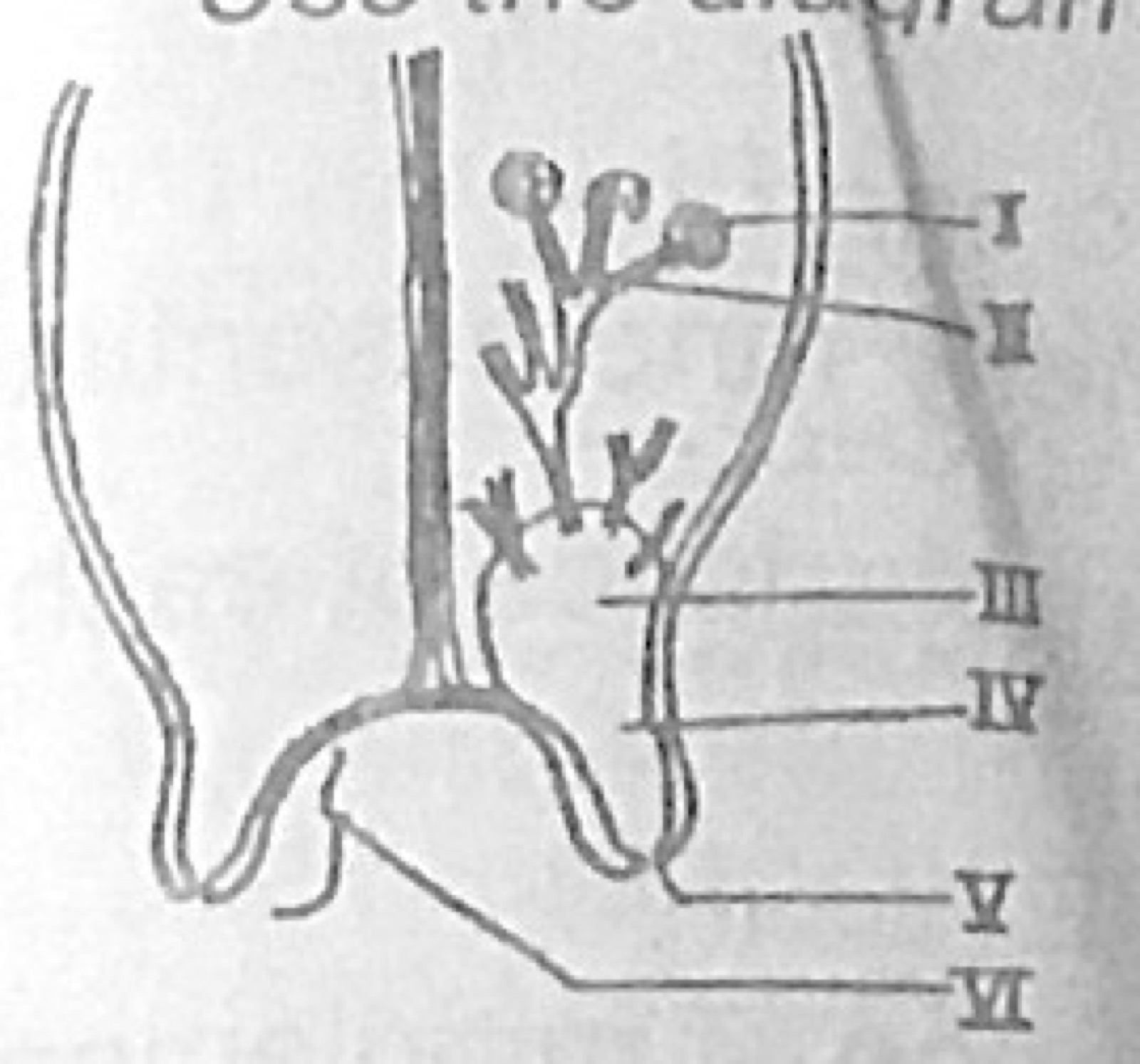
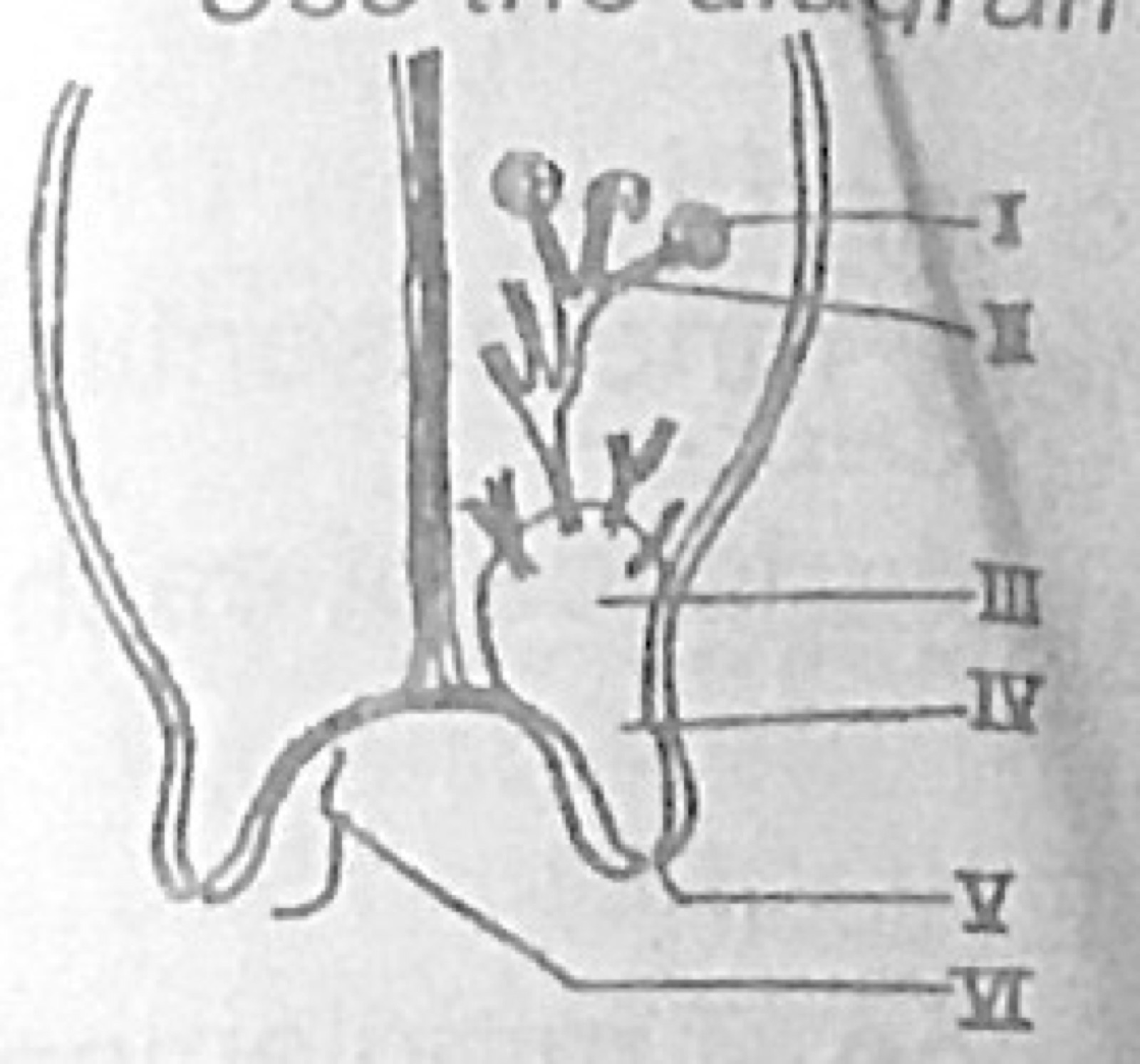
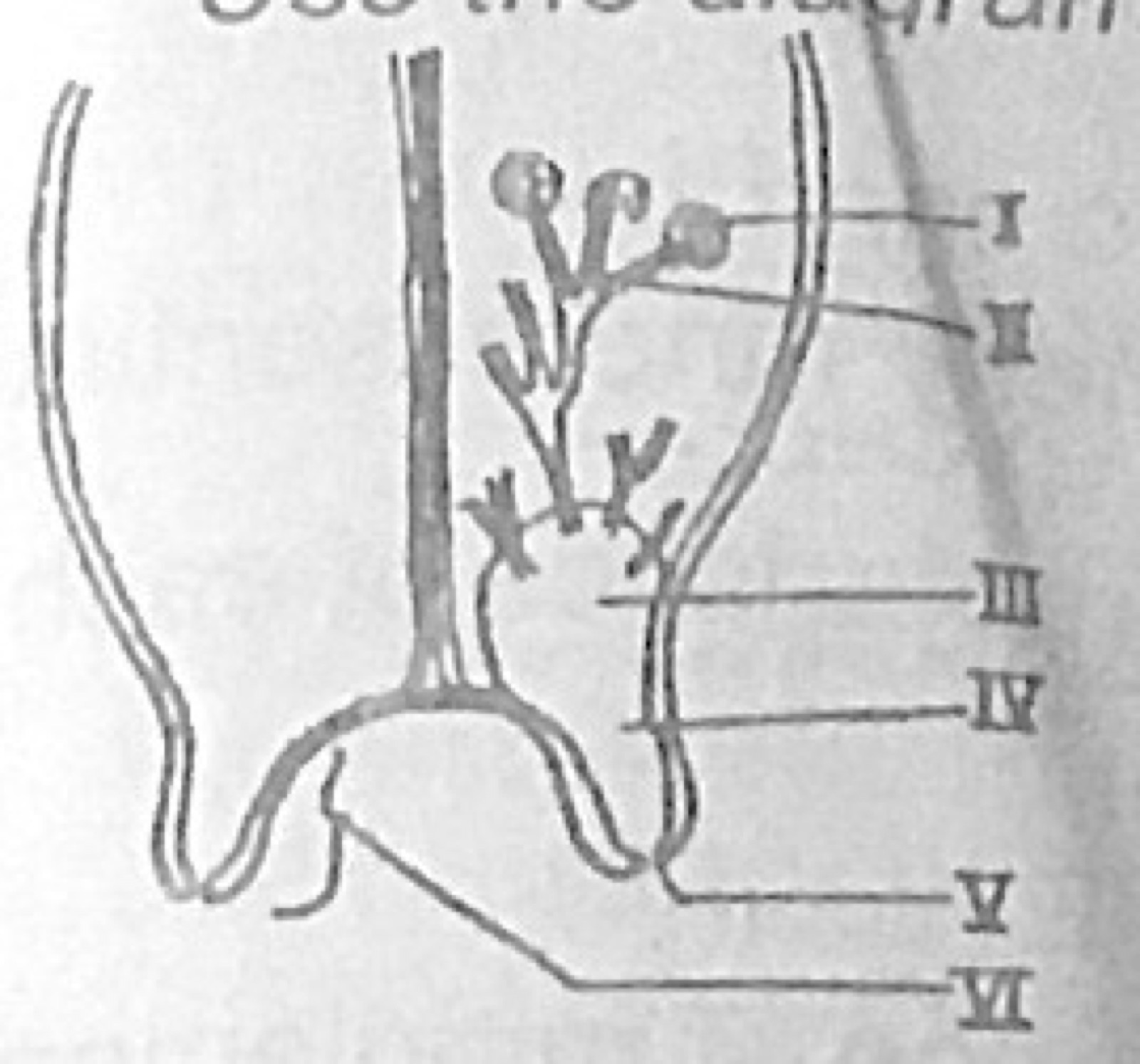
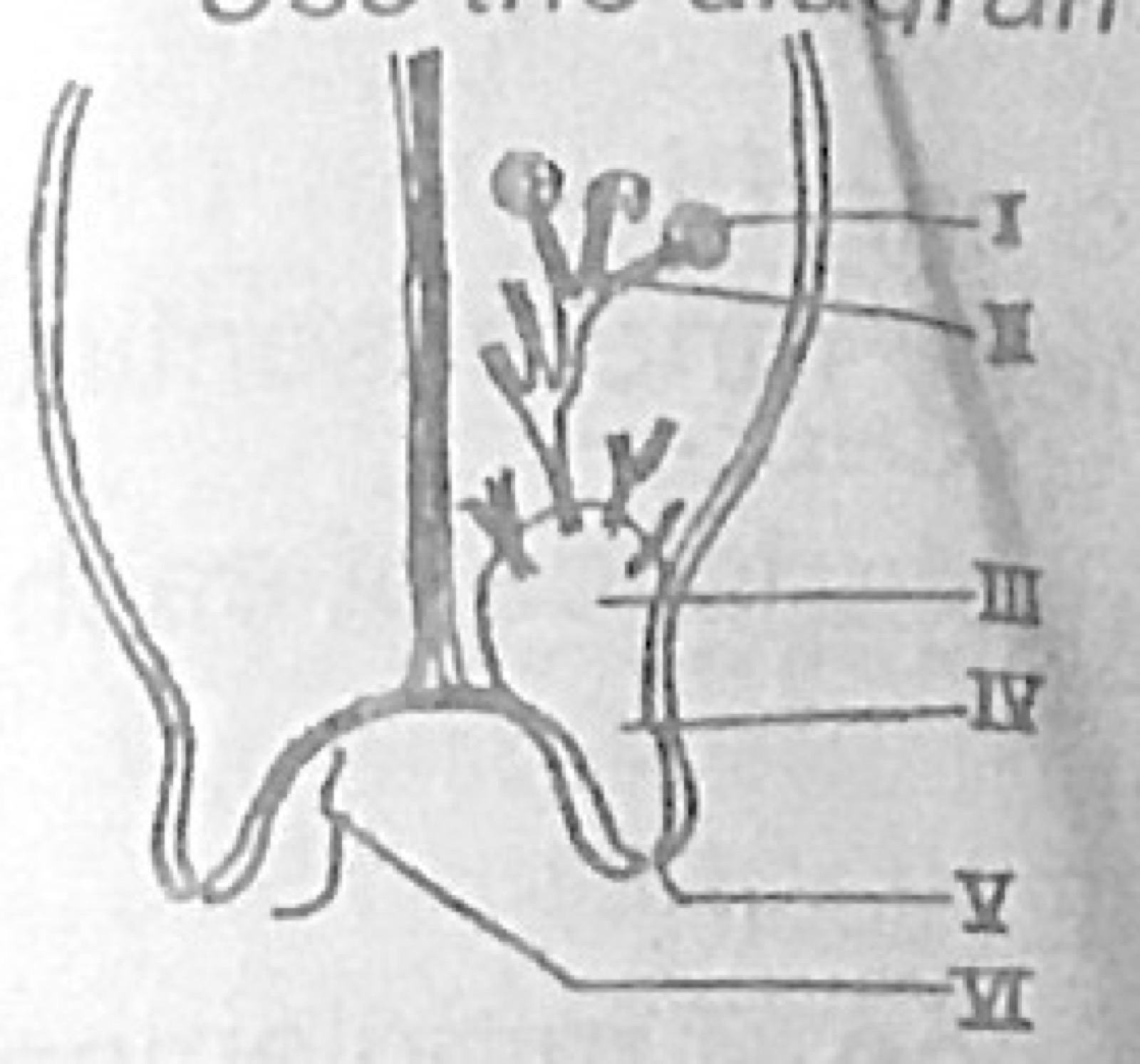
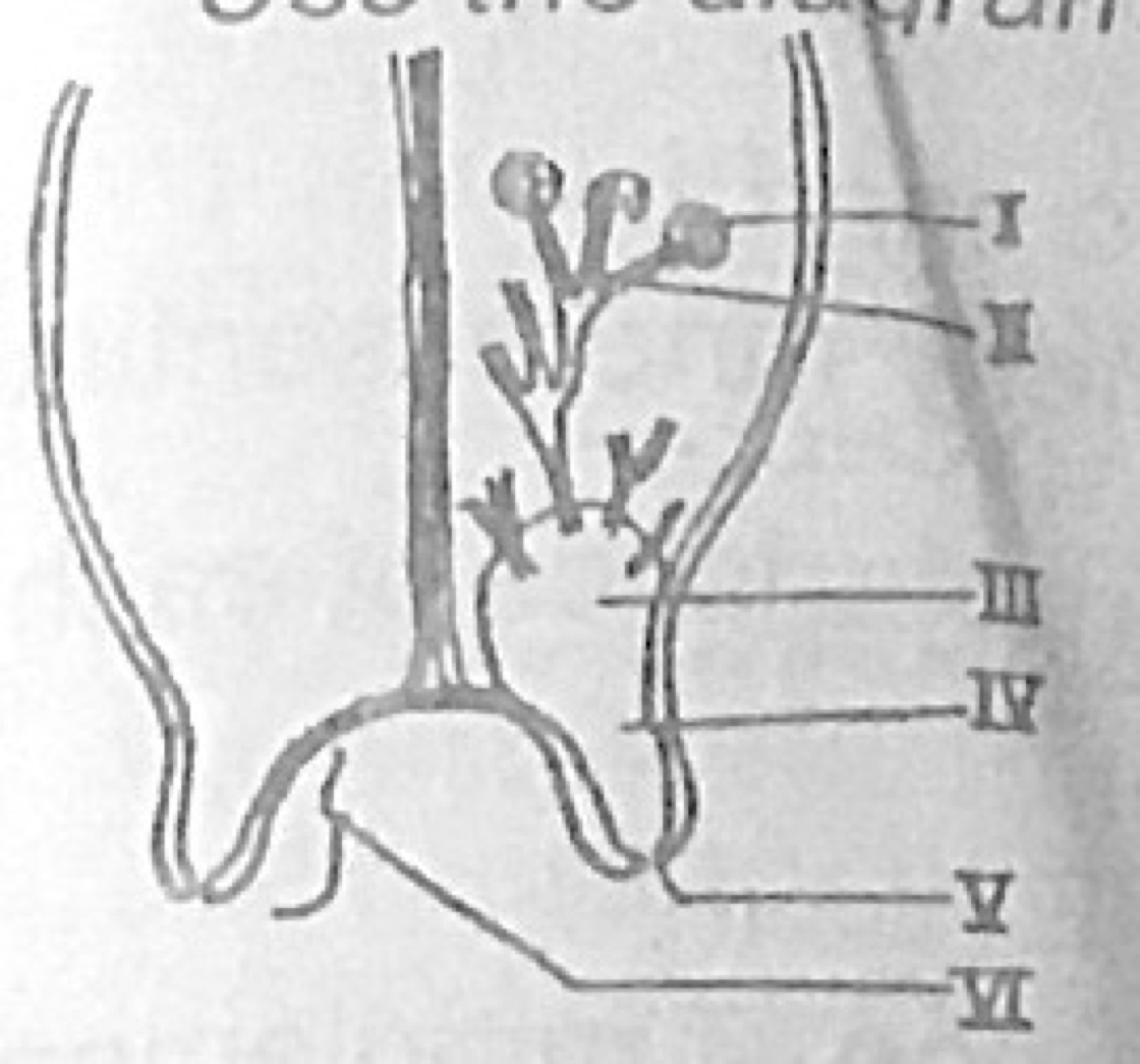
Use the diagram (section of a cow's udder, parts labelled I to VI). The part labelled I is the

Diagram for this question
  1. A.alveolus
  2. B.duct
  3. C.gland cistern
  4. D.teat cistern
  5. E.streak canal
Show the answer and explanation

Answer: A (alveolus)

Explanation

I points to the small grape-like sacs at the top: alveoli.

Open this question

Question 40

Animal Anatomy and Physiology

Use the diagram (section of a cow's udder, parts labelled I to VI). The teat is labelled

Diagram for this question
  1. A.VI
  2. B.V
  3. C.IV
  4. D.III
  5. E.II
Show the answer and explanation

Answer: A (VI)

Explanation

VI points to the teat.

Open this question

Question 41

Animal Anatomy and Physiology

Use the diagram (section of a cow's udder, parts labelled I to VI). Milk is synthesised and secreted at the part labelled

Diagram for this question
  1. A.VI
  2. B.V
  3. C.III
  4. D.II
  5. E.I
Show the answer and explanation

Answer: E (I)

Explanation

Milk is made in the alveoli (I).

Open this question

Question 42

Animal Anatomy and Physiology

Use the diagram (section of a cow's udder, parts labelled I to VI). The organ is attached to the body of animal by the

Diagram for this question
  1. A.nerves
  2. B.bones
  3. C.skin
  4. D.ligaments
  5. E.lumph glands.
Show the answer and explanation

Answer: D (ligaments)

Explanation

Suspensory ligaments hold the udder to the body.

Open this question

Question 43

Animal Anatomy and Physiology

Use the diagram (section of a cow's udder, parts labelled I to VI). Milk passes out of the alveoli to the gland cistern through the part labelled

Diagram for this question
  1. A.VI
  2. B.V
  3. C.IV
  4. D.II
  5. E.I.
Show the answer and explanation

Answer: D (II)

Explanation

Ducts (II) carry milk from the alveoli to the cistern.

Open this question

Question 44

Livestock Management

Rabbits are kept in

  1. A.hutches
  2. B.cages
  3. C.food boxes
  4. D.pens
  5. E.paddocks
Show the answer and explanation

Answer: A (hutches)

Explanation

Rabbit houses are called hutches.

Open this question

Question 45

Livestock Management

A castrated male pig is called a

  1. A.boar
  2. B.barrow
  3. C.gilt
  4. D.sow
  5. E.swine
Show the answer and explanation

Answer: B (barrow)

Explanation

A barrow is a castrated male pig.

Open this question

Question 46

Poultry Production

Layers mash should contain a high percentage of

  1. A.iron
  2. B.calcium
  3. C.iodine
  4. D.fluorine
  5. E.sulphur
Show the answer and explanation

Answer: B (calcium)

Explanation

Layers need calcium for eggshells.

Open this question

Question 47

Animal Nutrition

Which of the following symptoms occurs when there is deficiency of iron and copper in livestock rations?

  1. A.Rickets
  2. B.Scaly skin
  3. C.Reduced growth rate
  4. D.Anaemia
  5. E.Lameness.
Show the answer and explanation

Answer: D (Anaemia)

Explanation

Iron and copper are needed to make haemoglobin; lack causes anaemia.

Open this question

Question 48

Pasture and Forage Crops

The methods of rangeland management include the following except

  1. A.overgrazing
  2. B.good irrigation schedule
  3. C.rotational grazing
  4. D.fertilizer application
  5. E.roguing of pastures.
Show the answer and explanation

Answer: A (overgrazing)

Explanation

Overgrazing damages rangeland.

Open this question

Question 49

Animal Health

A miracidium is a larval stage of a

  1. A.tapeworm
  2. B.liver fluke
  3. C.trypanosome
  4. D.tick
  5. E.roundworm
Show the answer and explanation

Answer: B (liver fluke)

Explanation

The miracidium hatches from a liver-fluke egg and enters a snail.

Open this question

Question 50

Animal Health

The foot and mouth disease of cattle is caused by a

  1. A.virus
  2. B.bacterium
  3. C.fungus
  4. D.nematode
  5. E.protozoan.
Show the answer and explanation

Answer: A (virus)

Explanation

Foot and mouth disease is viral.

Open this question

Question 51

Animal Health

Which of the following is most ideal when a cow dies due to anthrax disease?

  1. A.Bury or burn the carcass of the dead animal immediately
  2. B.Slaughter all other animals in the herd
  3. C.Cull the close relations of the dead animal
  4. D.Fumigate all pens
  5. E.Perform a post mortem examination on the dead animal.
Show the answer and explanation

Answer: A (Bury or burn the carcass of the dead animal immediately)

Explanation

Anthrax carcasses must be burnt or buried deep at once without opening them.

Open this question

Question 52

Fisheries and Aquaculture

The depth of a fish pond depends on the

  1. A.location
  2. B.landscape
  3. C.type of fish to be reared
  4. D.age of fish
  5. E.purpose of keeping the fish.
Show the answer and explanation

Answer: C (type of fish to be reared)

Explanation

Different species need different water depths.

Open this question

Question 53

Fisheries and Aquaculture

Cow dung is usually added to a fish pond in order to encourage the growth of

  1. A.lichen and mosses
  2. B.phytoplankton and zooplankton
  3. C.celosia and amaranthus
  4. D.shallot and lily
  5. E.lettuce and cabbage.
Show the answer and explanation

Answer: B (phytoplankton and zooplankton)

Explanation

Manure fertilises the pond, so plankton (fish food) grow.

Open this question

Question 54

Animal Improvement

The mating of different breeds of animals is known as

  1. A.out breeding
  2. B.cross-breeding
  3. C.line-breeding
  4. D.in-breeding
  5. E.back-crossing
Show the answer and explanation

Answer: B (cross-breeding)

Explanation

Mating different breeds is cross-breeding.

Open this question

Question 55

Farm Management and Records

Which of the following types of labour is commonly used in peasant agriculture?

  1. A.Skilled
  2. B.Casual
  3. C.Migratory
  4. D.Family
  5. E.Co-operative.
Show the answer and explanation

Answer: D (Family)

Explanation

Peasant farmers rely on family labour.

Open this question

Question 56

Basic Agricultural Economics

The quantity of food crop available for sale at the current market price over a period of time is known as

  1. A.demand
  2. B.joint supply
  3. C.supply
  4. D.competitive demand
  5. E.surplus.
Show the answer and explanation

Answer: C (supply)

Explanation

Supply is the quantity offered for sale at a given price.

Open this question

Question 57

Agricultural Finance

The source of farm credit which is interest-free is

  1. A.a commercial bank
  2. B.an agricultural and co-operative bank
  3. C.a money lender
  4. D.a co-operative society
  5. E.self financing
Show the answer and explanation

Answer: E (self financing)

Explanation

Using one's own savings costs no interest.

Open this question

Question 58

Farm Management and Records

A motorised sprayer was purchased at N2,000.00 and sold at N1,000.00 after 5 years. Calculate the annual depreciation of the sprayer.

  1. A.N100.00
  2. B.N200.00
  3. C.N300.00
  4. D.N400.00
  5. E.N500.00
Show the answer and explanation

Answer: B (N200.00)

Explanation

(2,000 − 1,000) ÷ 5 = N200 per year.

Open this question

Question 59

Marketing of Agricultural Produce

Which of the following gives the proper channel of agricultural marketing?

  1. A.Producer → wholesaler → retailer → consumer
  2. B.Producer → consumer → retailer → wholesaler
  3. C.Producer → retailer → wholesaler → consumer
  4. D.Producer → wholesaler → consumer → retailer
  5. E.Producer → retailer → consumer → wholesaler.
Show the answer and explanation

Answer: A (Producer → wholesaler → retailer → consumer)

Explanation

Goods go from producer to wholesaler to retailer to consumer.

Open this question

Question 60

Agricultural Extension

The problems encountered by extension agents in the discharge of their duties include the following except

  1. A.poor transportation
  2. B.communication problem
  3. C.inadequate extension tools
  4. D.inadequate farm labour
  5. E.farmer's low level of education.
Show the answer and explanation

Answer: D (inadequate farm labour)

Explanation

Farm labour is the farmer's concern, not the extension agent's.

Open this question

Theory question 101

Agricultural Development

(a) Discuss briefly four ways in which any three of the following government agricultural programmes have contributed to the agricultural development of Nigeria. (i) Agricultural Development Projects. (ii) Farm Settlement Scheme. (iii) Co-operative Farming. (iv) River Basin and Rural Development Authorities. (v) Agricultural Research Institutes.
(b) List four agro-based industries in Nigeria and state the raw materials used in each industry.

Show the model answer
Model answer

(a) Any three programmes, four points each:
ADPs – supply inputs through farm service centres; intensive extension (training and visit); build feeder roads, earth dams and boreholes; bring services close to rural farmers; raise output and income
Farm settlements – reduce unemployment of school leavers; teach modern farming; develop rural infrastructure, reducing rural–urban drift; demonstration effect on nearby farmers; increase food output
Co-operative farming – farmers pool resources; bulk purchase of inputs at lower cost; easier access to credit; joint storage, processing, transport and marketing; spreads risks
River Basin and Rural Development Authorities – build dams for irrigation and all-year farming; provide land clearing/tractor hire; supply water; build roads; fish ponds and fingerlings
Research institutes – develop improved varieties and breeds; better pest and disease control and vaccines; improved cultural practices; better storage and processing methods
(b) Any four: oil mill – oil palm, groundnut, soya bean; textile/ginnery – cotton; brewery – maize, sorghum, barley; sugar industry – sugarcane; tyre/rubber industry – latex; cigarette – tobacco; flour mill – wheat, maize; starch/garri – cassava; paper – wood pulp; fruit canning/juice – fruits; leather – hides and skins; feed mill – maize, soya, groundnut cake

Explanation

Pick three programmes and give four contributions each.

Open this question

Theory question 102

Farm Machinery and Mechanisation

(a) Explain the term farm mechanisation.
(b) State seven advantages and seven disadvantages of farm mechanisation.

Show the model answer
Model answer

(a) Farm mechanisation is the use of machines (tractors and power-driven implements and processing machines) to carry out farm operations in place of human and animal labour
(b) Advantages (any seven): timely operations; larger area cultivated; higher output; reduces drudgery; saves labour cost in the long run; better quality work; encourages large-scale/commercial farming; makes farming attractive to youths; supplies agro-industries; increases income
Disadvantages (any seven): high cost of machines and spare parts; displaces labour/unemployment; soil compaction and structure damage; encourages erosion; pollution (noise, fumes); needs skilled operators and mechanics; unsuitable for small, scattered or hilly plots; destroys soil organisms; fuel costs; accidents

Explanation

Seven distinct points on each side.

Open this question

Theory question 103

Rocks and Soil Formation

(a) Explain briefly four factors of soil formation.
(b) List four chemical processes in the weathering of rocks.

Show the model answer
Model answer

(a) Any four explained: parent material – decides mineral content and texture; climate – rainfall and temperature drive weathering and leaching; living organisms – plants and animals add organic matter, roots break rocks, microbes decompose; topography – slope affects drainage, erosion and soil depth; time – longer time gives deeper, more developed soils
(b) Any four: hydrolysis; hydration; oxidation; carbonation; solution; reduction

Explanation

Explain how each factor affects the soil formed.

Open this question

Theory question 104

Soil Fertility and Plant Nutrition

Write short notes on the following:
(a) bush burning.
(b) clean clearing.
(c) organic manuring.

Show the model answer
Model answer

(a) Bush burning: clearing by setting fire to vegetation; cheap and quick, kills pests and weed seeds, ash adds potash; but destroys organic matter and soil organisms, loses nitrogen and sulphur, exposes soil to erosion, pollutes air
(b) Clean clearing: complete removal of all vegetation and debris; makes tillage and mechanisation easy; but exposes soil to sun, erosion and leaching, loses organic matter
(c) Organic manuring: adding decayed plant and animal materials (farmyard manure, compost, green manure, poultry droppings); adds nutrients slowly, improves structure, water holding, aeration and microbial activity; bulky, low nutrient content, may carry weeds and diseases

Explanation

Give meaning, benefits and drawbacks for each.

Open this question

Theory question 105

Crop Husbandry

Describe briefly the production of cocoa under the following headings:
(a) method of propagation.
(b) climatic and soil requirements.
(c) nursery requirement
(d) maturity period.
(e) method of harvesting.
(f) two major diseases and their control.

Show the model answer
Model answer

(a) Mainly by seeds (fresh beans from selected pods); also cuttings and budding
(b) Rainfall 1250–2500 mm well distributed; temperature 21–32 °C; high humidity; shade when young; deep, well-drained loamy soil rich in humus, pH about 6–7
(c) Seeds sown in polythene bags filled with topsoil, under shade; watering, weeding, pest control; transplanted at 4–6 months, spaced about 3 m × 3 m in the field with shade crops (plantain, cocoyam)
(d) Starts bearing 3–5 years after planting; full bearing about 7–10 years
(e) Ripe pods (yellow/orange) cut with a cutlass or a harvesting hook on a pole; pods broken, beans fermented 5–7 days, dried and bagged
(f) Black pod (Phytophthora fungus) – remove infected pods, regular harvesting, spray copper fungicides; swollen shoot (virus spread by mealybugs) – cut out and burn infected trees, resistant varieties, control mealybugs; also capsid damage

Explanation

Give figures for climate, spacing and years to bearing.

Open this question

Theory question 106

Crop Pests

(a) State three effects of maize weevil on maize grains.
(b) Explain briefly five general control measures of insect pests of grains in storage.
(c) Name the vector for each of the following crop diseases: (i) groundnut rosette. (ii) maize streak. (iii) cassava mosaic.

Show the model answer
Model answer

(a) Any three: bore holes in grains; reduce weight and food value; lower viability/germination; contaminate grains with droppings, encourage moulds and heating; reduce market value
(b) Any five: dry grains well before storage; clean and disinfect stores before use; fumigation (e.g. phostoxin); dust with storage insecticides (e.g. Actellic); airtight storage containers; store on raised platforms/use pallets; sort out infested grain; use resistant varieties; traditional methods such as ash or pepper
(c)(i) Aphids (Aphis craccivora); (ii) leafhoppers (Cicadulina spp.); (iii) whiteflies (Bemisia tabaci)

Explanation

Name the correct insect vector for each disease.

Open this question

Theory question 107

Poultry Production

(a) State seven reasons for good housing in poultry management.
(b) Describe briefly nine essential features of a poultry deep litter house.

Show the model answer
Model answer

(a) Any seven: protect birds from rain, sun and cold; protect from predators and thieves; prevent spread of diseases; ease feeding, watering and management; easy egg collection; good ventilation and comfort; keep records/identify birds; increase productivity; reduce stress
(b) Any nine: site on well-drained land away from homes; east–west orientation to reduce direct sun; concrete floor; low walls (about 0.5–1 m) with wire mesh above for ventilation; roof with overhang (eaves) to keep out rain; litter (wood shavings, rice husk) 5–10 cm deep; feeders and drinkers; nests for layers; perches; foot bath at entrance; adequate space (about 3 birds per m² for layers); lighting; door and store

Explanation

Nine distinct features of the house.

Open this question

Theory question 108

Animal Nutrition

(a) Explain the term ration.
(b) Name four classes of livestock feed and list two characteristics of each class.
(c) Distinguish between maintenance and production rations.

Show the model answer
Model answer

(a) A ration is the total amount of feed given to an animal in 24 hours
(b) Any four with two characteristics: roughages – high fibre, bulky, low energy (hay, silage, grass); concentrates – low fibre, high energy or protein, easily digested (maize, groundnut cake); basal/energy feeds – high carbohydrate, low protein (maize, cassava); protein supplements – high protein (fish meal, soya meal); minerals/vitamin supplements – small amounts, prevent deficiency diseases (bone meal, premix); additives – non-nutritive, improve growth/health (antibiotics, coccidiostats)
(c) Maintenance ration keeps the animal alive and healthy at constant weight with no production; production ration is extra feed above maintenance for growth, milk, eggs, work or pregnancy

Explanation

Define, classify, then contrast the two rations.

Open this question

Theory question 109

Marketing of Agricultural Produce

(a) List four marketing agents for agricultural products.
(b) Discuss briefly four importance of middlemen in agricultural marketing.
(c) Outline eight problems of agricultural marketing in Nigeria.

Show the model answer
Model answer

(a) Any four: farmers/producers; middlemen (wholesalers, retailers, brokers, commission agents); cooperative societies; commodity boards/marketing agencies; processors; exporters
(b) Any four: buy in bulk, saving farmers' time; provide storage and transport; grade, process and package produce; give credit/advance payment to farmers; provide market information; bear risks; bridge producers and consumers
(c) Any eight: poor roads and transport; lack of storage; perishability; price fluctuations; exploitation by middlemen; lack of grading/standards; small, scattered supply; lack of market information; poor packaging and processing; inadequate finance; multiple taxes and levies; insecurity

Explanation

Give a short explanation for each importance.

Open this question

Theory question 110

Farm Management and Records

Explain briefly the following terms in farm management:
(a) farm valuation.
(b) cash analysis account
(c) profit and loss account.
(d) balance sheet.

Show the model answer
Model answer

(a) Farm valuation: assessing the money value of farm assets (land, buildings, machines, livestock, stores) at a given time, e.g. opening and closing valuations
(b) Cash analysis account: record of all cash received and paid out, arranged under headings (enterprises/items) so that income and expenses of each can be analysed
(c) Profit and loss account: statement of income (sales, closing valuation) and expenses (costs, opening valuation) over a period, showing whether the farm made a profit or loss
(d) Balance sheet: statement of the farm's assets and liabilities at a particular date, showing its net worth
Explanation

One clear definition for each.

Open this question