Home › Past questions › UI Post-UTME › Mathematics › 2024 Model questions 21 questions. Try each one, then open the answer to check yourself and read the explanation.
Sign up free to answer these questions on a CBT screen with a timer, then see your score and every answer explained.
Start practising free
Question 1 Logarithms Solve the equation: log2 (x2 − 5x + 6) = 1
A. x = 1 or 2 B. x = 1 or 4 C. x = 2 or −3 D. x = −1 or 3 Show the answer and explanation Answer: B (x = 1 or 4 )
Explanation x² − 5x + 6 = 2¹, so x² − 5x + 4 = 0, (x − 1)(x − 4) = 0, x = 1 or 4 (both make the log's argument 2 > 0).
Open this question
Question 2 Surds Let a = √5 + √3. Find the value of a2 − 2√15
A. 8 B. 16 C. 10 D. 12 Show the answer and explanation Answer: A (8 )
Explanation a² = 5 + 2√15 + 3 = 8 + 2√15, so a² − 2√15 = 8.
Open this question
Question 3 Polynomials Find the remainder when x4 + 3x3 − 5x2 + x − 6 is divided by x − 2
A. 14 B. 6 C. 16 D. −3 Show the answer and explanation Answer: C (16 )
Explanation Remainder = f(2) = 16 + 24 − 20 + 2 − 6 = 16.
Open this question
Question 5 Mensuration of Plane Shapes A sector of a circle with radius 7cm has an angle of 60°. Find the area of the sector
A. 50/7 πcm2 B. 160/7 πcm2 C. 49/6 πcm2 D. 14πcm2 Show the answer and explanation Answer: C (49/6 πcm2 )
Explanation Area = (60/360) × π × 7² = 49π/6 cm².
Open this question
Question 6 Mensuration of Solids A cone has a height of 12cm and a base radius of 5cm. Find the total surface area
A. 283cm2 B. 204.23cm2 C. 78.77cm2 D. 142cm2 Show the answer and explanation Answer: A (283cm2 )
Explanation Slant height l = √(12² + 5²) = 13. Total surface area = πr(l + r) = (22/7) × 5 × 18 ≈ 282.9 ≈ 283 cm².
Open this question
Question 7 Trigonometry Solve for x in the interval 0° ≤ x ≤ 360°, 2 sin x = √3
A. 60° only B. 60°, 120° C. 60°, 240° D. 50°, 150° Show the answer and explanation Answer: B (60°, 120° )
Explanation sin x = √3/2, which is positive in the first and second quadrants: x = 60° or 180° − 60° = 120°.
Open this question
Question 8 Differentiation If y = e2x sin x, find dy/dx
A. e2x cos x B. 2e2x sin x C. ex cos x D. e2x (2 sin x + cos x) Show the answer and explanation Answer: D (e2x (2 sin x + cos x) )
Explanation Product rule: dy/dx = 2e²ˣ sin x + e²ˣ cos x = e²ˣ(2 sin x + cos x).
Open this question
Question 9 Measures of Central Tendency The mean of five numbers is 12. Four of them are 10, 15, 8 and 14. What is the fifth number?
A. 20 B. 60 C. 13 D. 17 Show the answer and explanation Answer: C (13 )
Explanation The five numbers add to 5 × 12 = 60; the four given add to 47, so the fifth is 13.
Open this question
Question 10 Fractions, Decimals and Approximation How many integers between 1 and 500 are divisible by both 3 and 7?
A. 23 B. 32 C. 14 D. 17 Show the answer and explanation Answer: A (23 )
Explanation Such numbers are multiples of 21; 500 ÷ 21 = 23.8, so there are 23.
Open this question
Question 11 Progressions The 5th term of an arithmetic progression is 20 and the 10th term is 40. What is the first term?
A. 5 B. 4 C. 2 D. 6 Show the answer and explanation Answer: B (4 )
Explanation a + 4d = 20 and a + 9d = 40 give 5d = 20, d = 4, so a = 20 − 16 = 4.
Open this question
Question 12 Vectors and Transformations If a = 3i + 4j, find the magnitude of a
A. 1 B. 7 C. 25 D. 5 Show the answer and explanation Answer: D (5 )
Explanation |a| = √(3² + 4²) = √25 = 5.
Open this question
Question 13 Permutation and Combination A committee of 3 is to be formed from 7 people. How many different committees are possible?
A. 35 B. 42 C. 63 D. 22 Show the answer and explanation Answer: A (35 )
Explanation ⁷C₃ = (7 × 6 × 5)/(3 × 2 × 1) = 35.
Open this question
Question 14 Quadratic Equations Find the discriminant of the equation x2 + 2x − 3 = 0
A. 4 B. 12 C. 16 D. 8 Show the answer and explanation Answer: C (16 )
Explanation b² − 4ac = 2² − 4(1)(−3) = 4 + 12 = 16.
Open this question
Question 15 Integration integrate ∫(2x + 1)dx
A. x2 + x + c B. x2 − x + c C. x2 + 2x + c D. x2 − 2x + c Show the answer and explanation Answer: A (x2 + x + c )
Explanation ∫2x dx = x² and ∫1 dx = x, so the result is x² + x + c.
Open this question
Question 16 Variation If y varies directly as x and inversely as z and when x = 2 and z = 3, y = 4, find y when x = 3 and z = 2
A. 6 B. 12 C. 15 D. 9 Show the answer and explanation Answer: D (9 )
Explanation y = kx/z: 4 = 2k/3 gives k = 6. Then y = 6 × 3/2 = 9.
Open this question
Question 17 Circle Theorems The angle subtended by a diameter at the circumference of a circle is
A. 180° B. 90° C. 60° D. 120° Show the answer and explanation Answer: B (90° )
Explanation The angle in a semicircle is a right angle, 90°.
Open this question
Question 18 Algebraic Expressions For what value of x is (x4 + 3x3 − 4x2 + 6)/(x − 5) undefined?
A. 15 B. 3 C. 5 D. 1/2 Show the answer and explanation Answer: C (5 )
Explanation A fraction is undefined when its denominator is zero: x − 5 = 0, x = 5.
Open this question
Question 19 Quadratic Equations If α and β are the solutions to x2 + 3x − 10 = 0, find 1/α + 1/β
A. −3/10 B. 3/10 C. −10/3 D. 10/3 Show the answer and explanation Answer: B (3/10 )
Explanation 1/α + 1/β = (α + β)/(αβ) = (−3)/(−10) = 3/10.
Open this question
Question 21 Differentiation At what value of x is the function y = x2 − 2x − 3 minimum and what is the minimum value of the function?
A. −1, 4 B. 1, −4 C. 2, 3 D. 1, 5 Show the answer and explanation Answer: B (1, −4 )
Explanation dy/dx = 2x − 2 = 0 at x = 1, and y(1) = 1 − 2 − 3 = −4.
Open this question
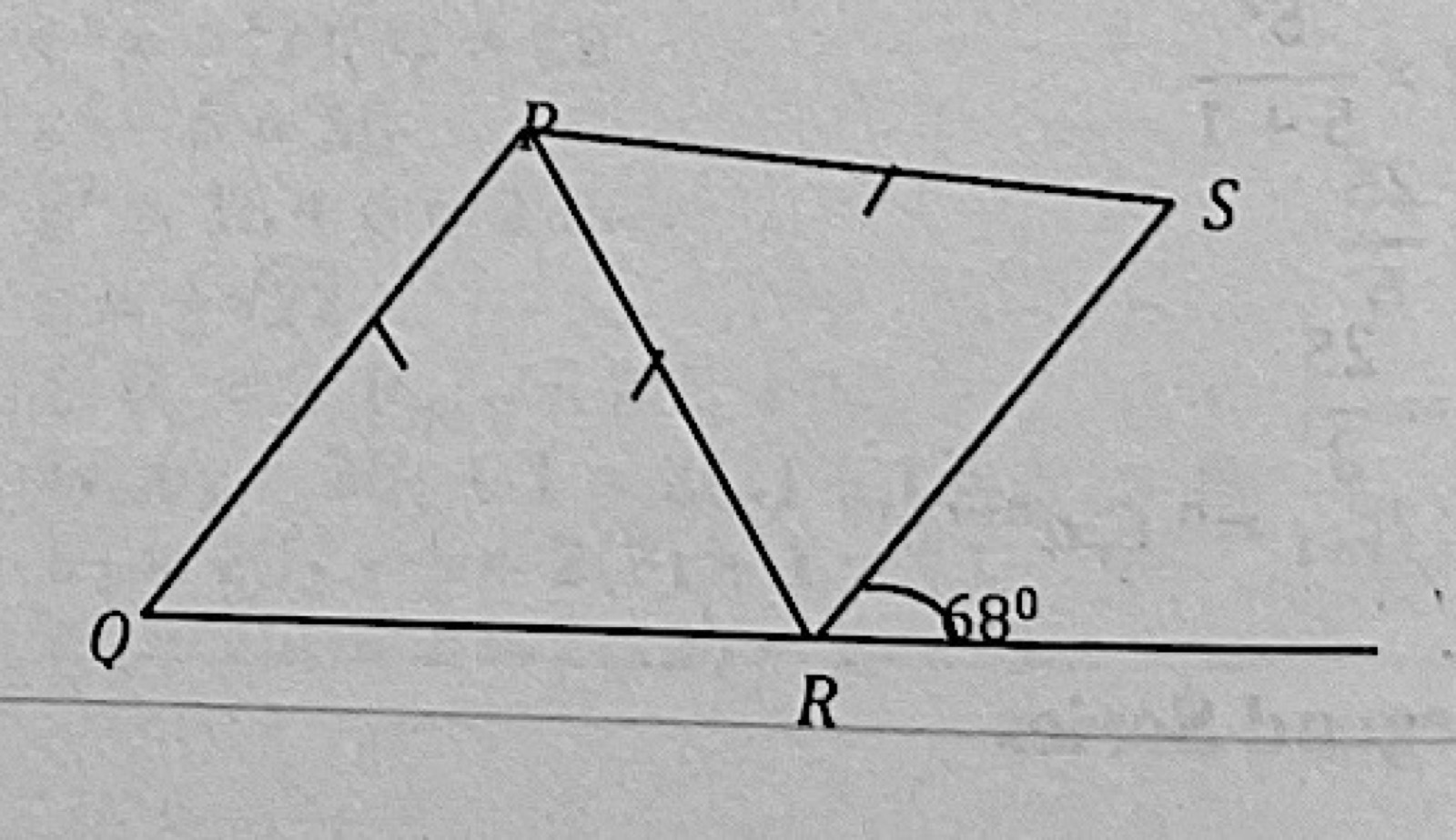
Question 22 Triangles and Quadrilaterals In the figure below |PQ| = |PR| = |PS| and SR̂T = 68°, find QP̂S
A. 68° B. 112° C. 136° D. 56° Show the answer and explanation Answer: C (136° )
Explanation Triangles PQR and PRS are isosceles, so ∠PRQ = ∠PQR and ∠PRS = ∠PSR. On the straight line at R, ∠PRQ + ∠PRS = 180° − 68° = 112°. Then ∠QPS = (180° − 2∠PRQ) + (180° − 2∠PRS) = 360° − 224° = 136°.
Open this question
Question 23 Indices Find x from the equation 273x + 1/2 = 95x − 1/4
A. 3/4 B. 2 C. 4 D. 1/2 Show the answer and explanation Answer: B (2 )
Explanation Write both as powers of 3: 3^(9x + 3/2) = 3^(10x − 1/2), so 9x + 3/2 = 10x − 1/2 and x = 2.
Open this question Sign up free for every UI Post-UTME Mathematics year, practice by topic and timed mocks.
Start practising free JAMB, UTME, WAEC, WASSCE, NECO, NABTEB and GCE are names of their respective examining bodies. Passwella is an independent practice platform and is not affiliated with or endorsed by any of them.