JAMB Use of English 1987 past questions and answers

98 questions. Try each one, then open the answer to check yourself and read the explanation.

Question 1

Comprehension
JAMB 1987 Passage I: Obituaries
There are one or two things this country can teach others, one of which is the art of writing obituaries. One suspects that the reason why some of our newspapers still manage to break even is because of the great amount of revenue they derive from obituaries. It is not unusual for about one quarter of the volume of an average daily to be constituted of obituaries and In memoriam alone. One possible explanation for this, it has been argued, is that Nigerians value their dead greatly. And there is a saying amongst us that you do not say evil things against the dead. This is obviously the philosophy behind the large dose of encomiums with which our dead are bestowed. From the evidences of these obituaries and In memoriam, every dead Nigerian must have been something of a saint while alive. This would explain why the death of most Nigerians is attributed to the evil machinations of the wicked. Only very few people in our country die natural death, and even when they do, the obituaries, etc. always give the impression that such deaths constitute the saddest loss to befall the deceased's family. And, that is why writers of these obituaries and their allied advertisements are experts on 'mortuary stylistics' This 'mortuary stylistics,' the study in the art of eulogizing the dead and making their loss sound so heart breaking, is one of the commodities we can export to other countries.

The tone of this passage is

  1. A.angry.
  2. B.satirical.
  3. C.non-commital.
  4. D.pleasant.
Show the answer and explanation

Answer: B (satirical.)

Explanation

The writer mocks the habit of praising every dead person as a saint and jokes about exporting 'mortuary stylistics', so the tone is satirical.

Open this question

Question 2

Comprehension

'Mortuary stylistics' as used in the passage refers to the

  1. A.art of writing obituaries.
  2. B.text of obituaries.
  3. C.study of obituaries.
  4. D.art of eulogizing the dead
Show the answer and explanation

Answer: D (art of eulogizing the dead)

Explanation

The passage itself defines 'mortuary stylistics' as 'the study in the art of eulogizing the dead and making their loss sound so heart breaking'.

Open this question

Question 3

Comprehension

'One suspects that the reason why some of our newspapers still manage to break even.....' suggests that some Nigerian newspapers

  1. A.would be running at a loss but for obituaries.
  2. B.are patronized only because they specialize in obituaries.
  3. C.derive all their revenue from obituaries.
  4. D.invest huge revenue in obituaries.
Show the answer and explanation

Answer: A (would be running at a loss but for obituaries.)

Explanation

To break even is to make neither profit nor loss; if obituary revenue is what lets them break even, without it they would make a loss.

Open this question

Question 4

Comprehension

Obituaries are very popular in Nigeria because

  1. A.evil things are not said against the dead.
  2. B.every dead Nigerian must have lived a saintly life.
  3. C.only very few Nigerians die natural deaths.
  4. D.Nigerians value their dead greatly.
Show the answer and explanation

Answer: D (Nigerians value their dead greatly.)

Explanation

The passage gives as the 'possible explanation' for the many obituaries that 'Nigerians value their dead greatly'.

Open this question

Question 5

Comprehension

Which of the following can be deduced from the passage?

  1. A.The writer believes that most Nigerians do not die natural deaths.
  2. B.Obituaries insinuate that most Nigerians do not die natural deaths.
  3. C.The writer is convinced that every death in Nigeria is a big blow to the bereaved.
  4. D.the writer suspects that every death in Nigeria is a big blow to the bereaved.
Show the answer and explanation

Answer: B (Obituaries insinuate that most Nigerians do not die natural deaths.)

Explanation

The obituaries attribute most deaths to 'the evil machinations of the wicked', so it is the obituaries, not the writer, that suggest people seldom die naturally.

Open this question

Question 6

Comprehension
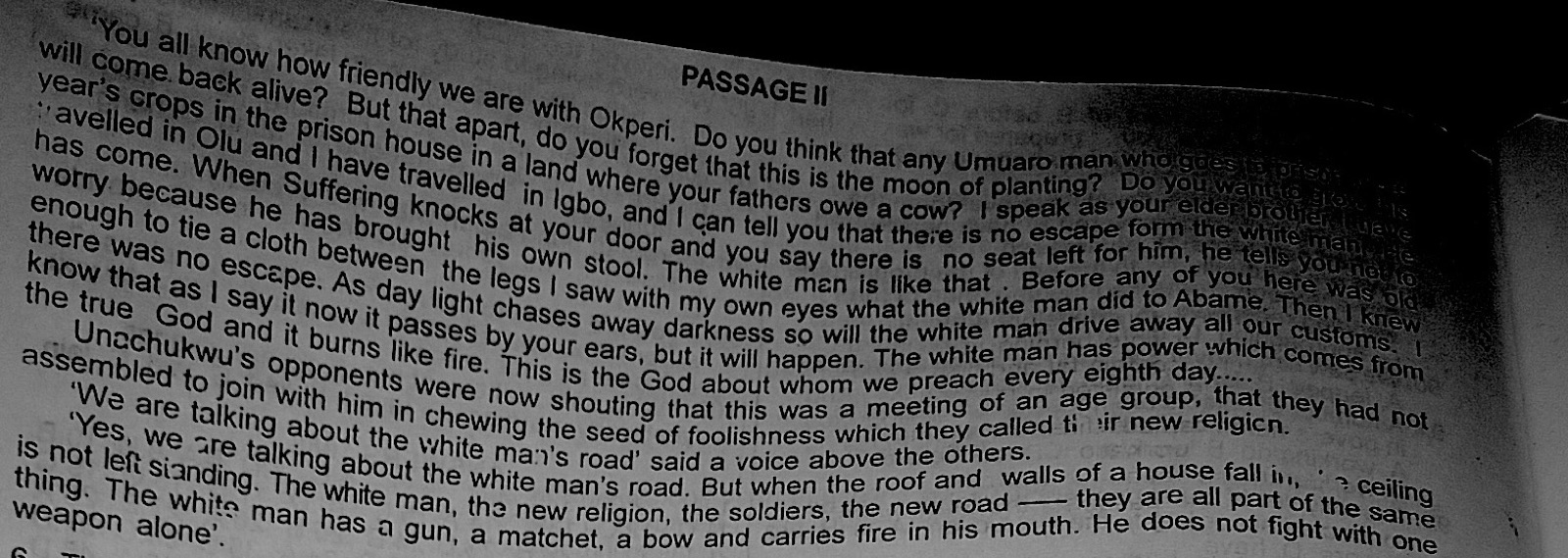
JAMB 1987 Passage II: The white man's road
The passage, as printed

The dominant subject of this passage is the

  1. A.white man's road
  2. B.new religion
  3. C.white man's influence
  4. D.white man's weapons
Show the answer and explanation

Answer: C (white man's influence)

Explanation

The road, the religion, the soldiers and the weapons are all described as 'part of the same thing': the white man's growing influence.

Open this question

Question 7

Comprehension

According to the passage, the people of Umuaro and Okperi

  1. A.are friends
  2. B.are only acquaintances
  3. C.are no friends
  4. D.can never be enemies
Show the answer and explanation

Answer: C (are no friends)

Explanation

'You all know how friendly we are with Okperi' is said ironically: the speaker warns that any Umuaro man taken to Okperi's prison would not come back alive, so the two are not friends.

Open this question

Question 8

Comprehension

'There is no escape from the white man' in the passage means that the

  1. A.white man will send the people to prison
  2. B.white man can kill all the people with his gun
  3. C.people are only trying to run away from the white man
  4. D.people must accept the white man.
Show the answer and explanation

Answer: D (people must accept the white man.)

Explanation

The speaker means that the white man's coming cannot be avoided, so the people have no choice but to accept him.

Open this question

Question 9

Comprehension

'Passes by your ears' in the passage means

  1. A.piercing through you ears
  2. B.listening eagerly
  3. C.making no impression
  4. D.accepting as the truth
Show the answer and explanation

Answer: C (making no impression)

Explanation

Words that pass by your ears are heard without being taken seriously, i.e. they make no impression.

Open this question

Question 10

Comprehension

Unachukwu's speech in this passage shows that he

  1. A.is a coward
  2. B.wants his people to suffer
  3. C.loves the white man
  4. D.is wise with experience.
Show the answer and explanation

Answer: D (is wise with experience.)

Explanation

He speaks 'as your elder brother', has travelled widely and saw what happened at Abame, so his warning comes from wisdom and experience.

Open this question

Question 11

Comprehension
JAMB 1987 Passage III: The untidy Conference Room
Manager: Mr. Mbu, I would not describe you as an inefficient worker; I therefore find it difficult to understand why the Conference Room is so untidy, in spite of the fact that I had reminded you of the meeting scheduled to take place there this afternoon.
Secretary: Sir, I did instruct the cleaner to tidy up the place before the meeting
Manager: Are you trying to hold the cleaner responsible for the untidy condition of the room?
Secretary: Partly, sir, I gave him an instruction which he failed to carry out. It is certainly my intention to make a formal complaint against him for dereliction of duty.
Manager: And would you wash your hands off any blame after that? Do you think that just making a formal complaint against the cleaner absolves you of all blame? When do you consider an assignment as properly executed: when the execution is properly supervised or not? Was it sufficient for you to give instructions to the cleaner without ensuring that he actually carried them out?
Secretary: Sir, I do not see what else I could have done, short of doing the job myself. The cleaner is a six-footer and I could not have intimidated him physically.
Manager: I see, I await your complaint against the cleaner, but I shall not forget that you allowed a board meeting to take place in an untidy Conference Room

The relationship between the manager and his secretary, as revealed in the passage, could be said to be

  1. A.strained
  2. B.charged
  3. C.personal
  4. D.cordial
Show the answer and explanation

Answer: A (strained)

Explanation

The manager questions and blames the secretary sharply and says he 'shall not forget' the lapse, so the relationship is tense, i.e. strained.

Open this question

Question 12

Comprehension

'I would not describe you as an inefficient worker.....' suggests that the manager

  1. A.is quite pleased with the level of diligence of his secretary
  2. B.has had cause in the past to complain against his secretary
  3. C.is dissatisfied with the level of performance of his secretary
  4. D.is non- committal over efficiency of his secretary
Show the answer and explanation

Answer: D (is non- committal over efficiency of his secretary)

Explanation

By only saying he would not call him 'inefficient', the manager avoids praising or condemning the secretary; he is being non-committal.

Open this question

Question 13

Comprehension

It would appear that the manager feels that the secretary

  1. A.should have, if possible, personally cleaned the Conference Room
  2. B.should have ensured that someone else cleaned the Conference Room
  3. C.should have ensured that the cleaner did his job
  4. D.is a coward
Show the answer and explanation

Answer: C (should have ensured that the cleaner did his job)

Explanation

The manager asks whether it was enough 'to give instructions to the cleaner without ensuring that he actually carried them out', so he expected the secretary to make sure the cleaner did the job.

Open this question

Question 14

Comprehension

The secretary's attitude seems to be

  1. A.'manager sir, you employed this huge and recalcitrant cleaner and I am not going to do his job for him'
  2. B.'It is not the duty of a secretary to enforce the instructions he gives to his junior workers'
  3. C.'I am a secretary by profession not a cleaner
  4. D.'It is not terribly important how tidy the Conference Room is for the meeting'
Show the answer and explanation

Answer: B ('It is not the duty of a secretary to enforce the instructions he gives to his junior workers')

Explanation

The secretary believes that giving the instruction was enough and says he could not have done anything else, so he does not see enforcing it as his duty.

Open this question

Question 15

Comprehension

The last comment by the manager suggests that he

  1. A.is going to hold the secretary responsible for what has happened
  2. B.is likely to reprimand both the secretary and the cleaner for dereliction of duty
  3. C.will punish the cleaner but warn the secretary
  4. D.will warn the cleaner and punish the secretary.
Show the answer and explanation

Answer: A (is going to hold the secretary responsible for what has happened)

Explanation

'I shall not forget that you allowed a board meeting to take place in an untidy Conference Room' shows he holds the secretary responsible.

Open this question

Question 16

Comprehension
JAMB 1987 Passage IV: Fire, torches and lamps
Primitive man was probably more concerned with fire as a source of warmth an as a means of cooking food than as a source of light. Before he discovered less laborious ways of making fire, he had to preserve it, and whenever he went on a journey he carried a firebrand with him. He discovery that the firebrand, from which the torch may well have developed, could be used for illumination was probably incidental to the primary purpose of preserving a flame.

Lamps, too, probably developed by accident. Early man may have had his first conception of a lamp while watching a twing or fibre burning in the molten fat dropped form roasting carcass. All he had to do was to fashion a vessel to contain fat and float a lighted reed in it. Such lamps, which were made of hollowed stones or sea-shells, have persisted in identical form up to quite recent times

Primitive man carried a firebrand during his journeys mainly for

  1. A.illumination
  2. B.cooking of food
  3. C.flame preservation
  4. D.warmth
Show the answer and explanation

Answer: C (flame preservation)

Explanation

He carried the firebrand because he 'had to preserve' fire; its use for light was only 'incidental to the primary purpose of preserving a flame'.

Open this question

Question 17

Comprehension

According to the passage, the torch probably developed from a

  1. A.firebrand
  2. B.twig
  3. C.lamp
  4. D.fibre
Show the answer and explanation

Answer: A (firebrand)

Explanation

The passage speaks of 'the firebrand, from which the torch may well have developed'.

Open this question

Question 18

Comprehension

Primitive man was least concerned with fire as a

  1. A.means of cooking
  2. B.source of warmth
  3. C.source of light
  4. D.means of travelling
Show the answer and explanation

Answer: C (source of light)

Explanation

He was 'more concerned with fire as a source of warmth an as a means of cooking food than as a source of light', so light mattered least.

Open this question

Question 19

Comprehension

One way early man made a lamp was by putting a lighted reed in a

  1. A.hollowed stone
  2. B.sea shell
  3. C.vessel
  4. D.molten fat
Show the answer and explanation

Answer: D (molten fat)

Explanation

He made a vessel to hold fat and floated 'a lighted reed in it', i.e. in the fat.

Open this question

Question 20

Comprehension

Primitive man preserved fire because

  1. A.he used it for illumination during his travels
  2. B.his method of making fire was labourious
  3. C.he wanted to discover how to make a lamp
  4. D.he wanted to develop the torch
Show the answer and explanation

Answer: B (his method of making fire was labourious)

Explanation

He preserved fire because making a new one was hard work; the passage says this was before he found 'less laborious ways of making fire'.

Open this question

Question 21

Comprehension
JAMB 1987 Passage V: Record keeping
Developments in electronic science have transformed the art of record keeping the modern age. Traditionally, records of events were kept only in people's minds. It depended very much on the retentive power of the human memory. This was extremely dangerous as people either forgot events wholly or in part, or deliberately falsified details to suit their various interests. Interminable arguments were thus the order of the day. Even writing which replaced mental recording was not entirely free from these shortcomings as untruths could be written as true records either willingly or inadvertently. With the advent of the electronic memory, however, these dangers have been largely overcome. Recording on audio and video cassettes now show not what happened, but also who did or said what including how and when.

The author believes that electronic recording is

  1. A.superior only to mental recording
  2. B.inferior to both mental recording and writing
  3. C.superior to both mental recording and writing
  4. D.inferior to only writing
Show the answer and explanation

Answer: C (superior to both mental recording and writing)

Explanation

Both memory and writing could be wrong, but 'with the advent of the electronic memory ... these dangers have been largely overcome', so electronic recording is better than both.

Open this question

Question 22

Comprehension

The writer believes that the art of record keeping has

  1. A.improved over the years
  2. B.endangered the art of writing
  3. C.changed human memory
  4. D.overcome all the problems facing it
Show the answer and explanation

Answer: A (improved over the years)

Explanation

Record keeping moved from memory to writing to electronic recording, each better than the last, so it has improved; the dangers are 'largely', not all, overcome.

Open this question

Question 23

Comprehension

How many stages of development did the writer mention while discussing the art of record keeping?

  1. A.Two
  2. B.Three
  3. C.Four
  4. D.Five
Show the answer and explanation

Answer: B (Three)

Explanation

The passage describes three stages: records kept in people's minds, then writing, then electronic recording on audio and video cassettes.

Open this question

Question 24

Comprehension

According to the author, human memory is unreliable because people

  1. A.die and we forget what they said
  2. B.forget events or tell lies
  3. C.do not always know when events happen
  4. D.do not always know who did what and when
Show the answer and explanation

Answer: B (forget events or tell lies)

Explanation

People 'either forgot events wholly or in part, or deliberately falsified details', i.e. they forget or tell lies.

Open this question

Question 25

Comprehension

From the passage, we gather that writings almost

  1. A.as unreliable as human memory
  2. B.as reliable as electronic memory
  3. C.more reliable than electronic recording
  4. D.not to be compared to any recording system
Show the answer and explanation

Answer: A (as unreliable as human memory)

Explanation

Writing 'was not entirely free from these shortcomings' of memory, since untruths could be written down, so it is almost as unreliable as memory.

Open this question

Question 26

Antonyms

Choose the option opposite in meaning to the word(s) in italics: The house – wife was hard up before the end of each month

  1. A.upset
  2. B.penniless
  3. C.borrowing
  4. D.in no need
Show the answer and explanation

Answer: D (in no need)

Explanation

To be hard up is to be short of money; the opposite is to be in no need.

Open this question

Question 27

Antonyms

Choose the option opposite in meaning to the word(s) in italics: The retired General became a hard -nosed officer after fighting the war.

  1. A.tough
  2. B.weak
  3. C.indifferent
  4. D.bed-ridden
Show the answer and explanation

Answer: B (weak)

Explanation

Hard-nosed means tough and unsentimental; the opposite is weak.

Open this question

Question 28

Antonyms

Choose the option opposite in meaning to the word(s) in italics: The Lions lost the match because their goalkeeper was in a haze most of the time.

  1. A.indisposed
  2. B.confused
  3. C.alert
  4. D.sleeping.
Show the answer and explanation

Answer: C (alert)

Explanation

To be in a haze is to be confused and not thinking clearly; the opposite is alert.

Open this question

Question 29

Antonyms

Choose the option opposite in meaning to the word(s) in italics: Unless we see the evils clearly, contending against them is ike fighting the air

  1. A.avoiding
  2. B.struggling with
  3. C.combating
  4. D.repelling.
Show the answer and explanation

Answer: A (avoiding)

Explanation

To contend against something is to fight it; to avoid it is the opposite.

Open this question

Question 30

Antonyms

Choose the option opposite in meaning to the word(s) in italics: The explosive growth of world population has not been caused by a sudden increase in human fertility.

  1. A.fantastic
  2. B.gradual
  3. C.combustible
  4. D.dangerous
Show the answer and explanation

Answer: B (gradual)

Explanation

Explosive growth is sudden and very fast; gradual growth is slow and steady.

Open this question

Question 32

Antonyms

Choose the option opposite in meaning to the word(s) in italics: My brother's primary school foundation was solid and this influenced his secondary education

  1. A.sound
  2. B.sordid
  3. C.shaky
  4. D.weak
Show the answer and explanation

Answer: D (weak)

Explanation

A solid foundation is strong; a weak one is its opposite. 'Sound' means the same as solid.

Open this question

Question 33

Synonyms

Choose the option nearest in meaning to the word(s) or phrases in italics: 'It is very difficult to know who is not entitled to essential commodities these days' observed the mobbed NNSC official.

  1. A.qualified for
  2. B.disqualified from
  3. C.eligible
  4. D.worthy of
Show the answer and explanation

Answer: C (eligible)

Explanation

To be entitled to something is to be eligible for it, to have the right to it.

Open this question

Question 34

Synonyms

Choose the option nearest in meaning to the word(s) or phrases in italics: 'This is a miniaturized version of you house' remarked the Architect.

  1. A.compressed
  2. B.abridged
  3. C.decreased
  4. D.smaller
Show the answer and explanation

Answer: D (smaller)

Explanation

A miniaturized version is a much smaller copy of something.

Open this question

Question 36

Synonyms

Choose the option nearest in meaning to the word(s) or phrases in italics: Bola has a sonorous voice.

  1. A.high-pitched
  2. B.beautiful
  3. C.strong
  4. D.throaty
Show the answer and explanation

Answer: C (strong)

Explanation

Sonorous describes a deep, full, resonant sound, so a sonorous voice is a strong one.

Open this question

Question 37

Synonyms

Choose the option nearest in meaning to the word(s) or phrases in italics: Some workers went on rampage at a trade-fair.

  1. A.turned violent
  2. B.robbed
  3. C.were angry
  4. D.demostrated
Show the answer and explanation

Answer: A (turned violent)

Explanation

To go on the rampage is to rush about behaving violently.

Open this question

Question 38

Synonyms

Choose the option nearest in meaning to the word(s) or phrases in italics: We have to identify the protagonists of the new movement

  1. A.enemies
  2. B.leading figures
  3. C.opponents
  4. D.believers
Show the answer and explanation

Answer: B (leading figures)

Explanation

The protagonists of a movement are its leading supporters, its main figures.

Open this question

Question 39

Synonyms

Choose the option nearest in meaning to the word(s) or phrases in italics: My nephew came in stealthily through the back gate.

  1. A.briskly
  2. B.boldly
  3. C.wearily
  4. D.quietly
Show the answer and explanation

Answer: D (quietly)

Explanation

Stealthily means quietly and secretly, so as not to be noticed.

Open this question

Question 40

Idioms and Phrasal Verbs

Choose the option nearest in meaning to the word(s) or phrases in italics: The distance is not more than twenty kilometres as the crow flies

  1. A.by the longest route
  2. B.by the shortest route
  3. C.by air
  4. D.by the fastest means
Show the answer and explanation

Answer: B (by the shortest route)

Explanation

'As the crow flies' means in a straight line, the shortest distance between two places.

Open this question

Question 41

Synonyms

Choose the option nearest in meaning to the word(s) or phrases in italics: Your extreme patience sometimes infuriates me.

  1. A.impresses
  2. B.annoys
  3. C.frustrates
  4. D.amuses
Show the answer and explanation

Answer: B (annoys)

Explanation

To infuriate is to make very angry; 'annoys' is closest in meaning.

Open this question

Question 42

Synonyms

Choose the option nearest in meaning to the word(s) or phrases in italics: I cannot understand how he suddenly became audacious contrary to his nature.

  1. A.proud
  2. B.bold
  3. C.rude
  4. D.hostile
Show the answer and explanation

Answer: B (bold)

Explanation

Audacious means daring or bold.

Open this question

Question 43

Idioms and Phrasal Verbs

Choose the option nearest in meaning to the word(s) or phrases in italics: His as been a life of make -belief.

  1. A.faith
  2. B.fantasy
  3. C.grandeur
  4. D.religion
Show the answer and explanation

Answer: B (fantasy)

Explanation

Make-believe is pretending or imagining things that are not real, i.e. fantasy.

Open this question

Question 44

Synonyms

Choose the option nearest in meaning to the word(s) or phrases in italics: Our teacher seldom comes late to school.

  1. A.very often
  2. B.always
  3. C.frequently
  4. D.hardly ever
Show the answer and explanation

Answer: D (hardly ever)

Explanation

Seldom means rarely, i.e. hardly ever.

Open this question

Question 45

Idioms and Phrasal Verbs

Choose the option nearest in meaning to the word(s) or phrases in italics: At the age of 80, Musa wished he could put the clock back.

  1. A.stop the clock
  2. B.put down the clock
  3. C.go back in time
  4. D.have more time
Show the answer and explanation

Answer: C (go back in time)

Explanation

To put the clock back is to return to an earlier time; at 80, Musa wishes he could go back to his younger days.

Open this question

Question 46

Idioms and Phrasal Verbs

Choose the option nearest in meaning to the word(s) or phrases in italics: The Director left his secret file to the Secretary in good faith

  1. A.with proof
  2. B.in anxiety
  3. C.in anticipation
  4. D.in trust
Show the answer and explanation

Answer: D (in trust)

Explanation

Doing something in good faith means doing it honestly, trusting the other person.

Open this question

Question 47

Synonyms

Choose the option nearest in meaning to the word(s) or phrases in italics: The Chief approached the issue with convincing disinterestedness.

  1. A.lack of interest
  2. B.lack of personal interest
  3. C.inability to be interested
  4. D.unwillingness
Show the answer and explanation

Answer: B (lack of personal interest)

Explanation

Disinterestedness means impartiality: having nothing personal to gain. It is different from 'uninterested', which means not caring.

Open this question

Question 48

Synonyms

Choose the option nearest in meaning to the word(s) or phrases in italics: Nothing irritates the clerk more, than being assigned miscellaneous duties

  1. A.classified
  2. B.confidential
  3. C.unscheduled
  4. D.assorted.
Show the answer and explanation

Answer: D (assorted.)

Explanation

Miscellaneous means of various kinds, i.e. assorted.

Open this question

Question 49

Synonyms

Choose the option nearest in meaning to the word(s) or phrases in italics: It is of fundamental importance that one sleeps properly.

  1. A.undisputed
  2. B.basic
  3. C.special
  4. D.least
Show the answer and explanation

Answer: B (basic)

Explanation

Fundamental means basic, forming the foundation of something.

Open this question

Question 50

Synonyms

Choose the option nearest in meaning to the word(s) or phrases in italics: I know you've been eaves-dropping all along.

  1. A.dropping gently
  2. B.paying attention
  3. C.listening secretly
  4. D.dropping all the leaves
Show the answer and explanation

Answer: C (listening secretly)

Explanation

To eavesdrop is to listen secretly to other people's conversation.

Open this question

Question 51

Synonyms

Choose the option nearest in meaning to the word(s) or phrases in italics: She showed an affected interest in the game.

  1. A.real
  2. B.pretended
  3. C.concerned
  4. D.slight
Show the answer and explanation

Answer: B (pretended)

Explanation

'Affected' here means artificial or put on for show, so an affected interest is a pretended one.

Open this question

Question 52

Synonyms

Choose the option nearest in meaning to the word(s) or phrases in italics: I would not like you to do the work piecemeal

  1. A.at meal time
  2. B.bit by bit
  3. C.badly
  4. D.as a masterpiece
Show the answer and explanation

Answer: B (bit by bit)

Explanation

Piecemeal means one part at a time, bit by bit.

Open this question

Question 53

Synonyms

Choose the option nearest in meaning to the word(s) or phrases in italics: I think I'll like to reiterate the points earlier made.

  1. A.withdraw
  2. B.change
  3. C.challenge
  4. D.repeat
Show the answer and explanation

Answer: D (repeat)

Explanation

To reiterate is to say something again, to repeat it.

Open this question

Question 54

Idioms and Phrasal Verbs

Choose the option nearest in meaning to the word(s) or phrases in italics: The sudden death of the king put paid to the ambition of the Minister.

  1. A.encouraged
  2. B.rewarded
  3. C.benefitted
  4. D.terminated
Show the answer and explanation

Answer: D (terminated)

Explanation

To put paid to something is to end it completely.

Open this question

Question 55

Idioms and Phrasal Verbs

Choose the option nearest in meaning to the word(s) or phrases in italics: The man insisted on having no strings attached to the agreements.

  1. A.financial obligations
  2. B.documents
  3. C.conditions
  4. D.moral obligations
Show the answer and explanation

Answer: C (conditions)

Explanation

Strings attached are special conditions or restrictions.

Open this question

Question 56

Prepositions

Choose the word(s) or phrase(s) which best fills the gap(s): I was........ hearing distance of the speaker.

  1. A.on
  2. B.at
  3. C.within
  4. D.in
Show the answer and explanation

Answer: C (within)

Explanation

The fixed phrase is 'within hearing distance'.

Open this question

Question 57

Idioms and Phrasal Verbs

Choose the word(s) or phrase(s) which best fills the gap(s): Peter was such a skilful boxer that he was not afraid to take anybody.

  1. A.to
  2. B.upon
  3. C.on
  4. D.in
Show the answer and explanation

Answer: C (on)

Explanation

To 'take on' someone is to accept them as an opponent.

Open this question

Question 58

Idioms and Phrasal Verbs

Choose the word(s) or phrase(s) which best fills the gap(s): Owing to the constant harassment of ... by armed robbers, all night guards have been instructed to shoot...... every moving thing

  1. A.on sight
  2. B.by sight
  3. C.in sight
  4. D.off sight
Show the answer and explanation

Answer: A (on sight)

Explanation

The idiom is 'shoot on sight': shoot as soon as one is seen.

Open this question

Question 59

Vocabulary in Context

Choose the word(s) or phrase(s) which best fills the gap(s): My wife and I were to celebrate our silver wedding anniversary last Sunday. Unfortunately on that ...... day, my father -in-law died mysteriously.

  1. A.fruitless
  2. B.faithful
  3. C.futile
  4. D.fateful
Show the answer and explanation

Answer: D (fateful)

Explanation

A fateful day is one on which something important, often terrible, happens.

Open this question

Question 60

Idioms and Phrasal Verbs

Choose the word(s) or phrase(s) which best fills the gap(s): The first graduation ceremony of the university was attended by men from all...... of life

  1. A.works
  2. B.areas
  3. C.walks
  4. D.parts
Show the answer and explanation

Answer: C (walks)

Explanation

The fixed phrase is 'all walks of life', meaning all types of jobs and backgrounds.

Open this question

Question 61

Nouns and Determiners

Choose the word(s) or phrase(s) which best fills the gap(s): ........ guests enjoyed joy's birthday party.

  1. A.The whole
  2. B.All the
  3. C.Every
  4. D.Those very
Show the answer and explanation

Answer: B (All the)

Explanation

'Guests' is plural, so it takes 'All the'; 'every' needs a singular noun and 'the whole' an uncountable or single thing.

Open this question

Question 62

Verb Forms

Choose the word(s) or phrase(s) which best fills the gap(s): One would wish.......... missed that opportunity to be present at the graduation ball.

  1. A.to have not
  2. B.for having not
  3. C.to having
  4. D.not to have
Show the answer and explanation

Answer: D (not to have)

Explanation

The negative perfect infinitive is 'not to have missed', with 'not' before 'to'.

Open this question

Question 63

Idioms and Phrasal Verbs

Choose the word(s) or phrase(s) which best fills the gap(s): The ceremony was rounded .......... very late.

  1. A.up
  2. B.off
  3. C.of
  4. D.out
Show the answer and explanation

Answer: B (off)

Explanation

To 'round off' an event is to bring it to a finish.

Open this question

Question 64

Adjectives and Adverbs

Choose the word(s) or phrase(s) which best fills the gap(s): My....... brother intends to get married in December.

  1. A.senior
  2. B.elder
  3. C.older
  4. D.oldest
Show the answer and explanation

Answer: B (elder)

Explanation

Before a family noun like 'brother' we normally use 'elder'.

Open this question

Question 65

Nouns and Determiners

Choose the word(s) or phrase(s) which best fills the gap(s): The........ Affairs Officer is expecting all of us in the dining room.

  1. A.Student
  2. B.Student's
  3. C.Students
  4. D.Students'
Show the answer and explanation

Answer: A (Student)

Explanation

In job titles the noun is used like an adjective without an apostrophe: 'Student Affairs Officer'.

Open this question

Question 66

Concord

Choose the word(s) or phrase(s) which best fills the gap(s): Many a candidate.... to realise the difference between written and spoken English.

  1. A.fails
  2. B.fail
  3. C.have failed
  4. D.is failing
Show the answer and explanation

Answer: A (fails)

Explanation

'Many a' takes a singular noun and verb: 'Many a candidate fails'.

Open this question

Question 67

Vocabulary in Context

Choose the word(s) or phrase(s) which best fills the gap(s): Chinyere has not really described the Cabinet as irresponsible; she only........ it in her speech.

  1. A.alluded to
  2. B.implied
  3. C.applied
  4. D.suggested
Show the answer and explanation

Answer: A (alluded to)

Explanation

She did not say it directly but only referred to it indirectly, i.e. alluded to it.

Open this question

Question 68

Idioms and Phrasal Verbs

Choose the word(s) or phrase(s) which best fills the gap(s): '...... at 9:30 for more news', said the announcer.

  1. A.Switch on
  2. B.Tune in
  3. C.Hook on
  4. D.Channel in
Show the answer and explanation

Answer: B (Tune in)

Explanation

On radio, listeners are asked to 'tune in' to a station at a given time.

Open this question

Question 69

Vocabulary in Context

Choose the word(s) or phrase(s) which best fills the gap(s): The way that big boy bullied his sister with relish make me think he could be a .......

  1. A.bully
  2. B.sadist
  3. C.pugilist
  4. D.tyrant
Show the answer and explanation

Answer: B (sadist)

Explanation

A sadist is someone who enjoys hurting others; he bullied his sister 'with relish', that is, with enjoyment.

Open this question

Question 70

Concord

Choose the word(s) or phrase(s) which best fills the gap(s): All................ well with Peter.

  1. A.are not
  2. B.have not been
  3. C.were not
  4. D.is not.
Show the answer and explanation

Answer: D (is not.)

Explanation

'All' meaning 'everything' takes a singular verb: 'All is not well with Peter.'

Open this question

Question 71

Tenses

Choose the word(s) or phrase(s) which best fills the gap(s): Ore...... so if she had thought it necessary.

  1. A.would have said
  2. B.would say
  3. C.may have said
  4. D.could say
Show the answer and explanation

Answer: A (would have said)

Explanation

A third conditional ('if she had thought') needs 'would have' + past participle in the main clause.

Open this question

Question 72

Tenses

Choose the word(s) or phrase(s) which best fills the gap(s): We have done three quarters of the journey already; we ....... as well see the end of it.

  1. A.can
  2. B.might
  3. C.could
  4. D.may
Show the answer and explanation

Answer: B (might)

Explanation

'Might as well' means there is no good reason not to do something, which fits finishing a journey that is mostly done.

Open this question

Question 73

Vocabulary in Context

Choose the word(s) or phrase(s) which best fills the gap(s): My little daughter has.... sights; hence, she now wears glasses.

  1. A.diminutive
  2. B.blurred
  3. C.painful
  4. D.defective
Show the answer and explanation

Answer: D (defective)

Explanation

Faulty eyesight that needs glasses is described as defective sight.

Open this question

Question 74

Prepositions

Choose the word(s) or phrase(s) which best fills the gap(s): Bassey's evidence led... Okon being imprisoned for life.

  1. A.at.
  2. B.into
  3. C.in
  4. D.to
Show the answer and explanation

Answer: D (to)

Explanation

The verb 'lead' takes 'to': 'led to Okon being imprisoned'.

Open this question

Question 75

Adjectives and Adverbs

Choose the word(s) or phrase(s) which best fills the gap(s): My boss is usually a charming man but........ he can be very irritable.

  1. A.atimes
  2. B.at times
  3. C.those times
  4. D.with times
Show the answer and explanation

Answer: B (at times)

Explanation

'At times' (two words) means sometimes; 'atimes' is not standard English.

Open this question

Question 76

Vocabulary in Context

Choose the word(s) or phrase(s) which best fills the gap(s): We surely ought to have an... arrangement in case somebody discovers the present strategy.

  1. A.alternate
  2. B.alternating
  3. C.alternative
  4. D.alternant
Show the answer and explanation

Answer: C (alternative)

Explanation

An 'alternative' arrangement is another one that can be used instead; 'alternate' means every other one.

Open this question

Question 77

Prepositions

Choose the word(s) or phrase(s) which best fills the gap(s): The nurse kept apologizing to mothers as she stuck her needle.... every baby at the clinic.

  1. A.in
  2. B.onto
  3. C.on to
  4. D.into
Show the answer and explanation

Answer: D (into)

Explanation

A needle goes inside the body, so 'stuck her needle into' is correct.

Open this question

Question 78

Concord

Choose the word(s) or phrase(s) which best fills the gap(s): One of the ladies who...... in the premises....... been asked to withdraw.

  1. A.sells/have
  2. B.sell/have
  3. C.sells/has
  4. D.sell/has
Show the answer and explanation

Answer: D (sell/has)

Explanation

'Who' refers to 'the ladies' (plural), so 'sell'; the main subject is 'One', so 'has'.

Open this question

Question 79

Concord

Choose the word(s) or phrase(s) which best fills the gap(s): A Tale of Two Cities... the ........... we are studying for the examination.

  1. A.are/novels
  2. B.was/novel.
  3. C.were/novels
  4. D.is/novel
Show the answer and explanation

Answer: D (is/novel)

Explanation

A book title is one work, so it takes a singular verb and noun: 'is the novel'.

Open this question

Question 80

Tenses

Choose the word(s) or phrase(s) which best fills the gap(s): We must not take with us the feelings of inadequacy..... experienced during our preparations for the debate.

  1. A.that were
  2. B.those were
  3. C.that was
  4. D.that is
Show the answer and explanation

Answer: C (that was)

Explanation

'That was' refers back to 'inadequacy' and puts the experience in the past, during the preparations.

Open this question

Question 81

Tenses

Choose the word(s) or phrase(s) which best fills the gap(s): Omogbai reported that the examinations..... before he arrived in the hall.

  1. A.started
  2. B.have started
  3. C.had started
  4. D.are started
Show the answer and explanation

Answer: C (had started)

Explanation

The exams started before he arrived, both in the past, so the earlier action takes the past perfect 'had started'.

Open this question

Question 82

Concord

Choose the word(s) or phrase(s) which best fills the gap(s): In my opinion, neither the players nor the coach..... praise for the result of the match.

  1. A.deserves
  2. B.deserve
  3. C.are deserving
  4. D.is deserving
Show the answer and explanation

Answer: A (deserves)

Explanation

With 'neither ... nor' the verb agrees with the nearer subject, 'the coach', which is singular: 'deserves'.

Open this question

Question 83

Tenses

Choose the word(s) or phrase(s) which best fills the gap(s): No one has said anything yet, but I think I ..... be getting a salary increase next month

  1. A.must
  2. B.can
  3. C.would
  4. D.may
Show the answer and explanation

Answer: D (may)

Explanation

Nobody has confirmed the raise, so the speaker is only guessing about a possibility: 'I think I may be getting a salary increase'. 'Would' needs a condition such as 'if…'.

Open this question

Question 84

Verb Forms

Choose the word(s) or phrase(s) which best fills the gap(s): Student: Excuse me sir, must we complete the assignment before lunch? Teacher: No you...

  1. A.needn't
  2. B.mustn't
  3. C.can't
  4. D.shouldn't
Show the answer and explanation

Answer: A (needn't)

Explanation

The negative answer to 'must we?' is 'you needn't' (it is not necessary); 'mustn't' would forbid it.

Open this question

Question 85

Idioms and Phrasal Verbs

Choose the word(s) or phrase(s) which best fills the gap(s): During the demonstration, the mobile police were instructed to break.... the students' defence line.

  1. A.off
  2. B.open
  3. C.through
  4. D.down
Show the answer and explanation

Answer: C (through)

Explanation

To break through a line is to force a way past it.

Open this question

Question 86

Adjectives and Adverbs

Choose the word(s) or phrase(s) which best fills the gap(s): Roli failed because the examination was... difficult for her

  1. A.so
  2. B.very
  3. C.highly
  4. D.too
Show the answer and explanation

Answer: D (too)

Explanation

'Too' means more than is acceptable, which explains why she failed.

Open this question

Question 87

Prepositions

Choose the word(s) or phrase(s) which best fills the gap(s): My brother does not have a flair... Mathematics.

  1. A.for
  2. B.in
  3. C.at
  4. D.of
Show the answer and explanation

Answer: A (for)

Explanation

The noun 'flair' takes 'for': a flair for something.

Open this question

Question 88

Prepositions

Choose the word(s) or phrase(s) which best fills the gap(s): The poor little kid has been down.... fever these few days.

  1. A.with
  2. B.from
  3. C.in
  4. D.for
Show the answer and explanation

Answer: A (with)

Explanation

The phrase is 'down with' an illness.

Open this question

Question 89

Sentence Structure

Choose the word(s) or phrase(s) which best fills the gap(s): He did not stop to ask himself why... such thing.

  1. A.should he do
  2. B.he should do
  3. C.should he have done
  4. D.did he do
Show the answer and explanation

Answer: B (he should do)

Explanation

In an indirect question the word order is subject + verb: 'why he should do'.

Open this question

Question 90

Vocabulary in Context

Choose the word(s) or phrase(s) which best fills the gap(s): The quarrel has got to a stage where someone has to ......

  1. A.interrupt
  2. B.interfere
  3. C.intrude
  4. D.intervene
Show the answer and explanation

Answer: D (intervene)

Explanation

To intervene is to step in to settle a quarrel; 'interfere' suggests meddling.

Open this question

Question 91

Idioms and Phrasal Verbs

Choose the word(s) or phrase(s) which best fills the gap(s): The villages looked ... their leader for good examples.

  1. A.up to
  2. B.on to
  3. C.up at
  4. D.forward to
Show the answer and explanation

Answer: A (up to)

Explanation

To look up to someone is to admire them as an example.

Open this question

Question 92

Adjectives and Adverbs

Choose the word(s) or phrase(s) which best fills the gap(s): The hunter brought home.... antelope.

  1. A.alive
  2. B.a life
  3. C.a live
  4. D.a living
Show the answer and explanation

Answer: C (a live)

Explanation

'Live' (rhymes with 'five') is the adjective used before a noun, and 'antelope' needs the article 'a'.

Open this question

Question 93

Tenses

Choose the word(s) or phrase(s) which best fills the gap(s): Do not take my books out of this office unless you..... my permission to do so.

  1. A.get
  2. B.have
  3. C.had got
  4. D.are having
Show the answer and explanation

Answer: B (have)

Explanation

After 'unless' we use the simple present for a present condition: 'unless you have my permission'.

Open this question

Question 94

Nouns and Determiners

Choose the word(s) or phrase(s) which best fills the gap(s): The man insisted on giving unsolicited...

  1. A.advice
  2. B.advices
  3. C.advise
  4. D.advises
Show the answer and explanation

Answer: A (advice)

Explanation

'Advice' is an uncountable noun with no plural; 'advise' is the verb.

Open this question

Question 95

Vocabulary in Context

Choose the word(s) or phrase(s) which best fills the gap(s): Cultural patterns are modified as they are....... from one generation to the next.

  1. A.transported
  2. B.transposed
  3. C.translated
  4. D.transmitted
Show the answer and explanation

Answer: D (transmitted)

Explanation

To transmit is to pass something on; culture is passed on from one generation to the next.

Open this question

Question 96

Adjectives and Adverbs

Choose the word(s) or phrase(s) which best fills the gap(s): We discovered at the end of last term that we had to read.... books before we could confidently go for our final examination.

  1. A.more of many
  2. B.very many more
  3. C.very much more
  4. D.more very many
Show the answer and explanation

Answer: B (very many more)

Explanation

With a countable plural like 'books' we say 'very many more'; 'much' is for uncountables.
Open this question

Question 97

Tenses

Choose the word(s) or phrase(s) which best fills the gap(s): Chinedu took his umbrella with him in case it......

  1. A.rain
  2. B.rained
  3. C.would rain
  4. D.is raining
Show the answer and explanation

Answer: B (rained)

Explanation

After a past main verb ('took'), 'in case' is followed by the simple past: 'in case it rained'.

Open this question

Question 98

Idioms and Phrasal Verbs

Choose the word(s) or phrase(s) which best fills the gap(s): The train was too slow so I decided to ....... at the next stop

  1. A.get by
  2. B.get bye
  3. C.get off
  4. D.get of
Show the answer and explanation

Answer: C (get off)

Explanation

To leave a train is to 'get off'.

Open this question

Question 99

Nouns and Determiners

Choose the word(s) or phrase(s) which best fills the gap(s): Dapo has made good use of some useful.......on the chemical composition of chalk.

  1. A.information
  2. B.piece of information
  3. C.informations
  4. D.pieces of informations
Show the answer and explanation

Answer: A (information)

Explanation

'Information' is uncountable, so 'some useful information' with no plural.

Open this question

Question 100

Adjectives and Adverbs

Choose the word(s) or phrase(s) which best fills the gap(s): Tonye said that he was going to bed because he was .... to do any more work

  1. A.tired out
  2. B.very tired
  3. C.too tired
  4. D.extremely tired.
Show the answer and explanation

Answer: C (too tired)

Explanation

The pattern 'too + adjective + to-infinitive' means something is impossible: he was too tired to work.

Open this question