Home › Past questions › JAMB › Mathematics › 2006 48 questions. Try each one, then open the answer to check yourself and read the explanation.
Sign up free to answer these questions on a CBT screen with a timer, then see your score and every answer explained.
Start practising free
Question 1 Measures of Central Tendency Score: 1, 2, 3, 4, 5, 6, 7, 8
A. (33, 4) B. (22, 4) C. (33, 12) D. (12, 4) Show the answer and explanation Answer: A ((33, 4) )
Explanation The highest frequency (12) is for score 4, so m = 4. Students scoring 4 or more: 12 + 10 + 6 + 4 + 1 = 33, so (n, m) = (33, 4).
Open this question
Question 2 Permutation and Combination A final examination requires that a student answer any 4 out of 6 questions. In how many ways can this be done?
A. 15 B. 20 C. 30 D. 45 Show the answer and explanation Answer: A (15 )
Explanation 6 C4 = 6!/(4! 2!) = 15.
Open this question
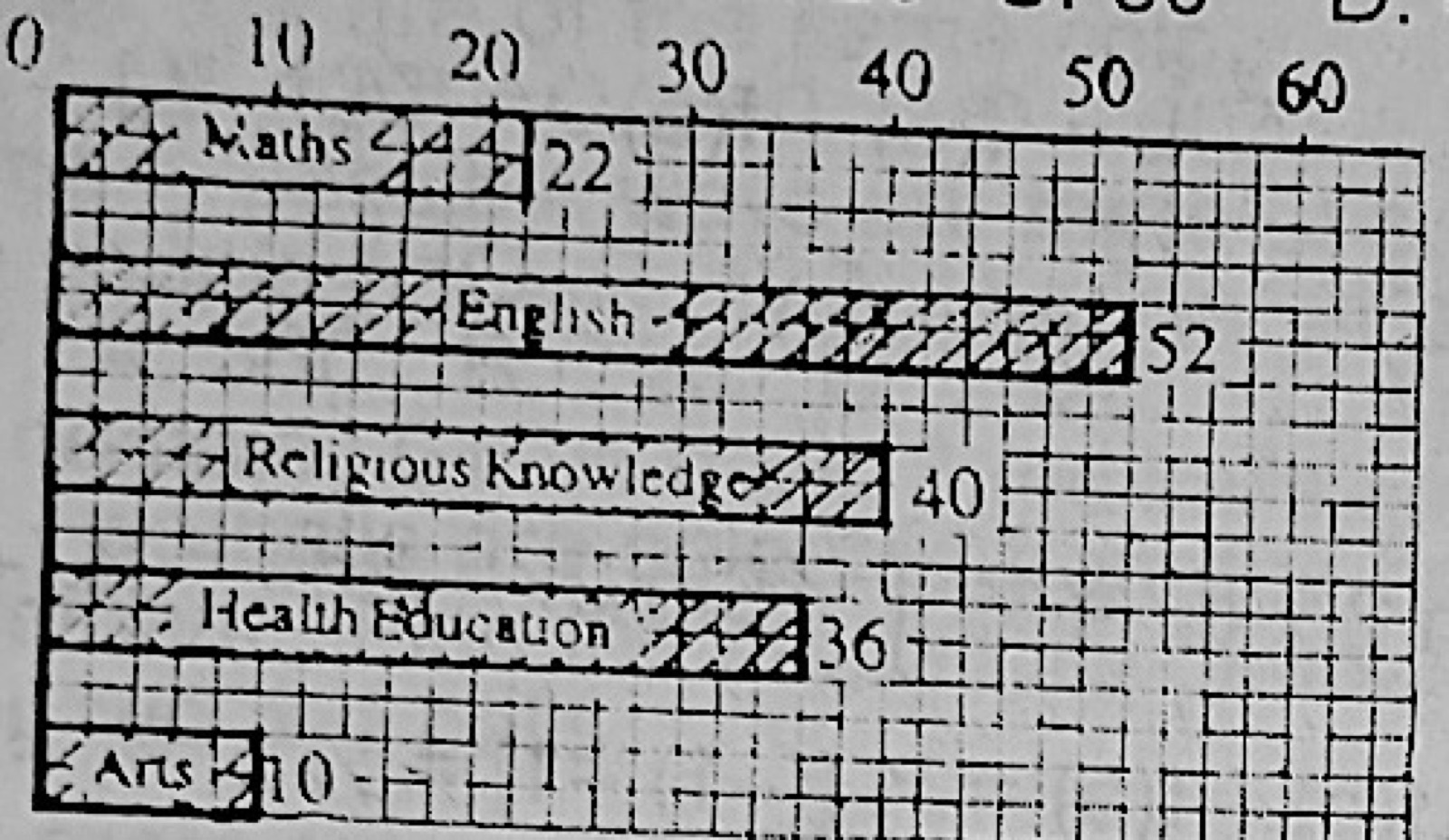
Question 3 Data Presentation The response of 160 pupils in a school asked to indicate their favourite subjects is given in the bar chart above. What percentage of the pupils have English and Health Education as their favourite subjects?
A. 36% B. 52% C. 55% D. 22% Show the answer and explanation Answer: C (55% )
Explanation English 52 + Health Education 36 = 88 pupils. 88/160 × 100% = 55%.
Open this question
Question 4 Measures of Central Tendency If the mean of five consecutive integers is 30, find the largest of the numbers.
A. 28 B. 30 C. 32 D. 34 Show the answer and explanation Answer: C (32 )
Explanation For five consecutive integers the mean is the middle one, 30, so they are 28 to 32 and the largest is 32.
Open this question
Question 5 Probability A bag contains 5 black, 4 white and x red marbles. If the probability of picking a red marble is 2/5, find the value of x.
A. 8 B. 10 C. 4 D. 6 Show the answer and explanation Answer: D (6 )
Explanation x/(9 + x) = 2/5 gives 5x = 18 + 2x, so x = 6.
Open this question
Question 6 Measures of Dispersion Find the variance of 2x, 2x − 1 and 2x + 1
A. 2/3 B. 2 C. √(2/3) D. 1 Show the answer and explanation Answer: A (2/3 )
Explanation The mean is 2x and the deviations are 0, −1, 1. Variance = (0 + 1 + 1)/3 = 2/3.
Open this question
Question 7 Probability GSM operators: GTN, PLO, Qtel, Cmob
A. 3/20 B. 1/4 C. 2/5 D. 3/4 Show the answer and explanation Answer: C (2/5 )
Explanation There are 20 cards and 5 + 3 = 8 are GTN or Qtel, so the probability is 8/20 = 2/5.
Open this question
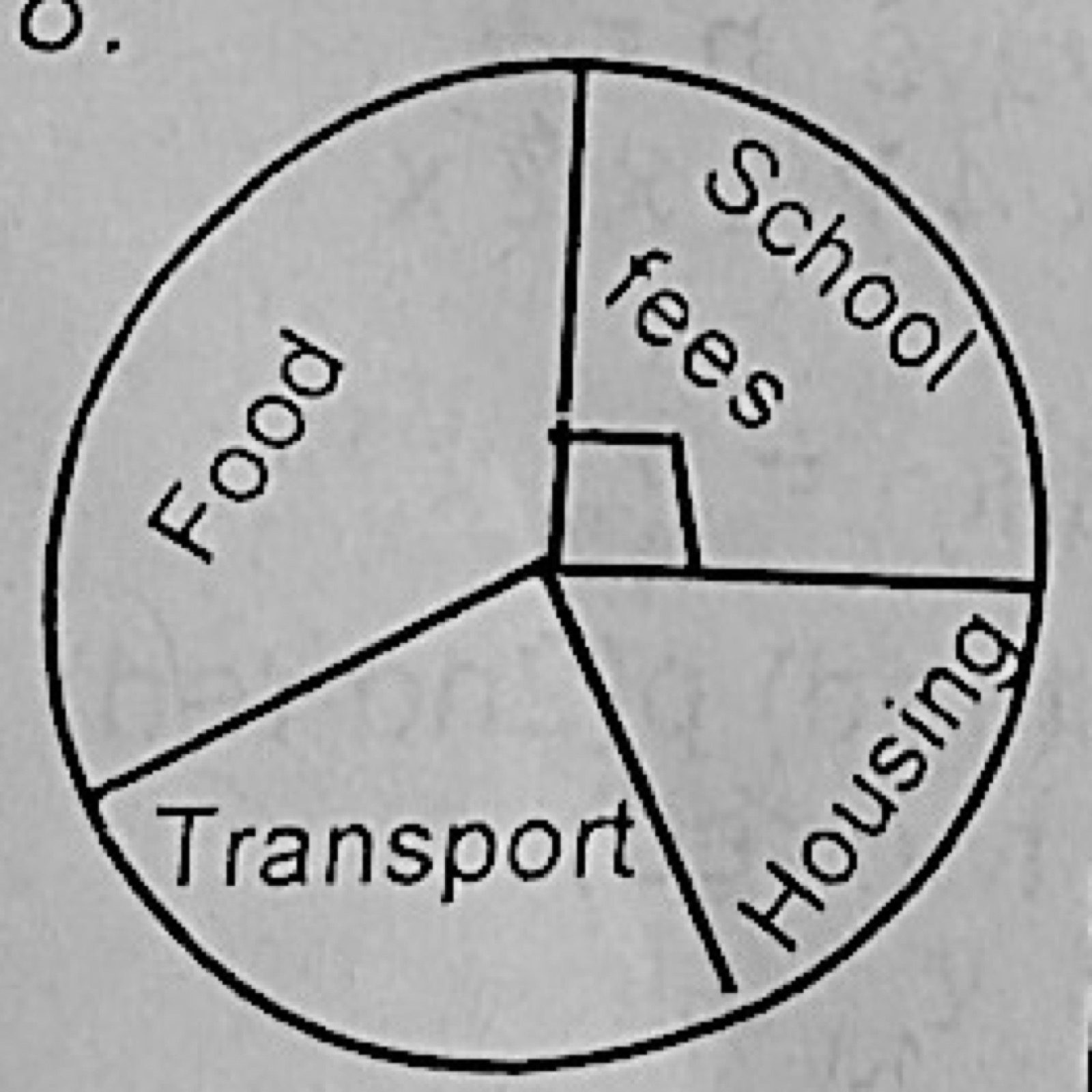
Question 8 Data Presentation The pie chart above shows the expenditure of a family whose income is N30,000. If the expenditure on food is twice that on housing and that on school fees is twice that on transport, how much does the family spend on food?
A. N28,000 B. N25,500 C. N15,000 D. N12,500 Show the answer and explanation Answer: D (N12,500 )
Explanation School fees is a right angle (90°), so transport is 45°. Food + housing = 360° − 135° = 225° = 3 × housing, so housing = 75° and food = 150°. Food = 150/360 × 30,000 = N12,500.
Open this question
Question 9 Permutation and Combination For what value of n is n+1 C3 = 4(n C3 )?
A. 6 B. 5 C. 4 D. 3 Show the answer and explanation Answer: D (3 )
Explanation n+1 C3 /n C3 = (n + 1)/(n − 2) = 4, so n + 1 = 4n − 8 and n = 3.
Open this question
Question 10 Integration The gradient of a curve is 2x + 7 and the curve passes through point (2, 0). Find the equation of the curve.
A. y = x2 + 7x + 9 B. y = x2 + 7x − 18 C. y = x2 + 7x + 18 D. y = x2 + 14x + 11 Show the answer and explanation Answer: B (y = x2 + 7x − 18 )
Explanation Integrating, y = x2 + 7x + c. At (2, 0): 4 + 14 + c = 0, so c = −18.
Open this question
Question 11 Differentiation Differentiate (x2 − 1/x)2 with respect to x.
A. 4x3 − 4x − 2/x B. 4x3 − 2 + 2/x3 C. 4x3 − 2 − 2/x3 D. 4x3 − 3x + 2/x Show the answer and explanation Answer: C (4x3 − 2 − 2/x3 )
Explanation dy/dx = 2(x2 − 1/x)(2x + 1/x2 ) = 2(2x3 + 1 − 2 − 1/x3 ) = 4x3 − 2 − 2/x3 .
Open this question
Question 12 Differentiation Find the value of x for which the function 3x3 − 9x2 is minimum.
A. 0 B. 2 C. 3 D. 5 Show the answer and explanation Answer: B (2 )
Explanation f'(x) = 9x2 − 18x = 9x(x − 2) = 0 at x = 0 or 2. f''(2) = 54 − 18 > 0, so the minimum is at x = 2.
Open this question
Question 13 Integration If dy/dx = x + cos x, find y.
A. x2 − sin x + c B. x2 + sin x + c C. x2 /2 − sin x + c D. x2 /2 + sin x + c Show the answer and explanation Answer: D (x2 /2 + sin x + c )
Explanation Integrate each term: ∫x dx = x2 /2 and ∫cos x dx = sin x, plus a constant.
Open this question
Question 14 Differentiation Differentiate (cos θ − sin θ)2 with respect to θ.
A. −2 cos 2θ B. −2 sin 2θ C. 1 − 2 cos 2θ D. 1 − 2 sin 2θ Show the answer and explanation Answer: A (−2 cos 2θ )
Explanation (cos θ − sin θ)2 = 1 − 2 sin θ cos θ = 1 − sin 2θ, whose derivative is −2 cos 2θ.
Open this question
Question 15 Integration Evaluate ∫−4 1 (1 − 2x)dx.
A. −16 B. −20 C. 20 D. 10 Show the answer and explanation Answer: C (20 )
Explanation [x − x2 ] from −4 to 1 = (1 − 1) − (−4 − 16) = 20.
Open this question
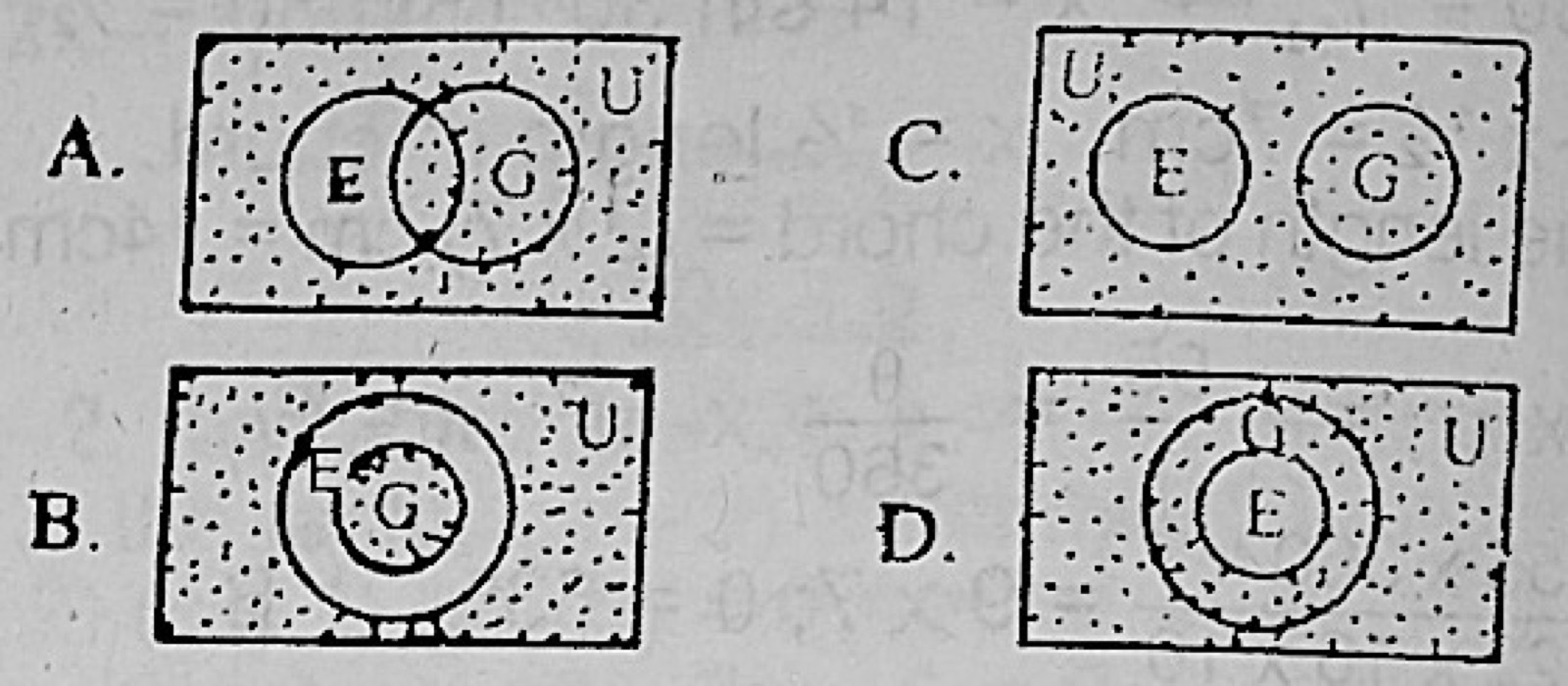
Question 16 Sets If E ⊆ G ⊆ U, where U is the universal set, then the shaded venn diagram representing U − E or Ec is
A. Diagram A B. Diagram B C. Diagram C D. Diagram D Show the answer and explanation Answer: D (Diagram D )
Explanation E is inside G, which is inside U, so the diagram must show E's circle within G's. U − E is everything except E, which is the shading in D.
Open this question
Question 18 Ratio, Percentages and Rates If m : n = 13 : 11, find m2 − n2 : (m + n)2 .
A. 1 : 11 B. 1 : 13 C. 1 : 10 D. 1 : 12 Show the answer and explanation Answer: D (1 : 12 )
Explanation Take m = 13, n = 11: m2 − n2 = 48 and (m + n)2 = 576. 48 : 576 = 1 : 12.
Open this question
Question 19 Logarithms Calculate the logarithm to base 9 of 3−4 × 92 × (81)−1 .
A. 2 B. 0 C. −2 D. −4 Show the answer and explanation Answer: C (−2 )
Explanation In powers of 9: 3−4 = 9−2 and 81−1 = 9−2 , so the product is 9−2 + 2 − 2 = 9−2 , whose log to base 9 is −2.
Open this question
Question 20 Number Bases If (k2)6 × 36 = 35 (k4)5 , what is the value of k?
A. 1 B. 4 C. 3 D. 2 Show the answer and explanation Answer: D (2 )
Explanation In base ten: (6k + 2) × 3 = 3 × (5k + 4), so 18k + 6 = 15k + 12 and k = 2.
Open this question
Question 21 Sets In a small village of 500 people, 350 speak the local language while 200 speak pidgin English. What percentage of the population speak both?
A. 30% B. 10% C. 50% D. 14% Show the answer and explanation Answer: B (10% )
Explanation Both = 350 + 200 − 500 = 50 people, which is 50/500 = 10%.
Open this question
Question 22 Commercial Arithmetic Find the tax on an income of N20,000 if no tax is paid on the first N10,000 and tax is paid at N50 in N1,000 on the next N5,000 and at N55 in N1,000 on the remainder.
A. N500 B. N552 C. N255 D. N525 Show the answer and explanation Answer: D (N525 )
Explanation Next N5,000: 5 × N50 = N250. Remaining N5,000: 5 × N55 = N275. Total tax = N525.
Open this question
Question 23 Surds Rationalize 2/(6 − 5√3)
A. −12/39 − 10√3/39 B. 12/39 − 10√3/39 C. −12/39 + 10√3/39 D. 12/39 + 10√3/39 Show the answer and explanation Answer: A (−12/39 − 10√3/39 )
Explanation Multiply by (6 + 5√3)/(6 + 5√3): 2(6 + 5√3)/(36 − 75) = (12 + 10√3)/(−39) = −12/39 − 10√3/39.
Open this question
Question 24 Number Bases Compute 1100112 + 111112 .
A. 10010102 B. 10100102 C. 10001102 D. 10001002 Show the answer and explanation Answer: B (10100102 )
Explanation 1100112 = 51 and 111112 = 31. Their sum 82 = 64 + 16 + 2 = 10100102 .
Open this question
Question 25 Indices Simplify (25)−½ × (27)1/3 + (121)−½ × (625)−¼
A. 34/55 B. 9/11 C. 14/5 D. 3/275 Show the answer and explanation Answer: A (34/55 )
Explanation This is 1/5 × 3 + 1/11 × 1/5 = 3/5 + 1/55 = 33/55 + 1/55 = 34/55.
Open this question
Question 26 Number Bases Convert 22324 to a number in base six.
A. 4506 B. 2546 C. 5536 D. 5406 Show the answer and explanation Answer: A (4506 )
Explanation 22324 = 128 + 32 + 12 + 2 = 174. Dividing by 6 repeatedly: 174 = 4 × 36 + 5 × 6 + 0, so 4506 .
Open this question
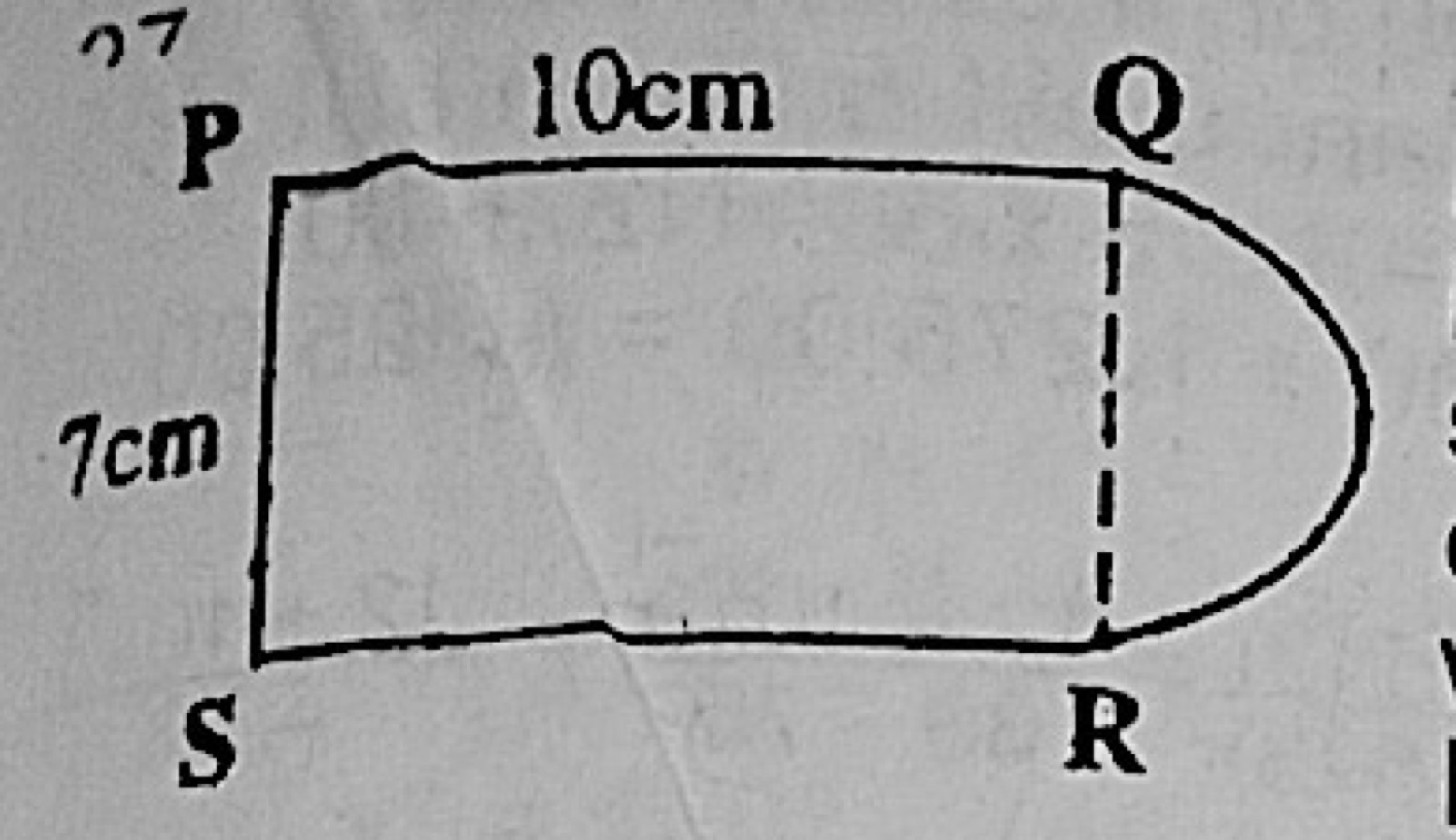
Question 27 Mensuration of Plane Shapes In the diagram above, |QR| is the diameter of the semicircle QR. Find the area of the figure to the nearest whole number. [π = 22/7]
A. 89cm2 B. 70cm2 C. 90cm2 D. 80cm2 Show the answer and explanation Answer: A (89cm2 )
Explanation Rectangle = 10 × 7 = 70cm2 . Semicircle with radius 3.5cm = ½ × 22/7 × 3.52 = 19.25cm2 . Total ≈ 89cm2 .
Open this question
Question 28 Trigonometry If tan θ = 5/4, find sin2 θ − cos2 θ.
A. 5/4 B. 41/9 C. 9/41 D. 1 Show the answer and explanation Answer: C (9/41 )
Explanation The hypotenuse is √(25 + 16) = √41, so sin2 θ − cos2 θ = 25/41 − 16/41 = 9/41.
Open this question
Question 29 Coordinate Geometry PQ and RS are two parallel lines. If the coordinates of P, Q, R, S are (1, q), (3, 2), (3, 4), (5, 2q) respectively, find the value of q.
A. 3 B. 4 C. 1 D. 2 Show the answer and explanation Answer: D (2 )
Explanation Gradient of PQ = (2 − q)/2 and gradient of RS = (2q − 4)/2. Parallel lines have equal gradients, so 2 − q = 2q − 4 and q = 2.
Open this question
Question 30 Trigonometry In triangle XYZ, ∠XYZ = 15°, ∠XZY = 45° and |XY| = 7cm. Find |YZ|.
A. 14√2cm B. (7/2)√6cm C. 7√2cm D. 7cm Show the answer and explanation Answer: B ((7/2)√6cm )
Explanation ∠YXZ = 180° − 15° − 45° = 120°. By the sine rule, YZ = 7 × sin 120°/sin 45° = 7 × (√3/2)/(√2/2) = 7√6/2.
Open this question
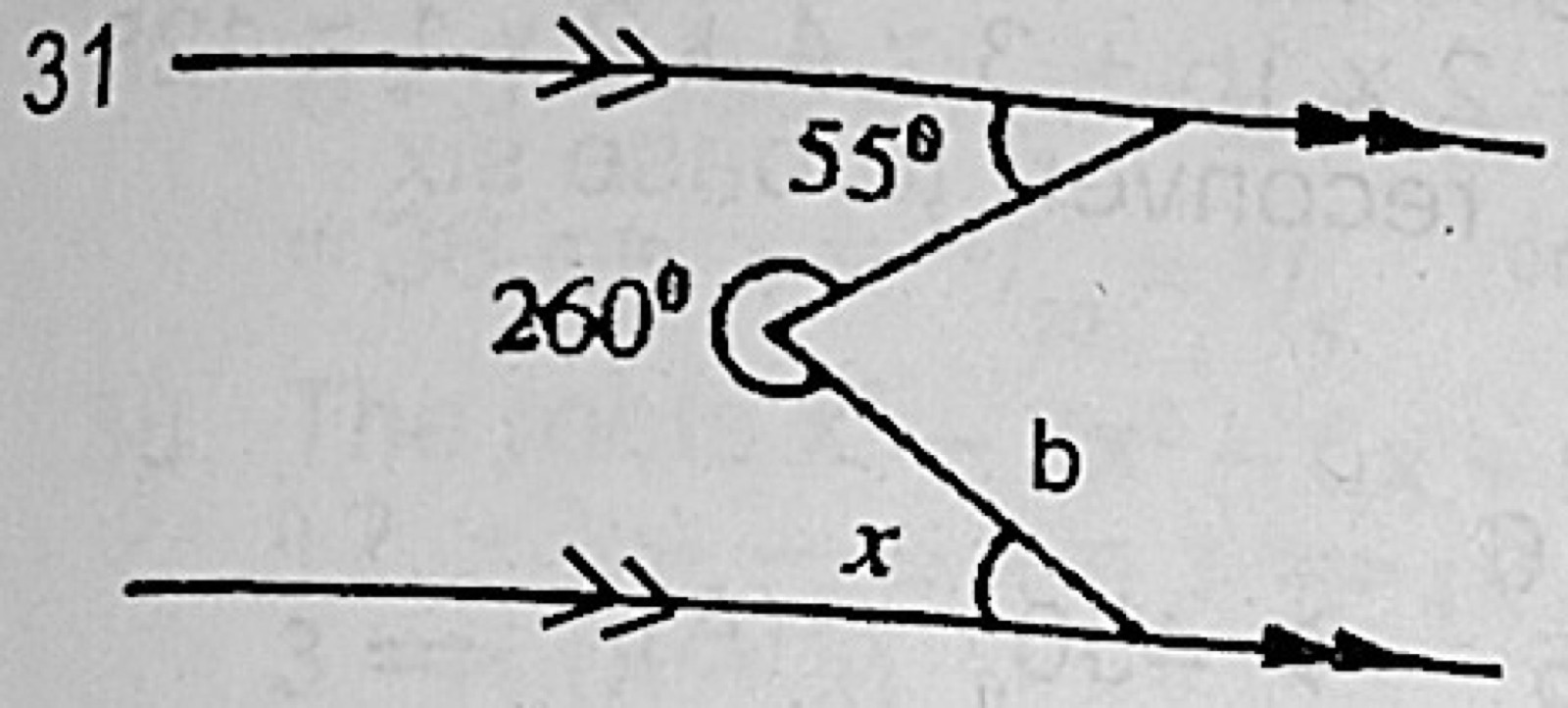
Question 31 Triangles and Quadrilaterals In the diagram above, find the value of x.
A. 55° B. 50° C. 45° D. 40° Show the answer and explanation Answer: C (45° )
Explanation The angle inside the vertex is 360° − 260° = 100°. A line through the vertex parallel to the others splits it into 55° and x (alternate angles), so x = 100° − 55° = 45°.
Open this question
Question 33 Loci What is the locus of points equidistant from the line ax + by + c = 0?
A. A line bx − ay + q = 0 B. A line ax − by + q = 0 C. A line bx + ay + q = 0 D. A line ax + by + q = 0 Show the answer and explanation Answer: D (A line ax + by + q = 0 )
Explanation Points at a fixed distance from a line lie on lines parallel to it, which have the same x and y coefficients: ax + by + q = 0.
Open this question
Question 34 Angles and Polygons PQRSTW is a regular hexagon and QS intersects RT at V. Calculate ∠TVS.
A. 120° B. 90° C. 30° D. 60° Show the answer and explanation Answer: D (60° )
Explanation Each interior angle is 120°. Triangles QRS and RST are isosceles, so ∠RSQ = ∠STR = 30°. Then ∠VST = 120° − 30° = 90° and ∠TVS = 180° − 90° − 30° = 60°.
Open this question
Question 35 Loci If the locus of the points which are equidistant from points P and Q meets line PQ at point N, then PN equals
A. NQ B. −NQ C. 2NQ D. −NQ Show the answer and explanation Answer: A (NQ )
Explanation That locus is the perpendicular bisector of PQ, which meets PQ at its midpoint, so PN = NQ.
Open this question
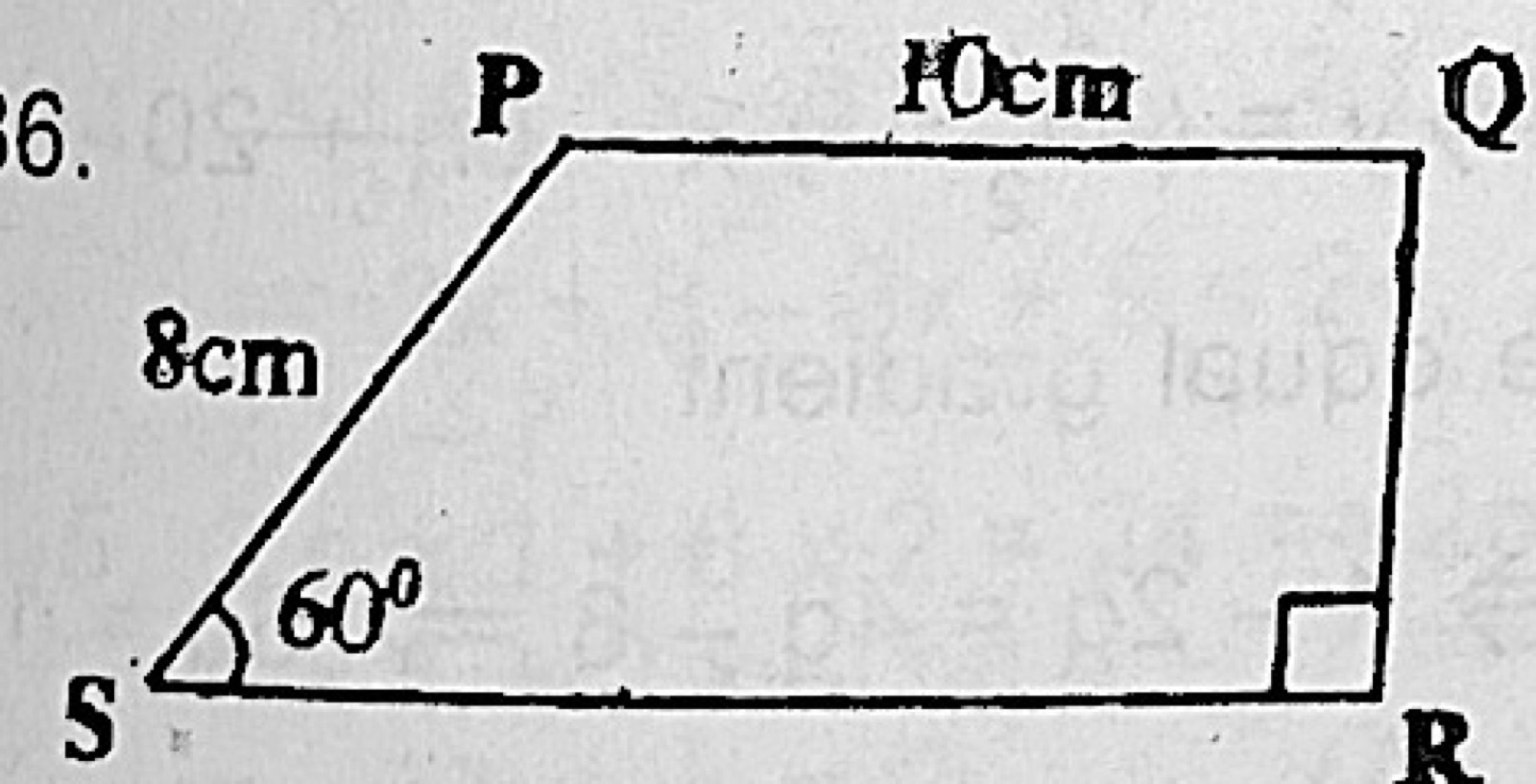
Question 36 Trigonometry In the diagram above, PQ = 10cm, PS = 8cm and ∠PSR is 60° while ∠SRQ is a right angle. Find SR.
A. 14cm B. 14√3cm C. 10cm D. 10√3cm Show the answer and explanation Answer: A (14cm )
Explanation Drop a perpendicular from P to N on SR. SN = 8 cos 60° = 4cm and NR = PQ = 10cm, so SR = 14cm.
Open this question
Question 37 Binary Operations A binary operation ⊖ defined on the set of real numbers is such that x⊖y = xy/6 for all x, y ∈ R. Find the inverse of 20 under this operation when the identity element is 6.
A. 1/12 B. 10/3 C. 1/20 D. 9/5 Show the answer and explanation Answer: D (9/5 )
Explanation 20 ⊖ x = 20x/6 must equal the identity 6, so 20x = 36 and x = 9/5.
Open this question
Question 38 Polynomials Find the roots of x3 − 2x2 − 5x + 6 = 0.
A. 1, 2, −3 B. −1, −2, 3 C. −1, 2, −3 D. 1, −2, 3 Show the answer and explanation Answer: D (1, −2, 3 )
Explanation x = 1 gives 1 − 2 − 5 + 6 = 0. Dividing leaves x2 − x − 6 = (x − 3)(x + 2), so the roots are 1, −2, 3.
Open this question
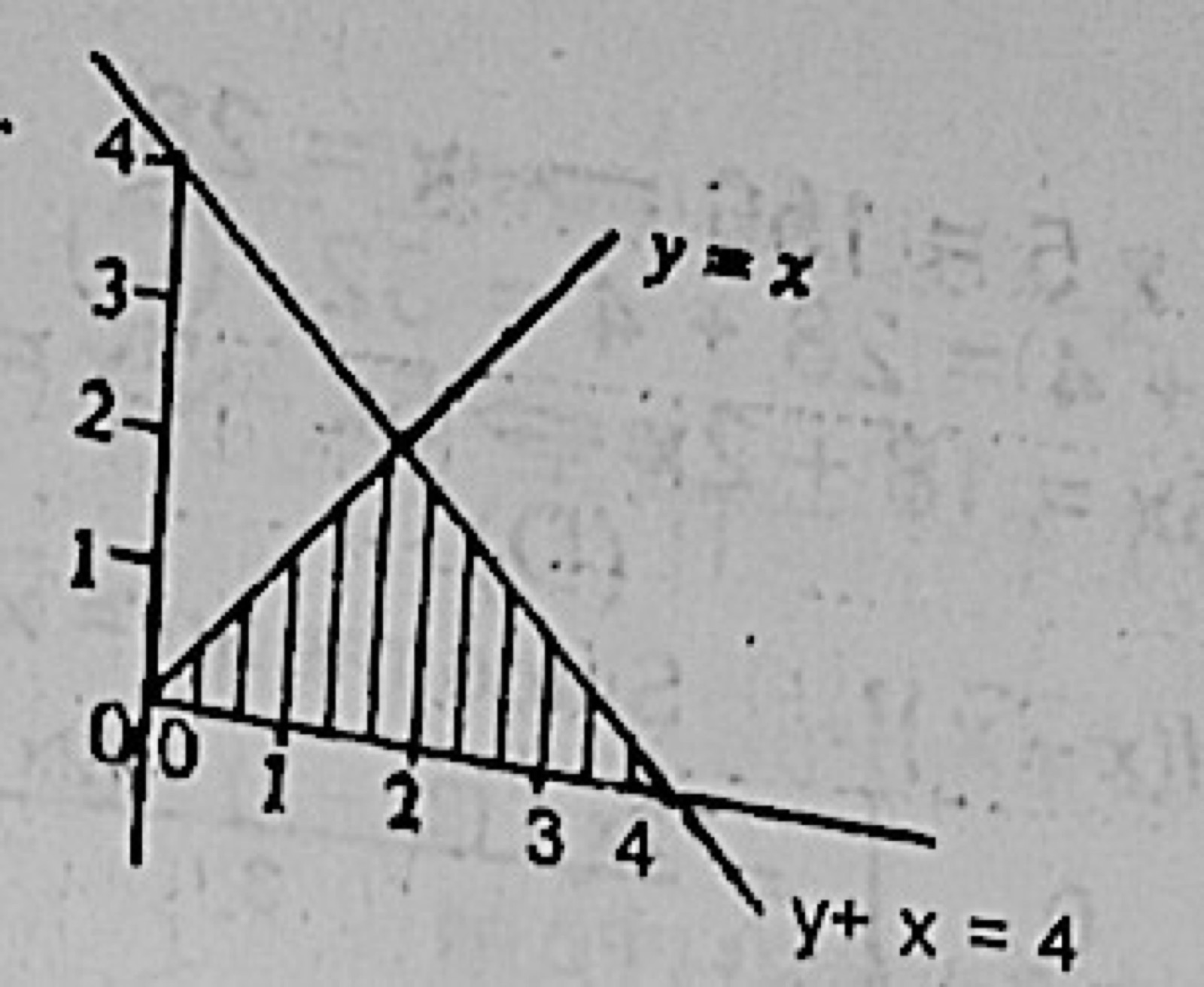
Question 39 Inequalities The solution set of the shaded area above is
A. y ≥ 0, y ≥ x and y + x ≤ 4 B. y ≤ x, y + x ≤ 4 C. y + x ≥ 4, y ≤ x D. y ≤ x, y + x ≤ 4 and y ≥ 0 Show the answer and explanation Answer: D (y ≤ x, y + x ≤ 4 and y ≥ 0 )
Explanation The shaded triangle has vertices (0, 0), (2, 2) and (4, 0): it is above the x-axis, below the line y = x and below the line y + x = 4.
Open this question
Question 40 Matrices and Determinants If x = (1 0 1; 2 −1 0; −1 0 1) and y = (−1 1 2; 0 −1 −1; 2 −1 1), find 2x − y. (Matrices written row by row.)
A. (3 −1 0; 4 −3 −1; −4 1 1) B. (3 −1 0; 4 −3 1; −4 1 1) C. (3 −1 0; 4 −1 1; −4 1 1) D. (3 −1 0; 4 1 1; −4 −1 1) Show the answer and explanation Answer: C ((3 −1 0; 4 −1 1; −4 1 1) )
Explanation 2x = (2 0 2; 4 −2 0; −2 0 2). Subtracting y entry by entry gives (3 −1 0; 4 −1 1; −4 1 1).
Open this question
Question 41 Variation If p varies inversely as the cube of q and q varies directly as the square of r, what is the relationship between p and r?
A. p varies directly as r3 B. p varies inversely as r6 C. p varies inversely as ∛r D. p varies directly as r6 Show the answer and explanation Answer: B (p varies inversely as r6 )
Explanation p = k/q3 and q = mr2 , so p = k/(m3 r6 ): p varies inversely as r6 .
Open this question
Question 42 Binary Operations A binary operation * on the set of rational numbers is defined as x * y = (x2 − y2 )/2xy. Find −5 * 3.
A. −8/15 B. 8/15 C. 17/15 D. −17/15 Show the answer and explanation Answer: A (−8/15 )
Explanation (25 − 9)/(2 × (−5) × 3) = 16/(−30) = −8/15.
Open this question
Question 43 Polynomials Find the value of k if the expression kx3 + x2 − 5x − 2 leaves a remainder 2 when it is divided by 2x + 1.
A. 10 B. 8 C. −10 D. −8 Show the answer and explanation Answer: C (−10 )
Explanation Put x = −½: −k/8 + 1/4 + 5/2 − 2 = 2, so −k/8 = 5/4 and k = −10.
Open this question
Question 44 Inequalities Solve the inequality for which (x + 4)/3 − (x − 3)/2 < 4
A. x < 7 B. x > −7 C. x < −7 D. x > 7 Show the answer and explanation Answer: B (x > −7 )
Explanation Multiply by 6: 2x + 8 − 3x + 9 < 24, so −x < 7 and x > −7.
Open this question
Question 45 Matrices and Determinants Find p, q for which (2p 8; 3 −5q)(1; 2) = (24; −17). (Matrices written row by row.)
A. −4, 2 B. 4, 2 C. −4, −2 D. 4, −2 Show the answer and explanation Answer: B (4, 2 )
Explanation Row 1: 2p + 16 = 24, so p = 4. Row 2: 3 − 10q = −17, so q = 2.
Open this question
Question 46 Commercial Arithmetic The cost of renovating a 6m square room is N540. What is the cost of renovating a 9m square room?
A. N1,215 B. N720 C. N1,620 D. N810 Show the answer and explanation Answer: A (N1,215 )
Explanation A 6m square room has area 36m2 (N15 per m2 ); a 9m square room has area 81m2 , so the cost is 81 × N15 = N1,215.
Open this question
Question 47 Progressions The sum of the first n positive integers is
A. ½n(n − 1) B. n(n + 1) C. n(n − 1) D. ½n(n + 1) Show the answer and explanation Answer: D (½n(n + 1) )
Explanation 1 + 2 + ... + n is an AP with first term 1 and last term n, so the sum is n/2 × (1 + n) = ½n(n + 1).
Open this question
Question 48 Algebraic Expressions If T = 2π√(l/g), make g the subject of the formula.
A. 4πl2 /T B. 4π2 l/T2 C. 4π2 l2 /T2 D. 2π√l/T Show the answer and explanation Answer: B (4π2 l/T2 )
Explanation Square both sides: T2 = 4π2 l/g, so g = 4π2 l/T2 .
Open this question
Question 49 Inequalities If y = x2 − x − 12, find the range of values of x for which y ≥ 0.
A. x < −3 or x > 4 B. x ≤ −3 or x ≥ 4 C. −3 < x ≤ 4 D. −3 ≤ x ≤ 4 Show the answer and explanation Answer: B (x ≤ −3 or x ≥ 4 )
Explanation y = (x + 3)(x − 4), which is zero at −3 and 4 and positive outside them, so y ≥ 0 for x ≤ −3 or x ≥ 4.
Open this question
Question 50 Progressions How many terms of the series 3, −6, +12, −24, +... are needed to make a total of 1 − 28 ?
A. 12 B. 10 C. 9 D. 8 Show the answer and explanation Answer: D (8 )
Explanation a = 3 and r = −2, so Sn = 3(1 − (−2)n )/(1 + 2) = 1 − (−2)n . This equals 1 − 28 when n = 8.
Open this question Sign up free for every JAMB Mathematics year, practice by topic and timed mocks.
Start practising free