Question 1
Number BasesFind n if 34n = 100112
- A.5
- B.6
- C.7
- D.8
Show the answer and explanation
Answer: A (5)
Explanation
100112 = 16 + 2 + 1 = 19. So 3n + 4 = 19, giving n = 5.
47 questions. Try each one, then open the answer to check yourself and read the explanation.
Find n if 34n = 100112
Answer: A (5)
100112 = 16 + 2 + 1 = 19. So 3n + 4 = 19, giving n = 5.
The radius of a circle is given as 5cm subject to an error of 0.1cm. What is the percentage error in the area of the circle?
Answer: C (4)
The radius error is 0.1/5 = 2%. Since the area depends on r2, its error is about 2 × 2% = 4% (exactly, (5.12 − 52)/52 = 4.04%).
Evaluate logb an if b = a1/n.
Answer: A (n2)
b = a1/n means a = bn, so an = bn². Hence logb an = n2.
What is the value of x satisfying the equation 42x/43x = 2?
Answer: B (−½)
42x/43x = 4−x = 2−2x. Setting 2−2x = 21 gives −2x = 1, so x = −½.
Simplify 5√18 − 3√72 + 4√50
Answer: C (17√2)
5√18 = 15√2, 3√72 = 18√2 and 4√50 = 20√2. So the total is (15 − 18 + 20)√2 = 17√2.
If x = 3 − √3, find x2 + 36/x2
Answer: C (24)
x2 = 12 − 6√3. Then 36/x2 = 6/(2 − √3) = 6(2 + √3) = 12 + 6√3. Adding gives 24.
If x = (all prime factors of 44) and y = (all prime factors of 60), the element of x∪y and x∩y respectively are
Answer: D ({2, 3, 5, 11} and {2})
44 = 22 × 11, so x = {2, 11}; 60 = 22 × 3 × 5, so y = {2, 3, 5}. The union is {2, 3, 5, 11} and the intersection is {2}.
If U = {0, 2, 3, 6, 7, 8, 9, 10} is the universal set E = {0, 4, 6, 8, 10} and F = {x : x2 = 26, x is odd}. Find (E∩F)′ where ′ means the complement of a set
Answer: B (U)
x2 = 64 gives x = ±8, which are not odd, so F = ϕ. Then E∩F = ϕ, and the complement of the empty set is U.
Make t the subject of formula s = ut + ½ at2
Answer: D (1/a[−u ± √(u2 + 2as)])
Rearrange as ½at2 + ut − s = 0 and use the quadratic formula: t = [−u ± √(u2 + 2as)]/a.
Factorize 9p2 − q2 + 6qr − 9r2
Answer: C ((3p − q + 3r)(3p + q − 3r))
Group the last three terms: 9p2 − (q2 − 6qr + 9r2) = (3p)2 − (q − 3r)2 = (3p − q + 3r)(3p + q − 3r).
Solve the equation y − 11√y + 24 = 0
Answer: B (64, 9)
Let u = √y: u2 − 11u + 24 = 0 gives u = 3 or 8. So y = 9 or 64.
A man invested the sum of N280.00 partly at 5% and partly at 4%. If the total interest is N12.80 per annum, find the amount invested at 5%.
Answer: D (₦160.00)
Let x be at 5%: 0.05x + 0.04(280 − x) = 12.80, so 0.01x + 11.20 = 12.80 and x = ₦160.
If x + 1 is a factor of x3 + 3x2 + kx + 4, find the value of k.
Answer: A (6)
By the factor theorem, putting x = −1 gives zero: −1 + 3 − k + 4 = 0, so k = 6.
Resolve 3/(x2 + x − 2) into partial fractions
Answer: A (1/(x − 1) − 1/(x + 2))
x2 + x − 2 = (x − 1)(x + 2). Writing 3 = a(x + 2) + b(x − 1): x = 1 gives a = 1 and x = −2 gives b = −1.
Find all values of x satisfying the inequality −11 ≤ 4 − 3x ≤ 28
Answer: C (−8 ≤ x ≤ 5)
Subtract 4: −15 ≤ −3x ≤ 24. Divide by −3 and reverse the signs: 5 ≥ x ≥ −8, i.e. −8 ≤ x ≤ 5.
The sketch above is the curve of y = ax2 + bx + c. Find a, b and c respectively
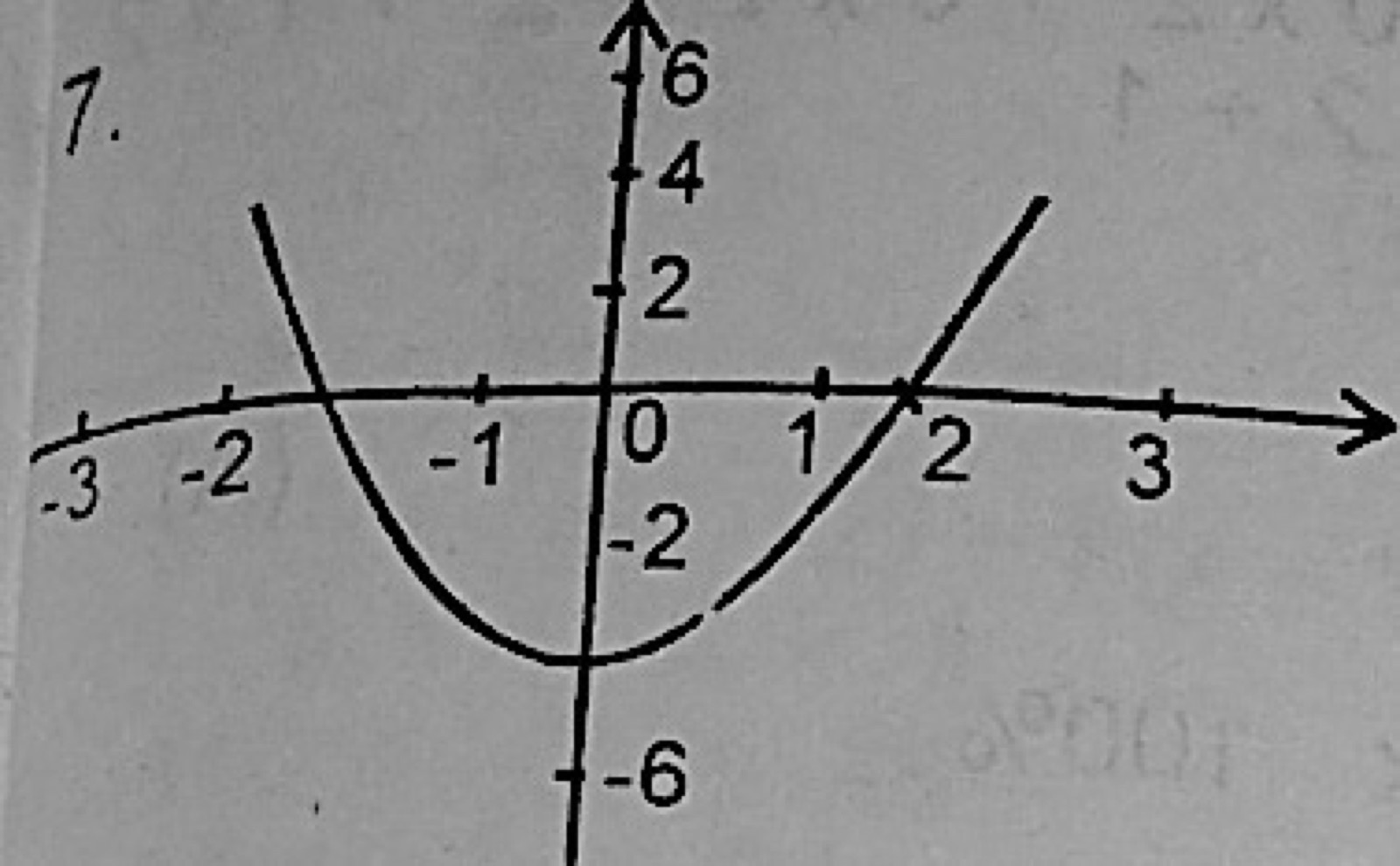
Answer: A (1, 0, −4)
The curve cuts the y-axis at −4, is symmetric about the y-axis and opens upwards, crossing the x-axis at about ±2. So y = x2 − 4: a = 1, b = 0, c = −4.
Find the sum to the infinity of the following series 3 + 2 + 4/3 + 8/9 + 16/27 + ...
Answer: D (9)
It is a G.P. with a = 3 and r = ⅔. Sum to infinity = a/(1 − r) = 3/(⅓) = 9.
What is the n-th term of the sequence 2, 6, 12, 20, .......?
Answer: C (n2 + n)
2 = 1 × 2, 6 = 2 × 3, 12 = 3 × 4, 20 = 4 × 5, so the nth term is n(n + 1) = n2 + n.
For an arithmetical sequence, the first term is 2 and the common difference is 3. Find the sum of the first 11 terms.
Answer: B (187)
S11 = 11/2 × [2(2) + 10(3)] = 11/2 × 34 = 187.
If the binary operation * is defined by m * n = mn + m + n for any real number m and n, find the identity element e under the operation
Answer: D (e = 0)
We need m * e = m: me + m + e = m, so e(m + 1) = 0 for every m. Hence e = 0.
Use the matrices below to answer questions 22 and 23.
P = [x 3 0; 2 y 3; 4 2 z] (rows: x, 3, 0 / 2, y, 3 / 4, 2, z)
Q = [x 2 4; 3 y 2; 0 3 z] (rows: x, 2, 4 / 3, y, 2 / 0, 3, z)
When PT is the transpose of P, calculate |PT| when x = 0, y = 1 and z = 2
Answer: B (24)
A matrix and its transpose have the same determinant. With x = 0, y = 1, z = 2: |P| = 0(2 − 6) − 3(4 − 12) + 0 = 24.
Use the matrices below to answer questions 22 and 23.
P = [x 3 0; 2 y 3; 4 2 z] (rows: x, 3, 0 / 2, y, 3 / 4, 2, z)
Q = [x 2 4; 3 y 2; 0 3 z] (rows: x, 2, 4 / 3, y, 2 / 0, 3, z)
PQ is equivalent to
Answer: A (PPT)
Q's rows are P's columns, so Q = PT and PQ = PPT.
In the fig. above, TŜP = 105° and PR̂Q = 20°, find PQ̂R
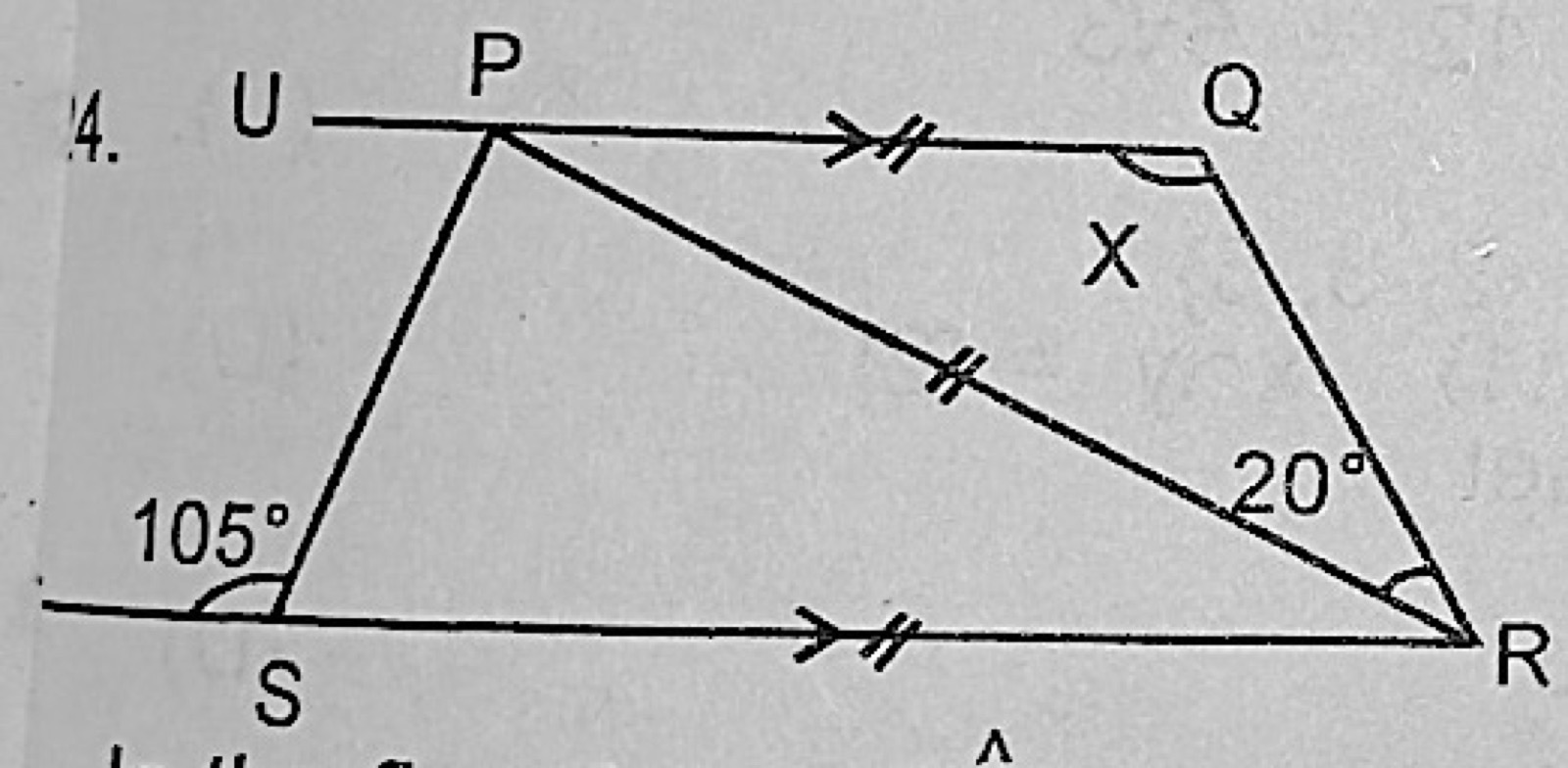
Answer: A (130°)
Angle PSR = 180° − 105° = 75°. PR = SR (marked), so angle SPR = 75° and angle PRS = 30°. UQ is parallel to SR, so angle QPR = angle PRS = 30°, and in triangle PQR, PQR = 180° − 30° − 20° = 130°.
In the fig. above, PQR is a semicircle while PQ and QR are chords. QS is the perpendicular from Q to the diameter PR. What is the expression for QS?

Answer: B (QS = √(PS.SR))
Angle PQR is 90° (angle in a semicircle), so triangles PSQ and QSR are similar. This gives QS/PS = SR/QS, i.e. QS2 = PS × SR.
Determine the distance on the earth's surface between two towns P(Lat. 60°N, Long. 20°E) and Q(Lat. 60°N, Long. 25°W) (Radius of the earth = 6400km)
Answer: C (800πkm)
The longitude difference is 20° + 25° = 45°. The radius of latitude 60° is 6400 cos 60° = 3200km. Distance = 45/360 × 2π × 3200 = 800πkm.
If in the diagram above, FG is parallel to KM, find the value of x

Answer: B (95°)
Draw a line through H parallel to FG. HG makes 20° with it and HK makes 180° − 105° = 75° with it (co-interior angles with KM). So x = 20° + 75° = 95°.
X is a point due east of Y on a coast. Z is another point on the coast but 6√3km due south of Y. If the distance XZ is 12km, calculate the bearing of Z from X.
Answer: B (210°)
Triangle XYZ is right-angled at Y, so sin(angle YXZ) = 6√3/12 = √3/2 and angle YXZ = 60°. From X, Y is due west (270°), and Z is 60° further round towards the south: 270° − 60° = 210°.
The above diagram is a circle with centre O. Find the area of the shaded portion.
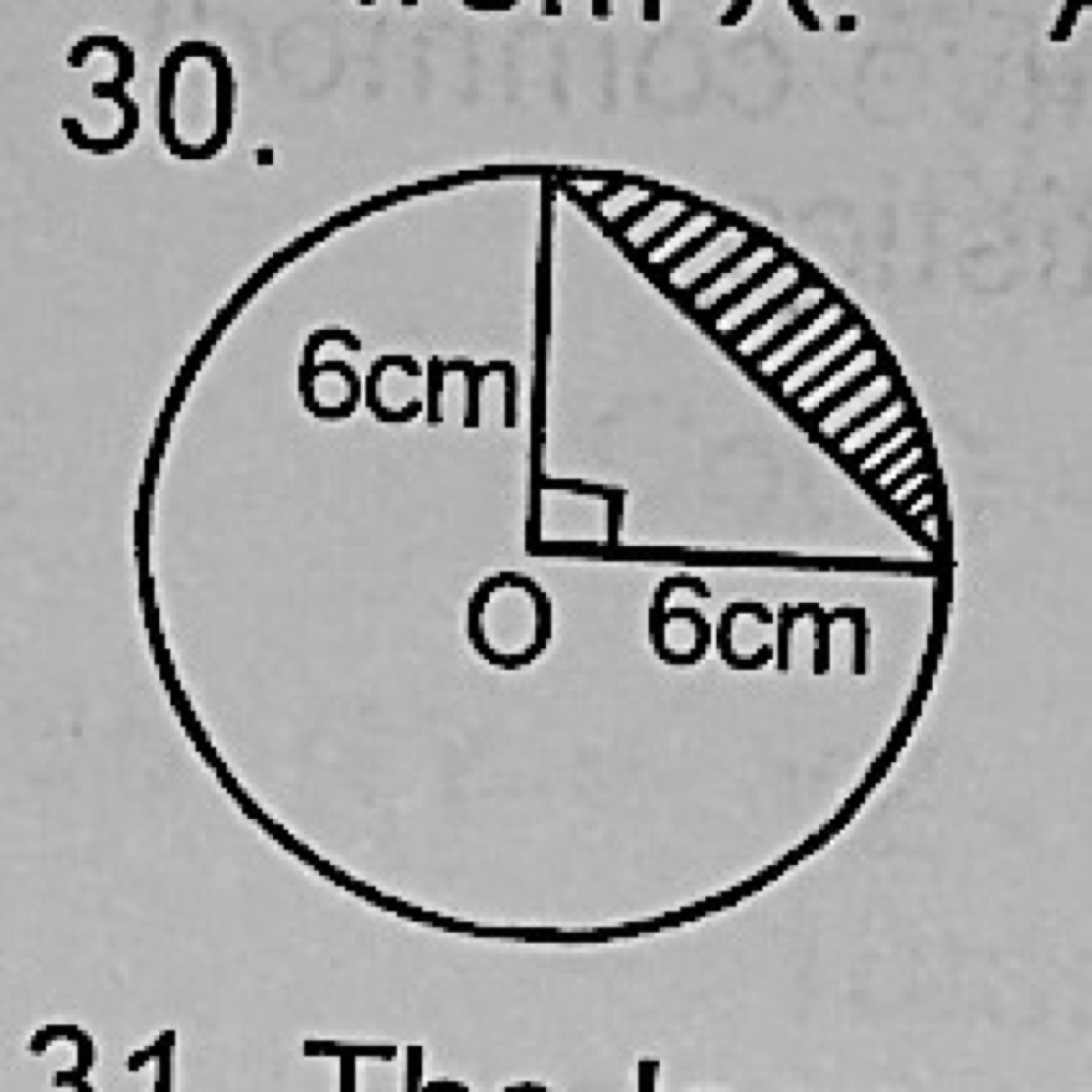
Answer: B (9(π − 2)cm2)
The shaded segment is a quarter circle of radius 6cm minus the right triangle: 90/360 × π × 36 − ½ × 6 × 6 = 9π − 18 = 9(π − 2)cm2.
The locus of a point which is equidistant from two given fixed points is the
Answer: A (perpendicular bisector of the straight line joining them.)
Every point the same distance from two fixed points lies on the perpendicular bisector of the line joining them.
What is the perpendicular distance of a point (2,3) from the line 2x − 4y + 3 = 0?
Answer: A (√5/2)
Distance = |2(2) − 4(3) + 3|/√(22 + 42) = 5/√20 = 5/(2√5) = √5/2.
Find the equation of the line through (5, 7) parallel to the line 7x + 5y = 12
Answer: B (7x + 5y = 70)
A parallel line has the form 7x + 5y = k. Through (5, 7): k = 35 + 35 = 70.
Given that θ is an acute angle and sin θ = m/n, find cot θ
Answer: B (√((n + m)(n − m))/m)
In a right triangle with opposite side m and hypotenuse n, the adjacent side is √(n2 − m2). So cot θ = √(n2 − m2)/m = √((n + m)(n − m))/m.
In the fig. above, if XZ is 10cm, calculate RY in cm
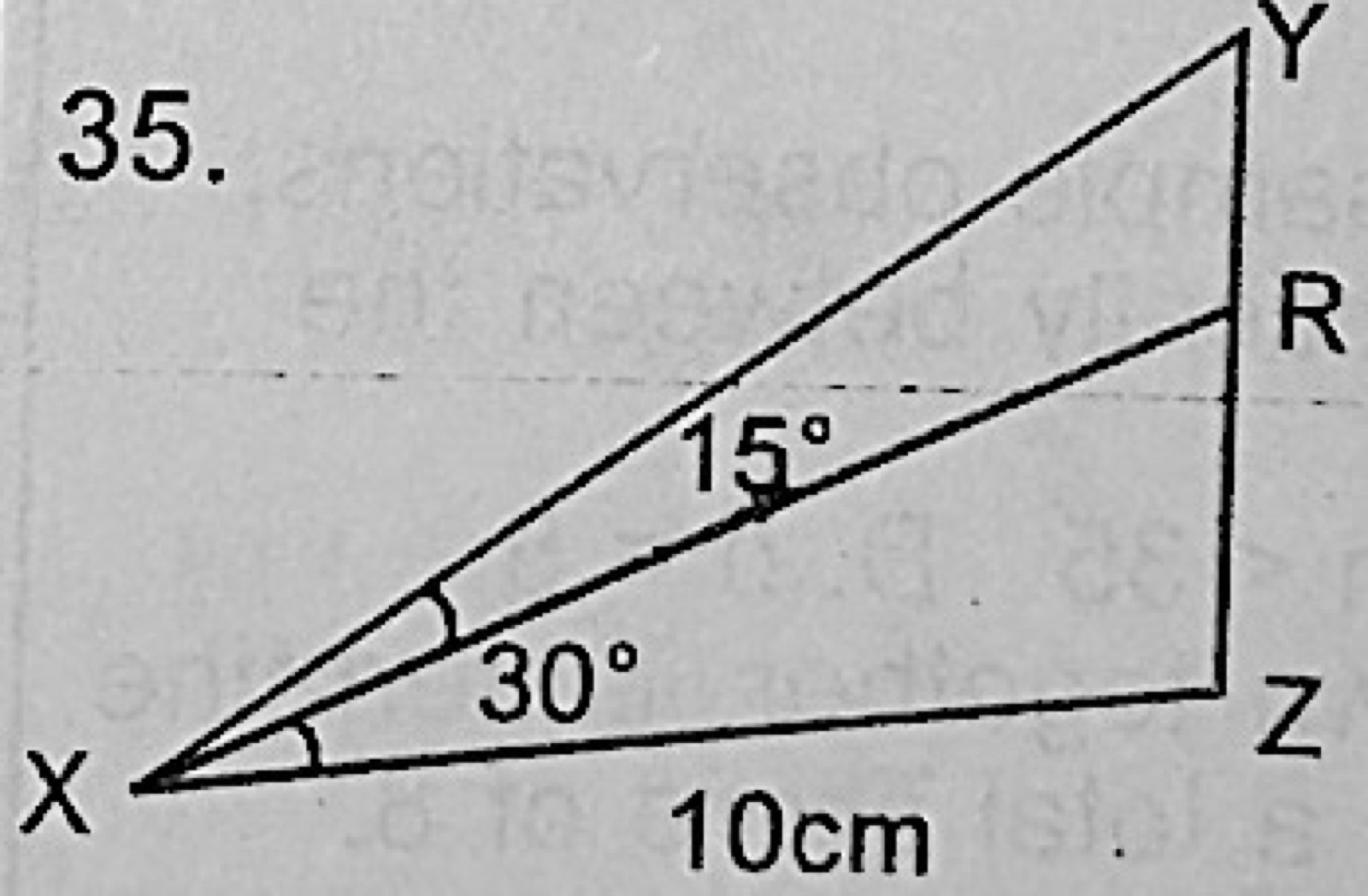
Answer: B (10(1 − 1/√3))
Angle YXZ = 30° + 15° = 45°, so YZ = 10 tan 45° = 10. RZ = 10 tan 30° = 10/√3. RY = 10 − 10/√3 = 10(1 − 1/√3).
Evaluate limx→2 (x − 2)(x2 + 3x − 2)/(x2 − 4)
Answer: B (2)
Cancel (x − 2) using x2 − 4 = (x − 2)(x + 2). The limit is (4 + 6 − 2)/(2 + 2) = 8/4 = 2.
If y = x sin x, find d2y/dx2
Answer: A (2cos x − x sin x)
By the product rule dy/dx = sin x + x cos x. Differentiating again: cos x + cos x − x sin x = 2cos x − x sin x.
Obtain a maximum value of the function f(x) = x3 − 12x + 11
Answer: D (27)
f′(x) = 3x2 − 12 = 0 gives x = ±2. f″(−2) = −12 < 0, so the maximum is at x = −2: f(−2) = −8 + 24 + 11 = 27.
A student blows a balloon and its volume increases at a rate of π(20 − t2)cm3 s−1 after t seconds. If the initial volume is 0 cm3, find the volume of the balloon after 2 seconds.
Answer: B (37.33π)
V = π(20t − t3/3), starting from 0. At t = 2: π(40 − 8/3) = 37.33π.
Evaluate the integral ∫π/12π/4 2 cos 2x dx
Answer: C (½)
The integral of 2 cos 2x is sin 2x. So the value is sin(π/2) − sin(π/6) = 1 − ½ = ½.
A storekeeper checked his stock of five commodities and arrived at the following statistics:
Commodity: F, G, H, K, M
Quantity: 215, 113, 108, 216, 68
What angle will commodity H represent on a pie chart?
Answer: D (54°)
The total quantity is 720. H's angle is 108/720 × 360° = 54°.
x: 2, 4, 6, 8
f: 4, y, 6, 5
If the mean of the above frequency distribution is 5.2, find y
Answer: C (5.0)
Σfx = 8 + 4y + 36 + 40 = 84 + 4y and Σf = 15 + y. Setting (84 + 4y)/(15 + y) = 5.2 gives 84 + 4y = 78 + 5.2y, so y = 5.
No. of children: 0, 1, 2, 3, 4, 5, 6
No. of families: 7, 11, 6, 7, 7, 5, 3
Find the mode and median respectively of the distribution above.
Answer: B (1, 2)
The most common number of children is 1 (11 families), so the mode is 1. There are 46 families; the 23rd and 24th values both fall in the '2 children' group (cumulative 7, 18, 24), so the median is 2.
If the scores of 3 students in a test are 5, 6 and 7, find the standard deviation of their scores.
Answer: C (√(2/3))
The mean is 6, and the squared deviations are 1, 0 and 1. Variance = 2/3, so the standard deviation is √(2/3).
Sample variance can be defined as S2 = (1/n) Σ (xi − x̄)2 and S2 = (1/(n − 1)) Σ (xi − x̄)2 where n is the number of sample observations. There is no difference practically between the above definitions when
Answer: B (n > 35)
Dividing by n or by n − 1 gives almost the same result when n is large, so the two definitions agree in practice for large samples (n > 35 here).
Two perfect dice are thrown together. Determine the probability of obtaining a total score of 8.
Answer: B (5/36)
A total of 8 comes from (2,6), (3,5), (4,4), (5,3) and (6,2): 5 of the 36 outcomes.
The probability of an event P is 3/4 while that of another event Q is 1/6. If the probability of both P and Q is 1/12, what is the probability of either P or Q?
Answer: C (5/6)
P(P or Q) = P(P) + P(Q) − P(both) = 9/12 + 2/12 − 1/12 = 10/12 = 5/6.
Five people are to be arranged in a row for a photograph. How many arrangements are there if a married couple in the group insists on sitting next to each other?
Answer: A (48)
Treat the couple as one block, so 4 items are arranged in a row in 4! = 24 ways. The couple can swap places within the block, giving 24 × 2 = 48.
A student has five courses to take from Mathematics and Physics. There are 4 courses in Mathematics and 3 in Physics which he can choose from at will. In how many ways can he choose his courses such that he takes exactly two courses in Physics.
Answer: B (12)
He chooses 2 of the 3 Physics courses (3 ways) and the other 3 courses from the 4 Mathematics courses (4 ways). 3 × 4 = 12.