Home › Past questions › JAMB › Economics › 2003 49 questions. Try each one, then open the answer to check yourself and read the explanation.
Sign up free to answer these questions on a CBT screen with a timer, then see your score and every answer explained.
Start practising free
Question 1 Tools of Economic Analysis When two variables are positively related, the graph of the relationship
A. is a downward-sloping curve B. has a negative intercept C. is a straight line D. is an upward-sloping curve Show the answer and explanation Answer: D (is an upward-sloping curve )
Explanation A positive relationship means both variables rise together, so the graph slopes upwards.
Open this question
Question 2 Price Determination For an inferior good, a decrease in real income will lead to
A. a lower equilibrium price B. a change in quantity demanded C. an outward shift of the demand curve D. an inward shift of the demand curve Show the answer and explanation Answer: C (an outward shift of the demand curve )
Explanation People buy more of an inferior good when their income falls, so its demand curve shifts outwards (to the right).
Open this question
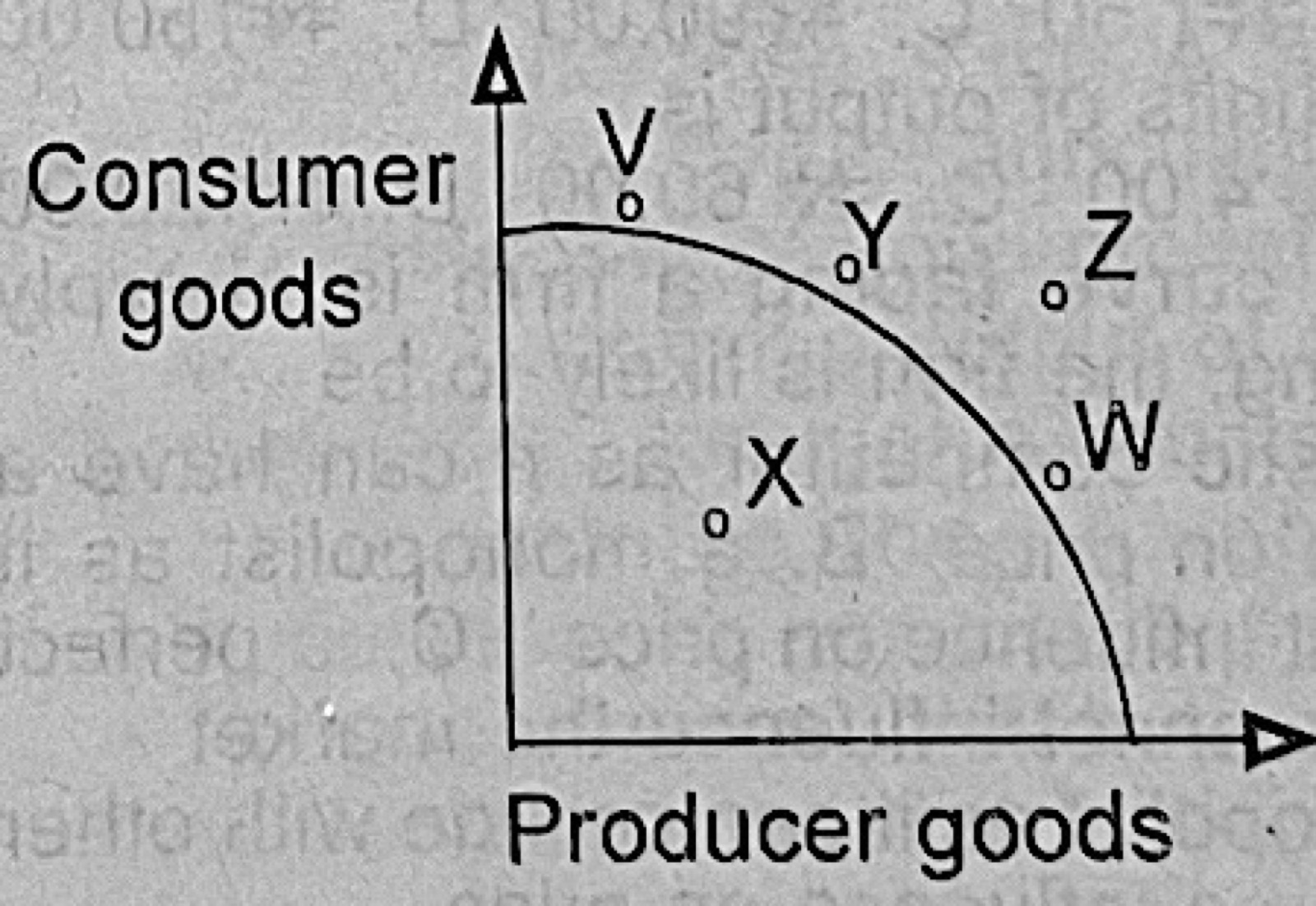
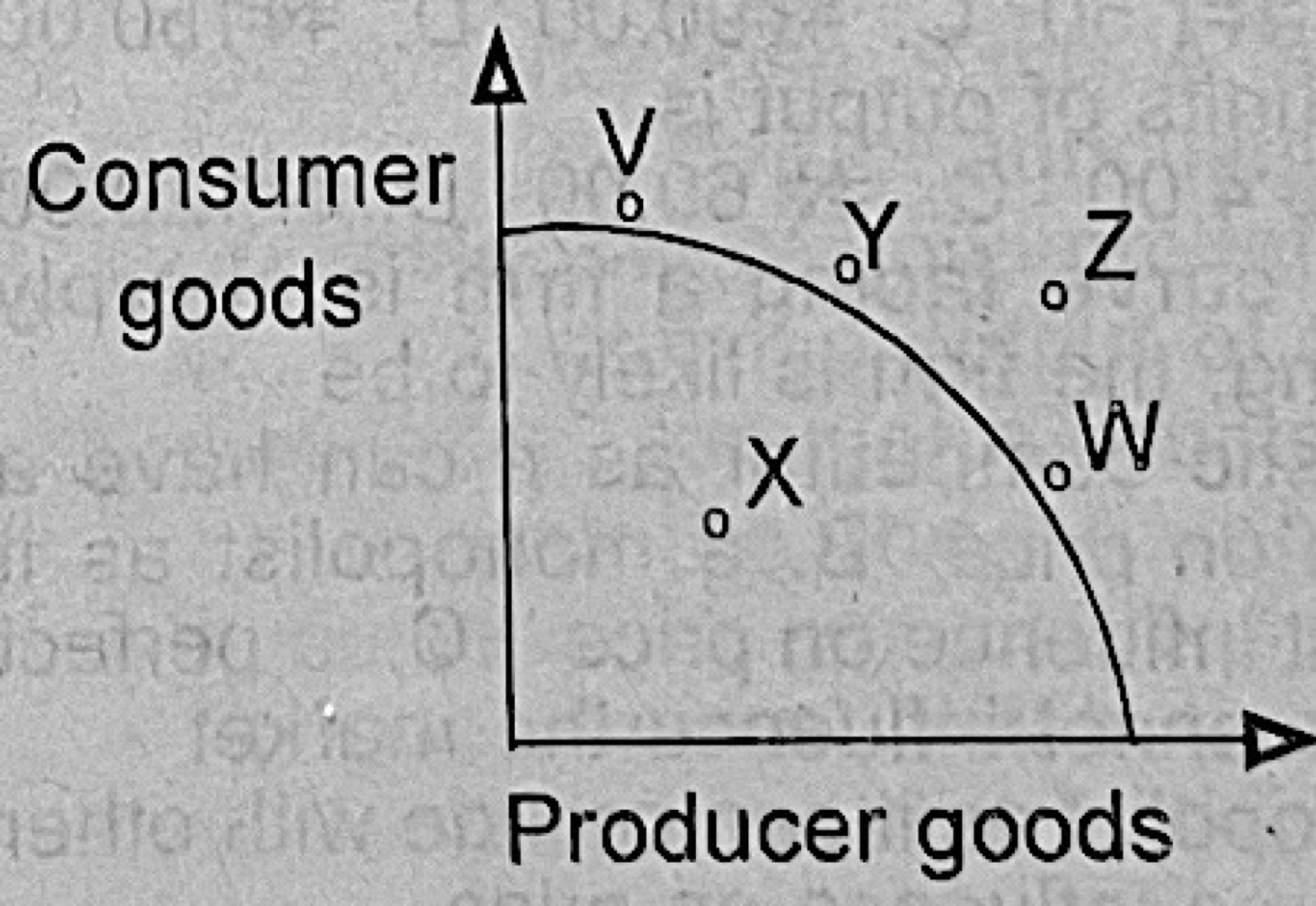
Question 3 Basic Concepts Use the production possibility curve of a country represented in the diagram to answer this question. If the country is currently producing at point Y, it can increase production of producer goods by moving to the point
A. W B. X C. Z D. V Show the answer and explanation Answer: A (W )
Explanation Use the diagram. W is on the curve and to the right of Y, so the country can produce more producer goods (giving up some consumer goods). Z lies outside the curve and cannot be reached with present resources.
Open this question
Question 4 Basic Concepts Use the production possibility curve of a country represented in the diagram to answer this question. An improvement in technology will enable the country to produce at
A. X B. V C. Z D. W Show the answer and explanation Answer: C (Z )
Explanation Use the diagram. Better technology shifts the production possibility curve outwards, so a point beyond the present curve such as Z becomes attainable.
Open this question
Question 5 Basic Concepts In economic analysis, a statement is said to be normative if it
A. relates to value judgement B. is incorrect C. can be tested scientifically D. is contradictory Show the answer and explanation Answer: A (relates to value judgement )
Explanation Normative statements say what ought to be; they are based on opinions or value judgements and cannot be tested.
Open this question
Question 6 Theory of Consumer Behaviour Utility is the satisfaction derived from
A. demand B. production C. distribution D. consumption Show the answer and explanation Answer: D (consumption )
Explanation Utility is the satisfaction a consumer gets from consuming a good or service.
Open this question
Question 7 Elasticity The price of a good rises from ₦5 to ₦8 and the quantity demanded falls from 200 to 190 units. Over this price range, the demand curve is
A. perfectly inelastic B. fairly inelastic C. perfectly elastic D. fairly elastic Show the answer and explanation Answer: B (fairly inelastic )
Explanation Quantity falls by 10/200 = 5% while price rises by 3/5 = 60%, so elasticity = 5 ÷ 60 ≈ 0.08: less than 1 but not zero, i.e. fairly inelastic.
Open this question
Question 8 Economic Systems In a planned economy, the emphasis is on
A. public ownership and control B. prices and competition C. individual choices and decisions D. private ownership and control Show the answer and explanation Answer: A (public ownership and control )
Explanation In a planned (command) economy the state owns and controls the means of production.
Open this question
Question 9 Theory of Consumer Behaviour The table below gives the marginal utilities of commodities y and x.y | 16 | 14 | 12 | 10 | 8 | 6 | 4 | 2x | 11 | 10 | 9 | 8 | 7 | 6 | 5 | 4
A. 6y and 4x B. 3y and 6x C. 5y and 5x D. 3y and 3x Show the answer and explanation Answer: B (3y and 6x )
Explanation Utility is maximised when MUy /Py = MUx /Px and all income is spent. At 3y and 6x: 12/2 = 6 = 6/1, and cost = 3 × ₦2 + 6 × ₦1 = ₦12.
Open this question
Question 10 Price Determination If there is an increase in demand without a corresponding increase in supply, there will be a
A. rise in price B. shift in demand curve to the left C. fall in price D. shift in supply curve to the right Show the answer and explanation Answer: A (rise in price )
Explanation More buyers chasing the same supply creates a shortage, so the price rises.
Open this question
Question 11 Theory of Production The best method of production in an underpopulated country is
A. labour-intensive B. labour-extensive C. land-intensive D. capital-intensive Show the answer and explanation Answer: D (capital-intensive )
Explanation An underpopulated country is short of labour, so it should use more machines in place of workers: capital-intensive methods.
Open this question
Question 12 Theory of Costs and Revenue Use the table below to answer the question.
A. ₦2.50 B. ₦1.50 C. ₦90.00 D. ₦150.00 Show the answer and explanation Answer: B (₦1.50 )
Explanation Variable cost = total cost − fixed cost = ₦150 − ₦60 = ₦90. AVC = ₦90 ÷ 60 = ₦1.50.
Open this question
Question 13 Theory of Costs and Revenue Use the table below to answer the question.
A. ₦3.00 B. ₦4.00 C. ₦60.00 D. ₦120.00 Show the answer and explanation Answer: B (₦4.00 )
Explanation Average total cost = total cost ÷ output = ₦120 ÷ 30 = ₦4.00.
Open this question
Question 14 Market Structures If the demand curve facing a firm is sharply downward-sloping, the firm is likely to be
A. a monopolistic competitor as it can have a limited influence on price B. a monopolist as it can have a great influence on price C. a perfect competitor as it cannot influence the market price D. an oligopolist as it can collude with other firms to have some influence on price Show the answer and explanation Answer: B (a monopolist as it can have a great influence on price )
Explanation A steep (inelastic) downward-sloping demand curve means there are no close substitutes, which is the case of a monopolist with great power over price.
Open this question
Question 15 Theory of Supply A normal supply curve is usually positively sloped because the relationship between
A. price and supply is positive B. demand and price is positive C. supply and price is negative D. price and demand is negative Show the answer and explanation Answer: A (price and supply is positive )
Explanation Sellers offer more at higher prices, so price and quantity supplied move in the same direction: a positive relationship.
Open this question
Question 16 Theory of Production Short-run period in production is a period too short for a firm to be able to change its
A. scale of operation B. total revenue C. variable inputs D. total outputs Show the answer and explanation Answer: A (scale of operation )
Explanation In the short run some factors (such as plant and machinery) are fixed, so the firm cannot change its scale of operation.
Open this question
Question 17 Elasticity Price elasticity of supply is a ratio of the change in
A. original quantity to a change in new quantity B. quantity supplied to the change in price C. price to the change in quantity supplied D. quantity supplied to the change in demand Show the answer and explanation Answer: B (quantity supplied to the change in price )
Explanation Elasticity of supply = proportionate change in quantity supplied ÷ proportionate change in price.
Open this question
Question 18 Theory of Costs and Revenue The long-run average cost curve is called a planning curve because it shows what happens to costs when
A. a bigger size of plant is built B. different sizes of plants are built C. variable inputs are increased D. fixed factors are increased Show the answer and explanation Answer: B (different sizes of plants are built )
Explanation The long-run average cost curve shows the lowest cost of each output when the firm can choose any plant size, so it helps the firm plan which size of plant to build.
Open this question
Question 19 Market Structures Imperfect market is characterised by
A. perfect mobility of factors of production B. many buyers and few sellers C. a large number of buyers and sellers D. non-preferential treatment Show the answer and explanation Answer: B (many buyers and few sellers )
Explanation When there are only a few sellers, each can influence price, so the market is imperfect. The other options describe a perfect market.
Open this question
Question 20 Money and Inflation The term 'Near money' is best described as
A. a financial instrument that is readily convertible to cash B. government financial instrument that is convertible to cash C. time deposits with low interest rates D. a financial asset that is convertible to cash Show the answer and explanation Answer: A (a financial instrument that is readily convertible to cash )
Explanation Near money is an asset (such as a savings deposit or treasury bill) that is not money itself but can quickly be turned into cash.
Open this question
Question 21 Financial Institutions The commercial banks differ from non-bank financial institutions because they
A. contribute to economic development B. accept deposits withdrawable by cheque C. mobilize savings D. invest surplus funds Show the answer and explanation Answer: B (accept deposits withdrawable by cheque )
Explanation Only commercial banks keep current accounts whose deposits can be withdrawn by cheque; the other features are shared with non-bank institutions.
Open this question
Question 22 Financial Institutions The distinguishing characteristic between the money market and the capital market lies in whether the
A. securities are primary or secondary B. debt instruments provided are long-term or short-term C. funds mobilized are private or public D. securities are in debentures or ordinary shares Show the answer and explanation Answer: B (debt instruments provided are long-term or short-term )
Explanation The money market deals in short-term funds and the capital market in long-term funds.
Open this question
Question 23 National Income For a firm, value added can be defined as the difference between the
A. input prices and product prices B. value of its output and inputs purchased from other firms C. value of its output and the cost of production D. total revenue and total cost Show the answer and explanation Answer: B (value of its output and inputs purchased from other firms )
Explanation Value added = value of the firm's output − value of the inputs it bought from other firms.
Open this question
Question 24 Financial Institutions Insurance companies, pension and provident funds and unit trusts are all examples of
A. rural-based revenue mobilizers B. non-governmental orgnisations C. government financial agencies D. non-bank financial institutions Show the answer and explanation Answer: D (non-bank financial institutions )
Explanation These bodies collect and invest savings but do not accept cheque deposits, so they are non-bank financial institutions.
Open this question
Question 25 Money and Inflation Inflation that is usually associated with periods of trade boom is
A. creeping inflation B. cost-push inflation C. stagflation D. demand-pull inflation Show the answer and explanation Answer: D (demand-pull inflation )
Explanation In a boom, spending rises faster than output, so too much money chases too few goods: demand-pull inflation.
Open this question
Question 26 Financial Institutions The monetary control instrument most effectively used by the Central Bank of Nigeria is the
A. open market operations B. margin requirement C. reserve ratio D. discount rate Show the answer and explanation Answer: A (open market operations )
Explanation The CBN mainly controls the money supply by buying and selling government securities: open market operations.
Open this question
Question 27 Financial Institutions Securities are described as listed when they are
A. mobilised as long-term debt instruments B. traded on a recognised stock market C. bought and sold purely for development purposes D. mobilized as short-term debt instruments Show the answer and explanation Answer: B (traded on a recognised stock market )
Explanation A listed security is one admitted for trading on a recognised stock exchange.
Open this question
Question 29 International Trade The theory of comparative advantage states that a commodity should be produced in that nation where the
A. absolute money cost is least B. opportunity cost is least C. production possibility curve increases D. absolute cost is least Show the answer and explanation Answer: B (opportunity cost is least )
Explanation Comparative advantage means producing what you can make at a lower opportunity cost than others.
Open this question
Question 30 Business Organisations An advantage of the sole proprietorship over the partnership form of business organisation is that
A. its existence is limited by an individual's life span B. it relies on the decision of friends to succeed C. the possibility of conflict in management is virtually non-existent D. it enjoys limited liability for debt in the event of failure Show the answer and explanation Answer: C (the possibility of conflict in management is virtually non-existent )
Explanation A sole proprietor makes all decisions alone, so there are no quarrels between partners over management.
Open this question
Question 31 Public Finance The distinction between capital and recurrent expenditure lies in the
A. nature of the goods and services to be provided B. time frame of the expenditure C. source of the revenue generated D. amount of expenditure involved Show the answer and explanation Answer: B (time frame of the expenditure )
Explanation Recurrent spending (salaries, running costs) recurs every year, while capital spending creates long-lasting assets; the difference is the time span the spending covers.
Open this question
Question 32 Balance of Payments and Exchange Rates Under a floating exchange rate regime, the determinant of the exchange rate is
A. an Act of the National Assembly B. the highest denomination of the currency C. demand for and supply of foreign goods D. the system of government Show the answer and explanation Answer: C (demand for and supply of foreign goods )
Explanation Under a floating system the exchange rate is set by market forces of demand and supply, which come from trade in foreign goods and services.
Open this question
Question 33 Public Finance The major objective of a revenue allocation formula in a country is to
A. share revenue between the different tiers of government B. divert revenue from areas of surplus to areas of need C. ensures the financial viability of the country D. share revenue between the public and private factors Show the answer and explanation Answer: A (share revenue between the different tiers of government )
Explanation A revenue allocation formula decides how federally collected revenue is shared among federal, state and local governments.
Open this question
Question 34 Public Finance A greater burden of the taxes on essential goods is borne by the
A. lower income group B. higher income group C. contract workers D. newly recruited workers Show the answer and explanation Answer: A (lower income group )
Explanation Poor people spend a larger share of their income on essential goods, so taxes on them fall more heavily on the lower income group.
Open this question
Question 35 Business Organisations Privatization and commercialization of public enterprises in Nigeria is necessitated by
A. the IBRD conditions B. the government's loss of interest in them C. their operational inefficiency D. the IMF conditions Show the answer and explanation Answer: C (their operational inefficiency )
Explanation Public enterprises were often wasteful and loss-making, so government privatised or commercialised them to improve efficiency.
Open this question
Question 36 Balance of Payments and Exchange Rates The effectiveness of devaluation as a solution to a balance of payments problem depends on the
A. value of visible and invisible goods B. value of invisible items of both domestic and foreign trades C. relative elasticities of demand and supply of imports and exports D. foreign investments of businessmen Show the answer and explanation Answer: C (relative elasticities of demand and supply of imports and exports )
Explanation Devaluation works only if demand for exports and imports is elastic enough for the price changes to raise export earnings and cut import spending.
Open this question
Question 37 Business Organisations Statutory organisations usually established by Acts of Parliament are called
A. public corporations B. cooperative societies C. joint-stock companies D. public enterprises Show the answer and explanation Answer: A (public corporations )
Explanation Public corporations (e.g. NNPC, NPA) are set up by Acts of Parliament (statutes), so they are statutory corporations.
Open this question
Question 38 Public Finance The effect of an increase in the personal income tax is to
A. reduce unemployment B. raise the absolute price level C. reduce the disposable income D. distort the economy Show the answer and explanation Answer: C (reduce the disposable income )
Explanation Disposable income is income after tax, so a higher income tax leaves people with less to spend.
Open this question
Question 39 International Economic Organisations IBRD as an international monetary institution is concerned with the
A. improvement of trade among member nations B. development of infrastructure in member nations C. balance of payments problems of member nations D. financing of private businesses in member nations Show the answer and explanation Answer: B (development of infrastructure in member nations )
Explanation The IBRD (World Bank) lends for long-term development projects such as roads, power and dams.
Open this question
Question 40 Economic Growth and Development To compare the standard of living among nations, the most widely used economic indicator is the
A. real domestic output B. real gross national income C. real per capita income D. per capita nominal income Show the answer and explanation Answer: C (real per capita income )
Explanation Real income per head allows for both price changes and population size, so it best compares living standards.
Open this question
Question 41 Natural Resources and Petroleum The major role of multi-national companies in the petroleum industry in Nigeria is
A. the establishment of refineries B. oil marketing and prospecting C. oil marketing only D. oil prospecting only Show the answer and explanation Answer: B (oil marketing and prospecting )
Explanation Multinational oil companies search for (prospect), produce and market Nigeria's crude oil.
Open this question
Question 42 Industrialisation Two basic features common to an industry are
A. production processes and source of capital B. source of capital and labour supply C. similarity of products and source of raw materials D. similarity of products and production processes Show the answer and explanation Answer: D (similarity of products and production processes )
Explanation An industry is a group of firms making similar products, usually with similar production processes.
Open this question
Question 43 Labour Market The demand for labour is an example of
A. composite demand B. joint demand C. derived demand D. competitive demand Show the answer and explanation Answer: C (derived demand )
Explanation Labour is demanded for the goods it helps to make, so its demand is derived demand.
Open this question
Question 44 Labour Market When a union is composed of workers with the same skill, it is termed
A. a technical union B. a craft union C. an industrial union D. a workers' union Show the answer and explanation Answer: B (a craft union )
Explanation A craft union brings together workers with the same skill or trade, e.g. carpenters or electricians.
Open this question
Question 45 Natural Resources and Petroleum An adverse environmental impact of the petroleum industry on the economy is
A. communal riots B. the vandalization of oil equipment C. oil spillage D. community development Show the answer and explanation Answer: C (oil spillage )
Explanation Oil spills pollute land, rivers and farmland, which is environmental damage.
Open this question
Question 46 Theory of Production Occupational mobility as applied to factors of production means the ease by which
A. factors can be transferred from one form of use to another B. resources can be transferred from one place to another C. resources can be transformed from one form to another D. factors can be transferred from one place to another Show the answer and explanation Answer: A (factors can be transferred from one form of use to another )
Explanation Occupational mobility is the ease of moving a factor from one job or use to another; moving between places is geographical mobility.
Open this question
Question 47 Population A country is said to be overpopulated when
A. the resources are more than enough to cater for the population B. the size of the population is greater than the annual budget C. the resources are inadequate to cater for the population D. there are too many able-bodied men and women in the country Show the answer and explanation Answer: C (the resources are inadequate to cater for the population )
Explanation Overpopulation exists when there are too many people for the available resources.
Open this question
Question 48 Industrialisation An important factor hindering the rapid development of the industrial sector in Nigeria is
A. rural-urban migration B. excessive demand for finished products C. inadequate infrastructural facilities D. the dominance of the oil sector Show the answer and explanation Answer: C (inadequate infrastructural facilities )
Explanation Poor power supply, roads and water raise production costs and slow industrial growth.
Open this question
Question 49 Agriculture Fixing the prices of agricultural products can be a problem because of the
A. activities of marketing boards B. size of agricultural exports C. instability of government policies D. unpredictable output of farmers Show the answer and explanation Answer: D (unpredictable output of farmers )
Explanation Farm output depends on weather and seasons and varies from year to year, which makes fixed prices hard to maintain.
Open this question
Question 50 Population The labour force of a country can be determined by examining the
A. age structure of the population B. sex distribution of the population C. geographical distribution of the population D. occupational distribution of the population Show the answer and explanation Answer: A (age structure of the population )
Explanation The labour force consists of people of working age, so the age structure of the population shows its size.
Open this question Sign up free for every JAMB Economics year, practice by topic and timed mocks.
Start practising free