Home › Past questions › JAMB › Economics › 2002 47 questions. Try each one, then open the answer to check yourself and read the explanation.
Sign up free to answer these questions on a CBT screen with a timer, then see your score and every answer explained.
Start practising free
Question 1 Elasticity The elasticity of supply of perishable goods is
A. unitary B. inelastic C. zero D. elastic Show the answer and explanation Answer: B (inelastic )
Explanation Perishable goods cannot be stored, so sellers cannot easily hold back or add to supply when the price changes: supply is inelastic.
Open this question
Question 2 Theory of Production The demand for factors of production is an example of
A. joint demand B. competitive demand C. derived demand D. composite demand Show the answer and explanation Answer: C (derived demand )
Explanation Factors are wanted not for themselves but for the goods they help produce, so their demand is derived from the demand for those goods.
Open this question
Question 3 Theory of Consumer Behaviour In the diagram above, the marginal rate of substitution of X for Y for a movement from S to T is
A. 13:3 B. 1:5 C. 18:4 D. 5:1 Show the answer and explanation Answer: D (5:1 )
Explanation Use the diagram. From S to T, Y falls from 18 to 13 (5 units) while X rises from 3 to 4 (1 unit), so 5 units of Y are given up for 1 of X: MRS = 5:1.
Open this question
Question 4 Basic Concepts A student has ₦30.00 with which to buy a ruler costing ₦18.00 and an exercise book costing ₦25.00. If he buys the exercise book, his opportunity cost is
A. the ruler B. the exercise book C. ₦25.00 D. ₦18.00 Show the answer and explanation Answer: A (the ruler )
Explanation He cannot afford both (₦43 > ₦30). Opportunity cost is the next best alternative given up, which is the ruler itself, not its money price.
Open this question
Question 5 Theory of Supply A shift in supply curve indicates that a different quantity will be supplied at each possible price because
A. consumers are willing to pay higher prices B. supply is facing competition C. other factors than price have changed D. price has changed Show the answer and explanation Answer: C (other factors than price have changed )
Explanation A change in the good's own price only moves along the curve; the whole curve shifts when other factors (costs, technology, weather, etc.) change.
Open this question
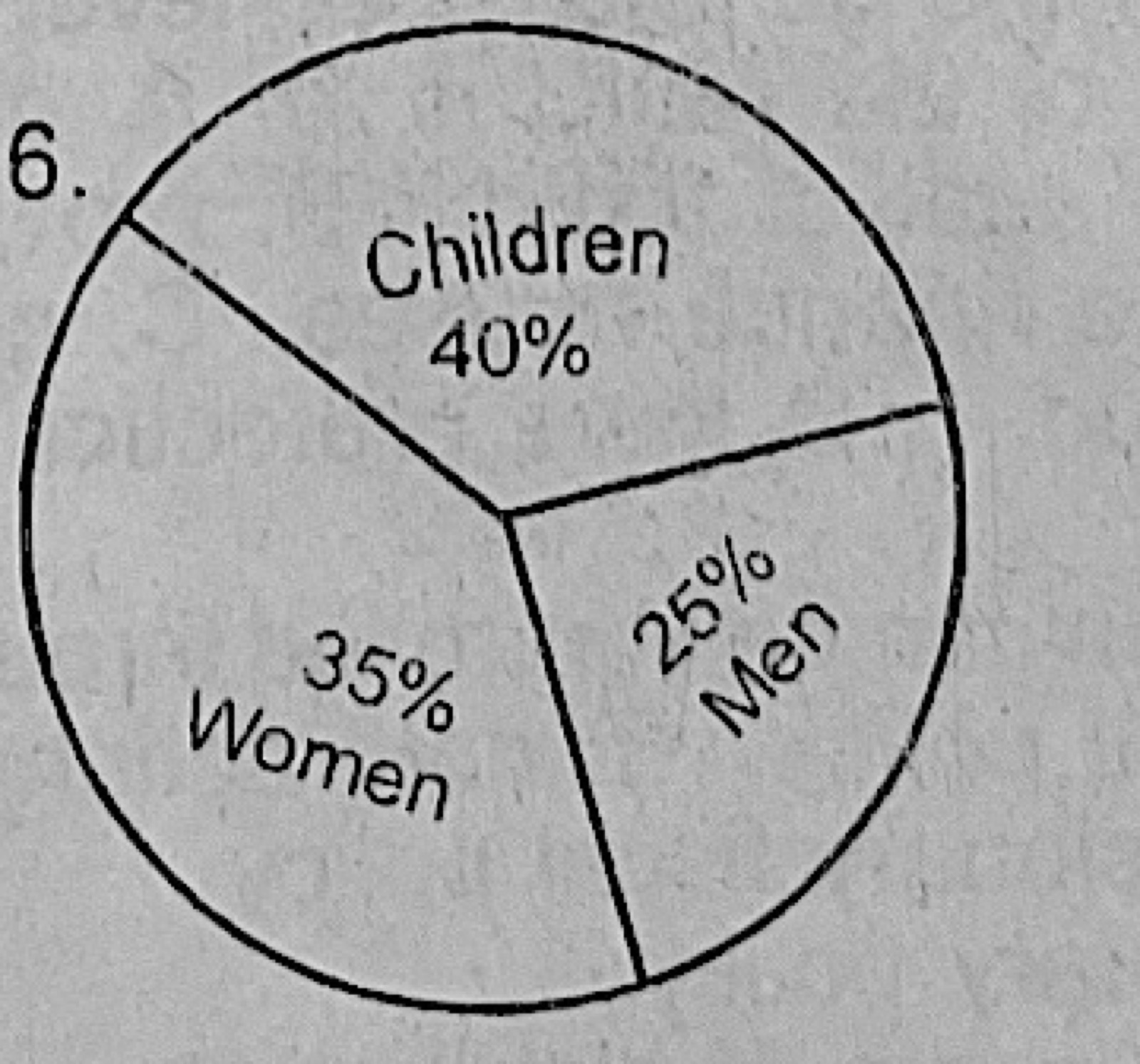
Question 6 Tools of Economic Analysis In the pie chart above, the percentage for children is equivalent to
A. 288° B. 72° C. 90° D. 144° Show the answer and explanation Answer: D (144° )
Explanation Use the pie chart. Children are 40% of the circle: 40/100 × 360° = 144°.
Open this question
Question 7 Theory of Consumer Behaviour If goods P and Q are purchased by a consumer, a fall in the price of P with the price of Q unchanged will cause the budget line to
A. shift parallel inwards B. rotate outwards away from the origin C. rotate inwards towards the origin D. shift parallel outwards Show the answer and explanation Answer: B (rotate outwards away from the origin )
Explanation The consumer can now buy more P with the same income, so the budget line pivots outwards on the P axis while its Q intercept stays fixed.
Open this question
Question 8 Theory of Demand One of the reasons for an exceptional demand curve is the
A. expectation of a future change in price B. availability of credit facilities C. change in the price of the commodity D. availability of substitutes Show the answer and explanation Answer: A (expectation of a future change in price )
Explanation If people expect prices to rise further, they buy more now even though the price has risen, giving an upward-sloping (exceptional) demand curve.
Open this question
Question 9 Tools of Economic Analysis A scientific approach in economic analysis entails
A. a deductive method only B. both inductive and normative methods C. a normative method only D. both inductive and deductive methods Show the answer and explanation Answer: D (both inductive and deductive methods )
Explanation The scientific method uses induction (from facts to generalisation) and deduction (from theory to predictions). Normative statements are value judgements, not scientific methods.
Open this question
Question 10 Economic Systems In a centrally planned economy, the economic problem of deciding what to produce is dependent on
A. average profit B. state command C. average cost D. relative prices Show the answer and explanation Answer: B (state command )
Explanation In a command economy the government (state) decides what, how and for whom to produce.
Open this question
Question 11 Money and Inflation The solution to the problem of double coincidence of wants requires a buyer and a seller whose demands are precisely
A. competitive B. composite C. supplementary D. complementary Show the answer and explanation Answer: D (complementary )
Explanation Under barter, trade happens only when each person wants exactly what the other offers, i.e. their wants complement each other.
Open this question
Question 12 Financial Institutions The stock exchange is a market for the buying and selling of
A. monetary instruments B. new shares C. existing shares D. treasury bills Show the answer and explanation Answer: C (existing shares )
Explanation The stock exchange is mainly a secondary market where already-issued (existing) shares and securities change hands.
Open this question
Question 13 National Income National Income estimates can be used to
A. differentiate between the rich and the poor in a country B. prepare a country's annual budget C. project the level of a country's economic development D. compare a country's growth rate with that of another over a period of time Show the answer and explanation Answer: D (compare a country's growth rate with that of another over a period of time )
Explanation National income figures over several years show how fast an economy grows, and can be compared with other countries' figures.
Open this question
Question 14 Financial Institutions In Nigeria, the bank that can correctly be described as a unit bank is
A. the Central Bank B. people's bank C. mortgage bank D. community bank Show the answer and explanation Answer: D (community bank )
Explanation A unit bank operates from a single office with no branches. Community banks in Nigeria were unit banks serving one locality.
Open this question
Question 15 National Income If the country's GNP in the current year is ₦65 billion and the GNP in the base year ₦50 billion, the GNP deflator is
A. 130.0 B. 30.0 C. 15.0 D. 1.3 Show the answer and explanation Answer: A (130.0 )
Explanation GNP deflator = current-year GNP ÷ base-year GNP × 100 = 65 ÷ 50 × 100 = 130.
Open this question
Question 16 National Income In a closed economy, the marginal propensity to consume is 0.6 and the average propensity to consume is 0.8. The value of the multiplier is
A. 2.5 B. 2.6 C. 2.7 D. 2.4 Show the answer and explanation Answer: A (2.5 )
Explanation The multiplier uses the marginal propensity: k = 1/(1 − MPC) = 1/(1 − 0.6) = 1/0.4 = 2.5. The APC is not needed.
Open this question
Question 17 Financial Institutions Insurance companies invest mainly in instruments traded on the
A. capital market B. commodity market C. money market D. open market Show the answer and explanation Answer: A (capital market )
Explanation Insurance companies hold long-term funds, so they invest mainly in long-term securities on the capital market.
Open this question
Question 18 Money and Inflation Liquidity preference refers to the
A. need to borrow money for short periods to meet some temporary crises B. wish to hold more funds for precautionary purposes C. need to increase the money supply in order to lower the interest rate D. demand to hold money as assets rather than as stocks Show the answer and explanation Answer: D (demand to hold money as assets rather than as stocks )
Explanation Liquidity preference is the desire to hold wealth in the form of money (cash) rather than in other assets such as stocks.
Open this question
Question 19 Money and Inflation Creeping inflation implies that there is a
A. gentle and persistent increase in the general price level B. rapid and persistent increase in the general price level C. gentle but not permanent increase in the general price level D. rapid but not permanent increase in the general price level Show the answer and explanation Answer: A (gentle and persistent increase in the general price level )
Explanation Creeping inflation is a slow, mild but continuing rise in the general price level.
Open this question
Question 20 Financial Institutions The primary objective of the NDIC is to
A. give protection to the CBN against fraud B. provide regulations guiding the finance houses C. give protection against fraud D. give protection to bank depositors Show the answer and explanation Answer: D (give protection to bank depositors )
Explanation The Nigeria Deposit Insurance Corporation insures bank deposits so depositors are protected if a bank fails.
Open this question
Question 21 Money and Inflation Excess demand inflation can be controlled through
A. contractionary fiscal policy B. contractionary trade policy C. expansionary fiscal policy D. expansionary monetary policy Show the answer and explanation Answer: A (contractionary fiscal policy )
Explanation Demand-pull inflation is cured by reducing total spending, e.g. raising taxes or cutting government spending: contractionary fiscal policy.
Open this question
Question 22 Distributive Trade The middlemen in the chain of distribution are
A. manufacturers and consumers B. wholesalers and retailers C. consumers and wholesalers D. retailers and consumers Show the answer and explanation Answer: B (wholesalers and retailers )
Explanation Middlemen stand between producers and consumers; they are the wholesalers and retailers.
Open this question
Question 23 Population If the growth rate of available resources continuously outpaces that of the population, a country will eventually experience
A. maximum population B. underpopulation C. overpopulation D. optimum population Show the answer and explanation Answer: B (underpopulation )
Explanation If resources keep growing faster than population, there are too few people to make full use of the resources: underpopulation.
Open this question
Question 24 Labour Market The equilibrium wage in an economy is determined by the
A. public service B. workers' union C. rate of inflation D. supply and demand for labour Show the answer and explanation Answer: D (supply and demand for labour )
Explanation Like any price, the equilibrium wage is set where the demand for labour equals the supply of labour.
Open this question
Question 25 Population The Malthusian theory of population growth is often said to be
A. ambiguous B. oversimplified C. pessimistic D. optimistic Show the answer and explanation Answer: C (pessimistic )
Explanation Malthus predicted that population would outgrow food supply, leading to famine and misery, so his theory is called pessimistic.
Open this question
Question 26 Labour Market Improved labour efficiency can be measured by
A. an increase in output-input ratio B. a decrease in output-input ratio C. the constancy of input-output ratio D. an increase in input-output ratio Show the answer and explanation Answer: A (an increase in output-input ratio )
Explanation Efficiency means getting more output from the same input, so a rising output-input ratio shows improved efficiency.
Open this question
Question 27 Theory of Costs and Revenue As a firm increases its output, the average fixed cost
A. tends to rise continuously B. remains constant C. rises and then falls D. tends to decrease continuously Show the answer and explanation Answer: D (tends to decrease continuously )
Explanation Fixed cost stays the same, so dividing it over more units makes average fixed cost fall continuously.
Open this question
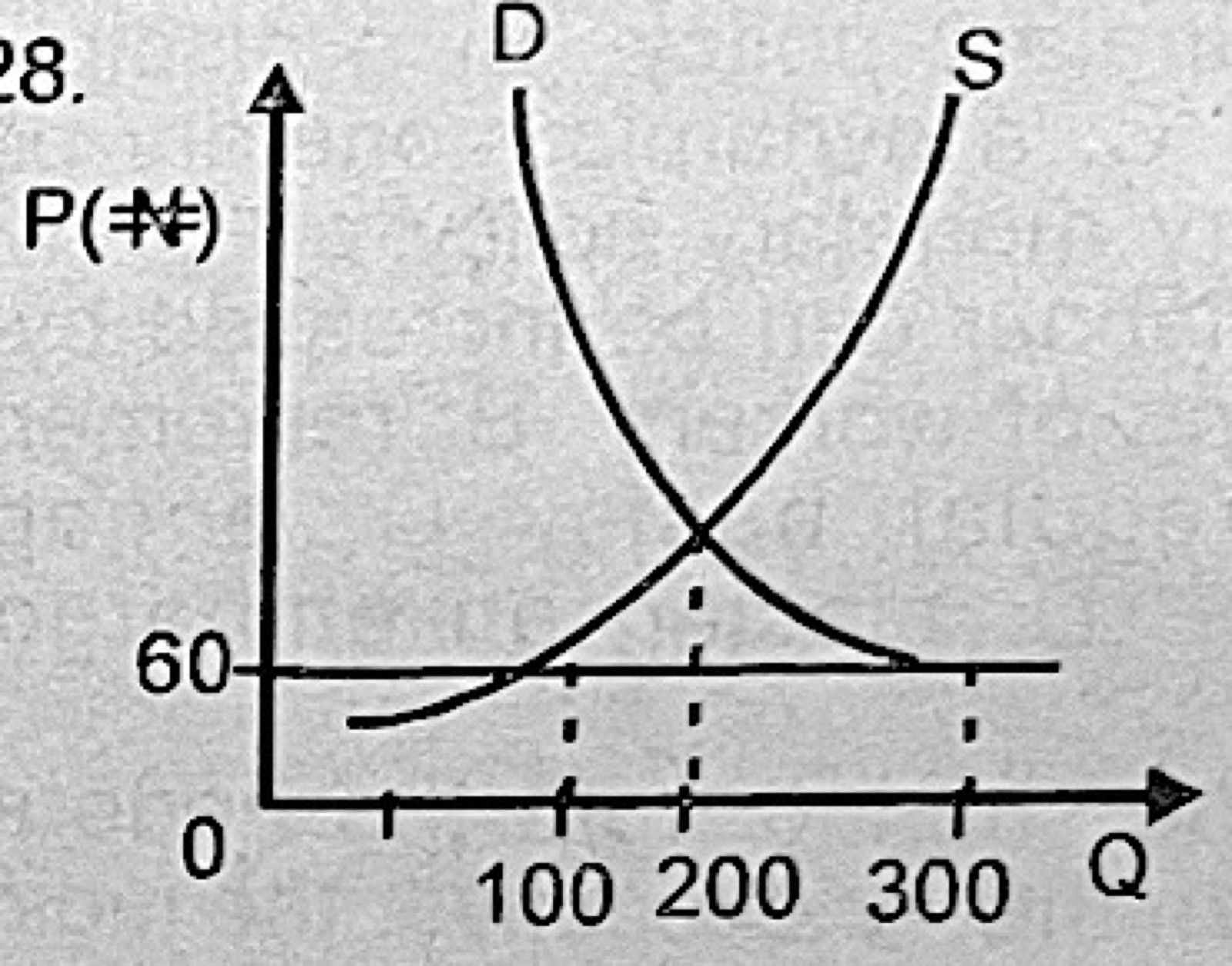
Question 28 Price Determination In the diagram above, what is the excess demand at the price of ₦60?
A. 200 B. 300 C. 600 D. 100 Show the answer and explanation Answer: A (200 )
Explanation Use the diagram. At ₦60 the supply curve gives 100 units and the demand curve 300 units, so excess demand = 300 − 100 = 200.
Open this question
Question 29 Market Structures The short-run equilibrium output for a monopolist is determined by the
A. highest point on the total revenue curve B. minimum point on the average cost curve C. intersection of the average revenue and the average cost curves D. intersection of the marginal cost and marginal revenue curves Show the answer and explanation Answer: D (intersection of the marginal cost and marginal revenue curves )
Explanation A monopolist maximises profit at the output where marginal cost equals marginal revenue.
Open this question
Question 30 Industrialisation The benefits that accrue to a firm as a result of an improvement in the industry it belongs to are called
A. internal economies of scale B. economies of scale C. market economies D. external economies Show the answer and explanation Answer: D (external economies )
Explanation Benefits from the growth of the whole industry, outside the firm's own control, are external economies.
Open this question
Question 32 Market Structures The economic policy of deregulation is aimed at encouraging
A. a monopolistic market structure B. a duopolistic market structure C. a competitive market structure D. an oligopolistic market structure Show the answer and explanation Answer: C (a competitive market structure )
Explanation Deregulation removes government controls and barriers to entry so more firms can compete.
Open this question
Question 33 Market Structures Under conditions of perfect competition, a firm's supply curve is determined by its
A. total cost curve B. marginal cost curve C. variable cost curve D. fixed cost curve Show the answer and explanation Answer: B (marginal cost curve )
Explanation A competitive firm produces where price = marginal cost, so its supply curve is its marginal cost curve above average variable cost.
Open this question
Question 34 Price Determination The effect of an increase in demand for a commodity accompanied by a decrease in supply will be to
A. raise the price of the commodity and affect the quantity in an indeterminate way B. decrease the equilibrium quantity and affect the price in an intermediate way C. raise its price as well as the equilibrium quantity D. lower its price while affecting the equilibrium quantity in an indeterminate way Show the answer and explanation Answer: A (raise the price of the commodity and affect the quantity in an indeterminate way )
Explanation Both changes push the price up. Higher demand raises quantity but lower supply reduces it, so the change in quantity depends on which is bigger.
Open this question
Question 35 Business Organisations External finance for a limited liability company is mainly sourced through
A. the leasing of equipment B. the issuing of shares C. trade credits D. bank loans Show the answer and explanation Answer: B (the issuing of shares )
Explanation A limited company raises most of its outside capital by selling shares to the public or to investors.
Open this question
Question 36 Economic Growth and Development Some of the key indicators of underdevelopment in a country are
A. poverty, high level of literacy and low income B. poverty, low level of literacy and low income C. low level of illiteracy, low income and poverty D. poverty, low income and low unemployment level Show the answer and explanation Answer: B (poverty, low level of literacy and low income )
Explanation Underdeveloped countries are marked by widespread poverty, low literacy and low incomes per head.
Open this question
Question 37 Natural Resources and Petroleum One of the roles of NNPC in the production and refining of crude oil is to
A. secure maximum government revenue and regulate price B. prevent the smuggling of petroleum products C. satisfy the domestic consumption of petroleum products D. protect the local operators in the petroleum industry Show the answer and explanation Answer: C (satisfy the domestic consumption of petroleum products )
Explanation NNPC runs the country's refineries mainly to meet local demand for petroleum products.
Open this question
Question 38 Balance of Payments and Exchange Rates One way of correcting the balance of payments problem of a country is to
A. introduce import-promotion measures B. buy investments abroad C. devalue the currency D. de-emphasize import-substitution industries Show the answer and explanation Answer: C (devalue the currency )
Explanation Devaluation makes exports cheaper and imports dearer, which helps to reduce a balance of payments deficit.
Open this question
Question 40 Industrialisation Import substitution aims at
A. substituting agricultural products with industrial ones B. substituting imports with agricultural exports C. the diversification of industries D. improving the balance of payments Show the answer and explanation Answer: D (improving the balance of payments )
Explanation Import substitution means producing at home goods that were imported. This saves foreign exchange and so improves the balance of payments.
Open this question
Question 41 Economic Growth and Development One of the major criticisms of the 1962-1968 National Development Plan was that
A. it failed to incorporate lessons gained from earlier plans to enhance its efficiency B. it came too quickly after the country's independence C. planned expenditure was based too heavily on expected earnings from crude oil D. its execution was based largely on foreign sourced financial resources Show the answer and explanation Answer: D (its execution was based largely on foreign sourced financial resources )
Explanation The first national plan depended heavily on foreign aid and loans (about half its finance), which did not all come.
Open this question
Question 42 Public Finance A deficit budget can be used to
A. stimulate recovery from a trade depression B. protect the economy from inflation C. starve the economy of funds for economic development D. provide measures to remedy the balance of payments Show the answer and explanation Answer: A (stimulate recovery from a trade depression )
Explanation Spending more than revenue injects money into the economy, raising demand and helping recovery from a depression.
Open this question
Question 44 Industrialisation One of the major factors militating against industrialization in Nigeria is the
A. inadequacy of infrastructural facilities B. absence of government participation C. frequent breakdown of equipment D. failure to get foreign partners and supporters Show the answer and explanation Answer: A (inadequacy of infrastructural facilities )
Explanation Poor roads, unreliable power and inadequate water supply raise costs and hold back industries in Nigeria.
Open this question
Question 45 Public Finance The types, sources and uses of government income are mainly concerned with
A. public expenditure B. public revenue C. public budget D. public finance Show the answer and explanation Answer: D (public finance )
Explanation Public finance studies how government raises revenue and how it spends it.
Open this question
Question 46 Business Organisations The present privatization policy in Nigeria is aimed at
A. reducing income inequality B. reducing the prices of goods and services C. poverty alleviation D. increasing efficiency in production Show the answer and explanation Answer: D (increasing efficiency in production )
Explanation Privatisation sells government enterprises to private owners, who are expected to run them more efficiently.
Open this question
Question 47 Industrialisation One of the problems arising from the localization of industries is
A. high prices of output B. the exportation of output C. the scarcity of foreign exchange D. structural unemployment Show the answer and explanation Answer: D (structural unemployment )
Explanation When the dominant industry of an area declines, many workers with the same skills lose their jobs at once: structural unemployment.
Open this question
Question 48 International Economic Organisations The major purpose of African Development Bank is to
A. provide loans for trade development B. provide loans for infrastructural development C. provide loans for development banks in distress D. educate peasant farmers in new techniques Show the answer and explanation Answer: B (provide loans for infrastructural development )
Explanation The African Development Bank lends to member countries mainly for development projects such as roads, power and water.
Open this question
Question 49 Agriculture As a country gets more developed, the percentage of labour engaged in agriculture tends to
A. remain constant B. decrease steadily C. switch over to trading D. increase steadily Show the answer and explanation Answer: B (decrease steadily )
Explanation With development, farming becomes more mechanised and industry and services grow, so the share of labour in agriculture falls.
Open this question
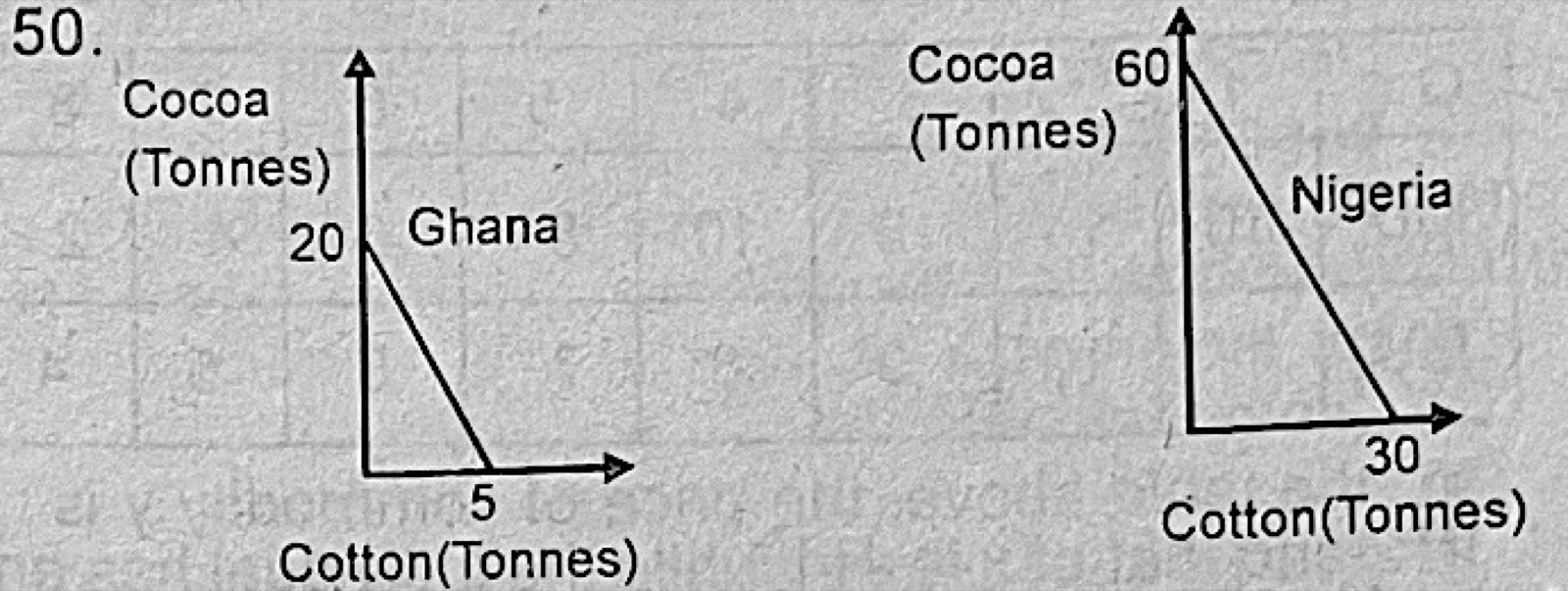
Question 50 International Trade In the diagram above, the opportunity cost of a unit of cotton in terms of cocoa is
A. 4 for Ghana; 2 for Nigeria B. 20 for Ghana; 60 for Nigeria C. 1/4 for Ghana; 1/2 for Nigeria D. 5 for Ghana; 30 for Nigeria Show the answer and explanation Answer: A (4 for Ghana; 2 for Nigeria )
Explanation Use the diagram. Ghana gives up 20 cocoa for 5 cotton (20 ÷ 5 = 4 cocoa per cotton); Nigeria gives up 60 cocoa for 30 cotton (60 ÷ 30 = 2).
Open this question Sign up free for every JAMB Economics year, practice by topic and timed mocks.
Start practising free