Home › Past questions › JAMB › Economics › 1994 50 questions. Try each one, then open the answer to check yourself and read the explanation.
Sign up free to answer these questions on a CBT screen with a timer, then see your score and every answer explained.
Start practising free
Question 1 Basic Concepts The basic economic problems of the society include
A. what to produce, how and for whom B. how to produce and sell C. scarcity, when to produce and how D. scarcity, for whom to produce and where Show the answer and explanation Answer: A (what to produce, how and for whom )
Explanation Every society must decide what goods to produce, how to produce them and for whom.
Open this question
Question 2 Basic Concepts Opportunity cost is an economic concept which describes the
A. monetary equivalent of the utility of a commodity B. amount of time or money invested on a commodity C. sacrifice made for the satisfaction of a want D. cost of retaining an optimum level of production of commodities Show the answer and explanation Answer: C (sacrifice made for the satisfaction of a want )
Explanation Opportunity cost is the next best alternative given up (sacrificed) to satisfy a want.
Open this question
Question 3 National Income If the marginal propensity to consume is 0.80 and the investment expenditure changes from N100 million to N140 million in a given economy, find the level of equilibrium in the given economy, using the formula K = 1/(1 − MPC) (K = Multiplier; MPC = Marginal Propensity to Consume)
A. N20 million B. N40 million C. N80 million D. N200 million Show the answer and explanation Answer: D (N200 million )
Explanation K = 1 ÷ (1 − 0.8) = 5. Investment rises by N40 million, so income rises by 5 × 40 = N200 million.
Open this question
Question 4 National Income The circular flow of income defines the
A. relationship between ends and means in the economic system B. allocation of income to various members of the household C. flow of goods, services and money among the various macro-sectors of the economy D. micro-economic relationships in economic analysis Show the answer and explanation Answer: C (flow of goods, services and money among the various macro-sectors of the economy )
Explanation The circular flow shows goods, services, factors and money moving between households, firms, government and the foreign sector.
Open this question
Question 5 Basic Concepts The necessity of choice is due to the fact that
A. human wants are insatiable B. consumers like to maximize satisfaction C. resources are abundant D. consumers are selective Show the answer and explanation Answer: A (human wants are insatiable )
Explanation Because wants are unlimited while means are limited, people cannot have everything and must choose.
Open this question
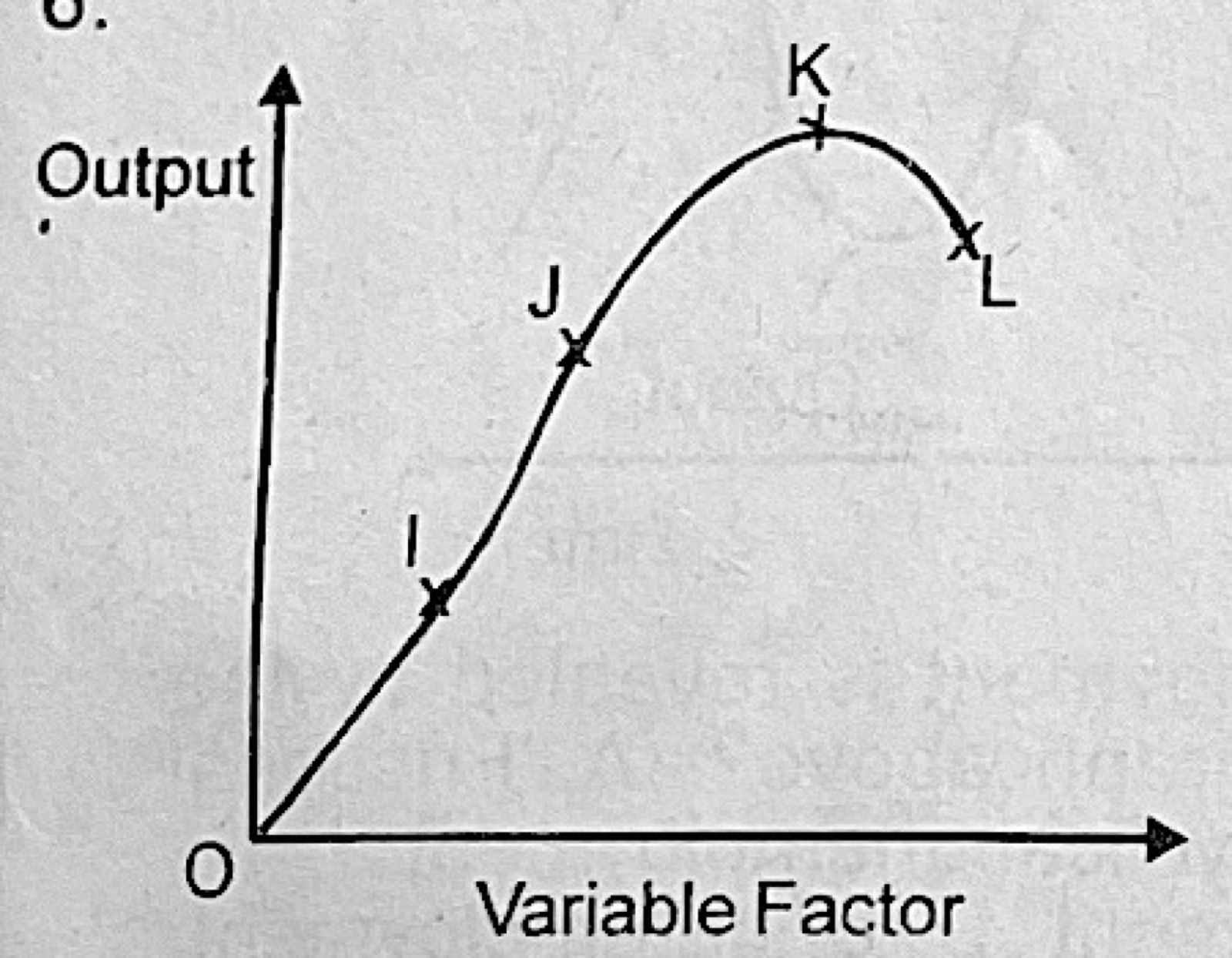
Question 6 Theory of Production The graph above represents a production function. At which of the points does diminishing returns set in?
A. I B. J C. K D. L Show the answer and explanation Answer: B (J )
Explanation Up to J the curve gets steeper (rising marginal product); after J it bends over, so each extra unit adds less: diminishing returns begin at J. K is where total output peaks.
Open this question
Question 7 Economic Systems In a mixed economy, decisions to produce are taken by
A. men and women acting in their own best interest B. the government acting in the interest of the country C. the market women, the labour unions and the employers' association D. private individuals, organizations and the government Show the answer and explanation Answer: D (private individuals, organizations and the government )
Explanation A mixed economy has both a private sector and a public sector, so production decisions are made by private persons and firms as well as by government.
Open this question
Question 8 Population Every economy requires an accurate census because it assists in
A. solving inflation problem B. providing a sound framework for policy formulation C. stimulating economic activities in the national economy D. solving unemployment problem Show the answer and explanation Answer: B (providing a sound framework for policy formulation )
Explanation Accurate population figures give government a sound basis for planning and making policy.
Open this question
Question 9 Population The population of country X in 1990 was 35 million. The births were 450,000 while it recorded 210,000 deaths. If in the same year, its immigrants were 20,000 and 10,000 of its citizens left the country, calculate the total population of the country at the end of 1990.
A. 24,250,000 B. 25,350,000 C. 34,750,000 D. 35,250,000 Show the answer and explanation Answer: D (35,250,000 )
Explanation 35,000,000 + 450,000 − 210,000 + 20,000 − 10,000 = 35,250,000.
Open this question
Question 10 Population If the actual population in a country is less than the optimum population, then
A. it is desirable to have a larger population B. it is necessary to have an improved technology to sustain the population C. it is desirable to have a smaller population D. the available resources are inadequate to sustain the population Show the answer and explanation Answer: A (it is desirable to have a larger population )
Explanation Below the optimum the country is underpopulated: more people would raise output per head, so a larger population is desirable.
Open this question
Question 11 Labour Market Unemployment can be reduced by
A. restricting the productive base of the economy B. adopting capital-intensive techniques of production C. adopting labour-intensive techniques of production D. adopting a mixture of labour and capital-intensive techniques of production Show the answer and explanation Answer: C (adopting labour-intensive techniques of production )
Explanation Labour-intensive methods use more workers per unit of output, so they create more jobs.
Open this question
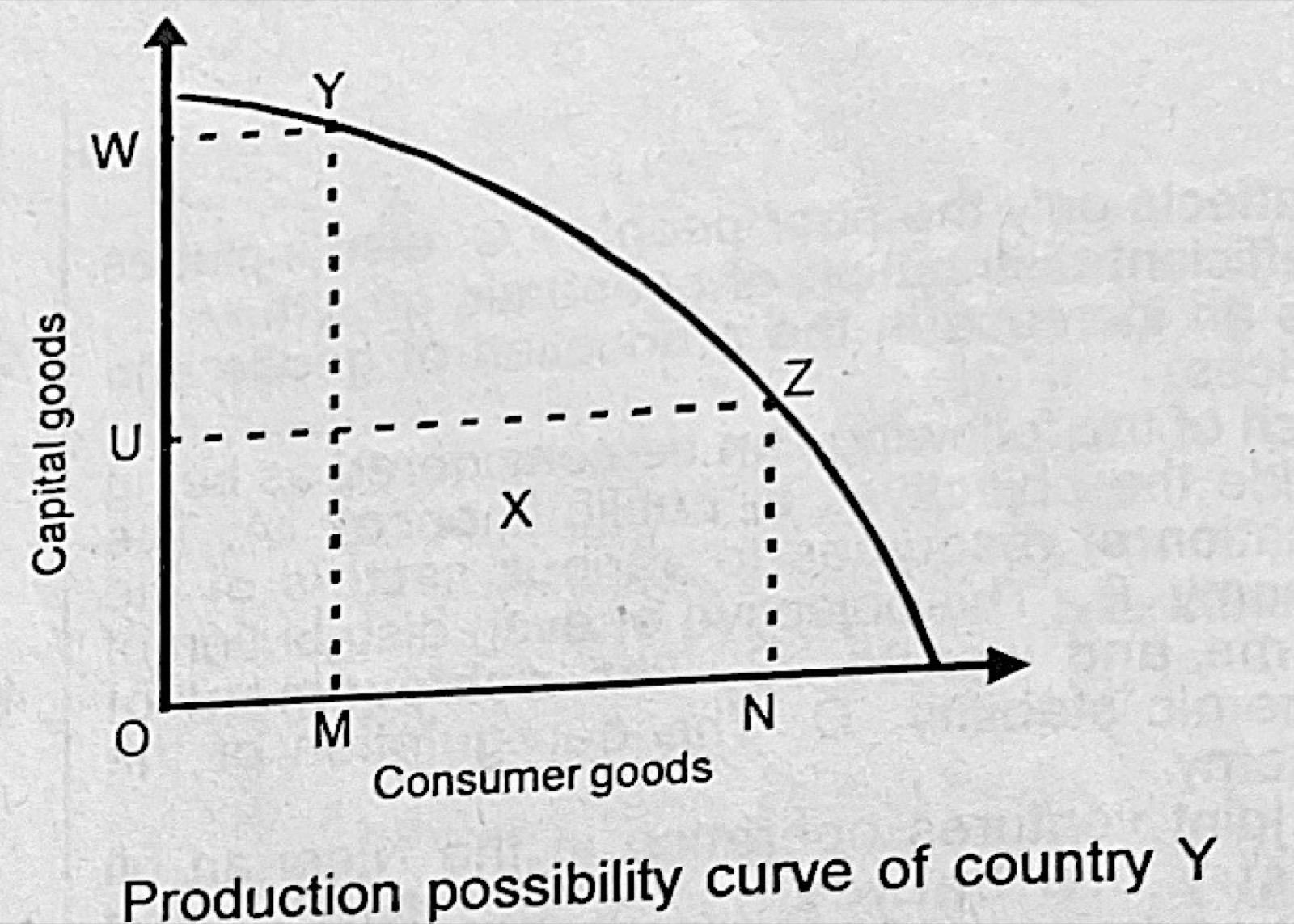
Question 12 Basic Concepts Production possibility curve of country Y. If the economy of the country is operating at X, the implication is that
A. the productive capacity is being fully utilized B. the productive capacity is not being fully utilized C. too little of consumer goods is being produced D. there is a disequilibrium between the production of capital and consumer goods Show the answer and explanation Answer: B (the productive capacity is not being fully utilized )
Explanation X lies inside the curve, so the economy could produce more of both goods: some resources are idle or wasted.
Open this question
Question 13 Theory of Production When the Total Product (TP) is at maximum point, the Marginal Product (MP) and the Average Product (AP) respectively are
A. zero and decreasing B. decreasing and zero C. negative and decreasing D. both at their maximum Show the answer and explanation Answer: A (zero and decreasing )
Explanation TP stops rising when the extra unit adds nothing, so MP = 0; AP is already falling at that point.
Open this question
Question 14 Theory of Costs and Revenue In the long run, all production factors are
A. fixed B. semi-fixed C. variable D. semi-variable Show the answer and explanation Answer: C (variable )
Explanation The long run is a period long enough for the firm to change the quantity of every factor.
Open this question
Question 15 Theory of Costs and Revenue A company's expenditure on raw materials is regarded as
A. explicit cost B. implicit cost C. prime cost D. average cost Show the answer and explanation Answer: A (explicit cost )
Explanation Money actually paid out to buy inputs such as raw materials is an explicit cost; implicit costs are the owner's own resources used without payment.
Open this question
Question 16 Theory of Costs and Revenue The basic relationship between the cost of production and the market price of any commodity in the short run is that the market price
A. always reflects the cost of labour B. reflects the variable, but not the fixed cost of production C. does not rise above variable costs D. is determined by the cost of production and the current rate of inflation Show the answer and explanation Answer: B (reflects the variable, but not the fixed cost of production )
Explanation In the short run a firm stays in business if price covers its variable costs; fixed costs must be paid anyway, so price need not cover them.
Open this question
Question 17 Theory of Costs and Revenue A firm determines its profits when it studies its
A. Marginal Cost B. Average Cost C. Total Cost D. Average Cost relative to price in the market Show the answer and explanation Answer: D (Average Cost relative to price in the market )
Explanation Profit per unit is price minus average cost, so the firm compares its average cost with the market price.
Open this question
Question 18 Labour Market An increase in the supply of labour in a factory while other things remain equal will lead to
A. an increase in the wage rate and an increase in the number of people employed B. a decrease in the wage rate and a decrease in employment C. an increase in the wage rate and decrease in employment D. a decrease in the wage rate and an increase in employment Show the answer and explanation Answer: D (a decrease in the wage rate and an increase in employment )
Explanation More labour supplied shifts the supply curve to the right: the wage falls and more workers are hired.
Open this question
Question 19 Theory of Demand A demand which is positively related to price is true of
A. normal goods B. giffen goods C. ostentatious goods D. capital goods Show the answer and explanation Answer: B (giffen goods )
Explanation For a Giffen good, a rise in price leads to more being demanded, so demand moves in the same direction as price.
Open this question
Question 20 Price Determination Price (N); quantity demanded; quantity supplied:
A. 50 B. 250 C. 350 D. 450 Show the answer and explanation Answer: B (250 )
Explanation At N30 quantity demanded (250) equals quantity supplied (250), so the equilibrium quantity is 250.
Open this question
Question 21 Price Determination Above the equilibrium point, a further rise in price tends to
A. increase demand and restrict supply B. restrict demand and restrict supply C. increase demand and decrease supply D. decrease demand and increase supply Show the answer and explanation Answer: D (decrease demand and increase supply )
Explanation A higher price makes buyers take less and sellers offer more.
Open this question
Question 22 Theory of Costs and Revenue Price (N); quantity sold:
A. N5 B. N6 C. N8 D. N10 Show the answer and explanation Answer: A (N5 )
Explanation Each extra unit sells at the same price of N5, so it adds N5 to total revenue: MR = N5.
Open this question
Question 23 Elasticity Elasticity of demand is an effective tool in the hands of a producer in that it enables him
A. raise his profits and lower his costs B. discourage buyers from cheating C. determine what he will produce D. set his price to maximize his profit Show the answer and explanation Answer: D (set his price to maximize his profit )
Explanation Knowing how buyers react to price changes tells the producer whether raising or lowering price will increase revenue and profit.
Open this question
Question 24 Elasticity Cross elasticity of demand can be mathematically expressed as the
A. (percentage change in quantity of commodity X) ÷ (percentage change in quantity of commodity Y) B. (percentage change in quantity demanded) ÷ (percentage change in price) C. (percentage change in quantity demanded of commodity X) ÷ (percentage change in price of commodity Y) D. (percentage change in quantity demanded) ÷ (percentage change in income) Show the answer and explanation Answer: C ((percentage change in quantity demanded of commodity X) ÷ (percentage change in price of commodity Y) )
Explanation Cross elasticity measures how demand for X responds to a change in the price of another good Y.
Open this question
Question 25 Market Structures The basic idea behind brand differentiation under an imperfect market arrangement is to
A. stimulate demand for rival products B. create demand for the particular product C. enable the product penetrate the market D. enable the product to compete with others Show the answer and explanation Answer: B (create demand for the particular product )
Explanation By making its brand look different, a firm builds loyal customers for its own product.
Open this question
Question 26 Market Structures In the long run, a firm in a perfectly competitive market will make
A. normal profit B. abnormal profit C. marginal profit D. no profit Show the answer and explanation Answer: A (normal profit )
Explanation Free entry and exit remove any supernormal profit or loss, leaving only normal profit.
Open this question
Question 27 Market Structures Output restriction, fixing of prices, creating obstacles to free entry into the market are features of
A. pure monopoly B. perfect competition C. monopolistic competition D. monopsonist competition Show the answer and explanation Answer: A (pure monopoly )
Explanation A monopolist controls supply, so he can restrict output, set price and block new firms.
Open this question
Question 28 Business Organisations A major shortcoming of the sole proprietorship form of business is lack of
A. working capital B. patronage C. continuity D. market Show the answer and explanation Answer: C (continuity )
Explanation The business depends on one person, so it may end when the owner dies or falls ill.
Open this question
Question 29 Business Organisations In the event of liquidation of a private limited liability company, the shareholders' liability is limited in their total
A. income from all sources B. family assets C. collateral offered for bank loans D. investment in the company Show the answer and explanation Answer: D (investment in the company )
Explanation With limited liability a shareholder can lose only the amount he has put into the company's shares.
Open this question
Question 30 Agriculture The major factor that causes fluctuations in the supply of agricultural produce is
A. high price B. pests C. weather variations D. rural-urban migration Show the answer and explanation Answer: C (weather variations )
Explanation Farm output depends heavily on rainfall and other weather conditions, which change from year to year.
Open this question
Question 31 Agriculture The system of agricultural practice which involves hunting, gathering and growing of food crops for family consumption only is described as
A. peasant agriculture B. plantation agriculture C. co-operative farming D. subsistence farming Show the answer and explanation Answer: D (subsistence farming )
Explanation Producing only enough for the family's own use, with nothing for sale, is subsistence farming.
Open this question
Question 32 Industrialisation What is the term used to describe a policy aimed at promoting the local production of goods which are usually imported?
A. Deregulation B. Import substitution C. Tariff reduction D. Backward integration Show the answer and explanation Answer: B (Import substitution )
Explanation Import substitution means making at home the goods that were formerly imported.
Open this question
Question 33 Industrialisation Labour-intensive strategy of industrialization emphasizes the use of
A. steam energy in the process of production B. manual method of production C. synthetic raw materials D. hydro-electric power Show the answer and explanation Answer: B (manual method of production )
Explanation Labour-intensive production relies mostly on workers (manual methods) rather than machines.
Open this question
Question 34 Natural Resources and Petroleum Petroleum is the mainstay of the Nigerian economy because it is the
A. main foreign exchange earner B. greatest employer of labour C. greatest contributor to the growth of agriculture D. source of high income for its workers Show the answer and explanation Answer: A (main foreign exchange earner )
Explanation Oil earns most of Nigeria's foreign exchange and government revenue.
Open this question
Question 35 Natural Resources and Petroleum An indigenous company wholly owned by the federal government of Nigeria which currently engages in prospecting for oil is
A. the Nigerian National Oil Company B. Peak Petroleum Industries Nigeria Limited C. Nigeria Exploration and Production Company D. the Nigerian National Petroleum Corporation Show the answer and explanation Answer: D (the Nigerian National Petroleum Corporation )
Explanation The NNPC is the state oil corporation, fully owned by the Federal Government, and takes part in oil exploration and production.
Open this question
Question 36 Money and Inflation An increase in both the legal reserve ratio and discount rate has the effect of
A. increasing the quantity of money in circulation B. decreasing the quantity of money in circulation C. increasing the value of money D. decreasing the value of money Show the answer and explanation Answer: B (decreasing the quantity of money in circulation )
Explanation Banks must keep more reserves and borrowing from the Central Bank costs more, so they lend less and money supply falls.
Open this question
Question 37 Money and Inflation Inflation in the Nigerian economy may be fuelled by increase in
A. the dollar price of crude oil B. the sale of company shares C. government expenditure D. sale of government bonds Show the answer and explanation Answer: C (government expenditure )
Explanation More government spending adds to aggregate demand and pushes prices up.
Open this question
Question 38 Money and Inflation Gresham's law in Economics shows that
A. good money drives out bad money B. bad money drives out good money C. the value of money varies inversely with the price level D. gold must be available to maintain the value of paper money Show the answer and explanation Answer: B (bad money drives out good money )
Explanation When good and debased coins circulate together, people hoard the good ones and spend the bad, so bad money drives good money out of circulation.
Open this question
Question 39 Money and Inflation Monetary policy aimed at reducing demand-pull inflation in the country may be carried out through
A. increase in taxation of private companies, public corporations and private individuals B. increase in cash reserve ratio of commercial banks and the sale of government securities C. decrease in government expenditure on education D. direct price control in the market place Show the answer and explanation Answer: B (increase in cash reserve ratio of commercial banks and the sale of government securities )
Explanation Monetary policy works through money and credit: raising the cash reserve ratio and selling securities (open market operations) reduce the money supply.
Open this question
Question 40 Public Finance Progressive tax structure is designed to
A. take more from the income of the poor B. take more from the income of the rich C. take equal proportion of income from both the rich and the poor D. reduce the problems emanating from tax imposition Show the answer and explanation Answer: B (take more from the income of the rich )
Explanation Under a progressive tax the rate rises with income, so the rich pay a larger share.
Open this question
Question 41 Public Finance Taxes and government expenditures are instruments of
A. monetary policy B. tax policy C. economic policy D. fiscal policy Show the answer and explanation Answer: D (fiscal policy )
Explanation Fiscal policy is the use of government taxation and spending to influence the economy.
Open this question
Question 42 National Income The national income of a country indicates that the gross national income was N17 700 million and gross domestic product was N16 800 million. The difference of N900 million represents
A. debt repayments B. investments abroad C. net income from abroad D. capital consumption Show the answer and explanation Answer: C (net income from abroad )
Explanation GNP − GDP = net factor income from abroad, so the N900 million is net income from abroad.
Open this question
Question 43 National Income If national income rises by 6% and population rises by 3%, per capita income will
A. rise by 6 per cent B. fall by 3 per cent C. fall by 6 per cent D. rise by 3 per cent Show the answer and explanation Answer: D (rise by 3 per cent )
Explanation Income per head grows by roughly the growth of income minus the growth of population: 6% − 3% = 3%.
Open this question
Question 44 Economic Growth and Development One of the ways by which the government can speed up economic development is through the
A. increase in consumption pattern of the people B. encouragement of savings, investment and equitable distribution of goods and services C. increase in the rate of population growth so as to ensure that the country has a large labour force D. encouragement of importation of raw materials to produce consumer goods Show the answer and explanation Answer: B (encouragement of savings, investment and equitable distribution of goods and services )
Explanation Savings fund investment, investment raises output, and fair distribution spreads the gains, all of which promote development.
Open this question
Question 45 Economic Growth and Development A sustained increase in the production of goods and services in a country is called economic
A. development B. growth C. diversification D. planning Show the answer and explanation Answer: B (growth )
Explanation A continued rise in real output (GDP) is economic growth.
Open this question
Question 46 Balance of Payments and Exchange Rates One of the techniques for rectifying a deficit balance of payment is
A. import promotion B. devaluation C. physical intervention D. borrowing from abroad Show the answer and explanation Answer: B (devaluation )
Explanation Devaluation makes exports cheaper and imports dearer, which helps to close a deficit.
Open this question
Question 47 International Economic Organisations The main objective of the Economic Community of West African States is to
A. establish a West African Development Bank B. create a West African army C. introduce a common currency for the sub-region D. promote the free movement of persons, goods and services within the sub-region Show the answer and explanation Answer: D (promote the free movement of persons, goods and services within the sub-region )
Explanation ECOWAS was formed mainly to promote economic integration through free movement of people, goods and services.
Open this question
Question 48 Balance of Payments and Exchange Rates In international trade, shipping and other freight charges are treated as
A. invisible items B. unilateral transfers C. capital transactions D. autonomous capital transactions Show the answer and explanation Answer: A (invisible items )
Explanation Shipping and freight are services, not goods, so they are invisible items.
Open this question
Question 49 International Trade A situation in which a commodity is sold abroad below its cost of production in the home country is known as
A. dumping B. counter trade C. bilateral trade D. trade liberalization Show the answer and explanation Answer: A (dumping )
Explanation Selling goods abroad below their cost or home price is dumping.
Open this question
Question 50 International Economic Organisations The borrowing rights of a member country of the International Monetary Fund are determined by
A. the seriousness of the country's economic problems B. its balance of payments position C. its quota to the fund D. the size of its gold reserve Show the answer and explanation Answer: C (its quota to the fund )
Explanation Each member's quota (subscription) to the IMF fixes how much it can borrow and its voting power.
Open this question Sign up free for every JAMB Economics year, practice by topic and timed mocks.
Start practising free