Home › Past questions › JAMB › Economics › 1993 50 questions. Try each one, then open the answer to check yourself and read the explanation.
Sign up free to answer these questions on a CBT screen with a timer, then see your score and every answer explained.
Start practising free
Question 1 Basic Concepts It is impossible to satisfy all human wants because
A. areas of fertile land are very limited B. oceans and seas limit land space for farming C. resources are not equitably distributed D. available resources are limited Show the answer and explanation Answer: D (available resources are limited )
Explanation Wants are unlimited but the resources to satisfy them are limited (scarce).
Open this question
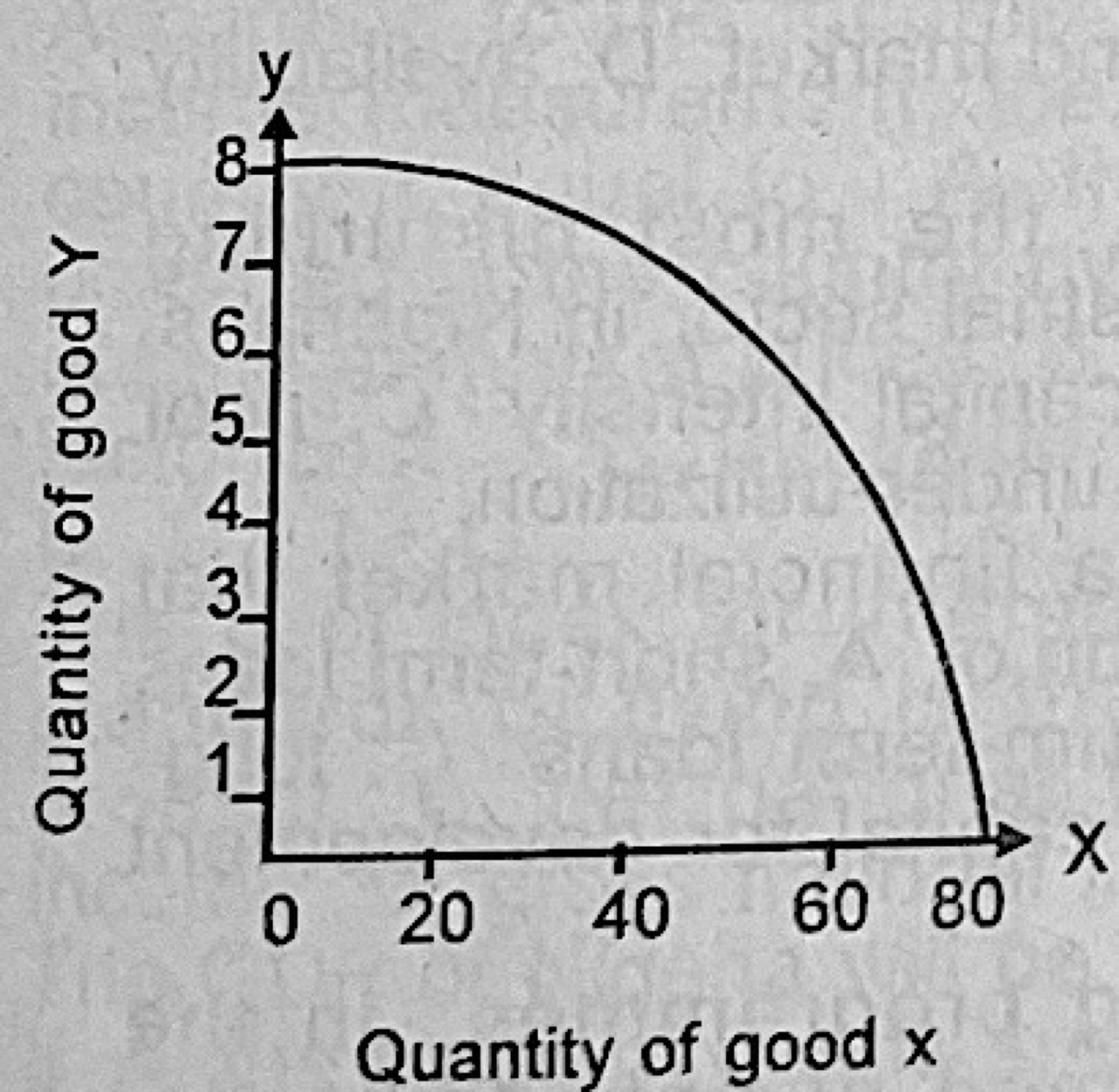
Question 2 Basic Concepts The diagram (quantity of good Y against quantity of good X) showing the maximum possible combination of commodities X and Y produced in Nigeria is called the
A. production indicator B. maximum production curve C. production possibility curve D. total output curve Show the answer and explanation Answer: C (production possibility curve )
Explanation A curve showing the greatest combinations of two goods that can be produced with given resources is the production possibility curve.
Open this question
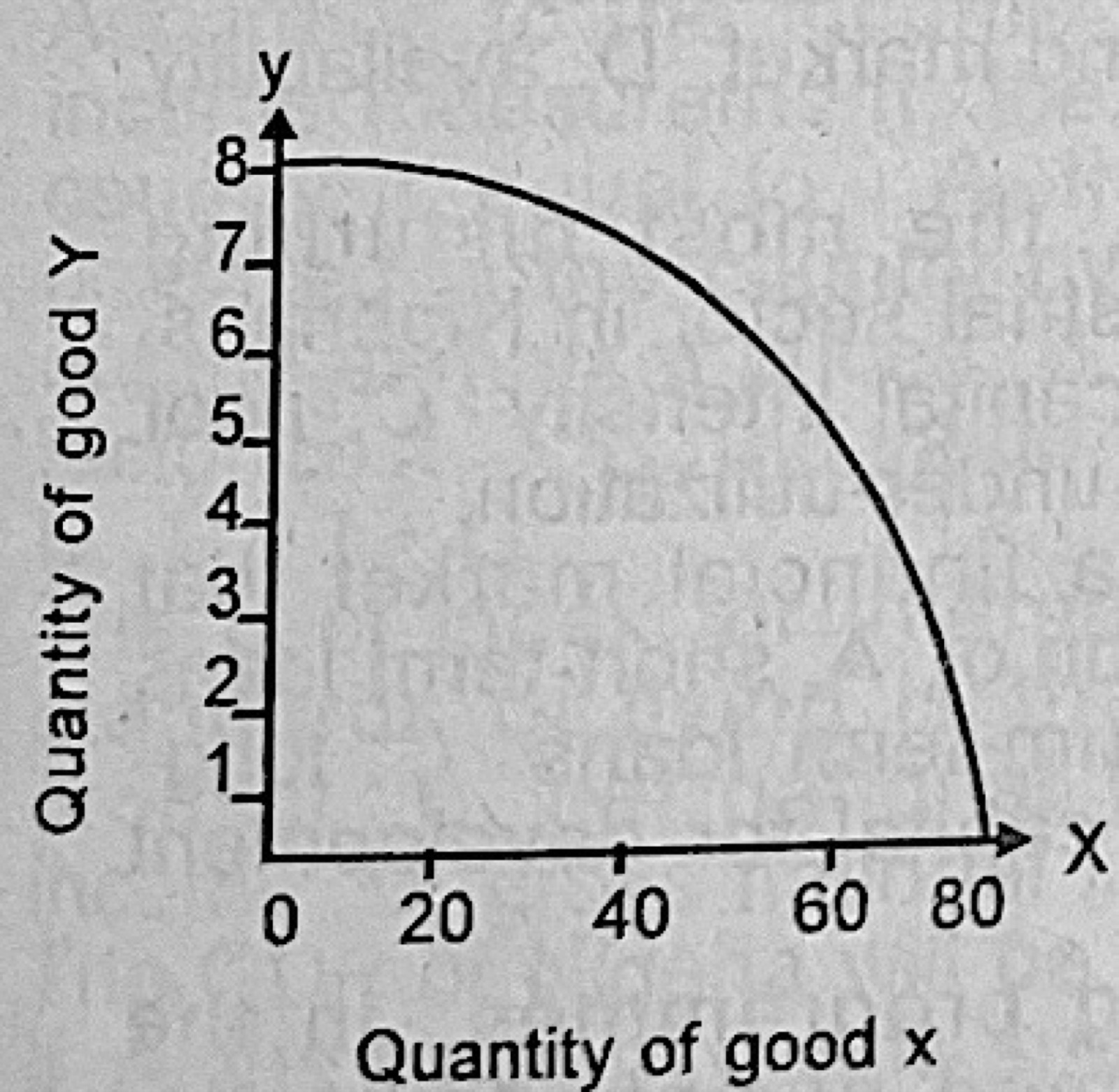
Question 3 Basic Concepts Use the production possibility diagram. How many units of good X is produced for 8 units of commodity Y?
A. 80 B. 40 C. 20 D. 0 Show the answer and explanation Answer: D (0 )
Explanation The curve meets the Y-axis at 8 units, so producing 8 units of Y leaves no resources for X: X = 0.
Open this question
Question 4 Economic Systems The main function of the price system is to
A. distribute resources equally among competing ends B. ensure efficient allocation of resources in the economic system C. allocate goods and services equally D. minimize cheating Show the answer and explanation Answer: B (ensure efficient allocation of resources in the economic system )
Explanation Prices signal where resources are most wanted and move them there, so resources are allocated efficiently (not equally).
Open this question
Question 5 Economic Systems A system in which the means of production is held in trust for the people by government is known as a
A. socialist economy B. capitalist economy C. subsistence economy D. mixed economy Show the answer and explanation Answer: A (socialist economy )
Explanation Under socialism the state owns the means of production on behalf of the people.
Open this question
Question 6 Population The working population refers to
A. a population where the average age is falling B. the population within the '0 - 14' age bracket C. the economically active segment of the population D. the dependent population Show the answer and explanation Answer: C (the economically active segment of the population )
Explanation The working population is the part of the population that is of working age and able and willing to work.
Open this question
Question 7 Population Which of the following factors is NOT responsible for the rural/urban drift in Nigeria?
A. The infrastructural facilities in cities B. Declining fertility of rural farmlands C. Rural electrification programme D. Higher living standards in urban areas Show the answer and explanation Answer: C (Rural electrification programme )
Explanation Rural electrification improves life in the villages, so it reduces rather than causes the drift to towns.
Open this question
Question 8 Population An accurate census is important to a country because it helps
A. in solving unemployment problem B. to ensure equitable population redistribution relative to natural resources C. in deciding on the creation of more local governments D. in providing a sound basis for formulating development policy Show the answer and explanation Answer: D (in providing a sound basis for formulating development policy )
Explanation Planners need correct figures on the size and structure of the population to plan schools, hospitals, jobs and so on.
Open this question
Question 9 Population If 502.75 million tonnes of grains are consumed annually by a population of 88.5 million people, the per capita grains consumption will be
A. 6.00 tonnes B. 5.68 tonnes C. 0.60 ton D. 0.57 ton Show the answer and explanation Answer: B (5.68 tonnes )
Explanation Per capita consumption = 502.75 ÷ 88.5 ≈ 5.68 tonnes.
Open this question
Question 10 Theory of Costs and Revenue In the theory of production and cost, the average total cost of a firm is minimized when the marginal cost curve cuts the average total cost curve at its
A. lowest point B. middle point C. maximum point D. downward sloping section Show the answer and explanation Answer: A (lowest point )
Explanation MC always cuts ATC at ATC's lowest point: below it MC pulls ATC down, above it MC pushes ATC up.
Open this question
Question 11 Theory of Production A firm faces diminishing returns when its
A. total output diminishes B. average output diminishes C. marginal output diminishes D. marginal revenue diminishes Show the answer and explanation Answer: C (marginal output diminishes )
Explanation Diminishing returns begin when each extra unit of the variable factor adds less output than the one before, i.e. marginal product falls.
Open this question
Question 12 Theory of Production If labour productivity in the cement industry is increasing as output of cement is expanded, then the amount of labour per unit of output produced must be
A. less than zero B. decreasing C. constant D. increasing Show the answer and explanation Answer: B (decreasing )
Explanation Higher output per worker means fewer workers (less labour) are needed for each unit of output.
Open this question
Question 13 Labour Market If profit maximization is assumed to be the objective of a business enterprise, labour must be paid a wage rate equal to the
A. marginal revenue of the enterprise B. marginal revenue product of labour in the enterprise C. average revenue of the enterprise D. marginal cost of production Show the answer and explanation Answer: B (marginal revenue product of labour in the enterprise )
Explanation A profit-maximising firm hires workers until the wage equals the extra revenue the last worker brings in, the marginal revenue product of labour.
Open this question
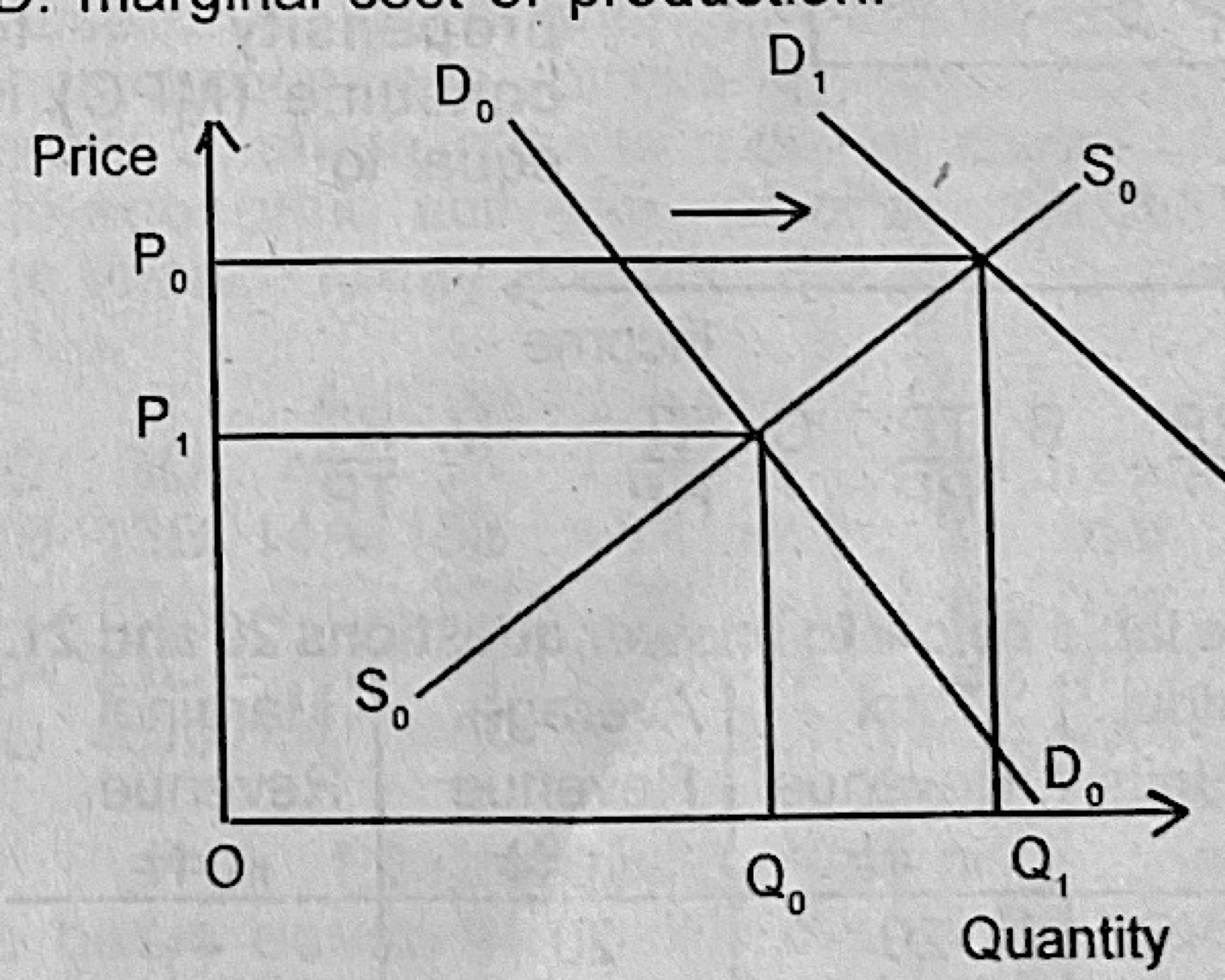
Question 14 Price Determination From the diagram, a shift in the demand curve from D0 D0 to D1 D1 implies
A. a rise in the demand for the commodity B. a fluctuation in the demand for the commodity C. a fall in the demand for the commodity D. an equilibrium in the demand for the commodity Show the answer and explanation Answer: A (a rise in the demand for the commodity )
Explanation The demand curve moves to the right, so more is demanded at every price: demand has increased.
Open this question
Question 15 Price Determination If the equilibrium price of a certain commodity is N120.00 and the government fixes its price at N110.00, the supply will be
A. greater than the equilibrium supply B. smaller than the equilibrium supply C. the same as the equilibrium supply D. a determinant of the market forces of equilibrium Show the answer and explanation Answer: B (smaller than the equilibrium supply )
Explanation At a price below equilibrium producers offer less, so quantity supplied falls below the equilibrium quantity.
Open this question
Question 16 Elasticity If the price elasticity of demand for a certain commodity is less than unity, then
A. an increase in the price of the commodity will raise the total revenue of the producer B. an increase in price leaves the total revenue unchanged C. a decrease in price raises the total revenue of the supplier D. a decrease in price leaves the total revenue constant Show the answer and explanation Answer: A (an increase in the price of the commodity will raise the total revenue of the producer )
Explanation With inelastic demand, quantity falls proportionally less than price rises, so total revenue increases.
Open this question
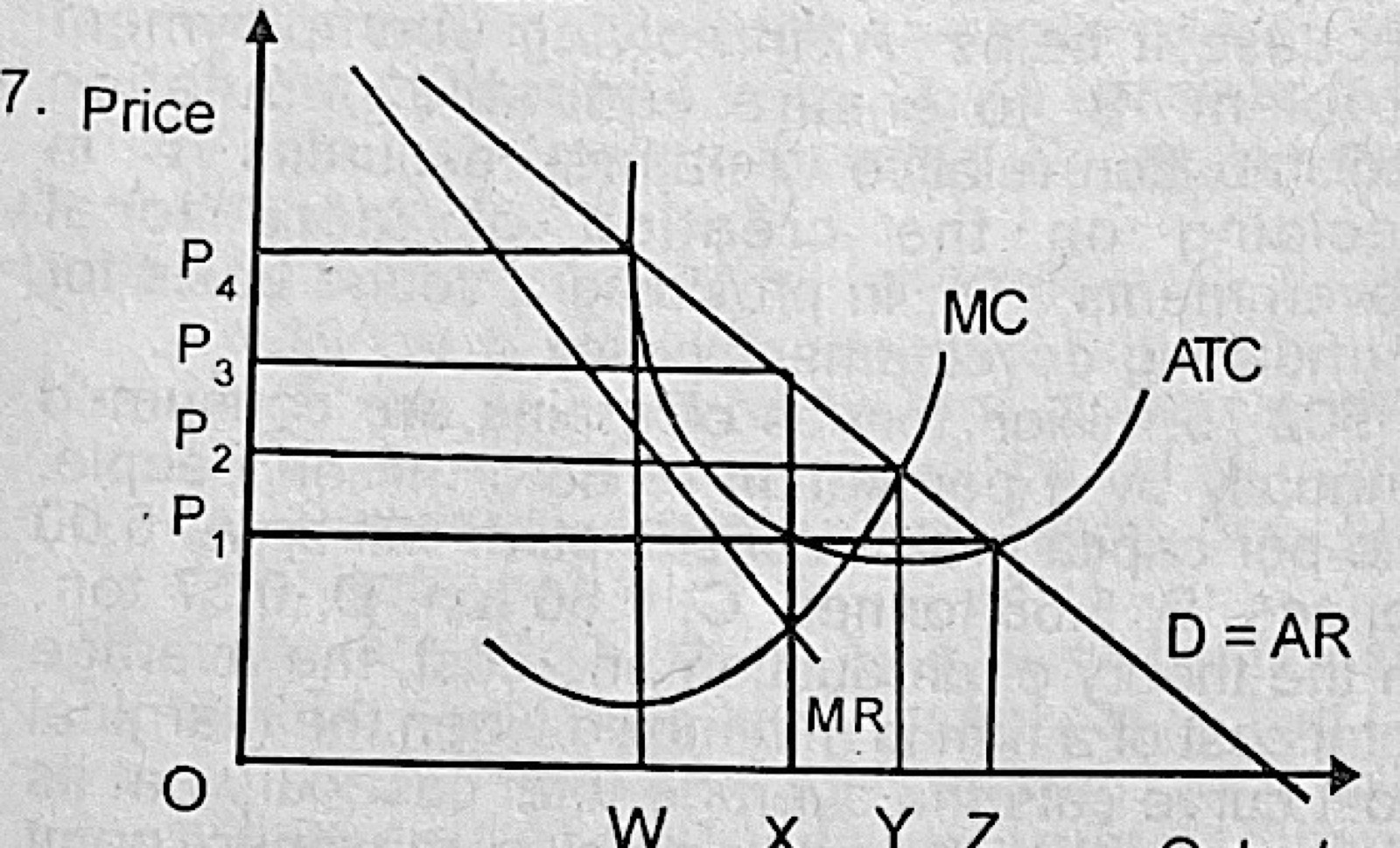
Question 17 Market Structures In the diagram above, what is the lowest possible price the monopolist could charge and still break even without there being excess demand?
A. P1 B. P2 C. P3 D. P4 Show the answer and explanation Answer: A (P1 )
Explanation To break even, price must equal average total cost. The demand curve cuts ATC at output Z, price P1; there quantity demanded equals output, so there is no excess demand.
Open this question
Question 18 Market Structures At equilibrium, one of the distinctive features of monopoly compared with perfect competition is that in the former
A. price is always equal to marginal cost B. supply is always equal to demand C. price is always higher than marginal cost D. there are always many buyers and many sellers Show the answer and explanation Answer: C (price is always higher than marginal cost )
Explanation A monopolist's marginal revenue is below price, so at MC = MR the price is above marginal cost; in perfect competition P = MC.
Open this question
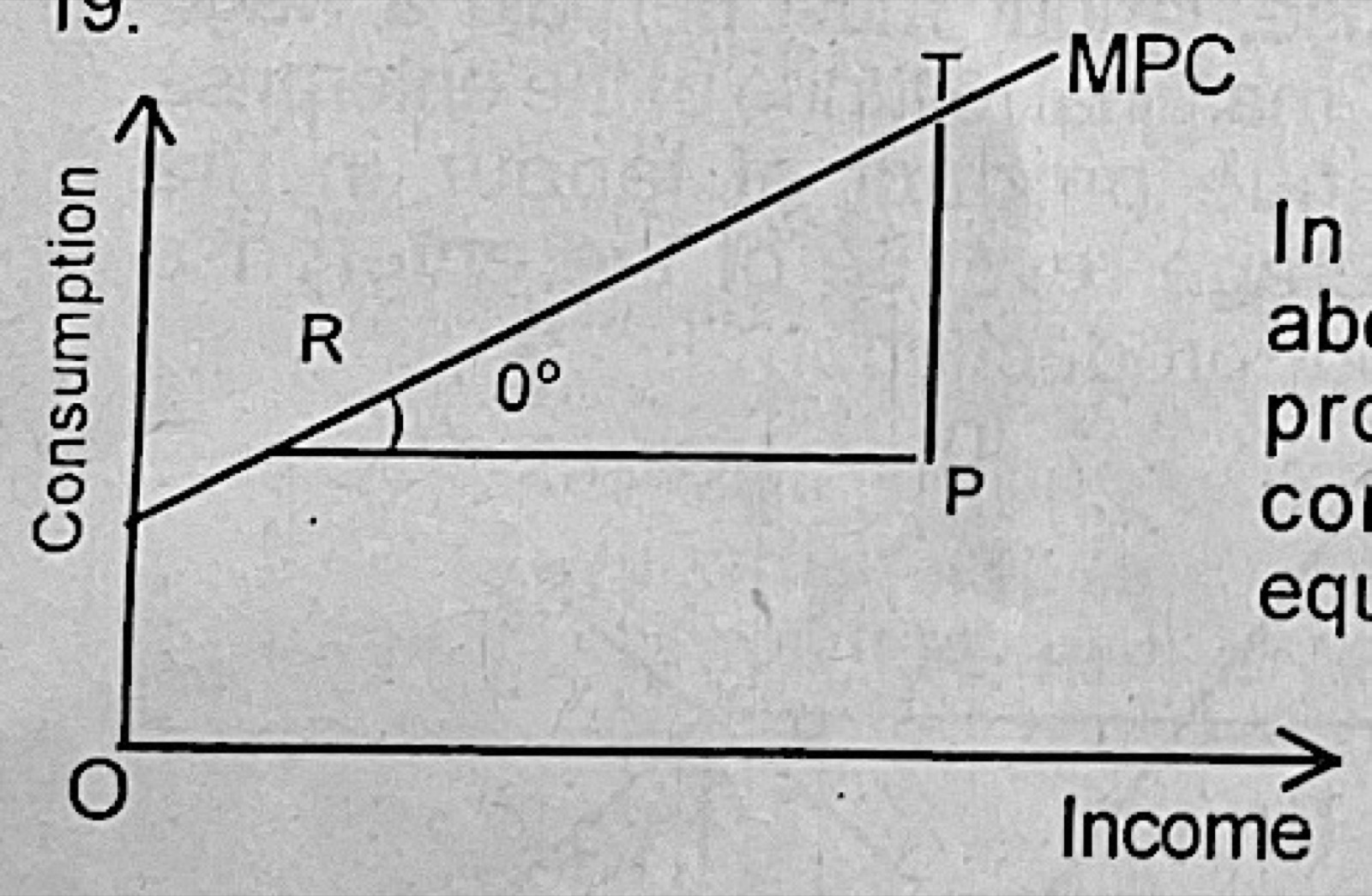
Question 19 National Income In the diagram above, the marginal propensity to consume (MPC) is equal to
A. RP/TP B. TP/RP C. RT/RP D. RT/TP Show the answer and explanation Answer: B (TP/RP )
Explanation MPC = change in consumption ÷ change in income. On the triangle, the rise TP is the change in consumption and RP the change in income, so MPC = TP/RP.
Open this question
Question 20 Theory of Costs and Revenue Output in units; total revenue (N); average revenue (N); marginal revenue (N):
A. N16.00 B. N18.00 C. N20.00 D. N24.00 Show the answer and explanation Answer: B (N18.00 )
Explanation Average revenue = total revenue ÷ output = 54 ÷ 3 = N18.
Open this question
Question 21 Theory of Costs and Revenue Output in units; total revenue (N); average revenue (N); marginal revenue (N):
A. N12.00 B. N14.00 C. N16.00 D. N18.00 Show the answer and explanation Answer: A (N12.00 )
Explanation TR rises from N68 (4 units) to N80 (5 units), so MR = 80 − 68 = N12.
Open this question
Question 22 Distributive Trade Which of the following functions does the wholesaler perform to save the retailer the burden of carrying large stocks?
A. I and II B. I and IV C. II and III D. I, II, III and IV Show the answer and explanation Answer: A (I and II )
Explanation By breaking bulk and repacking goods into small lots, the wholesaler lets the retailer buy only the small quantities he can sell, so he need not hold large stocks.
Open this question
Question 23 Theory of Production Production is said to be completed when
A. goods and services reach the consumers B. prices of goods and services are determined C. goods are sold to the wholesaler D. goods are packaged Show the answer and explanation Answer: A (goods and services reach the consumers )
Explanation Production includes every activity up to the point where the good reaches the final consumer, including distribution.
Open this question
Question 24 Business Organisations A debenture share entitles its holder to
A. participate in the annual general meeting of the company B. share in the dividends declared C. receive a fixed interest on sums invested D. have a representative on the Board of Directors Show the answer and explanation Answer: C (receive a fixed interest on sums invested )
Explanation A debenture holder lends money to the company and receives a fixed rate of interest; he is not an owner.
Open this question
Question 25 Business Organisations A public liability company is different from a private limited company because it
A. is registered with the registrar of companies B. is a legal entity C. can raise capital of any size by way of loans D. can sell shares in the stock exchange Show the answer and explanation Answer: D (can sell shares in the stock exchange )
Explanation Only a public company may offer its shares to the general public through the stock exchange; both kinds are registered and are legal entities.
Open this question
Question 26 Business Organisations A modern corporation is owned by
A. debenture holders B. ordinary shareholders C. preference shareholders D. creditors Show the answer and explanation Answer: B (ordinary shareholders )
Explanation Ordinary shareholders are the real owners: they carry the main risk and have voting rights. Debenture holders are creditors.
Open this question
Question 27 Agriculture Wheat grows best in
A. tropical climate B. temperate climate C. equatorial climate D. hot desert Show the answer and explanation Answer: B (temperate climate )
Explanation Wheat needs a cool, fairly dry growing season, which is found in temperate lands.
Open this question
Question 28 Agriculture On the basis of the contribution to employment, the most important economic sector in West Africa is
A. industry B. agriculture C. construction D. commerce Show the answer and explanation Answer: B (agriculture )
Explanation Most working people in West Africa are farmers, so agriculture employs the most people.
Open this question
Question 29 Industrialisation The most popularly adopted industrialization strategy in West Africa is
A. import substitution B. export promotion C. ports development D. infant industries protection Show the answer and explanation Answer: A (import substitution )
Explanation West African countries mainly tried to industrialise by producing at home the goods they used to import.
Open this question
Question 30 Industrialisation One of the most important factors that should be considered in the location of an industry is
A. nearness to the financial centre B. assured patronage by government functionaries C. availability of inputs and market D. availability of adequate security Show the answer and explanation Answer: C (availability of inputs and market )
Explanation Firms locate where they can get raw materials and other inputs and sell their products cheaply.
Open this question
Question 31 Industrialisation Since the mid-1980s, the most disturbing development in the industrial sector in Nigeria is
A. labour intensity B. capital intensity C. poor technology D. capacity under-utilization Show the answer and explanation Answer: D (capacity under-utilization )
Explanation After the fall in oil earnings, factories could not get imported raw materials and spare parts, so they worked far below capacity.
Open this question
Question 32 Financial Institutions The money market is a financial market that specializes in the provision of
A. short-term loans and advances B. medium-term loans C. long-term loans D. venture capital for development projects Show the answer and explanation Answer: A (short-term loans and advances )
Explanation The money market deals in short-term funds; long-term funds are raised in the capital market.
Open this question
Question 33 Financial Institutions Which of the following programmes in the monetary sector is aimed at enhancing the banking habit of the rural areas?
A. The deregulation of the banking system B. The increase in the number of merchant banks C. The community banking scheme D. The deregulation of interest rate Show the answer and explanation Answer: C (The community banking scheme )
Explanation Community banks were set up in rural communities to bring banking services to people there.
Open this question
Question 34 Financial Institutions The sum of N80,000 is deposited in a bank and the cash ratio of the banking system is 10%. Calculate the total sum of money the bank can create from the deposit.
A. N100 000 B. N800 000 C. N1 000 000 D. N8 000 000 Show the answer and explanation Answer: B (N800 000 )
Explanation Total deposits = 80,000 ÷ 0.10 = N800,000.
Open this question
Question 35 Economic Growth and Development Economic development is distinguishable from economic growth because the former
A. is not concerned with growth parameters B. affects only the poor people C. also includes an efficient distribution of economic growth D. is an increase in the production of goods and services Show the answer and explanation Answer: C (also includes an efficient distribution of economic growth )
Explanation Growth is just a rise in output; development also means the gains are shared so that living conditions improve for the people.
Open this question
Question 36 Public Finance Which of the following can be considered as being outside the objectives of public finance?
A. The allocation of resources to various sectors of the economy B. The objective of even distribution of income and wealth C. The achievement of economic stability D. The deregulation of the economy Show the answer and explanation Answer: D (The deregulation of the economy )
Explanation Allocation, distribution and stabilisation are the aims of public finance; deregulation is a policy of withdrawing government control.
Open this question
Question 37 Natural Resources and Petroleum The joint ventures operating in the Nigerian oil industry are between
A. the NNPC and independent marketers B. the NNPC and multinational marketers C. the NNPC and producer marketers D. multinational corporations and independent marketers Show the answer and explanation Answer: C (the NNPC and producer marketers )
Explanation The oil joint ventures are partnerships between the NNPC and the (mainly foreign) oil-producing companies.
Open this question
Question 38 Public Finance Which of the following are the major disadvantages of direct system of taxation?
A. I and II B. I and III C. II and III D. I, II and III Show the answer and explanation Answer: D (I, II and III )
Explanation Direct taxes such as income tax can discourage people from working harder, are difficult and costly to assess and collect, and are often assessed imperfectly (allowing evasion). All three are disadvantages.
Open this question
Question 39 National Income Items (N m):
A. N58m B. N54m C. N50m D. N46m Show the answer and explanation Answer: D (N46m )
Explanation Factor incomes 38 + 11 = 49; add net income from abroad (2 − 1 = 1) to get 50; subtract depreciation 4 to get net income of N46m.
Open this question
Question 40 National Income According to the income approach to national income measurement, the national income of a country is equal to
A. the value of all output produced in the country over the relevant period of time at market prices B. the value of output at factor cost C. the value added of production D. C + I + G Show the answer and explanation Answer: B (the value of output at factor cost )
Explanation The income approach adds the incomes paid to the factors of production, which equals the value of output at factor cost.
Open this question
Question 41 National Income The best index for international comparison of standards of living is the
A. gross national product B. net national income C. per capita income D. gross national income Show the answer and explanation Answer: C (per capita income )
Explanation Income per head takes account of population size, so it compares living standards better than total national income.
Open this question
Question 42 National Income The GDP of Nigeria will be greater than her GNP if
A. the value of goods and services to Nigeria is greater than the value of those from Nigeria B. consumption is greater than investment C. government expenditures are greater than the foreign aid received D. the value of goods and services produced by Nigerian businesses abroad is less than that of foreign businesses in Nigeria Show the answer and explanation Answer: D (the value of goods and services produced by Nigerian businesses abroad is less than that of foreign businesses in Nigeria )
Explanation GNP = GDP + net factor income from abroad. If foreigners earn more in Nigeria than Nigerians earn abroad, net factor income is negative and GDP exceeds GNP.
Open this question
Question 43 National Income Below equilibrium, the gap between aggregate demand and the full employment level of income is called the
A. inflationary gap B. income gap C. unemployment gap D. deflationary gap Show the answer and explanation Answer: D (deflationary gap )
Explanation When aggregate demand is too low to reach full-employment income, the shortfall is a deflationary gap.
Open this question
Question 44 International Economic Organisations Which of the following are the advantages of Nigeria's membership of ECOWAS?
A. I and II only B. I and III only C. II and III only D. I, II and III Show the answer and explanation Answer: D (I, II and III )
Explanation Economic integration lets members trade according to comparative cost advantage, gives industries a bigger market so they can cut unit costs, and exposes local monopolies to competition. All three are advantages.
Open this question
Question 45 International Trade Comparative advantage implies that a country will specialize in producing the commodity
A. with the highest opportunity cost B. for which output per worker is lower than in other countries C. with the lowest opportunity cost D. for which output per worker is the same with those of other countries Show the answer and explanation Answer: C (with the lowest opportunity cost )
Explanation A country has a comparative advantage in the good it can produce at a lower opportunity cost than other countries.
Open this question
Question 46 Balance of Payments and Exchange Rates Devaluation is effective when
A. demand for imports is price inelastic B. demand for imports is neutral C. production for export is low D. demand for exports is price elastic Show the answer and explanation Answer: D (demand for exports is price elastic )
Explanation Devaluation makes exports cheaper abroad; if foreign demand for them is elastic, export earnings rise a lot.
Open this question
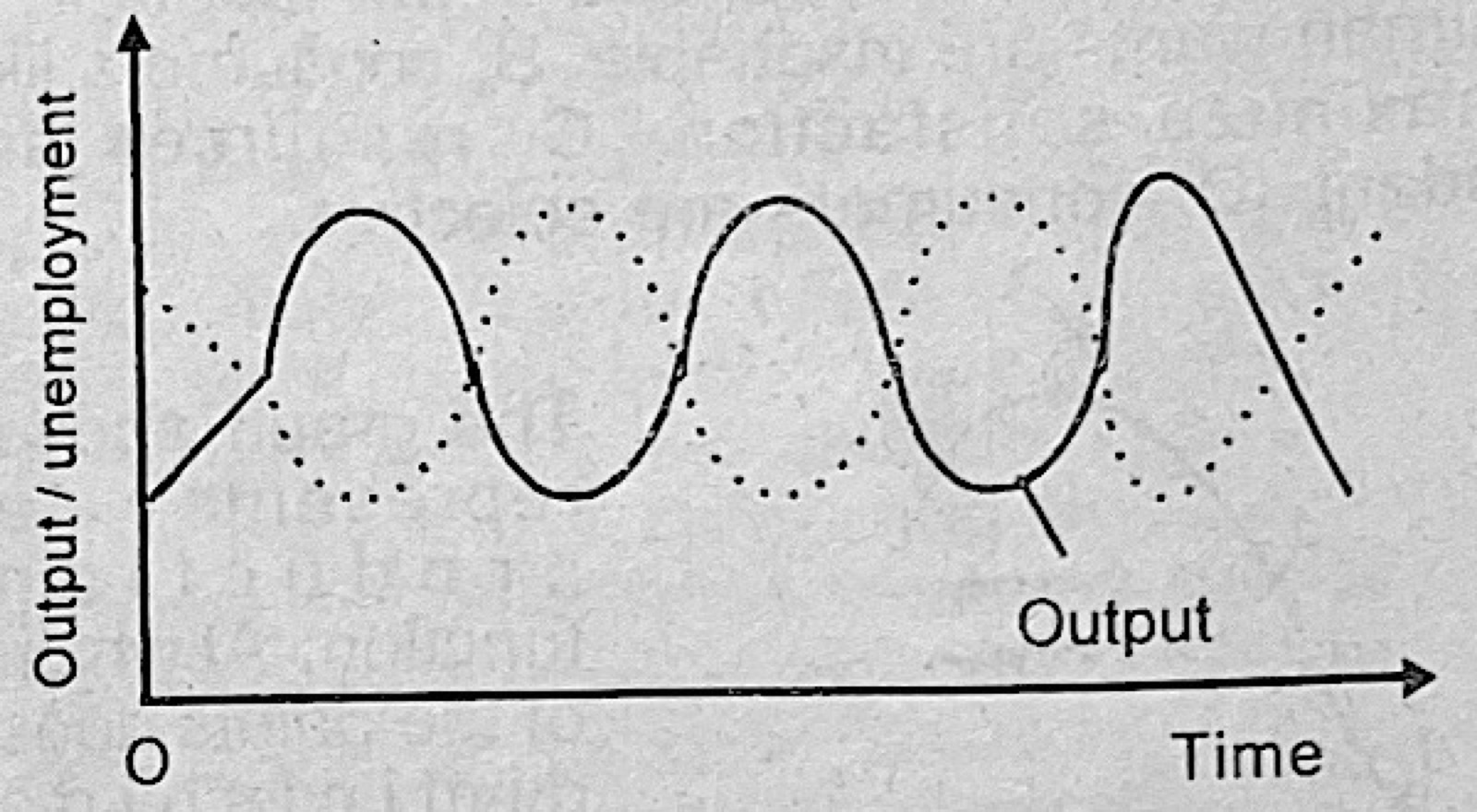
Question 47 Labour Market What type of unemployment is revealed by the dotted lines on the graph above?
A. Frictional unemployment B. Cyclical unemployment C. Circular unemployment D. Underemployment Show the answer and explanation Answer: B (Cyclical unemployment )
Explanation The dotted line rises and falls opposite to output over the trade cycle: unemployment caused by booms and slumps is cyclical.
Open this question
Question 48 International Economic Organisations From which of the following does Nigeria derive trade concessions?
A. IMF B. World Bank C. ADB D. EEC Show the answer and explanation Answer: D (EEC )
Explanation Under the Lomé Convention the EEC gave African countries such as Nigeria preferential access for their exports.
Open this question
Question 49 International Trade Tariffs on imports are meant to
A. prevent a country from becoming a dumping ground for foreign goods B. discourage exports C. encourage exports D. increase the level of external dependency Show the answer and explanation Answer: A (prevent a country from becoming a dumping ground for foreign goods )
Explanation Import duties make cheap foreign goods dearer, protecting home industries from dumping.
Open this question
Question 50 International Economic Organisations The International Bank for Reconstruction and Development is important to developing countries because it
A. gives loans to member countries for legal proceedings B. offers grants and aid for defence C. offers loans to member countries for socio-economic activities D. offers grants and aid to finance luxury projects Show the answer and explanation Answer: C (offers loans to member countries for socio-economic activities )
Explanation The IBRD (World Bank) lends to member countries for development projects such as roads, power, health and education.
Open this question Sign up free for every JAMB Economics year, practice by topic and timed mocks.
Start practising free