Home › Past questions › JAMB › Economics › 1992 45 questions. Try each one, then open the answer to check yourself and read the explanation.
Sign up free to answer these questions on a CBT screen with a timer, then see your score and every answer explained.
Start practising free
Question 1 Basic Concepts Which of the following situations can give rise to economic problems?
A. Unlimited human wants B. Wants of varying importance C. Limited means available for satisfying wants D. Means used in different ways Show the answer and explanation Answer: C (Limited means available for satisfying wants )
Explanation The economic problem arises because the resources for satisfying wants are limited (scarce) while wants are many.
Open this question
Question 2 Basic Concepts Scale of preference refers to
A. consumers preference for luxury goods B. the household monthly income C. list of goods and services in order of priority D. budget preparation without paying due regard to priority Show the answer and explanation Answer: C (list of goods and services in order of priority )
Explanation A scale of preference is a list of wants arranged in order of importance, so the most pressing are satisfied first.
Open this question
Question 3 Basic Concepts For an economy which last year produced only two commodities X and Y, the real cost of the quantity of X which it produced can be measured by the
A. amount of X it could not produce B. amount of Y it produced C. total amount of Y it could have produced D. extra amount of Y it could have produced Show the answer and explanation Answer: C (total amount of Y it could have produced )
Explanation The real (opportunity) cost of X is the amount of Y the economy gave up, i.e. the Y it could have produced with the resources used for X.
Open this question
Question 4 Economic Systems Which of the following is applicable in a wholly capitalist economy?
A. There is government intervention in price determination B. Consumer sovereignty does not exist C. The price mechanism allocates resources D. Households cannot freely decide what to spend on goods and services Show the answer and explanation Answer: C (The price mechanism allocates resources )
Explanation In pure capitalism there is no government direction; prices set by demand and supply decide how resources are used.
Open this question
Question 5 Population Age group (years): distribution (%)
A. 11 : 9 B. 9 : 11 C. 7 : 3 D. 3 : 7 Show the answer and explanation Answer: A (11 : 9 )
Explanation Dependants = 30 + 25 = 55%; working age = 45%. Dependency ratio = 55 : 45 = 11 : 9.
Open this question
Question 6 Population Population (million): food production (million tonnes)
A. 50 B. 70 C. 90 D. 100 Show the answer and explanation Answer: A (50 )
Explanation Food per person is 220/50 = 4.4, 210/70 = 3, 225/90 = 2.5 and 275/100 = 2.75 tonnes. It is highest at 50 million, the optimum population.
Open this question
Question 7 Population The major objective of the current campaign for family planning in Nigeria is to
A. reduce the death rate B. limit the number of women a man can marry C. keep the population growth rate constant D. raise the standard of living of the population Show the answer and explanation Answer: D (raise the standard of living of the population )
Explanation Family planning aims at smaller families that parents and the nation can feed, educate and care for, i.e. a higher standard of living.
Open this question
Question 8 Labour Market The migration of young people from rural to urban areas in Nigeria should help to raise the
A. standard of living in the urban areas B. total productivity of labour in the rural areas C. marginal productivity of labour in the rural areas D. marginal productivity of labour in the urban areas Show the answer and explanation Answer: C (marginal productivity of labour in the rural areas )
Explanation When surplus workers leave the overcrowded farms, each remaining worker has more land to work with, so the marginal product of rural labour rises; in the towns extra workers lower it.
Open this question
Question 9 Theory of Costs and Revenue By definition, variable costs (VC) is related to total costs (TC) and fixed costs (FC) by the equation
A. VC = TC + FC B. VC = TC − FC C. VC = TC/FC D. VC = (TC)(FC) Show the answer and explanation Answer: B (VC = TC − FC )
Explanation TC = FC + VC, so VC = TC − FC.
Open this question
Question 10 Theory of Production The higher the price of capital relative to the price of labour, the more production techniques should be
A. labour-intensive B. capital-intensive C. fixed D. technology-intensive Show the answer and explanation Answer: A (labour-intensive )
Explanation A firm uses more of the factor that is relatively cheap; if capital is dear, it uses more labour.
Open this question
Question 13 Theory of Costs and Revenue The U-shape of the long run average cost curve can be explained by the
A. law of increasing returns B. law of constant returns C. law of diminishing returns D. concepts of economies and diseconomies of scale Show the answer and explanation Answer: D (concepts of economies and diseconomies of scale )
Explanation In the long run all inputs vary; LRAC falls at first because of economies of scale and later rises because of diseconomies of scale.
Open this question
Question 14 Theory of Costs and Revenue Quantity of singlets: short-run total costs (N)
A. N1,000 B. N400 C. N70 D. N20 Show the answer and explanation Answer: D (N20 )
Explanation Fixed cost is the cost at zero output, N1,000. At 20 units variable cost = 1,400 − 1,000 = N400, so per unit it is 400 ÷ 20 = N20.
Open this question
Question 15 Economic Systems The price mechanism is more effective in achieving efficient performance of the economy than the planning mechanism because of the
A. role of supply and demand B. role of material incentive C. existence of buyers and sellers D. role of money Show the answer and explanation Answer: A (role of supply and demand )
Explanation Prices formed by demand and supply automatically signal what people want and direct resources there, without the delays of planning.
Open this question
Question 16 Elasticity If demand is relatively inelastic and sellers are able to raise the price of their commodity, then there will be a
A. fall in both quantity demanded and total revenue B. fall in the quantity demanded and a rise in total revenue C. fall in the quantity demanded and a rise in marginal revenue D. rise in both the quantity demanded and the marginal revenue Show the answer and explanation Answer: B (fall in the quantity demanded and a rise in total revenue )
Explanation With inelastic demand, quantity falls by a smaller percentage than price rises, so sales fall a little but total revenue rises.
Open this question
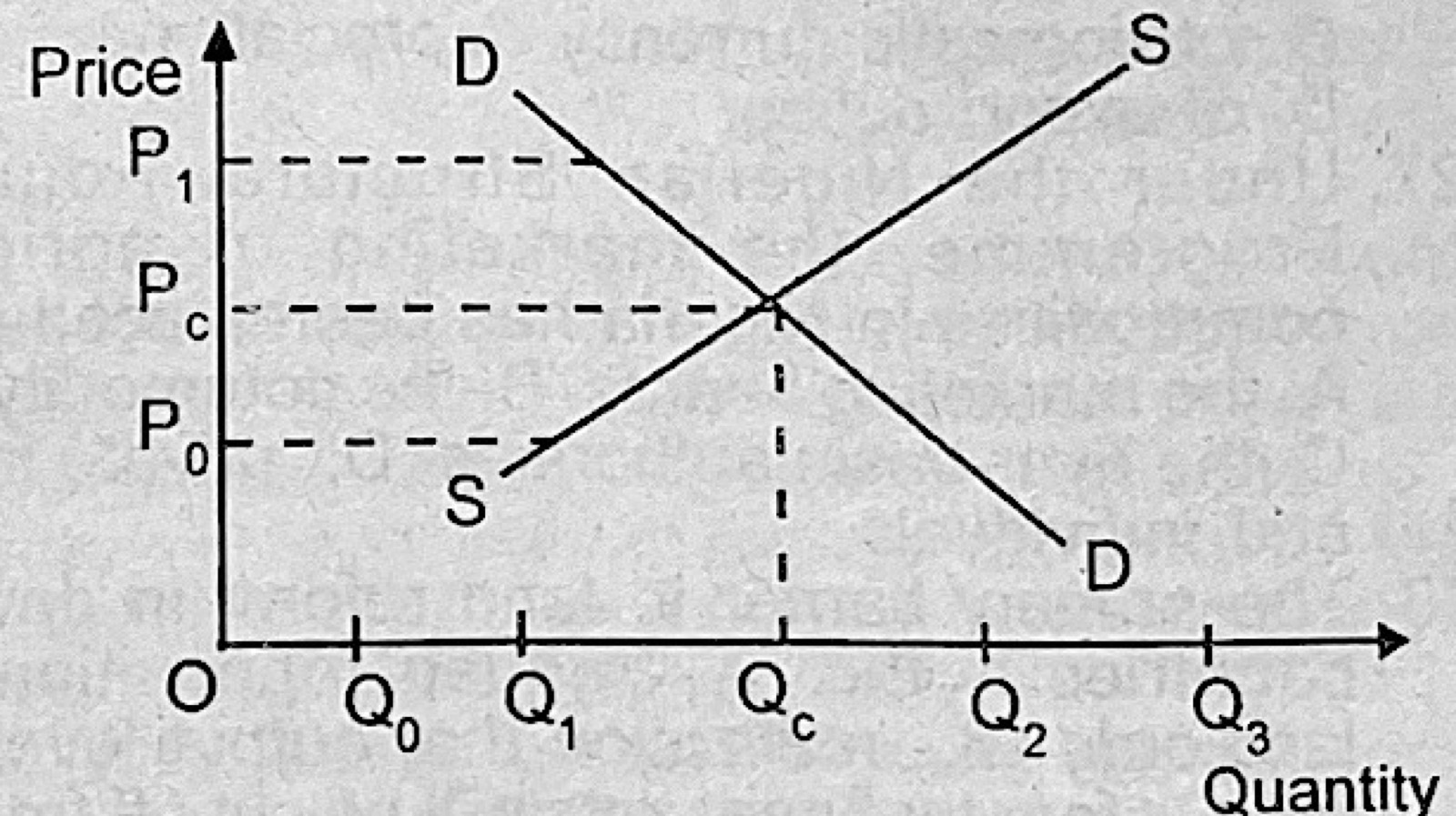
Question 17 Price Determination If in the graph above, it is assumed that the price is initially P1 , it can be deduced that price will
A. fall because there is a surplus B. remain constant because it is the equilibrium price C. rise because there is a shortage D. double Show the answer and explanation Answer: A (fall because there is a surplus )
Explanation P1 is above the equilibrium price Pc, so quantity supplied exceeds quantity demanded; the surplus pushes price down.
Open this question
Question 18 Theory of Demand The demand curve for a normal good will shift to the left if
A. the incomes of consumers rise B. the price of the goods rises C. the prices of complementary goods rise D. advertising expenditure on complementary goods increases Show the answer and explanation Answer: C (the prices of complementary goods rise )
Explanation If complements become dearer, people buy fewer of them and less of this good at every price, so demand shifts left. A change in the good's own price only moves along the curve.
Open this question
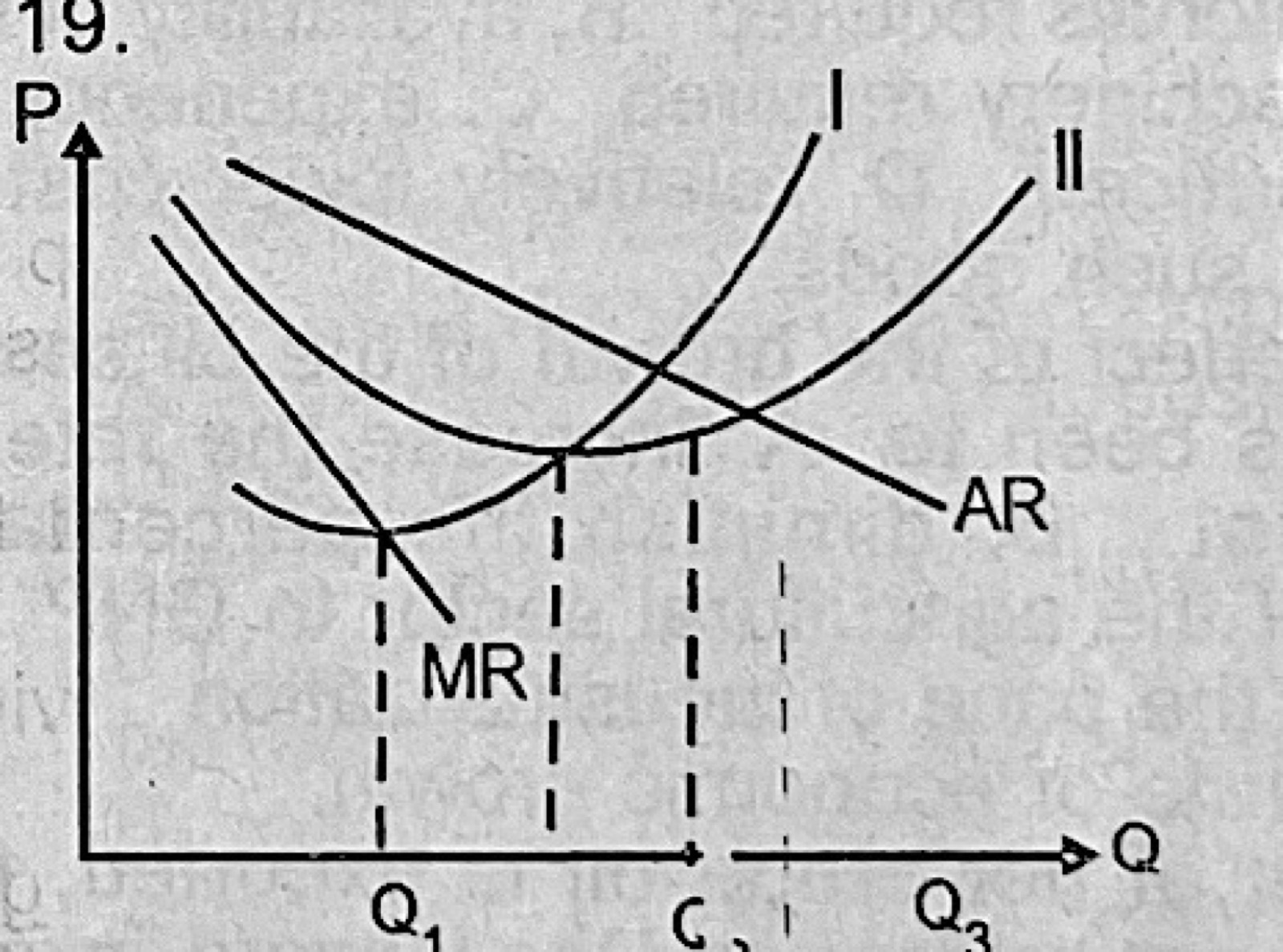
Question 19 Market Structures In the diagram above, the profit maximizing output is
A. Q1 while I = AC and II = MC B. Q1 while I = MC and II = AC C. Q2 while I = MC and II = AC D. Q3 while I = AC and II = MC Show the answer and explanation Answer: B (Q1 while I = MC and II = AC )
Explanation Curve I is steeper and passes through the lowest point of II, so I is MC and II is AC. Profit is maximised where MR cuts MC, at output Q1.
Open this question
Question 20 Market Structures A firm with marginal cost equal to its marginal revenue will produce the equilibrium output if it is in
A. pure competition only B. pure monopoly only C. monopolistic competition only D. any type of market Show the answer and explanation Answer: D (any type of market )
Explanation MC = MR is the profit-maximising rule for every firm, whatever the market structure.
Open this question
Question 22 Business Organisations The main handicap of sole proprietorship is
A. limited liability B. lack of technical know-how C. low profit margin D. inadequate capital Show the answer and explanation Answer: D (inadequate capital )
Explanation A sole trader depends on his own savings and small loans, so shortage of capital limits the business.
Open this question
Question 23 Business Organisations The type of business organizations mostly used for producing public goods in Nigeria is
A. sole proprietorship B. limited liability companies C. co-operative societies D. statutory corporations Show the answer and explanation Answer: D (statutory corporations )
Explanation Public utilities such as power, water and railways are run by statutory corporations set up by law.
Open this question
Question 24 Business Organisations The main reason for the current programme of privatization and commercialization of public enterprises in Nigeria is to
A. reduce public expenditure B. encourage efficiency in the performance of such enterprises C. reduce the number of public enterprises D. raise the prices of goods and services produced by the enterprises Show the answer and explanation Answer: B (encourage efficiency in the performance of such enterprises )
Explanation Public enterprises were inefficient and loss-making; selling them or running them commercially is meant to make them efficient.
Open this question
Question 26 Agriculture Farmers' income may fall if they produce more cash crops for export because
A. foreign demand is inelastic B. the price of the crops will rise C. of domestic currency depreciation D. of export duties Show the answer and explanation Answer: A (foreign demand is inelastic )
Explanation With inelastic demand, more supply causes a large fall in price, so total earnings fall.
Open this question
Question 27 Agriculture Under the Nigerian Structural Adjustment Programme, the marketing of agricultural commodities in Nigeria has been placed under
A. the marketing boards B. the commodity boards C. the river-basin authorities D. private investors and individuals Show the answer and explanation Answer: D (private investors and individuals )
Explanation SAP abolished the commodity boards and left the marketing of crops to private buyers.
Open this question
Question 28 Agriculture The primary barrier to land reform in developing countries is the
A. frequent opposition by the landlords B. realization that output levels might fall C. fear that peasants will be cut off from credit D. general contentment with the present arrangement Show the answer and explanation Answer: A (frequent opposition by the landlords )
Explanation Land reform takes land from the big owners, who are powerful and resist it.
Open this question
Question 29 Industrialisation Firms are often set up close to each other in order to take advantage of
A. supply of skilled labour B. agglomeration economies C. internal economies of scale D. external economies of scale Show the answer and explanation Answer: D (external economies of scale )
Explanation When firms cluster they share services such as skilled labour, suppliers and infrastructure; these benefits from outside the firm are external economies of scale.
Open this question
Question 30 Industrialisation The consumer-goods industry is predominant in the industrial sector of the Nigerian economy because of the
A. availability of market and most of the raw materials required B. availability of the necessary machinery required C. experience of Nigerian producers D. relatively lower cost of production of such goods Show the answer and explanation Answer: A (availability of market and most of the raw materials required )
Explanation There is a large home market for consumer goods and many of their raw materials are found locally, so such industries are easy to start.
Open this question
Question 31 Natural Resources and Petroleum A significant effect of the growth of the oil sector in Nigeria has been to
A. increase the rate of unemployment B. diminish the percentage contribution of the agricultural sector to GNP C. slow down the pace of industrialization D. retard the rate of economic growth Show the answer and explanation Answer: B (diminish the percentage contribution of the agricultural sector to GNP )
Explanation As oil output and earnings grew, agriculture's share of national output fell sharply.
Open this question
Question 32 Natural Resources and Petroleum Because most of her crude oil is exported, the foreign exchange earnings and the forward linkage effects Nigeria realizes from her oil production are
A. both high B. respectively high and low C. respectively low and high D. both low Show the answer and explanation Answer: B (respectively high and low )
Explanation Exporting crude earns much foreign exchange, but little is refined or processed at home, so forward linkages are weak.
Open this question
Question 33 Financial Institutions Which of the following is NOT directly concerned with dealings in treasury bills?
A. The stock exchange B. The Central Bank C. Commercial banks D. Discount houses Show the answer and explanation Answer: A (The stock exchange )
Explanation Treasury bills are short-term money-market instruments issued by the Central Bank and traded by banks and discount houses; the stock exchange deals in long-term securities.
Open this question
Question 34 Money and Inflation Monetization refers to the ratio of
A. total transactions to monetary transactions B. monetary assets to total assets C. monetary transactions to total transactions D. money in circulation to total income Show the answer and explanation Answer: D (money in circulation to total income )
Explanation The book takes monetization as the ratio of money in circulation to national income, a measure of how much the economy uses money.
Open this question
Question 35 Money and Inflation The best way to reduce the supply of money in the economy is to
A. increase the liquidity ratio B. increase the number of bank-notes and cheques produced C. decrease treasury bills D. liberalize access to credit Show the answer and explanation Answer: A (increase the liquidity ratio )
Explanation A higher liquidity ratio forces banks to keep more assets idle, so they lend and create less money.
Open this question
Question 36 Money and Inflation The total amount of money in circulation includes cash
A. and current account balances owned by the non-bank public B. owned by banks and the non-bank public C. and current account balances owned by banks and the non-bank public D. owned by banks, the government and the non-bank public Show the answer and explanation Answer: A (and current account balances owned by the non-bank public )
Explanation Money supply counts currency and current (demand) deposits held by the non-bank public; cash held by banks is not in circulation.
Open this question
Question 37 Money and Inflation To reduce the high rate of inflation in the economy, the Government should
A. increase taxes and have a budget surplus B. increase taxes and have a budget deficit C. decrease taxes and have budget deficit D. decrease taxes and have a balanced budget Show the answer and explanation Answer: A (increase taxes and have a budget surplus )
Explanation Higher taxes and spending less than revenue take money out of the economy, which reduces demand and inflation.
Open this question
Question 38 Business Organisations When interest rates are high and still rising the least-cost method used by public limited companies to obtain additional funds for their operations is by
A. obtaining long-term loans from merchant banks B. obtaining short-term loans from commercial banks C. selling floating-rate debenture stocks to the general public D. selling new ordinary shares to the general public Show the answer and explanation Answer: D (selling new ordinary shares to the general public )
Explanation Shares carry no fixed interest, so selling them avoids the high and rising cost of borrowing.
Open this question
Question 39 Public Finance The objective of public finance is to promote
A. full employment, national income and price stability B. government revenue drive and expenditure to as high a level as possible C. the expansion of government social services D. government revenue drive and minimize government expenditure Show the answer and explanation Answer: A (full employment, national income and price stability )
Explanation Government uses taxes and spending to achieve full employment, growth of national income and stable prices.
Open this question
Question 40 Public Finance An account from which allocations are made to the three tiers of government in Nigeria is called the
A. National Income Account B. Public Sector Account C. Federation Account D. National Revenue Mobilization Account Show the answer and explanation Answer: C (Federation Account )
Explanation Federally collected revenue is paid into the Federation Account and shared among federal, state and local governments.
Open this question
Question 41 National Income Year 1: GNP at current prices N20,000m; population 20 million
A. 3.5% B. 14.0% C. 20.0% D. 35.0% Show the answer and explanation Answer: D (35.0% )
Explanation Increase = 27,000 − 20,000 = 7,000; 7,000 ÷ 20,000 × 100 = 35%.
Open this question
Question 42 National Income Year 1: GNP at current prices N20,000m; population 20 million
A. N2000.00; N1000.00 B. N1125.00; N2000.00 C. N1000.00; N2000.00 D. N1000.00; N1125.00 Show the answer and explanation Answer: D (N1000.00; N1125.00 )
Explanation Year 1: 20,000m ÷ 20m = N1,000. Year 2: 27,000m ÷ 24m = N1,125.
Open this question
Question 43 National Income In national income accounting, aggregate saving in any year is defined as
A. all disposable income not spent on consumption B. all savings deposits in all banks during the year C. all savings and time deposits in all banks during the year D. the value of inventory change for the year Show the answer and explanation Answer: A (all disposable income not spent on consumption )
Explanation Saving is the part of disposable income not spent on consumption, wherever it is kept.
Open this question
Question 44 Economic Growth and Development Which of the following combinations is a veritable set of development indicators?
A. Growth of government expenditure and imports B. Growth of population and national income C. High fertility, literacy and school enrolment rates D. Low infant mortality and high per capita income and literacy rates Show the answer and explanation Answer: D (Low infant mortality and high per capita income and literacy rates )
Explanation A developed society has few infant deaths, high income per head and a literate population.
Open this question
Question 46 Balance of Payments and Exchange Rates If a country has a balance of payment crisis, which of the following measures can best bring about an improvement in the short run?
A. Large-scale importation of foreign goods B. Investment in capital market abroad C. Large-scale export of locally made goods D. Repayment of debt to her creditors Show the answer and explanation Answer: C (Large-scale export of locally made goods )
Explanation Exporting more brings in foreign exchange and reduces the deficit; the other options send money out.
Open this question
Question 47 International Trade The terms of trade of a country is defined as
A. (index of import prices ÷ index of export prices) × 100 B. (index of exportables ÷ index of importables) × 100 C. (index of visible imports ÷ index of visible exports) × 100 D. (index of export prices ÷ index of import prices) × 100 Show the answer and explanation Answer: D ((index of export prices ÷ index of import prices) × 100 )
Explanation Terms of trade = (index of export prices ÷ index of import prices) × 100.
Open this question
Question 48 Balance of Payments and Exchange Rates When a foreigner on a visit to Nigeria pays for hotel accommodation and meals with some foreign currency, the amount paid should be recorded in Nigeria's balance of payments as an item of
A. Nigeria's invisible export trade B. Nigeria's import trade C. Nigeria's visible trade D. foreign capital inflow into Nigeria Show the answer and explanation Answer: A (Nigeria's invisible export trade )
Explanation Services sold to foreigners (tourism) earn foreign exchange but involve no goods crossing the border, so they are invisible exports.
Open this question
Question 49 International Economic Organisations The Nigerian Trust Fund is managed on behalf of Nigeria by the
A. World Bank B. International Monetary Fund C. African Development Bank D. Economic Commission for Africa Show the answer and explanation Answer: C (African Development Bank )
Explanation Nigeria set up the Nigeria Trust Fund in 1976 and the African Development Bank manages it to give soft loans to poorer African countries.
Open this question
Question 50 International Economic Organisations One of the gains by member states of the Economic Community of West African States is
A. monocultural dependency B. trade creation C. trade inversion D. economic independency Show the answer and explanation Answer: B (trade creation )
Explanation Removing trade barriers among members lets cheaper producers within the region replace dearer ones, creating new trade.
Open this question Sign up free for every JAMB Economics year, practice by topic and timed mocks.
Start practising free