Home › Past questions › JAMB › Economics › 1991 49 questions. Try each one, then open the answer to check yourself and read the explanation.
Sign up free to answer these questions on a CBT screen with a timer, then see your score and every answer explained.
Start practising free
Question 1 Economic Systems In market economy, the question of what, how and for whom to produce are solved by the
A. elected representatives of the people B. planning committee C. price mechanism D. government Show the answer and explanation Answer: C (price mechanism )
Explanation In a market economy the forces of demand and supply, through prices, decide what is produced, how and for whom.
Open this question
Question 2 Basic Concepts Economic goods are termed scarce goods when they are
A. not available in sufficient quantities to satisfy all wants for them B. not produced in sufficient quantities to satisfy the effective demand for them C. of high quality D. of primary importance in satisfying the needs of a society Show the answer and explanation Answer: A (not available in sufficient quantities to satisfy all wants for them )
Explanation Goods are scarce when the quantity available is less than what people would want, so they command a price.
Open this question
Question 3 Basic Concepts A school girl who needs a book and mirror, each costing five naira, decides to purchase the book instead of the mirror since she cannot pay for the two at the same time. Determine the real cost of her book.
A. The five naira she spent on the book B. Five naira real cash value C. The mirror D. The book Show the answer and explanation Answer: C (The mirror )
Explanation The real (opportunity) cost of the book is the next best alternative she gave up, which is the mirror.
Open this question
Question 4 Basic Concepts Macroeconomics is a study of economic science from the point of view of
A. resource markets or production units B. individual producers or consumers C. aggregate or general economy D. companies or individual firms Show the answer and explanation Answer: C (aggregate or general economy )
Explanation Macroeconomics studies the economy as a whole: national income, total employment, the general price level. Individual firms and consumers belong to microeconomics.
Open this question
Question 6 Theory of Production If units of a variable factor are increasingly added to a fixed factor and the marginal physical product keeps increasing, production is said to be taking place under conditions of
A. increasing returns to the variable factor B. increasing returns to scale C. constant returns to the variable factor D. external economies of scale Show the answer and explanation Answer: A (increasing returns to the variable factor )
Explanation Only one factor is being varied and each extra unit adds more output than the last, so there are increasing returns to the variable factor (not to scale, which needs all inputs to change).
Open this question
Question 7 Theory of Costs and Revenue At any given level of output, the total cost of a firm equals the
A. marginal cost plus the average cost B. fixed costs less its variable cost C. average cost multiplied by its output D. economic costs multiplied by variable costs Show the answer and explanation Answer: C (average cost multiplied by its output )
Explanation Average cost = total cost ÷ output, so total cost = average cost × output.
Open this question
Question 8 Theory of Costs and Revenue At any given level of output, a firm's total variable cost equals
A. total cost less marginal cost B. total cost less total fixed costs C. total cost less average cost D. average variable cost and marginal variable cost Show the answer and explanation Answer: B (total cost less total fixed costs )
Explanation Total cost = total fixed cost + total variable cost, so TVC = TC − TFC.
Open this question
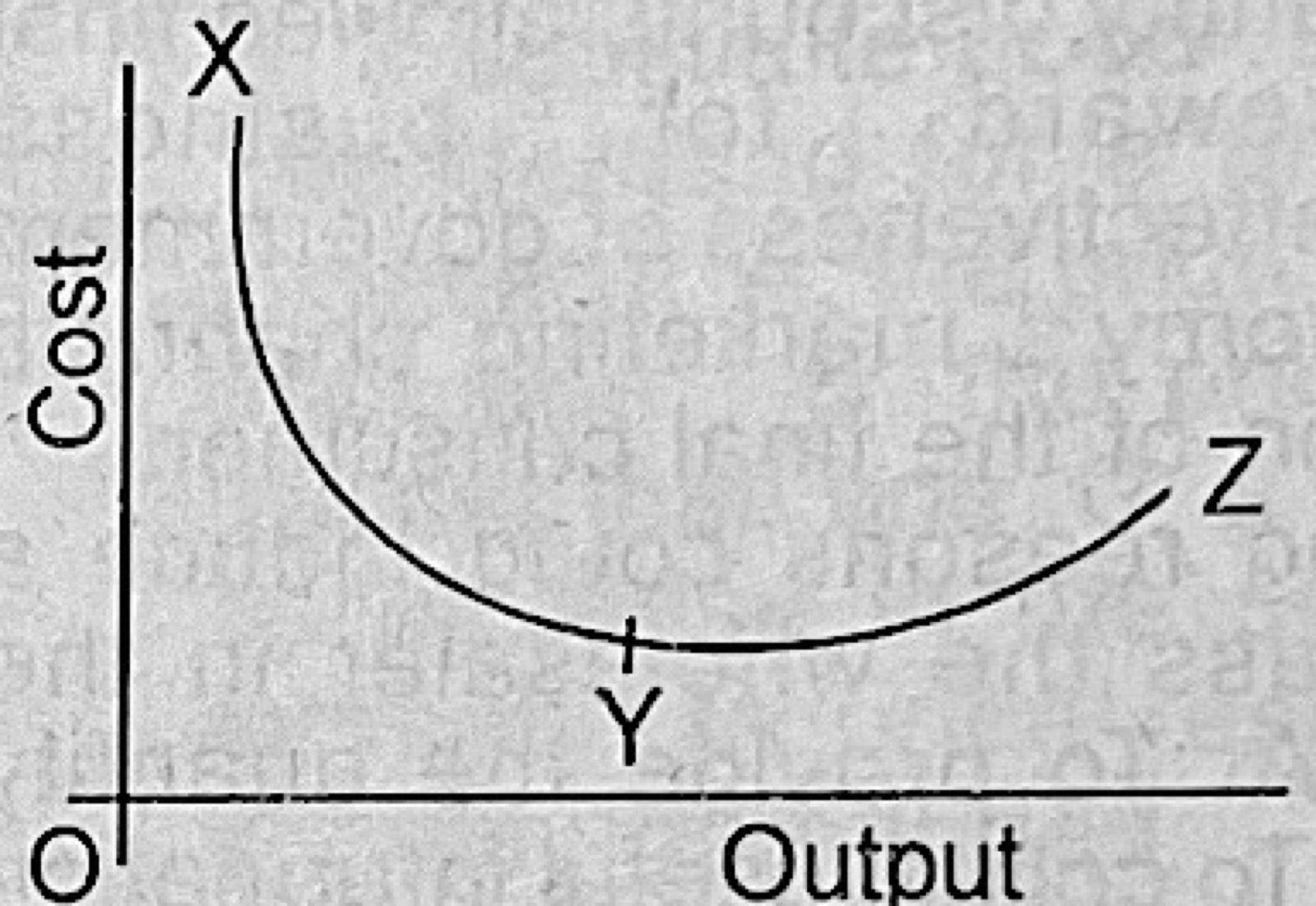
Question 9 Theory of Costs and Revenue Consider the diagram where XYZ represent the average cost curve of a firm. XY shows that as output increases the average declines. However, this decline cannot continue indefinitely because of
A. managerial economies B. indivisibilities C. the extent of the market D. the pooling of dissimilar risks Show the answer and explanation Answer: C (the extent of the market )
Explanation Average cost falls as output grows only while the market can absorb the extra output; the size (extent) of the market limits how far the firm can expand and enjoy economies.
Open this question
Question 10 Elasticity If the price of a ball point pen falls from N1.00 to N0.60 and the quantity demanded increases from 200 to 300, the point elasticity of demand is equal to
A. 1.25 B. 0.80 C. 0.50 D. 0.40 Show the answer and explanation Answer: A (1.25 )
Explanation Quantity rises by 100/200 = 50% while price falls by 0.40/1.00 = 40%, so elasticity = 50 ÷ 40 = 1.25.
Open this question
Question 11 Basic Concepts If a society is operating on the production possibility curve, this implies that the resources are
A. fully and efficiently utilized B. fully but inefficiently utilized C. efficiently but not fully utilized D. abundant Show the answer and explanation Answer: A (fully and efficiently utilized )
Explanation Points on the PPC show the most that can be produced with all resources employed efficiently; points inside show waste or unemployment.
Open this question
Question 12 Price Determination A market is in disequilibrium if
A. the quantity purchased is greater than the quantity sold B. the quantity sold differs from the quantity purchased C. at a lower price, a large quantity is sold D. the quantity demanded differs from the quantity supplied Show the answer and explanation Answer: D (the quantity demanded differs from the quantity supplied )
Explanation Equilibrium means quantity demanded equals quantity supplied; when they differ there is a shortage or surplus.
Open this question
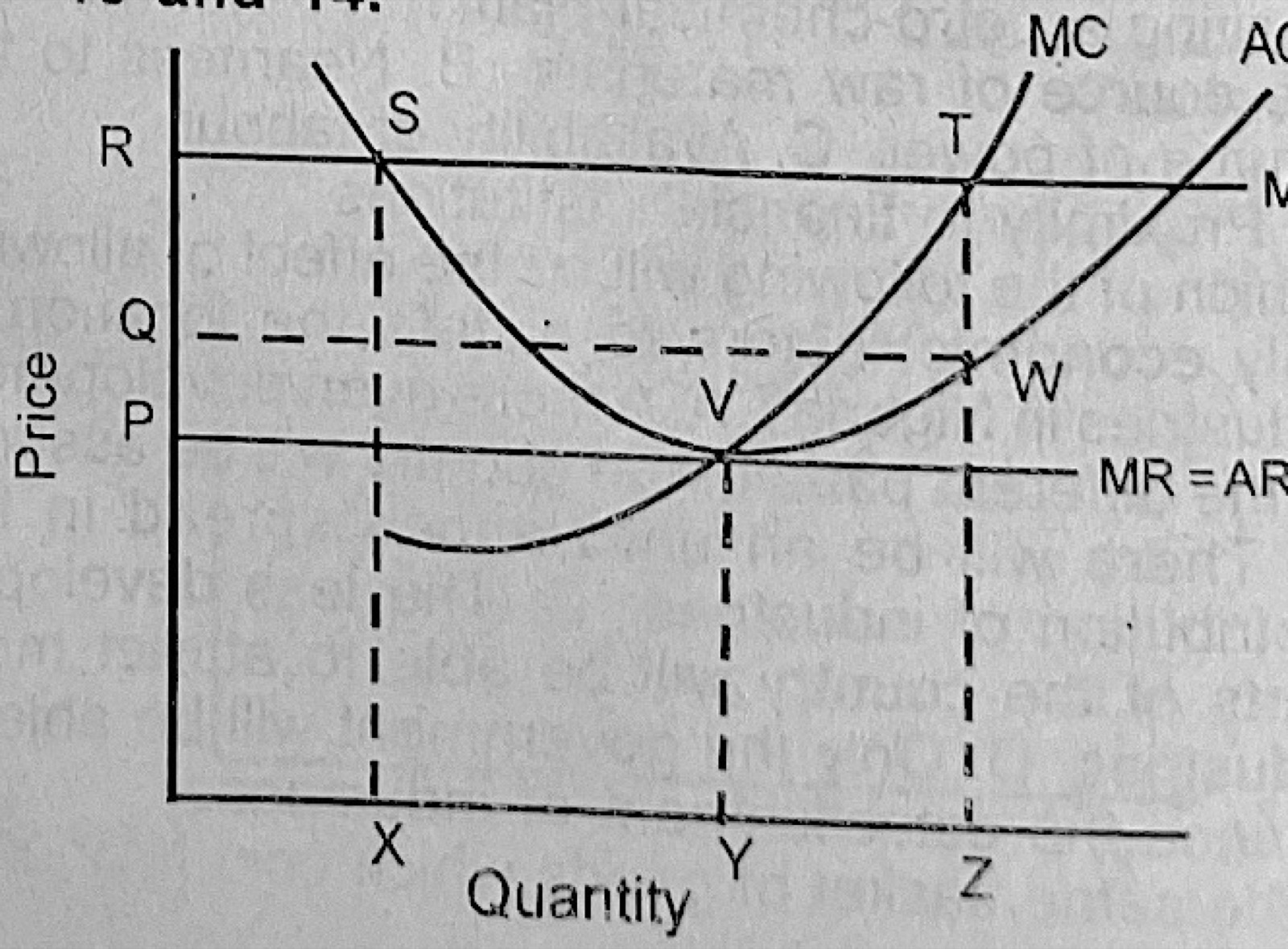
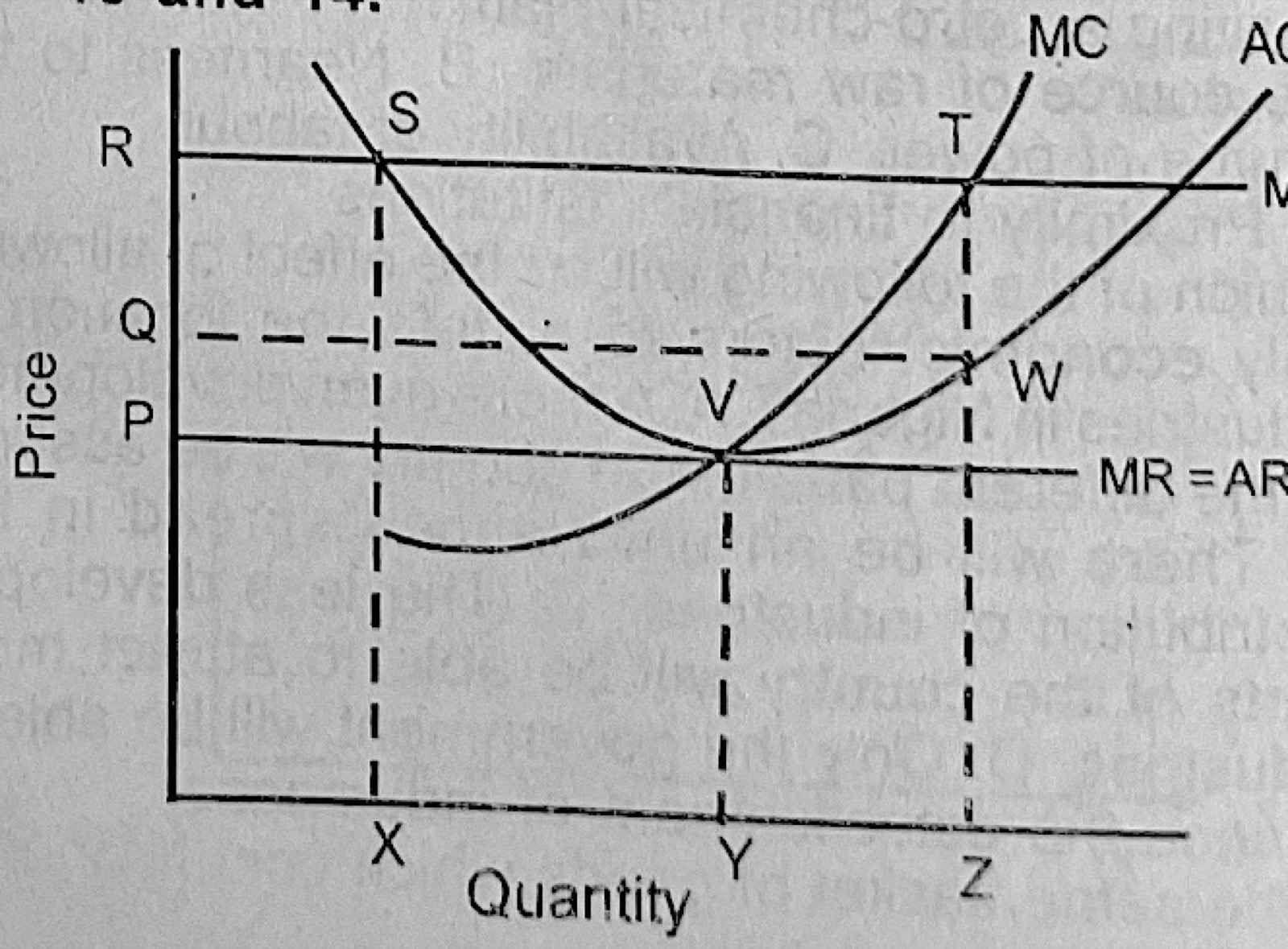
Question 13 Market Structures Use the diagram (MC and AC curves with MR = AR lines at R and P). The excess profit made by the firm in the short-run is represented by
A. ORTZ B. OPVY C. QRTW D. ORSX Show the answer and explanation Answer: C (QRTW )
Explanation In the short run price is OR and the firm produces OZ where MC = MR at T. Average cost at that output is ZW = OQ, so the supernormal profit is the rectangle QRTW.
Open this question
Question 14 Market Structures Use the diagram (MC and AC curves with MR = AR lines at R and P). The long-run equilibrium price and quantity for the firm are respectively
A. OP, OY B. OR, OZ C. OR, OX D. OQ, OZ Show the answer and explanation Answer: A (OP, OY )
Explanation In the long run new firms push price down to the lowest point of AC, at V, where MC = MR = AR = P. Price is OP and output OY, and only normal profit is earned.
Open this question
Question 15 Elasticity The cross-elasticity of demand between complementary goods is
A. unitary B. positive C. zero D. negative Show the answer and explanation Answer: D (negative )
Explanation For complements a rise in the price of one reduces demand for the other, so the cross-elasticity has a negative sign.
Open this question
Question 16 Market Structures Resources are efficiently allocated when production takes place at that output where price equals
A. marginal revenue B. average variable cost C. marginal cost D. total cost Show the answer and explanation Answer: C (marginal cost )
Explanation Allocative efficiency requires P = MC: the value consumers place on the last unit equals the cost of the resources used to make it.
Open this question
Question 17 Market Structures Comparison of the price and output decisions of a perfectly competitive firm with those of a monopolist shows that the
A. monopolist charges a lower price than the perfect competitor B. perfect competitor charges a lower price and produces a larger output than the monopolist C. perfect competitor produces a smaller output than the monopolist D. monopolist charges a lower price and produces a larger output than the perfect competitor Show the answer and explanation Answer: B (perfect competitor charges a lower price and produces a larger output than the monopolist )
Explanation A monopolist restricts output to raise price; a competitive industry produces more and sells at a lower price.
Open this question
Question 18 Market Structures The table shows output (Q), total cost (TC) of production and marginal cost (MC) for a firm in a competitive market.
A. N2,000.00 B. N1,200.00 C. N1,000.00 D. N400.00 Show the answer and explanation Answer: B (N1,200.00 )
Explanation The firm produces where MC = P = N12, i.e. 900 tons. Revenue = 900 × 12 = N10,800; profit = 10,800 − 9,600 = N1,200, the largest in the table.
Open this question
Question 19 Market Structures In a perfectly competitive market, the firm is in long-run equilibrium at the output where
A. marginal cost is minimum B. average cost is minimum C. total revenue is maximum D. marginal revenue is maximum Show the answer and explanation Answer: B (average cost is minimum )
Explanation In the long run free entry removes supernormal profit, so price equals the minimum of average cost.
Open this question
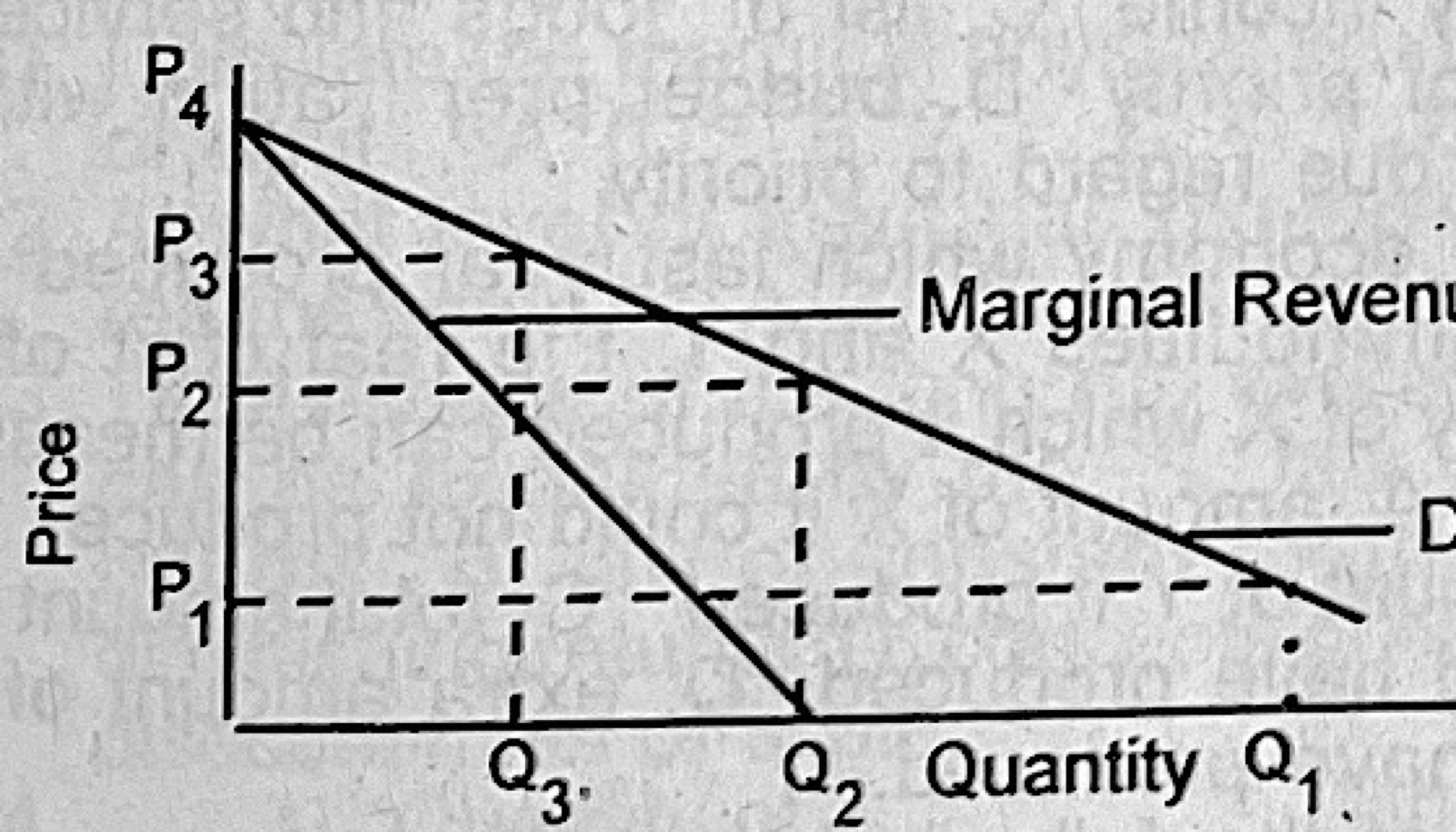
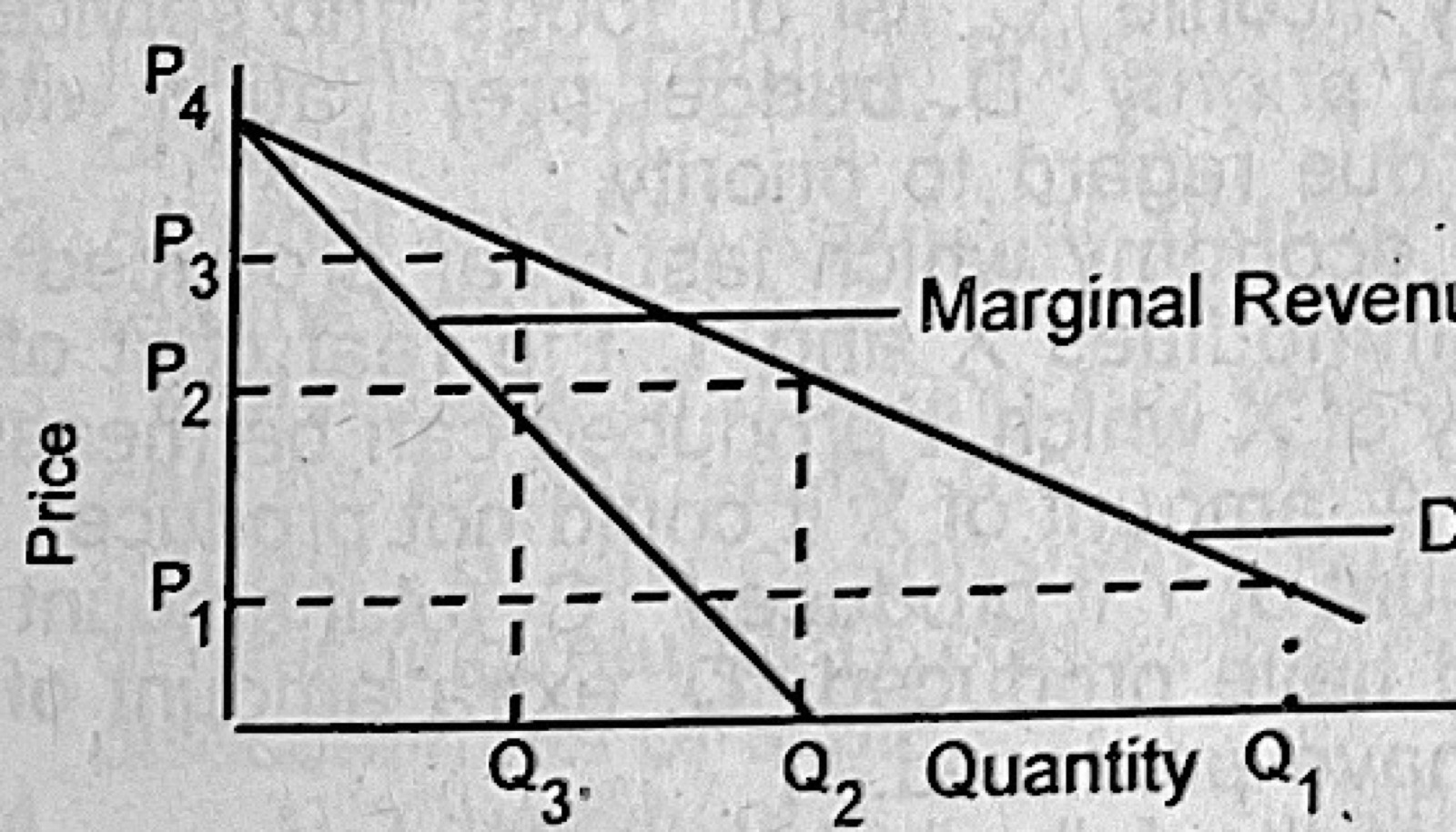
Question 20 Market Structures Use the diagram (demand and marginal revenue curves). The firm portrayed is selling in
A. a purely competitive market B. a market in which demand is elastic at all prices C. an imperfectly competitive market D. a market in which companies produce homogeneous commodities Show the answer and explanation Answer: C (an imperfectly competitive market )
Explanation The demand curve slopes downward and MR lies below it, which happens only in imperfect competition.
Open this question
Question 21 Elasticity Use the diagram (demand and marginal revenue curves). Demand is relatively inelastic
A. at P2 range B. in the P2 P4 price range C. at P3 only D. at any price below P2 Show the answer and explanation Answer: D (at any price below P2 )
Explanation MR is zero at output Q2, where the demand price is P2, so demand is unit elastic at P2. Below P2 MR is negative, which means demand is inelastic.
Open this question
Question 22 Market Structures Which of the following statements must hold if price discrimination is to be possible?
A. Elasticities in the various markets must not differ B. The seller must recognize the possibility of resale C. The markets must not be separated but integrated D. The markets should be separable and there should be no resale Show the answer and explanation Answer: D (The markets should be separable and there should be no resale )
Explanation Charging different prices only works if the markets can be kept apart so buyers in the cheap market cannot resell to the dear one.
Open this question
Question 23 Business Organisations The ordinary partner in a partnership
A. takes no active part in the management of the business B. has limited liability in case of business failure C. has unlimited liability in case of business failure D. cannot be sued personally on matters relating to the business Show the answer and explanation Answer: C (has unlimited liability in case of business failure )
Explanation An ordinary (general) partner can lose his private property to pay the firm's debts; only a limited partner has limited liability.
Open this question
Question 24 Business Organisations A possible factor which limits the extent of growth of a firm is the
A. existence of a monopoly B. bureaucratic delays in decision-making C. use of by-products D. unwillingness to share ownership and control Show the answer and explanation Answer: D (unwillingness to share ownership and control )
Explanation To grow, a firm usually needs new partners or shareholders; owners who refuse to share ownership and control keep the firm small.
Open this question
Question 25 Business Organisations One of the most outstanding disadvantages of co-operative societies as business organizations is that
A. true spirit of co-operation is marred by delegated authority B. members show much interest C. it is poorly financed D. membership interest is centred on sharing of essential commodities Show the answer and explanation Answer: C (it is poorly financed )
Explanation Co-operatives raise capital only from members' small contributions and cannot sell shares to the public, so they lack funds.
Open this question
Question 26 Business Organisations A disadvantage of a joint-stock company is
A. unlimited liability B. limited liability C. continuity D. loss of controlling interest Show the answer and explanation Answer: D (loss of controlling interest )
Explanation As shares are sold widely, the founders may lose control of the company to other shareholders. Limited liability and continuity are advantages.
Open this question
Question 27 Business Organisations A characteristic of a debenture is that
A. its yield is based on profits B. its yield is a fixed rate of interest C. it has no redemption date D. there is a voting right when interest is paid Show the answer and explanation Answer: B (its yield is a fixed rate of interest )
Explanation A debenture is a loan to the company that earns a fixed rate of interest whether or not profit is made.
Open this question
Question 28 Industrialisation Industries tend to be located closer to market centres than to the sources of major raw materials if the
A. products are relatively cheap to transport to market centres B. products are relatively more expensive to transport than the major raw materials C. raw materials are bulky D. raw materials can also be imported Show the answer and explanation Answer: B (products are relatively more expensive to transport than the major raw materials )
Explanation Firms locate to save transport costs; if finished goods are dearer to move (bulky, fragile or perishable), they set up near the market.
Open this question
Question 29 Money and Inflation One disadvantage of trade by barter is that
A. people are happier when they exchange the same quantities of goods through the medium of money rather than by barter B. the person wishing to buy good X may not have good Y which is what the other person wants C. one person must always be cheated when trade takes place by barter D. it increases the initial cost of producing goods Show the answer and explanation Answer: B (the person wishing to buy good X may not have good Y which is what the other person wants )
Explanation Barter needs a double coincidence of wants: each trader must have exactly what the other wants, which is often not the case.
Open this question
Question 30 Financial Institutions One of the functions of Development Banks is to
A. mint money for the development of the economy B. provide short-term loans to commercial banks C. provide medium and long-term finance for development of the banking system D. provide medium and long-term finance for the development of the economy Show the answer and explanation Answer: D (provide medium and long-term finance for the development of the economy )
Explanation Development banks lend for long periods to agriculture, industry and other productive projects that commercial banks avoid.
Open this question
Question 31 Money and Inflation To perform its function as a store of wealth and standard for deferred payment, money must be
A. portable B. in attractive form C. stable in value D. spent more on capital goods than on consumer goods Show the answer and explanation Answer: C (stable in value )
Explanation Money can hold wealth and settle future debts fairly only if its value does not change much over time.
Open this question
Question 32 Money and Inflation Fiduciary issue is that part of
A. the issue of notes backed entirely by gold B. a country's currency which is not negotiable C. the issue of notes not backed by gold D. a country's currency officially issued Show the answer and explanation Answer: C (the issue of notes not backed by gold )
Explanation The fiduciary issue is currency issued on trust (backed by government securities), not by gold.
Open this question
Question 33 Money and Inflation An effect of inflation is that it
A. discourages trade by barter B. favours debtors at the expense of creditors C. increases the real income of salary earners D. increases the value of a country's exports Show the answer and explanation Answer: B (favours debtors at the expense of creditors )
Explanation When prices rise, money loses value, so debtors repay with money worth less than what they borrowed and creditors lose.
Open this question
Question 34 Financial Institutions Banks aid economic expansion and development by
A. being very strict in lending policies B. mobilizing savings for investment lending C. paying interest on deposit accounts D. charging high interest on loans Show the answer and explanation Answer: B (mobilizing savings for investment lending )
Explanation Banks collect the savings of many people and lend them to firms for investment, which helps the economy grow.
Open this question
Question 35 Theory of Production The term 'Stock of Capital' means
A. amount of money necessary to start a business B. total amount receivable by all factors of production C. amount of equipment plant and inventory existing at a time D. total amount available for economic development Show the answer and explanation Answer: C (amount of equipment plant and inventory existing at a time )
Explanation The capital stock is the quantity of man-made productive goods (machines, buildings, stocks of goods) in existence at a point in time.
Open this question
Question 36 Public Finance A tax that takes an increasing fraction of income as income goes down is called
A. conditional B. regressive C. progressive D. proportional Show the answer and explanation Answer: B (regressive )
Explanation A regressive tax takes a larger share of a poor person's income than of a rich person's.
Open this question
Question 37 Public Finance Budget deficit is the amount by which
A. total expenditure exceeds revenue B. recurrent expenditure exceeds revenue C. capital expenditure exceeds revenue D. recurrent expenditure exceeds capital expenditure Show the answer and explanation Answer: A (total expenditure exceeds revenue )
Explanation A budget deficit is the gap when total government spending is greater than total revenue.
Open this question
Question 38 Public Finance The average tax rate is defined as
A. total tax rate less the marginal tax rate B. the tax rate which applies to additional value of income C. the ratio of total taxes paid to total income D. marginal tax rate for being progressive Show the answer and explanation Answer: C (the ratio of total taxes paid to total income )
Explanation Average tax rate = total tax paid ÷ total income; the rate on additional income is the marginal rate.
Open this question
Question 39 National Income Personal distribution of income implies
A. the way in which income is distributed among specific households or spending units B. the distribution of income according to basic resources C. dividing income according to industries D. dividing income between personal taxes, consumption expenditures and savings Show the answer and explanation Answer: A (the way in which income is distributed among specific households or spending units )
Explanation Personal distribution looks at how much income each household or person receives, as against the functional distribution among factors.
Open this question
Question 40 International Trade One of the advantages of international trade is that it
A. increases world output B. encourages economic independence among nations C. restricts spread of technical knowledge D. promotes self-reliance and satisfaction with only what can be produced internally Show the answer and explanation Answer: A (increases world output )
Explanation Trade lets each country specialise where it has comparative advantage, so total world output rises.
Open this question
Question 41 International Trade There is an improvement in the terms of trade of a country if
A. a large quantity of exports is given up to obtain a unit of imports B. the volume of exports is greater than the volume of imports C. a smaller quantity of exports is given up to obtain a unit of imports D. the value of exports is greater than the value of imports Show the answer and explanation Answer: C (a smaller quantity of exports is given up to obtain a unit of imports )
Explanation Terms of trade improve when export prices rise relative to import prices, so fewer exports buy the same imports.
Open this question
Question 42 Balance of Payments and Exchange Rates Under flexible exchange rates, a deficit could be corrected by
A. freezing the gold point B. appreciation of other currencies C. removing export subsidies D. removing tariffs Show the answer and explanation Answer: B (appreciation of other currencies )
Explanation If other currencies rise in value, the deficit country's exports become cheaper abroad and imports dearer at home, which reduces the deficit.
Open this question
Question 43 Population The higher the dependency ratio the
A. larger the proportion of the employed relative to the unemployed B. smaller the proportion of the active labour force relative to the inactive C. smaller the number of the non-working age groups relative to the active labour force D. lower the birth rate Show the answer and explanation Answer: B (smaller the proportion of the active labour force relative to the inactive )
Explanation Dependency ratio = dependants ÷ working-age population; a higher ratio means fewer active workers for each dependant.
Open this question
Question 44 Population The age distribution of a country's population is of economic importance because it affects the
A. pattern of expenditure B. size of the army C. optimum size of firms D. location of industries Show the answer and explanation Answer: A (pattern of expenditure )
Explanation Different age groups need different things (schools for the young, health care for the old), so age structure shapes spending patterns.
Open this question
Question 45 National Income It is important to measure the National Income of a country because
A. it is a major determinant of the standard of living B. it reveals hazards of development like pollution and congestion C. it reveals the distribution of the citizen's savings in foreign banks D. its size determines the extent of political stability Show the answer and explanation Answer: A (it is a major determinant of the standard of living )
Explanation National income (especially per head) shows how much goods and services people can enjoy, so it is used to judge the standard of living.
Open this question
Question 46 National Income The Gross Domestic Product is defined as the total value of
A. all final goods and services produced in a country during the year B. all assets of a country in a particular year C. exports net of total value of imports D. all receipts Show the answer and explanation Answer: A (all final goods and services produced in a country during the year )
Explanation GDP is the money value of all final goods and services produced within a country in a year.
Open this question
Question 47 National Income Stage of product: value of input; sale value of output
A. N57.00 B. N37.00 C. N20.00 D. N15.00 Show the answer and explanation Answer: C (N20.00 )
Explanation Value added at each stage = output − input: 10 + 2 + 3 + 5 = N20, which equals the value of the final product.
Open this question
Question 48 National Income If W stands for wages/salaries, P for profit, R for interest and Z for rent on land and real estate, then national income is
A. W − P − R − Z B. W + P + Z − R C. P − R − Z + W D. W + P + R + Z Show the answer and explanation Answer: D (W + P + R + Z )
Explanation By the income method, national income is the sum of all factor incomes: wages + profit + interest + rent.
Open this question
Question 49 National Income In the national income and product accounts, double counting is avoided if
A. only final goods are counted B. only intermediate goods are counted C. only intermediate and final goods are counted D. the value of all goods and services are added together Show the answer and explanation Answer: A (only final goods are counted )
Explanation Intermediate goods are already included in the price of final goods, so counting only final goods avoids counting them twice.
Open this question
Question 50 Economic Growth and Development A major obstacle to economic development is
A. a rise in industrial output B. low farm productivity C. free trade D. ineffective trade unions Show the answer and explanation Answer: B (low farm productivity )
Explanation Where most people farm, low output per farmer keeps incomes, savings and food supply low, which holds back development.
Open this question Sign up free for every JAMB Economics year, practice by topic and timed mocks.
Start practising free