Home › Past questions › JAMB › Economics › 1990 47 questions. Try each one, then open the answer to check yourself and read the explanation.
Sign up free to answer these questions on a CBT screen with a timer, then see your score and every answer explained.
Start practising free
Question 1 Basic Concepts If one orange costs 20k and one kilogram of beef costs N10.00, the opportunity cost of one kilogram of beef is
A. 50 oranges B. 10 oranges C. 5 oranges D. N9.80 Show the answer and explanation Answer: A (50 oranges )
Explanation N10.00 is 1,000 kobo, and 1,000k ÷ 20k = 50. Buying the beef means giving up 50 oranges.
Open this question
Question 2 Basic Concepts In economic life, choice among alternatives depends on the
A. income of the decision maker B. scarcity of resources C. scale of preference of the decision maker D. status of the decision maker Show the answer and explanation Answer: C (scale of preference of the decision maker )
Explanation Scarcity forces us to choose, but which alternative is chosen depends on how the decision maker ranks his wants, i.e. his scale of preference.
Open this question
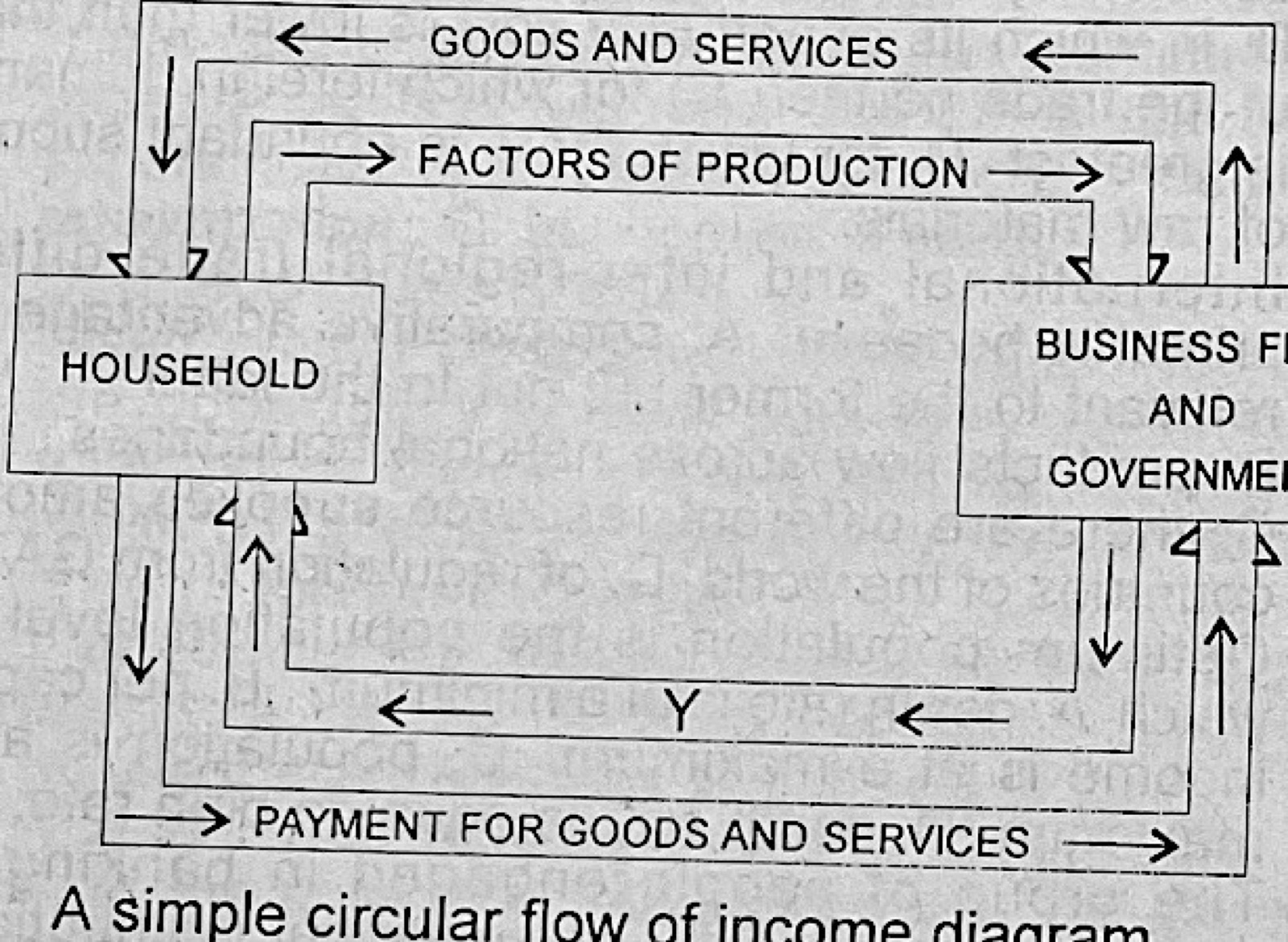
Question 3 National Income Use the circular flow diagram (a simple circular flow of income diagram). The flow labelled Y refers to
A. real income B. factor payments C. factor input D. national income Show the answer and explanation Answer: B (factor payments )
Explanation Y is money flowing from firms and government to households in return for the factors of production they supply, so it is factor payments (rent, wages, interest, profit).
Open this question
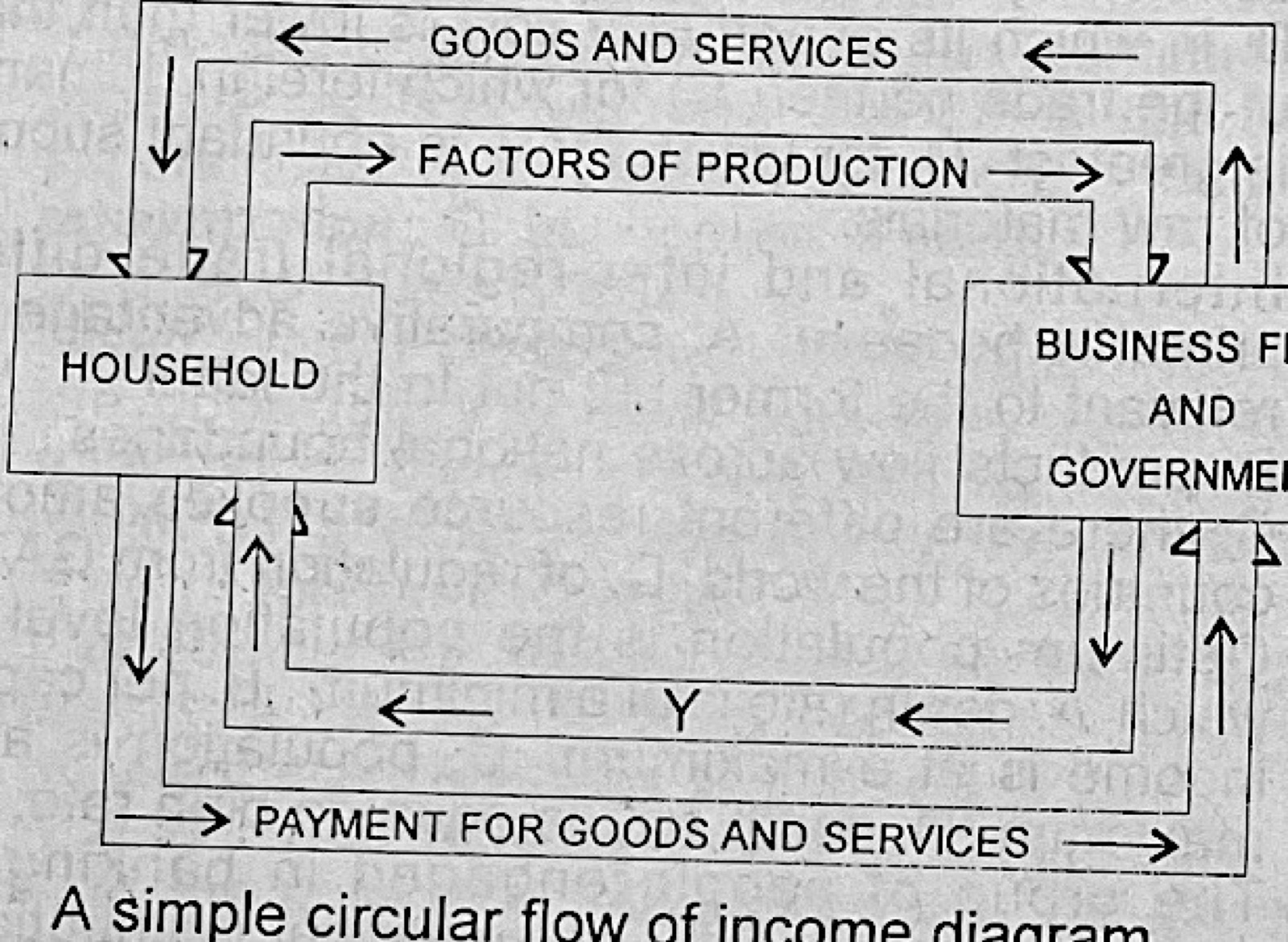
Question 4 National Income Use the circular flow diagram (a simple circular flow of income diagram). The lower half of the diagram indicates
A. the flow of goods and services B. payments for goods and services C. the flow of income D. government transactions Show the answer and explanation Answer: C (the flow of income )
Explanation The lower half shows money flows: factor payments to households and households' spending going back to firms. Together these are the flow of income.
Open this question
Question 5 Theory of Production One of the major advantages of specialization is that
A. the worker becomes a tenderer of machines B. it causes more employment of labour C. less machinery is required for production D. the worker wastes less time between operations Show the answer and explanation Answer: D (the worker wastes less time between operations )
Explanation A specialised worker stays on one task, so no time is lost moving from one operation to another.
Open this question
Question 6 Theory of Production Which of the following rewards is associated with entrepreneurship as a factor of production?
A. Salaries B. Profits C. Interests D. Rent Show the answer and explanation Answer: B (Profits )
Explanation The entrepreneur bears the risk of the business and his reward is profit (labour earns wages, capital interest and land rent).
Open this question
Question 8 Theory of Costs and Revenue Economies of scale operate only when
A. marginal cost is falling with input B. average cost is falling with output C. fixed cost is variable D. variable cost is less than fixed cost Show the answer and explanation Answer: B (average cost is falling with output )
Explanation Economies of scale are the savings from larger output, and they show as a falling average cost per unit.
Open this question
Question 9 Market Structures At the point of profit maximization by a firm, marginal cost is
A. minimum B. falling C. constant D. rising Show the answer and explanation Answer: D (rising )
Explanation Profit is maximised where MC = MR and MC cuts MR from below, so MC is rising at that point.
Open this question
Question 10 Theory of Production A situation in which all inputs are doubled and output also doubles is known as
A. constant proportions B. constant returns C. increasing returns to scale D. constant returns to scale Show the answer and explanation Answer: D (constant returns to scale )
Explanation When all inputs change by a proportion and output changes by the same proportion, the firm has constant returns to scale.
Open this question
Question 11 Theory of Demand The demand curve would shift to the left when there is a rise in
A. the price of a substitute B. the price of a complement C. income D. the supply of the commodity Show the answer and explanation Answer: B (the price of a complement )
Explanation If a complement becomes dearer, people buy less of it and so less of this good at every price: demand shifts left. A dearer substitute or higher income shifts it right.
Open this question
Question 12 Theory of Consumer Behaviour The law of diminishing marginal utility indicates that if a consumer increases his consumption of a commodity continuously, his
A. total utility must fall B. marginal utility must fall C. marginal utility may rise even though his total utility is falling D. marginal utility may fall even though his total utility may be rising Show the answer and explanation Answer: B (marginal utility must fall )
Explanation The law states that each additional unit gives less satisfaction than the one before, so marginal utility falls as consumption goes on.
Open this question
Question 13 Price Determination Technical progress that leads to reduction in costs results in
A. an increase in equilibrium price and quantity B. a decrease in equilibrium price and quantity C. an increase in equilibrium price and decrease in equilibrium quantity D. a decrease in equilibrium price and increase in equilibrium quantity Show the answer and explanation Answer: D (a decrease in equilibrium price and increase in equilibrium quantity )
Explanation Lower costs shift the supply curve to the right; with demand unchanged, price falls and quantity rises.
Open this question
Question 14 Theory of Demand If an increase in income induces a reduction in the demand for beans, beans can be referred to as
A. a normal good B. an inferior good C. a substitute good D. a giffen good Show the answer and explanation Answer: B (an inferior good )
Explanation A good whose demand falls when income rises is an inferior good.
Open this question
Question 15 Elasticity The demand for a product is said to be price inelastic if
A. the price elasticity of demand is less than one B. the price elasticity of demand is greater than one C. a reduction in price results in an increase in the quantity demanded D. an increase in price results in a decrease in the quantity demanded Show the answer and explanation Answer: A (the price elasticity of demand is less than one )
Explanation Demand is inelastic when quantity changes by a smaller percentage than price, i.e. elasticity is less than 1.
Open this question
Question 17 Market Structures In the diagram, RTX and STY are the marginal cost and the average cost curves respectively of a perfectly competitive firm. The supply curve of the firm is indicated by
A. TX B. RT C. ST D. TY Show the answer and explanation Answer: A (TX )
Explanation A competitive firm's supply curve is its marginal cost curve above the lowest point of the average cost curve. MC cuts AC at T, so the supply curve is TX.
Open this question
Question 18 Market Structures An imperfect market in which there is only one buyer of a commodity is
A. monopsony B. oligopoly C. monopoly D. duopoly Show the answer and explanation Answer: A (monopsony )
Explanation A single buyer is a monopsony; a single seller is a monopoly.
Open this question
Question 19 Market Structures The tailoring service is competitive partly because it consists of a large number of
A. large-scale enterprises B. medium scale enterprises C. small scale enterprises D. government-owned enterprises Show the answer and explanation Answer: C (small scale enterprises )
Explanation Tailoring needs little capital, so many small firms enter and compete with one another.
Open this question
Question 20 Market Structures Which of the following is applicable to a monopolistic firm operating at the output where marginal cost equals marginal revenue?
A. Cost of production is at a minimum B. The plant is of optimum size C. Price is above marginal revenue D. Average variable cost is at a minimum Show the answer and explanation Answer: C (Price is above marginal revenue )
Explanation A monopolist faces a downward-sloping demand curve, so its marginal revenue is below price; at MC = MR, price is greater than MR.
Open this question
Question 21 Distributive Trade Which of the following is the major function of the wholesaler?
A. Bulk breaking B. Provision of useful information to the manufacturer on products C. Provision of after-sales services to consumers D. Provision of warehousing facility Show the answer and explanation Answer: A (Bulk breaking )
Explanation The wholesaler buys in large quantities from manufacturers and sells in smaller lots to retailers; this bulk breaking is his main function.
Open this question
Question 22 Distributive Trade In the distribution channels for goods and services, the middleman's mark-up margin provides a rough measure for the
A. quantity discounts allowed final consumers B. reward for business entrepreneurship C. effectiveness of government control over the economy's marketing channels D. extent of exploitation of the final consumer Show the answer and explanation Answer: B (reward for business entrepreneurship )
Explanation The mark-up is the difference between the middleman's buying and selling prices; it pays him for his services and risk, so it measures his reward.
Open this question
Question 23 Distributive Trade Which of the following reasons could induce a manufacturer to bypass the wholesaler in the distribution chain?
A. To provide the quantity needed by retailers B. To collect useful information on his product C. To provide warehousing facilities D. To violate government regulation on distribution Show the answer and explanation Answer: B (To collect useful information on his product )
Explanation Selling directly brings the manufacturer close to retailers and consumers, so he gets first-hand information about how his product is received.
Open this question
Question 24 Business Organisations A major difference between a state-owned enterprise and a private enterprise is that the former
A. is not expected to cover its costs of production while the latter is B. is not always expected to maximize profits while the latter is C. has shareholders while the latter does not D. has a board of directors while the latter does not Show the answer and explanation Answer: B (is not always expected to maximize profits while the latter is )
Explanation Public enterprises are set up mainly to provide services to the public, not to maximise profit; private firms aim at profit.
Open this question
Question 25 Business Organisations Divorce of ownership from control is a characteristic of
A. sole proprietorship B. a limited liability company C. partnership D. a private limited company Show the answer and explanation Answer: B (a limited liability company )
Explanation In a (public) limited liability company the shareholders own it but salaried directors and managers run it.
Open this question
Question 26 Business Organisations Capital provided by individuals to the firm by purchasing stocks is called
A. debt capital B. fixed capital C. circulating capital D. equity capital Show the answer and explanation Answer: D (equity capital )
Explanation Money raised by selling shares gives the buyers part-ownership of the firm; this is equity capital.
Open this question
Question 27 Industrialisation Which of the following factors is the most important in siting a petro-chemical plant?
A. Nearness to the source of raw materials B. Nearness to the source of power C. Availability of labour D. Proximity to financial institutions Show the answer and explanation Answer: A (Nearness to the source of raw materials )
Explanation Petro-chemical plants use bulky crude oil and gas, so they are sited near the oil fields to save transport costs.
Open this question
Question 28 Industrialisation Which of the following will be the effect of allowing only economic factors to dictate the location of industries in Nigeria?
A. A more even development of the different parts of the country will be assured B. There will be an unbalanced spread in the distribution of industries C. The less developed parts of the country will be able to attract more industries D. Only the government will be able to finance the establishment of industries Show the answer and explanation Answer: B (There will be an unbalanced spread in the distribution of industries )
Explanation Firms would crowd into places with the best markets, power and transport, leaving other areas behind, so industries would be unevenly spread.
Open this question
Question 29 Money and Inflation If the same basket of goods which cost N12.00 in 1985 cost N15.00 in 1987, the price index for 1987 is
A. 25 B. 80 C. 100 D. 125 Show the answer and explanation Answer: D (125 )
Explanation Price index = (15 ÷ 12) × 100 = 125, with 1985 as the base year (100).
Open this question
Question 30 Money and Inflation Which of the following is likely to be inflationary?
A. Tax increase B. Increase in unemployment C. Budget surplus D. Wages increase Show the answer and explanation Answer: D (Wages increase )
Explanation Higher wages raise costs and spending power, pushing prices up (cost-push and demand-pull). The other options reduce spending.
Open this question
Question 31 Financial Institutions The basic purpose of imposing legal reserve requirements on commercial banks is to
A. assure the profitability of commercial banks B. provide a device through which credit creation by banks can be controlled C. provide a proper ratio between earning and non-earning bank assets D. provide the Central Bank with working capital Show the answer and explanation Answer: B (provide a device through which credit creation by banks can be controlled )
Explanation The higher the reserve the banks must keep, the less they can lend, so the Central Bank uses the requirement to control credit creation.
Open this question
Question 33 Financial Institutions Which of the following is a liability of a commercial bank?
A. Deposits in the bank B. Loans made by the bank to individuals C. Loans made by the bank to other banks D. Bonds purchased by the bank Show the answer and explanation Answer: A (Deposits in the bank )
Explanation Deposits belong to customers and the bank must repay them on demand, so they are liabilities; loans and bonds are assets.
Open this question
Question 34 Public Finance A tax on a commodity whose supply is perfectly inelastic is
A. shifted completely on the consumer B. completely borne by the supplier C. divided in the ratio 60:40 between the consumer and the supplier D. divided half-and-half between the producer and the consumer Show the answer and explanation Answer: B (completely borne by the supplier )
Explanation When supply cannot change, the price cannot rise without losing sales, so the seller bears all the tax.
Open this question
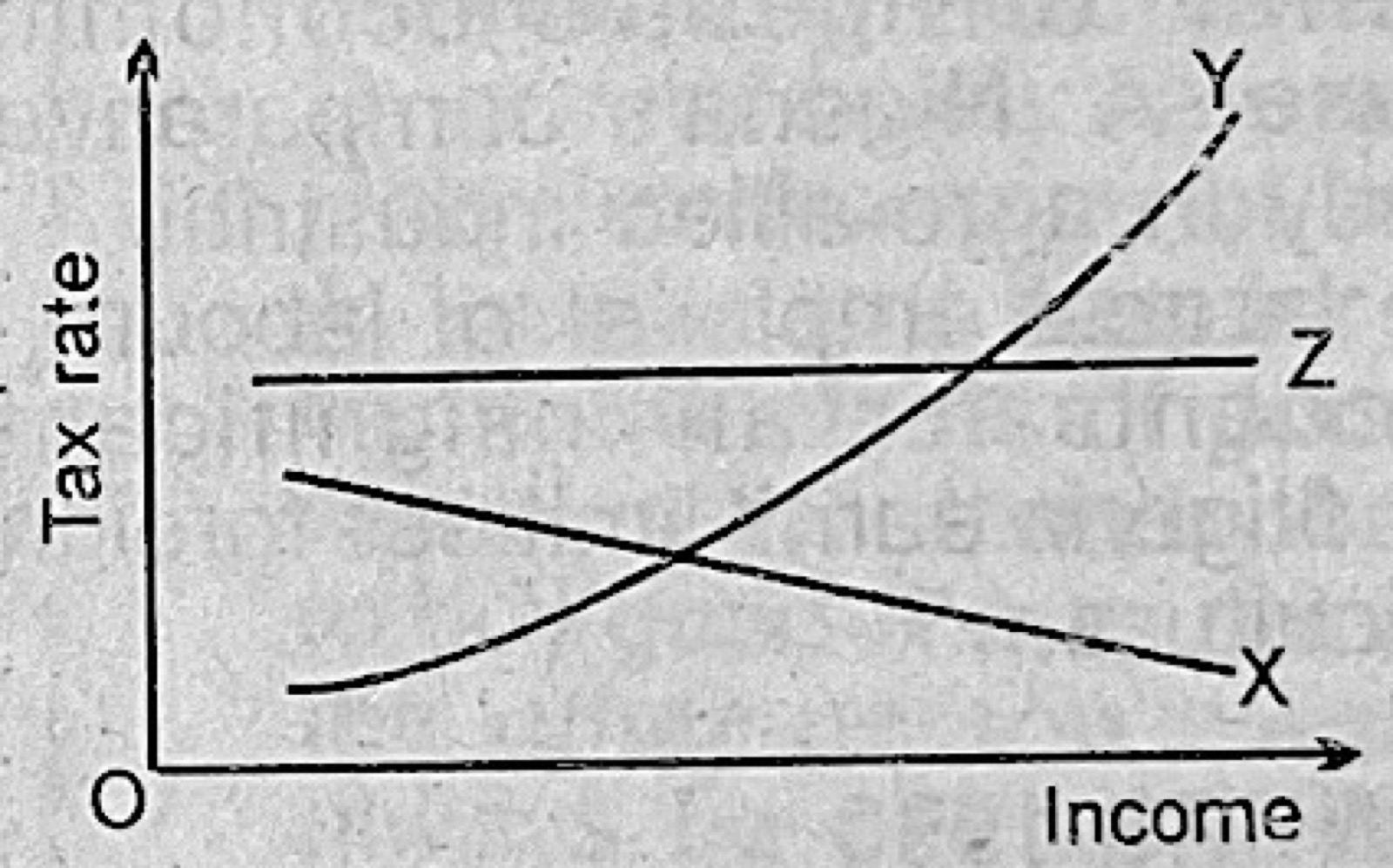
Question 35 Public Finance Use the figure (tax rate against income, curves X, Y and Z). The relationship between tax rate and income which is relevant to a progressive tax is shown by
A. curve X B. curve Y C. curve Z D. curves X and Z Show the answer and explanation Answer: B (curve Y )
Explanation Under a progressive tax the rate rises as income rises; curve Y slopes upward.
Open this question
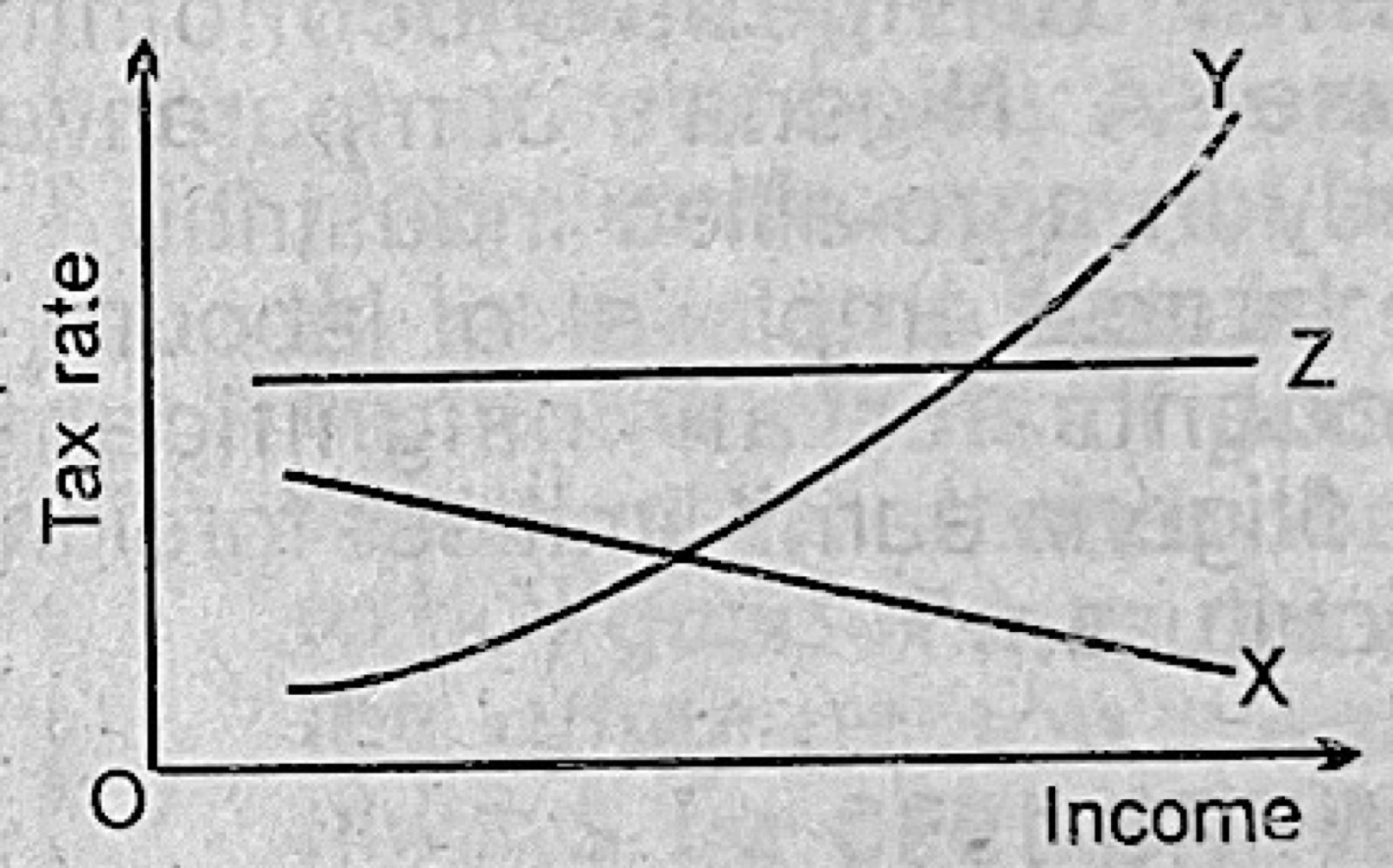
Question 36 Public Finance Use the figure (tax rate against income, curves X, Y and Z). The relationship between tax rate and income which is relevant to proportional tax is depicted by
A. curves Z and Y B. curve X C. curve Z D. curve Y Show the answer and explanation Answer: C (curve Z )
Explanation A proportional tax charges the same rate at every income, so it is the horizontal line Z.
Open this question
Question 37 Balance of Payments and Exchange Rates Under a system of freely floating exchange rates, an increase in the international value of a country's currency will cause
A. its exports to rise B. its imports to rise C. gold to flow into that country D. its currency to be in surplus Show the answer and explanation Answer: B (its imports to rise )
Explanation A stronger currency makes foreign goods cheaper at home and home goods dearer abroad, so imports rise.
Open this question
Question 38 Balance of Payments and Exchange Rates Balance of trade is the difference between
A. exports and imports of goods and services B. capital inflows and capital outflows C. visible and invisible balances D. exports and imports of goods Show the answer and explanation Answer: D (exports and imports of goods )
Explanation The balance of trade covers only visible items: the value of goods exported minus goods imported.
Open this question
Question 39 Balance of Payments and Exchange Rates Which of the following is likely to reduce a surplus in the balance of payments of a country?
A. Devaluation B. Increased tariff on imports C. Export promotion D. Currency appreciation Show the answer and explanation Answer: D (Currency appreciation )
Explanation Appreciation makes exports dearer and imports cheaper, which reduces a surplus. The other options increase it.
Open this question
Question 40 International Trade Which of the following is a tariff?
A. Limit on the amount of goods which can be imported B. Interest rate on foreign loans C. Government payment to domestic producers for exports D. Tax on imported goods Show the answer and explanation Answer: D (Tax on imported goods )
Explanation A tariff is a tax (duty) on imported goods; a limit on quantity is a quota and a payment to exporters is a subsidy.
Open this question
Question 41 International Trade Import duties will increase total expenditure on imports if the demand for imports is
A. elastic B. inelastic C. infinitely elastic D. derived Show the answer and explanation Answer: B (inelastic )
Explanation With inelastic demand the quantity bought falls only a little when the duty raises the price, so total spending goes up.
Open this question
Question 42 Labour Market Which of the following is likely to hinder labour mobility in Nigeria?
A. Higher wage elsewhere B. Cultural similarities C. Good accommodation elsewhere D. Ignorance of job opportunities elsewhere Show the answer and explanation Answer: D (Ignorance of job opportunities elsewhere )
Explanation Workers will not move to jobs they do not know about; the other options encourage movement.
Open this question
Question 43 Population If birth rate is constant and death rate declines, population
A. falls B. expands C. stabilizes D. oscillates Show the answer and explanation Answer: B (expands )
Explanation With the same number of births and fewer deaths, natural increase rises and population grows.
Open this question
Question 44 National Income If the government invests the sum of N1,000 000.00 and the marginal propensity to consume is 0.75, what is the change in income?
A. N1,000 000.00 B. N4,000 000.00 C. N6,000 000.00 D. N14,000 000.00 Show the answer and explanation Answer: B (N4,000 000.00 )
Explanation Multiplier = 1 ÷ (1 − 0.75) = 4, so income rises by 4 × N1,000,000 = N4,000,000.
Open this question
Question 45 National Income The system of measurement of national income as the sum of all final demands is called
A. income approach B. expenditure approach C. value-added approach D. final demands approach Show the answer and explanation Answer: B (expenditure approach )
Explanation Adding up spending on final goods and services (consumption, investment, government and net exports) is the expenditure approach.
Open this question
Question 46 National Income Disposable income is an income which
A. is available for consumption and savings B. pensioners receive from the government C. is payable to the disabled members of the community D. accrues to the environmental sanitation authorities for refuse disposal Show the answer and explanation Answer: A (is available for consumption and savings )
Explanation Disposable income is what is left after direct taxes, and households either spend it or save it.
Open this question
Question 47 National Income In equilibrium, injections are equal to
A. withdrawals B. surplus of imports over exports C. government spending D. wages Show the answer and explanation Answer: A (withdrawals )
Explanation National income is in equilibrium when what is added to the circular flow (investment, government spending, exports) equals what leaks out (savings, taxes, imports).
Open this question
Question 48 Economic Growth and Development Social overhead capital refers to
A. balanced growth B. gross investment C. the building of infrastructures D. capital formation Show the answer and explanation Answer: C (the building of infrastructures )
Explanation Social overhead capital is infrastructure such as roads, power, water and schools that serves the whole economy.
Open this question
Question 49 Economic Growth and Development The most common index used for measuring development is
A. the level of literacy B. per capita income C. nutritional levels D. population growth rate Show the answer and explanation Answer: B (per capita income )
Explanation Income per head (national income ÷ population) is the most widely used measure of a country's level of development.
Open this question
Question 50 Agriculture Agriculture is central to Nigeria's economic development because
A. Nigeria's comparative advantage lies mainly in agro-allied industries B. agriculture is the largest employer of labour C. agriculture accounts for an insignificant domestic product D. Nigeria earns limitless foreign exchange from agriculture Show the answer and explanation Answer: B (agriculture is the largest employer of labour )
Explanation Most Nigerians work in agriculture, so developing it raises the incomes of the largest part of the population.
Open this question Sign up free for every JAMB Economics year, practice by topic and timed mocks.
Start practising free