Home › Past questions › JAMB › Economics › 1988 48 questions. Try each one, then open the answer to check yourself and read the explanation.
Sign up free to answer these questions on a CBT screen with a timer, then see your score and every answer explained.
Start practising free
Question 1 Basic Concepts Scarcity in Economics means that
A. human wants are limitless B. the economy has very few resources C. the economy can scarcely produce anything D. resources are limited in relation to wants. Show the answer and explanation Answer: D (resources are limited in relation to wants. )
Explanation Scarcity does not mean resources are few; it means they are not enough to satisfy all our wants.
Open this question
Question 2 Basic Concepts Economics is often described as a science because
A. laboratory experiments are performed B. it makes use of controlled experiments C. it uses scientific methods to explain observed phenomena and predict future events D. it makes use of field work. Show the answer and explanation Answer: C (it uses scientific methods to explain observed phenomena and predict future events )
Explanation Economics is a science because it uses the scientific method: observing facts, forming theories and using them to predict.
Open this question
Question 3 Basic Concepts When a variable is associated with time period, it is
A. a flow B. a stock C. circular D. static. Show the answer and explanation Answer: A (a flow )
Explanation A flow is measured over a period of time (e.g. income per month); a stock is measured at a point in time (e.g. wealth).
Open this question
Question 4 Basic Concepts Ufuoma is a consumer. His scale of preference shows that he prefers a pair of shoes to a wrist watch; he prefers the wrist watch to a pair of trousers; he prefers the pair of trousers to the pair of shoes. This means that Ufuoma is
A. rational B. consistent C. inconsistent D. transitive. Show the answer and explanation Answer: C (inconsistent )
Explanation If shoes beat the watch and the watch beats trousers, a consistent consumer must prefer shoes to trousers. Ufuoma prefers trousers to shoes, so his choices are inconsistent.
Open this question
Question 5 Basic Concepts Air is essential to life but commands no price! Diamond is not essential to life but commands a high price! This is the paradox of
A. thrift B. value C. abundance D. scarcity. Show the answer and explanation Answer: B (value )
Explanation This is the paradox of value (water-diamond paradox): price depends on scarcity and marginal utility, not on how useful a thing is in total.
Open this question
Question 6 Theory of Production The average product of labour in a given period is obtained by dividing the
A. number of workers by the total product B. total product by the number of hours actually worked C. change in total product by the change in the total number of workers D. total product by the number of workers. Show the answer and explanation Answer: D (total product by the number of workers. )
Explanation Average product of labour = total product ÷ number of workers. Option C describes marginal product.
Open this question
Question 7 Industrialisation Developments outside a given firm which reduce the firm costs are called
A. internal economies B. external economies C. external diseconomies D. optimum effects. Show the answer and explanation Answer: B (external economies )
Explanation Cost savings that come from outside the firm, such as from the growth of the whole industry, are external economies.
Open this question
Question 8 Theory of Production Which of the following BEST describes the 'production function'?
A. It indicates the best output to produce B. It relates naira inputs to naira outputs C. it relates physical outputs to physical inputs D. It indicates the best way to combine factors to produce any given output. Show the answer and explanation Answer: C (it relates physical outputs to physical inputs )
Explanation A production function shows the physical relationship between the quantities of inputs used and the quantity of output produced.
Open this question
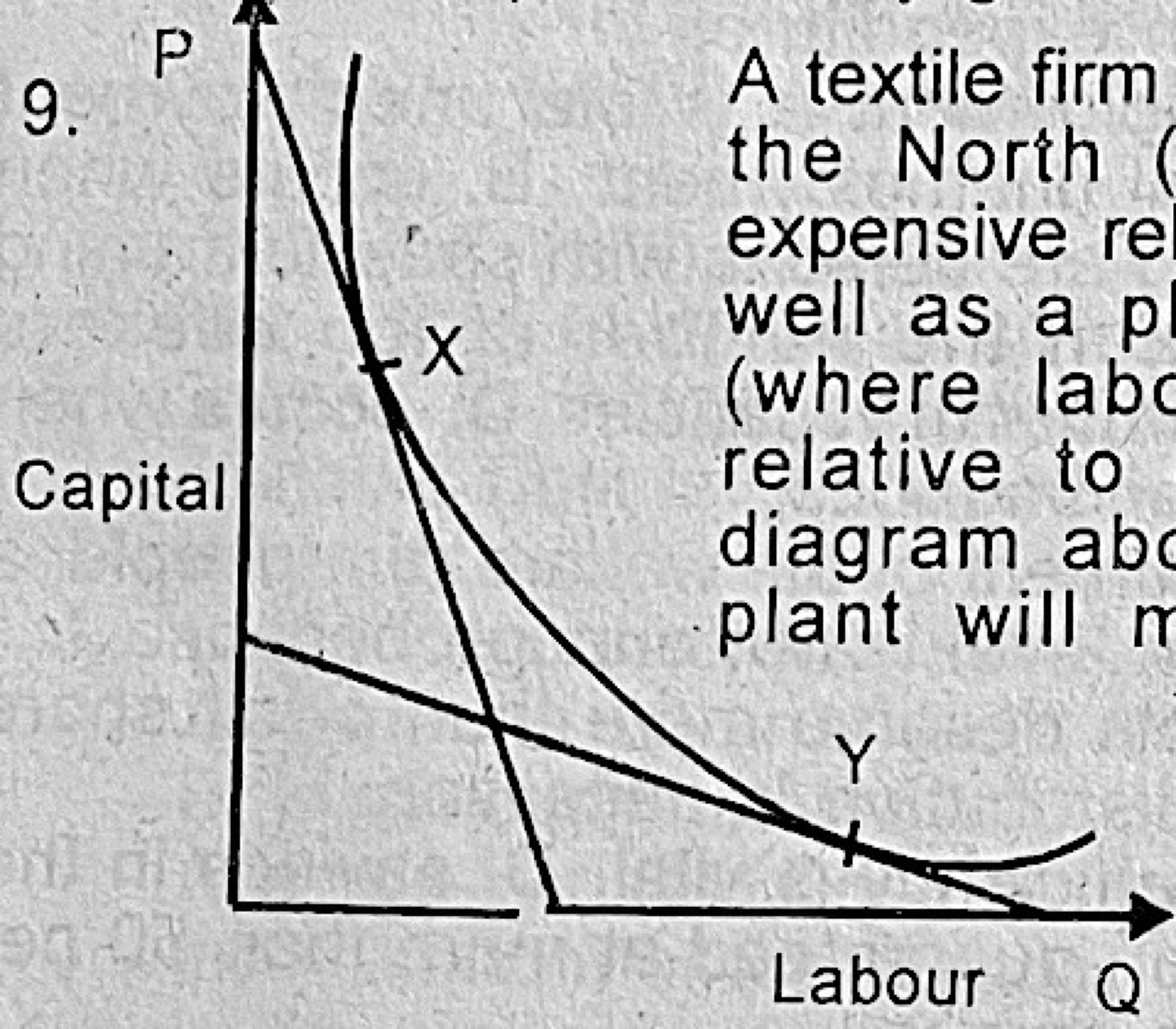
Question 9 Theory of Production A textile firm operates a plant in the North (where capital is expensive relative to labour) as well as a plant in the South (where labour is expensive relative to capital). In the diagram above the Southern plant will minimize cost by combining labour and capital in the amounts indicated by
A. P B. Q C. X D. Y Show the answer and explanation Answer: C (X )
Explanation Where labour is relatively dear, the cost line is steep and touches the isoquant at a point using more capital and less labour. That is point X.
Open this question
Question 10 Theory of Production The Law of Diminishing Returns begins to operate when
A. total product begins to rise B. total product begins to fall C. marginal product begins to fall D. marginal product begins to rise. Show the answer and explanation Answer: C (marginal product begins to fall )
Explanation Diminishing returns set in once each extra worker adds less output than the one before, i.e. when marginal product starts to fall.
Open this question
Question 11 Theory of Production The assumption of profit maximization implies that profit
A. is the most important consideration of the firm B. is the sole consideration of the firm C. assumes an insatiable proportion in the instinct of management D. is made in order to break-even. Show the answer and explanation Answer: A (is the most important consideration of the firm )
Explanation Assuming firms maximise profit means profit is taken as their main goal, not that nothing else matters.
Open this question
Question 12 Theory of Costs and Revenue Total fixed cost measures the cost of
A. all plant and machinery B. all assets where quantity cannot be varied in the short run C. all assets upon which the firm has control D. property owned by the firm. Show the answer and explanation Answer: B (all assets where quantity cannot be varied in the short run )
Explanation Fixed costs are the costs of factors whose quantity cannot be changed in the short run, whatever the output.
Open this question
Question 13 Theory of Costs and Revenue The output at which total revenue equals total cost is known as
A. profit-maximizing output B. break-even level output C. loss-minimizing output D. least-cost output. Show the answer and explanation Answer: B (break-even level output )
Explanation At the break-even output the firm makes neither profit nor loss because total revenue equals total cost.
Open this question
Question 14 Price Determination The demand and supply equations for a commodity are given respectively as
A. P = 12, Q = 16 B. P = 14, Q = 10 C. P = 12, Q = 14 D. P = 16, Q = 12 Show the answer and explanation Answer: D (P = 16, Q = 12 )
Explanation 20 − ½P = 8 + ¼P gives 12 = ¾P, so P = 16. Then Q = 20 − 8 = 12.
Open this question
Question 15 Theory of Demand A commodity is said to have a derived demand when the commodity
A. and another have joint demand B. is demanded because of what it can help to produce C. is demanded for different purposes D. has inelastic demand. Show the answer and explanation Answer: B (is demanded because of what it can help to produce )
Explanation Derived demand is demand for something because of what it helps to produce, as with factors of production.
Open this question
Question 16 Theory of Consumer Behaviour If all goods were free, a rational consumer would consume
A. an infinite amount of each good B. the amount where marginal utility became zero C. the same amount as when each good had a price D. the amount where marginal utility was the highest. Show the answer and explanation Answer: B (the amount where marginal utility became zero )
Explanation A consumer buys until marginal utility equals price. If the price is zero, he consumes until marginal utility falls to zero; beyond that, extra units would make him worse off.
Open this question
Question 17 Price Determination Which of the following changes in equilibrium price and quantity is as a result of an upward shift in the market demand for a commodity?
A. Both the price and the quantity fall B. The price rises and the quantity falls C. The price falls and the quantity rises D. Both the price and the quantity rise. Show the answer and explanation Answer: D (Both the price and the quantity rise. )
Explanation An increase in demand with an upward-sloping supply curve raises both the equilibrium price and quantity.
Open this question
Question 18 Elasticity One factor which influences the slope of a non-linear demand curve for a commodity is the
A. price of the commodity B. quantity of the commodity demanded C. availability of substitutes D. availability of complements. Show the answer and explanation Answer: C (availability of substitutes )
Explanation The more substitutes a good has, the more buyers respond to its price, making the demand curve flatter.
Open this question
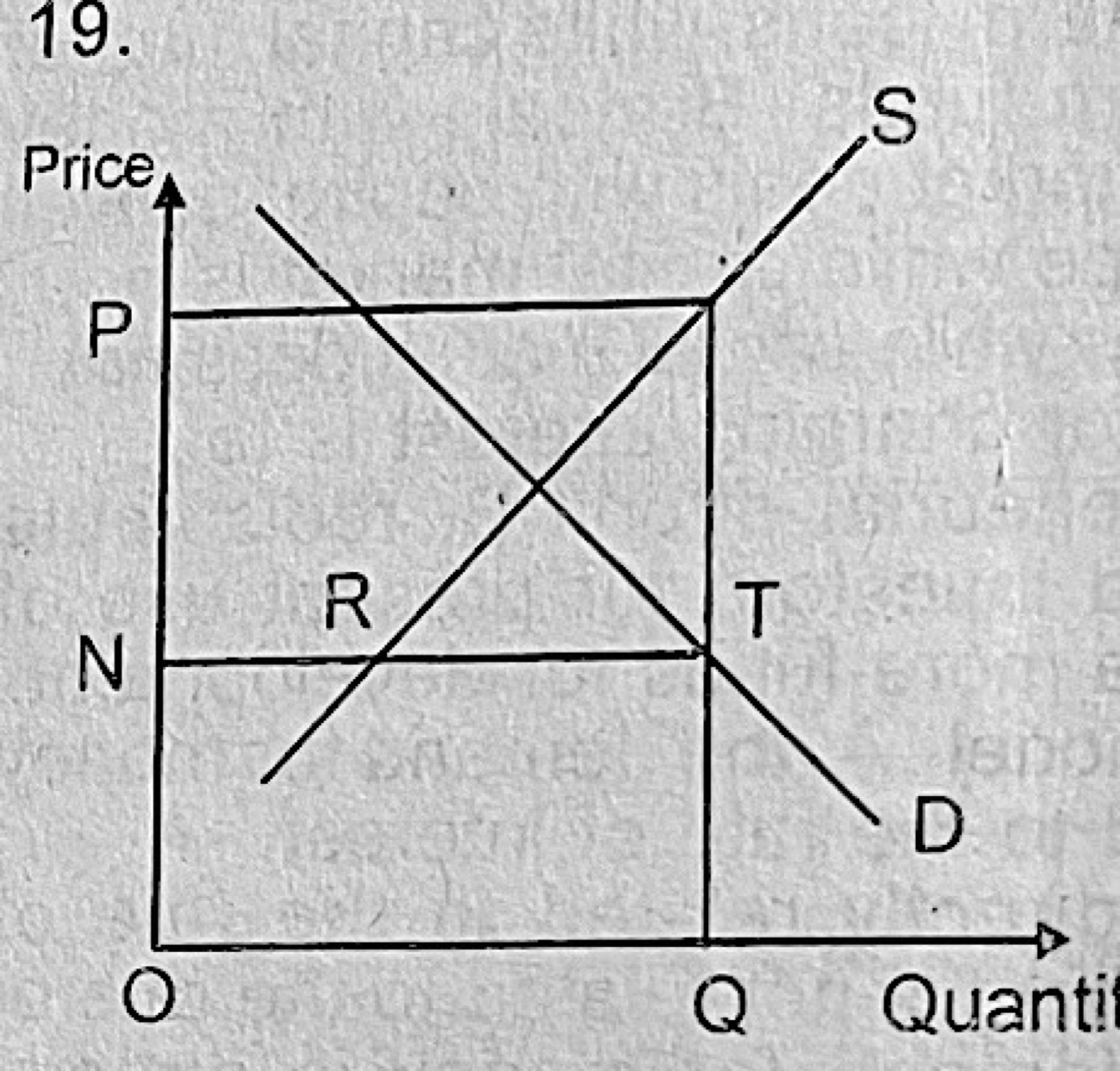
Question 19 Price Determination If in the demand-supply diagram above, the quantity supplied is OQ, then
A. price will be OP B. there will be excess demand of RT C. price will be ON D. price will tend to rise. Show the answer and explanation Answer: C (price will be ON )
Explanation At quantity OQ the demand curve is at point T, so buyers will take the whole quantity OQ only at price ON.
Open this question
Question 20 Market Structures One of the characteristics of an imperfect market is
A. a large number of buyers and sellers B. a lack of homogeneity of products C. an adequate awareness of market conditions by buyers and sellers D. the availability of substitutes. Show the answer and explanation Answer: B (a lack of homogeneity of products )
Explanation In imperfect markets products are differentiated (not identical); identical products, many traders and full information belong to perfect competition.
Open this question
Question 21 Theory of Costs and Revenue Total revenue is always equal to
A. marginal revenue multiplied by the quantity sold B. average revenue plus marginal revenue C. marginal revenue multiplied by marginal cost D. average revenue multiplied by the quantity sold. Show the answer and explanation Answer: D (average revenue multiplied by the quantity sold. )
Explanation Average revenue is revenue per unit (the price), so total revenue = AR × quantity sold.
Open this question
Question 22 Market Structures If prices fall in a perfectly competitive industry, the firms in that industry in the short run will
A. not decrease in number B. keep output at the same level but make losses C. reduce production D. intensify the advertisement of their products. Show the answer and explanation Answer: C (reduce production )
Explanation Each firm produces where price equals marginal cost; a lower price means a lower output, so firms cut production.
Open this question
Question 23 Theory of Costs and Revenue Which of the following is TRUE at the quantity of output where Average Cost (AC) per unit has reached its minimum level?
A. AVC = FC B. MC = AVC C. MC = AC D. AC = AFC. Show the answer and explanation Answer: C (MC = AC )
Explanation The marginal cost curve cuts the average cost curve at its lowest point, so MC = AC there.
Open this question
Question 24 Market Structures In the short run, the monopolistic competitor
A. always makes profit B. always incurs a loss C. always breaks-even D. may close down. Show the answer and explanation Answer: D (may close down. )
Explanation In the short run a monopolistic competitor can make supernormal profit, normal profit or a loss; none of these is certain. If price cannot cover average variable cost it may close down, so D is the only statement that is always true.
Open this question
Question 25 Market Structures Price leadership is
A. a form of tacit collusion B. used to explain price rigidity C. illegal in Nigeria D. a form of overt collusion. Show the answer and explanation Answer: A (a form of tacit collusion )
Explanation Under price leadership, firms follow the price set by a leading firm without any formal agreement; this is tacit (unspoken) collusion.
Open this question
Question 27 Business Organisations In a public company, entrepreneurial functions are performed by the
A. workers B. shareholders C. general manager D. board of directors. Show the answer and explanation Answer: D (board of directors. )
Explanation In a public company the board of directors, elected by shareholders, takes the major decisions and directs the business.
Open this question
Question 28 Business Organisations The most important limitation on the partnership as a form of business enterprise is the
A. implication for partners' liability B. legal limitation placed on the number of partners C. difficulties arising from having two co-ordinate heads of a firm D. fact that each partner regardless of the capital he contributes, must have the same voting rights. Show the answer and explanation Answer: A (implication for partners' liability )
Explanation In an ordinary partnership each partner has unlimited liability: his private property can be taken to pay the firm's debts. This risk is the main limitation of the partnership form.
Open this question
Question 29 Business Organisations Under partnership, investors who have no desires to be actively involved in the day-to-day management of such organizations, are called
A. stockbrokers B. sleeping partners C. part-time investors D. ordinary partners. Show the answer and explanation Answer: B (sleeping partners )
Explanation A sleeping (dormant) partner contributes capital and shares profit but takes no part in running the business.
Open this question
Question 30 Industrialisation Localization of industries refers to the
A. tendency to concentrate industries in particular areas B. siting of industries in certain areas C. deliberate policy of influencing location of industries generally D. zoning of industries. Show the answer and explanation Answer: A (tendency to concentrate industries in particular areas )
Explanation Localisation is the tendency of firms in an industry to concentrate in a particular area.
Open this question
Question 31 Financial Institutions Restriction on credit creation by commercial banks can be effected through
A. an overdraft B. loans and advances C. demand deposits D. liquidity ratio Show the answer and explanation Answer: D (liquidity ratio )
Explanation Raising the liquidity ratio forces banks to keep more liquid assets, so they can lend less.
Open this question
Question 32 Financial Institutions Which of the following factors enhances the ability of commercial banks to create money?
A. Reduction in the reserve ratio B. Leakage of cash out of the banking system C. Excess of reserves D. Insistence on collateral security. Show the answer and explanation Answer: A (Reduction in the reserve ratio )
Explanation A lower reserve ratio means banks keep less of each deposit and lend more, so the credit multiplier is larger.
Open this question
Question 34 Money and Inflation The rate at which money changes hands is known as the
A. rate of inflation B. velocity of transactions C. velocity of money D. velocity of circulation. Show the answer and explanation Answer: D (velocity of circulation. )
Explanation The number of times a unit of money is spent in a period is called the velocity of circulation.
Open this question
Question 35 Financial Institutions Merchant banks perform all the following functions EXCEPT
A. raising of capital for industry B. provision of current account facilities C. management of investment portfolios D. provision of credit for overseas trade. Show the answer and explanation Answer: B (provision of current account facilities )
Explanation Current accounts for ordinary customers are a commercial bank service; merchant banks deal in wholesale finance, issues and portfolio management.
Open this question
Question 36 Public Finance Which of the following is a direct tax?
A. Sales tax B. Purchase tax C. Export duties D. Property tax. Show the answer and explanation Answer: D (Property tax. )
Explanation A property tax is paid directly by the owner to the government; the others are taxes on goods, which are indirect.
Open this question
Question 37 Public Finance Which of the following would most likely be considered an example of benefit taxation?
A. Excise tax B. Corporate income tax C. Property tax D. Highway-user tax. Show the answer and explanation Answer: D (Highway-user tax. )
Explanation Under the benefit principle, those who use a service pay for it; a highway-user tax is paid by road users.
Open this question
Question 38 Balance of Payments and Exchange Rates When a nation is experiencing balance of payments surplus, it is in a better position to
A. increase its foreign exchange reserves B. increase its liabilities to foreigners C. reduce its foreign exchange reserves D. devalue its national currency. Show the answer and explanation Answer: A (increase its foreign exchange reserves )
Explanation A surplus means more foreign currency is coming in than going out, so the country can add to its foreign reserves.
Open this question
Question 39 Balance of Payments and Exchange Rates Which of the following is a good example of invisible item on balance of payments account?
A. Shipping and aviation B. Export and imports C. Merchandise D. Bullion Show the answer and explanation Answer: A (Shipping and aviation )
Explanation Invisible items are services, such as shipping, aviation, insurance and tourism.
Open this question
Question 40 Public Finance Deficit financing is mostly facilitated by the existence of
A. stock exchange market B. commercial bank C. central bank D. capital market. Show the answer and explanation Answer: C (central bank )
Explanation Governments mostly finance deficits by borrowing from the central bank, which can create money for them.
Open this question
Question 41 Population The Malthusian theory of population predicts that growth in food production will
A. keep pace with population growth B. be at a faster rate than population growth C. be at a slower rate than population growth D. be more rapid than population growth in the developing countries. Show the answer and explanation Answer: C (be at a slower rate than population growth )
Explanation Malthus said food grows arithmetically while population grows geometrically, so food production grows more slowly.
Open this question
Question 42 National Income If aggregate income is N500.00 and aggregate consumption is N400.00, this means that the average propensity to consume is
A. 0.20 B. 0.80 C. 1.25 D. 2.00 Show the answer and explanation Answer: B (0.80 )
Explanation APC = consumption ÷ income = 400 ÷ 500 = 0.80.
Open this question
Question 43 National Income Which of the following items is subtracted when computing Gross National Product at factor cost, by the expenditure method?
A. Consumption expenditure B. Indirect taxes C. Exports and property income from abroad D. Gross Domestic Fixed Capital Formation. Show the answer and explanation Answer: B (Indirect taxes )
Explanation Market prices include indirect taxes, so to get GNP at factor cost you subtract indirect taxes (and add subsidies).
Open this question
Question 44 National Income Which of the following occurs in the circular flow of economic activities with no leakages?
A. Consumption equals saving B. Saving equals investment C. Imports equal exports D. National income equal national expenditure. Show the answer and explanation Answer: D (National income equal national expenditure. )
Explanation If nothing leaks out of the circular flow (no saving, taxes or imports), all income earned is spent again, so national income equals national expenditure.
Open this question
Question 45 National Income In estimating the national income of a country, the three approaches usually adopted are the
A. expenditure, value-added and output B. income, final product and output C. expenditure, income and output D. avoidance of double counting, final expenditure and value-added. Show the answer and explanation Answer: C (expenditure, income and output )
Explanation National income is measured by the income, output (product) and expenditure methods.
Open this question
Question 46 Theory of Production If technology becomes less capital-intensive, it means
A. an increase in the capital/labour ratio B. an increase in the labour/capital ratio C. a fall in the labour/capital ratio D. increased unemployment. Show the answer and explanation Answer: B (an increase in the labour/capital ratio )
Explanation Less capital-intensive methods use more labour per unit of capital, so the labour/capital ratio rises.
Open this question
Question 47 Economic Growth and Development The most threatening problem for the less developed countries is
A. the continual depletion of their soil fertility B. the rise of nationalism C. population explosion D. their indifference towards economic growth. Show the answer and explanation Answer: C (population explosion )
Explanation Rapid population growth eats up gains in output, keeping income per head low in many developing countries.
Open this question
Question 48 Economic Growth and Development An increase in an economy's productive capacity implies
A. an increase in the economy's rate of capital replacement B. an increase in the economy's capital stock C. a decrease in government spending D. an increase in government spending. Show the answer and explanation Answer: B (an increase in the economy's capital stock )
Explanation Productive capacity grows when the economy has more capital goods (machines, roads, factories) to produce with.
Open this question
Question 49 Economic Systems Collectivism refers to the system of management of state enterprises in a
A. mixed economy B. co-operative organization C. capitalist economic system D. socialist economy. Show the answer and explanation Answer: D (socialist economy. )
Explanation Under socialism the state owns and manages the means of production collectively.
Open this question
Question 50 Labour Market The group of unemployed members of a community who are physically handicapped or disabled, is generally classified under unemployment as
A. frictional B. cyclical C. residual D. hidden. Show the answer and explanation Answer: C (residual )
Explanation Residual unemployment refers to people who find it hard to get work because of physical or mental disability.
Open this question Sign up free for every JAMB Economics year, practice by topic and timed mocks.
Start practising free