Home › Past questions › JAMB › Economics › 1987 49 questions. Try each one, then open the answer to check yourself and read the explanation.
Sign up free to answer these questions on a CBT screen with a timer, then see your score and every answer explained.
Start practising free
Question 1 Basic Concepts A production possibility curve shows
A. how much of the resources of society are used to produce a particular commodity B. the rate of inflation C. the rate of unemployment in the economy D. the various combinations of two commodities that can be produced. Show the answer and explanation Answer: D (the various combinations of two commodities that can be produced. )
Explanation A production possibility curve plots every combination of two goods that can be made when all resources are fully used.
Open this question
Question 2 Basic Concepts The study of the economic behaviour of individual decision-making units (consumers, resource owners and business firms) in a free-enterprise economy is known as
A. microeconomics B. macroeconomics C. production D. indifference curve. Show the answer and explanation Answer: A (microeconomics )
Explanation Microeconomics studies individual units such as households and firms; macroeconomics studies the whole economy.
Open this question
Question 3 Basic Concepts Which of the following best describes the concept of opportunity cost?
A. A special bargain or sale at below market price B. Costs for inputs tend to go up as we use more of them C. Goods that are not produced in order to produce more of another good D. A cost that constantly decreases. Show the answer and explanation Answer: C (Goods that are not produced in order to produce more of another good )
Explanation Opportunity cost is what is given up: the goods not produced so that more of another good can be produced.
Open this question
Question 4 Price Determination Market is defined as
A. one geographical location where people meet to buy and sell B. the demand and supply of goods and services C. a group of people whose sole interest is to make profit D. any organizational framework which links the buyers and sellers of a good or service. Show the answer and explanation Answer: D (any organizational framework which links the buyers and sellers of a good or service. )
Explanation In economics a market need not be a physical place; it is any arrangement through which buyers and sellers deal with each other.
Open this question
Question 5 Theory of Production The additional revenue obtained by using one more unit of a factor is called its
A. marginal product B. additional product C. marginal revenue product D. average product. Show the answer and explanation Answer: C (marginal revenue product )
Explanation Marginal revenue product is the extra revenue a firm earns from employing one more unit of a factor (MP × MR).
Open this question
Question 6 Theory of Production Labour productivity is defined as
A. output per man/hour B. average output C. the maximum number of hours worked D. total level of output. Show the answer and explanation Answer: A (output per man/hour )
Explanation Labour productivity measures how much each worker produces in a given time, such as output per man-hour.
Open this question
Question 7 Labour Market Efficiency of labour is enhanced by
A. involvement in own family affairs B. mechanization processes C. war against indiscipline D. improved working condition and training. Show the answer and explanation Answer: D (improved working condition and training. )
Explanation Workers become more efficient when they are well trained and work in good conditions.
Open this question
Question 8 Theory of Costs and Revenue Average Fixed Cost is
A. Average Total Cost less the sum of Average Variable Cost B. half the sum of all costs C. Total Fixed Cost divided by the level of output D. Total Fixed Cost plus Marginal Cost. Show the answer and explanation Answer: C (Total Fixed Cost divided by the level of output )
Explanation Average fixed cost is fixed cost per unit: total fixed cost ÷ output.
Open this question
Question 9 Labour Market The residual of production which accrues to the ownership of land after all other expenses have been met is called
A. wages B. rent C. interest D. profit. Show the answer and explanation Answer: B (rent )
Explanation The reward for land is rent; here it is the surplus left to the landowner after all other costs are paid.
Open this question
Question 10 Theory of Production In the history of Economic Thought the concept of Division of Labour is usually associated with
A. David Ricardo B. J.M. Keynes C. Adam Smith D. Karl Marx Show the answer and explanation Answer: C (Adam Smith )
Explanation Adam Smith explained division of labour with his pin-factory example in The Wealth of Nations (1776).
Open this question
Question 11 Theory of Production The form of capital which is usually consumed or transformed into finished goods and services in the production process is called
A. industrial capital B. social capital C. fixed capital D. circulating capital. Show the answer and explanation Answer: D (circulating capital. )
Explanation Circulating (working) capital, such as raw materials, is used up in one round of production; fixed capital like machines is used again and again.
Open this question
Question 12 Theory of Costs and Revenue The shut-down point for a firm in the short run is the output at which
A. the price of the product is lowest B. Marginal Cost is constant C. Average Variable Cost is not covered D. Average Cost is minimum. Show the answer and explanation Answer: C (Average Variable Cost is not covered )
Explanation In the short run a firm keeps producing as long as price covers average variable cost; once it does not, it shuts down.
Open this question
Question 13 Market Structures In the long run a firm will leave an industry if price
A. does not cover at least Average Total Cost B. is not equal to Marginal Cost C. is higher than Average Variable Cost D. is not at least equal to the minimum of the Marginal Cost curve. Show the answer and explanation Answer: A (does not cover at least Average Total Cost )
Explanation In the long run every cost is variable, so a firm that cannot cover its average total cost makes losses and leaves the industry.
Open this question
Question 14 Theory of Demand In the process of shopping, Mr. X whose salary per month does not exceed ₦ 200, finds that the price of a commodity he used to purchase with a fixed amount of ₦200 has now risen to ₦230. He therefore decides not to buy this commodity at all. Mr. X is thus affected by the
A. substitution effect of a price change B. income effect of a price change C. opportunity cost of a price change D. inflation effect of a price change. Show the answer and explanation Answer: B (income effect of a price change )
Explanation With a fixed income of ₦200, the price rise to ₦230 reduces what his income can buy, so he can no longer afford the good. This fall in real income is the income effect.
Open this question
Question 15 Price Determination Price can be defined as
A. a rate of exchange B. a medium of exchange C. the cost of a product D. the standard of accounting. Show the answer and explanation Answer: A (a rate of exchange )
Explanation Price is the rate at which a good is exchanged for money (or other goods).
Open this question
Question 16 Price Determination In the operation of market forces, the market is in equilibrium at the point where
A. demand and supply curves intersect in more than one point provided the market is cleared B. the excess in the market can be conveniently stored C. excess demand is negative D. demand and supply curves intersect. Show the answer and explanation Answer: D (demand and supply curves intersect. )
Explanation Equilibrium is where quantity demanded equals quantity supplied, i.e. where the demand and supply curves cross.
Open this question
Question 17 Price Determination A shift in the demand curve for a commodity when the supply curve is vertical will lead to a change in the
A. price only B. quantity only C. quality only D. price and quantity. Show the answer and explanation Answer: A (price only )
Explanation A vertical supply curve means quantity is fixed, so a shift in demand can only change the price.
Open this question
Question 18 Elasticity Given an original price of ₦3.50 per kilogram of rice and a change in price of ₦1.40, and given the quantity purchased at the old price as 10kg and a change in quantity as 5kg after the price change, the elasticity is equal to
A. 10.20 B. 3.57 C. 1.25 D. 0.80 . Show the answer and explanation Answer: C (1.25 )
Explanation % change in quantity = 5/10 = 50%. % change in price = 1.40/3.50 = 40%. Elasticity = 50 ÷ 40 = 1.25.
Open this question
Question 19 Elasticity For normal goods the income elasticity of demand is
A. positive B. negative C. zero D. infinite. Show the answer and explanation Answer: A (positive )
Explanation For a normal good, demand rises when income rises, so income elasticity is positive.
Open this question
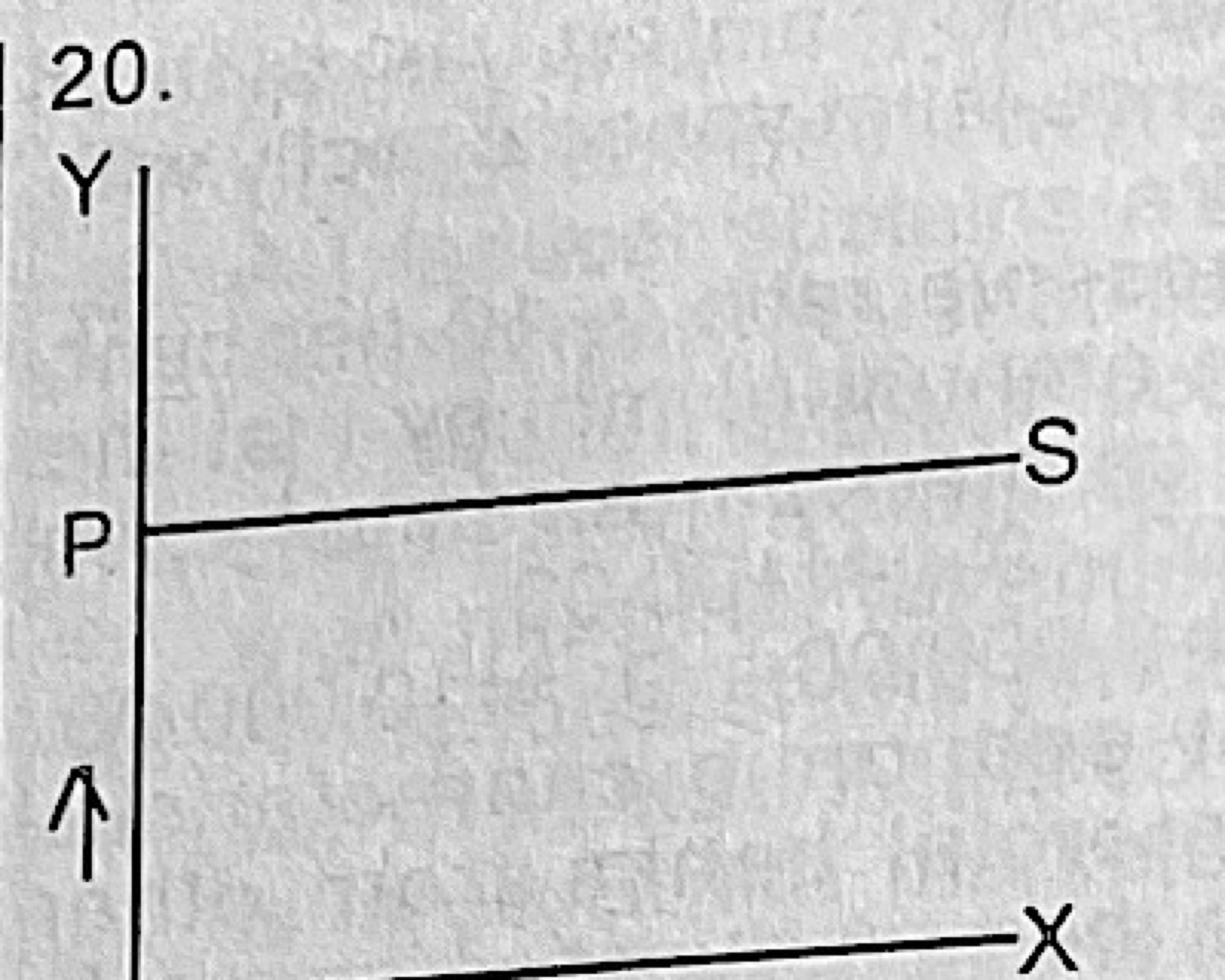
Question 20 Elasticity In the diagram above, PS is the supply curve for a particular commodity while OP is the price. Which of the following statements is correct?
A. The quantity supplied is infinitely elastic B. When price is zero, the quantity supplied is infinite C. When price is infinite, the quantity supplied is zero D. The quantity supplied is indefinite. Show the answer and explanation Answer: A (The quantity supplied is infinitely elastic )
Explanation A horizontal supply curve means suppliers will supply any quantity at price OP, so supply is perfectly (infinitely) elastic.
Open this question
Question 21 Theory of Demand Use the following information to answer this question. X, Y and Z are the only three consumers of a commodity. Their respective demand schedules for the commodity are as given below:
A. 75 units B. 35 units C. 7 units D. not determinable from the schedules except when graphed. Show the answer and explanation Answer: A (75 units )
Explanation The demand curve meets the quantity axis where price is zero. Add the three demands at ₦0: 20 + 15 + 40 = 75 units.
Open this question
Question 22 Theory of Demand Use the following information to answer this question. X, Y and Z are the only three consumers of a commodity. Their respective demand schedules for the commodity are as given below:
A. 65 units B. 40 units C. 30 units D. 20 units Show the answer and explanation Answer: C (30 units )
Explanation Market demand is the sum of individual demands: at ₦5, 10 + 5 + 15 = 30 units.
Open this question
Question 23 Theory of Demand If a good is an inferior good, then
A. it is also necessarily a Giffen good B. the quantity of the good demanded varies inversely with its price C. its income elasticity of demand is negative D. the poor buy the good only out of habit. Show the answer and explanation Answer: C (its income elasticity of demand is negative )
Explanation An inferior good is one whose demand falls as income rises, so its income elasticity is negative. Not every inferior good is a Giffen good.
Open this question
Question 24 Theory of Supply An increase in supply will lower price unless
A. supply is perfectly inelastic B. demand is perfectly elastic C. it is followed by an increase in demand D. demand is highly inelastic. Show the answer and explanation Answer: B (demand is perfectly elastic )
Explanation If demand is perfectly elastic, the demand curve is horizontal, so a rightward shift of supply raises quantity but leaves price unchanged.
Open this question
Question 25 Market Structures Which of the following is compatible with a firm in a purely competitive market?
A. Demand is inelastic B. Demand is infinitely elastic C. Marginal Cost is falling D. Price is greater than Marginal Cost. Show the answer and explanation Answer: B (Demand is infinitely elastic )
Explanation A perfectly competitive firm can sell any amount at the market price, so the demand curve it faces is horizontal (infinitely elastic).
Open this question
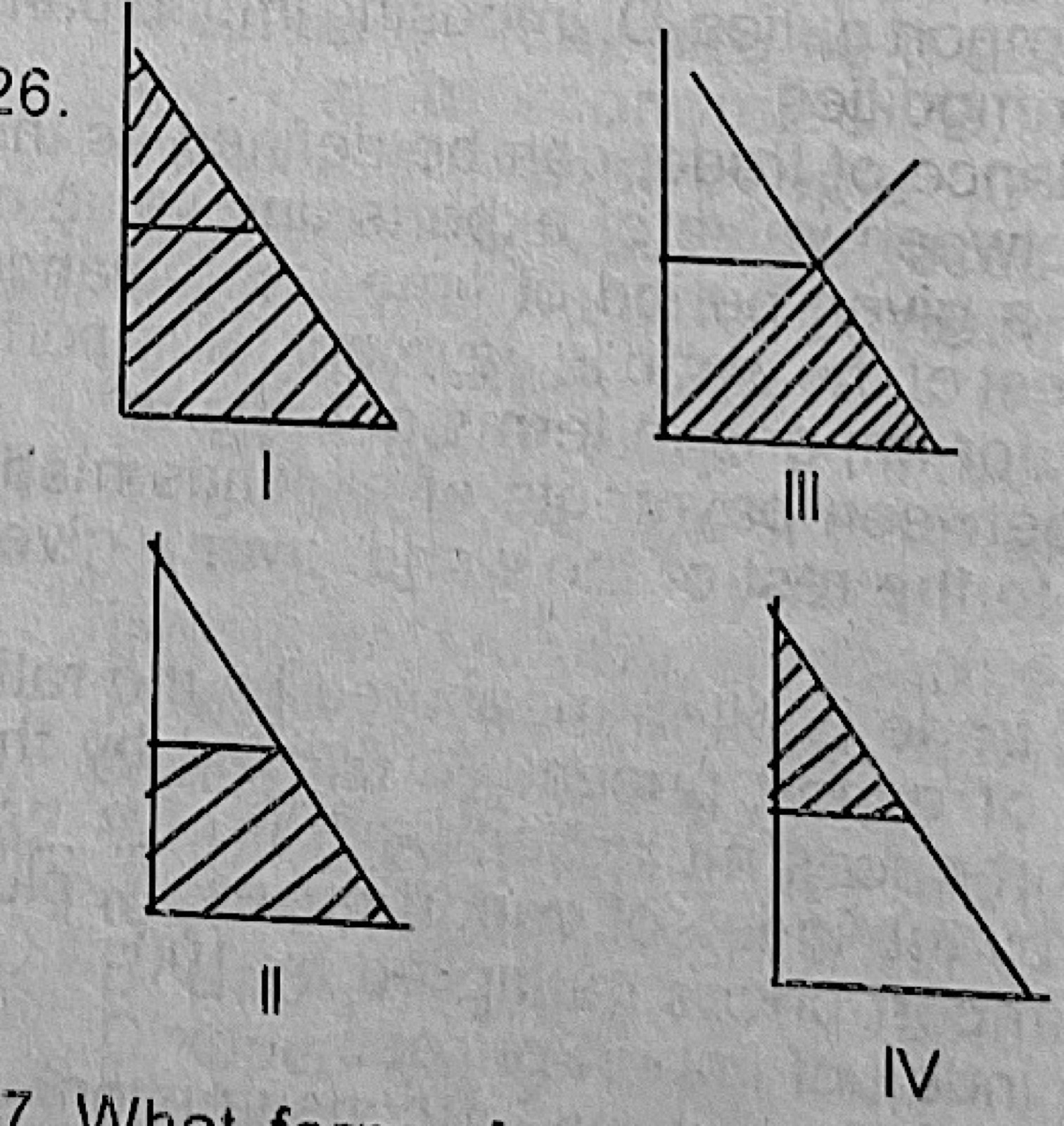
Question 26 Theory of Consumer Behaviour In which of the diagrams above is the consumer surplus correctly shaded?
A. I B. II C. III D. IV Show the answer and explanation Answer: D (IV )
Explanation Consumer surplus is the area below the demand curve and above the price line. Only diagram IV shades that triangle.
Open this question
Question 27 Market Structures What form of market is found in an imperfect competition where there are few buyers and many sellers?
A. Oligopoly B. Monopoly C. Duopoly D. Oligopsony. Show the answer and explanation Answer: D (Oligopsony. )
Explanation Oligopsony is a market with only a few buyers; oligopoly is one with a few sellers.
Open this question
Question 28 Basic Concepts To which of the following sectors do services belong?
A. Primary B. Secondary C. Tertiary D. Construction. Show the answer and explanation Answer: C (Tertiary )
Explanation Services such as banking, transport and trade belong to the tertiary sector.
Open this question
Question 29 Business Organisations The liability of the sole trader is
A. indeterminable B. unlimited C. transferable D. limited Show the answer and explanation Answer: B (unlimited )
Explanation A sole trader has unlimited liability: his personal property can be taken to pay the business's debts.
Open this question
Question 30 Business Organisations Which of the following is NOT a type of business ownership?
A. Debenture holding B. Private company C. Partnership D. Joint Stock venture. Show the answer and explanation Answer: A (Debenture holding )
Explanation A debenture holder lends money to a company; he is a creditor, not an owner.
Open this question
Question 31 Industrialisation Which of the following is a disadvantage of regional concentration of industries?
A. Development of congested urban areas B. Existence of regional unemployment C. High cost of labour D. Immobility of labour. Show the answer and explanation Answer: A (Development of congested urban areas )
Explanation When industries cluster in one area, people crowd into it, causing congestion, slums and pressure on facilities.
Open this question
Question 33 Financial Institutions Money market differs from capital market in that it
A. deals with short-term loans while capital market deals with long-term funds B. deals with money only while capital market deals with capital as well C. is limited in scope while capital market is not D. uses interest rates while capital market does not. Show the answer and explanation Answer: A (deals with short-term loans while capital market deals with long-term funds )
Explanation The money market handles short-term funds; the capital market handles medium- and long-term funds.
Open this question
Question 34 Labour Market The main reason for charging interest is to
A. reward entrepreneurial effort B. redistribute profits C. reward investors for present use of capital D. mobilize more funds for development. Show the answer and explanation Answer: C (reward investors for present use of capital )
Explanation Interest is the reward paid to the owners of capital for letting others use it now.
Open this question
Question 35 Money and Inflation In the Keynesian model
A. the demand for money is inversely related to the rate of interest B. investment is directly related to the rate of interest C. investment is not related to the rate of interest D. the demand for money is directly related to the rate of interest. Show the answer and explanation Answer: A (the demand for money is inversely related to the rate of interest )
Explanation The interest rate is the cost of holding money instead of bonds. When it rises, people hold less money (speculative demand falls), so the relationship is inverse.
Open this question
Question 36 Money and Inflation If inflation is anticipated to continue
A. people will lose confidence in goods B. lenders will demand higher interest rates C. the growth of full-employment output will be accelerated D. people will want to hold more money. Show the answer and explanation Answer: B (lenders will demand higher interest rates )
Explanation Inflation reduces the value of the money lenders are repaid, so they ask for higher interest to make up for it.
Open this question
Question 37 Public Finance Ad valorem tax means
A. a certain percentage tax based on the value of the commodity B. a certain percentage tax based on the volume of the commodity C. a tax on the income of the consumer D. payment of a tax on the profits made. Show the answer and explanation Answer: A (a certain percentage tax based on the value of the commodity )
Explanation An ad valorem tax is charged as a percentage of the value (price) of a good.
Open this question
Question 38 Public Finance In order to raise more revenue for a certain period, government should impose higher taxes on goods whose demand is
A. elastic B. inelastic C. perfectly elastic D. unitary elastic. Show the answer and explanation Answer: B (inelastic )
Explanation When demand is inelastic, people keep buying almost as much after the tax raises the price, so tax revenue rises.
Open this question
Question 39 Public Finance A budget with a projected revenue in excess of its expenditure is said to be
A. balanced B. surplus C. deficit D. inflationary. Show the answer and explanation Answer: B (surplus )
Explanation When planned revenue is more than planned spending, the budget is in surplus.
Open this question
Question 40 Public Finance The money which government spends yearly for the maintenance of its schools is
A. used only for wages and salaries B. part of the government's capital expenditure C. part of the government's recurrent expenditure D. the government's budget for its schools Show the answer and explanation Answer: C (part of the government's recurrent expenditure )
Explanation Spending that is repeated every year, such as maintenance and salaries, is recurrent expenditure.
Open this question
Question 41 International Trade Which of the following applies to a commodity sold abroad at a price lower than that in the producing country?
A. Dumping B. Counter-trade C. Bilateral trade D. Trade liberalization. Show the answer and explanation Answer: A (Dumping )
Explanation Dumping means selling a good abroad more cheaply than in the home market.
Open this question
Question 42 Balance of Payments and Exchange Rates The rate of exchange between a domestic and a foreign currency is defined as the
A. terms of trade B. domestic currency price of a unit of the foreign currency C. foreign currency price of gold D. domestic currency price of gold. Show the answer and explanation Answer: B (domestic currency price of a unit of the foreign currency )
Explanation The exchange rate is the price of one currency in terms of another, e.g. how many naira buy one dollar.
Open this question
Question 43 Population Which of the following best explains the structural changes in the population of a country?
A. Positive changes in the size and ethnic composition of the population B. A decrease in the size of the population C. An increase in the birth rate which is higher than the decrease in the death rate D. Changes in the age, sex and occupational composition of the population. Show the answer and explanation Answer: D (Changes in the age, sex and occupational composition of the population. )
Explanation Population structure refers to how the population is made up by age, sex and occupation, so structural change means change in these.
Open this question
Question 44 National Income Statistical information available in most West African countries suggests that
A. the marginal propensity to save is high B. the marginal propensity to consume is high C. the consumption pattern is negative D. there exists perfect correlation between consumption and savings. Show the answer and explanation Answer: B (the marginal propensity to consume is high )
Explanation Incomes are low in most West African countries, so people spend most of any extra income; the marginal propensity to consume is high.
Open this question
Question 45 Public Finance Transfer payments are
A. transfer earnings B. money transferred from one country to another C. unearned income D. payment transferred from one account to another. Show the answer and explanation Answer: C (unearned income )
Explanation Transfer payments, such as pensions and grants, are paid without any goods or services in return, so they are unearned income.
Open this question
Question 46 National Income Capital consumption allowance refers to
A. personal consumption expenditure B. indirect business taxes C. depreciation of capital equipment D. expenditure on capital equipment. Show the answer and explanation Answer: C (depreciation of capital equipment )
Explanation Capital consumption allowance is the value of capital worn out in production, i.e. depreciation.
Open this question
Question 47 National Income The difference between personal income and personal disposable income is
A. personal income tax B. investment income C. personal savings D. consumption expenditure. Show the answer and explanation Answer: A (personal income tax )
Explanation Disposable income is personal income after personal income tax has been deducted.
Open this question
Question 48 Labour Market Frictional unemployment
A. is total unemployment minus structural unemployment B. occurs when the unemployed are persons with specific training C. occurs when the number of job seekers exceeds the number of vacancies D. occurs when people are changing jobs. Show the answer and explanation Answer: D (occurs when people are changing jobs. )
Explanation Frictional unemployment is the short spell out of work while people move between jobs.
Open this question
Question 49 Economic Growth and Development For the improvement of the welfare of a people, a high production level is not enough because
A. the have-nots deserve more than a fair share B. equitable distribution is necessary C. productive efficiency is vital D. savings in the country must be guaranteed at more than 50 per cent of income earned. Show the answer and explanation Answer: B (equitable distribution is necessary )
Explanation A country may produce a lot, but if only a few people enjoy it, most people's welfare does not improve. Output must also be shared fairly.
Open this question
Question 50 Economic Growth and Development Economic development is defined as
A. positive change plus growth B. availability of more goods and services C. outward shift of the production possibility curve D. growth in the national income. Show the answer and explanation Answer: A (positive change plus growth )
Explanation Economic development is more than growth: national income must rise together with positive changes such as better health, education and living standards.
Open this question Sign up free for every JAMB Economics year, practice by topic and timed mocks.
Start practising free