Home › Past questions › JAMB › Economics › 1984 50 questions. Try each one, then open the answer to check yourself and read the explanation.
Sign up free to answer these questions on a CBT screen with a timer, then see your score and every answer explained.
Start practising free
Question 1 Basic Concepts The main economic objective behind the production of goods and services in any economy is to
A. maximize profits B. satisfy human wants C. become self reliant D. create job opportunities E. make people wealthy. Show the answer and explanation Answer: B (satisfy human wants )
Explanation Goods and services are produced in the end to satisfy human wants; profit and jobs are means or side effects.
Open this question
Question 2 Theory of Demand Demand for a commodity by a consumer is the quantity of that commodity that the consumer
A. demands at a given price at a point in time B. demands at a given price C. actually digests D. produces, given its price E. can store away during bad weather. Show the answer and explanation Answer: A (demands at a given price at a point in time )
Explanation Demand is the quantity a consumer is willing and able to buy at a given price over a given time.
Open this question
Question 3 Theory of Production Division of labour is limited by
A. the size of the market B. the productivity of capital C. cost of production D. the factors of production E. government policy. Show the answer and explanation Answer: A (the size of the market )
Explanation Specialisation produces large output, which only pays if there is a large enough market to buy it.
Open this question
Question 4 National Income The production within the domestic territory of a country is called the
A. net national product B. gross domestic product C. net income D. disposable income E. gross national product. Show the answer and explanation Answer: B (gross domestic product )
Explanation GDP is the value of all goods and services produced inside a country's borders, whoever owns the factors.
Open this question
Question 5 Labour Market In discussing the reasons why wages differ between occupations, which of the following should be regarded as a cardinal point that needs to be emphasized?
A. Length and cost of training B. Demand and supply C. Attractiveness of the job D. Influence of trade unions E. Government intervention. Show the answer and explanation Answer: B (Demand and supply )
Explanation Wages are the price of labour, so differences between jobs come down to differences in the demand for and supply of each kind of labour; the other factors work through demand and supply.
Open this question
Question 6 Basic Concepts A rightward shift in the production possibility frontier may be due to
A. use of inferior inputs B. inefficiency C. improvement in production techniques and practices D. changes in the product mix E. changes in consumers' tastes and preferences. Show the answer and explanation Answer: C (improvement in production techniques and practices )
Explanation Better techniques let the economy produce more of both goods with the same resources, pushing the frontier outwards.
Open this question
Question 7 Theory of Costs and Revenue Quantity | Fixed Cost (N) | Variable Cost (N) | Total Cost (N) | Marginal Cost (N) | Average Cost (N)
A. N350.00 B. N340.00 C. N360.00 D. N370.00 E. N505.00. Show the answer and explanation Answer: B (N340.00 )
Explanation MC of the 3rd item = TC(3) − TC(2) = 1650 − 1310 = N340 (or VC: 900 − 560 = 340).
Open this question
Question 8 Theory of Production The advantages that accrue to a firm as the size of the firm increases are known as
A. external diseconomies B. internal returns to scale C. internal economies D. internal diseconomies E. constant returns to scale. Show the answer and explanation Answer: C (internal economies )
Explanation Cost savings that a firm gains from its own growth are internal economies of scale.
Open this question
Question 9 Theory of Production One of the advantages of large-scale production is that
A. there is a rise in the cost of administration B. consumers sacrifice their individual tastes C. the firm can use labour-saving machinery D. the demand for a firm's products becomes localized E. decision making takes a long time because different levels of management are involved. Show the answer and explanation Answer: C (the firm can use labour-saving machinery )
Explanation A large firm can afford expensive labour-saving machines, lowering its unit costs; the other options are disadvantages.
Open this question
Question 10 Economic Growth and Development Which of the following is NOT an obstacle to economic development?
A. Low level of investment B. Lack of modern technology C. High rate of population growth D. Low productivity E. Dedicated leadership. Show the answer and explanation Answer: E (Dedicated leadership. )
Explanation Dedicated leadership helps development; the others hold it back.
Open this question
Question 11 Population An ageing population refers to the preponderance of
A. middle-aged people in the population B. young people in the population C. women in the population D. old men in the population E. old people in the population. Show the answer and explanation Answer: E (old people in the population. )
Explanation An ageing population is one in which old people (men and women) form a large and growing share.
Open this question
Question 12 Theory of Costs and Revenue Let TC = total costs, TVC = total variable costs, TFC = total fixed costs, ATC = average total costs, AVC = average variable costs, AFC = average fixed costs, Q = output. Which of the following is NOT true?
A. TC = TFC + TVC B. ATC = AVC + AFC C. AFC = TFC/Q D. TVC = AVC/Q E. AVC = TVC/Q Show the answer and explanation Answer: D (TVC = AVC/Q )
Explanation TVC = AVC × Q, not AVC divided by Q; the other formulas are correct.
Open this question
Question 13 Population Which of the following is NOT a determinant of the size of the economically active population?
A. Age structure B. Occupation of workers C. Proportion of men to women D. Average length of the working day E. Efficiency of the labour force. Show the answer and explanation Answer: B (Occupation of workers )
Explanation The kinds of jobs people do do not change how many people are available to work; age structure and the other factors do affect the effective labour force.
Open this question
Question 14 Population The population level that yields the maximum output when combined with available resources is known as
A. dependent population B. maximum population C. active population D. productive population E. optimum population. Show the answer and explanation Answer: E (optimum population. )
Explanation Optimum population is the size that gives the highest output per head with the resources available.
Open this question
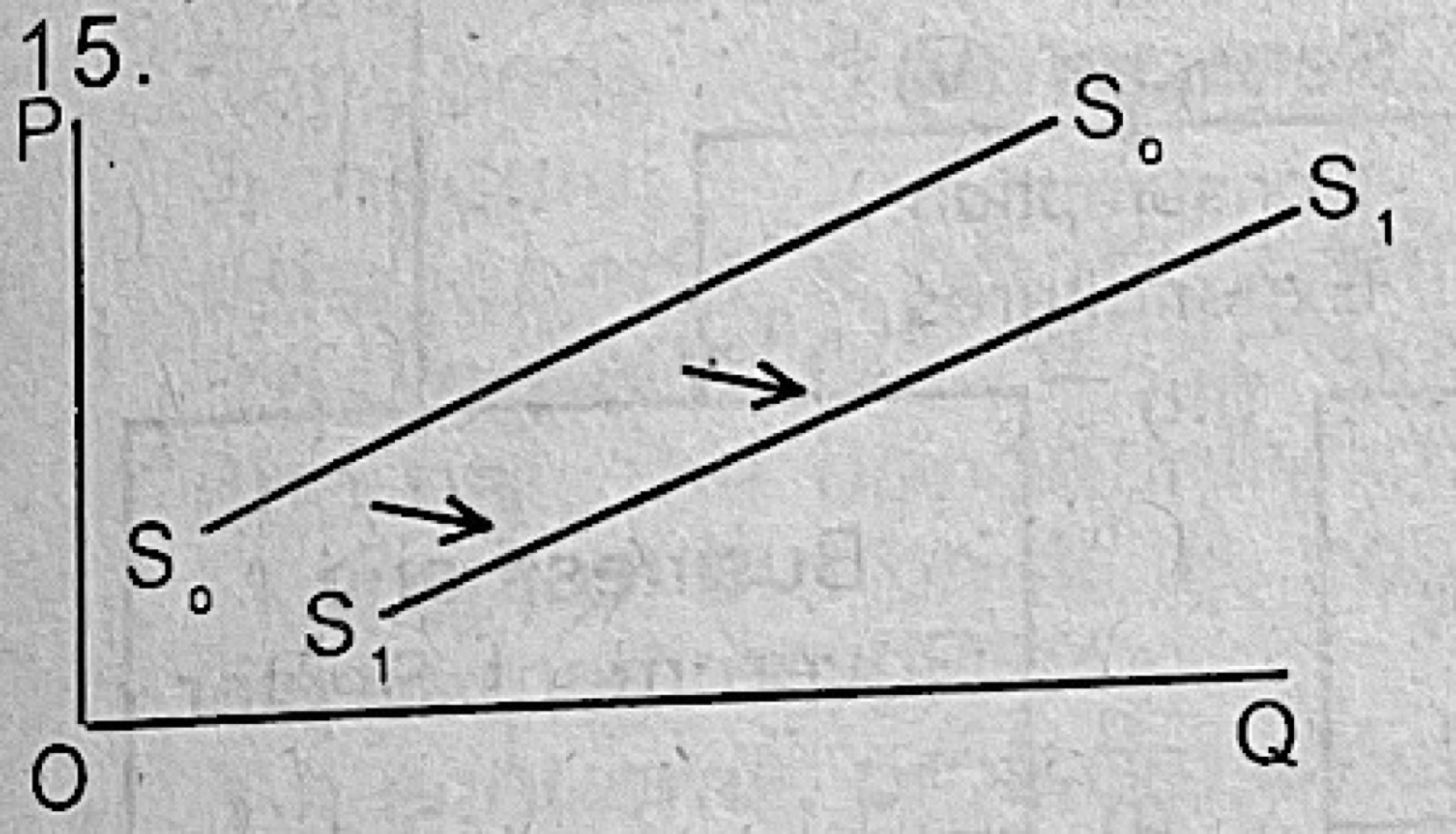
Question 15 Theory of Supply In the above diagram, the supply curve S0 S0 shifts to a new position S1 S1 to indicate
A. a drop in supply B. a rise in supply C. a supply-push inflation D. a stable supply curve E. an increase in quantity supplied. Show the answer and explanation Answer: B (a rise in supply )
Explanation The whole supply curve moves to the right, so more is offered at every price: an increase in supply.
Open this question
Question 16 Elasticity If X and Y are two goods, then the cross elasticity of demand for X with respect to Y is defined as the
A. percentage change in the quantity of X divided by the percentage change in the price of Y B. percentage change in the quantity of X divided by change in the price of Y C. change in the quantity of X divided by change in the price of Y D. percentage change in the quantity of X divided by the price of Y E. percentage change in the price of X divided by percentage change in the quantity of Y. Show the answer and explanation Answer: A (percentage change in the quantity of X divided by the percentage change in the price of Y )
Explanation Cross elasticity compares the percentage change in quantity demanded of one good with the percentage change in the price of the other.
Open this question
Question 17 Elasticity For two substitute goods, the cross elasticity of demand is
A. greater than one but less than two B. zero C. negative D. positive E. infinity. Show the answer and explanation Answer: D (positive )
Explanation If Y's price rises, people buy more of its substitute X, so the two changes have the same sign: positive cross elasticity.
Open this question
Question 18 Price Determination The control of prices by legislation usually produces a number of consequences. Which of the following is NOT an associated problem of maximum price control?
A. Excess supply B. Favouritism C. Bribery and corruption D. Black marketing E. Hoarding. Show the answer and explanation Answer: A (Excess supply )
Explanation A maximum price below equilibrium creates a shortage (excess demand), not excess supply; favouritism, bribery, black markets and hoarding follow from the shortage.
Open this question
Question 19 Market Structures For a non-discriminating monopolist in Nigeria, price at the profit maximizing output is
A. equal to marginal cost B. greater than marginal cost C. greater than average total cost D. equal to marginal revenue E. equal to total revenue. Show the answer and explanation Answer: B (greater than marginal cost )
Explanation A monopolist produces where MC = MR, and since its demand curve slopes down, price (AR) is above MR and therefore above MC.
Open this question
Question 20 Theory of Demand A demand curve slopes downwards because of
A. an increase in the money income of the consumer B. a decrease in the money income of the consumer C. the substitution effect and the rise in real income of the consumer D. the rise in demand for the complementary goods E. the increase in the demand for factors of production. Show the answer and explanation Answer: C (the substitution effect and the rise in real income of the consumer )
Explanation When price falls, the good becomes cheaper than substitutes (substitution effect) and the buyer's real income rises (income effect), so more is bought.
Open this question
Question 21 Market Structures An imperfectly competitive market is one where
A. a large number of firms sell homogenous products B. input and output prices are unaffected C. each firm faces a horizontal demand curve D. each firm maximizes profit by selecting an output level at which marginal cost equals market price E. commodities are differentiated. Show the answer and explanation Answer: E (commodities are differentiated. )
Explanation Differentiated products give firms some control over price, which marks imperfect competition; the other options describe perfect competition.
Open this question
Question 22 Public Finance In taxation, the benefit principle requires that
A. everybody must draw benefits from taxation B. all those who earn more income must pay more taxes C. only those who derive benefit from services provided from public revenue should be taxed D. taxes paid by businesses should be shifted to those consumers benefiting from such consumer commodities E. everybody pays an equal amount. Show the answer and explanation Answer: C (only those who derive benefit from services provided from public revenue should be taxed )
Explanation The benefit principle says people should pay tax according to the benefit they get from public services.
Open this question
Question 23 Market Structures A perfectly competitive firm does not influence the demand for its commodities by lowering its price below the market price because
A. it is illegal price cutting B. other competitors will be angry C. total revenue will decline due to its inelastic demand curve D. it is able to sell all it wants at the market price E. it does not maximize profit. Show the answer and explanation Answer: D (it is able to sell all it wants at the market price )
Explanation A perfectly competitive firm faces a perfectly elastic demand curve: it can sell any quantity at the market price, so cutting price only loses revenue.
Open this question
Question 24 Market Structures Pricing and output decisions of sellers are highly interdependent in markets known as
A. oligopoly B. perfect competition C. monopoly D. monopolistic competition E. imperfect competition. Show the answer and explanation Answer: A (oligopoly )
Explanation In oligopoly there are few sellers, so each must consider how rivals will react to its price and output.
Open this question
Question 25 Business Organisations One disadvantage of sole proprietorship is its
A. limited liability B. high profits C. high sense of ownership D. low credit rating E. low failure rate. Show the answer and explanation Answer: D (low credit rating )
Explanation A sole trader has limited assets and security, so banks are unwilling to lend to him: a low credit rating.
Open this question
Question 26 Distributive Trade The channel for food distribution in Nigeria consists of
A. farmers and their families B. producers, wholesalers and retailers C. producers and consumers D. producers and processors E. farmers, processors and consumers. Show the answer and explanation Answer: B (producers, wholesalers and retailers )
Explanation The usual chain of distribution runs from producers through wholesalers and retailers to consumers.
Open this question
Question 27 Business Organisations Which of the following is NOT true of debentures and debenture holders?
A. Debentures are instruments for raising long-term capital by limited liability companies B. Debentures are fixed interest-bearing securities with specified maturity dates C. Debenture holders are creditors to the company and therefore do not share in the risk of the company D. Debenture holders are entitled to interest payments whether or not profits are made E. Preference shareholders receive their share of profits before debenture holders receive their entitlements. Show the answer and explanation Answer: E (Preference shareholders receive their share of profits before debenture holders receive their entitlements. )
Explanation Debenture holders are creditors, so their interest is paid before any dividend goes to shareholders, preference or ordinary.
Open this question
Question 28 Business Organisations The economic goal of public utilities is to
A. maximize profits B. expand assets C. minimize costs D. provide essential services E. pay higher dividends to shareholders. Show the answer and explanation Answer: D (provide essential services )
Explanation Public utilities such as water and electricity exist mainly to provide essential services to the public.
Open this question
Question 29 Business Organisations The basic principles of co-operative societies are those of
A. active participation of capitalists in the affairs of co-operative societies B. worker ownership and worker control C. sole proprietorship D. partnership E. denying of credit facilities to members. Show the answer and explanation Answer: B (worker ownership and worker control )
Explanation Co-operatives are owned and democratically controlled by their own members, who are also the people who work in or use them.
Open this question
Question 30 Industrialisation The most important factor determining the location of the cement industry in Nigeria today is
A. capital and government policy B. the nature of the product, infrastructure and government policy C. nearness to the market and source of power D. price of the product and source of labour E. raw materials. Show the answer and explanation Answer: E (raw materials. )
Explanation Cement uses bulky limestone that loses weight in processing, so plants are sited near limestone deposits (e.g. Ewekoro, Nkalagu).
Open this question
Question 31 Money and Inflation The most important characteristic of money is
A. portability B. intrinsic value C. acceptability D. usefulness E. beauty. Show the answer and explanation Answer: C (acceptability )
Explanation Anything can serve as money only if people generally accept it in payment.
Open this question
Question 32 Financial Institutions The Central Bank instrument of control does NOT include
A. open market operations B. moral sanctions C. reserve requirements D. selective credit control E. printing bank-notes. Show the answer and explanation Answer: E (printing bank-notes. )
Explanation Open market operations, moral suasion, reserve requirements and selective credit controls are the CBN's tools of monetary control; printing bank-notes is a function, not a control instrument.
Open this question
Question 33 Money and Inflation Cost push inflation takes place due to
A. the rapid increase in the demand for goods B. an increase in productivity of the factors of production C. a rise in the cost of production D. a rise in the standard of living E. the low wage rate of the workers. Show the answer and explanation Answer: C (a rise in the cost of production )
Explanation Cost-push inflation happens when rising costs (wages, raw materials) push producers to raise prices.
Open this question
Question 34 Money and Inflation Lord Keynes identified three motives for holding money, that is, keeping one's resources in liquid form instead of in some form of investment. The motive which relates to making provision for the 'rainy day' is known as
A. speculative motive B. precautionary motive C. transactions motive D. investment motive E. rainy day motive. Show the answer and explanation Answer: B (precautionary motive )
Explanation Money held for emergencies and unforeseen needs is held for the precautionary motive.
Open this question
Question 35 Money and Inflation If a person demands money for buying and selling securities, it is referred to as demanding money for
A. transaction purposes B. speculative purposes C. precautionary purposes D. meeting the educational expenses of children E. carrying out gambling activities. Show the answer and explanation Answer: B (speculative purposes )
Explanation Holding money to take advantage of changes in bond and security prices is the speculative motive.
Open this question
Question 36 Public Finance Generally, property taxes
A. are borne entirely by landlords B. cannot be shifted in the long run C. are borne by all (renters, owner occupiers and landlords) D. are borne only by renters E. are borne by a few industrialists. Show the answer and explanation Answer: C (are borne by all (renters, owner occupiers and landlords) )
Explanation Landlords pass part of a property tax on in higher rents, so the burden is shared by landlords, owner-occupiers and tenants.
Open this question
Question 37 Public Finance One of the major effects of an increase in government expenditure on a nation's economy is that it
A. creates investment opportunities for foreign investors B. leads to indigenization of the private sector C. raises the level of total tax revenue D. raises the level of aggregate demand E. controls the spread of monopoly. Show the answer and explanation Answer: D (raises the level of aggregate demand )
Explanation Government spending is part of total spending, so raising it increases aggregate demand.
Open this question
Question 38 Public Finance Public expenditure on services, such as education and health, is known as expenditure on
A. general services B. community services C. social services D. economic services E. administrative services. Show the answer and explanation Answer: C (social services )
Explanation Education, health and welfare are classified as social services in the government budget.
Open this question
Question 39 International Trade Questions 39 and 40 are based on the table below:
A. 2,2 B. 2,1.5 C. 1.5,4 D. 1.5,2 E. 0.5,1.5. Show the answer and explanation Answer: D (1.5,2 )
Explanation Comparing the two products: Austria gives up 12 tonnes of cocoa for 8 metres of lace, a ratio of 12/8 = 1.5; Nigeria 20/10 = 2. So Austria 1.5, Nigeria 2.
Open this question
Question 40 International Trade Questions 39 and 40 are based on the table below:
A. Nigeria should produce cocoa and lace B. Austria should produce cocoa and lace C. Nigeria can benefit from producing lace only D. Nigeria should not produce any of the products because of her relative disadvantages E. Austria should produce lace and Nigeria should produce cocoa. Show the answer and explanation Answer: E (Austria should produce lace and Nigeria should produce cocoa. )
Explanation A metre of lace costs Austria 1.5 tonnes of cocoa but Nigeria 2 tonnes, so Austria has the comparative advantage in lace and Nigeria in cocoa.
Open this question
Question 41 International Trade The following except ONE, are the differences between international trade and internal trade
A. Differences in currencies B. Government control C. Mobility of factors of production D. Cultural differences E. Exchange of goods Show the answer and explanation Answer: E (Exchange of goods )
Explanation Both internal and international trade involve exchange of goods, so that is not a difference; currencies, controls, factor mobility and culture do differ.
Open this question
Question 42 International Trade Let Px represent the price of exports and Pm the price of imports. Then, the terms of trade (TOT) are said to be favourable if
A. Px /Pm < 1 B. Px /Pm = 1 C. Px /Pm > 1 D. Px /Pm ≠ 1 E. 0 < Px /Pm < 1 Show the answer and explanation Answer: C (Px /Pm > 1 )
Explanation Terms of trade are favourable when export prices are high relative to import prices, i.e. Px /Pm is greater than 1.
Open this question
Question 43 Balance of Payments and Exchange Rates Which of the following items does NOT belong to a country's current account in the balance of payments accounts?
A. Merchandise exports B. Merchandise imports C. Travel D. Foreign currencies E. Insurance services. Show the answer and explanation Answer: D (Foreign currencies )
Explanation Holdings of foreign currencies are reserve or capital items; goods, travel and insurance are current-account trade in goods and services.
Open this question
Question 44 International Trade An improvement in Nigeria's terms of trade should
A. lead to a fall in cost of her imports in terms of what she must sacrifice to obtain them B. make 'made in Nigeria' goods cheaper to buy C. increase Nigeria's domestic output of commodities D. lead to an increase in her exchange rates E. lead to an increase in Nigeria's exports of petroleum. Show the answer and explanation Answer: A (lead to a fall in cost of her imports in terms of what she must sacrifice to obtain them )
Explanation Better terms of trade mean each unit of exports buys more imports, so imports cost fewer exports.
Open this question
Question 45 Economic Growth and Development Which of the following is NOT a feature of economic underdevelopment of a country?
A. A large number of High income earners relative to the population B. High annual income for the few C. High incidence of poverty D. Low daily calorie intake per person E. High infant mortality rate. Show the answer and explanation Answer: A (A large number of High income earners relative to the population )
Explanation Underdeveloped countries have few high-income earners; most people are poor.
Open this question
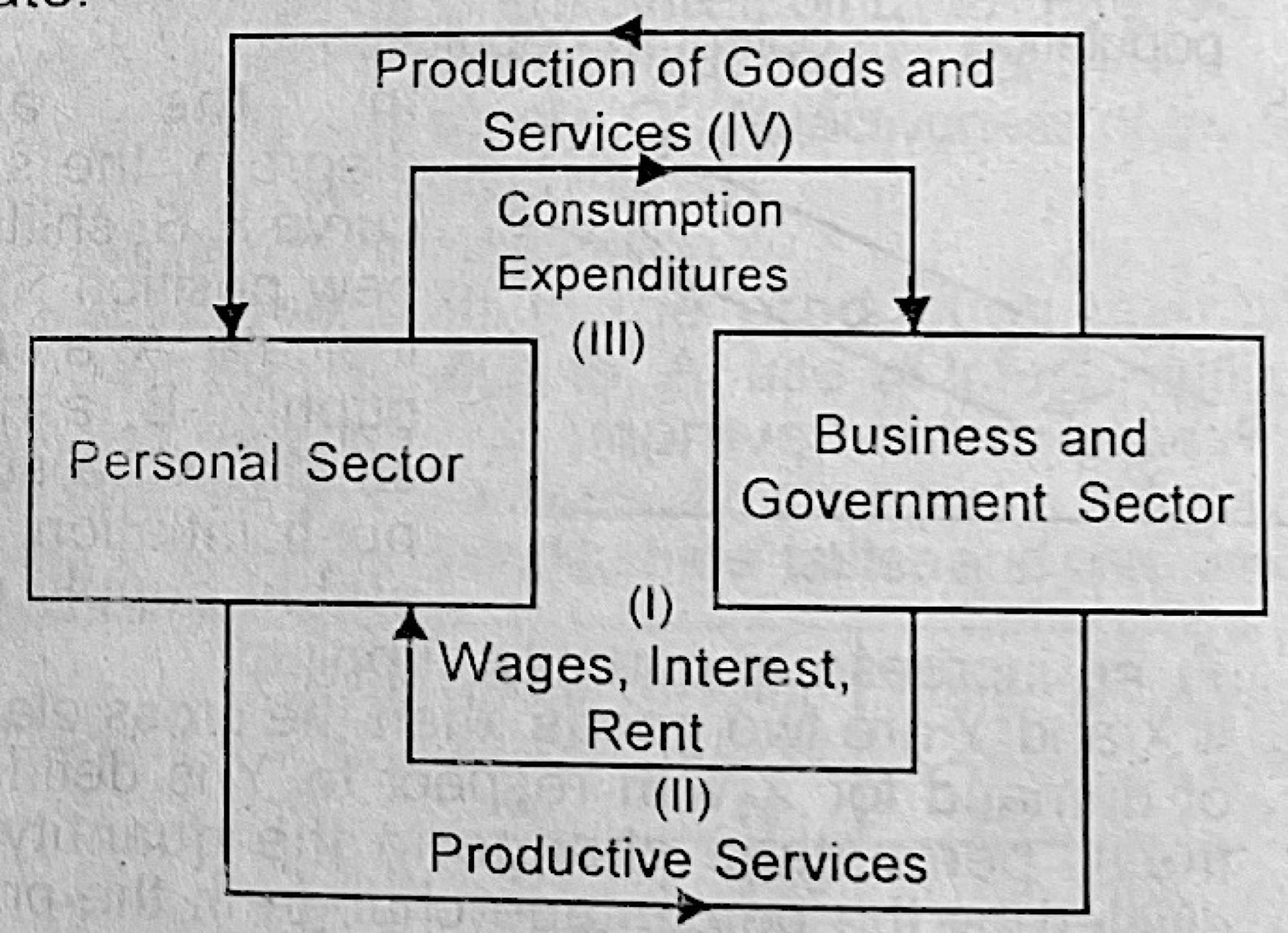
Question 46 National Income Use the above diagram to answer questions 46 to 48. The above diagram illustrates
A. the circular flow of income B. gross national product plus depreciation C. incomes of the private sector D. the profit of business enterprises E. the output approach to national income determination. Show the answer and explanation Answer: A (the circular flow of income )
Explanation The diagram shows money and real flows going round between households and firms: the circular flow of income.
Open this question
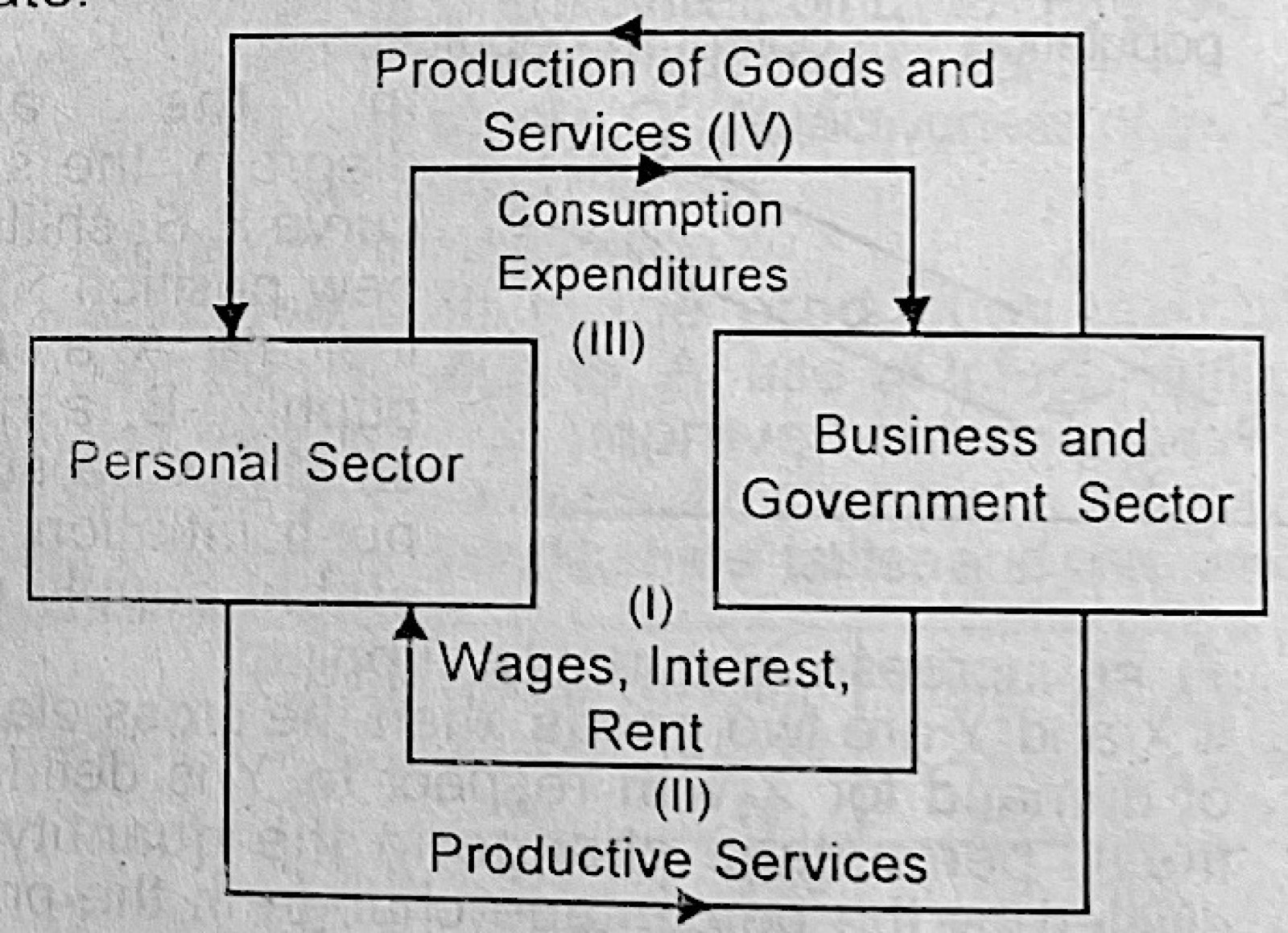
Question 47 National Income Use the above diagram to answer questions 46 to 48. In the diagram, (I) refers to the calculation of national income through the
A. expenditure approach B. input-output approach C. flow of funds approach D. income approach E. output approach. Show the answer and explanation Answer: D (income approach )
Explanation Flow (I) is wages, interest and rent paid to households, so adding it up is the income approach.
Open this question
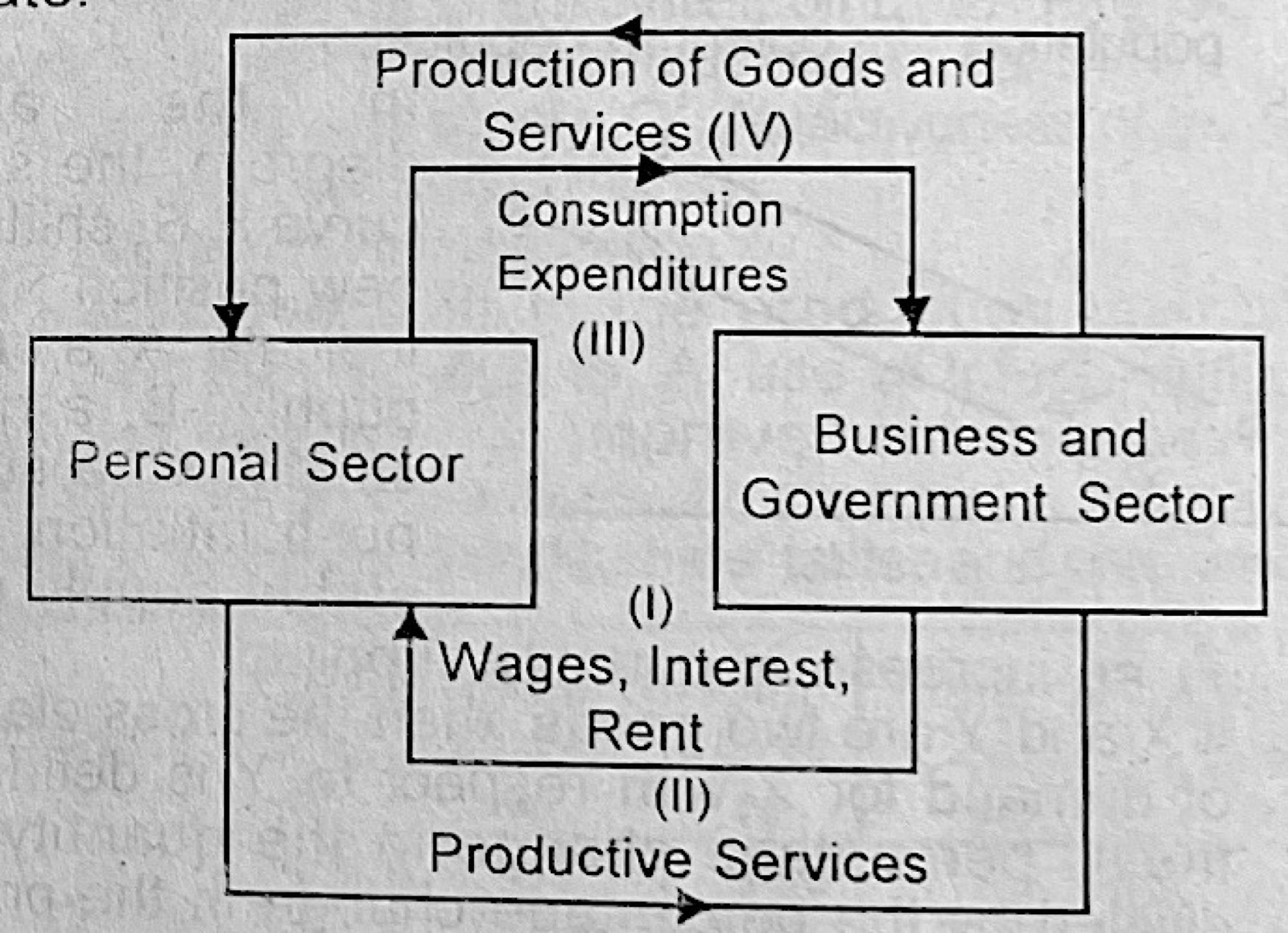
Question 48 National Income Use the above diagram to answer questions 46 to 48. In the same diagram, (III) refers to the calculation of national income through the
A. income approach B. government earnings approach C. expenditure approach D. output approach E. flow of funds approach. Show the answer and explanation Answer: C (expenditure approach )
Explanation Flow (III) is consumption expenditure on goods and services, so summing spending is the expenditure approach.
Open this question
Question 49 Economic Growth and Development Given the present state of the Nigerian economy, which of the following measures will promote more rapid economic development?
A. Complete dependence on oil exports B. Concentration on agricultural exports C. Diversification of the economy D. Building of more schools and universities E. Introduction of nuclear energy in Nigeria. Show the answer and explanation Answer: C (Diversification of the economy )
Explanation Nigeria depends heavily on oil; spreading production across many sectors reduces risk and creates more growth and jobs.
Open this question
Question 50 Market Structures Which of the following does NOT represent the behaviour of a monopolist?
A. Manipulating the market price of his goods B. Manipulating both the price and quantity of his goods at the same time C. Raising the price at one market, lowering it at another market D. Manipulating only quantity, price being a given factor E. Manipulating the quality of his goods. Show the answer and explanation Answer: B (Manipulating both the price and quantity of his goods at the same time )
Explanation A monopolist faces a demand curve, so he can fix price or quantity but not both; buyers decide the other.
Open this question Sign up free for every JAMB Economics year, practice by topic and timed mocks.
Start practising free