Home › Past questions › JAMB › Economics › 1983 47 questions. Try each one, then open the answer to check yourself and read the explanation.
Sign up free to answer these questions on a CBT screen with a timer, then see your score and every answer explained.
Start practising free
Question 1 National Income Which of the following items is NOT included in measuring national income by the income approach?
A. Wages and salaries of public servants B. Student grants and scholarships C. Profits of companies D. Income earned by self employed persons such as lawyers E. Rents on property. Show the answer and explanation Answer: B (Student grants and scholarships )
Explanation Grants and scholarships are transfer payments: nothing is produced in return, so they are left out of national income.
Open this question
Question 2 Price Determination A downward sloping demand curve intersects a fixed supply curve. A shift of this demand curve to the right implies that
A. both price and quantity will increase B. only price increases C. only quantity increases D. the price remains constant E. the price falls. Show the answer and explanation Answer: B (only price increases )
Explanation A fixed supply curve is vertical: the quantity cannot change. When demand shifts to the right, the new equilibrium is higher up the same vertical line, so only the price increases.
Open this question
Question 3 Industrialisation Which of the following items is NOT an argument for locating industries in rural areas?
A. Rural areas supply agricultural raw material B. The pace of development will be quickened in rural areas C. Employment will be provided for rural inhabitants D. Capital is easily available in rural areas E. Suitable humid climate is sometimes found in rural areas. Show the answer and explanation Answer: D (Capital is easily available in rural areas )
Explanation Capital is scarce in rural areas, so it cannot be a reason to site industries there; the other options are real attractions of rural locations.
Open this question
Question 5 Population The natural growth rate of a population is the
A. sum of the birth rate and the death rate B. sum of the birth rate and the net migration rate C. birth rate minus the death rate D. birth rate divided by the net migration E. death rate minus the net migration. Show the answer and explanation Answer: C (birth rate minus the death rate )
Explanation Natural growth ignores migration: it is simply the birth rate minus the death rate.
Open this question
Question 6 Theory of Production Which of the following sets fully represents factors of production?
A. Sunlight, machinery, man, land B. Land, labour, capital, enterprise, technology C. Capital, technology, ideas, market, land D. Land, water, weather E. Money, market, middlemen. Show the answer and explanation Answer: B (Land, labour, capital, enterprise, technology )
Explanation Of the sets given, only B lists land, labour, capital and enterprise (the four factors), together with technology.
Open this question
Question 7 Basic Concepts Production possibilities (alternatives)
A. one unit of shelter B. three units of shelter C. one third of a unit of shelter D. six units of shelter E. two units of shelter. Show the answer and explanation Answer: C (one third of a unit of shelter )
Explanation Going from R to S, one unit of shelter is given up to get 3 more units of food (9 to 12), so each unit of food costs one third of a unit of shelter.
Open this question
Question 8 Basic Concepts The concept of economic efficiency primarily refers to
A. obtaining the maximum output from available resources at the lowest possible cost B. conservation of our petroleum resources C. equity in the distribution of the nation's wealth D. producing without waste E. the limited wants-unlimited resources dilemma. Show the answer and explanation Answer: A (obtaining the maximum output from available resources at the lowest possible cost )
Explanation Economic efficiency means getting the greatest output from the resources available at the least cost.
Open this question
Question 9 Theory of Production If successive units of labour are added to a piece of land while capital and technology remain constant, a point will be reached in the level of production when each added unit of labour will add less to the output than previous units of labour. This concept is known as
A. the productivity of labour B. the law of diminishing marginal utility C. the law of diminishing returns D. the concept of factor intensity E. labour intensive production. Show the answer and explanation Answer: C (the law of diminishing returns )
Explanation When more of a variable factor is added to fixed factors, its marginal product eventually falls: the law of diminishing returns.
Open this question
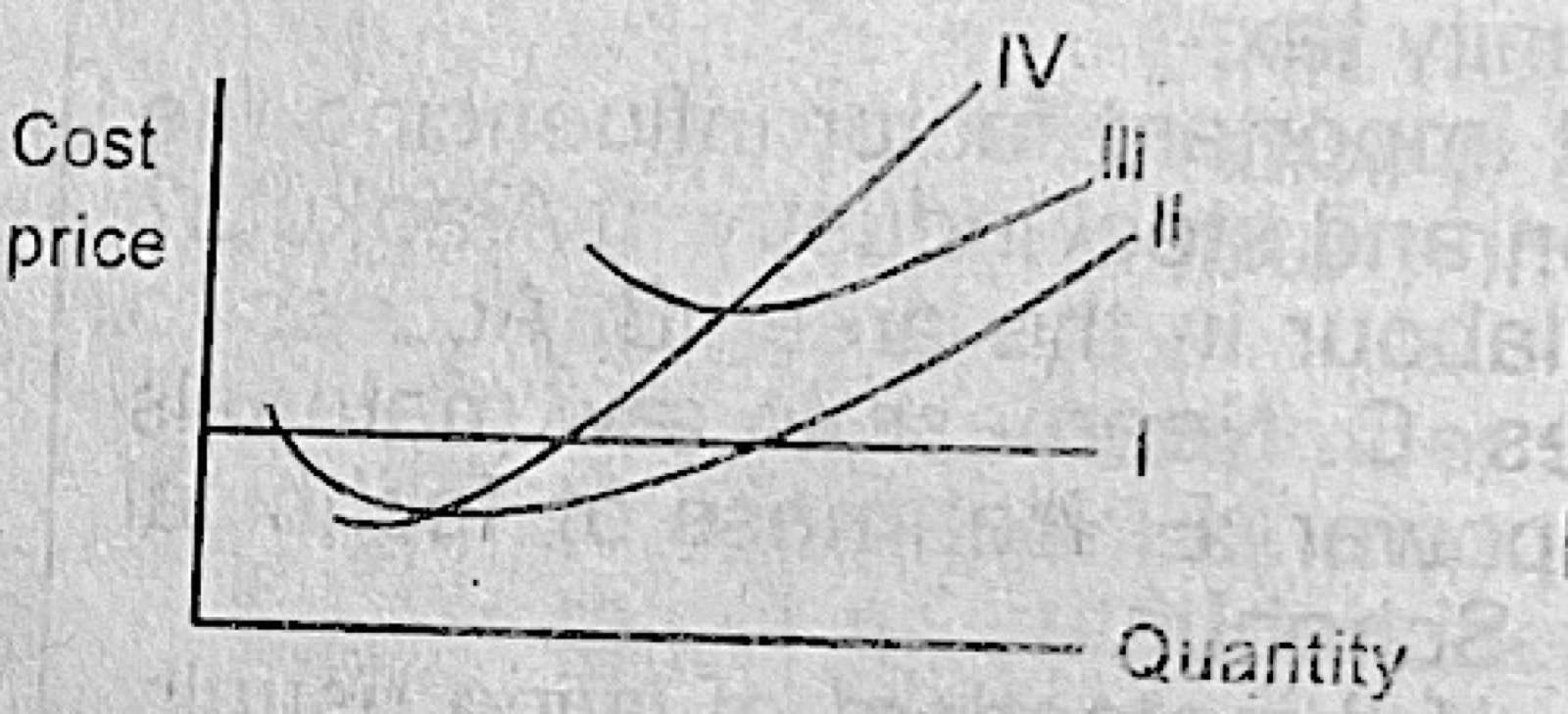
Question 10 Market Structures In perfect competition a firm's price is equal to its marginal revenue which is again equal to average revenue. This form maximizes its profits when its marginal cost (MC) is equal to price (P). Which of the curves in the diagram below represents the firm's marginal cost (MC)?
A. Curve I B. Curve II C. Curve III D. Curve IV E. Curves I and III. Show the answer and explanation Answer: D (Curve IV )
Explanation Curve I is the horizontal price line (P = MR = AR) and the U-shaped curve is average cost; the steeply rising curve IV that cuts through them is marginal cost.
Open this question
Question 11 Theory of Demand A Nigerian household's demand curve for semovita is downward sloping because
A. the demand for semovita is high B. the local markets are flooded with semovita C. it is produced in Nigeria D. every household can afford to buy semovita E. higher prices attract lower quantities while lower prices attract larger quantities. Show the answer and explanation Answer: E (higher prices attract lower quantities while lower prices attract larger quantities. )
Explanation A demand curve slopes downward because people buy less at higher prices and more at lower prices (the law of demand).
Open this question
Question 12 Price Determination The table below shows the market schedule for semovita.
A. N5.00 B. N8.00 C. N9.00 D. N7.00 E. N6.00 Show the answer and explanation Answer: E (N6.00 )
Explanation Equilibrium is where quantity demanded equals quantity supplied: at N6.00 both are 7,000 bags.
Open this question
Question 13 Theory of Costs and Revenue Marginal cost curve intersects average cost curve
A. from above at its lowest point B. from below before the lowest point C. from below at its lowest point D. from below after the lowest point E. at zero point. Show the answer and explanation Answer: C (from below at its lowest point )
Explanation While MC is below AC it pulls AC down; once MC rises above AC it pulls AC up. So MC cuts AC from below at AC's lowest point.
Open this question
Question 14 Industrialisation Palm oil industry is located in Bendel State because the State
A. imports raw material for palm oil industry B. is a palm tree growing area C. soil is unsuitable for other crops D. government does not engage land for other crops E. land is suitable for oil. Show the answer and explanation Answer: B (is a palm tree growing area )
Explanation Processing industries locate near their raw material; Bendel (now Edo/Delta) is an oil-palm growing area.
Open this question
Question 15 Money and Inflation The meaning of 'wage-price spiral' is
A. demand pull and cost push inflation pulling each other in different directions B. demand pull and cost push inflation intensifying each other C. both of them bringing about a reduction in the price level D. that demand pull and cost push inflation increases employment E. that wages and prices are rising at a proportional rate. Show the answer and explanation Answer: B (demand pull and cost push inflation intensifying each other )
Explanation Rising prices lead workers to demand higher wages, which raise costs and prices again: demand-pull and cost-push inflation feed each other.
Open this question
Question 16 Money and Inflation In an inflationary period which of the following statements is NOT true?
A. Wages rise simultaneously with prices B. The purchasing power of money diminishes C. More money runs after a limited quantity of goods D. Money supply increases E. Aggregate real demand exceeds aggregate real supply. Show the answer and explanation Answer: A (Wages rise simultaneously with prices )
Explanation In inflation wages usually lag behind prices, which is why wage earners lose; the other statements describe inflation correctly.
Open this question
Question 17 Distributive Trade Retailers in an economy perform the function of
A. production B. exchange C. distribution D. hoarding E. investment. Show the answer and explanation Answer: C (distribution )
Explanation Retailers are the last link in the chain of distribution, bringing goods to final consumers.
Open this question
Question 18 Business Organisations In a sole proprietorship, the decisions are made by the
A. government B. board of directors C. management D. shareholders' conference E. owner. Show the answer and explanation Answer: E (owner. )
Explanation A sole proprietor owns and runs the business alone, so he or she makes all the decisions.
Open this question
Question 19 Business Organisations Which of the following enterprises does NOT pursue the sole objective of profit maximization?
A. Roads Nigeria Ltd. B. Union Bank of Nigeria Ltd. C. Nigerian Electric Power Authority D. Volkswagen (VW) Nigeria Ltd. E. Kingsway Nigeria Ltd. Show the answer and explanation Answer: C (Nigerian Electric Power Authority )
Explanation NEPA was a public corporation whose main aim was to provide electricity as a service to the public, not to maximise profit.
Open this question
Question 21 Public Finance The maintenance of general economic stability in the country necessarily relies heavily on
A. federal fiscal policy B. coordinated federal, state and local fiscal policies C. tax and revenue policies of state governments D. federal grants to state and local governments E. federal grants to local governments. Show the answer and explanation Answer: B (coordinated federal, state and local fiscal policies )
Explanation All three tiers of government tax and spend, so stability needs their fiscal policies to work together.
Open this question
Question 22 Financial Institutions The supply of loanable funds is significantly influenced by
A. commercial banks B. mortgage banks C. financial intermediaries D. the Central Bank E. insurance companies. Show the answer and explanation Answer: D (the Central Bank )
Explanation The Central Bank controls the money supply and the lending capacity of all banks, so it has the biggest influence on loanable funds.
Open this question
Question 23 Public Finance Which of the following are direct taxes?
A. Sales taxes B. Excise duties C. Income and company taxes D. Tariff duties E. Commodity taxes. Show the answer and explanation Answer: C (Income and company taxes )
Explanation Direct taxes are paid straight to government by the person or firm on whom they fall, like income and company taxes; the others are taxes on goods.
Open this question
Question 24 Theory of Production Division of labour has many advantages. Notwithstanding, it is greatly limited by
A. monotony of work B. decline of craftmanship C. risk of unemployment D. extent of market demand E. boredom. Show the answer and explanation Answer: D (extent of market demand )
Explanation Specialisation pays only if the large output can be sold, so the size of the market limits division of labour; the others are disadvantages, not limits.
Open this question
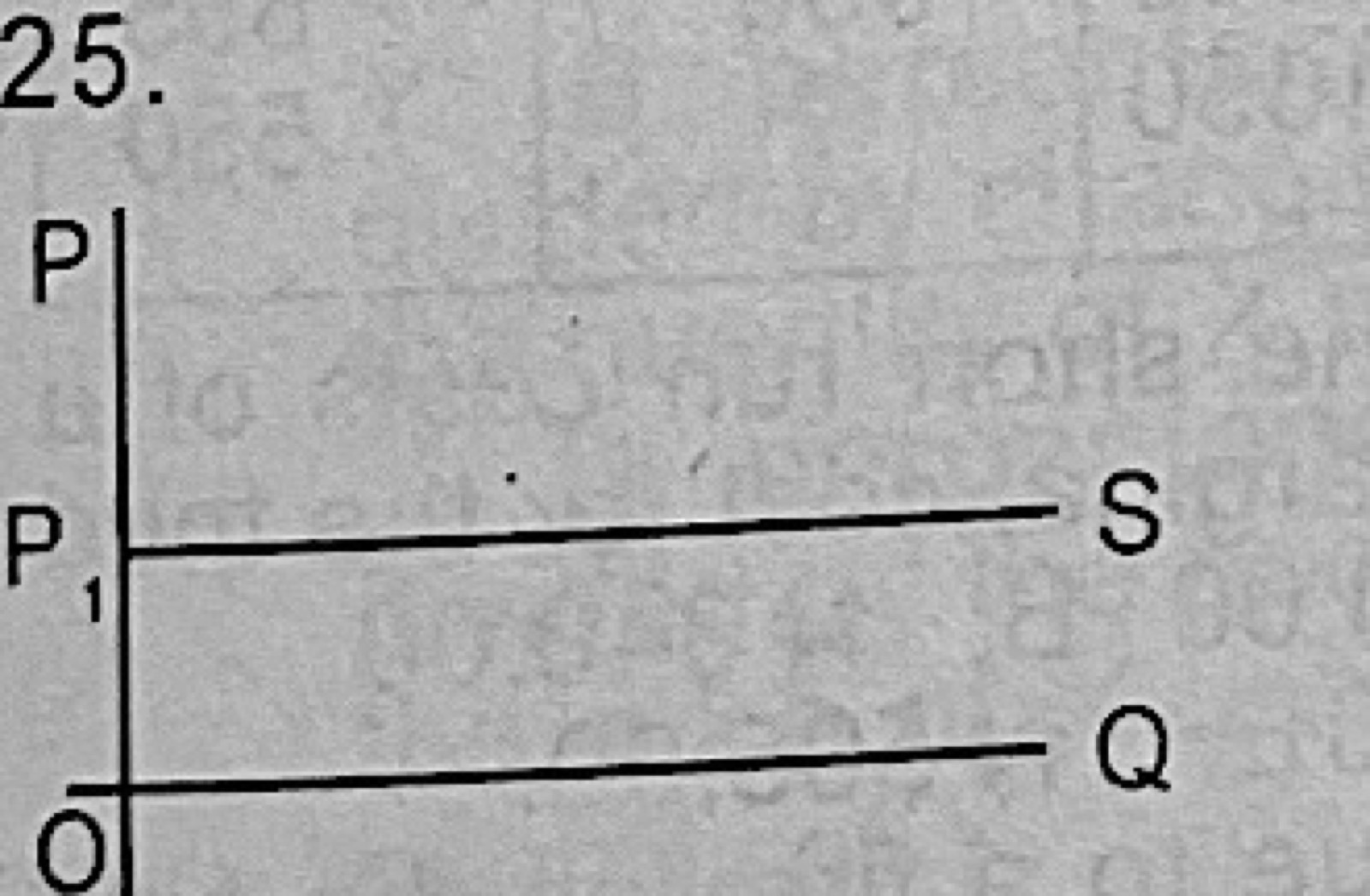
Question 25 Elasticity In the above diagram, P1 S is a supply curve for a manufactured good. It shows that
A. when price is OP1 , quantity is infinitely elastic B. the higher the price the greater the quantity supplied C. the higher the price the lower the quantity supplied D. when price is zero quantity supplied becomes infinite E. when price is infinite quantity supplied becomes zero. Show the answer and explanation Answer: A (when price is OP1 , quantity is infinitely elastic )
Explanation A horizontal supply curve is perfectly (infinitely) elastic: any quantity is supplied at price OP1 , but none below it.
Open this question
Question 26 Business Organisations In the event of a limited liability company going into liquidation each
A. shareholder may lose the maximum of the amount he has invested B. shareholder loses nothing C. shareholder loses everything including his house D. shareholder's liability becomes unlimited E. shareholder will lose the amount he has invested plus a proportion of his bank account. Show the answer and explanation Answer: A (shareholder may lose the maximum of the amount he has invested )
Explanation Limited liability means a shareholder can lose at most the money put into the shares; private property is safe.
Open this question
Question 27 Public Finance A greater burden of the taxes on essential goods is borne by the
A. middle income group B. higher income group C. lower income group D. people falling between the middle and higher income groups E. top few richest people of the country. Show the answer and explanation Answer: C (lower income group )
Explanation Poor people spend a larger share of their income on essentials, so such taxes take a bigger share of their income (they are regressive).
Open this question
Question 28 International Trade Comparative cost doctrine of international trade means specialization in production
A. according to absolute cost advantage B. according to absolute cost disadvantage C. according to comparative cost disadvantage D. according to comparative cost advantage E. on the basis of the availability of labour. Show the answer and explanation Answer: D (according to comparative cost advantage )
Explanation The law of comparative cost says each country should specialise in the goods it produces at a lower opportunity cost than others.
Open this question
Question 29 International Trade The meaning of 'Dumping' is selling goods in a foreign market
A. at a price below that received in the home market B. at a price higher than that received in the home market C. at a price equal to the costs price in the home market D. in order to encourage indigenous producers E. at a price equal to the selling price in the home market. Show the answer and explanation Answer: A (at a price below that received in the home market )
Explanation Dumping is selling exports abroad more cheaply than at home (or below cost), often to capture the foreign market.
Open this question
Question 30 Balance of Payments and Exchange Rates Disequilibrium in the balance of payments means
A. imports of the country exceeding its exports B. overall deficit or surplus in the current account and capital account of the balance of payments C. capital flowing out of the country exceeds the capital flowing into the country D. deficit in the trade balance E. export earnings exceed cost of imports. Show the answer and explanation Answer: B (overall deficit or surplus in the current account and capital account of the balance of payments )
Explanation Disequilibrium is any overall imbalance, deficit or surplus, when current and capital accounts are taken together.
Open this question
Question 31 Natural Resources and Petroleum Petroleum 'glut' in international trade means
A. a fall in petroleum production B. an over supply of petroleum C. a higher petroleum price offered by the buyer D. a higher petroleum price demanded by the seller E. higher prices for the consumption of petroleum. Show the answer and explanation Answer: B (an over supply of petroleum )
Explanation A glut is a situation where supply is far greater than demand, as happened to oil in the early 1980s, pushing prices down.
Open this question
Question 32 International Trade International trade is necessary because
A. no country can live in economic isolation B. different countries are differently endowed in natural and man-made resources C. some countries have comparative costs advantage in the production of particular commodities over other countries D. the world demand for and supply of various categories of commodities is expanding very fast. E. countries want to build up their foreign exchange reserves. Show the answer and explanation Answer: B (different countries are differently endowed in natural and man-made resources )
Explanation Countries have different natural and man-made resources, so none can produce everything it needs cheaply; this unequal endowment is the root reason for trade.
Open this question
Question 33 Economic Growth and Development Mono product economies are those that
A. have a rich cultural heritage B. produce only raw materials C. live from the export of their raw products D. produce one main commodity E. specialize in agricultural industries. Show the answer and explanation Answer: D (produce one main commodity )
Explanation A mono-product economy depends on one main commodity, as Nigeria depends on crude oil.
Open this question
Question 34 International Economic Organisations The quickest way of achieving an economic union on regional basis is to remove all
A. currency barriers B. language barriers C. political barriers D. customs barriers E. legal barriers. Show the answer and explanation Answer: D (customs barriers )
Explanation Removing customs duties and other trade barriers between members lets goods move freely at once; this is the first step towards economic union.
Open this question
Question 35 Economic Growth and Development If an economy is growing at an annual rate of 7% and 4% of it is known to be due to the improvements in labour and capital combined, the balance of 3% is usually due to
A. land and related factors B. abundance of natural resources C. level of human capital D. technical progress or other factors E. the discipline of political leadership. Show the answer and explanation Answer: D (technical progress or other factors )
Explanation Growth not explained by more labour and capital is put down to technical progress and other factors (better methods, organisation, skills).
Open this question
Question 37 Business Organisations When a government owns enterprises, a number of advantages arise. Which of the following is NOT one of such advantages?
A. More capital is provided B. Pricing policy may be in the interest of consumers C. Government workers may be indifferent towards the public D. Infrastructures are rapidly developed E. Income may be more evenly distributed. Show the answer and explanation Answer: C (Government workers may be indifferent towards the public )
Explanation Workers being indifferent to the public is a weakness of public enterprises, not an advantage.
Open this question
Question 38 Industrialisation Which of the following is NOT an advantage of localization of industries?
A. Reaping of external economies B. Development of a pool of skilled labour for the industry C. Development of subsidiary industries D. Development of organized markets E. Growth of conurbations. Show the answer and explanation Answer: E (Growth of conurbations. )
Explanation Conurbations (overcrowded, merged towns) bring congestion, slums and pollution, so they are a disadvantage of localization.
Open this question
Question 39 Money and Inflation The monetary system that requires double co-incidence of wants is known as
A. the gold standard B. barter C. the commodity system D. the gold exchange standard E. the cheque system. Show the answer and explanation Answer: B (barter )
Explanation In barter, goods are exchanged directly, so each trader must want what the other has: a double coincidence of wants.
Open this question
Question 40 Population The effect of emigration on a country's population, all other things remaining equal, is to
A. increase its size B. cause overpopulation C. increase its growth rate D. reduce the proportion of children E. reduce its size. Show the answer and explanation Answer: E (reduce its size. )
Explanation Emigrants leave the country, so with other things unchanged the population falls.
Open this question
Question 41 Money and Inflation Money performs a number of functions. ONE of these functions makes it possible for any person to provide for old age. Because of that particular function money is regarded as a
A. medium of exchange B. measure of value C. unit of account D. store of value E. standard for deferred payments. Show the answer and explanation Answer: D (store of value )
Explanation Money can be saved and used later, so as a store of value it lets people provide for old age.
Open this question
Question 42 Agriculture Agriculture plays a dominant role in West African economies because
A. the Green Revolution in Nigeria is agricultural B. it supplies all the foodstuff consumed in West Africa C. there are large plantations of cocoa, groundnut and palm oil in West Africa D. it is the main source of revenue in Nigeria E. it employes more than 50% of the total labour force in West Africa. Show the answer and explanation Answer: E (it employes more than 50% of the total labour force in West Africa. )
Explanation Agriculture is dominant because most of the labour force works in it; it does not supply all food, and oil, not farming, is Nigeria's main revenue source.
Open this question
Question 43 Basic Concepts Which of the following defines Economics most comprehensively?
A. Buying and selling B. Organization of industries C. Study of human behaviour in the allocation of scarce resources D. National development planning and budgeting E. Banking and Insurance. Show the answer and explanation Answer: C (Study of human behaviour in the allocation of scarce resources )
Explanation Economics studies how people behave when allocating scarce resources among competing uses; the other options are only parts of it.
Open this question
Question 44 Population Age-structure in Nigeria is such that the working age-group is in the years
A. 1-15 B. 15-65 C. 30-40 D. 40-65 E. 65 and above. Show the answer and explanation Answer: B (15-65 )
Explanation The working (active) population is usually taken as people aged about 15 to 65.
Open this question
Question 45 Market Structures NEPA as a public corporation is
A. a power-generating industry in Nigeria B. organized in a perfectly competitive market C. a duopoly D. a monopolistically competitive industry E. a monopoly. Show the answer and explanation Answer: E (a monopoly. )
Explanation NEPA was the only supplier of public electricity in Nigeria, which made it a monopoly.
Open this question
Question 46 Labour Market Full employment is a situation in which
A. every adult is employed B. all adults who can work are employed C. all persons who have attained the age of 15 years and above are employed D. only the disabled are not employed E. all those who are able and eligible to work can find employment. Show the answer and explanation Answer: E (all those who are able and eligible to work can find employment. )
Explanation Full employment means everyone who is able, willing and eligible to work can find a job; it does not mean every adult works.
Open this question
Question 47 Elasticity When demand is elastic, it means that consumers
A. react more proportionately to price change B. are not sensitive to price change C. will stop buying when price increases D. react less proportionately to price change E. react equally to price change. Show the answer and explanation Answer: A (react more proportionately to price change )
Explanation Elastic demand means the percentage change in quantity demanded is greater than the percentage change in price.
Open this question
Question 48 Theory of Production Demand for a factor of production is
A. a composite demand B. a joint demand C. a derived demand D. an elasticity of demand E. cross-elasticity of demand. Show the answer and explanation Answer: C (a derived demand )
Explanation Factors are wanted for the goods they help produce, so their demand is derived from the demand for those goods.
Open this question
Question 49 Market Structures Differentiated product is the characteristic feature of
A. perfect competition B. pure competition C. monopolistic competition D. monopoly E. oligopoly. Show the answer and explanation Answer: C (monopolistic competition )
Explanation In monopolistic competition many firms sell similar but branded (differentiated) products.
Open this question
Question 50 Economic Growth and Development Nigeria is currently implementing the
A. third development plan B. second development plan C. fourth development plan D. fifth development plan E. first development plan. Show the answer and explanation Answer: C (fourth development plan )
Explanation This 1983 paper fell within Nigeria's Fourth National Development Plan, 1981–1985.
Open this question Sign up free for every JAMB Economics year, practice by topic and timed mocks.
Start practising free