50 questions. Try each one, then open the answer to check yourself and read the explanation.
Question 1
Basic Concepts
Economics is a science which deals basically with
A.the factors of production
B.allocation of scarce resources
C.oil exportation
D.the gross domestic product (GDP)
E.national income.
Show the answer and explanation
Answer: B (allocation of scarce resources)
Explanation
Economics studies how scarce resources are allocated among competing wants. Factors of production, GDP and national income are only parts of what it studies.
We can classify the people of Nigeria into three broad age groups: Group One, 0 - 15 years; Group Two, 16-64 years; Group Three, 65 years and above. Group Two is the most important economically because
A.it is the dependent population of Nigeria, economically
B.all students in Nigeria are in this group
C.more than 50% of all Nigerians are in this group
D.it is the most expensive group of the economy
E.it is the productive group of the economy.
Show the answer and explanation
Answer: E (it is the productive group of the economy.)
Explanation
People aged 16–64 are the working-age population: they produce goods and services and support the young and the old.
In the study of Economics, land, labour, capital and entrepreneur are referred to as factors of production. These factors produce commodities only if they are
A.profitable to the production process
B.purchased for the purpose of production
C.combined in the production process
D.provided adequately for the production process
E.brought into the factory.
Show the answer and explanation
Answer: C (combined in the production process)
Explanation
No single factor produces on its own; output results only when land, labour, capital and enterprise are combined.
The control price for a carton of beer in Nigeria is N7.20. But a carton of beer is sold in parts of the country for as much as N15.00 The cause of this exorbitant price is that
A.there is a Government ban on the importation of beer
B.beer distributors want more profit
C.Nigeria is a large country
D.middlemen hoard beer
E.the demand for beer exceeds the supply.
Show the answer and explanation
Answer: E (the demand for beer exceeds the supply.)
Explanation
A control price set below equilibrium creates a shortage: demand exceeds supply, so buyers bid the price up on the black market.
Some of major problems hindering economic development in West Africa are in the areas of electricity supply, communications, education and health. These items are known in Economics as
A.development projects
B.infrastructural facilities
C.monoculture
D.capital investment
E.superstructure.
Show the answer and explanation
Answer: B (infrastructural facilities)
Explanation
Power, communications, education and health are basic facilities that support all other production; economists call them infrastructure.
If AC = Average Cost of production, TC = Total Cost of production, VC = Variable Cost of production, FC = Fixed Cost of production, Q = Quantity of goods produced, then
A.AC = TC/Q; TC = VC + FC
B.AC = (TC) Q; TC = VC + FC
C.AC = TC/Q; TC = (VC)(FC)
D.AC = TC − FC; VC = TC − AC
E.AC = TC/Q; TC = VC + AC
Show the answer and explanation
Answer: A (AC = TC/Q; TC = VC + FC)
Explanation
Average cost is total cost divided by output, and total cost is the sum of fixed and variable costs.
Import duties make imports dearer and so reduce trade; they raise revenue, protect local industry, save foreign exchange and discourage some consumption.
The chief sources of Federal Government revenue in Nigeria are
A.import duties, petroleum import tax, profit tax, royalties and government dividends
B.personal income tax, excise tax and vehicle licenses
C.export duties, personal income tax and royalties
D.property income, sales tax and excise tax
E.import duties, sales tax and poll tax.
Show the answer and explanation
Answer: A (import duties, petroleum import tax, profit tax, royalties and government dividends)
Explanation
The Federal Government earns most from customs duties and from oil (petroleum profit tax and royalties); income tax, vehicle licences and poll tax go mainly to states and local councils.
B.buying or selling treasury bills by the Central Bank
C.printing of more currency notes
D.increasing or decreasing cash reserve ratio by the Central Bank
E.raising the level of interest.
Show the answer and explanation
Answer: A (increasing the import duties)
Explanation
Import duties are a tax, so changing them is fiscal (or trade) policy; the other options change money supply or interest rates, which is monetary policy.
For questions 26 and 27, consider the information below about the Nigerian economy. Sector | Share of gross national product (GNP) | Share of total employment | Growth rate of output All agriculture | 40% | 70% | 3% Industry and mining | 30% | 10% | 10% Trade and services | 30% | 20% | 5% What is the growth rate of GNP?
A.18%
B.10%
C.6.7%
D.5.7%
E.4.1%
Show the answer and explanation
Answer: D (5.7%)
Explanation
Weight each sector's growth by its share of GNP: 0.4 × 3 + 0.3 × 10 + 0.3 × 5 = 1.2 + 3 + 1.5 = 5.7%.
For questions 26 and 27, consider the information below about the Nigerian economy. Sector | Share of gross national product (GNP) | Share of total employment | Growth rate of output All agriculture | 40% | 70% | 3% Industry and mining | 30% | 10% | 10% Trade and services | 30% | 20% | 5% What is the growth rate of employment?
A.18%
B.10%
C.6.7%
D.5.7%
E.4.1%
Show the answer and explanation
Answer: E (4.1%)
Explanation
Taking each sector's employment to grow with its output, weight the growth rates by employment shares: 0.7 × 3 + 0.1 × 10 + 0.2 × 5 = 2.1 + 1 + 1 = 4.1%.
Which is considered the most effective tool by which the Central Bank of Nigeria can control the activities of commercial banks?
A.Open market operation
B.Reserve requirements
C.Bank rate
D.Directives
E.Special deposits.
Show the answer and explanation
Answer: B (Reserve requirements)
Explanation
Nigeria's money market was too small for open market operations to work well, so changing the cash and liquidity reserve requirements was the CBN's most effective control.
What is the most important factor influencing the location of the iron and steel industry at Ajaokuta?
A.Availability of labour in the area
B.Access to transport facilities
C.Nearness to raw materials
D.Availability of power
E.Nearness of Technical and Engineering School.
Show the answer and explanation
Answer: C (Nearness to raw materials)
Explanation
Iron ore (at Itakpe) and other bulky raw materials are found near Ajaokuta, and heavy industries locate close to their raw materials to save transport costs.
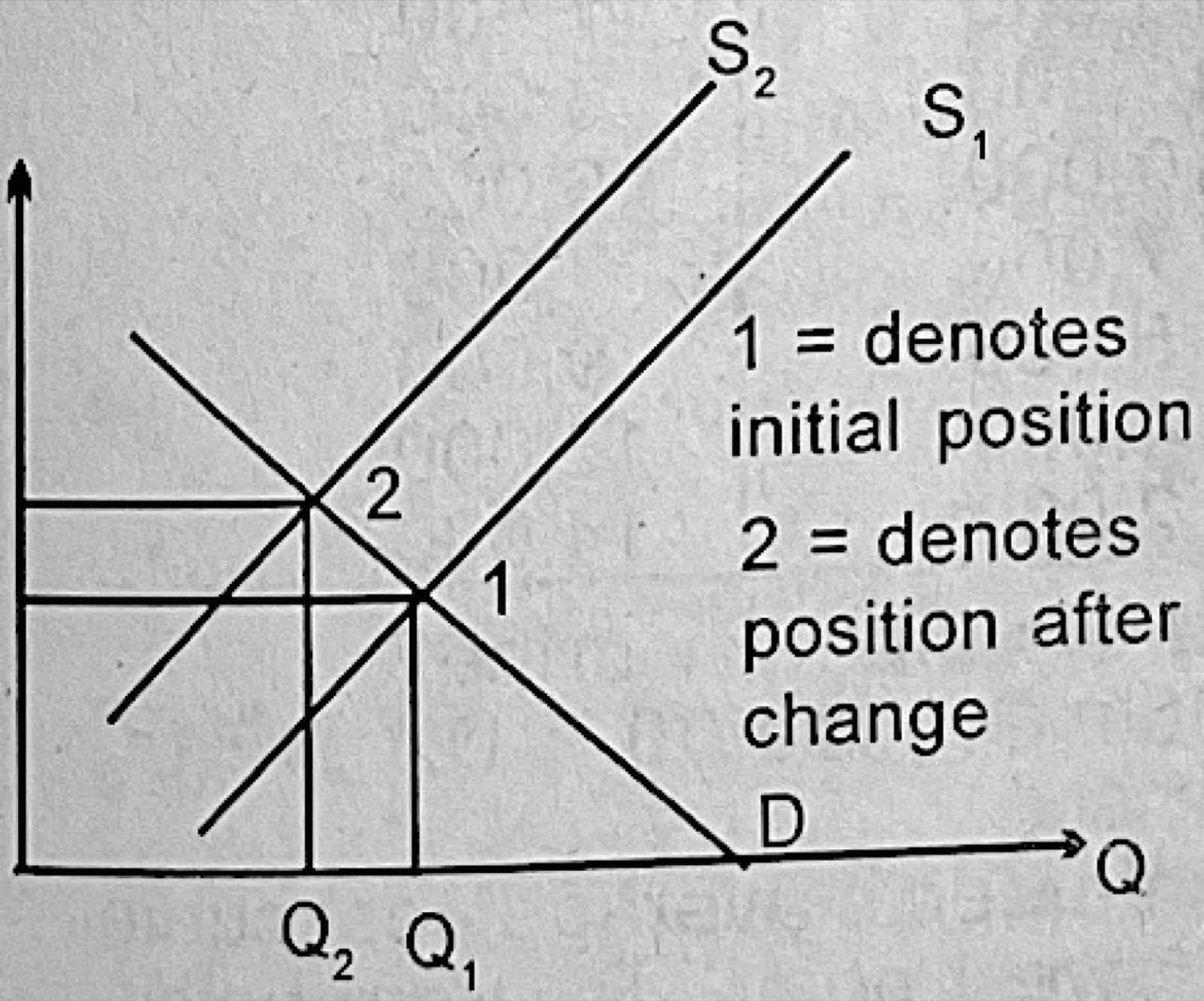
Market for maize. In the above diagram (1 denotes initial position; 2 denotes position after change), which of the following is NOT likely to be a factor causing the change from S1 to S2?
A.An imposition of a unit tax on maize
B.A decrease in the supply of labour
C.An increase in the price of other inputs
D.An increase in the price of maize
E.Unfavourable weather condition.
Show the answer and explanation
Answer: D (An increase in the price of maize)
Explanation
A change in the good's own price moves along the supply curve; it does not shift it. The other options raise costs or cut output and shift supply to the left.
Full equilibrium under perfect competition requires that
A.MC = MR and AC = AR
B.MC = MR but AR > AC
C.MR = MC = AR = AC
D.TR > TC
E.MR = MC.
Show the answer and explanation
Answer: C (MR = MC = AR = AC)
Explanation
In long-run (full) equilibrium a perfectly competitive firm produces where MC = MR, and since it earns only normal profit, price (AR = MR) also equals AC.
Price discrimination can be practised profitably by a monopolist when the elasticity of demand for his product is
A.elastic in both markets
B.unitary elastic in both markets
C.inelastic in both markets
D.elastic in one market and inelastic in the other
E.unitary elastic in none of the markets.
Show the answer and explanation
Answer: D (elastic in one market and inelastic in the other)
Explanation
Discrimination pays only if elasticities differ: the monopolist charges a higher price where demand is inelastic and a lower price where it is elastic.
All of the following EXCEPT ONE are normal functions of the Marketing Boards in Nigeria
A.Price stabilization
B.Efficient marketing of agricultural crops
C.Provision of funds for building access roads
D.Development of the agricultural industry
E.Establishment of agro-allied industries.
Show the answer and explanation
Answer: C (Provision of funds for building access roads)
Explanation
Marketing boards bought and sold export crops, stabilised prices and supported agricultural development; building access roads is a government public-works job.
In Nigeria, a balance of payments deficit can be solved by all of the following EXCEPT
A.imposing import bans on some commodities
B.imposing import duties
C.drawing down on external reserves
D.purchasing foreign exchange from foreign countries
E.devaluation of the currency.
Show the answer and explanation
Answer: D (purchasing foreign exchange from foreign countries)
Explanation
Buying foreign exchange from abroad needs payment in other foreign currency, so it does not remove a deficit; the others cut imports, raise exports or finance the gap from reserves.