Home › Past questions › JAMB › Chemistry › 2021 24 questions. Try each one, then open the answer to check yourself and read the explanation.
Sign up free to answer these questions on a CBT screen with a timer, then see your score and every answer explained.
Start practising free
Question 1 Alkanols Which of the following is an example of an Alcohol?
A. CH3 OH B. CH3 COOH C. CCl4 D. C2 H6 Show the answer and explanation Answer: A (CH3 OH )
Explanation CH3 OH (methanol) contains the –OH group joined to an alkyl group, which makes it an alcohol (alkanol).
Open this question
Question 3 Chemical Formulae and Equations If element X forms the following compounds with fluorine: XF4 , XF3 , XF2 . This illustrates the law of
A. chemical proportions B. multiple proportions C. constant proportions D. simple proportions Show the answer and explanation Answer: B (multiple proportions )
Explanation The same two elements form several compounds in which the masses of fluorine joined to a fixed mass of X are in a simple ratio (4 : 3 : 2): the law of multiple proportions.
Open this question
Question 4 Periodic Table In the periodic table, the arrangements is in order of their
A. atomic weights B. molecular weights C. atomic numbers D. isotopic weights Show the answer and explanation Answer: C (atomic numbers )
Explanation The modern periodic table arranges elements in order of increasing atomic number (number of protons).
Open this question
Question 5 Mole Concept and Stoichiometry How many grams of hydrogen gas will be produced when 6g of magnesium ribbon dissolves in 500cm3 of 6m HCl?
A. 0.5g B. 0.7g C. 0.3g D. 1.2g Show the answer and explanation Answer: A (0.5g )
Explanation Mg + 2HCl → MgCl2 + H2 . Mg = 6/24 = 0.25 mol and the acid (3 mol) is in excess, so 0.25 mol H2 = 0.25 × 2 = 0.5 g.
Open this question
Question 6 Metals and their Compounds Which of the following options is correct?
A. metals conduct electricity while non-metals do not B. metals have high density while non-metals have low density C. metals lose electron (s ) during normal reactions D. metals form basic oxides, non-metals form acidic oxides Show the answer and explanation Answer: D (metals form basic oxides, non-metals form acidic oxides )
Explanation As a general rule metal oxides are basic and non-metal oxides are acidic. A and B have exceptions (graphite conducts; sodium has low density).
Open this question
Question 7 Chemical Bonding The boiling point of methanol is lower than that of water because
A. intermolecular forces in methanol are weaker than those in water B. methanol is an alcohol while water is an oxide C. methanol is organic compound while water is an inorganic D. methanol is a covalent compound while water is an ionic compound Show the answer and explanation Answer: A (intermolecular forces in methanol are weaker than those in water )
Explanation Water forms more hydrogen bonds per molecule than methanol, so less energy is needed to separate methanol molecules and it boils at a lower temperature.
Open this question
Question 8 Electrolysis The process that takes place during electrolysis is
A. positive ions are discharged at the anode by gaining sufficient electrons to become neutral B. negative ions are discharged at the anode by gaining sufficient electrons to become neutral C. negative ions are discharged at the anode by losing sufficient electrons to become neutral D. positive ions are discharged at the anode by losing sufficient electrons to become neutral Show the answer and explanation Answer: C (negative ions are discharged at the anode by losing sufficient electrons to become neutral )
Explanation Negative ions (anions) move to the positive anode, where they give up electrons (oxidation) and become neutral atoms or molecules.
Open this question
Question 9 Introduction to Organic Chemistry Isomerism is found to occur in
A. C2 H4 B. C3 H8 C. C4 H10 D. C6 H6 Show the answer and explanation Answer: C (C4 H10 )
Explanation C4 H10 exists as butane and 2-methylpropane; ethene and propane have only one possible structure.
Open this question
Question 10 Energy Changes During the dissolution of sodium nitrate in water, the ΔH is positive, this means that
A. the reaction is complete B. the reaction is endothermic C. the reaction is exothermic D. the reaction is catalyzed Show the answer and explanation Answer: B (the reaction is endothermic )
Explanation A positive ΔH means heat is absorbed from the surroundings, i.e. the process is endothermic.
Open this question
Question 12 Solubility and Solutions During the addition of 9.8kg of solid potassium chlorate (KClO3 ) into 40cm3 of water, it was heated to dissolve all the solid. As the solution cooled crystals of potassium chlorate started forming at 66°C. Calculate the solubility of potassium chlorate at 66°C.
A. 24.5moles per dm3 B. 0.2moles per dm3 C. 10.0moles per dm3 D. 2.0moles per dm3 Show the answer and explanation Answer: D (2.0moles per dm3 )
Explanation Taking the mass as 9.8 g: moles of KClO3 = 9.8/122.5 = 0.08 mol in 0.040 dm3 , so solubility = 0.08/0.04 = 2.0 mol dm−3 .
Open this question
Question 16 Qualitative Analysis The solution that will give a white precipitate with Barium chloride solution and a green flame test is
A. Na2 SO4 B. CaSO4 C. CuSO4 D. (NH4 )2 SO4 Show the answer and explanation Answer: C (CuSO4 )
Explanation A white precipitate with BaCl2 (BaSO4 ) shows sulphate; a green (blue-green) flame shows copper. So the salt is CuSO4 .
Open this question
Question 17 Water NaOH Pellets are
A. hygroscopic B. deliquescent C. efflorescent D. hydrated Show the answer and explanation Answer: B (deliquescent )
Explanation Sodium hydroxide pellets absorb so much water from the air that they dissolve in it and form a solution, which is deliquescence.
Open this question
Question 18 Hydrocarbons Alkenes
A. are all gases B. have the general formula Cn H2n O2 C. are usually soluble in water D. contain only carbon and hydrogen Show the answer and explanation Answer: D (contain only carbon and hydrogen )
Explanation Alkenes are hydrocarbons (general formula Cn H2n ), made only of carbon and hydrogen; higher alkenes are liquids or solids and they are insoluble in water.
Open this question
Question 19 Alkanoic Acids and Esters In the esterification of ethanoic acid with ethanol conc. H2 SO4 serves as
A. a catalyst B. dehydrating agent C. a solvent D. an oxidizing agent Show the answer and explanation Answer: A (a catalyst )
Explanation Concentrated H2 SO4 provides H+ ions that speed up the esterification without being used up, so it acts as a catalyst.
Open this question
Question 21 Carbon and its Compounds The substance that conducts electricity from the following is
A. graphite B. sulphur C. diamond D. yellow phosphorus Show the answer and explanation Answer: A (graphite )
Explanation In graphite each carbon uses only three electrons in bonding; the fourth is delocalised and can move, so graphite conducts.
Open this question
Question 25 Acids, Bases and Salts The only acidic salt from the following is
A. Na2 SO4 B. NaHSO4 C. Na2 S D. CH3 CO2 Na Show the answer and explanation Answer: B (NaHSO4 )
Explanation NaHSO4 still has a replaceable hydrogen from the acid, which makes it an acid salt; the others are normal salts.
Open this question
Question 26 Atomic Structure An isotope X has atomic number of 17 and a mass number of 36. What is the number of neutrons and protons in the isotope X?
A. 19 neutrons, 17 protons B. 53 neutrons, 17 protons C. 36 neutrons, 17 protons D. 17 neutrons, 36 protons Show the answer and explanation Answer: A (19 neutrons, 17 protons )
Explanation Protons = atomic number = 17; neutrons = mass number − atomic number = 36 − 17 = 19.
Open this question
Question 28 Energy Changes In the preparation of H2 SO4(l) as shown in the chemical equation below3(g) + H2 O(l) → H2 SO4(l) 3(g) , H2 O(l) and H2 SO4(l) as −395KJmol−1 , −286KJmol−1 and −811KJmol−1 respectively. Calculate the enthalpy (H) change of the reaction.
A. −1032KJ B. +1032KJ C. +130KJ D. −130KJ Show the answer and explanation Answer: D (−130KJ )
Explanation ΔH = ΔHf (products) − ΔHf (reactants) = −811 − (−395 − 286) = −811 + 681 = −130 kJ.
Open this question
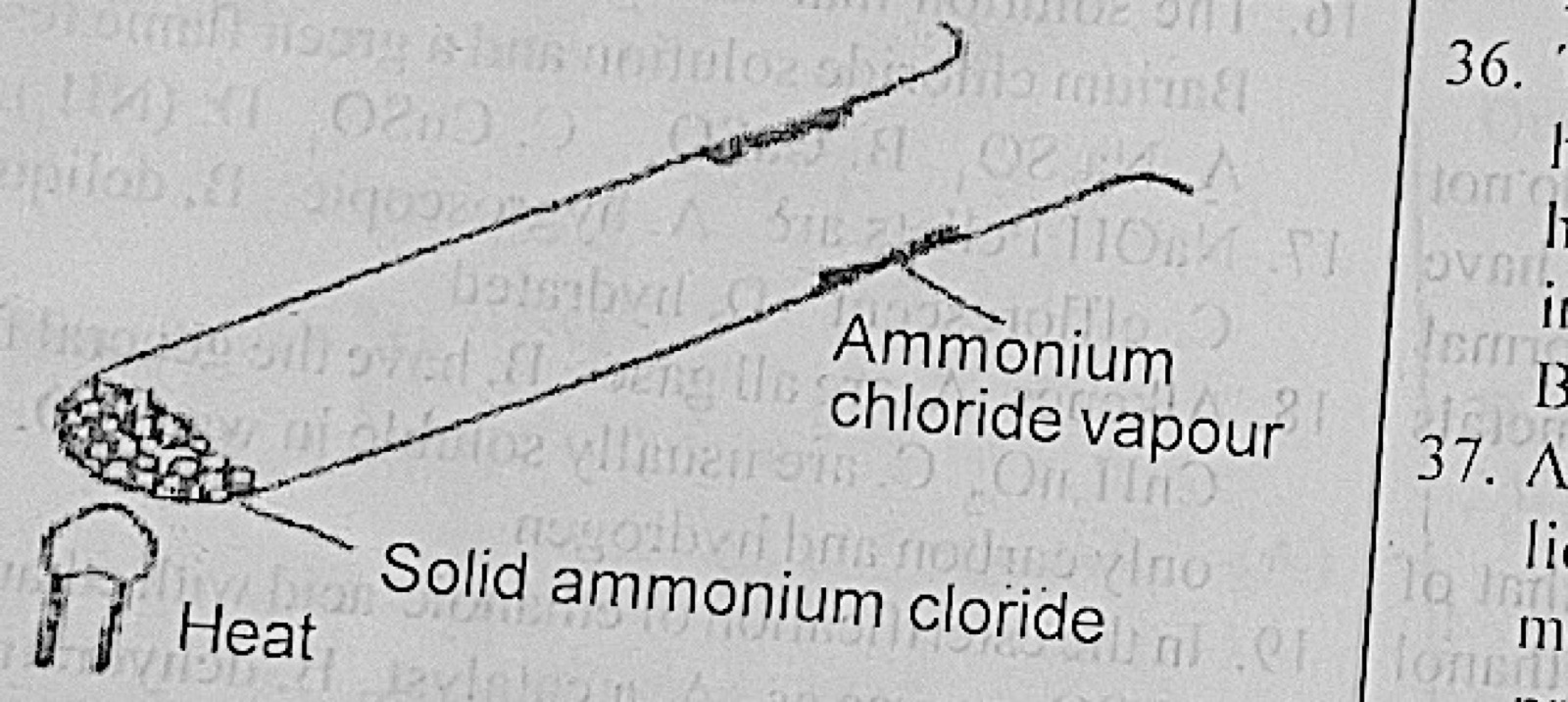
Question 29 Separation of Mixtures In the experiment below, ammonium chloride crystals deposit on the walls of the test tube is as a result of
A. evaporation B. sublimation C. recrystalization D. fractional precipitation Show the answer and explanation Answer: B (sublimation )
Explanation Heated ammonium chloride turns straight to vapour and then back to solid on the cooler part of the tube without melting: sublimation.
Open this question
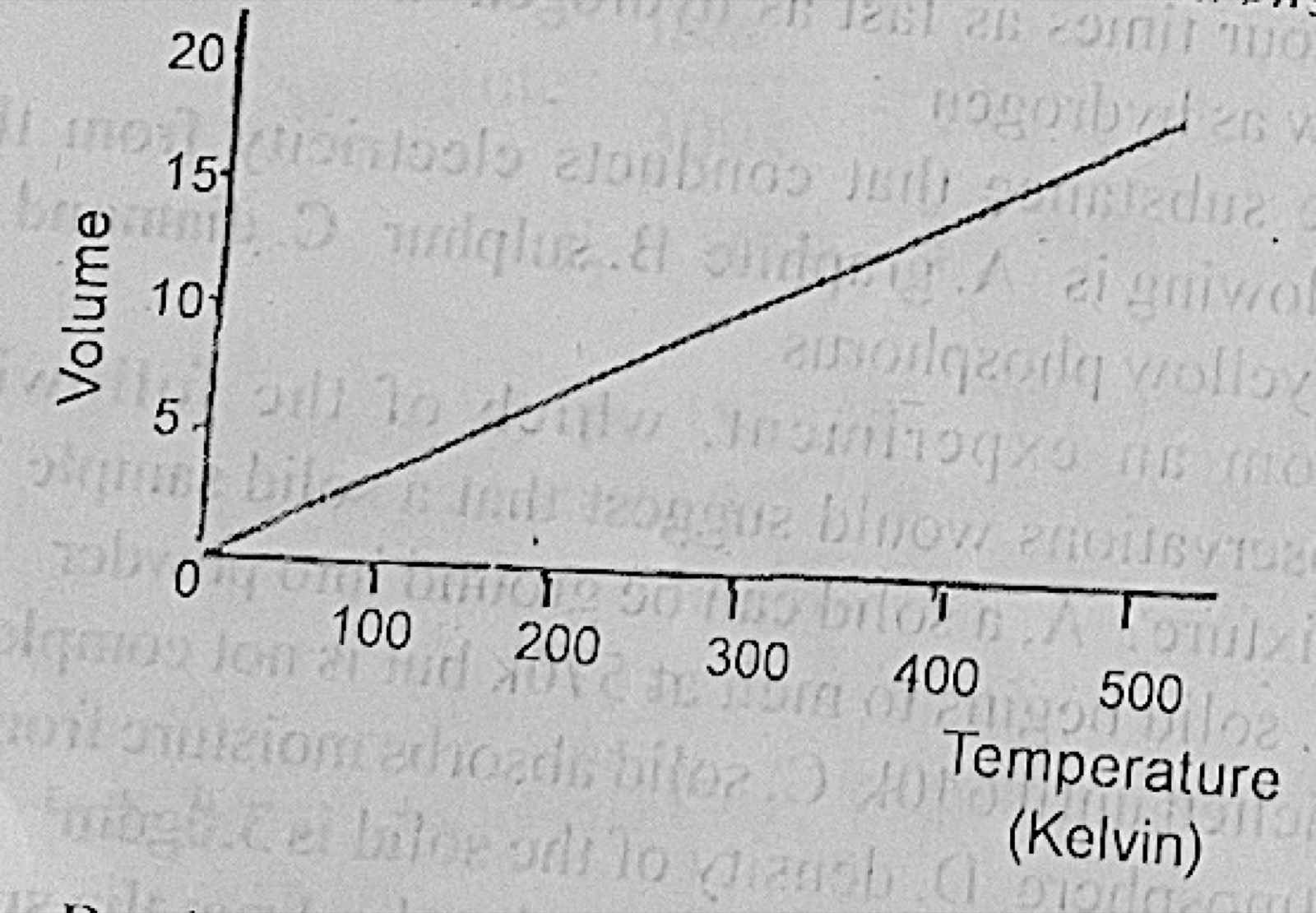
Question 30 Gas Laws The graph below illustrates which of the gas law?
A. Boyle B. Graham C. Charles D. Gay-Lusac Show the answer and explanation Answer: C (Charles )
Explanation The graph shows volume increasing in direct proportion to kelvin temperature (a straight line through the origin), which is Charles' law.
Open this question
Question 32 Gas Laws Calculate the minimum volume of oxygen needed for the complete combustion of a mixture of 10cm3 of CO and 15cm3 of H2 .
A. 25.0cm3 B. 10.0cm3 C. 12.5cm3 D. 5.0cm3 Show the answer and explanation Answer: C (12.5cm3 )
Explanation 2CO + O2 → 2CO2 needs 5 cm3 O2 for 10 cm3 CO; 2H2 + O2 → 2H2 O needs 7.5 cm3 for 15 cm3 H2 . Total = 12.5 cm3 .
Open this question
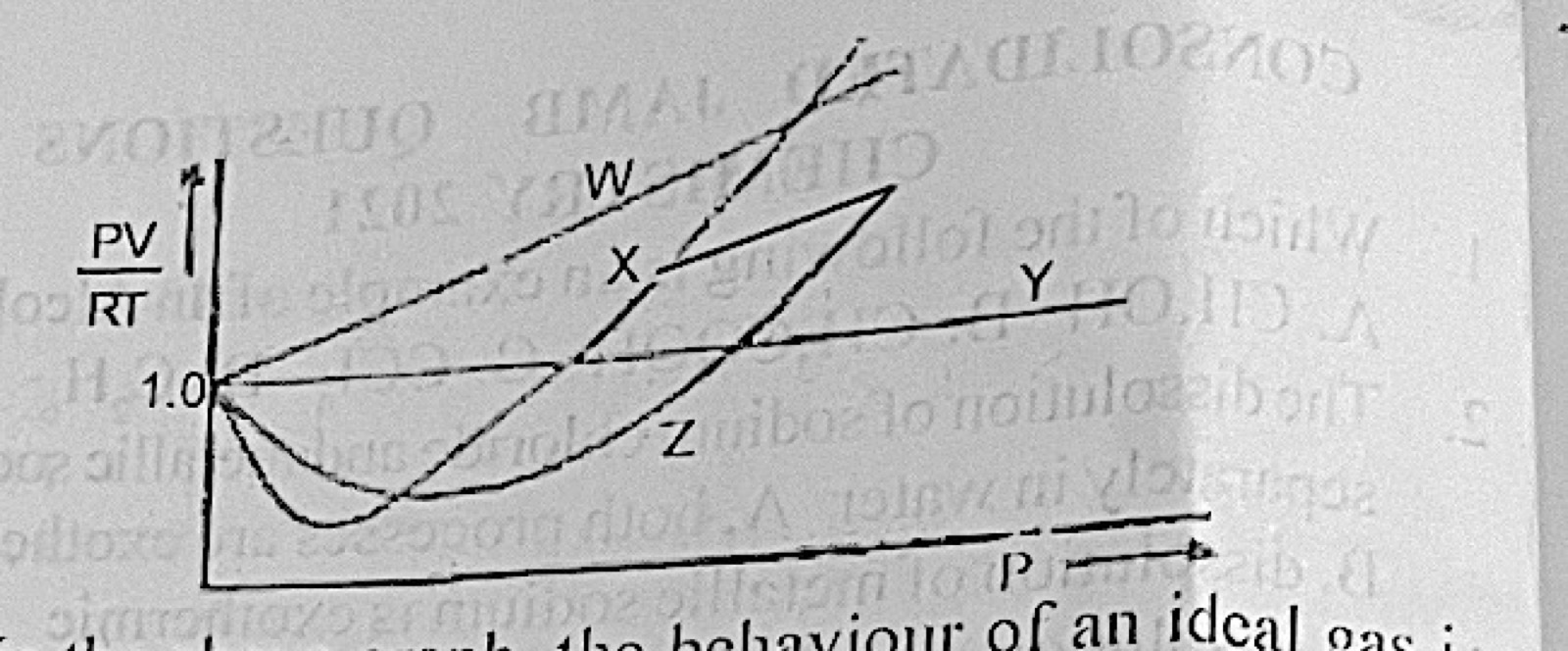
Question 33 Gas Laws In the above graph, the behaviour of an ideal gas is illustrated by which of the curves?
A. Z B. Y C. X D. W Show the answer and explanation Answer: B (Y )
Explanation For an ideal gas PV = RT, so PV/RT stays equal to 1 at every pressure: the horizontal line Y.
Open this question
Question 35 Acids, Bases and Salts Given a solution of pH 4.398, calculate it's H+ ions concentration in moles per dm3 .
A. 0.4×10⁻⁵ B. 0.4×10⁻³ C. 4.0×10⁻³ D. 4.0×10⁻⁵ Show the answer and explanation Answer: D (4.0×10⁻⁵ )
Explanation [H+ ] = 10−pH = 10−4.398 = 100.602 × 10−5 = 4.0 × 10⁻⁵ mol dm−3 .
Open this question
Question 37 Alkanols An unlabelled reagent bottle containing a clean organic liquid when tested with litmus paper and heated with metallic sodium. It was neutral to litmus paper and produced a colourless gas with the sodium. The liquid must be an
A. alkanoate B. alkanol C. alkane D. alkene Show the answer and explanation Answer: B (alkanol )
Explanation Alkanols are neutral to litmus but react with sodium to give hydrogen gas (2ROH + 2Na → 2RONa + H2 ); alkanes and alkenes do not react with sodium.
Open this question Sign up free for every JAMB Chemistry year, practice by topic and timed mocks.
Start practising free JAMB, UTME, WAEC, WASSCE, NECO, NABTEB and GCE are names of their respective examining bodies. Passwella is an independent practice platform and is not affiliated with or endorsed by any of them.