Home › Past questions › JAMB › Chemistry › 2013 44 questions. Try each one, then open the answer to check yourself and read the explanation.
Sign up free to answer these questions on a CBT screen with a timer, then see your score and every answer explained.
Start practising free
Question 2 Separation of Mixtures The presence of an impurity in substance will cause the melting point to
A. be zero. B. reduce. C. increase. D. be stable. Show the answer and explanation Answer: B (reduce. )
Explanation Impurities disturb the regular arrangement of particles, so a solid melts at a lower temperature (and over a range).
Open this question
Question 3 Gas Laws What volume of carbon(II) oxide is produced by reacting excess carbon with 10 dm3 of oxygen?
A. 5 dm3 B. 20 dm3 C. 15 dm3 D. 10 dm3 Show the answer and explanation Answer: B (20 dm3 )
Explanation 2C + O2 → 2CO: 1 volume of oxygen gives 2 volumes of CO, so 10 dm3 gives 20 dm3 .
Open this question
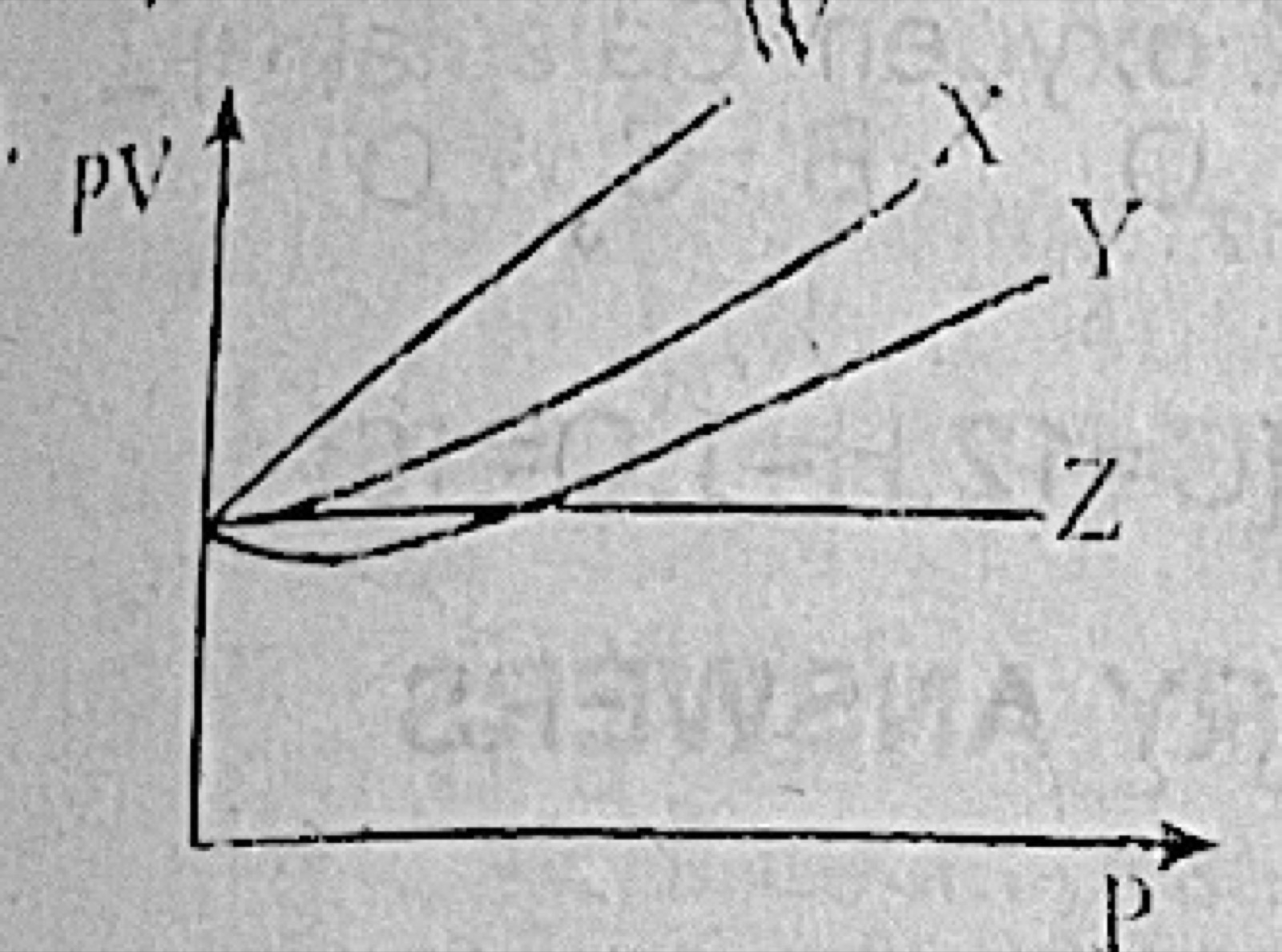
Question 4 Gas Laws From the diagram above, an ideal gas is represented by
A. Z B. W C. X D. Y Show the answer and explanation Answer: A (Z )
Explanation For an ideal gas PV stays constant as P changes, so the graph is the horizontal line Z.
Open this question
Question 6 Radioactivity The radioisotope used in industrial radiography for the rapid checking of faults in welds and casting is
A. carbon-14. B. phosphorus-32. C. cobalt-60. D. iodine-131. Show the answer and explanation Answer: C (cobalt-60. )
Explanation Cobalt-60 gives penetrating gamma rays that pass through metal and show hidden cracks.
Open this question
Question 7 Atomic Structure How many unpaired electrons are in the p-orbitals of a fluorine atom?
A. 3 B. 0 C. 1 D. 2 Show the answer and explanation Answer: C (1 )
Explanation Fluorine is 1s2 2s2 2p5 : 2px 2 2py 2 2pz 1 , so one electron is unpaired.
Open this question
Question 8 Radioactivity The radioactive emission with the least ionization power is
A. α-particles. B. X-rays. C. γ-rays. D. β-particles. Show the answer and explanation Answer: C (γ-rays. )
Explanation Gamma rays have no charge and no mass, so they ionise least (but penetrate most); alpha particles ionise most.
Open this question
Question 9 Chemical Bonding The shape of the carbon(IV) oxide molecule is
A. pyramidal. B. linear. C. angular. D. tetrahedral. Show the answer and explanation Answer: B (linear. )
Explanation O=C=O: the two double bonds point in opposite directions, at 180°, so the molecule is linear.
Open this question
Question 10 Chemical Bonding Which of the following molecules is held together by hydrogen bond?
A. CH4 B. HBr C. H2 SO4 D. HF Show the answer and explanation Answer: D (HF )
Explanation Hydrogen bonds form when H is bonded to a very electronegative small atom (F, O or N); HF molecules are linked this way.
Open this question
Question 11 Atomic Structure The bond formed between two elements with electron configurations 1s2 2s2 2p6 3s2 and 1s2 2s2 2p4 is
A. metallic. B. covalent. C. dative. D. ionic. Show the answer and explanation Answer: D (ionic. )
Explanation The first is magnesium (gives 2 electrons) and the second oxygen (takes 2), so they form ionic MgO.
Open this question
Question 12 Air The constituent of air that acts as a diluent is
A. nitrogen. B. carbon(IV)oxide. C. noble gases. D. oxygen. Show the answer and explanation Answer: A (nitrogen. )
Explanation Nitrogen (about 78% of air) is unreactive and dilutes the oxygen, slowing down burning and respiration.
Open this question
Question 14 Water An example of a hygroscopic substance is
A. CuO(s) B. MgCl2(s) C. CaCl2(s) D. NaOH(s) Show the answer and explanation Answer: A (CuO(s) )
Explanation Copper(II) oxide absorbs moisture from the air without dissolving in it (hygroscopic); MgCl2 , CaCl2 and NaOH absorb enough to dissolve (deliquescent).
Open this question
Question 15 Solubility and Solutions If 24.4 g of lead(II) trioxonitrate(V) were dissolved in 42 g of distilled water at 20°C, calculate the solubility of the solute in gdm−3 .
A. 581.000 B. 0.581 C. 5.810 D. 58.100 Show the answer and explanation Answer: A (581.000 )
Explanation 42 g of water is about 42 cm3 . Per 1000 cm3 : 24.4 × 1000/42 = 581 g dm−3 .
Open this question
Question 17 Environmental Pollution In a water body, too much sewage leads to
A. a decrease in the temperature of the water which causes death of aquatic animals. B. an increase in the number of aquatic animals in the water. C. an increase in the bacterial population which reduces the level of oxygen in the water. D. a decrease in the bacterial population which increases the level of oxygen in the water. Show the answer and explanation Answer: C (an increase in the bacterial population which reduces the level of oxygen in the water. )
Explanation Bacteria multiply as they feed on the sewage and use up the dissolved oxygen, which suffocates fish.
Open this question
Question 18 Mole Concept and Stoichiometry 10.0 dm3 of water was added to 2.0 mol dm−3 of 2.5dm3 solution of HCl. What is the concentration of the final solution in mol dm−3 ?
A. 0.4 B. 8.0 C. 2.0 D. 0.5 Show the answer and explanation Answer: A (0.4 )
Explanation C1 V1 = C2 V2 : 2.0 × 2.5 = C2 × 12.5, so C2 = 0.4 mol dm−3 .
Open this question
Question 19 Acids, Bases and Salts Three drops of a 1.0 mol dm−3 solution of HCl was added to 20 cm3 of a solution of pH6.4. The pH of the resulting solution will be
A. close to that of pure water. B. less than 6.4. C. greater than 6.4. D. unaltered. Show the answer and explanation Answer: B (less than 6.4. )
Explanation Adding a strong acid increases the H+ concentration, so the pH falls below 6.4.
Open this question
Question 20 Acids, Bases and Salts Which of the following substances is not a salt?
A. Aluminium oxide B. Sodium hydrogentrioxosulphate(IV) C. Sodium trioxocarbonate(IV) D. Zinc chloride. Show the answer and explanation Answer: A (Aluminium oxide )
Explanation Aluminium oxide is an (amphoteric) oxide; the others are salts made from an acid and a base.
Open this question
Question 21 Acids, Bases and Salts An insoluble salt can be prepared by
A. the reaction of trioxocarbonate(IV) with an acid. B. double decomposition. C. the action of dilute acid on an insoluble base. D. the reaction of metals with an acid. Show the answer and explanation Answer: B (double decomposition. )
Explanation Mixing solutions of two soluble salts precipitates the insoluble salt (double decomposition), which is filtered off.
Open this question
Question 22 Redox Reactions 2H2 O(l) + 2F2(g) → 4HF(aq) + O2(g)
A. O2(g) B. H2 O(l) C. F2(g) D. HF(aq) Show the answer and explanation Answer: C (F2(g) )
Explanation Fluorine goes from 0 in F2 to −1 in HF: it gains electrons, so it is reduced.
Open this question
Question 23 Redox Reactions Zn(s) + CuSO4(aq) → ZnSO4(aq) + Cu(s)
A. CuSO4(aq) B. ZnSO4(aq) C. Cu(s) D. Zn(s) Show the answer and explanation Answer: A (CuSO4(aq) )
Explanation Cu2+ in CuSO4 takes electrons from zinc and is reduced to Cu, so CuSO4 is the oxidizing agent.
Open this question
Question 24 Electrolysis In an electrochemical cell, polarization is caused by
A. chlorine. B. oxygen. C. tetaoxosulphate(VI) acid. D. hydrogen. Show the answer and explanation Answer: D (hydrogen. )
Explanation Bubbles of hydrogen collect on the positive electrode of a simple cell and reduce its voltage; this is polarization.
Open this question
Question 25 Electrolysis Calculate the volume in cm3 of oxygen evolved as s.t.p. when a current of 5 A is passed through acidified water for 193 s [F = 96500 Cmol−1 , Molar volume of a gas at s.t.p. = 22.4 dm3 ]
A. 224.000 B. 0.056 C. 0.224 D. 56.000 Show the answer and explanation Answer: D (56.000 )
Explanation Q = 5 × 193 = 965 C = 0.01 F. Each mole of O2 needs 4 F, so 0.0025 mol × 22 400 cm3 = 56 cm3 .
Open this question
Question 26 Energy Changes In an endothermic reaction, if there is a loss in entropy the reaction will
A. be indeterminate. B. be spontaneous. C. not be spontaneous. D. be at equilibrium. Show the answer and explanation Answer: C (not be spontaneous. )
Explanation ΔG = ΔH − TΔS. With ΔH positive and ΔS negative, ΔG is always positive, so the reaction cannot be spontaneous.
Open this question
Question 27 Chemical Equilibrium 2SO2(g) + O2(g) ⇌ 2SO3(g) ΔH = −395.7kJmol−1 3(g) can be increased by
A. decreasing the pressure. B. decreasing the temperature. C. increasing the temperature. D. the addition of catalyst. Show the answer and explanation Answer: B (decreasing the temperature. )
Explanation The forward reaction is exothermic, so lowering the temperature shifts the equilibrium to the right, giving more SO3 .
Open this question
Question 28 Rates of Reaction The minimum amount of energy required for a reaction to take place is
A. lattice energy. B. ionization energy. C. activation energy. D. kinetic energy. Show the answer and explanation Answer: C (activation energy. )
Explanation Activation energy is the minimum energy colliding particles need to react.
Open this question
Question 29 Rates of Reaction In the graph above, the activation energy of the catalyzed reaction is
A. 100KJ. B. 300KJ. C. 250KJ. D. 200KJ. Show the answer and explanation Answer: A (100KJ. )
Explanation The reactants start at 100 kJ and the catalysed (lower, dashed) curve peaks at 200 kJ, so Ea = 200 − 100 = 100 kJ.
Open this question
Question 30 Chemical Equilibrium 3Fe(s) + 4H2 O(g) ⇌ Fe3 O4(s) + 4H2(g)
A. [Fe3 O4 ][H2 ]/[Fe][H2 O] B. [H2 O]4 /[H2 ]4 C. [H2 ]4 /[H2 O]4 D. [Fe]3 [H2 O]2 /[Fe3 O4 ][H2 ]4 Show the answer and explanation Answer: C ([H2 ]4 /[H2 O]4 )
Explanation Solids are left out of K, and products go on top raised to their coefficients: K = [H2 ]4 /[H2 O]4 .
Open this question
Question 31 Hydrogen, Oxygen and Oxides Which of the following compounds is a neutral oxide?
A. Carbon (IV) oxide. B. Sulphur (VI) oxide. C. Sulphur (IV) oxide. D. Carbon (II) oxide. Show the answer and explanation Answer: D (Carbon (II) oxide. )
Explanation CO reacts with neither acids nor alkalis, so it is neutral; the other three are acidic oxides.
Open this question
Question 32 Nitrogen and its Compounds In the laboratory preparation of ammonia, the flask is placed in a slanting position so as to
A. prevent condensed water from breaking the reaction flask. B. enable the proper mixing of the reactants in the flask. C. enhance the speed of the reaction. D. prevent formation of precipitate. Show the answer and explanation Answer: A (prevent condensed water from breaking the reaction flask. )
Explanation Water formed in the reaction condenses near the mouth; tilting the flask stops it running back onto the hot glass and cracking it.
Open this question
Question 33 Nitrogen and its Compounds Which of the following gases is employed as an anaesthesia?
A. N2 O B. NO2 C. NH3 D. NO Show the answer and explanation Answer: A (N2 O )
Explanation Dinitrogen(I) oxide (laughing gas) is used as a mild anaesthetic.
Open this question
Question 34 Sulphur and its Compounds Sulphur(IV) oxide is a strong reducing agent in the presence of water due to the formation of
A. hydroxide ion. B. sulphur (VI) oxide. C. hydrogen sulphide. D. trioxosulphate(IV) ion. Show the answer and explanation Answer: D (trioxosulphate(IV) ion. )
Explanation In water SO2 forms trioxosulphate(IV) ions, which are easily oxidised to tetraoxosulphate(VI), giving away electrons.
Open this question
Question 35 Sulphur and its Compounds A metal that forms soluble trioxosulphate (IV) salt is
A. barium. B. potassium. C. manganese. D. aluminium. Show the answer and explanation Answer: B (potassium. )
Explanation All potassium (group 1) salts are soluble; barium trioxosulphate(IV) is insoluble.
Open this question
Question 36 Metals and their Compounds Copper is displaced from the solution of its salts by most metals because it
A. is at the bottom of the activity series. B. is very reactive. C. is a transition element. D. has completely filled 3d-orbitals. Show the answer and explanation Answer: A (is at the bottom of the activity series. )
Explanation Copper is low in the activity series, so most metals above it can push it out of its salt solutions.
Open this question
Question 37 Metals and their Compounds The coloured nature of transition metal ions are associated with their partially filled
A. f-orbital. B. s-orbital. C. p-orbital. D. d-orbital. Show the answer and explanation Answer: D (d-orbital. )
Explanation Electrons moving between partly filled d-orbitals absorb visible light, so the ions appear coloured.
Open this question
Question 38 Metals and their Compounds Aluminium containers are frequently used to transport trioxonitrate(V) acid because aluminium
A. has a low density. B. does not react with the acid. C. does not corrode. D. has a silvery-white appearance. Show the answer and explanation Answer: B (does not react with the acid. )
Explanation Concentrated HNO3 forms a thin protective oxide layer on aluminium (it becomes passive), so the metal is not attacked.
Open this question
Question 39 Alkanols 2-methylbutan-2-ol is an example of a
A. dihydric alkanol. B. primary alkanol. C. secondary alkanol. D. tertiary alkanol. Show the answer and explanation Answer: D (tertiary alkanol. )
Explanation The carbon carrying the −OH is joined to three other carbon atoms, so it is a tertiary alkanol.
Open this question
Question 40 Carbohydrates, Proteins and Amines The reaction between ammonia and ethyl ethanoate produces
A. propanol and ethanamide. B. propanol and propanamide. C. ethanol and propanamide. D. ethanol and ethanamide. Show the answer and explanation Answer: D (ethanol and ethanamide. )
Explanation CH3 COOC2 H5 + NH3 → CH3 CONH2 (ethanamide) + C2 H5 OH (ethanol).
Open this question
Question 41 Alkanoic Acids and Esters The decarboxylation of ethanoic acid will produce carbon(IV) oxide and
A. methane. B. ethane. C. propane. D. butane. Show the answer and explanation Answer: A (methane. )
Explanation Removing CO2 from CH3 COOH leaves CH4 (methane).
Open this question
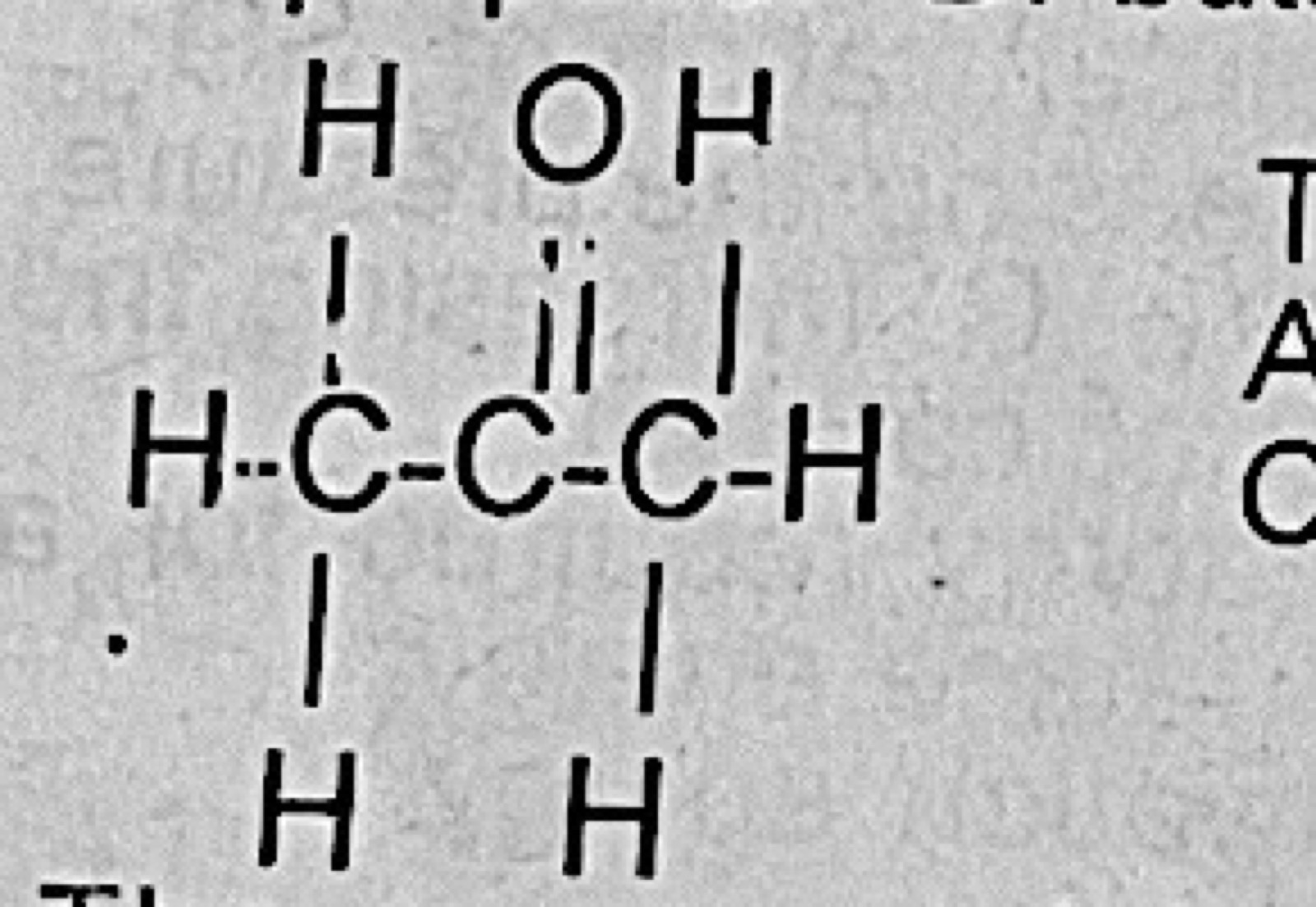
Question 42 Alkanals and Alkanones The compound above is an
A. alkanone. B. alkanoate. C. alkanal. D. akanol. Show the answer and explanation Answer: A (alkanone. )
Explanation The C=O group is on the middle carbon, between two carbons: CH3 COCH3 (propanone), an alkanone.
Open this question
Question 43 Alkanoic Acids and Esters The compound that will react with sodium hydroxide to form salt and water only is
A. C6 H12 O6 . B. (CH3 )3 COH. C. CH3 CH=CH2 . D. CH3 CH2 COOH. Show the answer and explanation Answer: D (CH3 CH2 COOH. )
Explanation Propanoic acid is an acid, so it neutralises NaOH to give sodium propanoate and water.
Open this question
Question 44 Carbohydrates, Proteins and Amines Which of the following compounds in solution will turn red litmus paper blue?
A. R′OR″ B. RCONR2 C. RNH2 D. RCOR Show the answer and explanation Answer: C (RNH2 )
Explanation Amines, like ammonia, have a lone pair on nitrogen that accepts protons, so their solutions are alkaline.
Open this question
Question 45 Carbohydrates, Proteins and Amines The dehydration of ammonium salt of alkanoic acids produces a compound with the general formula.
A. RCOOR B. RCONH2 C. RNH2 D. RCOR Show the answer and explanation Answer: B (RCONH2 )
Explanation RCOONH4 → RCONH2 + H2 O: heating the ammonium salt removes water and gives an amide.
Open this question
Question 47 Alkanoic Acids and Esters An organic compound with a pleasant smell is likely to have a general formula
A. Cn H2n+1 CHO. B. Cn H2n+1 COOH. C. Cn H2n+1 COOCn H2n+1 . D. Cn H2n+1 COCn H2n+1 . Show the answer and explanation Answer: C (Cn H2n+1 COOCn H2n+1 . )
Explanation Esters (RCOOR′) have pleasant, fruity smells.
Open this question
Question 48 Carbohydrates, Proteins and Amines A primary amide is generally represented by the formula
A. RCOOR. B. RCONH2 . C. RCONHR. D. RCONR2 . Show the answer and explanation Answer: B (RCONH2 . )
Explanation A primary amide has an unsubstituted −NH2 group: RCONH2 .
Open this question
Question 50 Introduction to Organic Chemistry An organic compound contains 60% carbon, 13.3% hydrogen and 26.7% oxygen. Calculate the empirical formula. [C = 12, H = 1, O = 16]
A. C5 H12 O. B. C3 H8 O. C. C6 H13 O2 . D. C4 H9 O. Show the answer and explanation Answer: B (C3 H8 O. )
Explanation C : H : O = 60/12 : 13.3/1 : 26.7/16 = 5 : 13.3 : 1.67 = 3 : 8 : 1, so C3 H8 O.
Open this question Sign up free for every JAMB Chemistry year, practice by topic and timed mocks.
Start practising free