Home › Past questions › JAMB › Chemistry › 2010 47 questions. Try each one, then open the answer to check yourself and read the explanation.
Sign up free to answer these questions on a CBT screen with a timer, then see your score and every answer explained.
Start practising free
Question 2 Separation of Mixtures Which of the following is an example of a mixture?
A. Common salt B. Blood C. Sand D. Washing soda Show the answer and explanation Answer: B (Blood )
Explanation Blood is made of cells, plasma and dissolved substances in varying amounts, so it is a mixture; common salt and washing soda are compounds.
Open this question
Question 3 Mole Concept and Stoichiometry Calculate the percentage by mass of nitrogen in calcium trioxonitrate (V). [Ca = 40, N = 14, O = 16]
A. 8.5 % B. 13.1 % C. 17.1 % D. 27.6% Show the answer and explanation Answer: C (17.1 % )
Explanation Ca(NO3 )2 = 40 + 2(14 + 48) = 164. Nitrogen = 28, so 28/164 × 100 = 17.1%.
Open this question
Question 4 Kinetic Theory and States of Matter The droplets of water observed around a bottle of milk taken out of the refrigerator is due to the fact that the
A. water vapour in the air around the bottle gains some energy from the bottle B. temperature of the milk drops as it loses heat into the surroundings C. saturated vapour pressure of the milk is equal to the atmospheric pressure D. water vapour in the air around the bottle loses some of its energy to the bottle Show the answer and explanation Answer: D (water vapour in the air around the bottle loses some of its energy to the bottle )
Explanation The cold bottle takes heat from nearby water vapour, which cools and condenses into droplets.
Open this question
Question 5 Gas Laws The volume of a given gas is V cm3 at P mm Hg. What is the new volume of the gas if the pressure is reduced to half at constant temperature?
A. 4V cm3 B. 2V cm3 C. V/2 cm3 D. V cm3 Show the answer and explanation Answer: B (2V cm3 )
Explanation Boyle's law: PV is constant, so halving the pressure doubles the volume to 2V.
Open this question
Question 6 Periodic Table Moving from left to right across a period, the general rise in the first ionization energy can be attributed to the
A. decrease in nuclear charge B. increase in nuclear charge C. decrease in screening effect D. increase in screening effect Show the answer and explanation Answer: B (increase in nuclear charge )
Explanation Across a period the number of protons rises while electrons enter the same shell, so the outer electrons are held more tightly.
Open this question
Question 7 Atomic Structure How many unpaired electron(s) are there in the nitrogen sub-levels?
A. 3 B. 2 C. 1 D. 0 Show the answer and explanation Answer: A (3 )
Explanation Nitrogen is 1s2 2s2 2p3 ; the three 2p electrons occupy separate orbitals, so 3 are unpaired.
Open this question
Question 8 Periodic Table The stability of the noble gases is due to the fact that they
A. have no electron in their outermost shells B. have duplet or octet electron configurations C. belong to group zero of the periodic table D. are volatile in nature Show the answer and explanation Answer: B (have duplet or octet electron configurations )
Explanation Helium has a full duplet and the others a full octet, so they have no tendency to gain, lose or share electrons.
Open this question
Question 9 Atomic Structure The maximum number of electrons in the L shell of an atom is
A. 2 B. 8 C. 18 D. 32 Show the answer and explanation Answer: B (8 )
Explanation The L shell is n = 2, which holds 2n2 = 8 electrons.
Open this question
Question 10 Atomic Structure Elements in the same period in the periodic table have the same
A. number of shells B. atomic number C. chemical properties D. physical properties Show the answer and explanation Answer: A (number of shells )
Explanation The period number equals the number of electron shells, so all elements in a period have the same number of shells.
Open this question
Question 11 Radioactivity 2 1 D + 3 1 T → 4 2 He + 1 0 n + energy
A. alpha decay B. artificial transmutation C. nuclear fussion D. nuclear fission Show the answer and explanation Answer: C (nuclear fussion )
Explanation Two light nuclei (deuterium and tritium) join to form a heavier nucleus with release of energy, which is fusion.
Open this question
Question 12 Periodic Table A noble gas with a high power of fog penetration used in aerodrome beacons is
A. krypton B. argon C. helium D. neon Show the answer and explanation Answer: D (neon )
Explanation Neon gives an intense red glow that passes through fog well, so it is used in airport beacons and signs.
Open this question
Question 13 Water Permanent hardness of water can be removed by
A. filtration B. adding slaked lime C. adding caustic soda D. boiling Show the answer and explanation Answer: C (adding caustic soda )
Explanation Permanent hardness (CaSO4 , MgSO4 ) is not removed by boiling or by slaked lime; it needs a chemical that precipitates the Ca2+ and Mg2+ ions, such as washing soda or caustic soda.
Open this question
Question 14 Water Substances employed as drying agents are usually
A. amphoteric B. hygroscopic C. efflorescent D. acidic Show the answer and explanation Answer: B (hygroscopic )
Explanation Hygroscopic substances absorb moisture from the air, which is what a drying agent must do.
Open this question
Question 15 Solubility and Solutions Calculate the solubility in mol dm−3 of 40g of CuSO4 dissolved in 100g of water at 120°C. [Cu = 64, S = 32, O = 16]
A. 4.00 B. 2.50 C. 0.40 D. 0.25 Show the answer and explanation Answer: B (2.50 )
Explanation CuSO4 = 160 g/mol, so 40 g = 0.25 mol in 100 g (≈ 100 cm3 ) of water. Per 1000 cm3 : 0.25 × 10 = 2.50 mol dm−3 .
Open this question
Question 16 Chemistry and Industry Coffee stains can best be removed by
A. kerosine B. turpentine C. a solution of borax in water D. ammonia solution Show the answer and explanation Answer: C (a solution of borax in water )
Explanation Coffee and tea stains are removed by soaking in a warm solution of borax (sodium tetraborate) in water, which is mildly alkaline and loosens the stain.
Open this question
Question 17 Carbon and its Compounds Carbon (II) oxide is considered dangerous if inhaled mainly because it
A. can cause injury to the nervous system B. competes with oxygen in the blood C. competes with carbon (IV) oxide in the blood D. can cause lung cancer Show the answer and explanation Answer: B (competes with oxygen in the blood )
Explanation CO binds to haemoglobin much more strongly than oxygen, so the blood carries less oxygen.
Open this question
Question 18 Acids, Bases and Salts The acid that is used to remove rust is
A. boric B. hydrochloric C. trioxonitrate (V) D. tetraoxosulphate (VI) Show the answer and explanation Answer: B (hydrochloric )
Explanation Dilute hydrochloric acid dissolves iron(III) oxide (rust), so it is used to clean (pickle) rusty iron.
Open this question
Question 19 Volumetric Analysis Calculate the volume of 0.5 mol dm−3 H2 SO4 that is neutralized by 25cm3 of 0.1 mol dm−3 NaOH.
A. 5.0 cm3 B. 2.5 cm3 C. 0.4 cm3 D. 0.1 cm3 Show the answer and explanation Answer: B (2.5 cm3 )
Explanation Moles NaOH = 0.1 × 0.025 = 0.0025. H2 SO4 + 2NaOH, so acid = 0.00125 mol. Volume = 0.00125/0.5 = 0.0025 dm3 = 2.5 cm3 .
Open this question
Question 20 Acids, Bases and Salts The colour of methyl orange in alkaline medium is
A. yellow B. pink C. orange D. red Show the answer and explanation Answer: A (yellow )
Explanation Methyl orange is red in acid and yellow in alkali.
Open this question
Question 21 Solubility and Solutions Which of the following salts is slightly soluble in water?
A. AgCl B. CaSO4 C. Na2 CO3 D. PbCl2 Show the answer and explanation Answer: B (CaSO4 )
Explanation Calcium tetraoxosulphate(VI) dissolves only slightly in water (it causes permanent hardness); AgCl is insoluble and Na2 CO3 is very soluble.
Open this question
Question 22 Redox Reactions 6AgNO3(aq) + PH3(g) + 3H2 O(l) → 6Ag(s) + H3 PO3(aq) + 6HNO3(aq)
A. HNO3(aq) B. H2 O(l) C. PH3(g) D. AgNO3(aq) Show the answer and explanation Answer: C (PH3(g) )
Explanation P goes from −3 in PH3 to +3 in H3 PO3 (oxidised) while Ag+ is reduced to Ag, so PH3 is the reducing agent.
Open this question
Question 23 Chemical Formulae and Equations The IUPAC nomenclature of the compound LiAlH4 is
A. lithium tetrahydridoaluminate (III) B. aluminium tetrahydrido lithium C. tetrahydrido lithium aluminate (III) D. lithium aluminium hydride Show the answer and explanation Answer: A (lithium tetrahydridoaluminate (III) )
Explanation The complex anion [AlH4 ]− is tetrahydridoaluminate(III), and the cation lithium is named first.
Open this question
Question 24 Metals and their Compounds Iron can be protected from corrosion by coating the surface with
A. gold B. silver C. copper D. zinc Show the answer and explanation Answer: D (zinc )
Explanation Zinc (galvanising) is more reactive than iron, so it corrodes in preference and protects the iron even when scratched.
Open this question
Question 25 Electrolysis What quantity of aluminium is deposited when a current of 10A is passed through a solution of an aluminium salt for 1930s? [Al = 27, F = 96 500 C mol−1 ]
A. 0.2 g B. 1.8 g C. 5.4 g D. 14.2 g Show the answer and explanation Answer: B (1.8 g )
Explanation Q = 10 × 1930 = 19 300 C = 0.2 F. Al3+ needs 3 F per mole, so 0.2/3 mol × 27 = 1.8 g.
Open this question
Question 26 Energy Changes In which of the following is the entropy change positive?
A. Thermal dissociation of ammonium chloride B. Reaction between an acid and a base C. Addition of concentrated acid to water D. Dissolution of sodium metal in water Show the answer and explanation Answer: A (Thermal dissociation of ammonium chloride )
Explanation NH4 Cl(s) → NH3 (g) + HCl(g): a solid turns into two gases, so disorder increases a lot.
Open this question
Question 27 Energy Changes If a reaction is exothermic and there is a great disorder, it means that
A. the reaction is static B. the reaction is in a state of equilibrium C. there will be a large increase in free energy D. there will be a large decrease in free energy Show the answer and explanation Answer: D (there will be a large decrease in free energy )
Explanation ΔG = ΔH − TΔS. A negative ΔH and a large positive ΔS both make ΔG strongly negative, a large decrease in free energy.
Open this question
Question 28 Rates of Reaction In the preparation of oxygen by heating KClO3 in the presence of MnO2 , only moderate heat is needed because the catalyst acts by
A. lowering the pressure of the reaction B. increasing the surface area of the reactant C. increasing the rate of the reaction D. lowering the energy barrier of the reaction Show the answer and explanation Answer: D (lowering the energy barrier of the reaction )
Explanation MnO2 provides a route with a lower activation energy (energy barrier), so less heat is needed.
Open this question
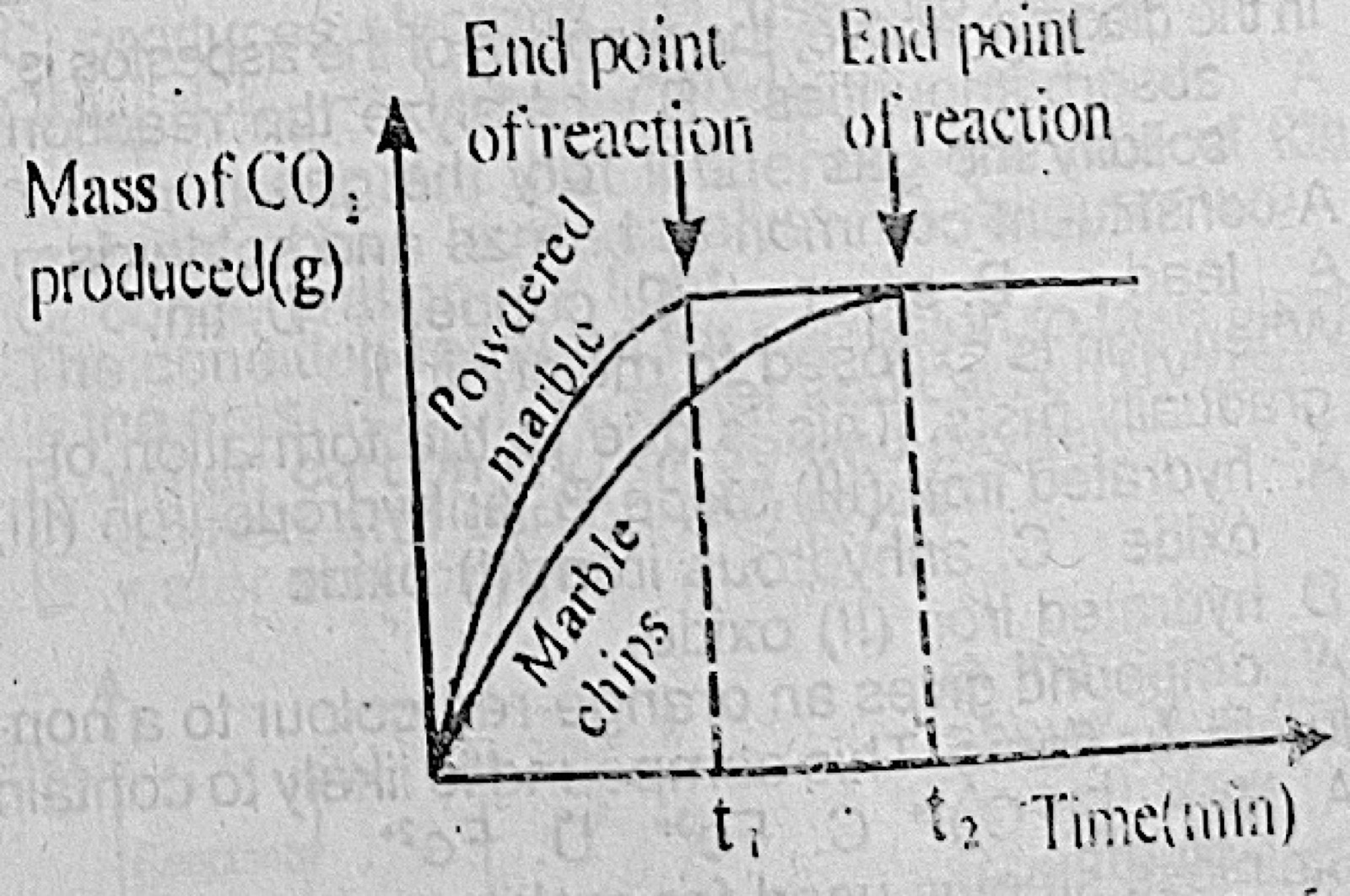
Question 29 Rates of Reaction The graph above demonstrates the effect of
A. surface area on the rate of reaction B. catalyst on the rate of reaction C. pressure on the rate of reaction D. concentration on the rate of reaction Show the answer and explanation Answer: A (surface area on the rate of reaction )
Explanation Powdered marble reaches the end point sooner than marble chips; only the particle size (surface area) differs.
Open this question
Question 30 Chemical Equilibrium 2H2(g) + O2(g) ⇌ 2H2 O(g) ΔH = −ve
A. It is unaffected. B. It becomes zero. C. It decreases. D. It increases. Show the answer and explanation Answer: C (It decreases. )
Explanation For an exothermic reaction, raising the temperature favours the backward reaction, so K decreases.
Open this question
Question 31 Qualitative Analysis To a solution of an unknown compound, a little dilute tetraoxosulphate (VI) acid was added with some freshly prepared iron (II) tetraoxosulphate (VI) solution. The brown ring observed after the addition of a stream of concentrated tetraoxosulphate (VI) acid confirmed the presence of
A. CO3 2− B. Cl− C. SO4 2− D. NO3 − Show the answer and explanation Answer: D (NO3 − )
Explanation The brown ring test is the standard test for the trioxonitrate(V) (nitrate) ion.
Open this question
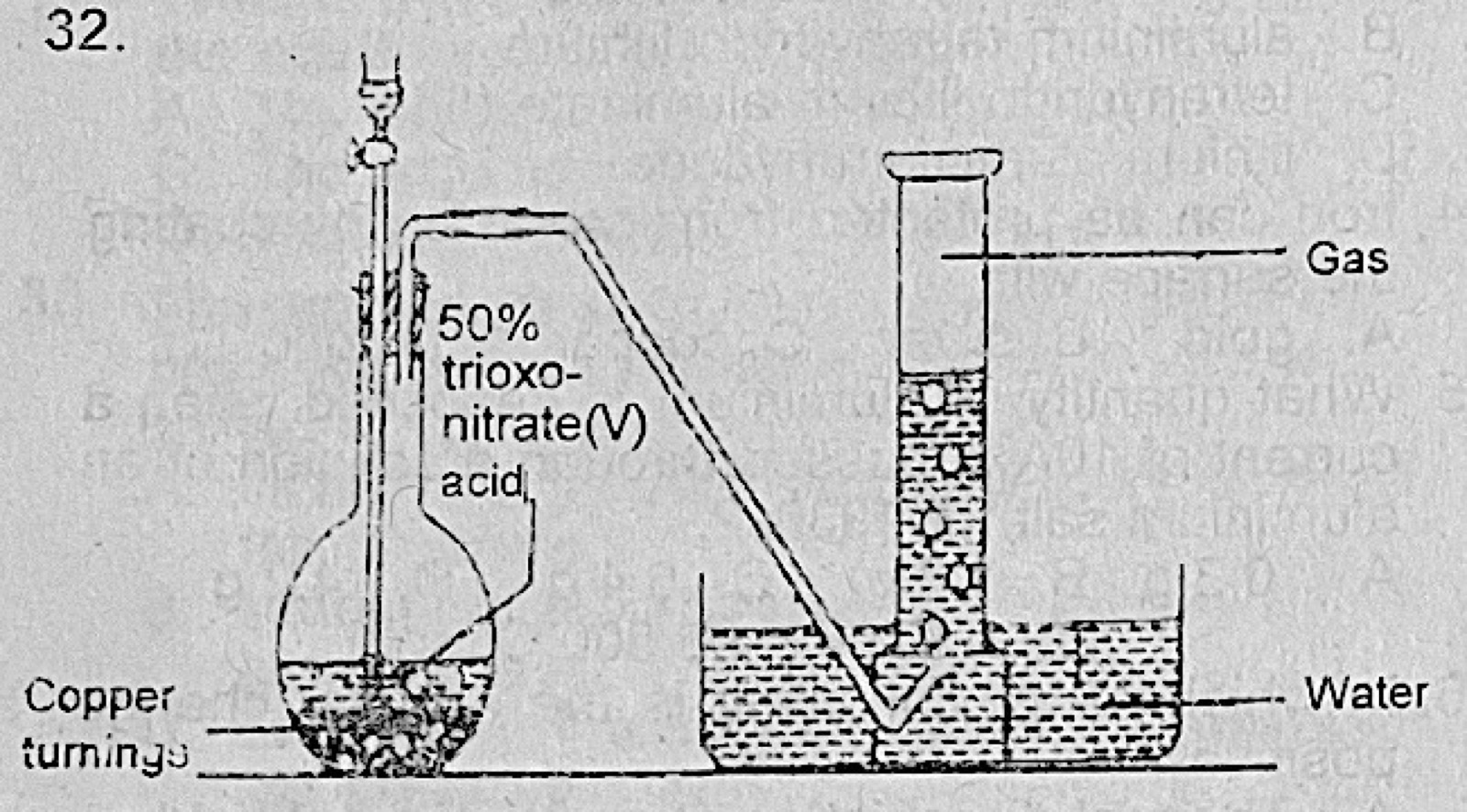
Question 32 Nitrogen and its Compounds In the diagram above, the gas produced is
A. NO B. NO2 C. N2 O D. N2 O4 Show the answer and explanation Answer: A (NO )
Explanation Copper with moderately dilute (50%) trioxonitrate(V) acid gives nitrogen(II) oxide, NO, which is collected over water.
Open this question
Question 33 Nitrogen and its Compounds Which of the following is used as a rocket fuel?
A. HNO3 B. CH3 COOH C. H2 SO4 D. HCl Show the answer and explanation Answer: A (HNO3 )
Explanation Concentrated trioxonitrate(V) acid is a powerful oxidant used in rocket propellants.
Open this question
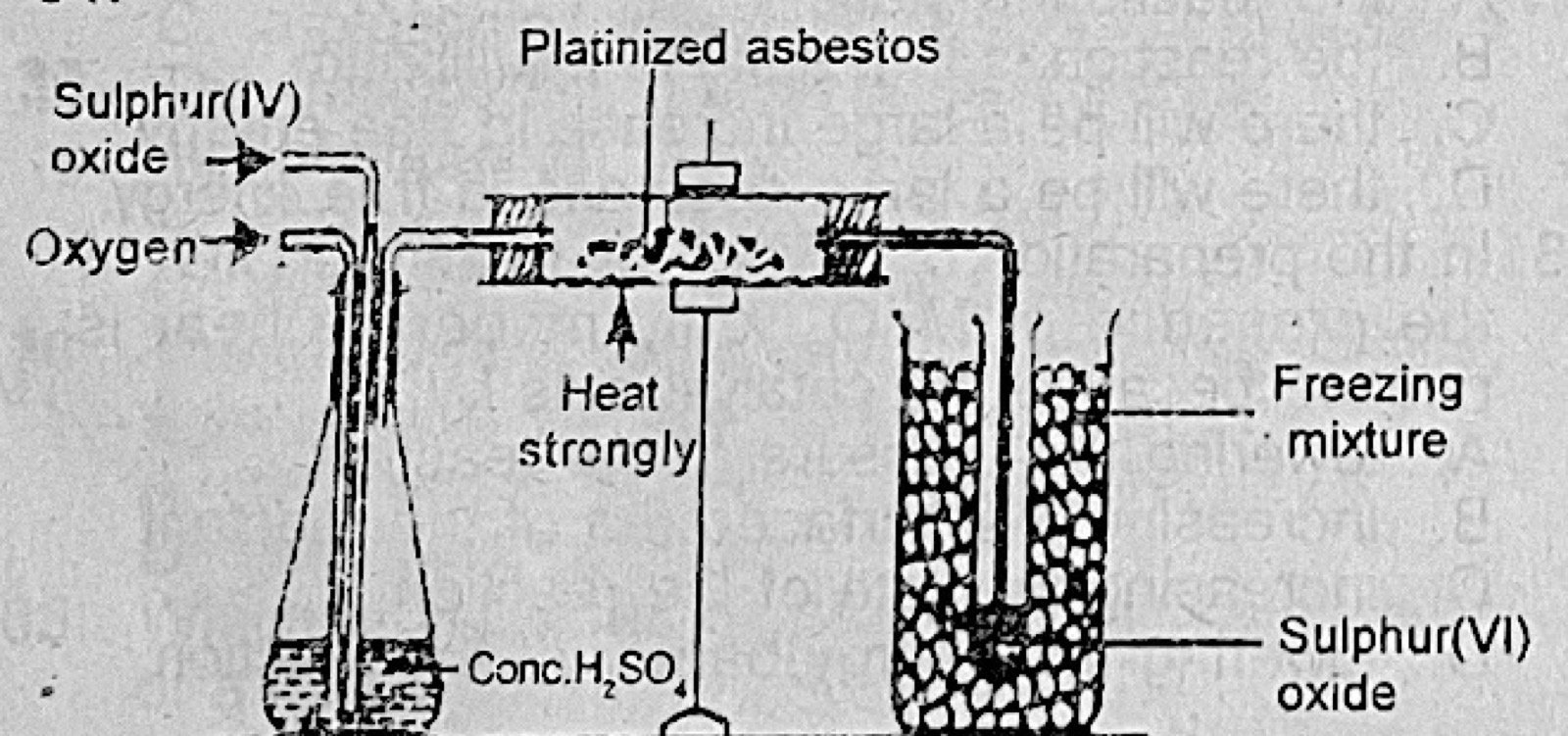
Question 34 Sulphur and its Compounds In the diagram above, the purpose of the asbestos is to
A. absorb impurities B. catalyze the reaction C. solidify the gas D. dry the gas Show the answer and explanation Answer: B (catalyze the reaction )
Explanation The asbestos is coated with platinum, which catalyses 2SO2 + O2 → 2SO3 .
Open this question
Question 35 Metals and their Compounds A constituent common to bronze and solder is
A. lead B. silver C. copper D. tin Show the answer and explanation Answer: D (tin )
Explanation Bronze is copper and tin; solder is lead and tin. Tin is in both.
Open this question
Question 36 Metals and their Compounds When iron is exposed to moist air, it gradually rusts. This is due to the formation of
A. hydrated iron (III) oxide B. anhydrous iron (III) oxide C. anhydrous iron (II) oxide D. hydrated iron (II) oxide Show the answer and explanation Answer: A (hydrated iron (III) oxide )
Explanation Rust is hydrated iron(III) oxide, Fe2 O3 .xH2 O.
Open this question
Question 37 Qualitative Analysis A compound gives an orange-red colour to a non-luminous flame. This compound is likely to contain
A. Na+ B. Ca2+ C. Fe3+ D. Fe2+ Show the answer and explanation Answer: B (Ca2+ )
Explanation Calcium ions give a brick/orange-red flame; sodium gives golden yellow.
Open this question
Question 39 Petroleum and Coal The residual solids from the fractional distillation of petroleum are used as
A. coatings for pipes B. raw materials for the cracking process C. fuel for driving tractors D. fuel for jet engines Show the answer and explanation Answer: A (coatings for pipes )
Explanation The residue is bitumen (asphalt), used for road surfaces and waterproof coatings on pipes.
Open this question
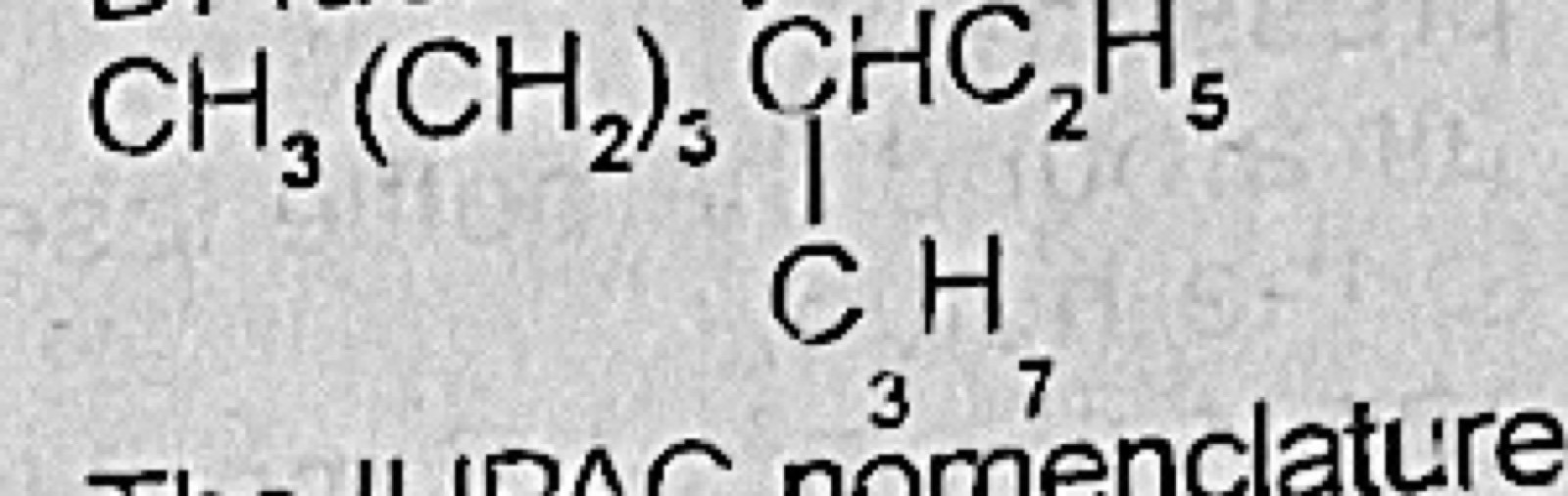
Question 40 Introduction to Organic Chemistry CH3 (CH2 )3 CH(C3 H7 )C2 H5
A. 4-ethyloctane B. 5-ethyloctane C. 5-propylheptane D. 3-propylheptane Show the answer and explanation Answer: A (4-ethyloctane )
Explanation The longest chain runs from the butyl end through the CH into the propyl group: 8 carbons. Numbering from the propyl end puts the ethyl group on carbon 4: 4-ethyloctane.
Open this question
Question 41 Hydrocarbons Which of the following is used as fuel in miners' lamp?
A. Ethanal. B. Ethyne. C. Ethene. D. Ethane. Show the answer and explanation Answer: B (Ethyne. )
Explanation Carbide lamps drip water on calcium carbide to make ethyne, which burns with a bright flame.
Open this question
Question 42 Introduction to Organic Chemistry Which of the following organic compounds is very soluble in water?
A. CH3 COOH B. C2 H2 C. C2 H4 D. CH3 COOC2 H5 Show the answer and explanation Answer: A (CH3 COOH )
Explanation Ethanoic acid forms hydrogen bonds with water and mixes in all proportions; the hydrocarbons and the ester are only slightly soluble.
Open this question
Question 43 Hydrocarbons Benzene reacts with hydrogen in the presence of nickel catalyst at 180°C to give
A. xylene B. toluene C. cyclopentane D. cyclohexane Show the answer and explanation Answer: D (cyclohexane )
Explanation C6 H6 + 3H2 → C6 H12 (cyclohexane); the six-carbon ring is kept.
Open this question
Question 44 Hydrocarbons Which of the following is used to hasten the ripening of fruits?
A. Ethene. B. Ethanol. C. Ethyne. D. Ethane. Show the answer and explanation Answer: A (Ethene. )
Explanation Ethene is a plant hormone that speeds up fruit ripening.
Open this question
Question 46 Introduction to Organic Chemistry The correct order of increasing boiling points of the following compounds C3 H7 OH, C7 H16 and C4 H10 is
A. C3 H7 OH → C4 H10 → C7 H16 B. C4 H10 → C7 H16 → C3 H7 OH C. C7 H16 → C3 H7 OH → C4 H10 D. C4 H10 → C3 H7 OH → C7 H16 Show the answer and explanation Answer: D (C4 H10 → C3 H7 OH → C7 H16 )
Explanation Butane is a gas (about 0 °C). Propanol boils near 97 °C because of hydrogen bonding, and heptane, a much larger molecule, boils at about 98 °C.
Open this question
Question 47 Hydrocarbons One of the major uses of alkanes is
A. as domestic and industrial fuels B. in the hydrogenation of oils C. in the textile industries D. in the production of plastics Show the answer and explanation Answer: A (as domestic and industrial fuels )
Explanation Alkanes such as methane, butane and petrol burn with a lot of heat, so they are mainly used as fuels.
Open this question
Question 48 Hydrocarbons The haloalkanes used in the dry-cleaning industries are
A. trichloromethane and tetrachloromethane B. chloroethene and dichloroethene C. trichoroethene and tetrachloroethene D. chloroethane and dichloroethene Show the answer and explanation Answer: A (trichloromethane and tetrachloromethane )
Explanation Chlorinated solvents dissolve grease without water. Of the options, only trichloromethane (CHCl3 ) and tetrachloromethane (CCl4 ) are haloalkanes, and CCl4 was a classic dry-cleaning solvent; the others are haloalkenes or not used for this.
Open this question
Question 49 Hydrocarbons Two hydrocarbons X and Y were treated with bromine water. X decolorised the solution and Y did not. Which class of compound does Y belong?
A. Benzene B. Alkynes C. Alkenes D. Alkanes Show the answer and explanation Answer: D (Alkanes )
Explanation Alkanes are saturated, so they do not decolourise bromine water; alkenes and alkynes do.
Open this question
Question 50 Hydrocarbons The compound that is used as an anaesthetic is
A. CCl4 B. CHCl3 C. CH2 Cl2 D. CH3 Cl Show the answer and explanation Answer: B (CHCl3 )
Explanation Trichloromethane (chloroform) was used as a general anaesthetic.
Open this question Sign up free for every JAMB Chemistry year, practice by topic and timed mocks.
Start practising free