Home › Past questions › JAMB › Chemistry › 2005 47 questions. Try each one, then open the answer to check yourself and read the explanation.
Sign up free to answer these questions on a CBT screen with a timer, then see your score and every answer explained.
Start practising free
Question 1 Acids, Bases and Salts Which of the following equimolar solutions will have the highest pH?
A. CH3 COONa B. NaOH C. HCl D. NH4 OH Show the answer and explanation Answer: B (NaOH )
Explanation NaOH is a strong alkali and ionises completely, so it gives the most OH− ions and the highest pH. NH4 OH is a weak base and CH3 COONa only slightly alkaline by hydrolysis.
Open this question
Question 2 Electrolysis Which of the following ions requires the largest quantity of electricity for discharge at an electrode?
A. 4.0 moles of Cl− B. 3.0 moles of Na+ C. 2.5 moles of Cu2+ D. 2.0 moles of Al3+ Show the answer and explanation Answer: D (2.0 moles of Al3+ )
Explanation Faradays needed = moles × charge: Cl− 4 × 1 = 4F, Na+ 3 × 1 = 3F, Cu2+ 2.5 × 2 = 5F, Al3+ 2 × 3 = 6F. Al3+ needs the most.
Open this question
Question 3 Acids, Bases and Salts Phenolphthalein in acidic solution is
A. red B. orange C. colourless D. yellow Show the answer and explanation Answer: C (colourless )
Explanation Phenolphthalein is colourless in acidic and neutral solutions and turns pink in alkaline solutions.
Open this question
Question 4 Energy Changes When iron is exposed to moisture and it rusts, the value of ΔG for the reaction is
A. neutral B. zero C. positive D. negative Show the answer and explanation Answer: D (negative )
Explanation A reaction that takes place spontaneously has a negative free-energy change (ΔG below zero). Iron rusts by itself in moist air, so ΔG is negative.
Open this question
Question 6 Energy Changes 2H2 + O2 → 2H2 O ΔH = −571 kJ
A. −1142 kJ B. −571 kJ C. +1142 kJ D. −1713 kJ Show the answer and explanation Answer: D (−1713 kJ )
Explanation 2 mol H2 = 4.0 g releases 571 kJ. 12.0 g is three times that, so ΔH = 3 × (−571) = −1713 kJ.
Open this question
Question 7 Electrolysis A concentrated solution containing H+ , Cu2+ , OH− and Cl− was electrolyzed using platinum electrodes. The ion that will be discharged at the cathode is
A. Cu2+ B. Cl− C. H+ D. OH− Show the answer and explanation Answer: A (Cu2+ )
Explanation Cations go to the cathode. Cu2+ is lower than H+ in the electrochemical series, so it is discharged first as copper metal.
Open this question
Question 8 Sulphur and its Compounds When sulphur (IV) oxide is passed into a solution of sodium hydroxide for a long time, it eventually produces a solution of
A. NaHSO4 B. Na2 SO3 C. NaHSO3 D. Na2 SO4 Show the answer and explanation Answer: C (NaHSO3 )
Explanation SO2 first forms Na2 SO3 ; with excess SO2 this reacts further (Na2 SO3 + SO2 + H2 O → 2NaHSO3 ) to give sodium hydrogensulphite.
Open this question
Question 9 Chemical Formulae and Equations What is the correct IUPAC name for NO2 − ?
A. Dioxonitrate (IV) ion. B. Trioxonitrate (III) ion C. Trioxonitrate (IV) ion D. Dioxonitrate (III) ion Show the answer and explanation Answer: D (Dioxonitrate (III) ion )
Explanation NO2 − has two oxygens (dioxo) and nitrogen is +3 (x − 4 = −1), so it is dioxonitrate(III) ion.
Open this question
Question 10 Redox Reactions What will happen if an aluminium spoon is used to stir a solution of iron (II) trioxonitrate (V)?
A. The spoon will be oxidized while the iron (II) ions will be reduced to the metal. B. The spoon will increase in size. C. The spoon will be reduced while the iron (II) ions will be oxidized. D. The spoon will be reduced. Show the answer and explanation Answer: A (The spoon will be oxidized while the iron (II) ions will be reduced to the metal. )
Explanation Aluminium is more reactive than iron, so it displaces iron: Al loses electrons (is oxidised) and Fe2+ gains electrons to form iron metal (is reduced).
Open this question
Question 11 Introduction to Organic Chemistry CH3 − CH(CH3 ) − CH = CH2
A. 1, 2-dimethylprop-2-ene B. 1, 1-dimethylprop-2-ene C. 2-methylbut-3-ene D. 3-methylbut-1-ene Show the answer and explanation Answer: D (3-methylbut-1-ene )
Explanation The longest chain has 4 carbons (butene). Numbering from the end nearest the double bond puts it at C1 and the methyl group on C3: 3-methylbut-1-ene.
Open this question
Question 12 Carbohydrates, Proteins and Amines The enzyme responsible for converting sucrose into two simple isomeric sugars is
A. maltase B. amylase C. invertase D. lactase Show the answer and explanation Answer: C (invertase )
Explanation Invertase (sucrase) hydrolyses sucrose into glucose and fructose, which are isomers (both C6 H12 O6 ).
Open this question
Question 13 Hydrocarbons The decolourization of the purple colour of tetraoxomanganate (VII) ion is a test for
A. alkenes B. alkanols C. alkanals D. alkanes Show the answer and explanation Answer: A (alkenes )
Explanation Alkenes have a C=C double bond which is oxidised by acidified KMnO4 , so the purple colour disappears; this is the standard test for unsaturation.
Open this question
Question 14 Alkanals and Alkanones Which of the following are structural isomers?
A. Propanoic acid and propan-1, 2-diol B. Propanal and propanone C. Ethanoic acid and propanoic acid D. Ethan-1, 2-diol and ethanoic acid Show the answer and explanation Answer: B (Propanal and propanone )
Explanation Propanal (CH3 CH2 CHO) and propanone (CH3 COCH3 ) both have the formula C3 H6 O but different structures.
Open this question
Question 15 Alkanoic Acids and Esters In the purification of impure samples of ethyl ethanoate synthesized by esterification, concentrated sodium trioxocarbonate (IV) solution is used to remove
A. water B. basic impurities C. acidic impurities D. ethoxyethane Show the answer and explanation Answer: C (acidic impurities )
Explanation Na2 CO3 is basic, so it neutralises leftover ethanoic acid and the acid catalyst, removing acidic impurities.
Open this question
Question 16 Hydrocarbons How many hydrogen atoms does a single ring cycloalkane have less than the corresponding open-chain alkane?
A. Two B. Three C. Four D. One Show the answer and explanation Answer: A (Two )
Explanation Alkanes are Cn H2n+2 and cycloalkanes are Cn H2n ; closing the ring removes two hydrogen atoms.
Open this question
Question 17 Hydrocarbons Equal moles of ethyne and hydrogen iodide react to give
A. CH2 = CH2 B. CH2 − CHI C. CH3 − CI3 D. CH2 = CHI Show the answer and explanation Answer: D (CH2 = CHI )
Explanation One mole of HI adds across one of the two π bonds of the triple bond: HC≡CH + HI → CH2 =CHI (iodoethene).
Open this question
Question 18 Hydrocarbons A substance that is used as a ripening agent for fruits is
A. ethene B. propene C. methane D. butane Show the answer and explanation Answer: A (ethene )
Explanation Ethene is a plant hormone that speeds up the ripening of fruits.
Open this question
Question 19 Water When water boilers are used for a long period of time, the solid substances left behind as scale are
A. magnesium trioxosilicate (IV) and rust B. magnesium trioxosilicate (IV) and calcium tetraoxosulphate (VI) C. clay and magnesium trioxosulphate (IV) D. clay and rust Show the answer and explanation Answer: B (magnesium trioxosilicate (IV) and calcium tetraoxosulphate (VI) )
Explanation Boiler scale forms from permanently hard water; the deposits are mainly calcium tetraoxosulphate(VI) and magnesium trioxosilicate(IV).
Open this question
Question 20 Air 25cm3 of a mixture of noble gases was obtained from air after the removal of other constituents. What was the original volume of air?
A. 2 500 cm3 B. 1 250 cm3 C. 125 cm3 D. 80 cm3 Show the answer and explanation Answer: A (2 500 cm3 )
Explanation Noble gases make up about 1% of air, so the air volume = 25 × 100 = 2500 cm3 .
Open this question
Question 21 Solubility and Solutions The solubility curve shows the variation of solute concentration with
A. volume B. temperature C. vapour density D. pressure Show the answer and explanation Answer: B (temperature )
Explanation A solubility curve plots how much solute dissolves (solubility) against temperature.
Open this question
Question 23 Separation of Mixtures Kerosine is commonly used to remove the red colour stain of palm oil from clothes because it
A. helps to spread the oil over a larger surface area B. reacts with the oil to form an odourless compound C. makes the oil evaporate easily by dissolving it D. helps to dilute the oil and reduce its colour. Show the answer and explanation Answer: C (makes the oil evaporate easily by dissolving it )
Explanation Palm oil is non-polar and dissolves in kerosene (a non-polar solvent); the volatile solvent then evaporates and carries the stain away.
Open this question
Question 24 Environmental Pollution The gas that is the most dangerous pollutant to humans is
A. sulphur (IV) oxide B. carbon (IV) oxide C. nitrogen (II) oxide D. hydrogen sulphide Show the answer and explanation Answer: D (hydrogen sulphide )
Explanation Hydrogen sulphide is extremely poisonous, even more toxic than carbon(II) oxide; small concentrations can paralyse breathing.
Open this question
Question 25 Water Natural water collected from rivers and ponds contains oxygen, carbon (IV) oxide and
A. nitrogen B. hydrogen C. chlorine D. sulphur (IV) oxide Show the answer and explanation Answer: A (nitrogen )
Explanation Rain and surface water dissolve gases from the air, so natural water contains dissolved nitrogen as well as oxygen and carbon(IV) oxide.
Open this question
Question 26 Mole Concept and Stoichiometry How many moles of limestone will be required to produce 5.6g of CaO? [Ca=40, C=12, O=16]
A. 0.20 mol B. 0.10 mol C. 1.12 mol D. 0.56 mol Show the answer and explanation Answer: B (0.10 mol )
Explanation CaCO3 → CaO + CO2 (1 : 1). Moles of CaO = 5.6/56 = 0.10 mol, so 0.10 mol of limestone is needed.
Open this question
Question 27 Chemical Bonding The shape of the hydrocarbon compound CH4 is
A. square planar B. planar C. linear D. tetrahedral Show the answer and explanation Answer: D (tetrahedral )
Explanation Carbon in methane is sp3 hybridised; its four bonds point to the corners of a tetrahedron (109.5°).
Open this question
Question 28 Kinetic Theory and States of Matter Which of these properties gives a solid its definite shape?
A. Strong intermolecular attraction B. High melting point C. High boiling point D. Weak intermolecular attraction Show the answer and explanation Answer: A (Strong intermolecular attraction )
Explanation In a solid, strong attractive forces hold the particles in fixed positions, so the solid keeps its shape.
Open this question
Question 29 Separation of Mixtures Sugar is separated from its impurities by
A. precipitation B. crystallization C. distillation D. evaporation Show the answer and explanation Answer: B (crystallization )
Explanation Sugar decomposes on strong heating, so it is purified by crystallisation: pure crystals form as a saturated solution cools, leaving impurities in solution.
Open this question
Question 30 Atomic Structure The component of an atom that contributes least to its mass is the
A. proton B. nucleus C. neutron D. electron Show the answer and explanation Answer: D (electron )
Explanation Protons and neutrons each have a mass of about 1 a.m.u., while an electron's mass is only about 1/1840 a.m.u., so electrons add almost nothing to an atom's mass.
Open this question
Question 31 Atomic Structure An element will readily form an electrovalent compound if its electron configuration is
A. 2, 8, 1 B. 2, 8, 4 C. 2, 8, 8 D. 2, 8, 5 Show the answer and explanation Answer: A (2, 8, 1 )
Explanation An atom with 2, 8, 1 (sodium) easily loses its single outer electron to form Na+ , so it readily forms ionic (electrovalent) compounds.
Open this question
Question 32 Separation of Mixtures A heterogenous mixture can be defined as any mixture
A. of a solute and a solvent B. whose composition is uniform C. whose composition is not uniform D. formed by solids and liquids Show the answer and explanation Answer: C (whose composition is not uniform )
Explanation A heterogeneous mixture does not have the same composition throughout; its parts can be seen or separated.
Open this question
Question 33 Gas Laws The pressure of 100cm3 of oxygen at 35°C is 750mmHg. What will be the volume of the gas if the pressure is reduced to 100mmHg without changing the temperature?
A. 650 cm3 B. 850 cm3 C. 580 cm3 D. 750 cm3 Show the answer and explanation Answer: D (750 cm3 )
Explanation At constant temperature, Boyle's law: P1 V1 = P2 V2 , so V2 = 750 × 100 / 100 = 750 cm3 .
Open this question
Question 34 Radioactivity I. Treatment of cancer
A. II and III B. I and II C. I, II and III D. I, II, III and IV Show the answer and explanation Answer: C (I, II and III )
Explanation Radioisotopes are used in radiotherapy for cancer, as tracers to find leaks, and in carbon dating of old objects; they are not used to prepare drugs.
Open this question
Question 35 Atomic Structure What is the valence shell electron configuration of the element with atomic number 17?
A. 1s2 2s2 2p6 3s2 3p4 B. 1s2 2s2 2p6 3s2 3p5 C. 2s2 2p6 D. 3s2 3p5 Show the answer and explanation Answer: D (3s2 3p5 )
Explanation Element 17 (chlorine) is 1s2 2s2 2p6 3s2 3p5 ; its valence shell is the third shell, 3s2 3p5 (7 electrons).
Open this question
Question 36 Mole Concept and Stoichiometry The density of a certain gas is 1.98gdm−3 at s.t.p. What is the molecular mass of the gas? [Molar volume of a gas at s.t.p. = 22.4 dm3 ]
A. 44.0 g B. 54.0 g C. 26.0 g D. 31.0 g Show the answer and explanation Answer: A (44.0 g )
Explanation Molar mass = density × molar volume = 1.98 × 22.4 ≈ 44 g.
Open this question
Question 37 Metals and their Compounds When pure aluminium metal is heated to red hot in the presence of nitrogen gas, the compound formed is
A. Al2 N B. Al2 N2 C. AlN D. Al2 N3 Show the answer and explanation Answer: C (AlN )
Explanation Aluminium is +3 and nitride is N3− , so they combine 1 : 1 to give aluminium nitride, AlN.
Open this question
Question 38 Nitrogen and its Compounds A dense white fume is formed when ammonia gas reacts with
A. O2(g) B. H2(g) C. Cl2(g) D. HCl(g) Show the answer and explanation Answer: D (HCl(g) )
Explanation NH3 + HCl → NH4 Cl; the solid ammonium chloride particles appear as dense white fumes.
Open this question
Question 39 Chemical Equilibrium N2(g) + 3H2(g) ⇌ 2NH3(g) ΔH = −90 kJ
A. increasing the pressure B. removing ammonia as it is formed C. increasing the temperature D. adding a catalyst Show the answer and explanation Answer: C (increasing the temperature )
Explanation The forward reaction is exothermic, so raising the temperature shifts the equilibrium to the left and less ammonia is formed.
Open this question
Question 40 Sulphur and its Compounds The gas that can be dried using concentrated tetraoxosulphate (VI) acid is
A. hydrogen bromide B. sulphur (IV) oxide C. hydrogen sulphide D. ammonia Show the answer and explanation Answer: B (sulphur (IV) oxide )
Explanation Concentrated H2 SO4 reacts with ammonia (a base) and oxidises HBr and H2 S, but does not react with acidic SO2 , so it can dry SO2 .
Open this question
Question 41 Chemical Equilibrium NH4 Cl(s) ⇌ NH3(g) + HCl(g)
A. a gaseous reactant is added B. one of the products is removed C. it is in a closed system D. it is in an open system Show the answer and explanation Answer: C (it is in a closed system )
Explanation Equilibrium needs both forward and reverse reactions; in an open system the gaseous products escape, so it can only be reached in a closed system.
Open this question
Question 42 Metals and their Compounds The most suitable metal that can be used as a lightning conductor is
A. silver B. copper C. iron D. aluminium Show the answer and explanation Answer: B (copper )
Explanation Copper is an excellent electrical conductor, resists corrosion and is much cheaper than silver, so it is used for lightning conductors.
Open this question
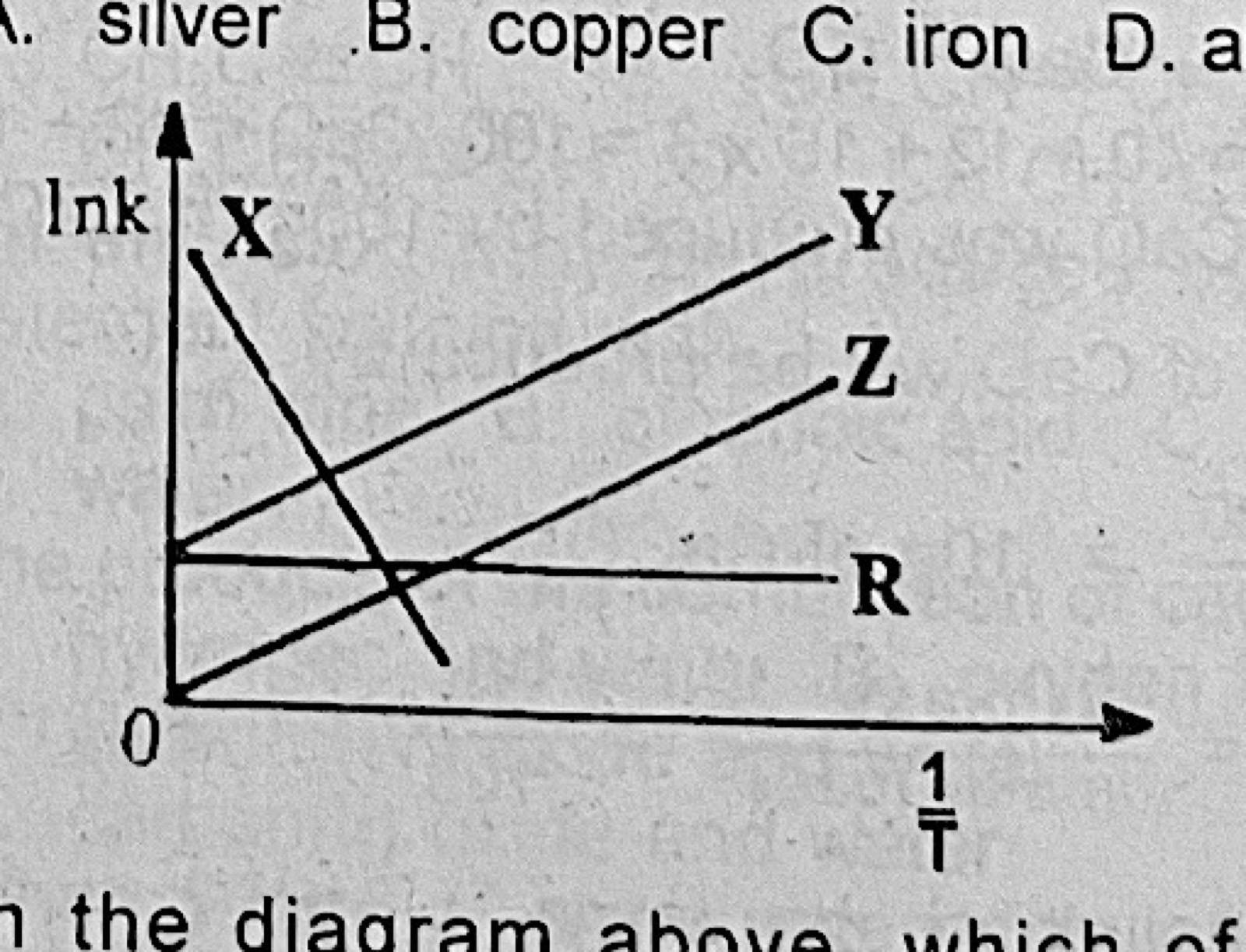
Question 43 Rates of Reaction In the diagram above (a graph of ln k against 1/T showing lines X, Y, Z and R), which of the curves illustrates Arrhenius' law?
A. Y B. Z C. R D. X Show the answer and explanation Answer: D (X )
Explanation Arrhenius: ln k = ln A − Ea /(RT). A plot of ln k against 1/T is a straight line with a negative slope, which is line X.
Open this question
Question 44 Periodic Table The most abundant element on the earth's crust is
A. nitrogen B. hydrogen C. oxygen D. fluorine Show the answer and explanation Answer: C (oxygen )
Explanation Oxygen makes up nearly half of the earth's crust by mass, mostly combined in silicates and oxides.
Open this question
Question 45 Periodic Table Metalloids are also referred to as
A. semi-metals B. metals C. colloids D. non-metals Show the answer and explanation Answer: A (semi-metals )
Explanation Metalloids such as silicon have properties between metals and non-metals, so they are called semi-metals.
Open this question
Question 46 Metals and their Compounds The ores that can be concentrated by flotation are
A. nitride ores B. sulphide ores C. oxide ores D. chloride ores Show the answer and explanation Answer: B (sulphide ores )
Explanation In froth flotation, sulphide ore particles stick to oil froth and float while the earthy impurities sink.
Open this question
Question 48 Qualitative Analysis In a flame test for calcium, the flame appears
A. green when viewed through a blue glass B. blue when viewed through a blue glass C. orange-red when viewed through a blue glass D. brick-red when viewed through a blue glass Show the answer and explanation Answer: A (green when viewed through a blue glass )
Explanation Calcium colours a flame brick-red. Blue cobalt glass absorbs much of the red-orange light, so the calcium flame looks (light) green through it.
Open this question
Question 49 Metals and their Compounds Which of the following alloys contain iron?
A. Duralumin and steel B. Brass and bronze C. Steel and permalloy D. Soft solder and duralumin Show the answer and explanation Answer: C (Steel and permalloy )
Explanation Steel is iron with carbon, and permalloy is a nickel–iron alloy. Duralumin, brass, bronze and solder contain no iron.
Open this question
Question 50 Carbon and its Compounds To obtain pure carbon (II) oxide from its mixture with carbon (IV) oxide, the mixture should be
A. passed over heated copper (II) oxide B. bubbled through water C. bubbled through concentrated tetraoxosulphate (VI) acid D. bubbled through sodium hydroxide Show the answer and explanation Answer: D (bubbled through sodium hydroxide )
Explanation Sodium hydroxide absorbs the acidic CO2 (forming Na2 CO3 ) while the neutral CO passes through unchanged.
Open this question Sign up free for every JAMB Chemistry year, practice by topic and timed mocks.
Start practising free