JAMB Biology 2009 past questions and answers

48 questions. Try each one, then open the answer to check yourself and read the explanation.

Question 1

Cell Structure and Organisation

What is the level of organization of an onion bulb?

  1. A.Tissue
  2. B.Organ
  3. C.Systemic
  4. D.Organismal
Show the answer and explanation

Answer: B (Organ)

Explanation

A tissue is a group of similar cells doing one job. The onion bulb is built from several tissues working together to store food, which makes it an organ.

Open this question

Question 2

Characteristics and Classification of Living Things

A characteristic exhibited by all living organisms is

  1. A.sexual reproduction
  2. B.aerobic respiration
  3. C.the ability to move from one place to another
  4. D.the ability to remove unwanted substances.
Show the answer and explanation

Answer: D (the ability to remove unwanted substances.)

Explanation

Excretion, the removal of waste made by the body's chemical reactions, happens in all living things. Not all organisms reproduce sexually, respire aerobically or move about.

Open this question

Question 3

Chromosomes, DNA and Sex Linkage

In a cell, the genes are carried by

  1. A.nuclear membranes
  2. B.chromatin threads
  3. C.lysosomes
  4. D.mitochondria.
Show the answer and explanation

Answer: B (chromatin threads)

Explanation

Chromatin threads are the DNA in the nucleus; they coil up to form chromosomes, and the genes are sections of this DNA.

Open this question

Question 4

Plant Kingdom

Alternation of asexual and sexual modes of reproduction is found in

  1. A.blue-green algae
  2. B.Euglena
  3. C.fern
  4. D.maize.
Show the answer and explanation

Answer: C (fern)

Explanation

A fern has alternation of generations: the fern plant makes spores (asexual), which grow into a small prothallus that makes gametes (sexual).

Open this question

Question 5

Evolution

The first terrestrial vertebrates evolved from

  1. A.Pisces
  2. B.Reptilia
  3. C.Amphibia
  4. D.Mammalia.
Show the answer and explanation

Answer: A (Pisces)

Explanation

The first land vertebrates were amphibians, and they evolved from lobe-finned fishes (Pisces).

Open this question

Question 6

Transport in Plants

In plants, the structures that play roles similar to the arteries and veins of animals are the

  1. A.xylem and phloem
  2. B.root hairs and xylem
  3. C.lenticels and phloem
  4. D.roots and stems.
Show the answer and explanation

Answer: A (xylem and phloem)

Explanation

Xylem and phloem are the plant's transport vessels: xylem carries water and minerals and phloem carries food, just as blood vessels carry materials in animals.

Open this question

Question 7

Viruses, Monera, Protista and Fungi

A blue-green alga is not a protophyte because

  1. A.it is aquatic
  2. B.its cells are prokaryotic
  3. C.it cannot move
  4. D.it is not a green plant.
Show the answer and explanation

Answer: B (its cells are prokaryotic)

Explanation

Protophytes are single-celled eukaryotes with a nucleus. Blue-green algae (cyanobacteria) have no nuclear membrane, so they belong with the bacteria in Monera.

Open this question

Question 8

Adaptation

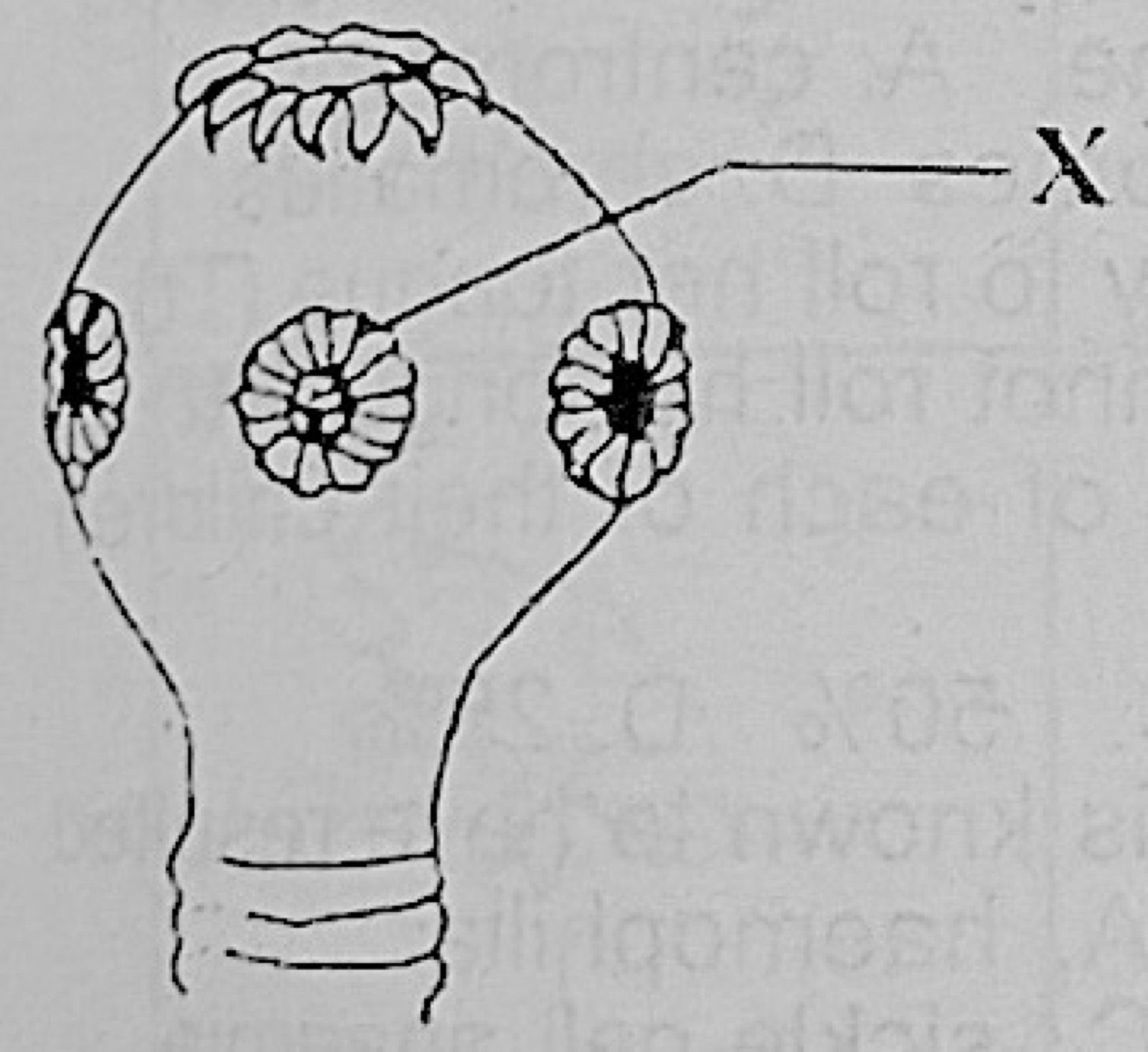
Use the diagram to answer: The structure labelled X is for

Diagram for this question
  1. A.attachment
  2. B.feeding
  3. C.seeing
  4. D.breathing.
Show the answer and explanation

Answer: A (attachment)

Explanation

The drawing is the head (scolex) of a tapeworm. X is one of its suckers, which, with the hooks, hold the worm onto the host's intestine wall.

Open this question

Question 9

Adaptation

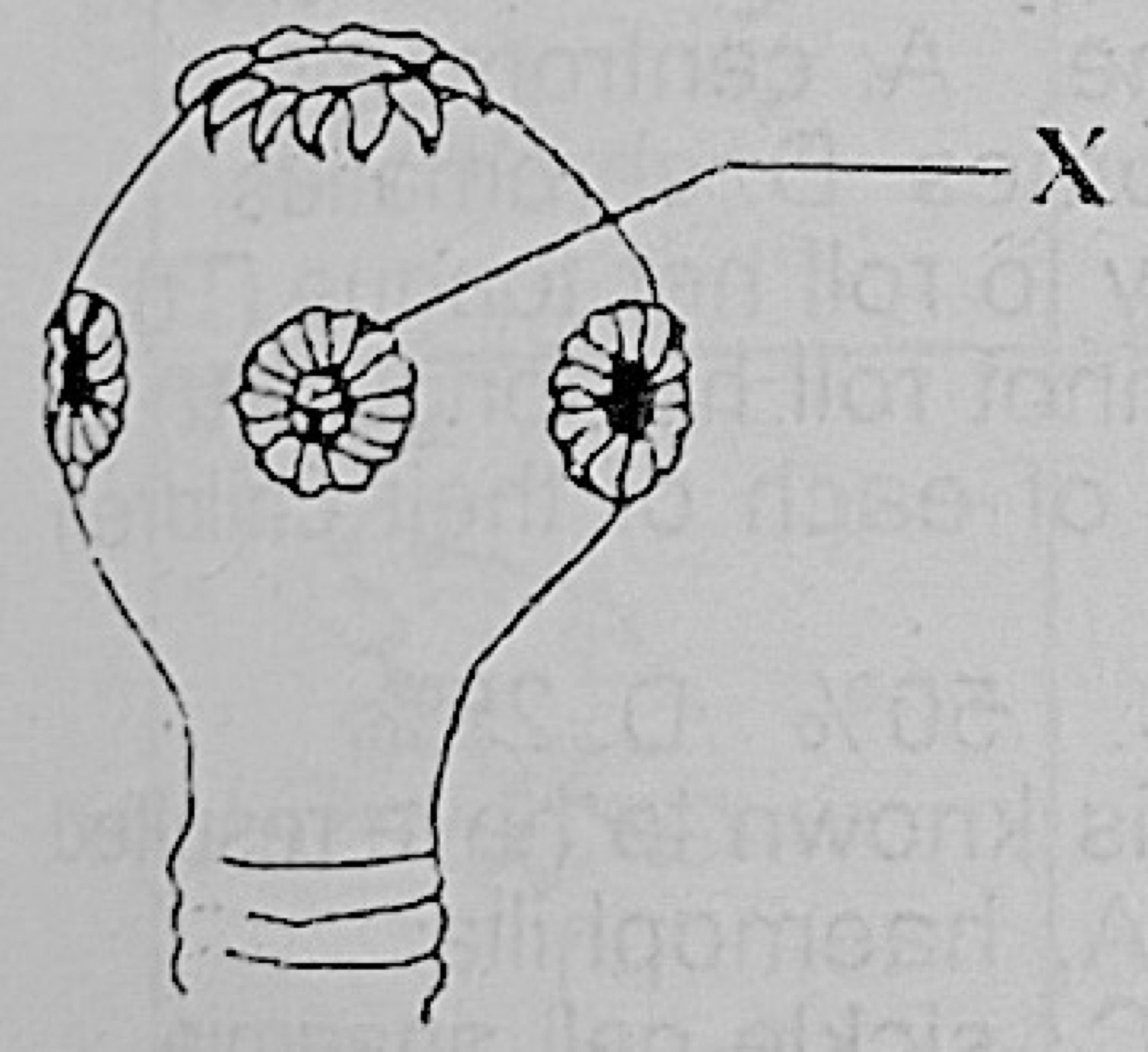
Use the diagram to answer: The habitat of the organism is

Diagram for this question
  1. A.slow moving streams and marshes
  2. B.the stomach of large mammals
  3. C.under leaf litter on forest floor
  4. D.the small intestine of large vertebrates.
Show the answer and explanation

Answer: D (the small intestine of large vertebrates.)

Explanation

The tapeworm is an endoparasite that lives attached to the wall of the small intestine of vertebrates such as man, cattle and pigs, absorbing digested food.

Open this question

Question 10

Adaptation

The feature that makes locomotion in water easy for fish is the

  1. A.scaly body
  2. B.slimy body
  3. C.streamlined body
  4. D.lateral line.
Show the answer and explanation

Answer: C (streamlined body)

Explanation

A streamlined body, pointed at both ends, cuts down water resistance so the fish moves through water easily.

Open this question

Question 11

Adaptation

Bird toes suitable for digging have claws that are

  1. A.blunt
  2. B.curved
  3. C.hooked
  4. D.sharp.
Show the answer and explanation

Answer: A (blunt)

Explanation

Scratching birds such as the domestic fowl have strong, blunt claws that dig into soil without breaking. Hooked, sharp claws are for grasping prey.

Open this question

Question 12

Animal Nutrition

Chewing the cud is an adaptation peculiar to

  1. A.herbivores
  2. B.omnivores
  3. C.rodents
  4. D.ruminants.
Show the answer and explanation

Answer: D (ruminants.)

Explanation

Ruminants have a four-chambered stomach. They swallow grass, bring it back up as cud, chew it again and swallow it, which helps digest cellulose.

Open this question

Question 13

Transport in Plants

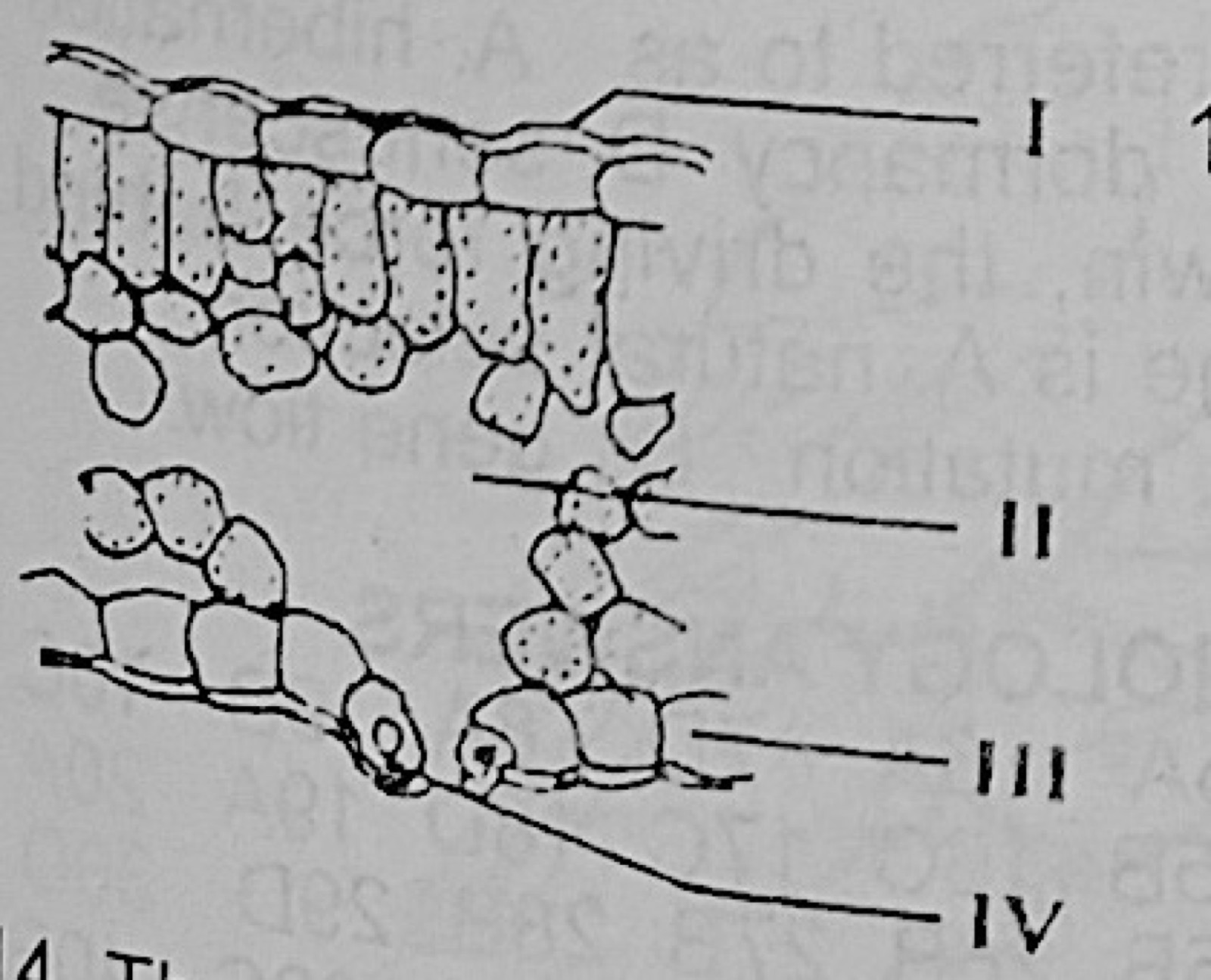
Use the diagram to answer: The structure that controls loss of water vapour during transpiration is labelled

Diagram for this question
  1. A.I
  2. B.II
  3. C.III
  4. D.IV.
Show the answer and explanation

Answer: D (IV.)

Explanation

IV points to the guard cells around the stoma in the lower epidermis. They open and close the pore and so control how much water vapour escapes.

Open this question

Question 14

Photosynthesis and Plant Nutrition

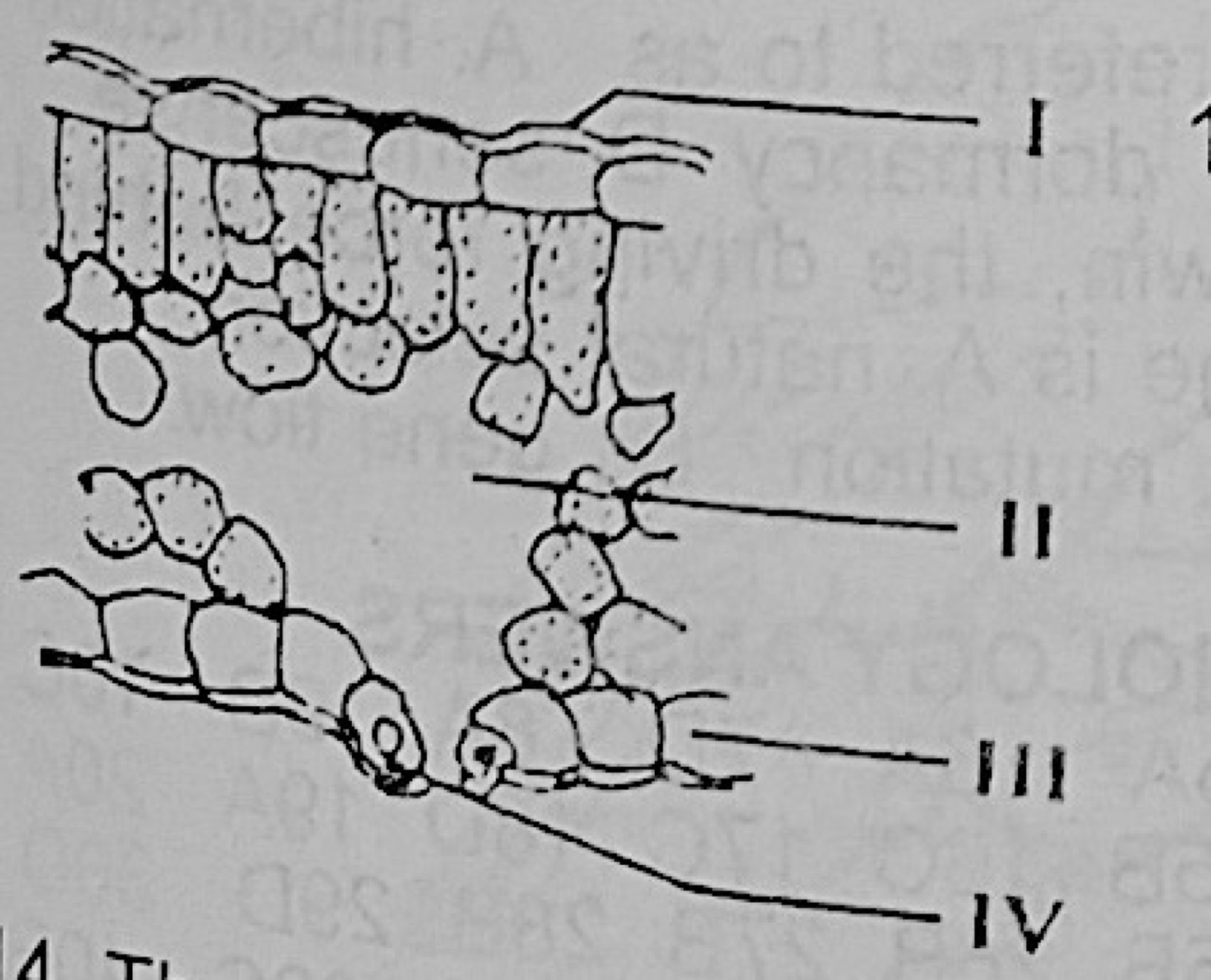
Use the diagram to answer: The part labelled I is the

Diagram for this question
  1. A.spongy mesophyll
  2. B.upper epidermis
  3. C.cuticle
  4. D.vein.
Show the answer and explanation

Answer: C (cuticle)

Explanation

I points to the thin waxy layer on the very top of the leaf, outside the epidermis cells. This is the cuticle, which cuts down water loss.

Open this question

Question 15

Photosynthesis and Plant Nutrition

Which of the following is an example of a carnivorous plant?

  1. A.Hydra
  2. B.Bladderwort
  3. C.Yeast
  4. D.Spirogyra.
Show the answer and explanation

Answer: B (Bladderwort)

Explanation

Bladderwort is a water plant with small bladders that suck in and digest tiny animals. Hydra is an animal, yeast a fungus and Spirogyra an ordinary alga.

Open this question

Question 16

Animal Nutrition

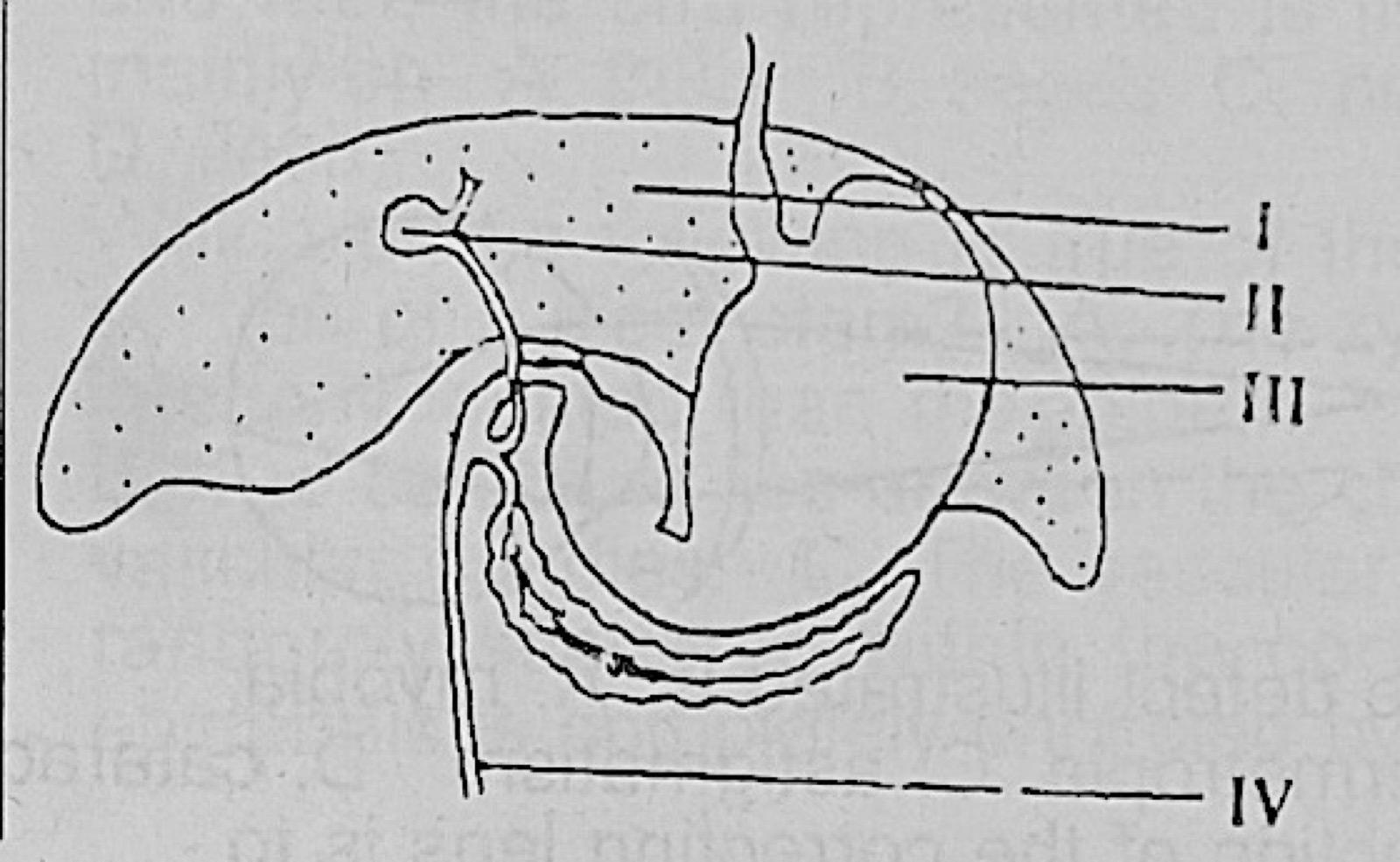
Use the diagram to answer: Emulsification of fats takes place in the part labelled

Diagram for this question
  1. A.I
  2. B.II
  3. C.III
  4. D.IV.
Show the answer and explanation

Answer: D (IV.)

Explanation

Bile from the liver and gall bladder breaks fat into tiny droplets (emulsification) in the small intestine (duodenum and ileum), labelled IV. The stomach (III) does not emulsify fats.

Open this question

Question 17

Animal Nutrition

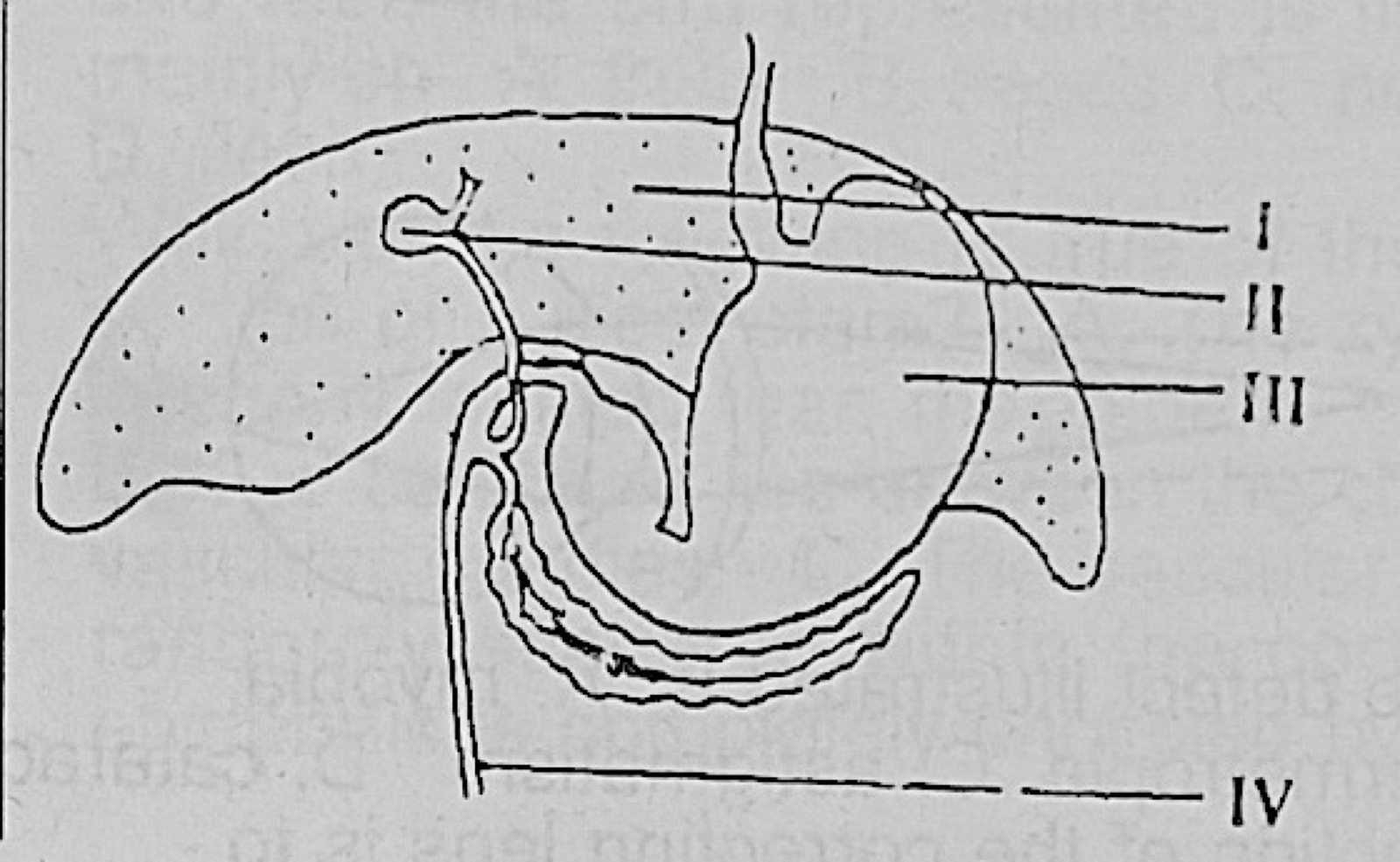
Use the diagram to answer: The content of the part labelled III is usually

Diagram for this question
  1. A.neutral
  2. B.alkaline
  3. C.acidic
  4. D.saline.
Show the answer and explanation

Answer: C (acidic)

Explanation

III is the stomach. Its glands secrete hydrochloric acid, which kills germs and gives pepsin the acid conditions it needs.

Open this question

Question 18

Animal Nutrition

The part of the alimentary system of a bird where food is ground into small particles is the

  1. A.cloaca
  2. B.stomach
  3. C.crop
  4. D.gizzard.
Show the answer and explanation

Answer: D (gizzard.)

Explanation

The gizzard has thick muscular walls and often holds grit; it grinds food because birds have no teeth. The crop only stores food.

Open this question

Question 19

Transport in Animals

Which of the following describes the sequence of blood flow from the heart to a tissue?

  1. A.Heart → artery → arteriole → tissue
  2. B.Heart → vein → venule → tissue
  3. C.Heart → venule → vein → tissue
  4. D.Heart → arteriole → artery → tissue.
Show the answer and explanation

Answer: A (Heart → artery → arteriole → tissue)

Explanation

Blood leaves the heart in arteries, which branch into smaller arterioles and then capillaries in the tissue. Veins and venules bring blood back to the heart.

Open this question

Question 20

Respiration

The enzymes of the glycolytic pathway are located in the

  1. A.mitochondria
  2. B.gastric juice
  3. C.plasma
  4. D.cytoplasm.
Show the answer and explanation

Answer: D (cytoplasm.)

Explanation

Glycolysis, the first stage of respiration that splits glucose into pyruvic acid, takes place in the cytoplasm of the cell.

Open this question

Question 21

Excretion

In insects, the structure that performs the same function as the kidney in man is the

  1. A.nephridium
  2. B.flame cell
  3. C.Malpighian tubule
  4. D.trachea.
Show the answer and explanation

Answer: C (Malpighian tubule)

Explanation

Malpighian tubules remove nitrogenous waste from the insect's blood. Nephridia are found in earthworms and flame cells in flatworms.

Open this question

Question 22

Support and Movement

The axial skeleton is found in the

  1. A.skull, ribs, vertebral column and breast bone
  2. B.skull, humerus, vertebral column and ribs
  3. C.breastbone, clavicle, ribs and vertebral column
  4. D.femur, sternum, ulna and skull.
Show the answer and explanation

Answer: A (skull, ribs, vertebral column and breast bone)

Explanation

The axial skeleton is the central axis of the body: skull, vertebral column, ribs and sternum (breast bone). The humerus, clavicle, femur and ulna belong to the appendicular skeleton.

Open this question

Question 23

Reproduction in Plants

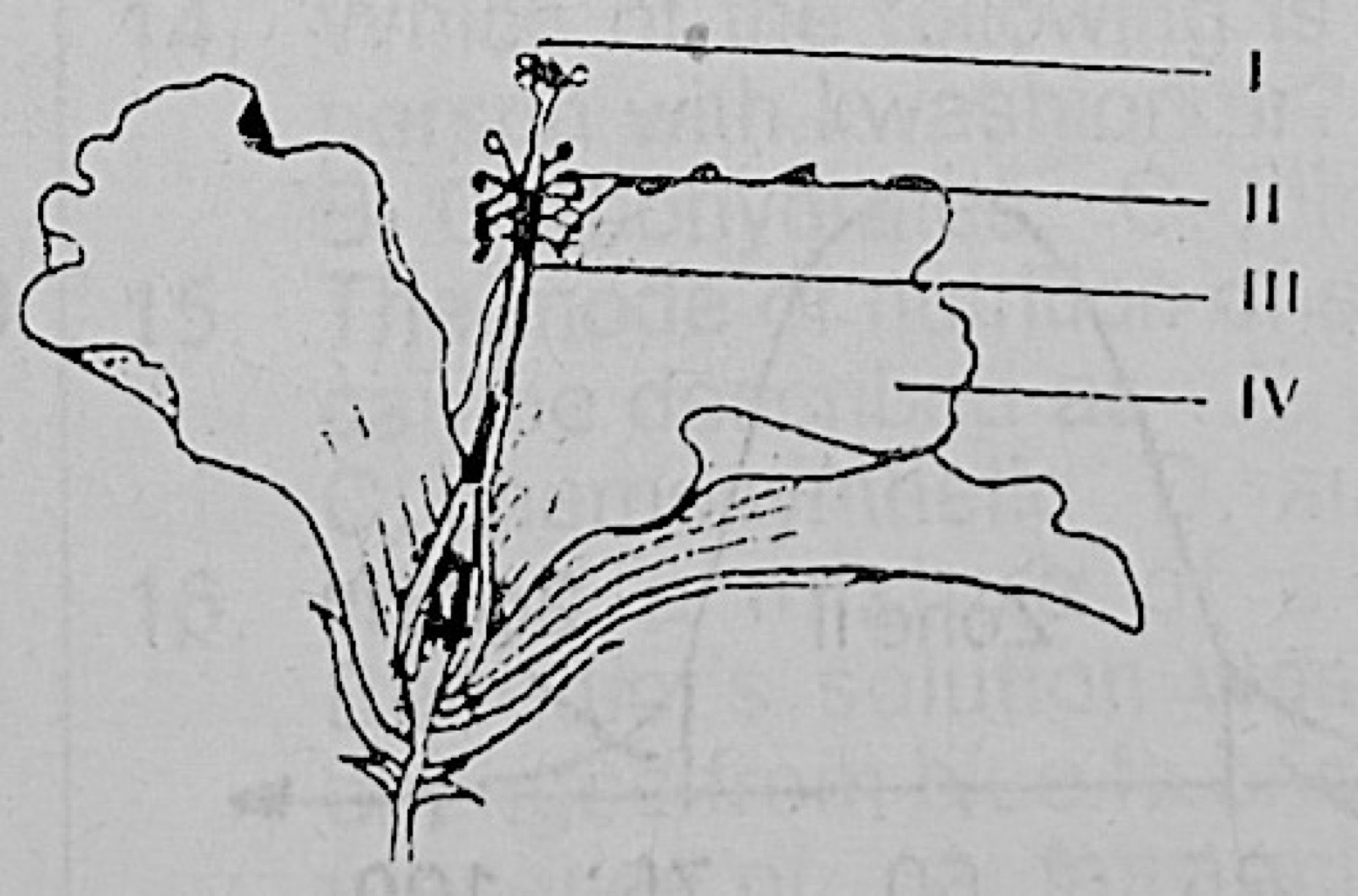
Use the diagram to answer: The male sex cells are contained in the part labelled

Diagram for this question
  1. A.I
  2. B.II
  3. C.III
  4. D.IV.
Show the answer and explanation

Answer: B (II)

Explanation

II points to the anthers on the staminal column. The anthers make pollen grains, which carry the male gametes. I is the stigma.

Open this question

Question 24

Reproduction in Plants

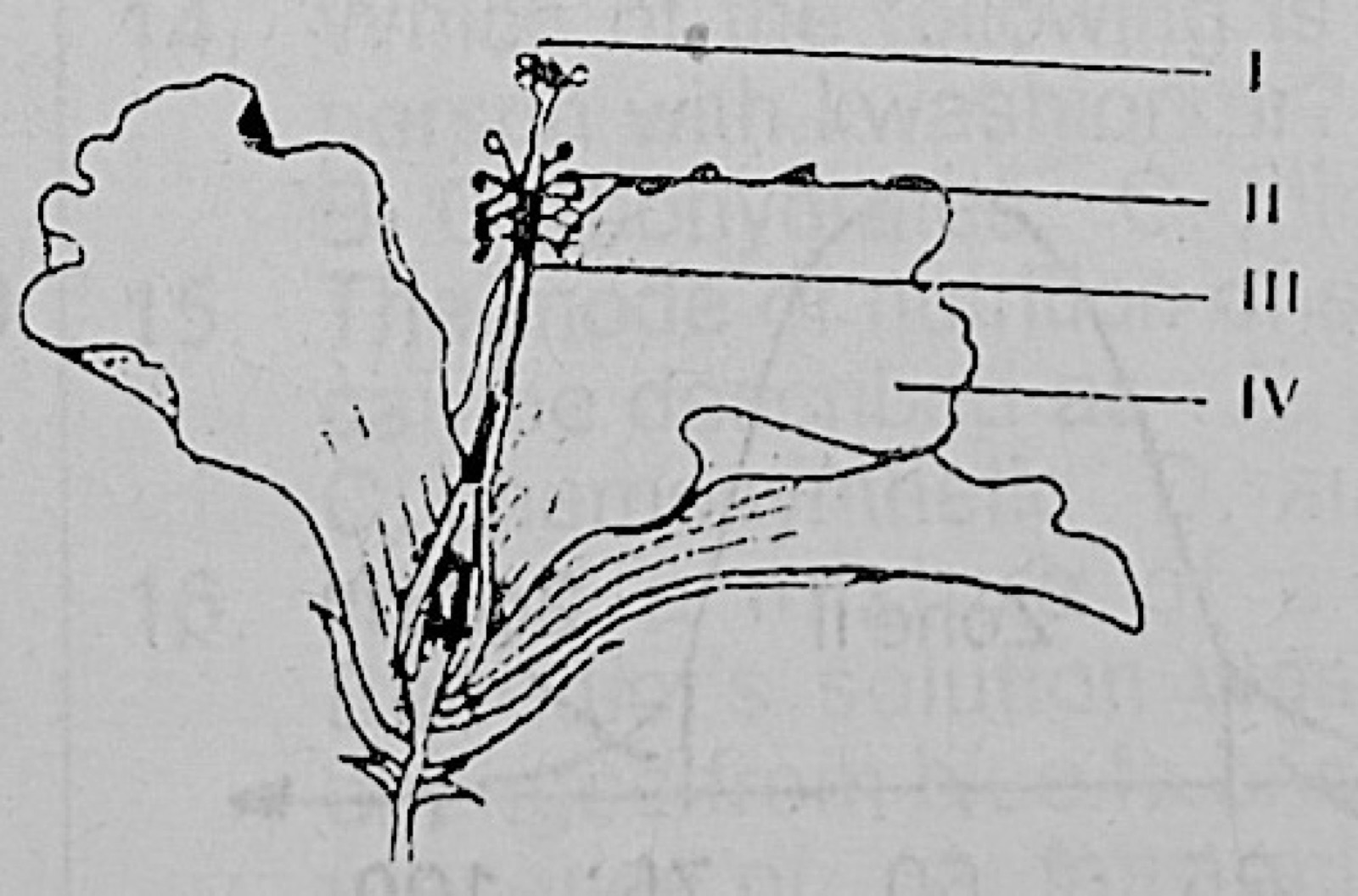
Use the diagram to answer: The likely pollinating agent of the flower is

Diagram for this question
  1. A.wind
  2. B.water
  3. C.insect
  4. D.man.
Show the answer and explanation

Answer: C (insect)

Explanation

The flower (like hibiscus) has large showy petals and a sticky stigma, features that attract insects to carry pollen.

Open this question

Question 25

Reproduction in Animals

The reproductive system of a male mammal is made up of

  1. A.claspers, prostrate gland, sperm duct and vas deferens
  2. B.testis, prostrate gland, sperm duct and vas deferens
  3. C.oviduct, urethra, testis and sperm duct
  4. D.testis, uterus, prostrate gland and sperm duct.
Show the answer and explanation

Answer: B (testis, prostrate gland, sperm duct and vas deferens)

Explanation

The male system includes the testes, the sperm ducts (vas deferens) and glands such as the prostate. Claspers are found in male sharks; the oviduct and uterus are female organs.

Open this question

Question 26

Growth and Development

In a bean seed, absorption of water at the beginning of germination is through the

  1. A.hilum
  2. B.micropyle
  3. C.testa
  4. D.plumule.
Show the answer and explanation

Answer: B (micropyle)

Explanation

The micropyle is a tiny pore in the testa next to the hilum. Water first enters the seed through it, making the seed swell.

Open this question

Question 27

Sense Organs

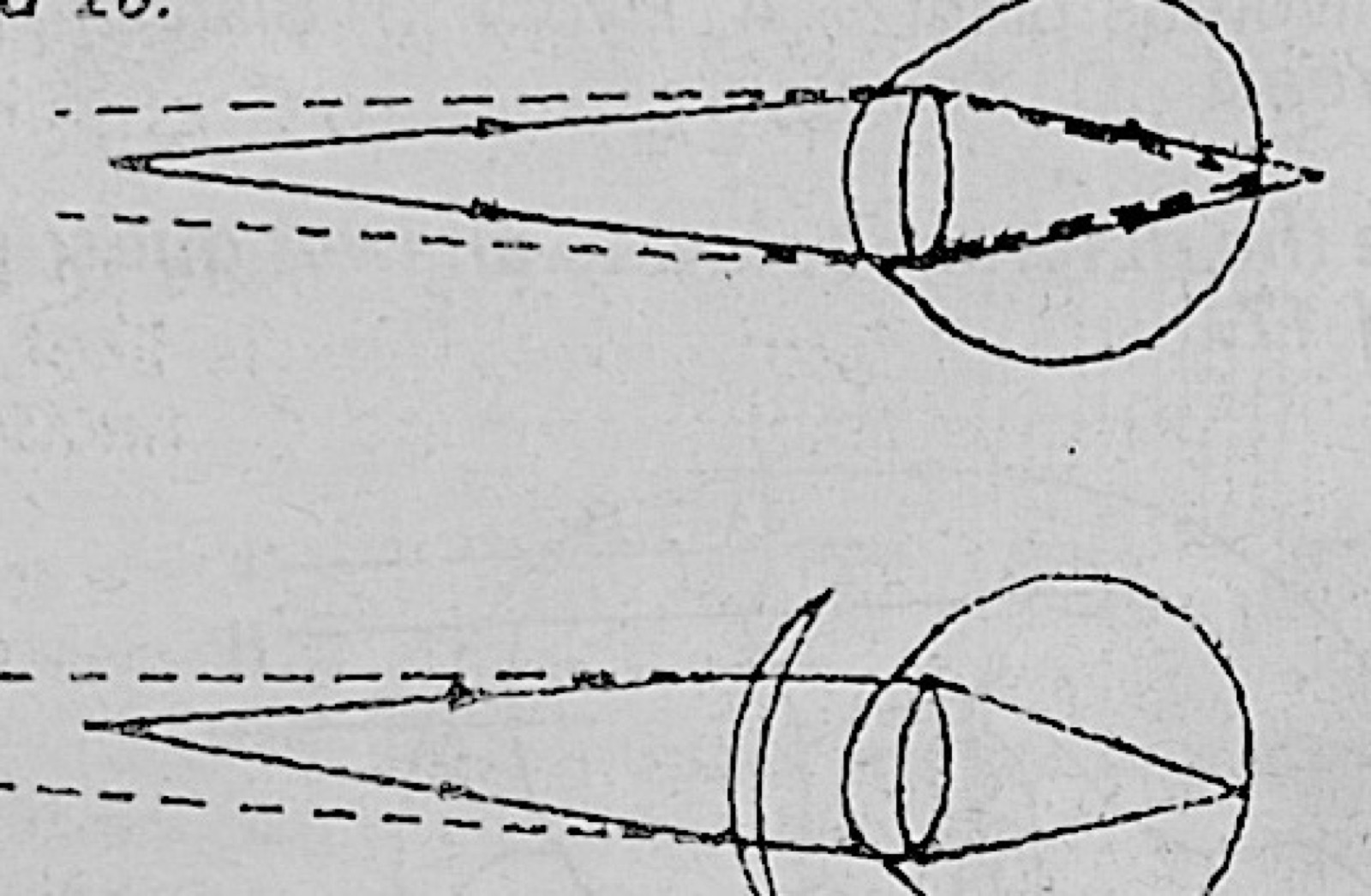
Use the diagram to answer: The eye defect illustrated is

Diagram for this question
  1. A.myopia
  2. B.hypermetropia
  3. C.astigmatism
  4. D.cataract.
Show the answer and explanation

Answer: B (hypermetropia)

Explanation

In the top drawing the rays from a near object meet behind the retina. This is long sight (hypermetropia), corrected with a converging lens as in the lower drawing.

Open this question

Question 28

Sense Organs

Use the diagram to answer: The function of the correcting lens is to

Diagram for this question
  1. A.diverge incoming rays
  2. B.converge incoming rays
  3. C.reflect incoming rays
  4. D.screen incoming rays.
Show the answer and explanation

Answer: B (converge incoming rays)

Explanation

The correcting lens is convex. It bends the rays inwards (converges them) before they enter the eye, so they focus on the retina.

Open this question

Question 29

Ecosystem and Ecological Factors

The most important ecological factor in a terrestrial environment is

  1. A.rainfall
  2. B.humidity
  3. C.wind
  4. D.soil.
Show the answer and explanation

Answer: A (rainfall)

Explanation

On land, water is often in short supply. The amount of rainfall decides whether an area becomes desert, savanna or forest, so it controls which organisms live there.

Open this question

Question 30

Ecological Associations

The association between bacteria residing in the caecum and the ruminant is

  1. A.parasitism
  2. B.predation
  3. C.saprophytism
  4. D.mutualism
Show the answer and explanation

Answer: D (mutualism)

Explanation

The bacteria digest cellulose for the ruminant, and in return get food and shelter in its gut. Both benefit, so it is mutualism.

Open this question

Question 31

Excretion

A marine protozoan is likely to have no contractile vacuole mainly because the cytoplasm is

  1. A.isotonic to sea water
  2. B.hypotonic to sea water
  3. C.hypertonic to sea water
  4. D.impervious to sea water
Show the answer and explanation

Answer: A (isotonic to sea water)

Explanation

When the cytoplasm and sea water have the same concentration (isotonic), no extra water flows in by osmosis, so the protozoan needs no contractile vacuole to pump it out.

Open this question

Question 32

Habitats and Biomes

In freshwater marshes and swamps, the most important abiotic factor that organisms have to adapt to is

  1. A.nature of substratum
  2. B.high salinity
  3. C.high temperature
  4. D.low pH.
Show the answer and explanation

Answer: A (nature of substratum)

Explanation

The ground of a marsh is soft, waterlogged mud with little oxygen. Plants need special roots and animals special habits to live on and in it.

Open this question

Question 33

Habitats and Biomes

Which of the following biomass could be characterized by very low rainfall, cold nights, hot days and fast blooming plants?

  1. A.Northern Guinea savanna
  2. B.Southern Guinea savanna
  3. C.Tropical desert
  4. D.Montane forest.
Show the answer and explanation

Answer: C (Tropical desert)

Explanation

Deserts get very little rain and lose heat fast at night because there are few clouds. Desert plants grow and flower quickly whenever it rains.

Open this question

Question 34

Ecosystem and Ecological Factors

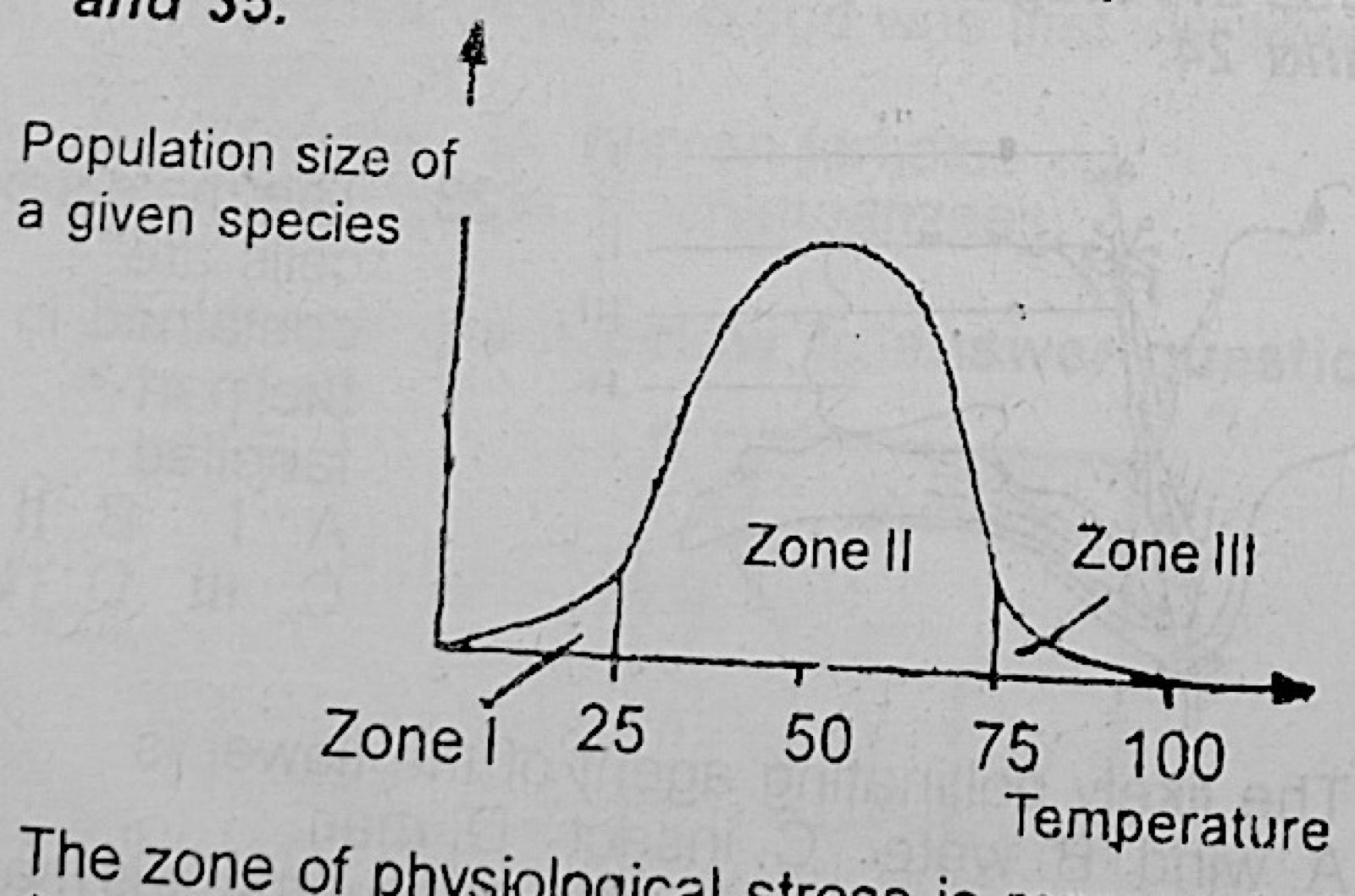
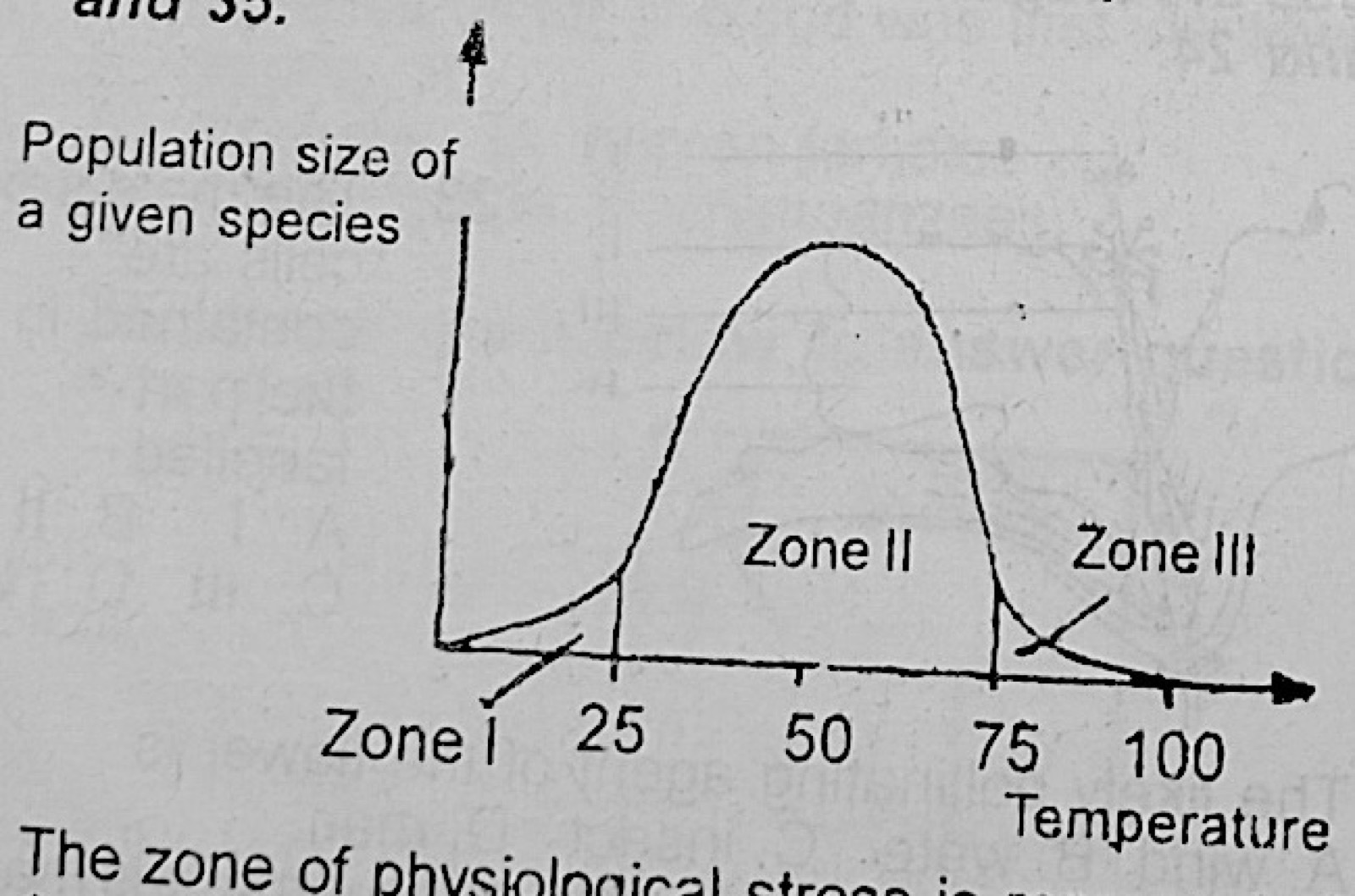
Use the graph to answer: The zone of physiological stress is represented by

Diagram for this question
  1. A.I and II
  2. B.II only
  3. C.II and III
  4. D.I and III.
Show the answer and explanation

Answer: D (I and III.)

Explanation

In zones I and III the temperature is too low or too high, so only a few individuals survive. These are the stress zones; zone II is the optimum range.

Open this question

Question 35

Population Ecology

Use the graph to answer: The optimum temperature for the growth of the organism is

Diagram for this question
  1. A.25°C
  2. B.50°C
  3. C.75°C
  4. D.100°C.
Show the answer and explanation

Answer: B (50°C)

Explanation

The population is largest at the peak of the curve, which is above 50 on the temperature axis.

Open this question

Question 37

Microorganisms and Health

I Onchocerciasis
II Schistosomiasis
III Salmonellosis
IV Meningitis
Which of the diseases listed above are associated with water?

  1. A.I and II only
  2. B.II, III and IV
  3. C.I, II and III
  4. D.II and IV.
Show the answer and explanation

Answer: C (I, II and III)

Explanation

River blindness is spread by blackflies that breed in fast streams, schistosomiasis by snails in still water, and salmonellosis by contaminated water. Meningitis spreads through air droplets.

Open this question

Question 38

Pollution

The major cause of global warming is the

  1. A.burning of fossil fuel
  2. B.construction of dams
  3. C.use of electricity
  4. D.exploration of space.
Show the answer and explanation

Answer: A (burning of fossil fuel)

Explanation

Burning coal, oil and gas releases carbon (IV) oxide, a greenhouse gas that traps heat in the atmosphere.

Open this question

Question 39

Variation

The uniqueness of an individual organism in a population is accounted for by

  1. A.evolution
  2. B.variation
  3. C.adaptation
  4. D.mutation
Show the answer and explanation

Answer: B (variation)

Explanation

Variation is the set of differences between members of the same species. It is why no two individuals are exactly alike.

Open this question

Question 40

Variation

A phenotypic character with intermediate forms that can be graded from one extreme to the other is referred to as

  1. A.discontinuous variation
  2. B.continuous variation
  3. C.a mutant
  4. D.a genome.
Show the answer and explanation

Answer: B (continuous variation)

Explanation

Characters like height and weight show a smooth range from shortest to tallest with many in-between values. This is continuous variation.

Open this question

Question 41

Mendelian Inheritance

A farmer's assumption that the seed from a good harvest will produce a good yield is explained by the theory of

  1. A.evolution
  2. B.adaptation
  3. C.variation
  4. D.heredity.
Show the answer and explanation

Answer: D (heredity.)

Explanation

Heredity is the passing of characters from parents to offspring. Seeds from high-yielding plants carry the genes for good yield.

Open this question

Question 42

Mendelian Inheritance

In Mendelian inheritance, discontinuous characters are controlled by the

  1. A.centromeres
  2. B.alleles
  3. C.chromosomes
  4. D.chromatids
Show the answer and explanation

Answer: B (alleles)

Explanation

Discontinuous characters fall into clear groups, such as tall or dwarf. Each is controlled by alleles of a single gene, one dominant and one recessive.

Open this question

Question 43

Mendelian Inheritance

A woman with the ability to roll her tongue (Tt) marries a man who cannot roll his tongue (tt). What is the probability of each of their children being a tongue roller?

  1. A.100%
  2. B.75%
  3. C.50%
  4. D.25%.
Show the answer and explanation

Answer: C (50%)

Explanation

Tt × tt gives Tt, Tt, tt, tt. Half the children are Tt and can roll their tongue, so the chance is 50%.

Open this question

Question 45

Adaptation

Plants that grow in an area that is neither too wet nor too dry are

  1. A.xerophytes
  2. B.mesophytes
  3. C.epiphytes
  4. D.hydrophytes.
Show the answer and explanation

Answer: B (mesophytes)

Explanation

'Meso-' means middle: mesophytes grow where water supply is moderate. Xerophytes live in dry places and hydrophytes in water.

Open this question

Question 46

Adaptation

The part of a domestic fowl responsible for preventing heat loss is the

  1. A.filoplume
  2. B.contour feather
  3. C.down feather
  4. D.quill.
Show the answer and explanation

Answer: C (down feather)

Explanation

Down feathers are soft and fluffy and lie close to the skin. They trap a layer of air, which insulates the bird.

Open this question

Question 47

Adaptation

Which of the following animals is most adapted for water conservation?

  1. A.Earthworms
  2. B.Mammals
  3. C.Flatworms
  4. D.Insects.
Show the answer and explanation

Answer: D (Insects.)

Explanation

Insects have a waxy waterproof cuticle, spiracles that can close, and they excrete almost dry uric acid, so they lose very little water.

Open this question

Question 48

Adaptation

The specialized pigment cells that are involved in colouration and colour change in animals are the

  1. A.xanthophyl
  2. B.chromatophores
  3. C.chlorophyll
  4. D.melanin.
Show the answer and explanation

Answer: B (chromatophores)

Explanation

Chromatophores are skin cells holding pigment. By spreading or bunching the pigment they let animals like chameleons and frogs change colour.

Open this question

Question 49

Adaptation

During the dry season in the tropics, the body metabolism of some animals slows to a minimal level in a process referred to as

  1. A.hibernation
  2. B.aestivation
  3. C.dormancy
  4. D.senescense.
Show the answer and explanation

Answer: B (aestivation)

Explanation

Animals like the lung fish and some snails become inactive during the hot dry season, cutting their metabolism to survive. This is called aestivation.

Open this question

Question 50

Evolution

According to Darwin, the driving force behind evolutionary change is

  1. A.natural selection
  2. B.genetic drift
  3. C.mutation
  4. D.gene flow.
Show the answer and explanation

Answer: A (natural selection)

Explanation

Darwin proposed that individuals best suited to their environment survive and reproduce more, passing on their features. This natural selection drives evolution.
Open this question