Characteristics and Classification of Living Things
A characteristic that can possibly be shared by both living and non-living organisms is
A.locomotion
B.irritability
C.increase in biomass
D.increase in size.
Show the answer and explanation
Answer: D (increase in size.)
Explanation
Non-living things like a growing crystal or a snowball can get bigger by adding material to the outside. Biomass means mass of living tissue, which non-living things do not have.
The cell of an onion bulb can be differentiated from a cheek cell by the presence of
A.plasmalemma
B.chloroplast
C.cell wall
D.nucleus.
Show the answer and explanation
Answer: C (cell wall)
Explanation
Plant cells have a cellulose cell wall but animal cells do not. Onion bulb cells grow underground, so they have no chloroplasts, and both cells have a membrane and nucleus.
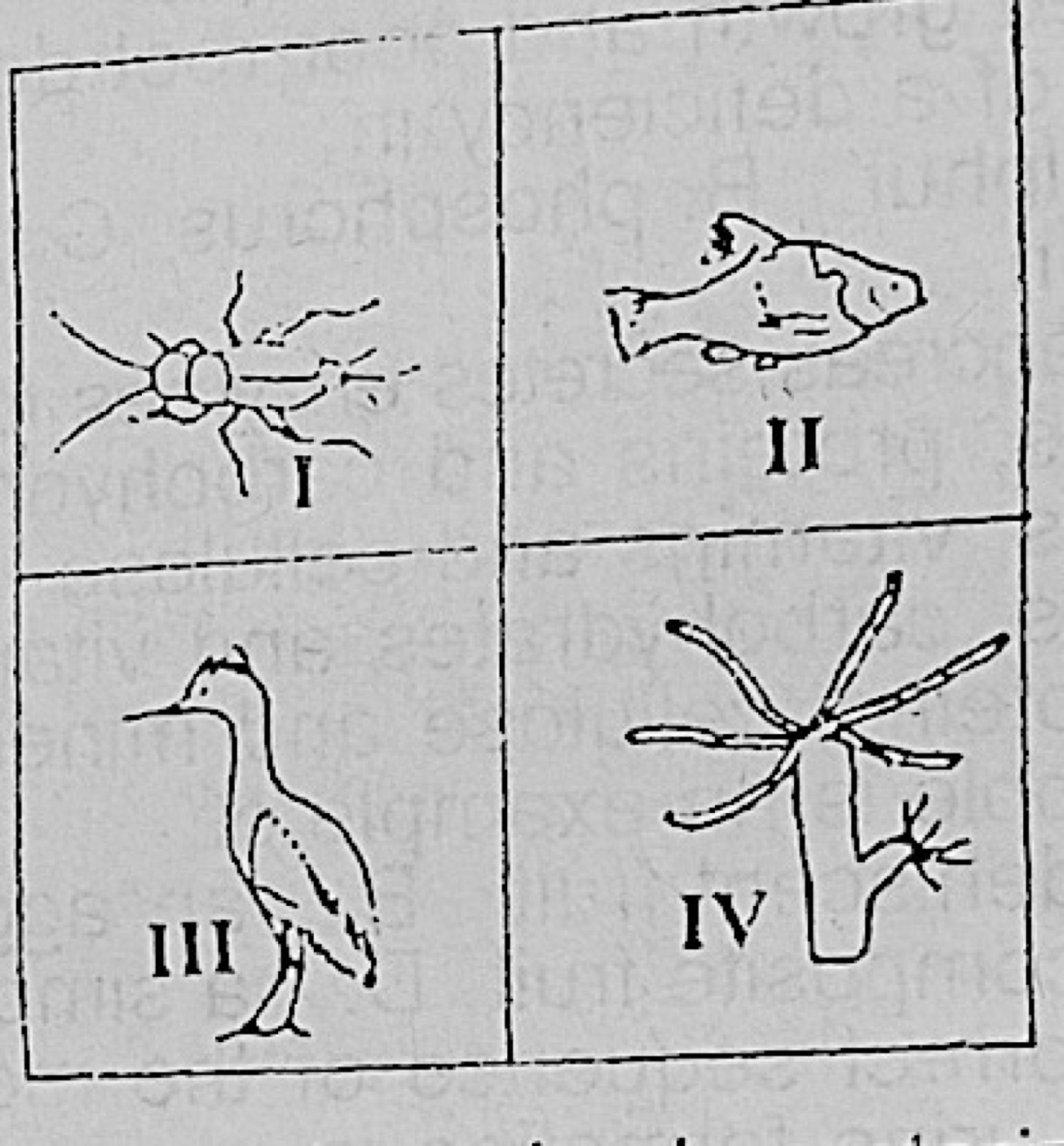
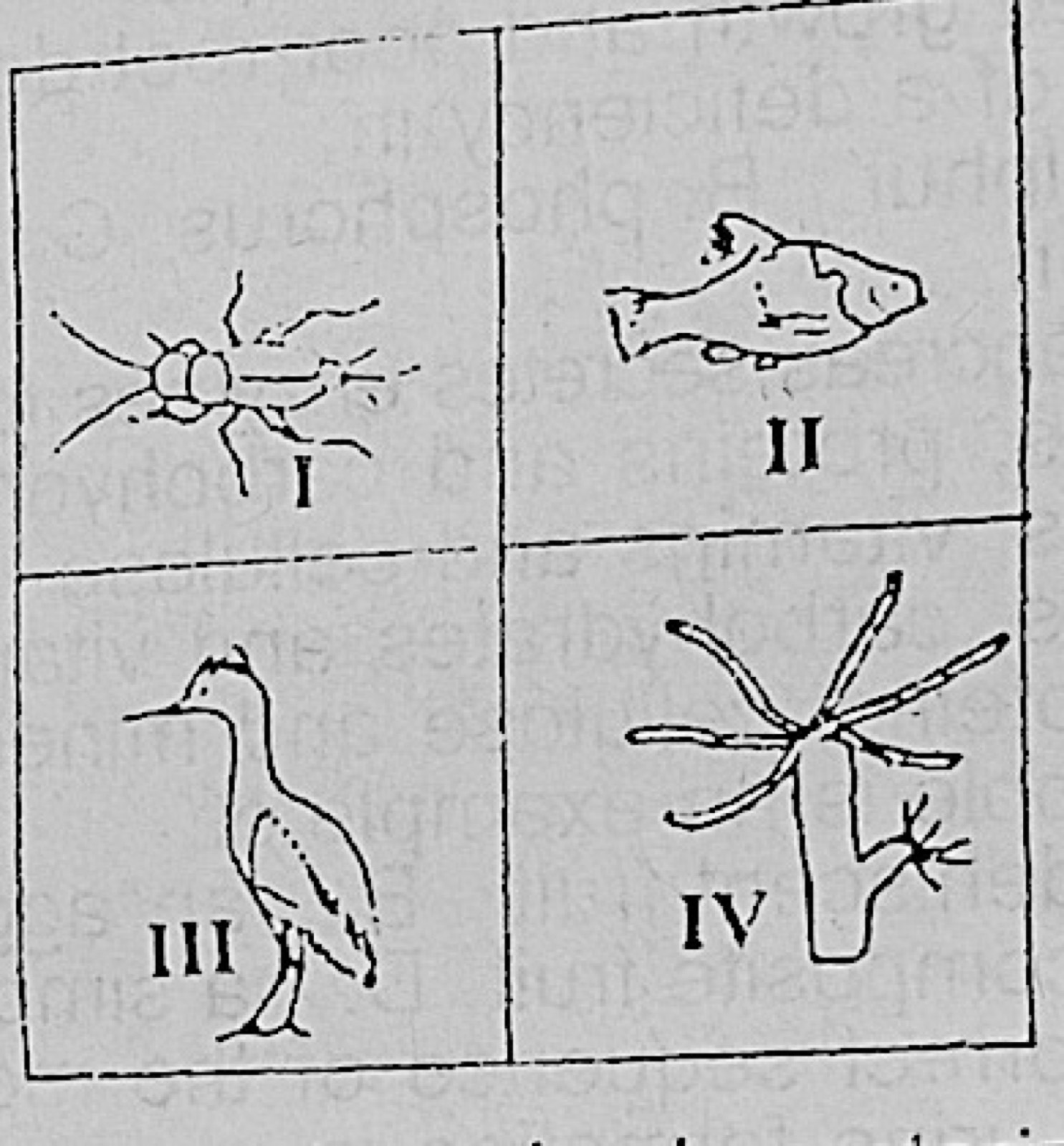
Coelenterates such as Hydra and jellyfish have body parts arranged around a central axis (radial symmetry). Flatworms, roundworms and arthropods are bilaterally symmetrical.
Which of the following is used mainly for balancing in fish?
A.The caudal fin
B.The pectoral fin
C.The anal fin
D.The dorsal fin.
Show the answer and explanation
Answer: D (The dorsal fin.)
Explanation
The dorsal fin on the back stops the fish from rolling over and keeps it upright. The caudal fin drives it forward and the pectoral fins steer and brake.
The most important characteristic that makes reptiles to conquer terrestrial habitats is the possession of
A.long tail
B.scaly skin
C.sharp claw
D.amniotic egg.
Show the answer and explanation
Answer: D (amniotic egg.)
Explanation
The amniotic egg has a shell and membranes that keep the embryo moist, so reptiles can breed on dry land without returning to water as amphibians must.
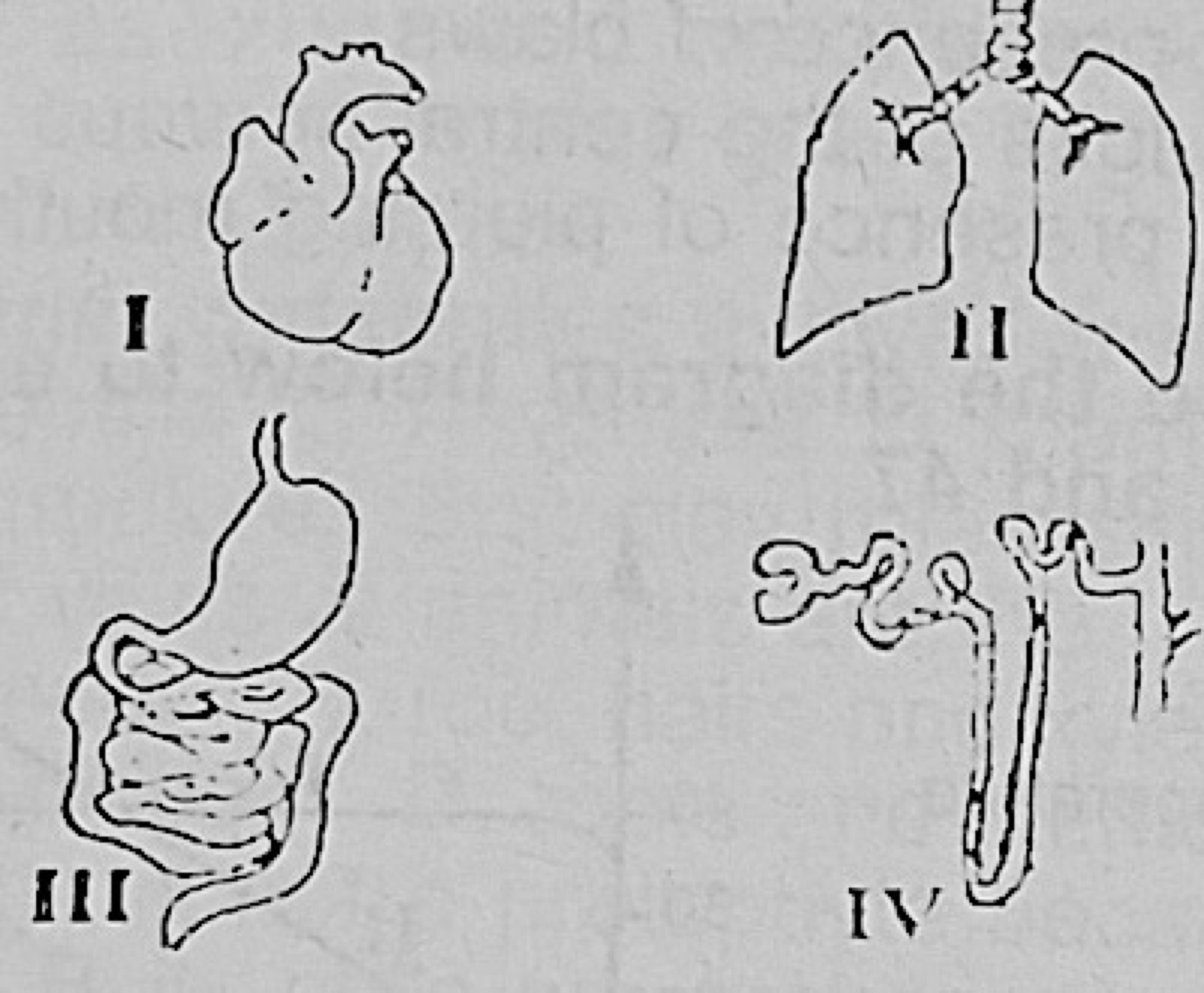
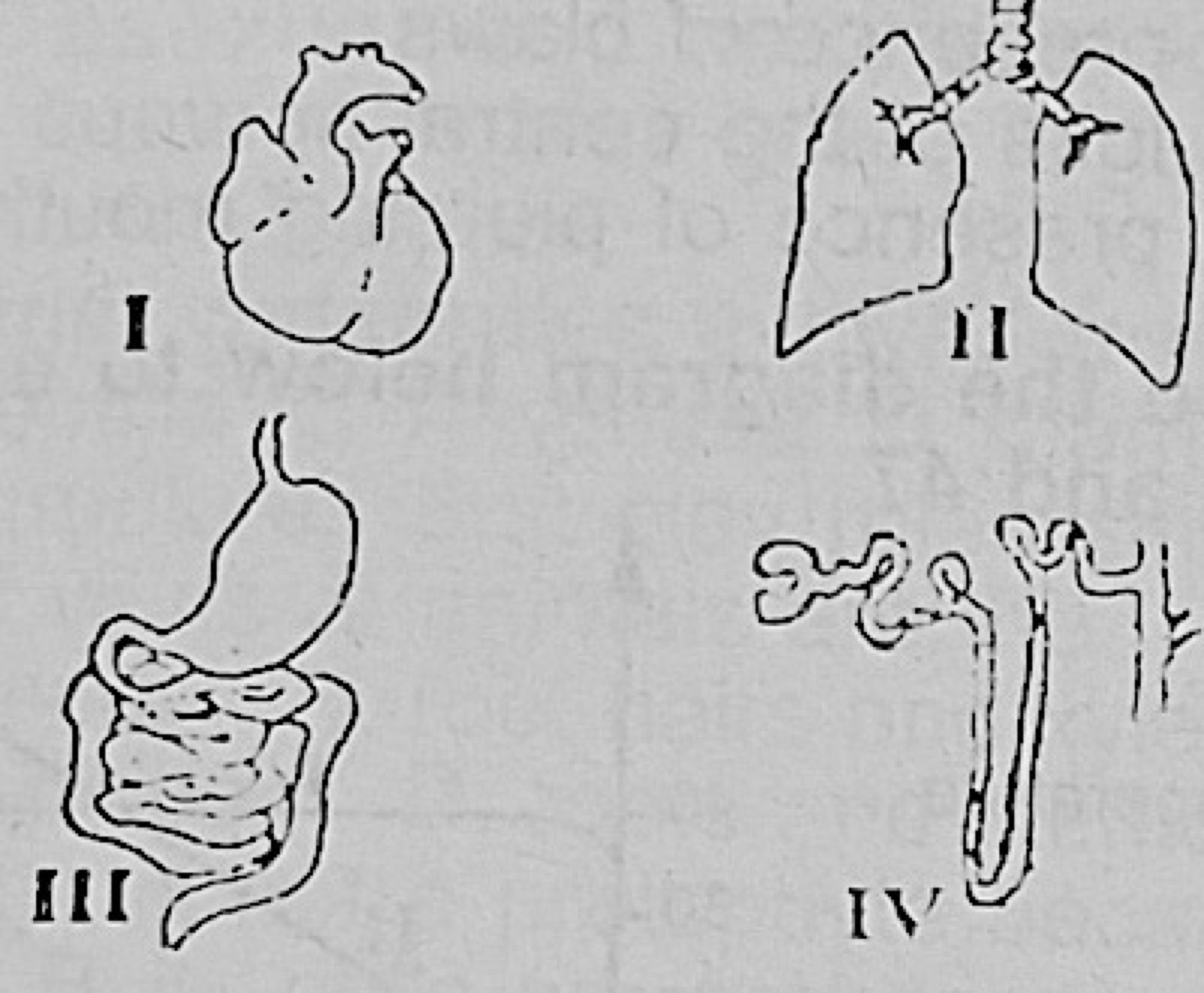
Use the diagram to answer: Water reabsorption takes place in
A.II and III
B.III and IV
C.I and IV
D.I and III.
Show the answer and explanation
Answer: B (III and IV)
Explanation
III is the alimentary canal, where the large intestine absorbs water, and IV is the nephron of the kidney, where water is reabsorbed from the filtrate.
What will happen when two equal sized pieces of unripe pawpaw labelled X and Y are dropped into equal volumes of concentrated salt solution and distilled water respectively?
A.Pawpaw X will become turgid
B.Both will increase in size
C.pawpaw Y will become turgid
D.Both will decrease in size.
Show the answer and explanation
Answer: C (pawpaw Y will become turgid)
Explanation
Y is in distilled water, so water enters its cells by osmosis and they become turgid. X loses water to the salt solution and becomes flaccid.
Which of the following associations is an example of mutualism?
A.Hydra viridis and zoochlorellae
B.Human and lice
C.Shark and Remora fish
D.Bread and Rhizopus stolonifer
Show the answer and explanation
Answer: A (Hydra viridis and zoochlorellae)
Explanation
The green algae (zoochlorellae) living in Hydra viridis give it food and oxygen from photosynthesis, and the Hydra gives them shelter and carbon (IV) oxide. Both benefit.
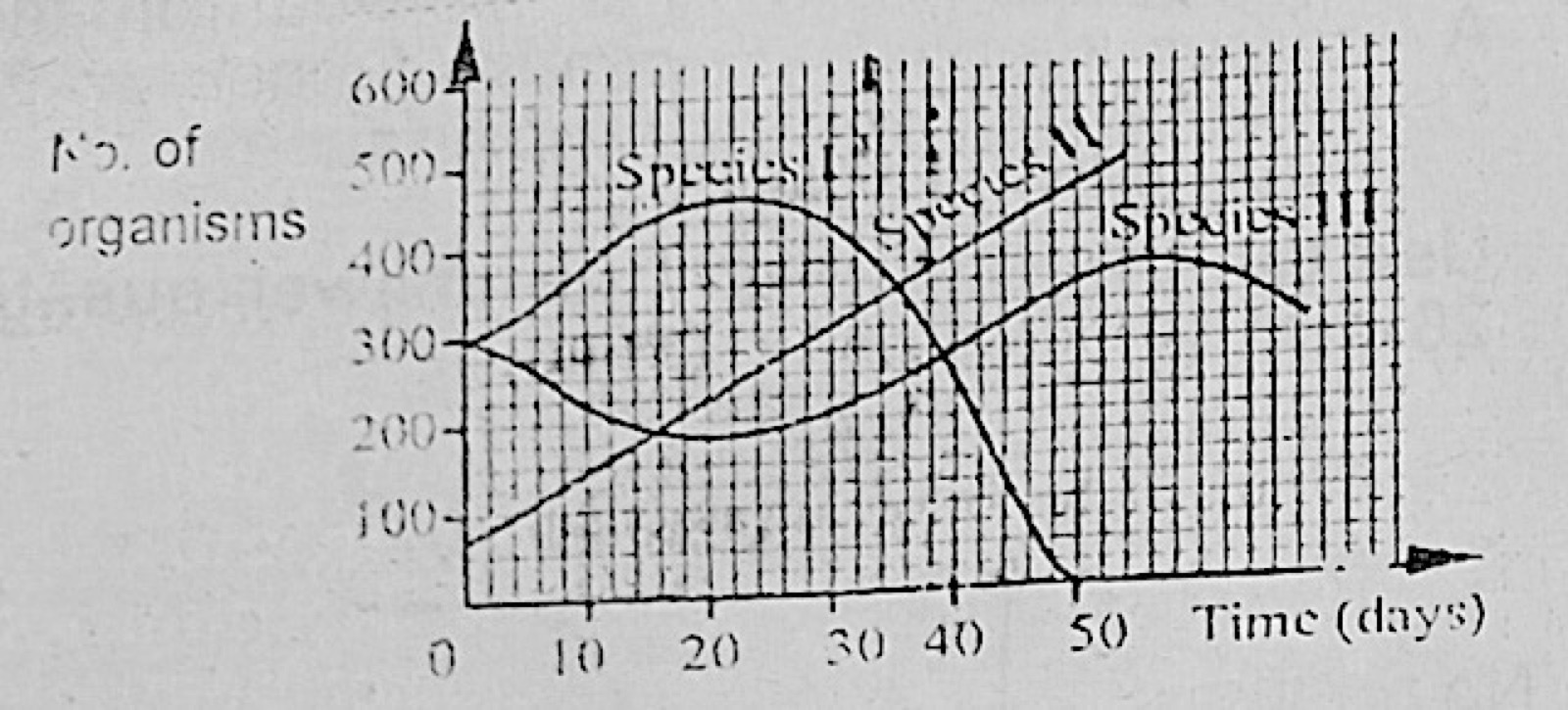
Use the graph to answer: If species I, II and III interact in a community, which of the following statements is true?
A.The population of species II is growing at a slow rate
B.The population of species III has reached its carrying capacity
C.The population of species I has become extinct
D.The population of species I is always higher than species II.
Show the answer and explanation
Answer: C (The population of species I has become extinct)
Explanation
The curve for species I rises, then falls to zero at about day 48, so that species has died out. Species II rises steadily and species III is still changing.
In an experiment to determine the percentage of air in a soil sample, the following readings were recorded: Volume of water in a measuring cylinder = 500cm3 Volume of soil added to water = 350cm3 Volume of water and soil after stirring = 800cm3 The percentage of air in the soil sample is
A.6.25%
B.10.36%
C.14.28%
D.43.28%.
Show the answer and explanation
Answer: C (14.28%)
Explanation
Air driven out = (500 + 350) − 800 = 50 cm³. Percentage of air in the soil = 50/350 × 100 = 14.28%.
A boy who is fond of swimming in a pond finds himself passing urine with traces of blood. He is likely to have contracted
A.schistosomiasis
B.onchocerciasis
C.poliomyelitis
D.salmonellosis.
Show the answer and explanation
Answer: A (schistosomiasis)
Explanation
Larvae of the blood fluke Schistosoma live in snail-infested ponds and enter through the skin. The adult worms damage the bladder, causing blood in the urine.
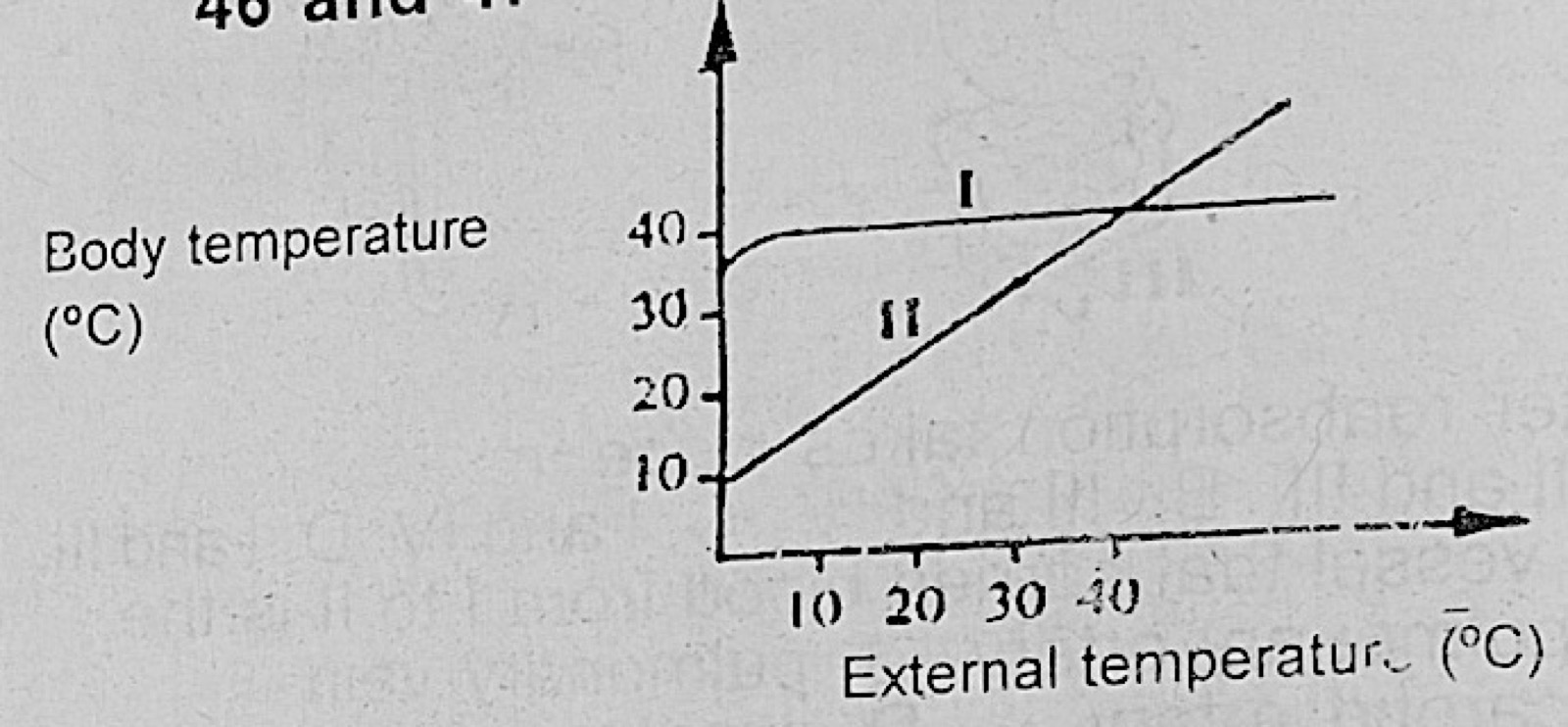
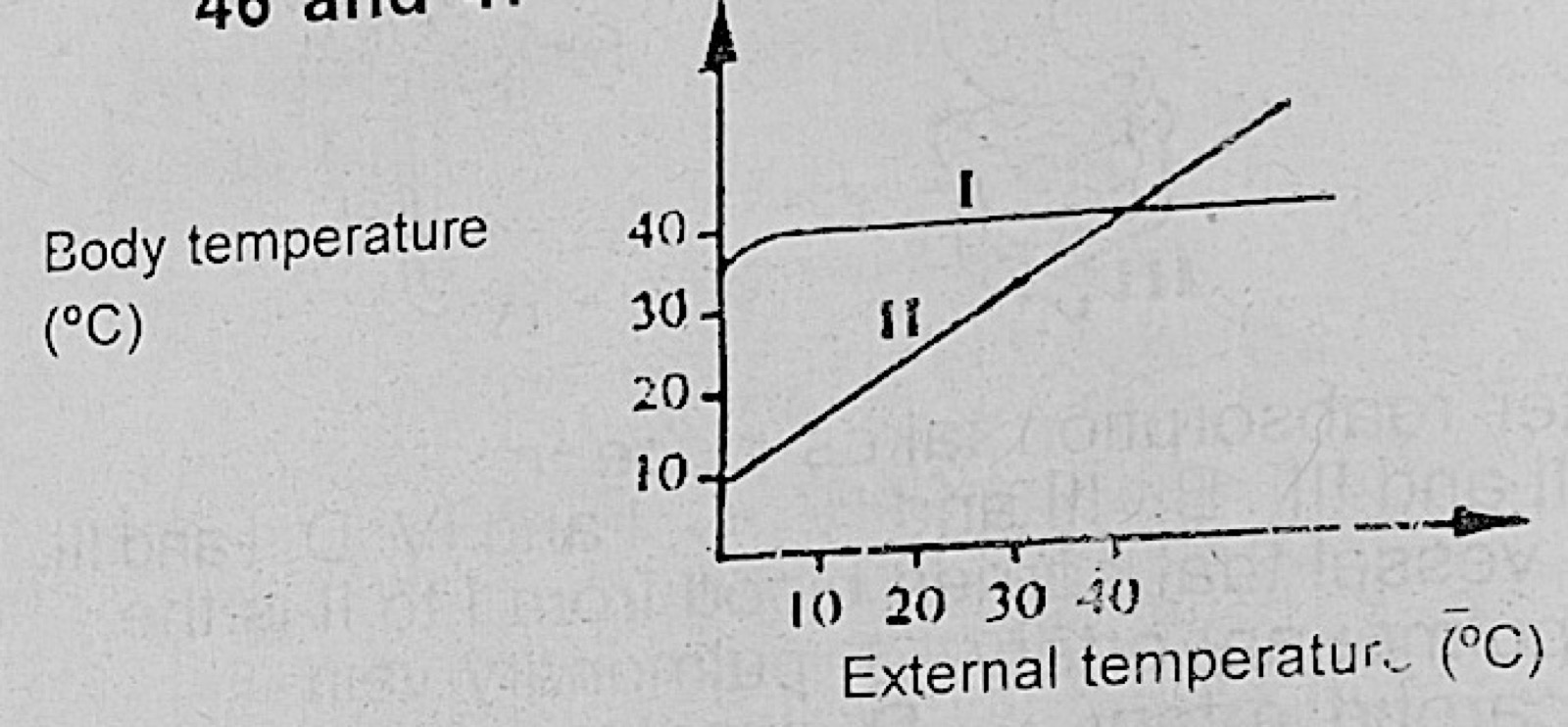
Use the graph to answer: From the graph above, it can be appropriately deduced that
A.the body temperature in II varies with that in I
B.the body temperature in I is independent of external temperature
C.I and II maintain constant body temperature
D.external temperatures affect the body temperature of I and II.
Show the answer and explanation
Answer: B (the body temperature in I is independent of external temperature)
Explanation
Line I stays flat at about 37–40 °C whatever the external temperature, while line II rises with it. So I's body temperature does not depend on its surroundings.
Use the graph to answer: The animal represented by I is a
A.poikilotherm
B.homoiotherm
C.carnivore
D.herbivore.
Show the answer and explanation
Answer: B (homoiotherm)
Explanation
An animal that keeps a constant body temperature, like a bird or mammal, is a homoiotherm (warm-blooded). II, whose temperature follows the surroundings, is a poikilotherm.
Which of the following is the most advanced evolutionary development in plants?
A.Possession of unicellular structures
B.Development of flowers
C.Dispersal of spores
D.Development of secondary thickening
Show the answer and explanation
Answer: B (Development of flowers)
Explanation
Flowers appear only in angiosperms, the most recently evolved and most advanced plant group. Spores and unicellular forms belong to simpler plants, and conifers also have secondary thickening.
The natural process that produces adaptive evolutionary changes is
A.mutation
B.gene flow
C.genetic drift
D.natural selection
Show the answer and explanation
Answer: D (natural selection)
Explanation
Natural selection lets individuals with useful variations survive and breed more, so over generations the population becomes better adapted. Mutation, drift and gene flow change genes at random.