49 questions. Try each one, then open the answer to check yourself and read the explanation.
Question 1
Cell Structure and Organisation
The organelle common to both plant and animal cells is the
A.centriole
B.plasmalemma
C.cell wall
D.chloroplast
Show the answer and explanation
Answer: B (plasmalemma)
Explanation
The plasmalemma (cell membrane) surrounds every cell, plant or animal. Cell walls and chloroplasts are found only in plants, and centrioles mainly in animal cells.
Hydra is a coelenterate with its body parts arranged in a circle around a central axis. Planaria, tapeworms and roundworms are bilaterally symmetrical.
I. Rattus rattus II. Agama agama III. Bufo regularis IV. Tilapia zilli The order of evolutionary advancement of the above vertebrates is
A.I, II, III, IV
B.I, IV, III, II
C.II, III, IV, I
D.IV, III, II, I
Show the answer and explanation
Answer: D (IV, III, II, I)
Explanation
Tilapia is a fish, Bufo a toad (amphibian), Agama a lizard (reptile) and Rattus a rat (mammal). From least to most advanced: fish, amphibian, reptile, mammal = IV, III, II, I.
Blackflies (Simulium) carry the worm that causes onchocerciasis (river blindness). Malaria and yellow fever are spread by mosquitoes, and sleeping sickness by tsetse flies.
The transition from amphibians to mammals involves the limbs becoming arranged to support the weight more effectively requiring modifications in the
A.collar bones and coccyx
B.pectoral and pelvic girdles
C.scapulae and clavicles
D.vertebrae and sternum
Show the answer and explanation
Answer: B (pectoral and pelvic girdles)
Explanation
The limbs are attached to the body by the pectoral (shoulder) and pelvic (hip) girdles. These had to change so the legs could hold the body up off the ground.
In the root vascular system, the stele is directly surrounded by the
A.pericycle
B.cortex
C.endodermis
D.parenchyma
Show the answer and explanation
Answer: C (endodermis)
Explanation
The endodermis is a ring of cells wrapped directly around the stele. The pericycle is the outer layer of the stele itself, and the cortex lies outside the endodermis.
The pleural membranes line the lungs and the chest wall and seal the chest cavity. This airtight seal is what lets the lungs fill when the chest expands.
A test tube containing yeast in glucose solution was suspended in a covered conical flask containing alkaline pyrogallol. The bubbles of carbon (IV) oxide produced indicate that the yeast cells are
A.respiring in the absence of oxygen
B.liberating oxygen on their own
C.living and consuming oxygen
D.being killed by the alcohol produced
Show the answer and explanation
Answer: A (respiring in the absence of oxygen)
Explanation
Alkaline pyrogallol absorbs oxygen, so the yeast has no oxygen. Bubbles of carbon(IV) oxide show it is still respiring anaerobically (fermentation).
The urinary tubules of the kidney function through
A.osmosis and diffusion
B.active transport and osmosis
C.ultrafiltration and selective reabsorption
D.active transport and cytoplasmic streaming
Show the answer and explanation
Answer: C (ultrafiltration and selective reabsorption)
Explanation
Blood is filtered under pressure in the Bowman's capsule (ultrafiltration). Useful substances are then taken back into the blood along the tubule (selective reabsorption).
Hydrostatic skeleton is the type of supporting system found in
A.mammals
B.reptiles
C.oligochaetes
D.arthropods
Show the answer and explanation
Answer: C (oligochaetes)
Explanation
Earthworms (oligochaetes) are supported by fluid under pressure in their body cavity. Mammals and reptiles have bony skeletons and arthropods have exoskeletons.
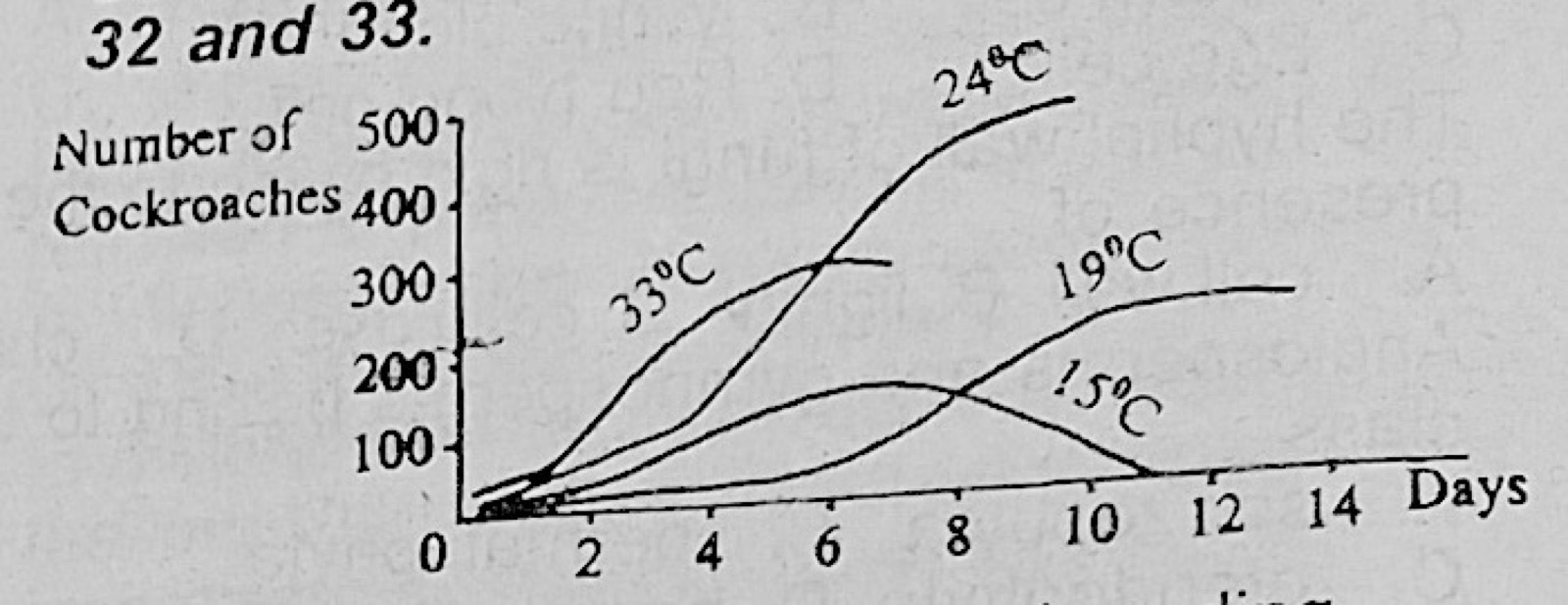
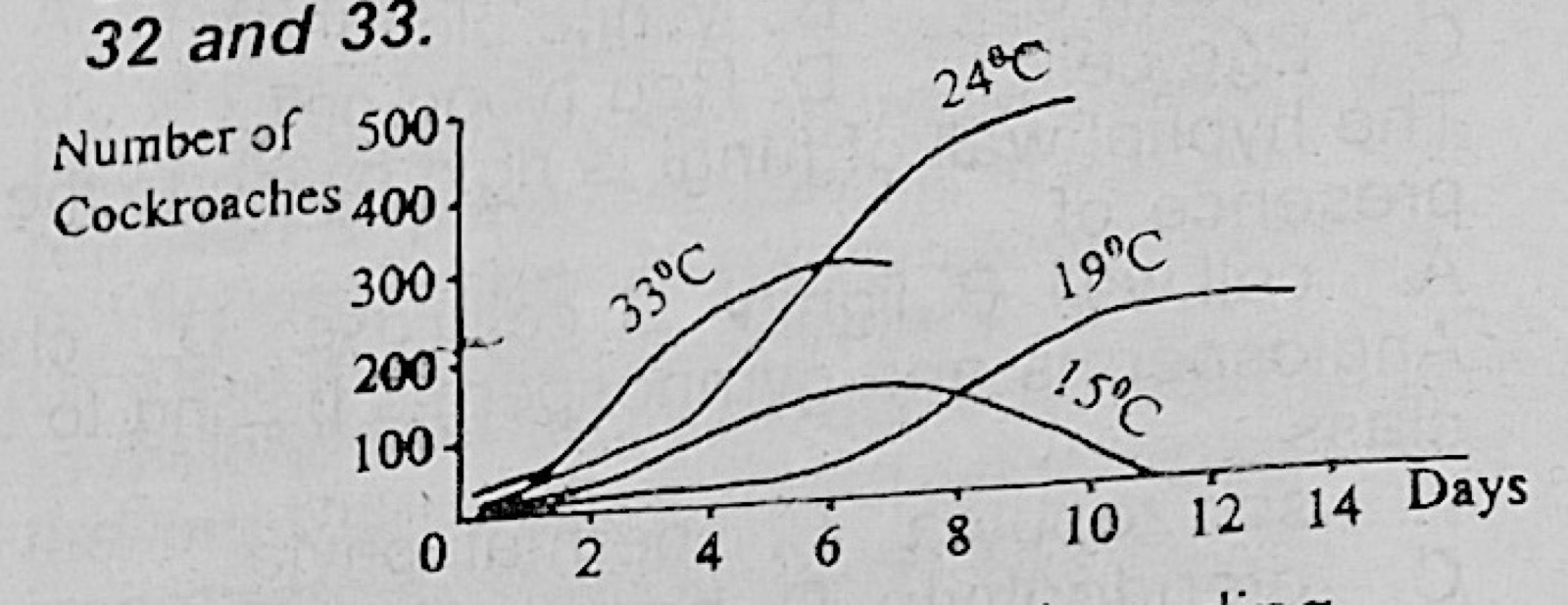
Use the graph to answer: At which temperature will cockroaches not survive after 10 days.
A.15°C
B.19°C
C.24°C
D.33°C
Show the answer and explanation
Answer: A (15°C)
Explanation
Find the curve that drops to zero. The 15°C population peaks at about 7 days and then falls to zero at about 10 days, so cockroaches kept at 15°C do not survive after 10 days.
The population density of Tridax in an abandoned square farmland of side 200 m was found to be 5 plants per m2. The population size of the plant on the farm is
A.40
B.1 000
C.40 000
D.200 000
Show the answer and explanation
Answer: D (200 000)
Explanation
Area = 200 m × 200 m = 40 000 m². Population = 5 × 40 000 = 200 000 plants.
Secondary succession is much faster than primary succession because
A.pioneer colonizers are more in number
B.Soil is already present
C.secondary seres require less nutrients
D.species competition is increased
Show the answer and explanation
Answer: B (Soil is already present)
Explanation
Secondary succession starts on land that already has soil, seeds and nutrients, for example after a fire. Primary succession must first make soil from bare rock, which takes a long time.
Which of the following is used to test for the presence of lime in a soil sample?
A.H2SO4(aq)
B.NaOH(aq)
C.HCl(aq)
D.HNO3(aq)
Show the answer and explanation
Answer: C (HCl(aq))
Explanation
Lime (calcium carbonate) fizzes, giving off carbon(IV) oxide, when dilute hydrochloric acid is added. Sodium hydroxide is an alkali and gives no fizzing.
The importance of practising crop rotation in agriculture is to
A.maintain soil fertility
B.improve the nutritional value of crops
C.control soil erosion
D.ensure the growth of crops
Show the answer and explanation
Answer: A (maintain soil fertility)
Explanation
Different crops use different nutrients, and legumes add nitrogen. Rotating crops stops one set of nutrients from being used up, keeping the soil fertile.