Home › Past questions › JAMB › Biology › 1991 50 questions. Try each one, then open the answer to check yourself and read the explanation.
Sign up free to answer these questions on a CBT screen with a timer, then see your score and every answer explained.
Start practising free
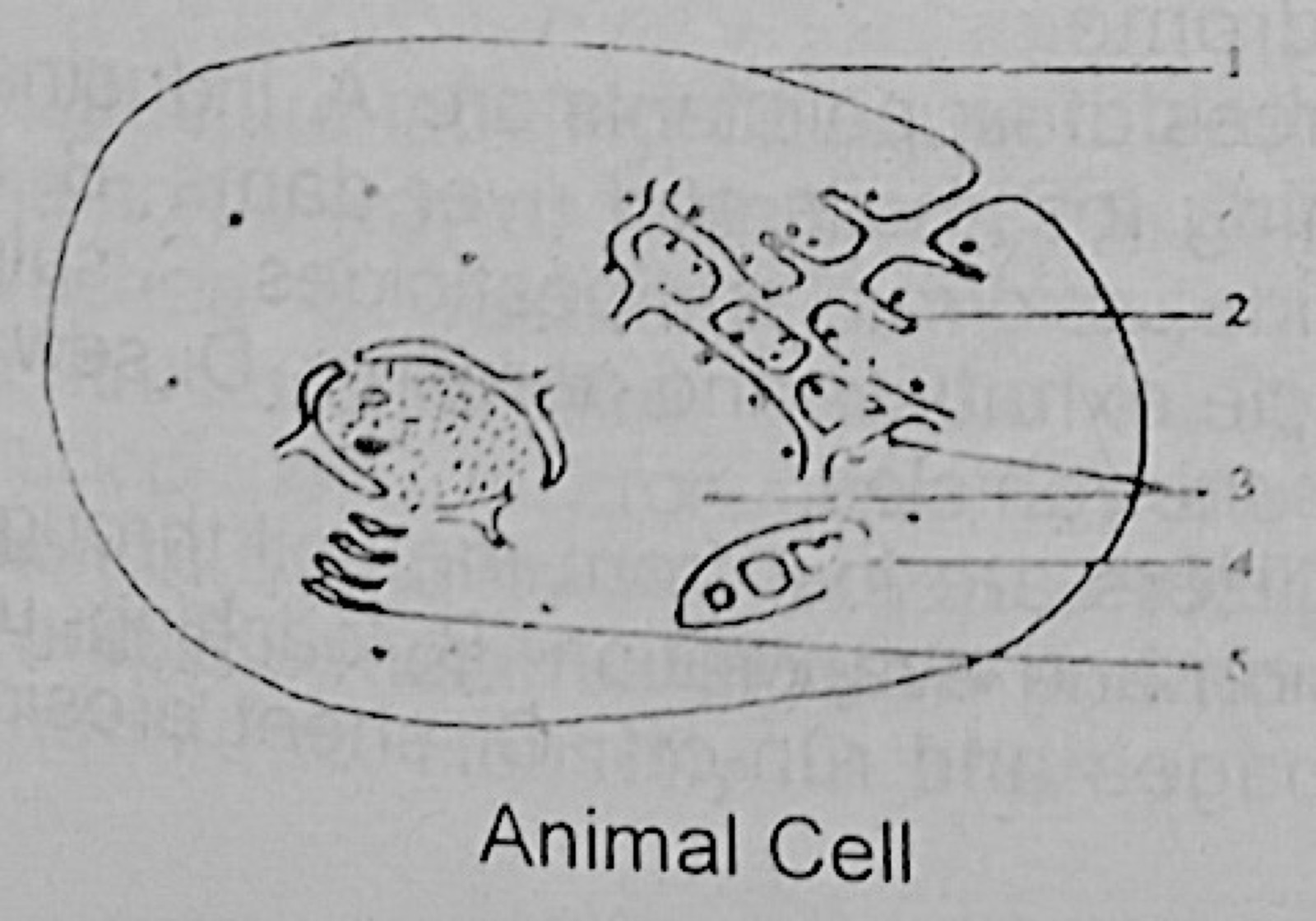
Question 1 Cell Structure and Organisation Use the figure (an animal cell) to answer: Which of the following structures is associated with aerobic respiration?
A. 1 B. 2 C. 3 D. 4 Show the answer and explanation Answer: D (4 )
Explanation Structure 4 is a mitochondrion (oval body with folded inner membrane), where aerobic respiration takes place.
Open this question
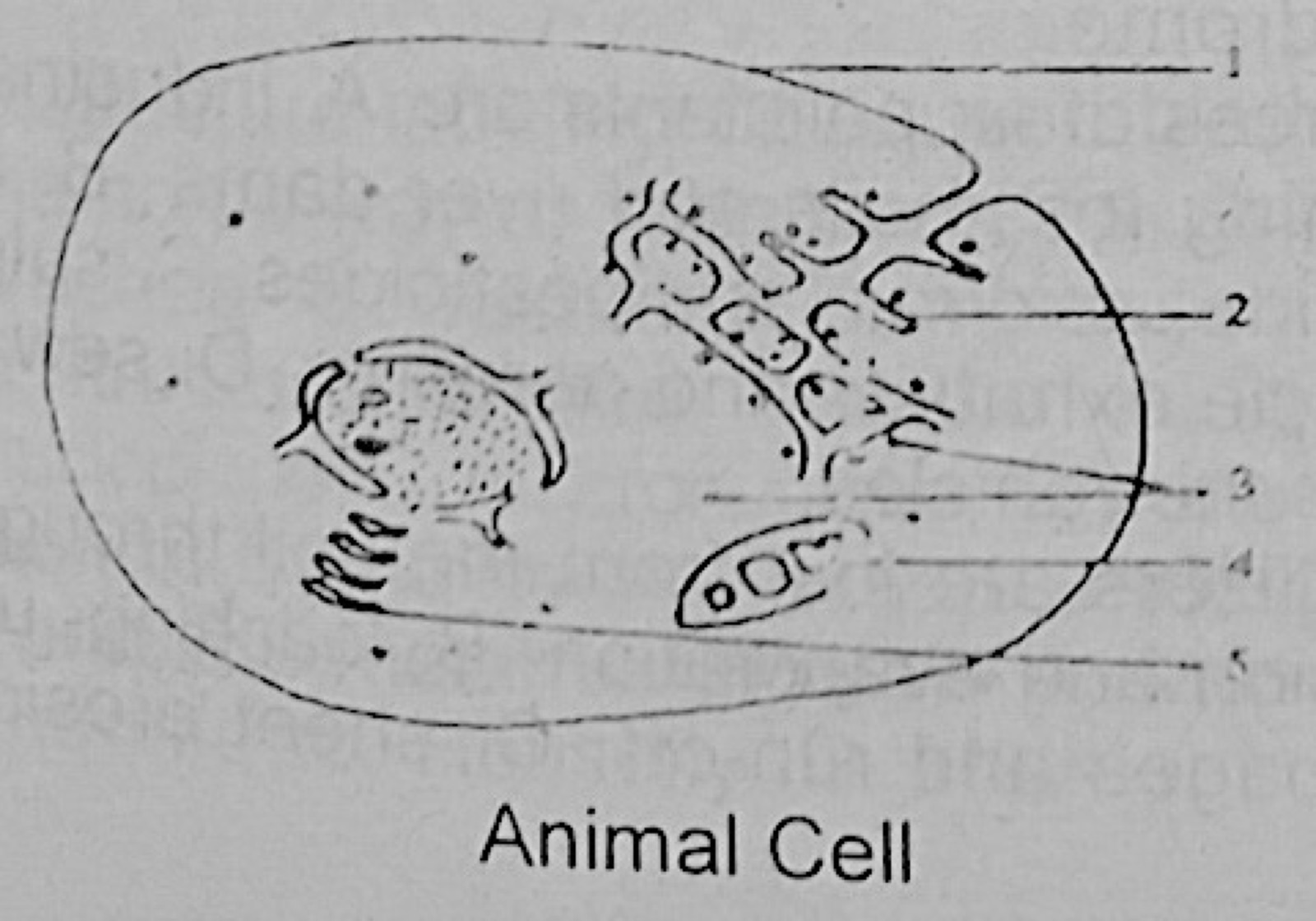
Question 2 Cell Structure and Organisation Use the figure (an animal cell) to answer: The structure labelled 5 is used for
A. protein synthesis B. energy production C. secretion D. excretion Show the answer and explanation Answer: C (secretion )
Explanation Structure 5 is the Golgi body, which packages substances such as enzymes and mucus for secretion.
Open this question
Question 3 Plant Kingdom Angiosperms and gymnosperms belong to the plant group known as
A. schizophyta B. bryophyta C. pteridophyta D. spermatophyta Show the answer and explanation Answer: D (spermatophyta )
Explanation Both produce seeds, so they are seed plants (spermatophyta).
Open this question
Question 4 Viruses, Monera, Protista and Fungi Which of the following are non-green plants?
A. Euglena B. Fungi C. Spirogyra D. Angiosperms Show the answer and explanation Answer: B (Fungi )
Explanation Fungi have no chlorophyll, so they cannot make their own food.
Open this question
Question 5 Animal Kingdom Sting cells are normally found in
A. Flatworms B. Hydra C. Snails D. Paramecium Show the answer and explanation Answer: B (Hydra )
Explanation Sting cells (cnidoblasts) on the tentacles are a feature of coelenterates such as Hydra.
Open this question
Question 6 Plant Kingdom Which of the following are differentiated into true roots, stems and leaves?
A. Algae B. Schizophyta C. Pteridophyta D. Bryophyta Show the answer and explanation Answer: C (Pteridophyta )
Explanation Ferns (pteridophytes) are the simplest plants with vascular tissue and true roots, stems and leaves; mosses have only rhizoids.
Open this question
Question 7 Respiration To facilitate gaseous exchange, breathing roots have
A. stomata B. mitochondria C. cuticle D. lenticels Show the answer and explanation Answer: D (lenticels )
Explanation Breathing roots (pneumatophores) of mangroves have many lenticels, pores through which air enters.
Open this question
Question 8 Plant Kingdom The annulus of fern sporangium helps in
A. spore dispersal B. conduction of mineral salts C. trapping of light energy D. water retention Show the answer and explanation Answer: A (spore dispersal )
Explanation As the annulus dries it tears the sporangium open and flicks the spores out.
Open this question
Question 9 Viruses, Monera, Protista and Fungi One of the features which adapts Paramecium to its environment is the possession of
A. a regular shape B. two nuclei C. cilia D. a pellicle Show the answer and explanation Answer: C (cilia )
Explanation Cilia let Paramecium swim through water and sweep food into its oral groove.
Open this question
Question 10 Reproduction in Animals In the earthworm, the cocoon is secreted by the
A. chaeta B. prostomium C. peristomium D. clitellum Show the answer and explanation Answer: D (clitellum )
Explanation The clitellum, the swollen band on the earthworm, secretes the cocoon that holds the eggs.
Open this question
Question 11 Animal Kingdom The function of maxillipeds in crayfish is to aid
A. walking B. swimming C. feeding D. respiration Show the answer and explanation Answer: C (feeding )
Explanation Maxillipeds are mouth appendages that hold and pass food to the jaws.
Open this question
Question 12 Respiration The respiratory organ in the land snail is the
A. radula B. mantle C. tentacle D. foot Show the answer and explanation Answer: B (mantle )
Explanation The land snail breathes through its mantle cavity, whose wall is rich in blood vessels and acts as a lung.
Open this question
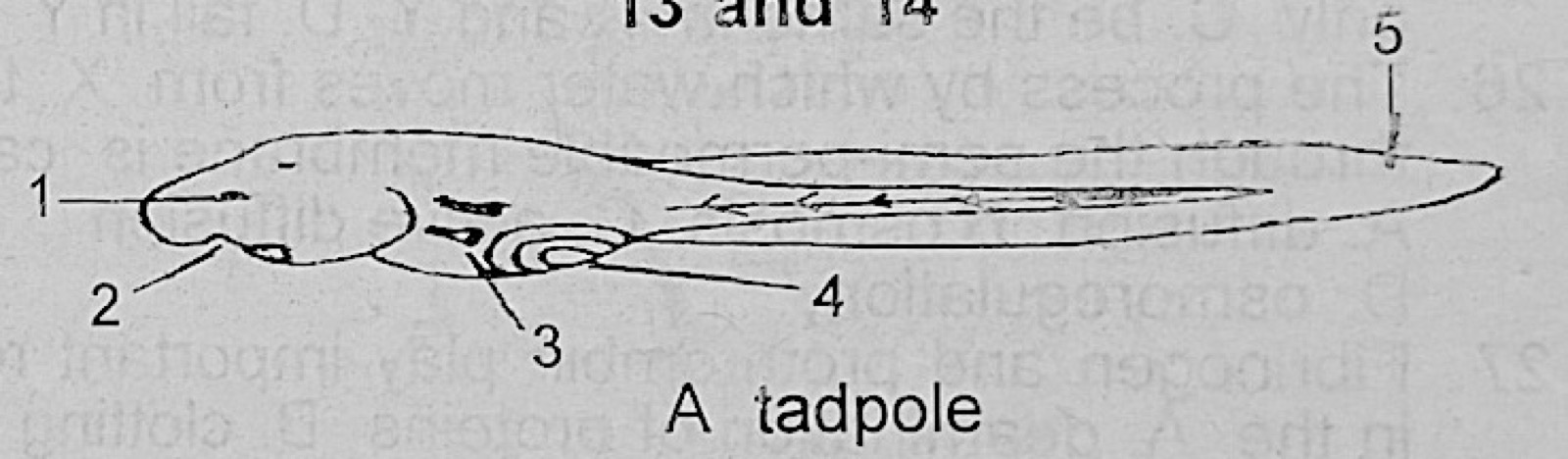
Question 13 Animal Kingdom Use the figure (a tadpole) to answer: The structure labelled 4 is for
A. feeding B. attachment C. excretion D. respiration Show the answer and explanation Answer: A (feeding )
Explanation Structure 4 is the long, coiled intestine seen through the belly wall, used in feeding (digesting plant food).
Open this question
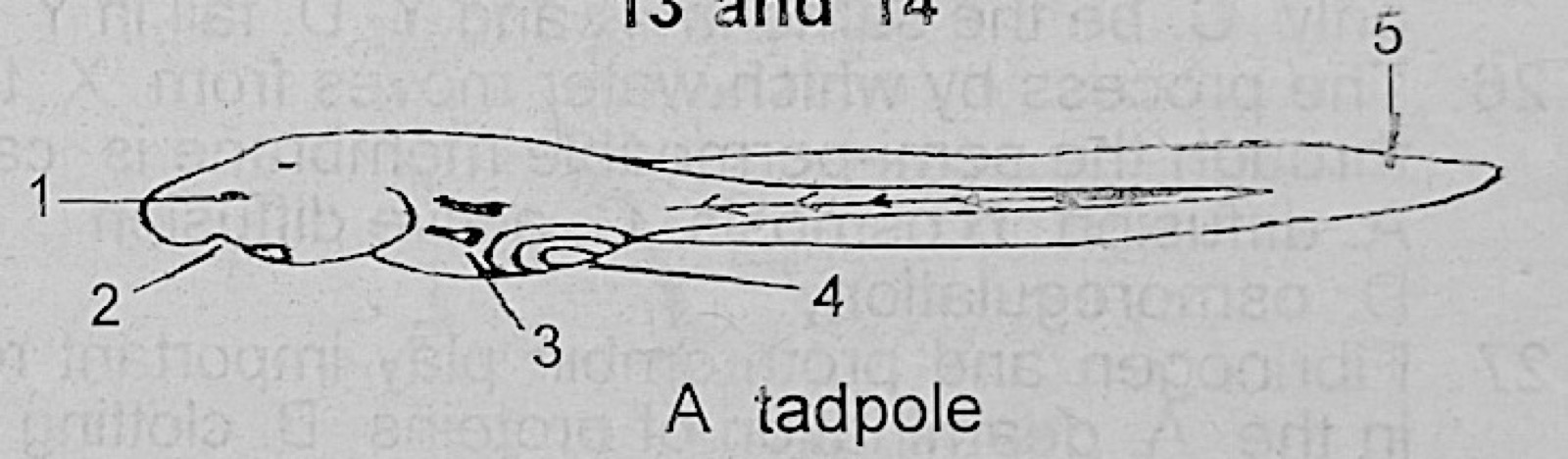
Question 14 Reproduction in Animals Use the figure (a tadpole) to answer: As the tadpole develops, the structure labelled 5
A. grows longer B. becomes shorter C. becomes the hind legs D. remains unchanged Show the answer and explanation Answer: B (becomes shorter )
Explanation Structure 5 is the tail, which is gradually absorbed during metamorphosis, so it becomes shorter.
Open this question
Question 15 Animal Nutrition The gill rakers of fishes take part in
A. feeding B. respiration C. swimming D. diffusion Show the answer and explanation Answer: A (feeding )
Explanation Gill rakers are bony projections on the gill arches that strain food particles from the water and keep them away from the gill filaments.
Open this question
Question 16 Structure of Flowering Plants A wide pith with a ring of conducting tissue is characteristic of the root of
A. sunflower B. maize C. bean D. okra Show the answer and explanation Answer: B (maize )
Explanation A monocot root such as maize has many xylem and phloem groups in a ring around a large central pith; dicot roots have little or no pith.
Open this question
Question 17 Photosynthesis and Plant Nutrition Which of the following is formed immediately after the first product of photosynthesis?
A. Lipid B. Starch C. Oxygen D. Sugar Show the answer and explanation Answer: B (Starch )
Explanation The first product is sugar (glucose), which is quickly changed into starch for storage.
Open this question
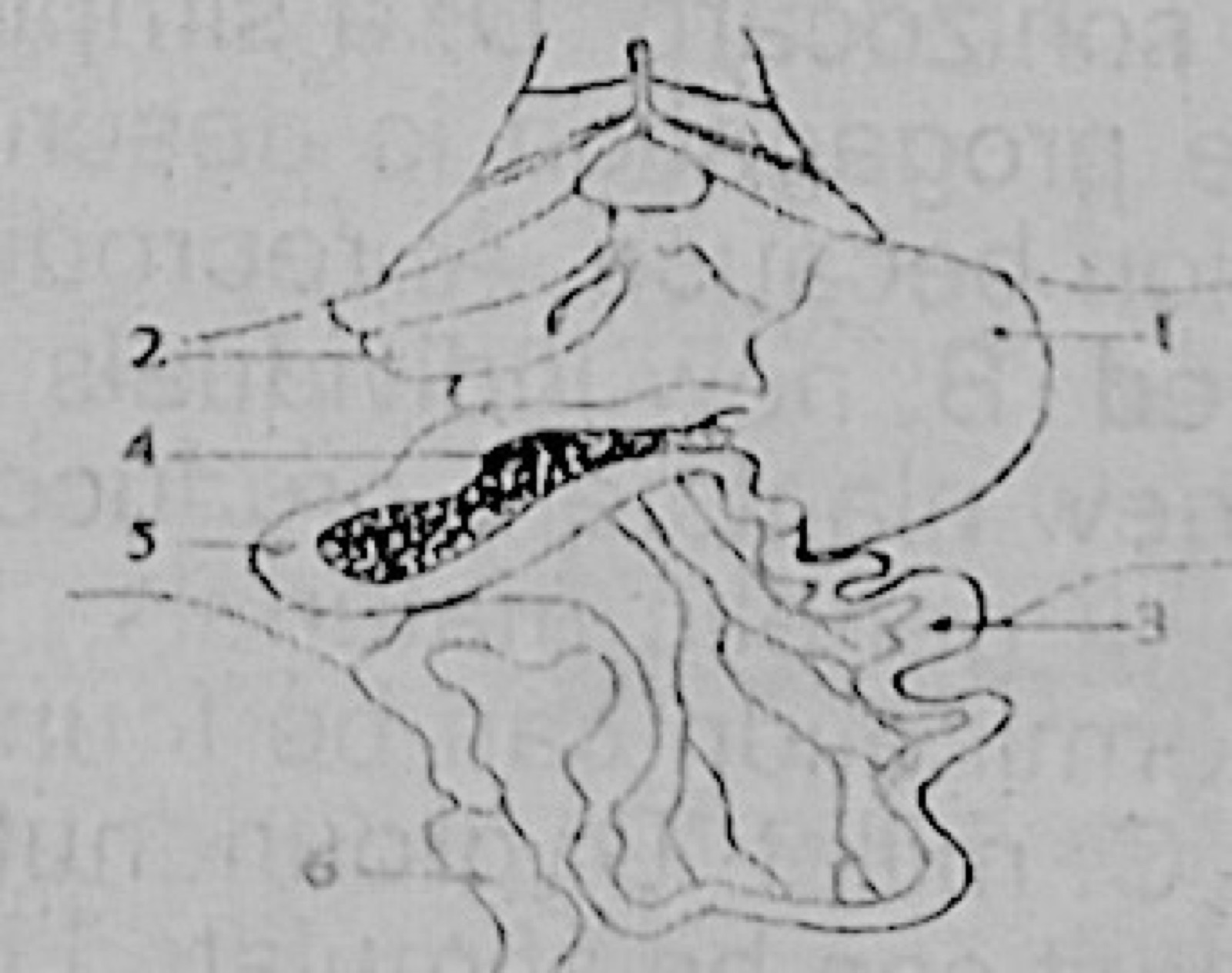
Question 18 Animal Nutrition Use the figure (dissection showing the abdominal cavity of a rat) to answer: In the digestive system, absorption of nutrients into the blood takes place in the part labelled
A. 1 B. 2 C. 3 D. 4 Show the answer and explanation Answer: C (3 )
Explanation Digested food is absorbed in the small intestine, the coiled tube labelled 3.
Open this question
Question 19 Animal Nutrition Use the figure (dissection showing the abdominal cavity of a rat) to answer: The gland which produces trypsin, amylase and lipase is labelled
A. 6 B. 4 C. 2 D. 1 Show the answer and explanation Answer: B (4 )
Explanation These three enzymes are in pancreatic juice, so the gland is the pancreas, labelled 4.
Open this question
Question 20 Animal Nutrition One of the accessory organs of the digestive system is the
A. kidney B. spleen C. liver D. lung Show the answer and explanation Answer: C (liver )
Explanation Accessory digestive organs are not part of the gut tube but help digestion; the liver makes bile.
Open this question
Question 21 Food Substances and Enzymes The element common to protein, carbohydrate and lipid is
A. hydrogen B. sulphur C. nitrogen D. phosphorus Show the answer and explanation Answer: A (hydrogen )
Explanation All three are made of carbon, hydrogen and oxygen; nitrogen and sulphur occur only in proteins.
Open this question
Question 22 Animal Nutrition The crown of the mammalian tooth is covered with
A. cement B. dentine C. caries D. enamel Show the answer and explanation Answer: D (enamel )
Explanation Enamel, the hardest substance in the body, covers the crown; cement covers the root.
Open this question
Question 23 Respiration In living cells, insufficient oxygen may cause a breakdown of glucose into
A. fatty acids B. lactic acids C. glycogen D. carbondioxide Show the answer and explanation Answer: B (lactic acids )
Explanation Without enough oxygen, muscle cells break glucose down only to lactic acid (anaerobic respiration).
Open this question
Question 24 Transport in Plants Which of the following can bring about the greatest increase in the rate of transpiration?
A. Increased humidity B. Reduced temperature C. Reduced wind speed D. Reduced humidity Show the answer and explanation Answer: D (Reduced humidity )
Explanation Dry air (low humidity) makes water vapour diffuse out of leaves faster; the other three slow transpiration down.
Open this question
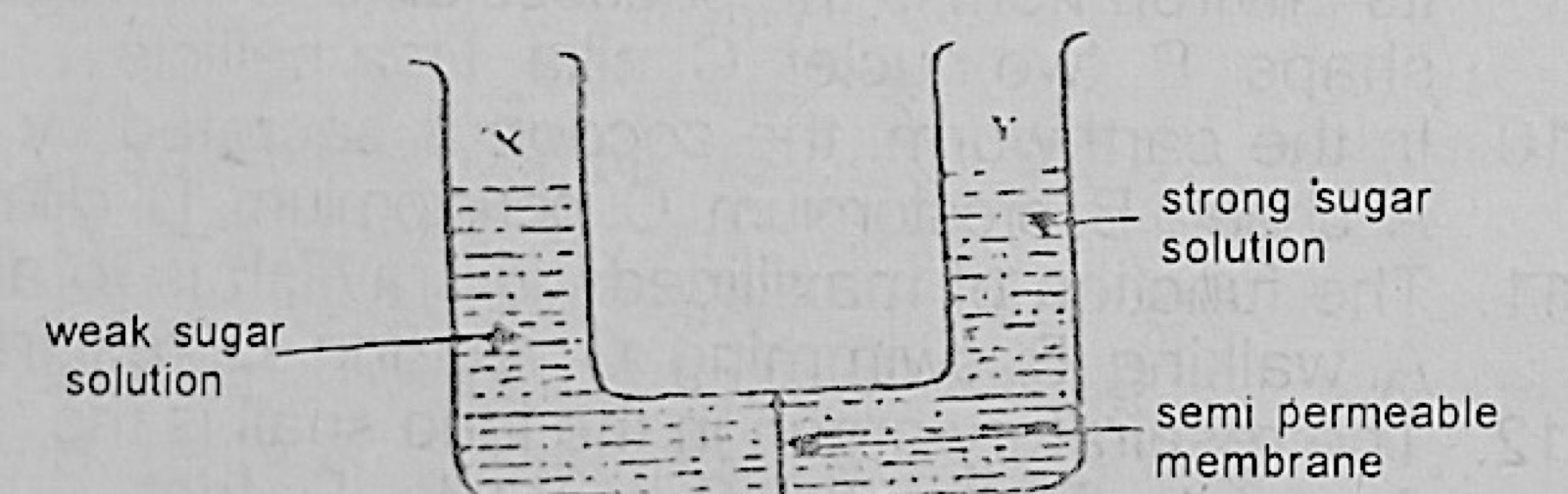
Question 25 Cell and Its Environment Use the figure (U-tube with weak sugar solution in X and strong sugar solution in Y, separated by a semi permeable membrane) to answer: After 30 minutes, the level of sugar solution in the above figure will
A. rise in X only B. rise in Y only C. be the same in X and Y D. fall in Y Show the answer and explanation Answer: B (rise in Y only )
Explanation Water moves by osmosis from the weak solution (X) into the strong solution (Y), so the level in Y rises.
Open this question
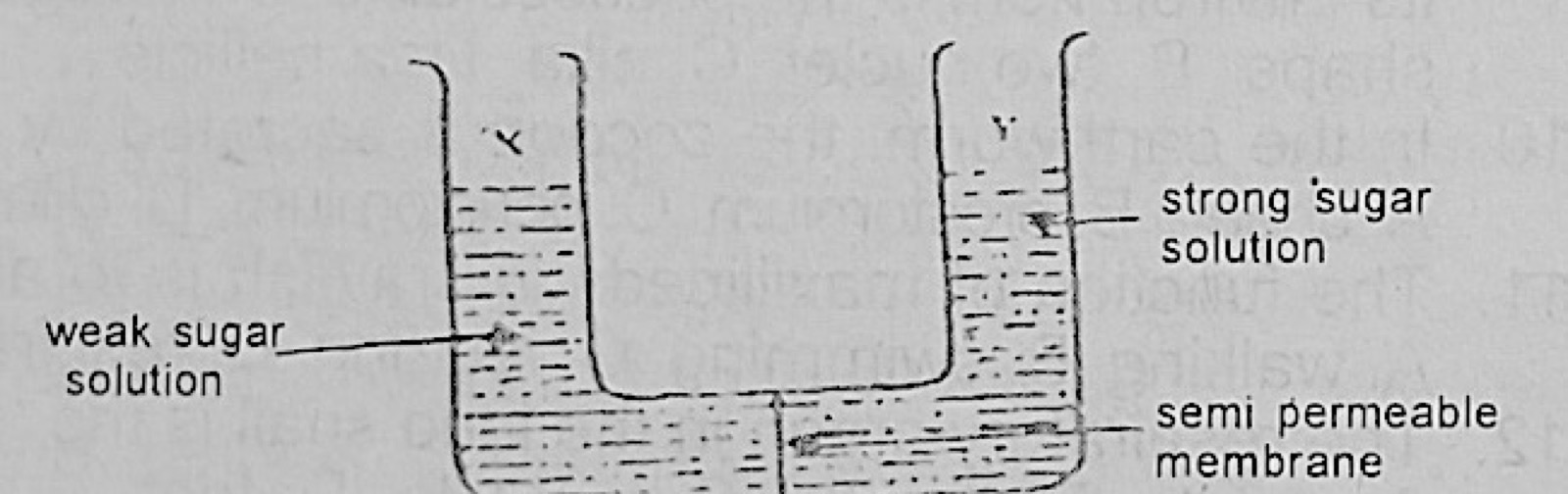
Question 26 Cell and Its Environment Use the figure (U-tube with a semi permeable membrane) to answer: The process by which water moves from X to Y through the semi-permeable membrane is called
A. diffusion B. osmosis C. active diffusion D. osmoregulation Show the answer and explanation Answer: B (osmosis )
Explanation Movement of water from a dilute to a concentrated solution through a semi-permeable membrane is osmosis.
Open this question
Question 27 Transport in Animals Fibrinogen and prothrombin play important roles in the
A. deamination of proteins B. clotting of blood C. detoxication of substances D. storage of vitamins Show the answer and explanation Answer: B (clotting of blood )
Explanation Prothrombin is turned into thrombin, which changes fibrinogen into fibrin threads that form a clot.
Open this question
Question 28 Transport in Animals Deoxygenated blood flows into the right and left lungs through the
A. pulmonary vein B. vena cava C. pulmonary artery D. subclavian vein Show the answer and explanation Answer: C (pulmonary artery )
Explanation The pulmonary artery carries deoxygenated blood from the right ventricle to the lungs; it is the only artery carrying deoxygenated blood.
Open this question
Question 29 Excretion Which of the following is a plant excretory product?
A. Oil B. Cytokinin C. Resin D. Amino acids Show the answer and explanation Answer: C (Resin )
Explanation Resin is a waste product stored by plants such as pines; cytokinin is a hormone and amino acids are used to make protein.
Open this question
Question 30 Plant Responses and Hormones The movement of the whole organism to an external stimulus is termed
A. tropism B. a taxis C. a nastic movement D. a phototropic movement Show the answer and explanation Answer: B (a taxis )
Explanation A taxis is the movement of a whole organism towards or away from a stimulus.
Open this question
Question 31 Support and Movement Which of the following vertebrae lacks a centrum?
A. Atlas B. Axis C. Thoracic D. Lumbar Show the answer and explanation Answer: A (Atlas )
Explanation The atlas is a ring of bone with no centrum; its centrum has joined the axis to form the odontoid process.
Open this question
Question 32 Reproduction in Animals The function of the epididymis in mammals is the
A. expulsion of urine B. storage of sperms C. circulation of blood D. activation of sperms Show the answer and explanation Answer: B (storage of sperms )
Explanation The epididymis is a coiled tube beside the testis where sperms are stored and mature.
Open this question
Question 33 Reproduction in Plants A collection of achenes formed from several carpels of a flower is
A. a multiple fruit B. an aggregate fruit C. a schizocarp D. a simple fruit Show the answer and explanation Answer: B (an aggregate fruit )
Explanation An aggregate fruit, such as the strawberry, forms from many free carpels of one flower.
Open this question
Question 34 Reproduction in Plants Vegetative progagation is described as asexual reproduction because
A. reproductive organs are not involved B. new individuals are not formed C. many new plants are produced D. there is no exchange of genetic materials Show the answer and explanation Answer: D (there is no exchange of genetic materials )
Explanation No gametes fuse, so there is no mixing of genetic material; the new plants are identical to the parent.
Open this question
Question 35 Growth and Development Epigeal germination can be found in
A. sorghum B. maize C. millet D. groundnut Show the answer and explanation Answer: D (groundnut )
Explanation In groundnut the cotyledons are lifted above the soil (epigeal); sorghum, maize and millet are cereals with hypogeal germination.
Open this question
Question 36 Plant Responses and Hormones A dwarf plant can be stimulated to grow to normal height by the application of
A. thyroxin B. gibberellin C. insulin D. kinin Show the answer and explanation Answer: B (gibberellin )
Explanation Gibberellins cause stem elongation, so they make dwarf plants grow tall.
Open this question
Question 37 Mendelian Inheritance The greatest contribution to genetic studies was made by
A. Thomas Morgan B. Gregor Mendel C. Charles Darwin D. Robert Hooke Show the answer and explanation Answer: B (Gregor Mendel )
Explanation Gregor Mendel's pea experiments discovered the basic laws of inheritance; he is called the father of genetics.
Open this question
Question 38 Chromosomes, DNA and Sex Linkage The exchange of genes between homologous chromosomes is called
A. test cross B. back cross C. crossing-over D. mutation Show the answer and explanation Answer: C (crossing-over )
Explanation During meiosis homologous chromosomes swap segments; this is crossing-over.
Open this question
Question 39 Mendelian Inheritance When two heterozygotes mate, the dominant trait will appear in
A. the F1 generation only B. the F2 generation only C. both the F1 and F2 generations D. neither the F1 nor F2 generation Show the answer and explanation Answer: C (both the F1 and F2 generations )
Explanation Heterozygotes (Tt) crossed give 3 dominant : 1 recessive, and the dominant trait keeps showing in later generations too.
Open this question
Question 40 Chromosomes, DNA and Sex Linkage Which of the following characters is NOT sex-linked?
A. River blindness B. Baldness C. Haemophilia D. Colour blindness Show the answer and explanation Answer: A (River blindness )
Explanation River blindness is an infection caused by a worm spread by blackflies, not an inherited trait.
Open this question
Question 41 Ecosystem and Ecological Factors The most important factors which influence an organism's way of life in its habitat are
A. the physical and biotic environment B. food and water availability C. temperature, water, light and predator-prey relationship D. competition for food and space Show the answer and explanation Answer: C (temperature, water, light and predator-prey relationship )
Explanation An organism's way of life is shaped by physical factors (temperature, water, light) together with biotic ones such as predators and prey.
Open this question
Question 42 Feeding Relationships and Energy Flow Organisms in an ecosystem are usually grouped according to their trophic level as
A. carnivores and epiphytes B. consumers and parasites C. producers and consumers D. producers and saprophytes Show the answer and explanation Answer: C (producers and consumers )
Explanation Trophic levels are feeding levels: producers make food, and consumers eat it.
Open this question
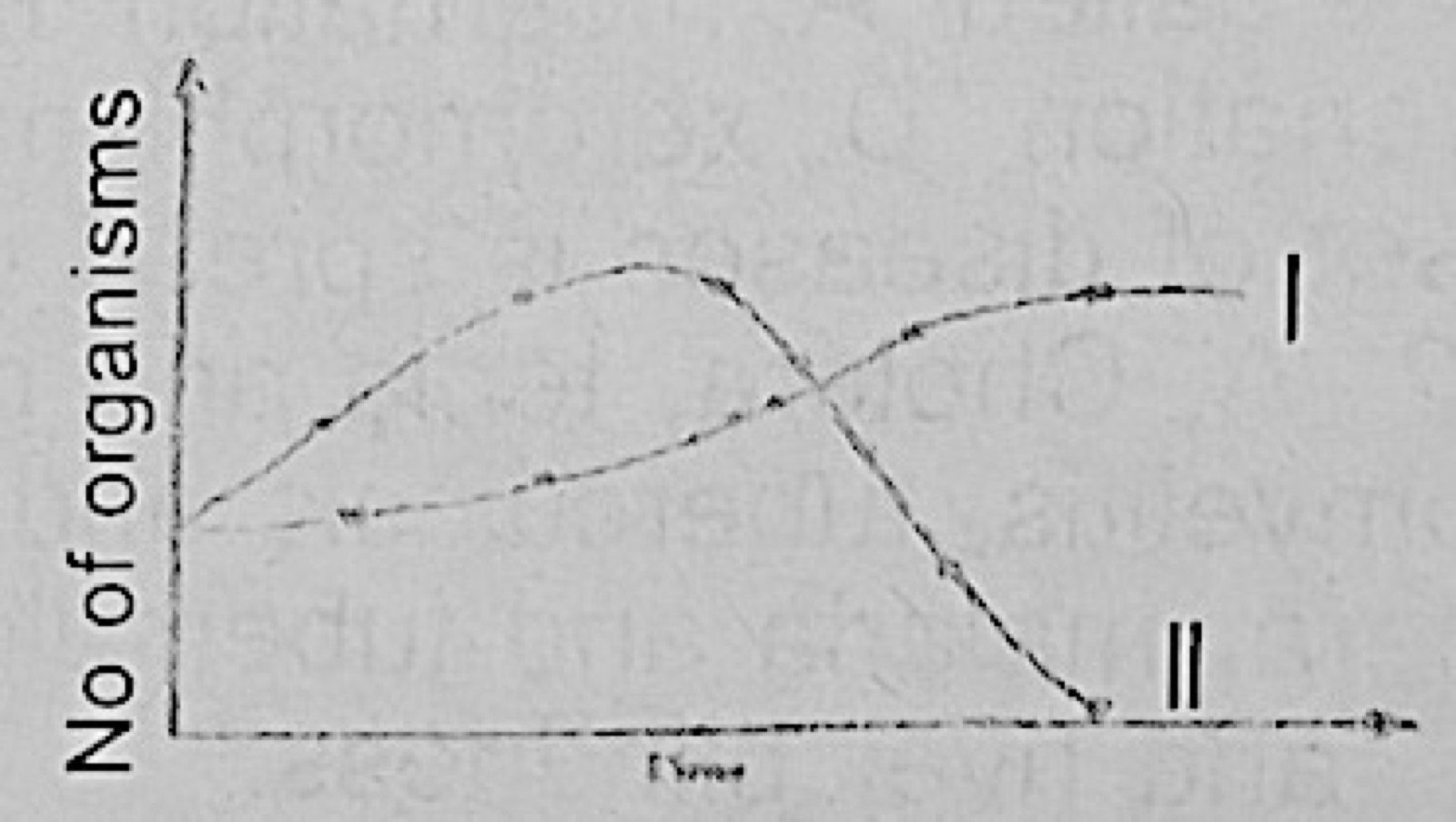
Question 43 Population Ecology Use the graph (number of organisms against time for communities I and II): The above diagram represents a competitive interaction between organisms in communities I and II. Which of the following statements is CORRECT?
A. The population of I was higher than II at the beginning of the experiment B. II was wiped out from the environment at the end of the experiment C. The population of II was always lower than that of I D. The population of I was lower at the end of the experiment than at the beginning Show the answer and explanation Answer: B (II was wiped out from the environment at the end of the experiment )
Explanation Curve II rises, then falls to zero at the end, so II was eliminated by the competition; I rose and levelled off.
Open this question
Question 44 Feeding Relationships and Energy Flow A food web is more stable than a food chain because
A. it contains more organisms B. it has greater energy source C. it is not easy to destroy D. every organism has an alternative source Show the answer and explanation Answer: D (every organism has an alternative source )
Explanation In a food web each animal has more than one food source, so losing one source does not starve it.
Open this question
Question 45 Habitats and Biomes Which of the following is likely to occur in a deciduous forest during the dry season?
A. New leaves are formed B. The trees die off C. The undergrowth increases D. The ground becomes bare Show the answer and explanation Answer: D (The ground becomes bare )
Explanation Deciduous trees shed their leaves and the undergrowth dries up in the dry season, leaving the forest floor exposed.
Open this question
Question 46 Adaptation Which of these is NOT an adaptive feature for arboreal life?
A. Possession of a long tail B. Possession of claws C. Possession of teeth D. Counter shading in coat colour Show the answer and explanation Answer: C (Possession of teeth )
Explanation A long tail helps balance, claws help grip bark and counter shading hides animals among branches, but teeth have nothing to do with living in trees.
Open this question
Question 47 Microorganisms and Health Which of the following diseases can be prevented by inoculation?
A. Syphilis B. Malaria fever C. Tuberculosis D. Acquired Immuned Deficiency Syndrome Show the answer and explanation Answer: C (Tuberculosis )
Explanation Tuberculosis can be prevented by the BCG vaccine; there is no routine vaccine for the others.
Open this question
Question 48 Pollution Sources of air pollutants are
A. industrial chimneys, burning fossil oils and river dams B. sulphur dioxide, acid rain and pesticides C. sulphur mines, vehicle exhausts and aerosols D. sewage, smoke and old vehicles Show the answer and explanation Answer: C (sulphur mines, vehicle exhausts and aerosols )
Explanation All three in C release harmful gases or particles into the air; river dams and sewage are not air-pollution sources, and B lists pollutants, not sources.
Open this question
Question 49 Soil Fertilizers are lost from the soil through
A. sheet erosion and evaporation B. leaching, underground seepages and run-off C. sheet erosion, gully erosion and wind erosion D. wind erosion and heavy rainfall Show the answer and explanation Answer: B (leaching, underground seepages and run-off )
Explanation Dissolved fertilizer is washed down by leaching and seepage or carried away by surface run-off.
Open this question
Question 50 Nutrient Cycling Nitrogen-fixing micro-organisms in leguminous plants live symbiotically in the
A. root nodules B. tap roots C. branch roots D. root hairs Show the answer and explanation Answer: A (root nodules )
Explanation Rhizobium bacteria live inside the swellings (nodules) on legume roots.
Open this question Sign up free for every JAMB Biology year, practice by topic and timed mocks.
Start practising free