Home › Past questions › JAMB › Biology › 1987 49 questions. Try each one, then open the answer to check yourself and read the explanation.
Sign up free to answer these questions on a CBT screen with a timer, then see your score and every answer explained.
Start practising free
Question 1 Cell Structure and Organisation The function of endoplasmic reticulum is
A. protein synthesis B. intracellular transport of materials C. digestion and destruction of foreign bodies D. production of energy from glucose. Show the answer and explanation Answer: B (intracellular transport of materials )
Explanation The endoplasmic reticulum is a network of membrane channels through the cytoplasm that carries materials from one part of the cell to another.
Open this question
Question 2 Viruses, Monera, Protista and Fungi Which of the following features of euglena is found only in animals?
A. Paramylum granules B. Flagellum C. Pellicle D. Pyrenoid Show the answer and explanation Answer: C (Pellicle )
Explanation Euglena is covered by a flexible pellicle instead of a cellulose cell wall, an animal-like feature. Pyrenoids and stored carbohydrate are plant-like.
Open this question
Question 3 Ecological Associations An organism found on a bare rock surface has features of algae and fungi. The organism is
A. an epiphyte B. a lichen C. a bryophyte D. a fern Show the answer and explanation Answer: B (a lichen )
Explanation A lichen is an alga and a fungus living together; it can grow on bare rock and is often the first coloniser there.
Open this question
Question 4 Plant Kingdom In a plant exhibiting alternation of generations, the diploid multicellular stage is known as
A. gametophyte B. spermatophyte C. holophyte D. sporophyte. Show the answer and explanation Answer: D (sporophyte. )
Explanation The diploid generation produces spores by meiosis, so it is called the sporophyte. The haploid generation makes gametes and is the gametophyte.
Open this question
Question 5 Plant Kingdom A characteristic that distinguishes bryophytes from flowering plants is the
A. possession of true stems and leaves B. ability to reproduce asexually C. absence of vascular tissues D. ability to grow in moist habitats. Show the answer and explanation Answer: C (absence of vascular tissues )
Explanation Bryophytes have no xylem or phloem, while flowering plants have well-developed vascular tissues.
Open this question
Question 6 Animal Kingdom A good example of a disploblastic organism is
A. amoeba B. hydra C. earthworm D. roundworm. Show the answer and explanation Answer: B (hydra )
Explanation Hydra's body is made of two cell layers, the ectoderm and endoderm, so it is diploblastic. Earthworms and roundworms have three layers, and amoeba is a single cell.
Open this question
Question 7 Reproduction in Animals The function of the clitellum in the earthworm is to
A. aid digestion B. prevent desiccation C. assist locomotion D. secrete cocoon. Show the answer and explanation Answer: D (secrete cocoon. )
Explanation The clitellum is a thick glandular band that secretes the cocoon in which the earthworm's eggs are laid.
Open this question
Question 8 Animal Kingdom The crayfish is an arthropod because
A. its body consists of a cephalothorax and an abdomen B. it has a pair each of antennae and antennules C. every segment of its body carries a pair of appendages D. its body is covered with an exoskeleton made of chitin. Show the answer and explanation Answer: D (its body is covered with an exoskeleton made of chitin. )
Explanation A chitinous exoskeleton (with jointed limbs) is a feature of all arthropods. A cephalothorax and antennules are found only in some groups, such as crustaceans.
Open this question
Question 9 Viruses, Monera, Protista and Fungi The hypha of Rhizopus is said to be coenocytic because it
A. does not contain chlorophyll B. has no cross walls C. is vacuolated D. stores oil globules. Show the answer and explanation Answer: B (has no cross walls )
Explanation A coenocytic hypha has no cross walls, so it is one long tube of cytoplasm with many nuclei.
Open this question
Question 10 Plant Kingdom In most true ferns sporangia are grouped into
A. indusium B. fronds C. prothalli D. sori Show the answer and explanation Answer: D (sori )
Explanation On the underside of a fern frond, sporangia are grouped in clusters called sori, each often covered by an indusium.
Open this question
Question 11 Plant Kingdom In the reproduction of mosses, water is essential because
A. they live in moist habitats B. they cannot reproduce without water C. the male gametes must swim to fertilize the ovum D. they produce spores. Show the answer and explanation Answer: C (the male gametes must swim to fertilize the ovum )
Explanation Moss sperms (antherozoids) have flagella and must swim through a film of water to reach the egg in the archegonium.
Open this question
Question 12 Animal Kingdom In tapeworm, the two structures that run throughout the length of the body are the
A. nerve cord and the excretory duct B. sperm duct and the nerve cord C. genital pore and the excretory duct D. sperm duct and the genital pore. Show the answer and explanation Answer: A (nerve cord and the excretory duct )
Explanation The nerve cords and excretory canals run continuously through every proglottid. Each proglottid has its own sperm duct and genital pore.
Open this question
Question 13 Animal Kingdom Which of the following is NOT a characteristic of snails?
A. Bilateral symmetry B. Chitinous exoskeleton C. Muscular foot D. Soft unsegmented body in a mantle. Show the answer and explanation Answer: B (Chitinous exoskeleton )
Explanation A chitinous exoskeleton is a feature of arthropods. The snail's shell is made of calcium carbonate, secreted by the mantle.
Open this question
Question 14 Animal Kingdom In the life history of a butterfly, destruction of crops is caused by the
A. maggot B. nymph C. caterpillar D. pupa. Show the answer and explanation Answer: C (caterpillar )
Explanation The caterpillar (larva) of the butterfly feeds heavily on leaves, damaging crops. The pupa does not feed and butterflies have no nymph stage.
Open this question
Question 15 Structure of Flowering Plants The correct sequence of tissues in the anatomy of a young dicotyledonous stem from the inside to the outside is
A. pith, phloem, cambium, xylem, parenchyma, collenchyma and epidermis B. xylem, phloem, cambium, cortex, endodermis, collenchyma and epidermis C. pith, xylem, cambium, phloem, collenchyma, parenchyma and epidermis D. phloem, xylem, cambium, cortex, endodermis, collenchyma and epidermis. Show the answer and explanation Answer: C (pith, xylem, cambium, phloem, collenchyma, parenchyma and epidermis )
Explanation From the centre outwards a young dicot stem has pith, then xylem, cambium and phloem in the bundles, then the cortex tissues and finally the epidermis. Only C has the xylem inside the cambium and phloem outside it.
Open this question
Question 16 Growth and Development Secondary thickening is initiated in a dicotyledonous stem by the
A. xylem parenchyma B. secondary phloem C. endodermis D. cambium. Show the answer and explanation Answer: D (cambium. )
Explanation Cambium cells divide to form a complete ring that produces new xylem inwards and new phloem outwards, which thickens the stem.
Open this question
Question 17 Photosynthesis and Plant Nutrition In demonstrating the importance of mineral elements in plants, the culture bottle must be darkened to
A. prevent algal growth in culture solution B. allow root growth C. prevent breakdown of mineral elements D. prevent photosynthesis in the root. Show the answer and explanation Answer: A (prevent algal growth in culture solution )
Explanation If light reached the culture solution, algae would grow in it and use up the minerals. Covering the bottle keeps the solution free of algae.
Open this question
Question 18 Food Substances and Enzymes The vitamin which is important in the formation of the retina pigment is
A. vitamin A B. vitamin B C. vitamin C D. vitamin D. Show the answer and explanation Answer: A (vitamin A )
Explanation Vitamin A is used to make visual purple (rhodopsin) in the rods of the retina. Lack of it causes night blindness.
Open this question
Question 19 Animal Nutrition Which of the following lists of organs is directly involved in nutrition?
A. Oesophagus, bronchus, stomach, pancreas and anus B. Spleen, pharynx, duodenum, jejunum and rectum C. Teeth, oesophagus, ileum lungs and large intestine D. Salivary gland, liver, stomach, villi and colon. Show the answer and explanation Answer: D (Salivary gland, liver, stomach, villi and colon. )
Explanation All the organs in D digest, absorb or help with food. The other lists include organs such as the bronchus, spleen or lungs, which do not.
Open this question
Question 20 Photosynthesis and Plant Nutrition In the standard experiment to show that oxygen is given off during photosynthesis, sodium bicarbonate is used to
A. neutralize the acid in water B. supply mineral salt to water plant C. supply carbondioxide for photosynthesis D. kill micro-organisms in water Show the answer and explanation Answer: C (supply carbondioxide for photosynthesis )
Explanation Sodium bicarbonate releases carbon dioxide into the water, so the water plant has plenty of carbon dioxide for photosynthesis.
Open this question
Question 21 Transport in Animals One cubic centimeter of lymph is richer than an equal volume of blood in
A. erythrocytes B. leucocytes C. amino acid D. glucose Show the answer and explanation Answer: B (leucocytes )
Explanation Lymph has no red cells but carries many lymphocytes (white cells) made in the lymph nodes.
Open this question
Question 22 Respiration The oxidative part of the respiratory process takes place in the
A. mitochondria B. ribosomes C. endoplasmic reticulum D. golgi bodies. Show the answer and explanation Answer: A (mitochondria )
Explanation The oxidation of food with oxygen (aerobic respiration) happens in the mitochondria, which release most of the cell's energy.
Open this question
Question 23 Respiration Fatigue of leg muscles may occur after riding many kilometers on a bicycle because of
A. insufficient glucose B. excess carbon dioxide C. excess protein D. insufficient oxygen. Show the answer and explanation Answer: D (insufficient oxygen. )
Explanation When muscles work hard they cannot get enough oxygen, so they respire anaerobically and lactic acid builds up, causing fatigue.
Open this question
Question 24 Excretion The function of the loop of Henle is to
A. increase the flow of urine B. concentrate amino acids in the kidney tissue C. concentrate sodium chloride in the medulla of the kidney D. increase the volume of urine. Show the answer and explanation Answer: C (concentrate sodium chloride in the medulla of the kidney )
Explanation The loop of Henle pumps salt (sodium chloride) into the medulla, making it very salty so that water can be drawn out of the collecting ducts and the urine is concentrated.
Open this question
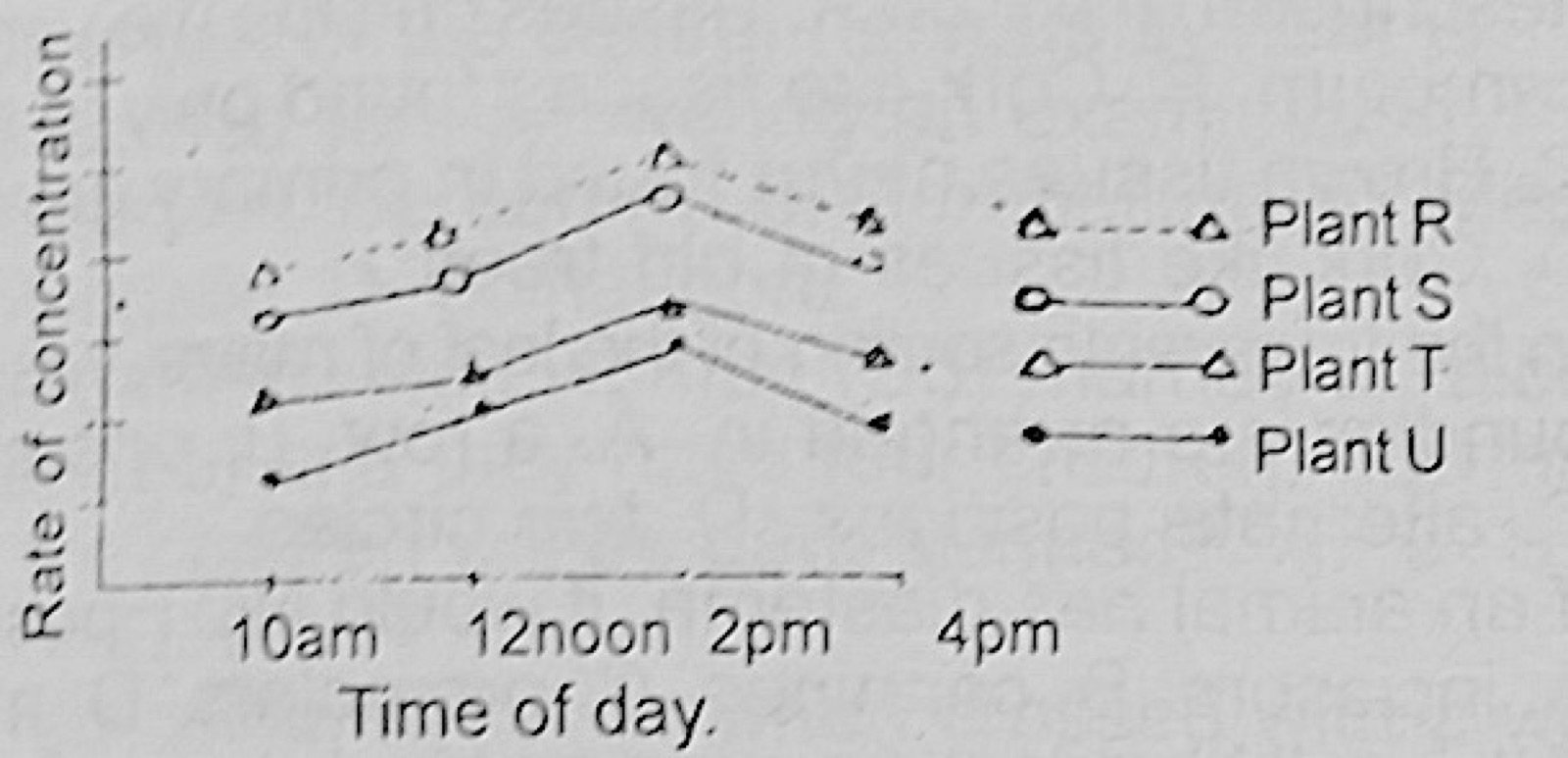
Question 25 Transport in Plants Use the information in the graph (rate against time of day for plants R, S, T and U) to answer this question. Which of the plants is likely to have broad leaves with thin cuticle?
A. R B. S C. T D. U Show the answer and explanation Answer: A (R )
Explanation Plant R shows the highest rate throughout the day. Broad leaves with a thin cuticle lose water fastest, so they would give the highest rate.
Open this question
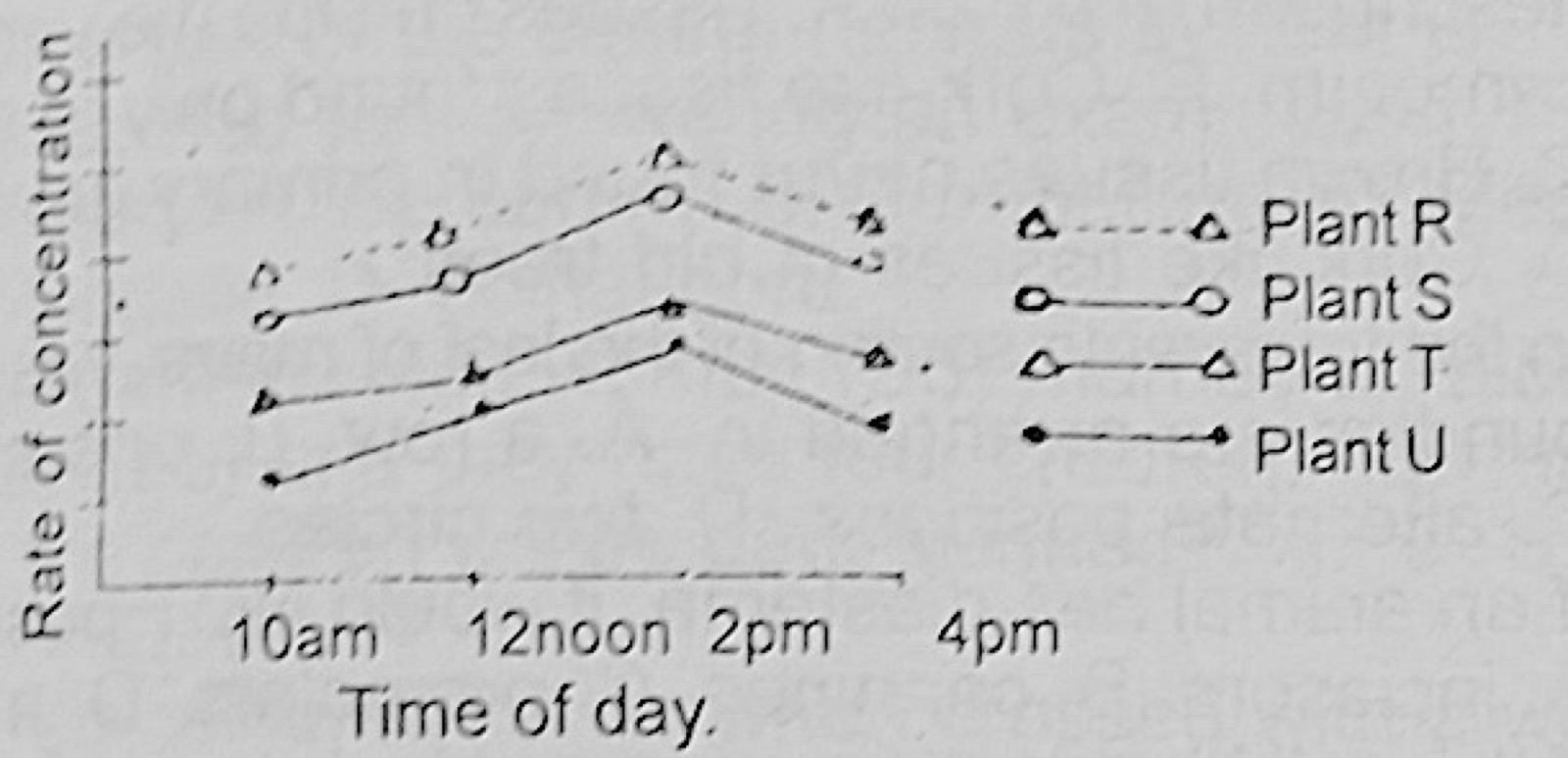
Question 26 Transport in Plants Use the information in the graph (rate against time of day for plants R, S, T and U) to answer this question. Which of the plants is likely to be a desert species?
A. U B. T C. S D. R. Show the answer and explanation Answer: A (U )
Explanation Plant U shows the lowest rate at every time. Desert plants have features that cut down water loss, so they would give the lowest rate.
Open this question
Question 27 Support and Movement Sclerenchyma cells are lignified to
A. strengthen and support the plant B. transport synthesized food C. conduct water and salt D. protect the plant from injury. Show the answer and explanation Answer: A (strengthen and support the plant )
Explanation Sclerenchyma fibres have thick, lignified walls that make them hard and strong, so they support the plant.
Open this question
Question 28 Reproduction in Plants The pineapple fruit is best described as
A. aggregate, succulent and indehiscent B. aggregate, succulent and dehiscent C. multiple, succulent and indehiscent D. multiple, succulent and dehiscent. Show the answer and explanation Answer: C (multiple, succulent and indehiscent )
Explanation The pineapple forms from a whole inflorescence of many flowers (multiple fruit), is fleshy (succulent) and does not split open (indehiscent).
Open this question
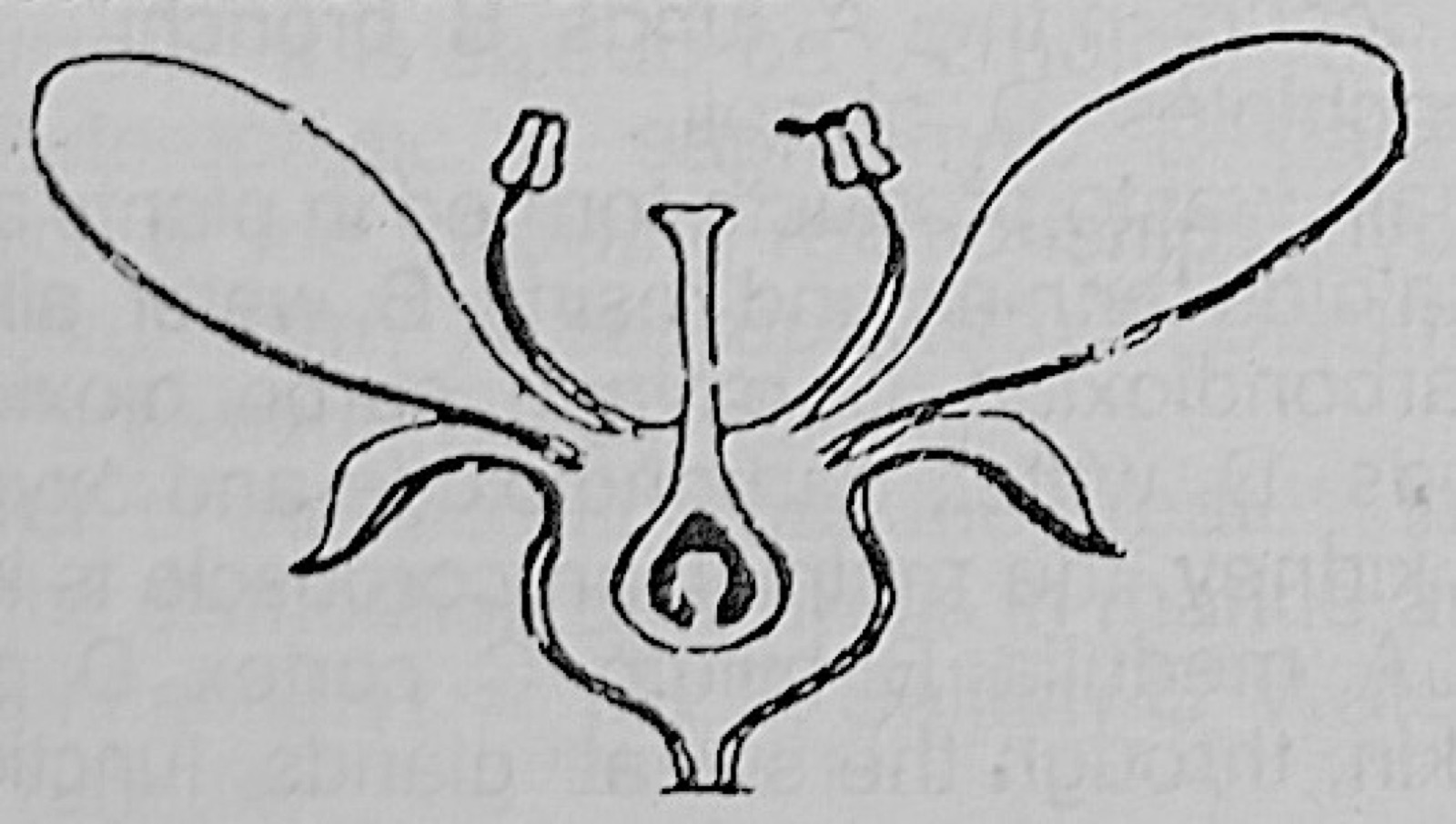
Question 29 Reproduction in Plants The flower shown above is
A. complete, regular, hermaphroditic with superior ovary B. incomplete, regular, staminate with inferior ovary C. complete, regular, hermaphroditic with inferior ovary D. incomplete, irregular, pistillate with superior ovary Show the answer and explanation Answer: C (complete, regular, hermaphroditic with inferior ovary )
Explanation The flower has sepals, petals, stamens and carpel (complete and hermaphroditic), is symmetrical (regular), and its ovary is sunk below the point where the other parts arise (inferior).
Open this question
Question 30 Reproduction in Plants A flower showing radial symmetry is said to be
A. pentamerous B. protandrous C. protogynous D. actinomorphic. Show the answer and explanation Answer: D (actinomorphic. )
Explanation An actinomorphic flower can be cut into equal halves along more than one plane, i.e. it is radially symmetrical.
Open this question
Question 31 Reproduction in Plants A samara differs from a cypsela by having
A. an extended pericarp B. a hard pericarp C. a pericarp fused with the seed coat D. some hairy outgrowths on the pericarp. Show the answer and explanation Answer: A (an extended pericarp )
Explanation A samara's pericarp is drawn out into a flat wing for wind dispersal. A cypsela (e.g. Tridax) has a hairy pappus instead.
Open this question
Question 32 Reproduction in Plants The plantain reproduces asexually by
A. suckers B. buds C. fragments D. spores Show the answer and explanation Answer: A (suckers )
Explanation Plantain and banana produce suckers, new shoots that grow from the underground stem, and these are used to propagate them.
Open this question
Question 34 Cell Division Most cells in higher animals retain their power of division EXCEPT
A. lymphocytes B. nerve cells C. malpighian cells D. germ cells. Show the answer and explanation Answer: B (nerve cells )
Explanation Mature nerve cells cannot divide, so damaged nerve tissue is hardly ever replaced.
Open this question
Question 35 Hormonal Coordination A severe deficiency of thyroxin results in
A. diabetes mellitus B. sexual underdevelopment C. cretinism D. gigantism. Show the answer and explanation Answer: C (cretinism )
Explanation Too little thyroxine in a child causes cretinism: stunted growth and poor mental development.
Open this question
Question 36 Plant Responses and Hormones The growth of a coleoptile towards unilateral light source is due to
A. rapid rate of photosynthesis B. unequal distribution of auxin C. the effect of geotropism D. the effect of photolysis Show the answer and explanation Answer: B (unequal distribution of auxin )
Explanation More auxin collects on the shaded side, so that side grows faster and the coleoptile bends towards the light.
Open this question
Question 37 Sense Organs The sequence of ear ossicles from the fenestra ovalis is
A. malleus, incus and stapes B. malleus, stapes and incus C. stapes, incus and malleus D. stapes, malleus and incus. Show the answer and explanation Answer: C (stapes, incus and malleus )
Explanation The stapes fits into the oval window (fenestra ovalis), the incus is in the middle and the malleus touches the eardrum.
Open this question
Question 38 Nervous Coordination The centre for controlling body temperature in the brain is the
A. cerebrum B. cerebellum C. medulla D. hypothalamus. Show the answer and explanation Answer: D (hypothalamus. )
Explanation The hypothalamus senses blood temperature and sets off sweating, shivering or changes in blood flow to keep it steady.
Open this question
Question 39 Plant Responses and Hormones Unlike auxins, gibberellins
A. induce the formation of adventitious roots B. do not affect leaf and fruit abscission C. cannot stimulate stem elongation D. are quite effective as herbicides. Show the answer and explanation Answer: B (do not affect leaf and fruit abscission )
Explanation Auxins control leaf and fruit fall (abscission), cause rooting and are used as weedkillers. Gibberellins mainly cause stem elongation and do not control abscission.
Open this question
Question 40 Mendelian Inheritance A gene which expresses itself only in the homozygous condition is
A. a mutant B. dominant C. recessive D. lethal Show the answer and explanation Answer: C (recessive )
Explanation A recessive allele is masked by the dominant one, so it shows only when two copies are present (homozygous).
Open this question
Question 41 Mendelian Inheritance An example of monohybrid inheritance in man is
A. astigmatism B. cretinism C. hyperthyroidism D. albinism. Show the answer and explanation Answer: D (albinism. )
Explanation Albinism is controlled by a single gene with a recessive allele. The others are not simple single-gene characters.
Open this question
Question 42 Mendelian Inheritance If a plant, homozygous for round and yellow (RR;YY), is crossed with a wrinkled green type (rr:yy) all of the resulting seeds will be
A. blue and wrinkled B. round and yellow C. wrinkled and yellow D. round and greenish-yellow. Show the answer and explanation Answer: B (round and yellow )
Explanation Every offspring is RrYy. Round and yellow are dominant, so all the seeds are round and yellow.
Open this question
Question 43 Mendelian Inheritance The ratio of carriers to sicklers in the F1 generation derived from a parental cross of two carriers of haemoglobin S gene is
A. 3:1 B. 1:3 C. 2:1 D. 1:2. Show the answer and explanation Answer: C (2:1 )
Explanation AS × AS gives 1 AA : 2 AS : 1 SS. Carriers (AS) to sicklers (SS) is therefore 2:1.
Open this question
Question 44 Chromosomes, DNA and Sex Linkage In which of the following crosses will all the female offspring be colour blind?
A. colour blind mother x colour blind father B. Colour blind mother x normal father C. Carrier mother x colour blind father D. Carrier mother x normal father. Show the answer and explanation Answer: A (colour blind mother x colour blind father )
Explanation Daughters get one X from each parent. Only when both parents' X chromosomes carry the colour-blind allele (Xc Xc × Xc Y) are all daughters colour blind.
Open this question
Question 45 Ecosystem and Ecological Factors Which of the following relates to edaphic factors?
A. The structure of the earth's surface B. The influence of living organisms on each other C. Temperature, rainfall and humidity D. The influence of soils on plants and animals. Show the answer and explanation Answer: D (The influence of soils on plants and animals. )
Explanation Edaphic factors are soil factors, such as soil texture, pH and mineral content, and how they affect living things.
Open this question
Question 46 Ecological Associations Epiphytes growing on the branches of trees provide an example of the relationship known as
A. parasitism B. commensalism C. saprophytism D. holophytism. Show the answer and explanation Answer: B (commensalism )
Explanation Epiphytes gain support and light from the tree without harming it or feeding on it, so it is commensalism.
Open this question
Question 47 Microorganisms and Health Poliomyelitis is an infectious disease caused by
A. virus B. protozoan C. bacterium D. fungus Show the answer and explanation Answer: A (virus )
Explanation Polio is caused by the poliovirus, which can be prevented by oral polio vaccine.
Open this question
Question 48 Microorganisms and Health One of the functions of UNICEF is to
A. prevent and control major diseases B. prevent disease outbreak by administering vaccines C. improve the health and nutrition of children and nursing mothers D. monitor environmental pollution. Show the answer and explanation Answer: C (improve the health and nutrition of children and nursing mothers )
Explanation UNICEF (the United Nations Children's Fund) works to improve the health, nutrition and welfare of children and mothers.
Open this question
Question 49 Nutrient Cycling Nitrifying bacteria are important because they
A. release nitrogen to the atmosphere B. convert atmospheric nitrogen to ammonia C. combine ammonia with nitrogen D. oxidize ammonium salts to nitrates. Show the answer and explanation Answer: D (oxidize ammonium salts to nitrates. )
Explanation Nitrifying bacteria (Nitrosomonas and Nitrobacter) oxidise ammonium compounds to nitrites and then to nitrates, which plants can absorb.
Open this question
Question 50 Soil The process by which lime is added to clay soils is known as
A. sedimentation B. flocculation C. leaching D. manuring. Show the answer and explanation Answer: B (flocculation )
Explanation Lime makes the fine clay particles clump together (flocculate) into larger crumbs, which improves drainage and aeration.
Open this question Sign up free for every JAMB Biology year, practice by topic and timed mocks.
Start practising free