Home › Past questions › JAMB › Biology › 1980 48 questions. Try each one, then open the answer to check yourself and read the explanation.
Sign up free to answer these questions on a CBT screen with a timer, then see your score and every answer explained.
Start practising free
Question 1 Viruses, Monera, Protista and Fungi In Mucor or Rhizopus carbohydrate is absorbed in the form of
A. starch B. sucrose C. glucose D. glycogen E. arabinose Show the answer and explanation Answer: C (glucose )
Explanation Mucor digests starch outside its body and absorbs the simple sugar glucose.
Open this question
Question 2 Viruses, Monera, Protista and Fungi One of the following statements is NOT true of Spirogyra.
A. It is a simple multicellular plant B. During conjugation, its gametes, which are structurally and physiologically similar, fuse to form a zygote C. It possesses spiral chloroplast which enables the plant to photosynthesize D. Its cells are protected externally by a layer of mucilage E. There are pyrenoids along the chloroplast. Show the answer and explanation Answer: B (During conjugation, its gametes, which are structurally and physiologically similar, fuse to form a zygote )
Explanation Spirogyra is a simple multicellular, filamentous green alga, so A is true. During conjugation the two gametes look alike, but one moves through the conjugation tube while the other stays still, so they are not physiologically similar: statement B is the one that is not true.
Open this question
Question 3 Microorganisms and Health Which of the following spreads malaria in Nigeria?
A. Anopheles mosquito B. Culex mosquito C. Aedes mosquito D. Tsetse fly E. House fly Show the answer and explanation Answer: A (Anopheles mosquito )
Explanation The female Anopheles mosquito carries the malaria parasite (Plasmodium).
Open this question
Question 4 Cell Structure and Organisation The vacuole of a plant cell is
A. a large empty space B. smaller than that of an animal cell C. filled with air D. an ordinary vacuum E. surrounded by a membrane Show the answer and explanation Answer: E (surrounded by a membrane )
Explanation The plant vacuole is filled with cell sap and enclosed by a membrane called the tonoplast.
Open this question
Question 5 Animal Kingdom Which one of the following animals is NEVER a secondary host of tapeworms?
A. Cow B. Fish C. Pig D. Man E. Dog. Show the answer and explanation Answer: D (Man )
Explanation Man is the primary (final) host in which the adult tapeworm lives; cows, pigs and fish carry the larval stage.
Open this question
Question 6 Animal Kingdom Some of the features of an animal are scales, teeth, nares and backbone. The animal is likely to be a
A. toad B. bird C. lizard D. rat E. bat Show the answer and explanation Answer: C (lizard )
Explanation A lizard is a reptile with scaly skin, teeth and nostrils; toads lack scales and birds lack teeth.
Open this question
Question 7 Microorganisms and Health Milk can be pasteurized by
A. the addition of common salt B. boiling for one hour C. heating to 75°C for 20 minutes D. the addition vinegar E. heating to 100°C for 12 hours. Show the answer and explanation Answer: C (heating to 75°C for 20 minutes )
Explanation Pasteurisation heats milk to a moderate temperature for a short time, killing most germs without boiling it.
Open this question
Question 8 Food Substances and Enzymes Human beings require vitamins in their diet because vitamins
A. contain carbohydrates and fats B. prevent kwashiorkor C. stimulate the alimentary canal D. digest proteins in the body E. influence many important chemical processes in the body. Show the answer and explanation Answer: E (influence many important chemical processes in the body. )
Explanation Vitamins are needed in small amounts to help many chemical reactions (metabolism) in the body; kwashiorkor is prevented by protein.
Open this question
Question 9 Animal Nutrition Which of the following organs produces bile?
A. Gall bladder B. Pancreas C. Spleen D. Liver E. Stomach. Show the answer and explanation Answer: D (Liver )
Explanation Bile is made by the liver and only stored in the gall bladder.
Open this question
Question 10 Reproduction in Animals The organ through which food and oxygen are supplied to the human embryo and which also prevents harmful materials from reaching the embryo is the
A. amnion B. uterus C. placenta D. umbilical cord E. fallopian tube. Show the answer and explanation Answer: C (placenta )
Explanation The placenta exchanges food, oxygen and wastes between mother and fetus and acts as a barrier to many harmful substances.
Open this question
Question 11 Reproduction in Plants A true fruit is formed from
A. a fertilized ovary and other floral parts B. a fertilized ovary C. a fertilized ovary and calyx D. a fertilized ovary and fleshy receptacle E. an unfertilized ovary and other floral parts. Show the answer and explanation Answer: B (a fertilized ovary )
Explanation A true fruit develops from the ovary alone; when other parts such as the receptacle join in it is a false fruit.
Open this question
Question 12 Growth and Development Water is required for seed germination to take place because it
A. activates the enzymes B. softens the testa C. liberates energy for growth D. permits radicle growth E. allows oxygen to diffuse into the seed Show the answer and explanation Answer: A (activates the enzymes )
Explanation Water activates the enzymes that break down stored food in the seed for the growing embryo.
Open this question
Question 13 Cell and Its Environment A fresh kolanut weighing 1g was put into salt solution. After 3 hours, the kolanut weighed 1.2 g. This simple experiment demonstrates that
A. the salt solution is more concentrated that the cell sap of the kolanut B. the cell sap of the kolanut is more concentrated than the salt solution C. The salt solution has the same concentration as the cell sap of the kolanut D. kolanut cells can multiply in water E. the kolanut lost some water molecules to the salt solution. Show the answer and explanation Answer: B (the cell sap of the kolanut is more concentrated than the salt solution )
Explanation The kolanut gained mass, so water entered it by osmosis; its cell sap must be more concentrated than the solution.
Open this question
Question 14 Support and Movement The joint between the atlas and axis vertebrae allows for
A. rotatory movements only B. up and down or nodding movements only C. rotatory and nodding movements D. no movement at all E. slight movement. Show the answer and explanation Answer: A (rotatory movements only )
Explanation The atlas turns round the odontoid peg of the axis, a pivot joint that allows rotation (shaking the head "no").
Open this question
Question 15 Animal Nutrition Which of the following food substances is digested in the stomach?
A. Carbohydrates B. Fats and oils. C. Fats and proteins D. Proteins E. Carbohydrates and fats. Show the answer and explanation Answer: D (Proteins )
Explanation The stomach secretes pepsin (and rennin), which digest proteins; fats are digested mainly in the small intestine.
Open this question
Question 16 Excretion The conversion of excess amino acids into urea occurs in the
A. kidney B. pancreas C. villi D. liver E. spleen. Show the answer and explanation Answer: D (liver )
Explanation Excess amino acids are deaminated in the liver and the amino groups turned into urea.
Open this question
Question 18 Food Substances and Enzymes In testing for glucose the necessary reagent and the condition under which the reagent reacts best are
A. Fehling's reagent, in the cold B. Millon's reagent, boiled C. Fehling's reagent in acid medium, heated D. iodine solution, boiled E. Fehling's reagent in neutral or alkaline medium, boiled. Show the answer and explanation Answer: E (Fehling's reagent in neutral or alkaline medium, boiled. )
Explanation Glucose, a reducing sugar, gives a brick-red precipitate when boiled with alkaline Fehling's solution.
Open this question
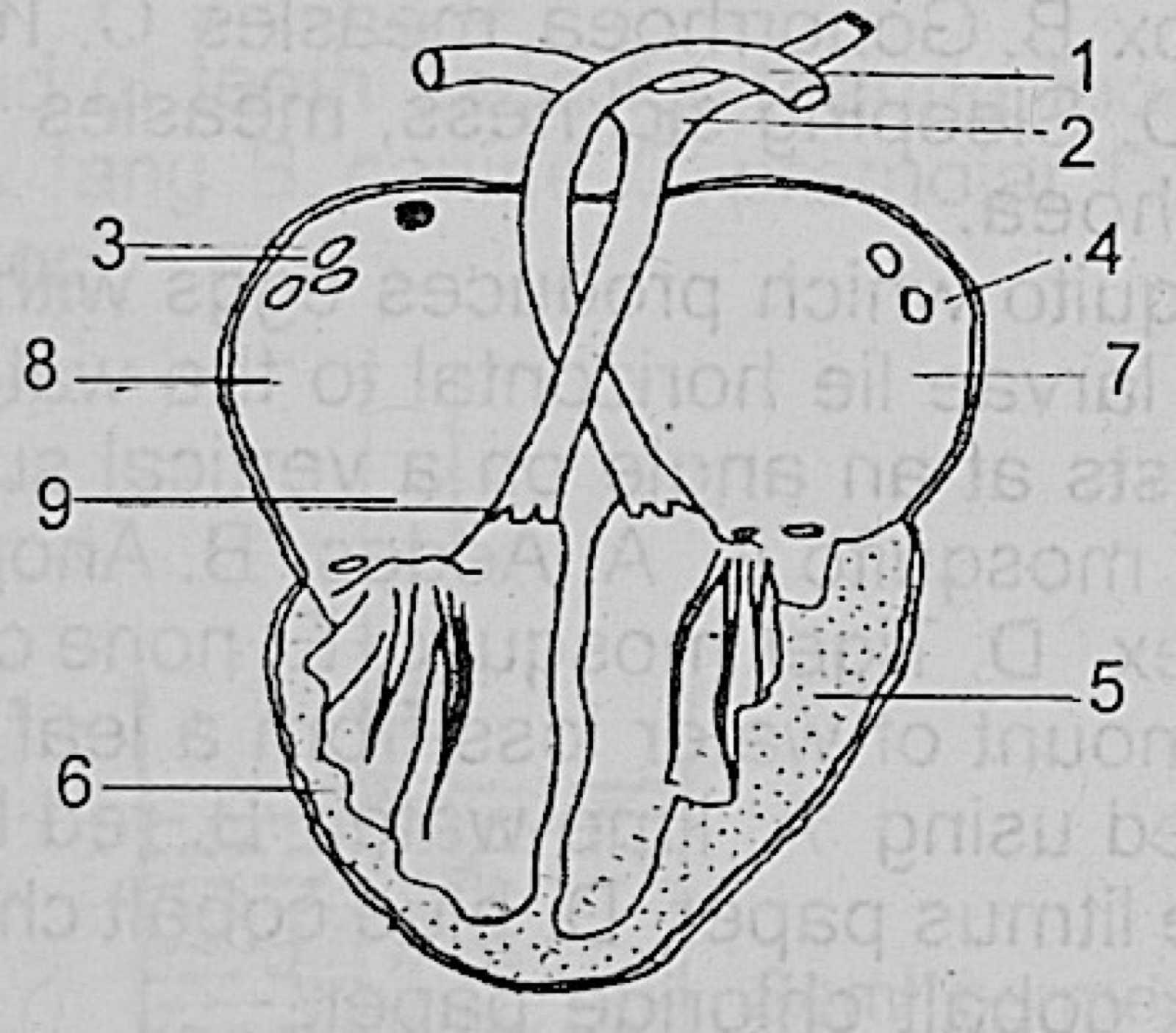
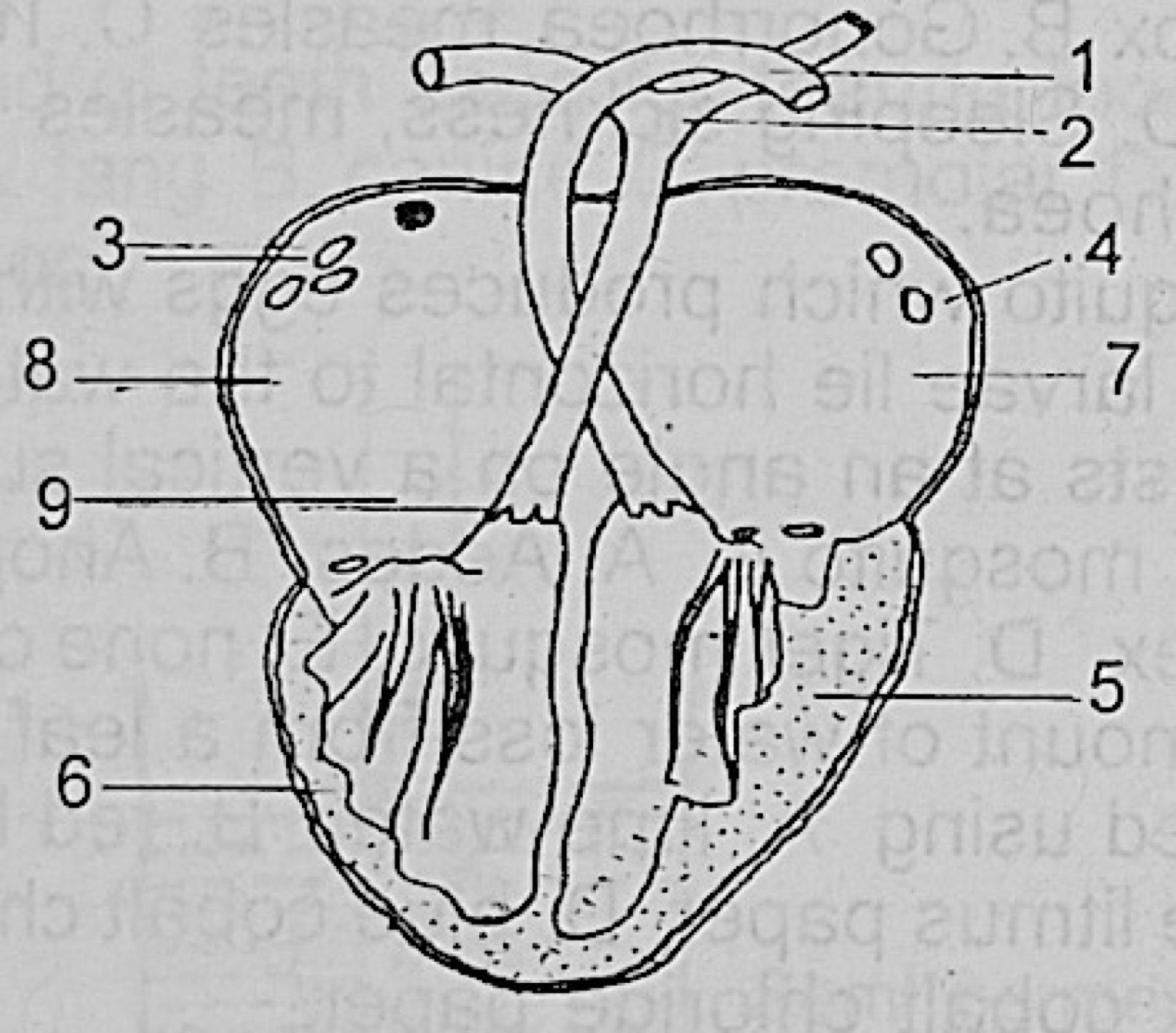
Question 19 Transport in Animals Fig. 2: Vertical section through the heart
A. 5 is the left ventricle and 6 the right ventricle B. 6 is the left ventricle and 5 the right ventricle C. 5 receives blood from the left auricle and 6 from the right D. 5 pumps blood round the body and 6 pumps blood only into the lungs E. 5 deals with oxygenated blood and 6 deoxygenated blood. Show the answer and explanation Answer: D (5 pumps blood round the body and 6 pumps blood only into the lungs )
Explanation The left ventricle (5) must pump blood all round the body, so it has a thicker muscular wall than the right ventricle, which pumps only to the lungs.
Open this question
Question 20 Transport in Animals Fig. 2: Vertical section through the heart
A. 1 B. 2 C. 3 D. 4 E. 9 Show the answer and explanation Answer: C (3 )
Explanation The venae cavae open into the right auricle; part 3 marks these openings.
Open this question
Question 21 Reproduction in Plants For pollination and fruit formation, the essential part(s) of the flower should be the
A. corolla B. ovary C. pistil (gynoecium) D. ovules E. receptacle. Show the answer and explanation Answer: C (pistil (gynoecium) )
Explanation The pistil has the stigma that receives pollen and the ovary that becomes the fruit.
Open this question
Question 22 Excretion Which one of the following parts of the mammalian body is most closely associated with the production of urine?
A. Malpighian capsule B. Urinary bladder C. Ureter D. Vas deferens E. Urethra. Show the answer and explanation Answer: A (Malpighian capsule )
Explanation Urine formation starts by filtration in the Malpighian body (glomerulus and Bowman's capsule) of the kidney.
Open this question
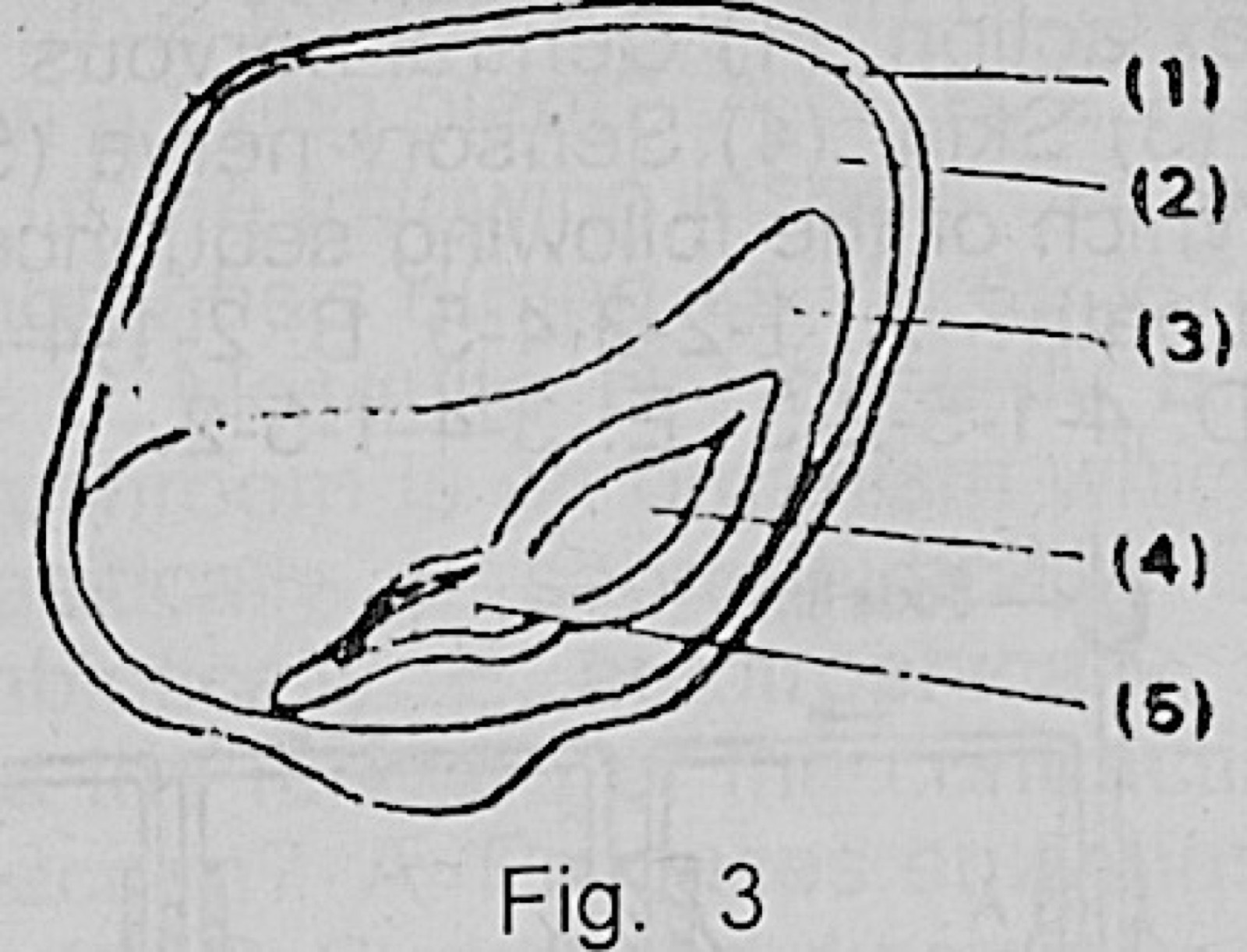
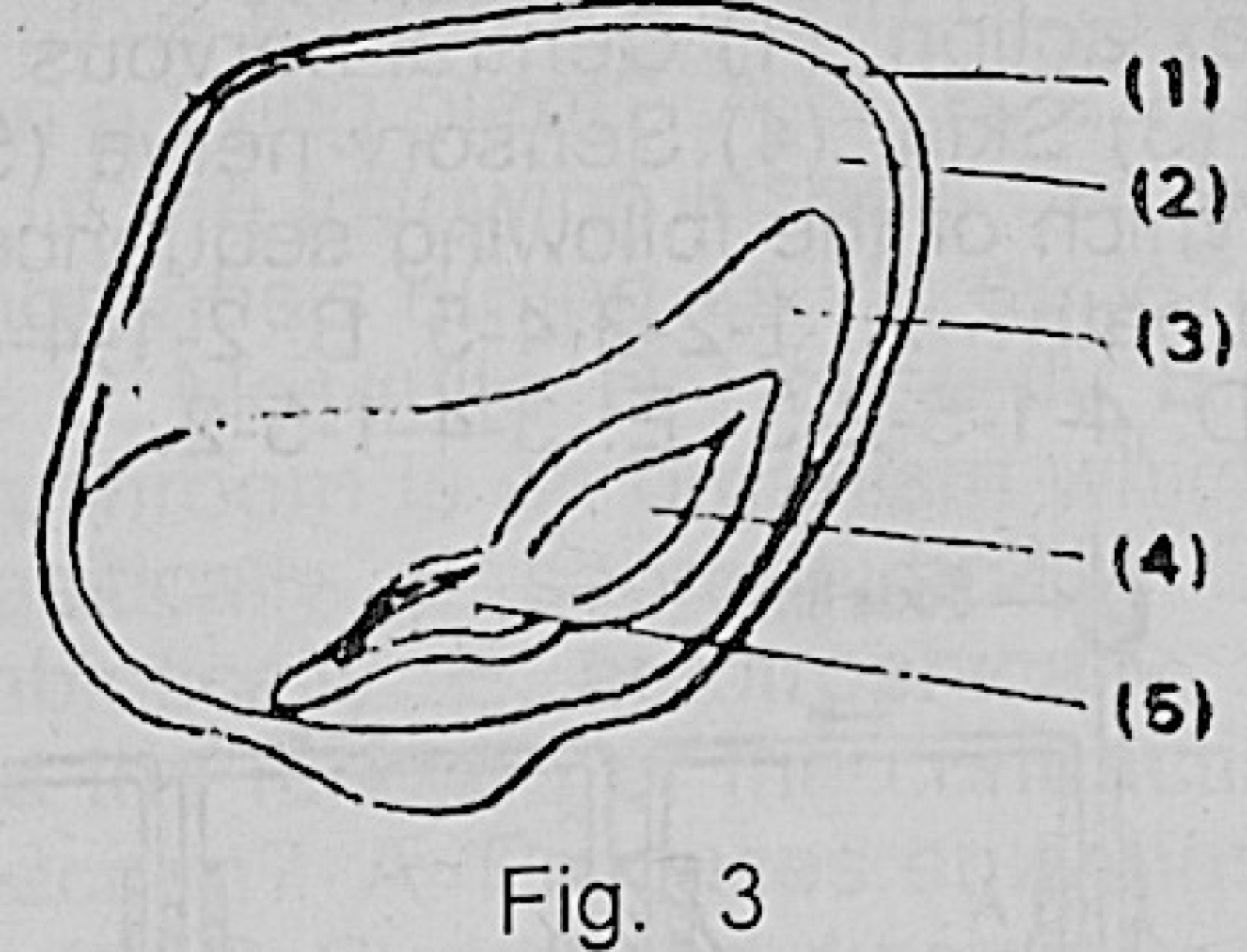
Question 23 Reproduction in Plants Use Fig. 3 to answer questions 23 and 24.
A. is normally absent B. is inlcuded in the part numbered (1) C. is fused with the part numbered (3) D. is the part numbered (1) E. surrounds the parts numbered (4) and (5). Show the answer and explanation Answer: B (is inlcuded in the part numbered (1) )
Explanation In the maize grain the testa is fused with the fruit wall, so it forms part of the outer layer (1).
Open this question
Question 24 Reproduction in Plants Use Fig. 3 to answer questions 23 and 24.
A. stored in the parts numbered (2) and (3) B. stored in the part numbered (3) only C. stored in the parts numbered (4) and (5) D. not concentrated in any particular part E. found in all the except(1). Show the answer and explanation Answer: A (stored in the parts numbered (2) and (3) )
Explanation Food is stored in the endosperm (2) and absorbed through the scutellum (3); 4 and 5 are parts of the embryo.
Open this question
Question 26 Photosynthesis and Plant Nutrition A green plant growing in a compost pit is feeding
A. holozoically B. parasitically C. saprophytically D. holophytically E. in none of the above ways. Show the answer and explanation Answer: D (holophytically )
Explanation A green plant makes its own food by photosynthesis (holophytic nutrition), wherever it grows.
Open this question
Question 27 Cell Structure and Organisation The part of the cell solely responsible for respiration is the
A. nucleus B. nucleolus C. itochondria D. golgi apparatus E. endoplasmic reticulum. Show the answer and explanation Answer: C (itochondria )
Explanation Mitochondria carry out aerobic respiration and release energy as ATP.
Open this question
Question 28 Respiration In anaerobic respiration, glucose is converted to one of the following:
A. Carbon dioxide and water B. Carbon dioxide only C. Carbon dioxide and alcohol D. Alcohol and water E. Water and acetic acid. Show the answer and explanation Answer: C (Carbon dioxide and alcohol )
Explanation Anaerobic respiration in yeast and plants breaks glucose into ethanol and carbon dioxide with a little energy.
Open this question
Question 29 Excretion During excretion of urea there is also a corresponding re-absorption of water into the blood. This reabsorption takes place in the
A. uriniferous tubules B. Bowman's capsule C. glomerulus D. malpighian capsule E. renal artery. Show the answer and explanation Answer: A (uriniferous tubules )
Explanation Water is reabsorbed into the blood as the filtrate passes along the kidney tubules.
Open this question
Question 30 Transport in Plants If the bark and phloem tissues of a woody shoot are peeled off by ringing, the whole plant will eventually die because
A. water does not reach the leaves B. water and salts remain below the ringed portion C. there is a withdrawal of water from the root by soil D. manufactured food does not reach the roots E. the roots store too much water. Show the answer and explanation Answer: D (manufactured food does not reach the roots )
Explanation Ringing removes the phloem, so food made in the leaves cannot reach the roots, which starve and die.
Open this question
Question 31 Cell and Its Environment The filaments of Spirogyra were put into equal volumes of sugar solutions X and Y. After 5 minutes, filaments from solution X had their cell contents rounded up while those from Y were unaffected. The experiment shows that
A. solution X was stronger than Y B. solution Y was stronger than X. C. Spirogyra used up the sugar in solution X D. solution X is good for stimulating sexual reproduction in Spirogyra E. solution Y was less contaminated than X. Show the answer and explanation Answer: A (solution X was stronger than Y )
Explanation Cell contents shrink (plasmolysis) when water leaves by osmosis into a stronger solution, so X was more concentrated.
Open this question
Question 32 Nervous Coordination Which part of the human brain is concerned with reflexes controlling the rate of heart beat and breathing?
A. Medulla B. Cerebrum C. Cerebellum D. Pineal body E. Olfactory lobe. Show the answer and explanation Answer: A (Medulla )
Explanation The medulla oblongata controls involuntary actions such as heartbeat and breathing.
Open this question
Question 33 Hormonal Coordination Which of the following hormones is produced during fright or when agitated?
A. Insulin B. Adrenalin C. Thyroxine D. Pituitrin E. Progesterone. Show the answer and explanation Answer: B (Adrenalin )
Explanation Adrenaline is released by the adrenal glands in fear or excitement to prepare the body for action.
Open this question
Question 34 Nervous Coordination The following are connected with the movement of a reflex action (1) Central nervous system (2) Muscle (3) Skin (4) Sensory nerve (5) Motor nerve. Which of the following sequences indicates a correct path?
A. 1-2-3-4-5 B. 2-1-4-5-3 C. 3-4-1-2-5 D. 4-1-5-2-3 E. 3-4-1-5-2. Show the answer and explanation Answer: E (3-4-1-5-2. )
Explanation The stimulus is picked up in the skin (3), carried by a sensory nerve (4) to the CNS (1), then by a motor nerve (5) to the muscle (2).
Open this question
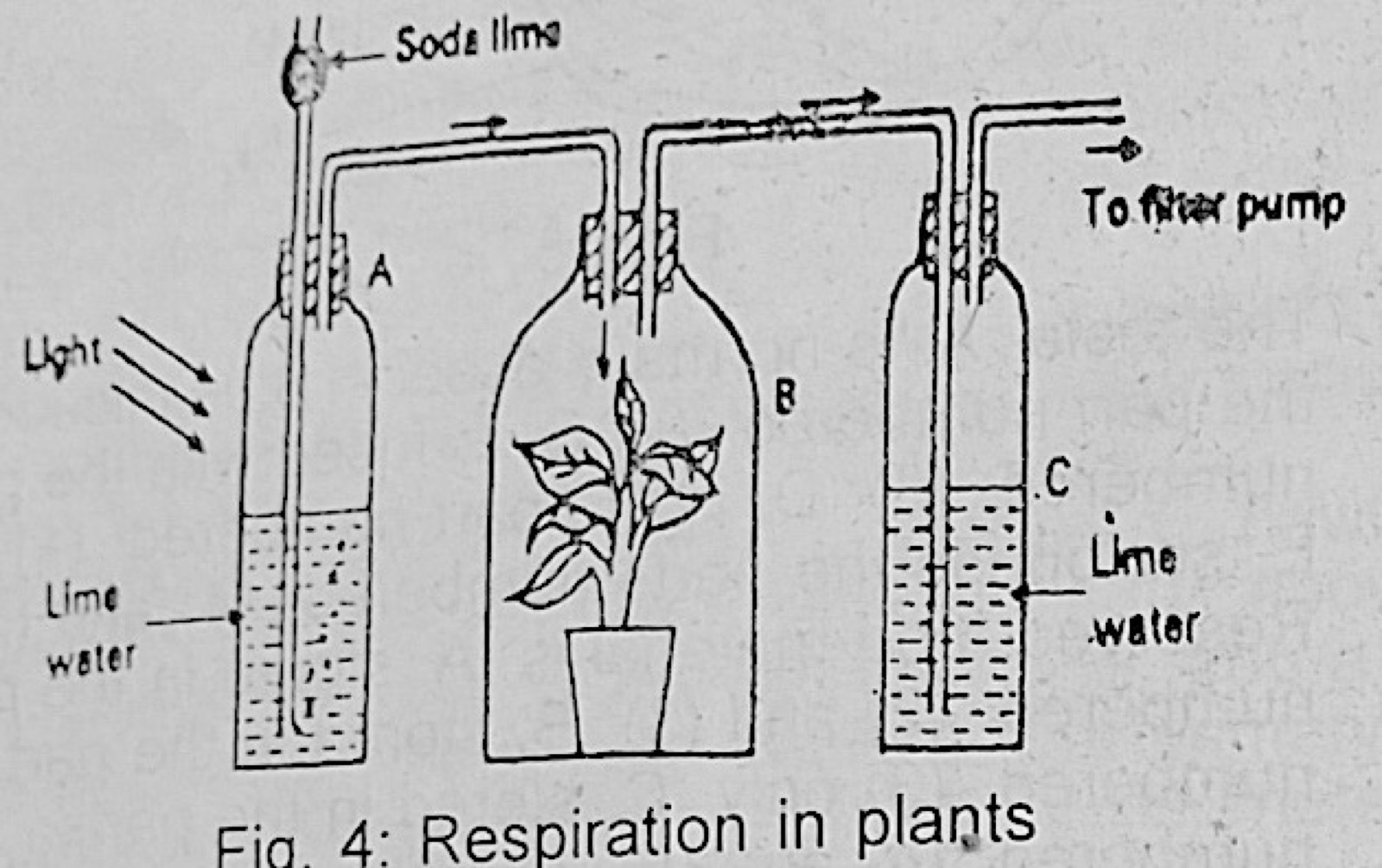
Question 35 Respiration Fig. 4: Respiration in plants
A. carbon dioxide was produced by plant B during respiration B. carbon dioxide entered C through the filter pump C. oxygen reacts with lime water to produce milkiness D. soda lime did not remove carbon dioxide from air E. the delivery tubes were not well connected. Show the answer and explanation Answer: A (carbon dioxide was produced by plant B during respiration )
Explanation The air reaching the plant had its CO2 removed (soda lime, lime water A), so the CO2 that turned lime water C milky came from the plant's respiration.
Open this question
Question 36 Sense Organs Biconcave lenses are used in the correction of an eye defect called
A. myopia B. colour blindness C. old age D. hypermetropia E. weakening of ciliary muscles. Show the answer and explanation Answer: A (myopia )
Explanation Short sight (myopia) is corrected with a diverging (biconcave) lens.
Open this question
Question 37 Nervous Coordination The centre which controls respiratory activities in the mammalian brain is the
A. cerebrum B. olfactory lobes C. pituitary organ D. cerebellum E. medulla Show the answer and explanation Answer: E (medulla )
Explanation The breathing centre is in the medulla oblongata.
Open this question
Question 38 Population Ecology A student trying to find out the order in which organisms appear on a cleared plot is studying one of the following
A. Ecosystem B. Food chain C. Food web D. Succession E. Community Show the answer and explanation Answer: D (Succession )
Explanation The orderly change in the kinds of organisms colonising an area over time is ecological succession.
Open this question
Question 39 Ecological Associations An organism X lives entirely on the waste products in another organism Y. In this association X is a
A. symbiont B. commensal C. saprophyte D. parasite E. epiphyte. Show the answer and explanation Answer: B (commensal )
Explanation X benefits by feeding on Y's wastes while Y is neither helped nor harmed: commensalism.
Open this question
Question 40 Plant Responses and Hormones The tips of some rice seedlings were cut off while some were left intact. Both were covered with a container which had only one small hole to allow light through. After twenty-four hours it was observed that
A. the cut tips bent away from light B. the cut tips bent towards source of light C. the intact tips bent away from the light D. the intact tips bent towards light E. both tips bent away from light. Show the answer and explanation Answer: D (the intact tips bent towards light )
Explanation The tip detects light and produces the auxin that causes bending, so only intact seedlings bend towards the light.
Open this question
Question 41 Soil If three 30 cm lengths of glass tubing are tightly packed with clay, sand and loamy soils respectively and then stood in a beaker of water for one week, the level of water will be
A. lowest in the tube with clay B. the same in all the tubes C. lowest in the tube with loamy soil D. highest in the tube with sandy soil E. lowest in the tube with sandy soil. Show the answer and explanation Answer: E (lowest in the tube with sandy soil. )
Explanation Sand has large pores and poor capillarity, so water rises least in it; clay has the finest pores and the highest rise.
Open this question
Question 42 Chromosomes, DNA and Sex Linkage If a baby is a female, her mother's ovum must have been fertilized by a sperm carrying the chromosome
A. X B. XY C. XX D. YY E. Y Show the answer and explanation Answer: A (X )
Explanation Every ovum carries X; an X-carrying sperm gives XX, a girl.
Open this question
Question 43 Soil Leguminous plants, e.g Mucana, are usually planted in cultivated farmlands because they
A. enrich the soil with phosphates B. provide animal food C. enrich the soil with organic nitrogen D. protect the soil from being over-heated E. protect the microorganisms in the soil. Show the answer and explanation Answer: C (enrich the soil with organic nitrogen )
Explanation Nitrogen-fixing bacteria in legume root nodules add nitrogen compounds to the soil.
Open this question
Question 44 Nutrient Cycling During thunderstorms the energy of lightning discharge causes
A. oxygen and nitrogen to combine B. more carbon dioxide to be formed C. nitrites to be converted to nitrates D. nitrates to be converted to nitrogen E. death. Show the answer and explanation Answer: A (oxygen and nitrogen to combine )
Explanation Lightning makes nitrogen and oxygen in the air combine into oxides of nitrogen, which rain washes into the soil as nitrates.
Open this question
Question 45 Soil A few grams of dried soil were first heated until red hot and then further heated until no more smoke was released. This experiment was to determine the
A. amount of water in soil B. percentage of water in soil C. presence of humus in soil D. resistance of laterites to heat E. release of smoke from the soil. Show the answer and explanation Answer: C (presence of humus in soil )
Explanation The soil was already dry, so the loss on strong heating comes from humus (organic matter) burning away.
Open this question
Question 46 Respiration Oxygen from the atmosphere reaches the mammalian bloodstream through one of the paths indicated below. Indicate the correct path. a= mouth, b= trachea, c= bronchiole, d=nostril, e= bronchus, f = alveoli
A. a → b → e → f → d B. b → d → f → e → c C. d → b → e → c → f D. b → a → f → e → c E. f → e → c → d → c. Show the answer and explanation Answer: C (d → b → e → c → f )
Explanation Air passes nostril → trachea → bronchus → bronchiole → alveoli, where oxygen enters the blood.
Open this question
Question 47 Microorganisms and Health Below are some groups of diseases. Which group of diseases is caused by bacteria?
A. Tuberculosis, smallpox B. Gonorrhoea, measles C. Tuberculosis, polio D. Sleeping sickness, measles E. Syphilis, gonorrhoea. Show the answer and explanation Answer: E (Syphilis, gonorrhoea. )
Explanation Syphilis and gonorrhoea are both bacterial; smallpox, measles and polio are viral and sleeping sickness is caused by a protozoan.
Open this question
Question 48 Microorganisms and Health A mosquito which produces eggs with float, and whose larvae lie horizontal to the water surface, also rests at an angle on a vertical surface. This type of mosquito is
A. Aedes B. Anopheles C. Culex D. Tiger mosquito E. none of the above. Show the answer and explanation Answer: B (Anopheles )
Explanation Anopheles eggs have floats, its larvae lie parallel to the surface and the adult rests at an angle.
Open this question
Question 49 Transport in Plants The amount of water loss from a leaf can be detected using
A. lime-water B. red litmus paper C. blue litmus paper D. blue cobalt chloride paper E. pink cobalt chloride paper. Show the answer and explanation Answer: D (blue cobalt chloride paper )
Explanation Dry blue cobalt chloride paper turns pink when it absorbs water given off by the leaf.
Open this question
Question 50 Support and Movement In animals, cilia, flagella, pseudopodia, and chaetae, can be used for
A. reproduction B. fighting enemies C. attachment to plants D. locomotion E. locating sensation. Show the answer and explanation Answer: D (locomotion )
Explanation All these structures help organisms move about.
Open this question Sign up free for every JAMB Biology year, practice by topic and timed mocks.
Start practising free