Home › Past questions › JAMB › Biology › 1979 47 questions. Try each one, then open the answer to check yourself and read the explanation.
Sign up free to answer these questions on a CBT screen with a timer, then see your score and every answer explained.
Start practising free
Question 1 Characteristics and Classification of Living Things All living organisms
A. photosynthesize B. respire C. move D. feed E. transpire Show the answer and explanation Answer: B (respire )
Explanation Every living cell respires to release energy from food; only green plants photosynthesise and only plants transpire.
Open this question
Question 2 Viruses, Monera, Protista and Fungi Amoeba moves by means of
A. cilia B. flagella C. pseudopodia D. swimmerets E. setae. Show the answer and explanation Answer: C (pseudopodia )
Explanation Amoeba pushes out cytoplasm as false feet (pseudopodia) and flows into them.
Open this question
Question 3 Support and Movement Which of these tissues serves the function of support and water conduction?
A. Parenchyma B. Collenchyma C. Sclerenchyma D. Xylem E. Phloem Show the answer and explanation Answer: D (Xylem )
Explanation Xylem vessels carry water and their lignified walls also support the plant.
Open this question
Question 4 Animal Nutrition Which of these is the terminal portion of the alimentary canal of a mammal?
A. Oesophagus B. Stomach C. Rectum D. Colon E. Appendix Show the answer and explanation Answer: C (Rectum )
Explanation The rectum is the last part of the gut, where faeces are stored before leaving through the anus.
Open this question
Question 5 Animal Nutrition An organism which lives on the remains of a dead plant is
A. an endoparasite B. a saprophyte C. a commensal D. a symbiont E. an ectoparasite. Show the answer and explanation Answer: B (a saprophyte )
Explanation Saprophytes feed on dead and decaying organic matter.
Open this question
Question 6 Photosynthesis and Plant Nutrition Which of the substances listed below is a trace element for plants?
A. Potassium B. Sodium C. Copper D. Phosphate E. Nitrate Show the answer and explanation Answer: C (Copper )
Explanation Copper is needed only in tiny amounts (a micronutrient); potassium, phosphate and nitrate are major nutrients.
Open this question
Question 7 Cell and Its Environment The movement of molecules from a region of higher concentration to one of lower concentration is
A. diffusion B. transpiration C. osmosis D. translocation E. plasmolysis. Show the answer and explanation Answer: A (diffusion )
Explanation Diffusion is the net movement of molecules down a concentration gradient; osmosis is the special case of water through a membrane.
Open this question
Question 8 Support and Movement Which of the structures listed below is peculiar to the Axis vertebra?
A. Odontoid process B. Anterior zygapophysis C. Posterior zygapophysis D. Lateral spine E. Centrum Show the answer and explanation Answer: A (Odontoid process )
Explanation Only the axis has the peg-like odontoid process, which fits into the atlas and lets the head turn.
Open this question
Question 9 Ecosystem and Ecological Factors The complex relationship between the members of a community and between the community as a whole and its physical environment is
A. ecosystem B. habitat C. environment D. niche E. microhabitat Show the answer and explanation Answer: A (ecosystem )
Explanation A community interacting with its non-living environment forms an ecosystem.
Open this question
Question 10 Ecosystem and Ecological Factors A Secchi disc is used in the determination of
A. rainfall B. tides C. waves D. turbidity E. current velocity Show the answer and explanation Answer: D (turbidity )
Explanation A Secchi disc is lowered into water until it disappears; the depth measures how cloudy (turbid) the water is.
Open this question
Question 11 Chromosomes, DNA and Sex Linkage The carrier of the hereditary characters in plants and animals is the
A. cell B. nucleus C. chromosome D. chloroplast E. gene Show the answer and explanation Answer: E (gene )
Explanation Genes are the units that carry hereditary characters from parents to offspring.
Open this question
Question 13 Food Substances and Enzymes Which of these is not an enzyme?
A. Pepsin B. Gastrin C. Amylase D. Chymotrypsin E. Trypsin. Show the answer and explanation Answer: B (Gastrin )
Explanation Gastrin is a hormone that stimulates gastric juice; the others are digestive enzymes.
Open this question
Question 14 Growth and Development The region of cell division in a root is
A. root cap B. endodermis C. xylem D. piliferous layer E. meristem. Show the answer and explanation Answer: E (meristem. )
Explanation Meristem cells just behind the root cap divide by mitosis to make new cells.
Open this question
Question 15 Reproduction in Plants Which of the statements below is not characteristic of wind pollinated flowers?
A. Stigmas are usually large and feathery B. Nectary is usually absent C. The pollen grains have rough spiny surfaces D. The flowers are not scented E. The pollen is light and smooth. Show the answer and explanation Answer: C (The pollen grains have rough spiny surfaces )
Explanation Rough, spiny pollen that sticks to insects is found in insect-pollinated flowers; wind pollen is light and smooth.
Open this question
Question 16 Excretion Which of the following is not an excretory organ?
A. Lungs B. Kidney C. Leaf D. Large intestine E. Skin Show the answer and explanation Answer: D (Large intestine )
Explanation The large intestine removes undigested food (egestion), not waste made by metabolism.
Open this question
Question 17 Sense Organs When the ciliary muscle of the eye contracts, the eye lens
A. bulges B. contracts C. rotates D. flattens E. is rounded Show the answer and explanation Answer: A (bulges )
Explanation Contraction of the ciliary muscle slackens the suspensory ligaments, so the elastic lens becomes thicker (bulges) for near vision.
Open this question
Question 19 Ecological Associations In which of these associations is much harm done to one of the partners?
A. Symbiosis B. Epiphytism C. Commensalism D. Parasitism E. Mutualism. Show the answer and explanation Answer: D (Parasitism )
Explanation A parasite feeds on its host and harms it; in the other associations neither partner is harmed.
Open this question
Question 20 Nervous Coordination The part of the mammalian brain responsible for maintaining balance is
A. medulla oblongata B. cerebellum C. optic lobe D. cerebrum E. olfactory lobe. Show the answer and explanation Answer: B (cerebellum )
Explanation The cerebellum coordinates muscle movement and keeps the body balanced.
Open this question
Question 22 Food Substances and Enzymes A sugar solution was boiled with Fehling's solutions A and B and the colour remained blue. The sugar tested was
A. glucose B. maltose C. fructose D. sucrose E. lactose. Show the answer and explanation Answer: D (sucrose )
Explanation Sucrose is a non-reducing sugar, so it does not turn Fehling's solution brick-red; the others are reducing sugars.
Open this question
Question 23 Respiration Alkaline pyrogallol was used in an experiment. That experiment must have been connected with
A. excretion B. germination C. transpiration D. digestion E. photosynthesis. Show the answer and explanation Answer: B (germination )
Explanation Alkaline pyrogallol absorbs oxygen, so it is used to show that germinating seeds need oxygen.
Open this question
Question 24 Reproduction in Plants The plumule is best described as
A. part of the cotyledon B. part of the endosperm C. a miniature shoot D. structure near the micropyle E. structure opposite the hilum Show the answer and explanation Answer: C (a miniature shoot )
Explanation The plumule is the embryonic shoot that grows into the stem and leaves.
Open this question
Question 25 Reproduction in Plants A dry indehiscent, winged fruit formed from one carpel is known as a
A. schizocarp B. caryopsis C. samara D. nut E. follicle Show the answer and explanation Answer: C (samara )
Explanation A samara is a dry fruit that does not split and has a wing for wind dispersal.
Open this question
Question 26 Soil Which of these is not a type of soil?
A. Sand B. Granite C. Loam D. Clay E. Sandy loam Show the answer and explanation Answer: B (Granite )
Explanation Granite is a rock from which soil may form; it is not itself a soil type.
Open this question
Question 27 Soil The farmer cannot check soil erosion effectively by
A. constructing his ridges for planting across the slope B. cultivating cover crops C. practising strip cropping D. clearing the land of vegetation E. constructing terraces Show the answer and explanation Answer: D (clearing the land of vegetation )
Explanation Removing vegetation leaves soil bare to rain and wind, which increases erosion.
Open this question
Question 28 Hormonal Coordination A gland in the human body secretes two hormones, one of which causes a disease called diabetes when there is a deficiency. Which of these organs produces the hormones?
A. Spleen B. Parathyroid C. Adrenal body D. Thyroid E. Pancreas. Show the answer and explanation Answer: E (Pancreas. )
Explanation The pancreas (islets of Langerhans) makes insulin and glucagon; lack of insulin causes diabetes.
Open this question
Question 29 Structure of Flowering Plants In which of the following tissues do the cells have the ability to divide?
A. Meristem B. Sclerenchyma C. Phloem D. Collenchyma E. Pith Show the answer and explanation Answer: A (Meristem )
Explanation Meristem cells are unspecialised and keep dividing to produce new cells.
Open this question
Question 30 Excretion Which one of the following is not an excretory product?
A. Urine B. Sweat C. Faeces D. Salts E. Carbon dioxide Show the answer and explanation Answer: C (Faeces )
Explanation Faeces are mostly undigested food that never entered body cells, so removing them is egestion.
Open this question
Question 31 Nutrient Cycling Bacteria inhabiting legume root nodules and which add atmospheric nitrogen to the soil are referred to as
A. denitrifying bacteria B. nitrifying bacteria C. nitrogen fixing bacteria D. nitrogen freeing bacteria E. nitrogen putrefying bacteria Show the answer and explanation Answer: C (nitrogen fixing bacteria )
Explanation Rhizobium in legume nodules turns nitrogen gas into nitrogen compounds: this is nitrogen fixation.
Open this question
Question 32 Viruses, Monera, Protista and Fungi One of the following statements is not true of viruses.
A. They are micro-organisms B. They are smaller than bacteria C. They can be seen with an ordinary light microscope D. They cause to tobacco disease E. They cause polio and smallpox Show the answer and explanation Answer: C (They can be seen with an ordinary light microscope )
Explanation Viruses are too small for a light microscope; an electron microscope is needed.
Open this question
Question 33 Mendelian Inheritance If you cross-breed a tall variety (Tt) of maize with a short variety (tt), the ratio of tall to short plants in the offspring will be
A. 2:1 B. 1:2 C. 1:1 D. 1:3 E. 3:1 Show the answer and explanation Answer: C (1:1 )
Explanation Tt × tt gives Tt and tt in equal numbers, so 1 tall : 1 short.
Open this question
Question 34 Animal Nutrition The digestive enzyme that coagulates proteins in milk is
A. ptyalin B. pepsin C. renin D. trypsin E. amylase Show the answer and explanation Answer: C (renin )
Explanation Rennin, made in the stomach of young mammals, clots milk protein (caseinogen).
Open this question
Question 35 Transport in Animals The hepatic portal vein is characterized by
A. beginning and ending with capillaries B. connecting the liver and kidney C. carrying deoxygenated blood D. ending with large capilarries E. having no capillaries. Show the answer and explanation Answer: A (beginning and ending with capillaries )
Explanation A portal vein starts in capillaries (of the intestine) and ends in capillaries (of the liver).
Open this question
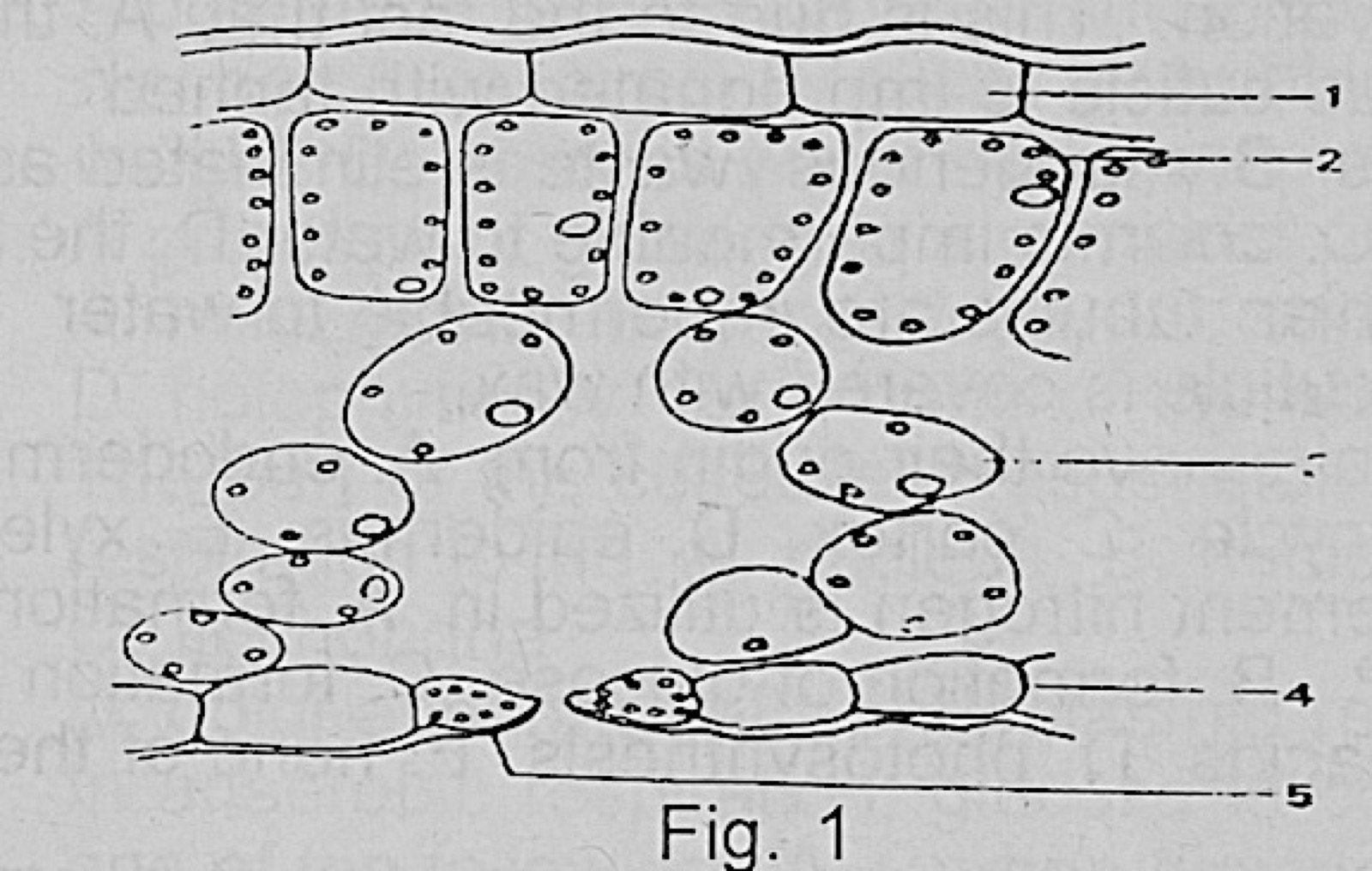
Question 36 Structure of Flowering Plants In the above diagram (Fig. 1) the cell which controls the opening and closing of stomatal pore is
A. 1 B. 2 C. 3 D. 4 E. 5 Show the answer and explanation Answer: E (5 )
Explanation Guard cells change shape to open and close the stoma; in Fig. 1 the guard cell is the small dotted cell labelled 5.
Open this question
Question 37 Transport in Animals The blood vessel which carries digested food from the small intestine to the liver is the
A. renal vein B. renal artery C. hepatic artery D. hepatic portal vein E. coeliac artery. Show the answer and explanation Answer: D (hepatic portal vein )
Explanation The hepatic portal vein carries absorbed food from the intestine to the liver.
Open this question
Question 38 Reproduction in Plants The maize grain is regarded as a fruit and not a seed because
A. it is covered by a sheath of leaves B. the testa and fruit wall fuse after fertilization C. it has both endosperm and cotyledon D. it has coleorhiza and coleoptile E. the pericarp and seed coat are separate. Show the answer and explanation Answer: B (the testa and fruit wall fuse after fertilization )
Explanation A maize grain is a caryopsis: the fruit wall (pericarp) is fused with the seed coat, so the whole grain is a fruit.
Open this question
Question 39 Mendelian Inheritance Identical twins are produced under one of the following conditions:
A. Two ova fertilized at the same time by two sperms B. One ovum fertilized, divides to give two embryos C. One ovum fertilized, twins formed shortly before birth D. Two ova fertilized by one sperm E. One ovum fertilized by two sperms. Show the answer and explanation Answer: B (One ovum fertilized, divides to give two embryos )
Explanation Identical twins come from one zygote that splits into two embryos, so they share the same genes.
Open this question
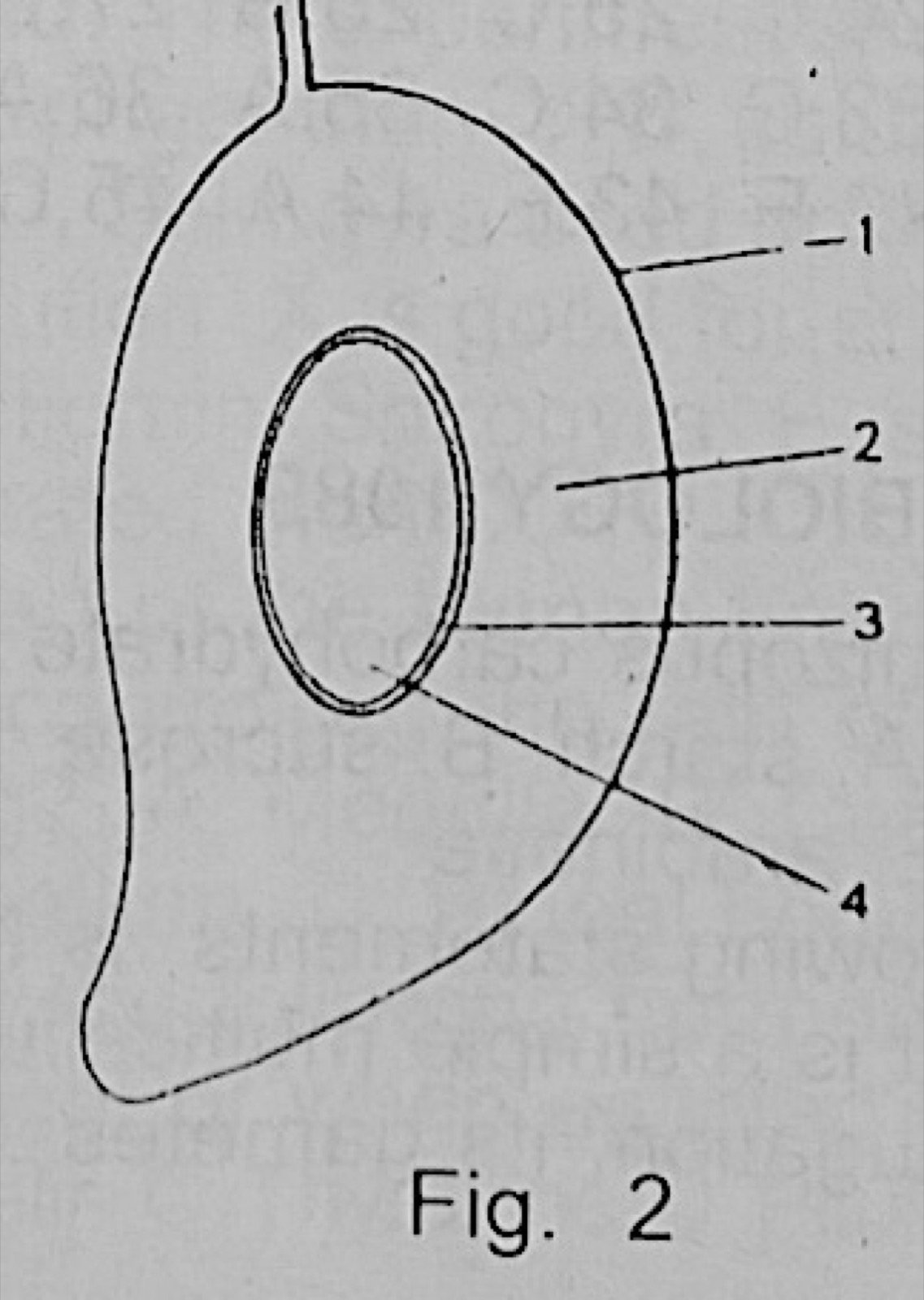
Question 40 Reproduction in Plants Figure 2 is a section of a drupe. The part numbered 2 is
A. epicarp B. endocarp C. mesocarp D. seed E. pericarp Show the answer and explanation Answer: C (mesocarp )
Explanation Part 2 is the thick fleshy middle layer between the skin (1) and the stony layer (3): the mesocarp.
Open this question
Question 41 Reproduction in Plants The one-seeded fruit in which the pericarp and seed coat have become fused together is known as
A. achene B. samara C. caryopsis D. legume E. drupe. Show the answer and explanation Answer: C (caryopsis )
Explanation A caryopsis, like the maize grain, has the pericarp fused to the seed coat.
Open this question
Question 42 Excretion The major function of contractile vacuole in Amoeba is
A. to secrete enzymes to digest food particles B. to store excess food materials C. to excrete nitrogenous wastes D. to absorb water from the surroundings E. to collect and expel excess water in the cytoplasm. Show the answer and explanation Answer: E (to collect and expel excess water in the cytoplasm. )
Explanation Water keeps entering Amoeba by osmosis; the contractile vacuole collects it and pumps it out (osmoregulation).
Open this question
Question 43 Feeding Relationships and Energy Flow Grasses → grasshoppers → lizards → snakes → hawks.In the above food chain the organisms which are the least in number are
A. grasses B. grasshoppers C. lizards D. snakes E. hawks Show the answer and explanation Answer: E (hawks )
Explanation Energy is lost at each level, so the top consumer (hawks) is the fewest in number.
Open this question
Question 44 Feeding Relationships and Energy Flow Which of these is not true? Grasses in the above food chain
A. trap all the sun energy B. trap a small percent of the sun energy C. are primary producers D. are eaten by primary consumers E. contain chlorophyll. Show the answer and explanation Answer: A (trap all the sun energy )
Explanation Plants trap only a small fraction of the sunlight falling on them; most is reflected or lost as heat.
Open this question
Question 45 Adaptation Insects show considerable powers of water conservation. This is due to the fact that
A. the chitinous cuticle is impregnated with tanned proteins B. nitrogenous waste is eliminated as urea C. chitin is impermeable to water D. the malpighian tubules are impermeable to water E. the cuticle is covered with wax. Show the answer and explanation Answer: E (the cuticle is covered with wax. )
Explanation A thin layer of wax on the outside of the insect cuticle stops water evaporating from the body.
Open this question
Question 46 Structure of Flowering Plants Root hairs have their origin from
A. endodermis B. pericycle C. cortex D. epidermis E. xylem Show the answer and explanation Answer: D (epidermis )
Explanation Root hairs are outgrowths of single cells of the root epidermis (piliferous layer).
Open this question
Question 47 Photosynthesis and Plant Nutrition The element nitrogen is utilized in
A. formation of ATP B. formation of glucose C. formation of amino acids D. photosynthesis E. none of the above. Show the answer and explanation Answer: C (formation of amino acids )
Explanation Nitrogen is a part of every amino acid, the building blocks of proteins.
Open this question
Question 48 Photosynthesis and Plant Nutrition Magnesium is utilized in the formation of
A. ATP B. glucose C. amino acids D. chlorophyll E. fats Show the answer and explanation Answer: D (chlorophyll )
Explanation Each chlorophyll molecule has a magnesium atom at its centre; lack of magnesium causes yellow leaves.
Open this question
Question 49 Structure of Flowering Plants One significant difference between roots and stem is that
A. branch roots originate in the pericycle while branch stems do not B. stems are always above the ground while roots are always below the ground C. stems are positively geotropic while roots are negatively geotropic D. stems are sometimes used for storage while roots are never so used E. stems grow in both length and circumference while roots grow only in length. Show the answer and explanation Answer: A (branch roots originate in the pericycle while branch stems do not )
Explanation Lateral roots arise inside the root from the pericycle, while branch stems grow from buds outside; the other statements are false.
Open this question
Question 50 Animal Nutrition The arrangements below are steps in protein digestion. Which is the correct sequence?
A. a → b → c → d B. c → d → a → b C. b → c → a → d D. b → d → a → c E. b → a → c → d Show the answer and explanation Answer: D (b → d → a → c )
Explanation Proteins are broken down to peptones, then polypeptides, then amino acids: b → d → a → c.
Open this question Sign up free for every JAMB Biology year, practice by topic and timed mocks.
Start practising free