GCE Financial Accounting 1989 past questions and answers

52 questions. Try each one, then open the answer to check yourself and read the explanation.

Question 1

Cash Book

The Bank Column in the Cash Book shows a credit balance of ₦180. This means

  1. A.a total payment of ₦180.
  2. B.a gross receipt of ₦180
  3. C.a left over of ₦180 in the bank.
  4. D.an overdraft of ₦180
  5. E.a left over of ₦180 cash.
Show the answer and explanation

Answer: D (an overdraft of ₦180)

Explanation

A credit balance on the bank column means the business has taken out more than it put in, i.e. it owes the bank (an overdraft).

Open this question

Question 2

Accounting Equation

T. Trader sets aside from his private funds ₦1,500 for business purposes. The ₦1,500 would be referred to as

  1. A.Capital
  2. B.Loan
  3. C.Reserve
  4. D.Drawings
  5. E.Profit
Show the answer and explanation

Answer: A (Capital)

Explanation

Money the owner puts into the business from his own funds is capital.

Open this question

Question 3

Double Entry and the Ledger

When goods are sold for cash the credit entry goes to the

  1. A.trader's account
  2. B.cash book
  3. C.purchases account
  4. D.sales account
  5. E.customer's account.
Show the answer and explanation

Answer: D (sales account)

Explanation

Cash sale: debit cash book (cash comes in), credit sales account.

Open this question

Question 4

Double Entry and the Ledger

The Sales Account is written up from

  1. A.cash sales to customers only
  2. B.credit sales to customers only
  3. C.credit sales less cash sales
  4. D.cash sales less cash discounts
  5. E.both credit and cash sales.
Show the answer and explanation

Answer: E (both credit and cash sales.)

Explanation

The sales account receives the total of the sales day book (credit sales) and cash sales from the cash book.

Open this question

Question 5

Petty Cash

The Petty Cash Book can have

  1. A.a debit balance only
  2. B.a credit balance only
  3. C.both debit and credit balances
  4. D.a debit or nil balance.
  5. E.a nil balance only
Show the answer and explanation

Answer: A (a debit balance only)

Explanation

Petty cash is money in hand, so it can never be overdrawn: its balance is a debit (cash still in the box), never a credit.

Open this question

Question 6

Banking and Bank Reconciliation

Which of the following may have been recorded in the Cash Book and fail to appear in the Bank Statement?

  1. A.Bank charges and commission
  2. B.Cheques issued, presented and cashed
  3. C.Bank lodgements
  4. D.payments made by the bank on a standing order
  5. E.Opening bank overdraft.
Show the answer and explanation

Answer: C (Bank lodgements)

Explanation

Money paid in late (uncredited lodgements) is already in the cash book but the bank has not yet entered it.

Open this question

Question 7

Double Entry and the Ledger

Which of the following accounts belongs to the Private Ledger?

  1. A.Drawings account
  2. B.Premises account
  3. C.Bank account
  4. D.Debtors account
  5. E.Rent and Rates accounts.
Show the answer and explanation

Answer: A (Drawings account)

Explanation

The private ledger keeps the owner's confidential accounts such as capital and drawings.

Open this question

Question 8

Double Entry and the Ledger

Which of the following accounts belongs to the Personal Ledger?

  1. A.Purchases account
  2. B.Capital account
  3. C.Machinery account
  4. D.Depreciation account
  5. E.V. Okafor's account.
Show the answer and explanation

Answer: E (V. Okafor's account.)

Explanation

Personal accounts are accounts of people or firms, such as V. Okafor's account.

Open this question

Question 9

Correction of Errors and Suspense Account

A cheque for ₦400 drawn in favour of Jeje was posted to the credit of his account. The entry necessary to correct the error is

  1. A.a debit suspense account ₦800, credit Jeje's account ₦800
  2. B.debit bank account ₦400, credit Jeje's account ₦400
  3. C.debit suspense account ₦400, credit Jeje's account ₦400
  4. D.debit Jeje's account ₦800, credit suspense account ₦800
  5. E.debit Jeje's account ₦400, credit suspense account ₦400.
Show the answer and explanation

Answer: D (debit Jeje's account ₦800, credit suspense account ₦800)

Explanation

Jeje should have been debited ₦400 but was credited ₦400, so his account must be debited ₦800 (₦400 to cancel, ₦400 to post correctly), with suspense credited.

Open this question

Question 10

Correction of Errors and Suspense Account

A sales for ₦2,570 was recorded in the Day Book as ₦2,750. The error committed was

  1. A.compensating error
  2. B.error of omission
  3. C.error of principle
  4. D.error of original entry
  5. E.error of transposition.
Show the answer and explanation

Answer: D (error of original entry)

Explanation

The wrong figure was entered in the book of original entry, so both ledger entries carry it: an error of original entry.

Open this question

Question 11

Final Accounts of a Sole Trader

Which of the following would be posted to the proprietor's capital account?

  1. A.Gross sales
  2. B.Gross profit
  3. C.Net sales
  4. D.Net profit
  5. E.Manufacturing profit.
Show the answer and explanation

Answer: D (Net profit)

Explanation

Net profit belongs to the owner and is added to his capital.

Open this question

Question 12

Final Accounts of a Sole Trader

The drawings account of a sole proprietor is transferred to the

  1. A.capital account
  2. B.debit side of the trading account
  3. C.credit side of the profit and loss account
  4. D.current liabilities in the Balance Sheet
  5. E.current assets in the Balance Sheet.
Show the answer and explanation

Answer: A (capital account)

Explanation

Drawings reduce what the business owes the owner, so they are deducted from capital.

Open this question

Question 13

Incomplete Records

A business marked up its cost by 50%. This would mean a Gross Profit of

  1. A.33⅓% on the cost price
  2. B.50% on the selling price
  3. C.66⅔% on the selling price
  4. D.66⅔% on the market price
  5. E.33⅓% on the selling price.
Show the answer and explanation

Answer: E (33⅓% on the selling price.)

Explanation

Cost ₦100 + 50 = selling price ₦150; profit 50/150 = 33⅓% of selling price.

Open this question

Question 14

Final Accounts of a Sole Trader

Which of the following shows the stock at the start of an accounting period?

  1. A.Appropriation account
  2. B.Current assets in the Balance Sheet
  3. C.Current liabilities in the Balance Sheet
  4. D.Trading account
  5. E.Profit and Loss account
Show the answer and explanation

Answer: D (Trading account)

Explanation

Opening stock is added to purchases on the debit side of the trading account; the balance sheet shows the closing stock.

Open this question

Question 15

Control Accounts

The balance in the purchases ledger control account is

  1. A.total purchases
  2. B.total sales
  3. C.the total of the debtors
  4. D.the total of the creditors
  5. E.the total credit purchases.
Show the answer and explanation

Answer: D (the total of the creditors)

Explanation

The purchases ledger control account summarises suppliers' accounts, so its balance is the total owed to creditors.

Open this question

Question 16

Control Accounts

Discount allowed would appear on the

  1. A.debit side of Sales Control Account and the credit side of Purchases Control Account
  2. B.debit side of Sales Ledger Control Account only
  3. C.debit side of Purchases Ledger Control Account
  4. D.credit side of the Sales Ledger Control Account
  5. E.credit -side of the Purchases Ledger Control Account.
Show the answer and explanation

Answer: D (credit side of the Sales Ledger Control Account)

Explanation

Discount allowed reduces what debtors owe, so it is credited in the sales ledger control account.

Open this question

Question 17

Control Accounts

Sales Ledger Control Account (1986)
Debit side: Jan. 1 Balance b/d ₦1,300; Jan. 31 Sales ₦7,630; Dishonoured Cheques ₦250; Stopped Cheques ₦100; Balance c/d ₦92; Total ₦9,372
Credit side: Jan. 1 Balance b/d ₦86; Bank ₦6,555; Discounts ₦345; Returns ₦130; Purchases Ledger ₦360; Balance c/d ₦1,896; Total ₦9,372
Feb. 1 Balance b/d ₦1,896 (debit); Feb. 1 Balance b/d ₦92 (credit)

The amount of ₦7,630 represents

  1. A.total credit sales
  2. B.total of all the debtors of the firms
  3. C.the total sales for the month
  4. D.cash sales only
  5. E.the double entry for the total of the sales account
Show the answer and explanation

Answer: A (total credit sales)

Explanation

Only credit sales go through the sales ledger control account; cash sales never create a debtor.

Open this question

Question 18

Control Accounts

Sales Ledger Control Account (1986)
Debit side: Jan. 1 Balance b/d ₦1,300; Jan. 31 Sales ₦7,630; Dishonoured Cheques ₦250; Stopped Cheques ₦100; Balance c/d ₦92; Total ₦9,372
Credit side: Jan. 1 Balance b/d ₦86; Bank ₦6,555; Discounts ₦345; Returns ₦130; Purchases Ledger ₦360; Balance c/d ₦1,896; Total ₦9,372
Feb. 1 Balance b/d ₦1,896 (debit); Feb. 1 Balance b/d ₦92 (credit)

The sum of ₦6,555 described as 'Bank' represents

  1. A.cash sales for the month, including discounts
  2. B.cash sales for the month excluding discounts
  3. C.receipts from trade debtors only
  4. D.receipts from all the debtors of the business
  5. E.takings from both cash and credit sales.
Show the answer and explanation

Answer: C (receipts from trade debtors only)

Explanation

Money credited in the sales ledger control account is what trade debtors paid in settlement of their accounts.

Open this question

Question 19

Control Accounts

Sales Ledger Control Account (1986)
Debit side: Jan. 1 Balance b/d ₦1,300; Jan. 31 Sales ₦7,630; Dishonoured Cheques ₦250; Stopped Cheques ₦100; Balance c/d ₦92; Total ₦9,372
Credit side: Jan. 1 Balance b/d ₦86; Bank ₦6,555; Discounts ₦345; Returns ₦130; Purchases Ledger ₦360; Balance c/d ₦1,896; Total ₦9,372
Feb. 1 Balance b/d ₦1,896 (debit); Feb. 1 Balance b/d ₦92 (credit)

The balance of ₦92 represents the I. amount necessary to balance the account II. sum due to the customers III. amount due from the customers.

  1. A.I only
  2. B.II only
  3. C.III only
  4. D.I and II only
  5. E.I and III only.
Show the answer and explanation

Answer: D (I and II only)

Explanation

₦92 is entered as balance c/d to make the debit side add up, and it comes down on the credit side, so it is a sum the business owes customers (I and II).

Open this question

Question 20

Control Accounts

Sales Ledger Control Account (1986)
Debit side: Jan. 1 Balance b/d ₦1,300; Jan. 31 Sales ₦7,630; Dishonoured Cheques ₦250; Stopped Cheques ₦100; Balance c/d ₦92; Total ₦9,372
Credit side: Jan. 1 Balance b/d ₦86; Bank ₦6,555; Discounts ₦345; Returns ₦130; Purchases Ledger ₦360; Balance c/d ₦1,896; Total ₦9,372
Feb. 1 Balance b/d ₦1,896 (debit); Feb. 1 Balance b/d ₦92 (credit)

The items 'Purchases Ledger ₦360' means I. cash purchases during the period II. credit purchases during the period III. trade debtors set off against debts on purchases

  1. A.I only
  2. B.II only
  3. C.III only
  4. D.I and II only
  5. E.II and III only
Show the answer and explanation

Answer: C (III only)

Explanation

A purchases ledger entry in the sales ledger control account is a contra (set-off) of a customer's debt against what we owe him as a supplier.

Open this question

Question 21

Control Accounts

Sales Ledger Control Account (1986)
Debit side: Jan. 1 Balance b/d ₦1,300; Jan. 31 Sales ₦7,630; Dishonoured Cheques ₦250; Stopped Cheques ₦100; Balance c/d ₦92; Total ₦9,372
Credit side: Jan. 1 Balance b/d ₦86; Bank ₦6,555; Discounts ₦345; Returns ₦130; Purchases Ledger ₦360; Balance c/d ₦1,896; Total ₦9,372
Feb. 1 Balance b/d ₦1,896 (debit); Feb. 1 Balance b/d ₦92 (credit)

The balance of ₦1,896 represents I. The sum required to balance the account II. amount due to the customers III. amount due from the customers.

  1. A.I only
  2. B.II only
  3. C.III only
  4. D.I and II only
  5. E.I and III only
Show the answer and explanation

Answer: E (I and III only)

Explanation

₦1,896 is the balancing figure (balance c/d) and comes down as a debit, i.e. money customers owe the business.

Open this question

Question 22

Depreciation

The balance of the provision for Depreciation Account is shown in the

  1. A.Trial Balance as a debit
  2. B.Trial Balance as a credit
  3. C.Balance Sheet as a Fixed Asset
  4. D.Balance Sheet as a long term liability
  5. E.Balance Sheet as a current liability.
Show the answer and explanation

Answer: B (Trial Balance as a credit)

Explanation

Provision for depreciation is a credit balance; in the balance sheet it is deducted from the asset's cost.

Open this question

Question 23

Double Entry and the Ledger

The concept of Double Entry Book-Keeping states that

  1. A.if you receive goods on credit the seller becomes your creditor
  2. B.for every debit entry there must be a corresponding credit entry
  3. C.one party receives and another party gives value
  4. D.purchases and sales are stated separately
  5. E.for every seller there is a buyer.
Show the answer and explanation

Answer: B (for every debit entry there must be a corresponding credit entry)

Explanation

Double entry: every transaction is recorded twice, a debit in one account and an equal credit in another.

Open this question

Question 24

Accounting Equation

Outstanding rent of ₦300 is paid by the proprietor. The effect on the balance sheet is that

  1. A.both the liability and asset are increased
  2. B.both the liability and asset are decreased
  3. C.liability is increased while the asset is decreased
  4. D.liability is decreased while the asset is increased
  5. E.both liability and asset remain unchanged.
Show the answer and explanation

Answer: B (both the liability and asset are decreased)

Explanation

Paying rent owed reduces the liability (rent owing) and reduces cash, an asset.

Open this question

Question 25

Double Entry and the Ledger

Which of the following in a classified form contains a permanent record of all transactions? The

  1. A.Sales Day Book
  2. B.Cash Book
  3. C.Ledger
  4. D.Journal
  5. E.Purchases Day Book
Show the answer and explanation

Answer: C (Ledger)

Explanation

All transactions end up classified into accounts in the ledger, the main book of record.

Open this question

Question 26

Source Documents

When a buyer returns damaged goods to the seller, the buyer receives a

  1. A.proforma invoice
  2. B.credit note
  3. C.debit note
  4. D.consignment note
  5. E.goods return note.
Show the answer and explanation

Answer: B (credit note)

Explanation

The seller sends a credit note to show the buyer's account has been reduced for the returns.

Open this question

Question 27

Cash Book

Trade discount is

  1. A.allowance for prompt payment
  2. B.allowance for damaged goods
  3. C.allowance off price list
  4. D.discount on creditors
  5. E.discount on debtors.
Show the answer and explanation

Answer: C (allowance off price list)

Explanation

Trade discount is a reduction off the list price given to traders; it is not entered in the ledger.

Open this question

Question 28

Correction of Errors and Suspense Account

Pending the location of error, the difference disclosed in the Trial Balance is normally posted to

  1. A.an Adjustment Account
  2. B.a Control Account
  3. C.a Suspense Account
  4. D.a Profit and Loss Account
  5. E.a Trading Account.
Show the answer and explanation

Answer: C (a Suspense Account)

Explanation

A suspense account holds the trial balance difference until the errors are found and corrected.

Open this question

Question 29

Company Accounts

Use the following information:
Issued Capital: ₦100,000
Ordinary shares: ₦40,000
Preference shares: ₦30,000
Reserves: ₦10,000
Debentures: ₦60,000
Current Liabilities: ₦150,000
Fixed Assets: ₦90,000
Current Assets: ₦240,000

What is the total of Net Assets of the business?

  1. A.₦200,000
  2. B.₦180,000
  3. C.₦160,000
  4. D.₦150,000
  5. E.₦140,000
Show the answer and explanation

Answer: B (₦180,000)

Explanation

Net assets = fixed assets + current assets − current liabilities = 90,000 + 240,000 − 150,000 = ₦180,000.

Open this question

Question 31

Company Accounts

Use the following information:
Issued Capital: ₦100,000
Ordinary shares: ₦40,000
Preference shares: ₦30,000
Reserves: ₦10,000
Debentures: ₦60,000
Current Liabilities: ₦150,000
Fixed Assets: ₦90,000
Current Assets: ₦240,000

What is the total of the loan capital of the business?

  1. A.₦10,000
  2. B.₦30,000
  3. C.₦40,000
  4. D.₦60,000
  5. E.₦70,000
Show the answer and explanation

Answer: D (₦60,000)

Explanation

Loan capital is the long-term borrowing, here the debentures of ₦60,000.

Open this question

Question 34

Capital and Revenue Expenditure

Which of the following is not true of capital expenditure? I. Assets acquired for the purpose of earning income II. Extension of office building III. It is incurred and its full benefits consumed in one period of account.

  1. A.I only
  2. B.II only
  3. C.I and II only
  4. D.II and III only
  5. E.III only
Show the answer and explanation

Answer: E (III only)

Explanation

Capital expenditure gives benefits over many years; spending used up within one period is revenue expenditure.

Open this question

Question 35

Depreciation

Which of the following may cause depreciation? I. wear and tear II. obsolescence and passage of time III. fluctuation in prices.

  1. A.I, II and III
  2. B.I and II only
  3. C.I and III only
  4. D.II and III only
  5. E.III only
Show the answer and explanation

Answer: B (I and II only)

Explanation

Depreciation comes from use (wear and tear), going out of date and the passing of time, not from price changes.

Open this question

Question 36

Depreciation

A machine cost ₦12,000 and has a useful life of 4 years and an expected disposal value of ₦400. Using the straight line method, the annual depreciation is

  1. A.₦3,100
  2. B.₦3,000
  3. C.₦2,900
  4. D.₦2,300
  5. E.₦2,000
Show the answer and explanation

Answer: C (₦2,900)

Explanation

(12,000 − 400) ÷ 4 = ₦2,900 a year.

Open this question

Question 37

Depreciation

A machine cost ₦12,000 and has a useful life of 4 years and an expected disposal value of ₦400. The accumulated depreciation at the end of year 3 using the straight line method is

  1. A.₦9,300
  2. B.₦9,000
  3. C.₦8,700
  4. D.₦6,900
  5. E.₦6,000
Show the answer and explanation

Answer: C (₦8,700)

Explanation

3 years × ₦2,900 = ₦8,700.

Open this question

Question 38

Depreciation

A machine cost ₦12,000 and has a useful life of 4 years and an expected disposal value of ₦400. Using the reducing balance method what will be the depreciation charge for year 2 at 20%? (ignore residual value)

  1. A.₦3,000
  2. B.₦2,900
  3. C.₦2,400
  4. D.₦1,920
  5. E.₦1,536
Show the answer and explanation

Answer: D (₦1,920)

Explanation

Year 1: 20% × 12,000 = 2,400, leaving 9,600. Year 2: 20% × 9,600 = ₦1,920.

Open this question

Question 39

Depreciation

A machine cost ₦12,000 and has a useful life of 4 years and an expected disposal value of ₦400. Using the reducing balance method, what is the net book value at the end of year 2? (ignore residual value)

  1. A.₦10,480
  2. B.₦10,080
  3. C.₦9,680
  4. D.₦9,600
  5. E.₦7,680.
Show the answer and explanation

Answer: E (₦7,680.)

Explanation

9,600 − 1,920 = ₦7,680.

Open this question

Question 40

Manufacturing Accounts

Factory cost consists of

  1. A.direct material and factory overhead
  2. B.direct labour and direct expenses
  3. C.direct labour and factory overhead
  4. D.direct materials, direct labour, direct expenses and factory overhead
  5. E.direct expenses and factory overhead.
Show the answer and explanation

Answer: D (direct materials, direct labour, direct expenses and factory overhead)

Explanation

Factory (production) cost = prime cost (direct materials, labour, expenses) + factory overheads.

Open this question

Question 41

Manufacturing Accounts

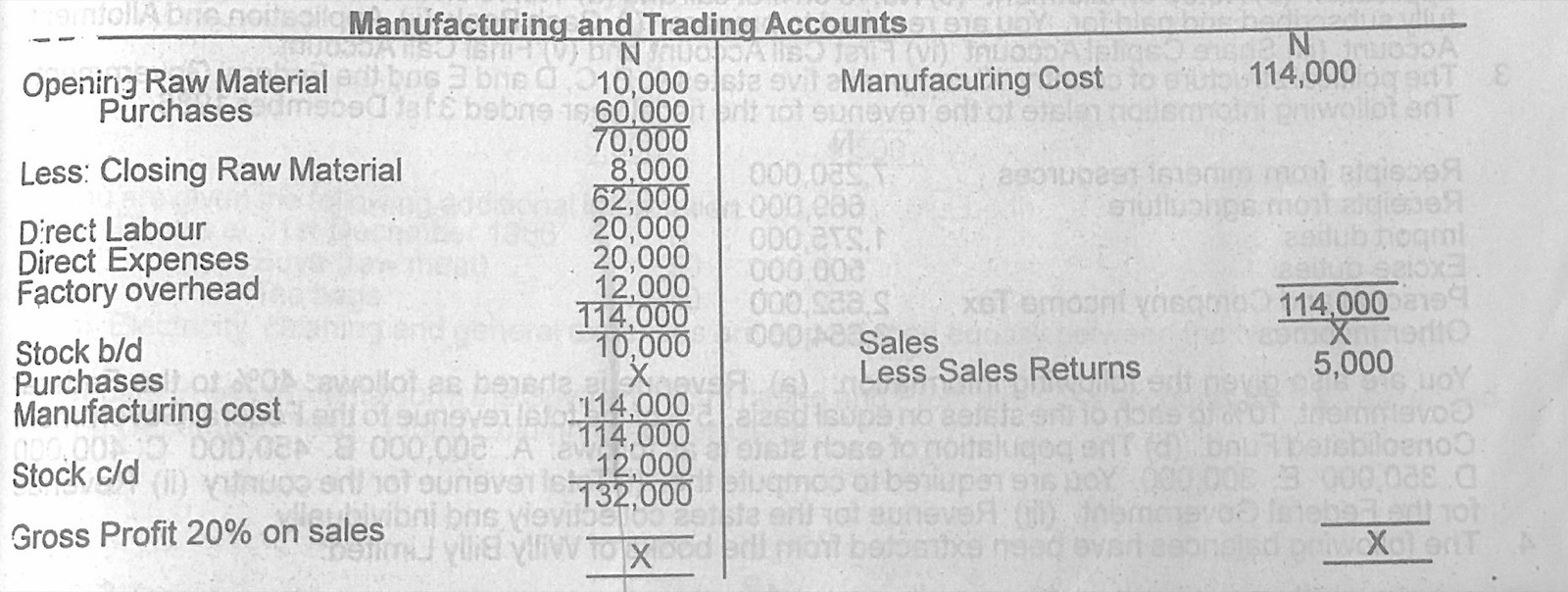
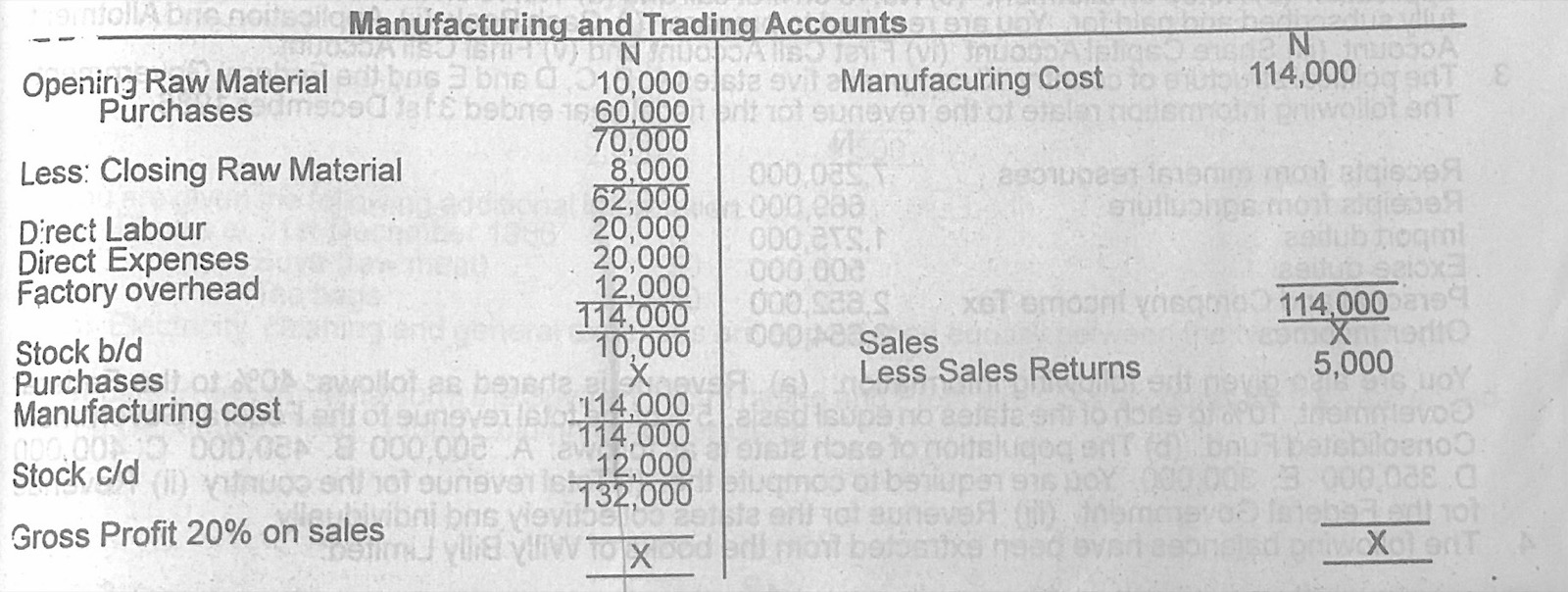
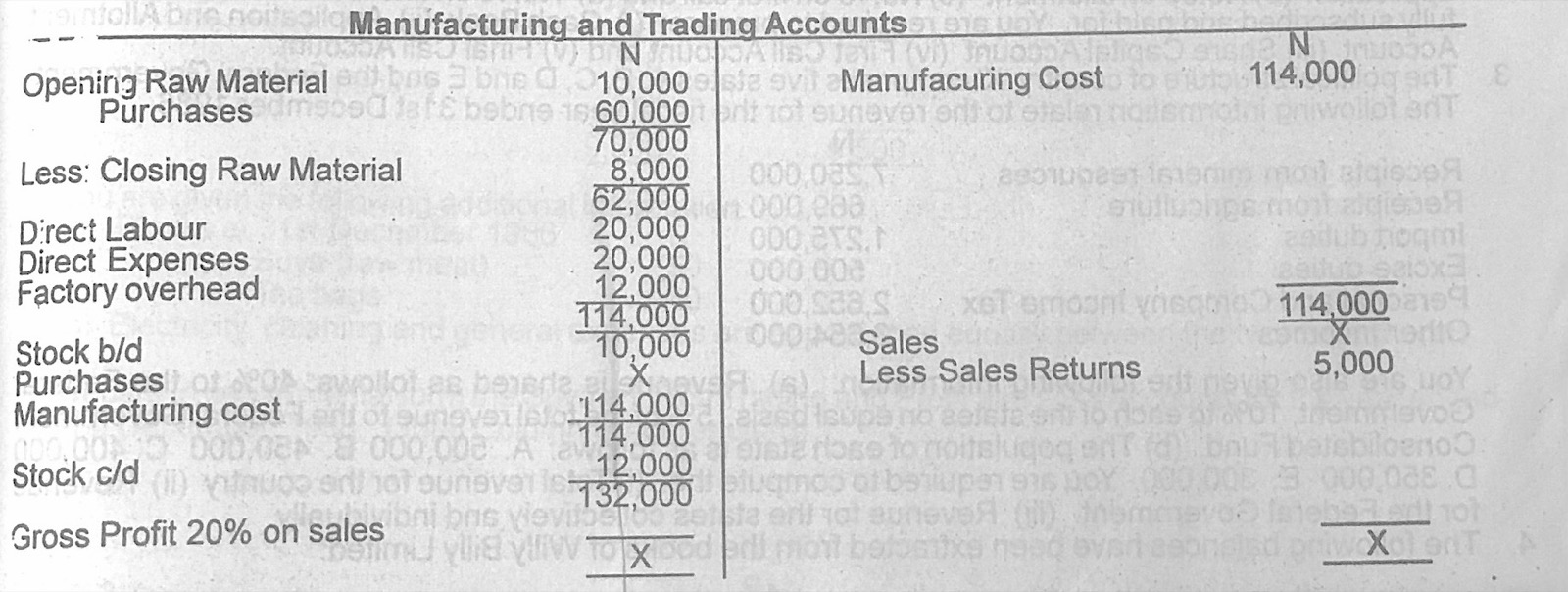
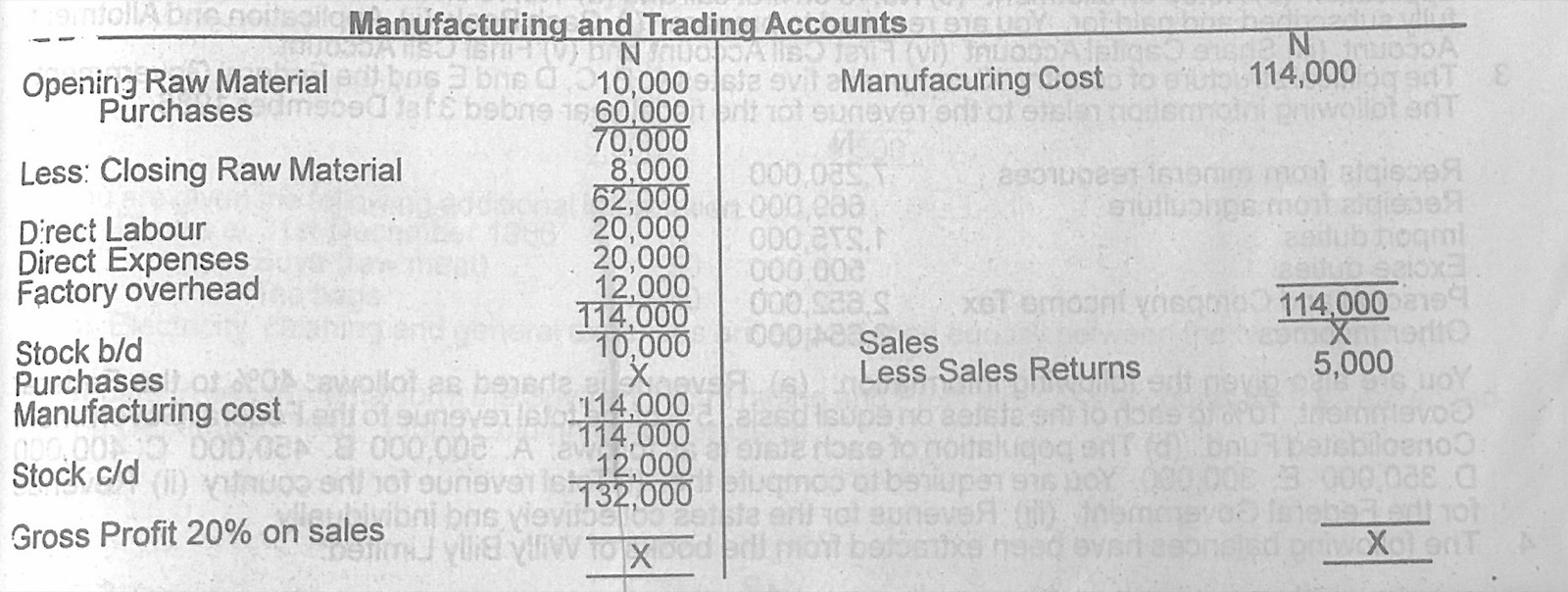
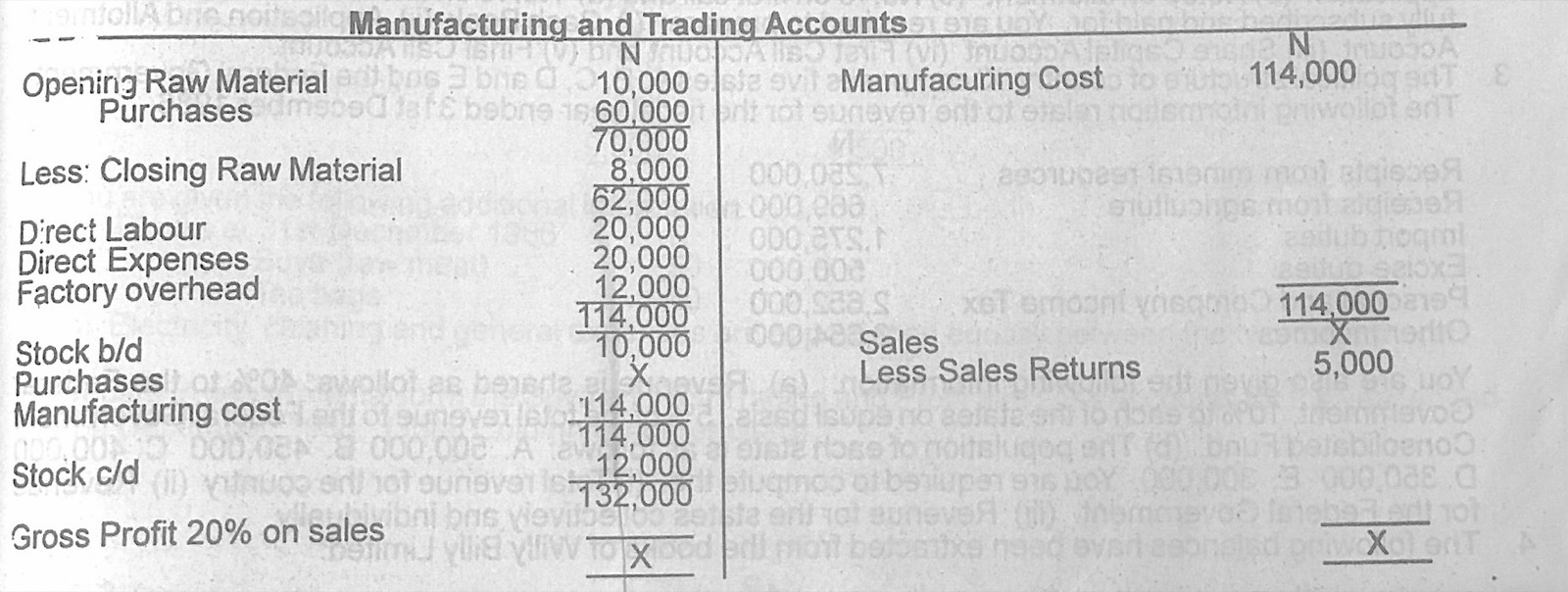
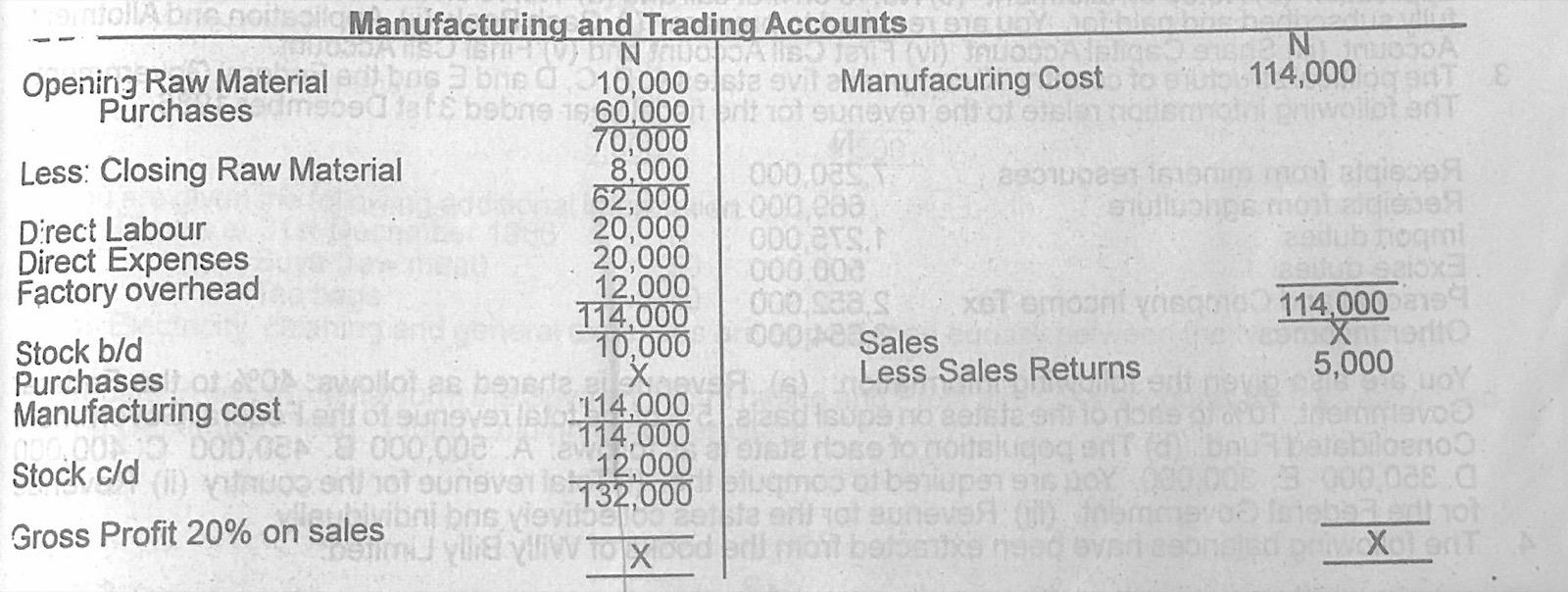
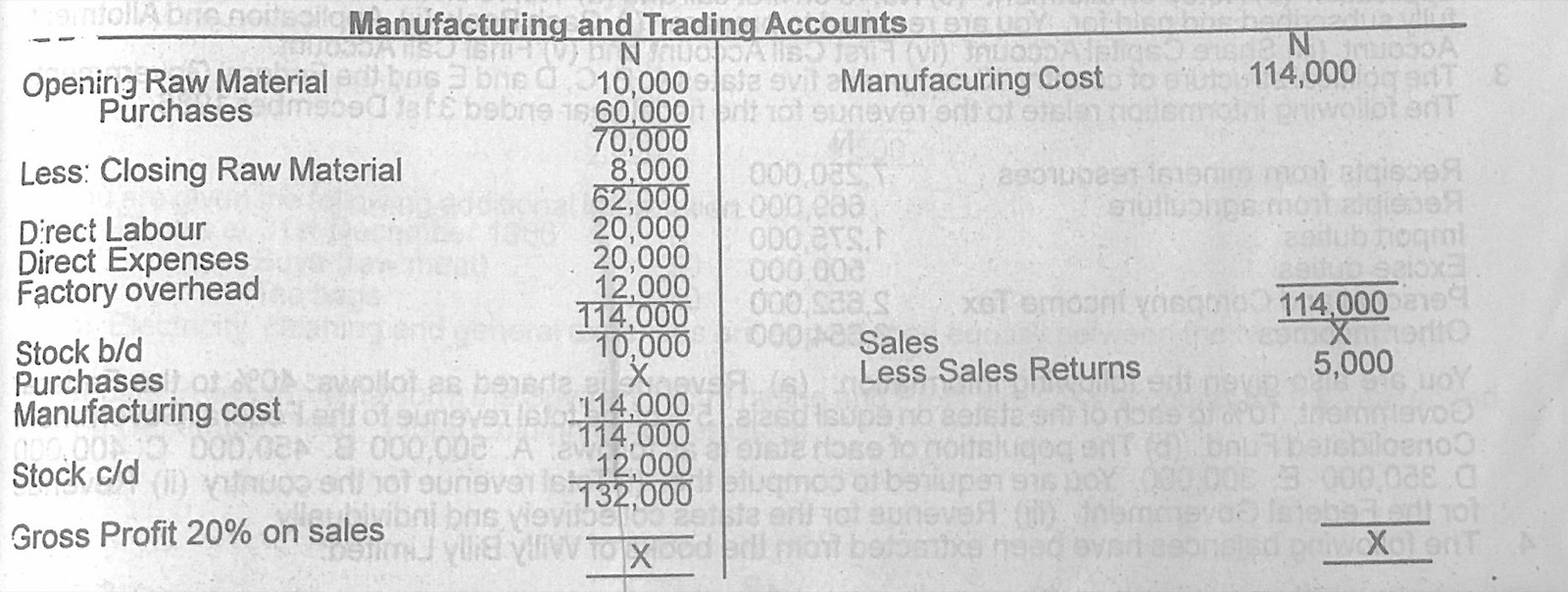
Use the Manufacturing and Trading Accounts shown (X marks figures you must work out). What is the total of raw materials consumed?

Diagram for this question
  1. A.₦144,000
  2. B.₦114,000
  3. C.₦70,000
  4. D.₦62,000
  5. E.₦60,000
Show the answer and explanation

Answer: D (₦62,000)

Explanation

10,000 + 60,000 − 8,000 = ₦62,000.

Open this question

Question 42

Manufacturing Accounts

Use the Manufacturing and Trading Accounts shown (X marks figures you must work out). What is the Prime Cost?

Diagram for this question
  1. A.₦62,000
  2. B.₦70,000
  3. C.₦78,000
  4. D.₦102,000
  5. E.₦114,000
Show the answer and explanation

Answer: D (₦102,000)

Explanation

Prime cost = materials 62,000 + direct labour 20,000 + direct expenses 20,000 = ₦102,000.

Open this question

Question 43

Manufacturing Accounts

Use the Manufacturing and Trading Accounts shown (X marks figures you must work out). What is the factory cost of production?

Diagram for this question
  1. A.₦114,000
  2. B.₦102,000
  3. C.₦78,000
  4. D.₦62,000
  5. E.₦60,000
Show the answer and explanation

Answer: A (₦114,000)

Explanation

Prime cost 102,000 + factory overhead 12,000 = ₦114,000.

Open this question

Question 44

Manufacturing Accounts

Use the Manufacturing and Trading Accounts shown (X marks figures you must work out). What is the cost of finished goods Purchased?

Diagram for this question
  1. A.₦60,000
  2. B.₦50,000
  3. C.₦40,000
  4. D.₦30,000
  5. E.₦20,000
Show the answer and explanation

Answer: E (₦20,000)

Explanation

Cost of sales is 132,000, so goods available = 132,000 + closing stock 12,000 = 144,000; purchases = 144,000 − 10,000 − 114,000 = ₦20,000.

Open this question

Question 45

Manufacturing Accounts

Use the Manufacturing and Trading Accounts shown (X marks figures you must work out). What is the net sales for the period?

Diagram for this question
  1. A.₦175,000
  2. B.₦170,000
  3. C.₦165,000
  4. D.₦132,000
  5. E.₦114,000
Show the answer and explanation

Answer: C (₦165,000)

Explanation

Gross profit is 20% of sales, so cost of sales 132,000 is 80% of sales: 132,000 ÷ 0.8 = ₦165,000.

Open this question

Question 46

Manufacturing Accounts

Use the Manufacturing and Trading Accounts shown (X marks figures you must work out). What is Average Stock of finished goods?

Diagram for this question
  1. A.₦8,000
  2. B.₦9,000
  3. C.₦10,000
  4. D.₦11,000
  5. E.₦12,000
Show the answer and explanation

Answer: D (₦11,000)

Explanation

(Opening 10,000 + closing 12,000) ÷ 2 = ₦11,000.

Open this question

Question 47

Manufacturing Accounts

Use the Manufacturing and Trading Accounts shown (X marks figures you must work out). What is the Gross Profit?

Diagram for this question
  1. A.₦33,000
  2. B.₦28,800
  3. C.₦28,500
  4. D.₦26,400
  5. E.₦22,800
Show the answer and explanation

Answer: A (₦33,000)

Explanation

Gross profit = 20% of net sales 165,000 = ₦33,000 (or 165,000 − 132,000).

Open this question

Question 48

Bad Debts and Provisions

The term Bad Debt means

  1. A.debt written on bad receipts
  2. B.debt owed by a bad person
  3. C.debt that can not be collected
  4. D.overcharge on a debtor's account
  5. E.debt paid with bad currency notes.
Show the answer and explanation

Answer: C (debt that can not be collected)

Explanation

A bad debt is money owed that will never be received, so it is written off.

Open this question

Question 49

Books of Original Entry

A subsidiary record is a book

  1. A.found in the ledger
  2. B.of subsidiary entries
  3. C.of original entry
  4. D.containing the final accounts
  5. E.of final entry.
Show the answer and explanation

Answer: C (of original entry)

Explanation

Subsidiary books (day books, journal, cash book) are the books of original (prime) entry.

Open this question

Theory question 101

Final Accounts of a Sole Trader

Section A
The following Trial Balance was extracted from the books of Yisa Aliyu, a sole proprietor as at 31st December, 1987.
Capital: Cr ₦50,000
Cash at Bank: Dr ₦10,820
Leasehold Premises: Dr ₦13,000
Plant and Equipment: Dr ₦11,000
Furniture and Fixtures: Dr ₦6,000
Motor Van: Dr ₦7,000
Stock 1/1/87: Dr ₦3,700
Wages and Salaries: Dr ₦1,800
Debtors and Creditors: Dr ₦850, Cr ₦770
6% Loan: Cr ₦2,000
Purchases and Sales: Dr ₦7,600, Cr ₦10,300
Office Expenses: Dr ₦80
Rent: Dr ₦200
Insurance: Dr ₦40
Discount Allowed and Received: Dr ₦20, Cr ₦40
Drawings: Dr ₦1,000
Totals: Dr ₦63,110, Cr ₦63,110

You are given the following additional information: (a) Stock at 31st December, 1987 was valued ₦8,000 (b) the leasehold premises is for a term of 10 years (c) Depreciation is to be charged as follows: Plant and Equipment 5%; Motor Van 10%; Furniture and Fixtures 2½%. (d) A debt of ₦10 is irrecoverable.
You are required to prepare: (i) Trading, Profit and Loss Account for the year ended 31st December 1987 (ii) The Balance Sheet as at the date.

Show the model answer
Model answer

Yisa Aliyu: Trading, Profit and Loss Account for the year ended 31 December 1987
Sales 10,300; opening stock 3,700 + purchases 7,600 = 11,300 − closing stock 8,000 = cost of sales 3,300
Gross profit = ₦7,000; add discount received 40 = 7,040
Expenses: wages and salaries 1,800; office expenses 80; rent 200; insurance 40; discount allowed 20; bad debt 10; loan interest accrued (6% × 2,000) 120; depreciation: plant 550 (5% × 11,000), motor van 700 (10% × 7,000), furniture 150 (2½% × 6,000); leasehold amortised 1,300 (13,000 ÷ 10); total 4,970
Net profit = ₦2,070
Balance Sheet as at 31 December 1987
Fixed assets (cost − depreciation = NBV): leasehold 13,000 − 1,300 = 11,700; plant 11,000 − 550 = 10,450; furniture 6,000 − 150 = 5,850; motor van 7,000 − 700 = 6,300; total ₦34,300
Current assets: stock 8,000; debtors 850 − 10 = 840; cash at bank 10,820; total 19,660
Current liabilities: creditors 770; loan interest accrued 120; total 890; working capital 18,770
Net assets 34,300 + 18,770 = 53,070; less 6% loan 2,000 = ₦51,070
Financed by: capital 50,000 + net profit 2,070 − drawings 1,000 = ₦51,070

Explanation

Remember the year's 6% loan interest (₦120) is not in the trial balance, so accrue it.

Open this question

Theory question 102

Company Accounts

Section B
Archibong Stores Limited registered with an Authorised Share Capital of ₦500,000, consisting of 500,000 ordinary shares of ₦1 each. The shares were issued and payable on the following terms: (a) ₦0.50 on application (b) ₦0.30 on allotment (c) ₦0.10 on first call and (d) ₦0.10 on final call. All the shares were fully subscribed and paid for. You are required to prepare: (i) Cash Book (ii) Application and Allotment Account (iii) Share Capital Account (iv) First Call Account and (v) Final Call Account.

Show the model answer
Model answer

Workings: application 500,000 × ₦0.50 = 250,000; allotment × ₦0.30 = 150,000; first call × ₦0.10 = 50,000; final call × ₦0.10 = 50,000
(i) Cash Book (Dr): application and allotment 400,000; first call 50,000; final call 50,000; total 500,000 = balance c/d (Cr) ₦500,000
(ii) Application and Allotment Account: Dr share capital 400,000 / Cr cash 400,000 (application 250,000 + allotment 150,000)
(iii) Ordinary Share Capital Account: Cr application and allotment 400,000; first call 50,000; final call 50,000; balance c/d (Dr) ₦500,000
(iv) First Call Account: Dr share capital 50,000 / Cr cash 50,000
(v) Final Call Account: Dr share capital 50,000 / Cr cash 50,000

Explanation

Each instalment account is debited when the money becomes due (credit share capital) and credited when cash comes in.

Open this question

Theory question 103

Public Sector Accounting

The political structure of country 'X' comprises five states A, B, C, D and E and the Federal Government. The following information relate to the revenue for the fiscal year ended 31st December 1986.
Receipts from mineral resources: ₦7,250,000
Receipts from agriculture: ₦669,000
Import duties: ₦1,275,000
Excise duties: ₦500,000
Personal and Company Income Tax: ₦2,652,000
Other Incomes: ₦3,654,000

You are also given the following information: (a) Revenue is shared as follows: 40% to the Federal Government, 10% to each of the states on equal basis, 5% of the total revenue to the Federal Government Consolidated Fund. (b) The population of each state is as follows: A. 500,000 B. 450,000 C. 400,000 D. 350,000 E. 300,000. You are required to compute the: (i) Total revenue for the country (ii) Revenue for the Federal Government. (iii) Revenue for the states collectively and individually.

Show the model answer
Model answer

(i) Total revenue = 7,250,000 + 669,000 + 1,275,000 + 500,000 + 2,652,000 + 3,654,000 = ₦16,000,000
Sharing: Federal 40%, Consolidated Fund 5%, states equally 5 × 10% = 50%; remaining 5% shared among states by population
(ii) Federal Government: 40% × 16,000,000 = 6,400,000 + Consolidated Fund 5% = 800,000; total ₦7,200,000
(iii) States collectively: equal share 8,000,000 + population share 800,000 = ₦8,800,000
Individually (equal 1,600,000 each + population share of 800,000 over total population 2,000,000): A 1,600,000 + 200,000 = 1,800,000; B 1,600,000 + 180,000 = 1,780,000; C 1,600,000 + 160,000 = 1,760,000; D 1,600,000 + 140,000 = 1,740,000; E 1,600,000 + 120,000 = 1,720,000

Explanation

The 5% left after 40% + 5% + 50% is the part shared by population (₦0.40 per head).

Open this question

Theory question 104

Control Accounts

The following balances have been extracted from the books of Willy Billy Limited:
1/1/86 Purchases Ledger Balance CR: ₦11,874
1/1/86 Sales Ledger Balances: ₦19,744
Total for the year 1986:
Purchases Journal: ₦154,652
Sales Journal: ₦199,662
Returns Outwards Journal: ₦2,648
Returns Inwards Journal: ₦4,556
Cheques paid to Suppliers: ₦146,100
Petty Cash paid to suppliers: ₦78
Cheques and Cash received from customers: ₦185,960
Discounts allowed: ₦5,830
Discounts received: ₦2,134
Bad debts written off: ₦394
Customers cheque dishonoured: ₦30
Balance on Sales Ledger set off against balances in Purchases Ledger: ₦1,036
31/12/86 Purchases Ledger: ₦14,530
31/12/86 Sales Ledger: ₦21,658
You are required to prepare the Control Accounts.

Show the model answer
Model answer

Purchases Ledger Control Account
Dr: returns outwards 2,648; bank 146,100; petty cash 78; discounts received 2,134; sales ledger set-off 1,036; balance c/d 14,530; total 166,526
Cr: balance b/d 11,874; credit purchases 154,652; total 166,526 → closing creditors ₦14,530, which agrees with the purchases ledger
Sales Ledger Control Account
Dr: balance b/d 19,744; credit sales 199,662; dishonoured cheque 30; total 219,436
Cr: returns inwards 4,556; cash and cheques 185,960; discounts allowed 5,830; bad debts 394; purchases ledger set-off 1,036; balance c/d 21,660; total 219,436
Closing debtors ₦21,660 (the sales ledger list of ₦21,658 is ₦2 short, so the ledgers should be checked)

Explanation

Set-offs (contras) appear in both control accounts: credit sales ledger control, debit purchases ledger control.

Open this question

Theory question 105

Partnership Admission, Retirement and Dissolution

Kadiri and Bello are trading partners. Their Balance Sheet as at 31st December 1986 when the partnership was dissolved was as follows:
Kadiri and Bello Balance Sheet as at 31/12/86
Capital: Kadiri ₦2,500; Bello ₦2,500
Creditors: ₦2,000
Total: ₦7,000
Furniture: ₦1,000
Stock: ₦3,000
Debtors: ₦2,000
Cash: ₦1,000
Total: ₦7,000

Additional Information: (a) Profits and Losses are shared equally. (b) All the assets (except cash) realised ₦7,500 (c) Creditors were paid off and dissolution expenses of ₦300 were also paid. You are required to prepare: (i) Realisation Account (ii) Cash Book (iii) Partner's Capital Accounts (iv) Creditor Account.

Show the model answer
Model answer

(i) Realisation Account: Dr furniture 1,000, stock 3,000, debtors 2,000, cash (expenses) 300, profit on realisation: Kadiri 600, Bello 600; total 7,500 / Cr cash (assets sold) 7,500
Profit = 7,500 − 6,000 − 300 = 1,200, shared equally
(ii) Cash Book: Dr balance b/d 1,000, realisation 7,500 = 8,500 / Cr realisation expenses 300, creditors 2,000, Kadiri 3,100, Bello 3,100 = 8,500
(iii) Capital Accounts (Kadiri | Bello): Cr balance b/d 2,500 | 2,500, realisation profit 600 | 600 = 3,100 | 3,100 / Dr cash 3,100 | 3,100
(iv) Creditors Account: Dr cash 2,000 / Cr balance b/d 2,000

Explanation

Cash is not taken to the realisation account; it is used to pay creditors and expenses first, then the partners.

Open this question

Theory question 106

Departmental Accounts

Sule runs two departments for Suya and Tea. The following balances were extracted from his ledgers at 31st December, 1986.
Sales: Suya Cr ₦5,000; Tea Cr ₦4,500
Stocks 1/1/86: Suya (Raw Meat) Dr ₦200; Tea Dr ₦250
Purchases: Raw Meat for suya ₦2,000; Ingredients for suya ₦500; Tea bags ₦1,000; Milk and Sugar for Tea ₦600
Sundry expenses for suya: ₦300
Salaries of Assistants: Suya ₦600; Tea ₦400
Electricity: ₦240
Cleaning: ₦110
General Expenses: ₦200
Debtors: ₦3,100
Totals: Dr ₦9,500, Cr ₦9,500

You are given the following additional information: (a) Stocks at 31st December 1986: Suya (raw meat) ₦50; Tea bags ₦40 (b) Electricity, cleaning and general expenses are apportioned equally between the two departments.
Prepare in departmental form the Suya and Tea Trading and Profit and Loss Accounts for the year ended 31st December, 1986. (Total Column is not required).

Show the model answer
Model answer

Departmental Trading and Profit and Loss Account for the year ended 31 December 1986 (Suya | Tea)
Sales 5,000 | 4,500
Opening stock 200 | 250; purchases: raw meat 2,000 + ingredients 500 | tea bags 1,000 + milk and sugar 600; goods available 2,700 | 1,850
Less closing stock 50 | 40; cost of sales 2,650 | 1,810
Gross profit ₦2,350 | ₦2,690
Expenses: sundry expenses 300 | –; salaries 600 | 400; electricity 120 | 120; cleaning 55 | 55; general expenses 100 | 100; total 1,175 | 675
Net profit ₦1,175 | ₦2,015
(Debtors ₦3,100 is a balance sheet item, not in these accounts.)

Explanation

Charge each department its own costs directly and split only the shared costs (electricity, cleaning, general) equally.
Open this question