Home › Past questions › GCE › Biology › 1990 61 questions. Try each one, then open the answer to check yourself and read the explanation.
Sign up free to answer these questions on a CBT screen with a timer, then see your score and every answer explained.
Start practising free
Question 1 Reproduction in Animals Which of the following methods of reproduction is common to Paramecium and Amoeba?
A. Conjugation B. Sexual reproduction C. Binary fission D. Budding E. Fragmentation Show the answer and explanation Answer: C (Binary fission )
Explanation Both Amoeba and Paramecium usually reproduce by splitting into two (binary fission).
Open this question
Question 2 Cell Structure and Organisation Which of the following structures controls the activities of the living cell?
A. Nucleus B. Centrosome C. Chloroplast D. Golgi body E. Mitochondrion Show the answer and explanation Answer: A (Nucleus )
Explanation The nucleus holds the genes that direct everything the cell does.
Open this question
Question 3 Cell Structure and Organisation Most of the energy in the cell is produced in the
A. mitochondrion B. lysosome C. plastid D. Golgi apparatus E. cytoplasm Show the answer and explanation Answer: A (mitochondrion )
Explanation Aerobic respiration in the mitochondria releases most of the cell's energy as ATP.
Open this question
Question 4 Cell Structure and Organisation The structure in the cell that controls the movement of substances in and out of the cell is the
A. cytoplasmic membrane B. nuclear membrane C. cytoplasm D. protoplasm E. endoplasm Show the answer and explanation Answer: A (cytoplasmic membrane )
Explanation The cell (cytoplasmic) membrane is selectively permeable and controls what enters and leaves.
Open this question
Question 5 Cell Structure and Organisation Which of the following structures differentiates an animal cell from a plant cell?
A. Ribosomes B. Cell membrane C. Chloroplast D. Mitochondrion E. Lysosome Show the answer and explanation Answer: C (Chloroplast )
Explanation Chloroplasts are found in plant cells but never in animal cells.
Open this question
Question 6 Cell Division At the end of mitosis the number of cells produced from a parent cell is
A. four B. six C. eight D. three E. two Show the answer and explanation Answer: E (two )
Explanation Mitosis divides one cell into two identical daughter cells.
Open this question
Question 7 Respiration Which of the following statements is not correct of respiration?
A. Gaseous exchange occurs by diffusion B. Oxygen combines with haemoglobin at the respiratory surface C. Carbondioxide produced in the tissues is removed by the process of osmosis D. There are no special organs for respiration in plants E. In higher animals, respiratory gases are transported in solution Show the answer and explanation Answer: C (Carbondioxide produced in the tissues is removed by the process of osmosis )
Explanation Carbon dioxide leaves the tissues by diffusion; osmosis is the movement of water only.
Open this question
Question 8 Cell Division At which of the following stages of mitosis do the two daughter chromosomes separate completely?
A. Early prophase B. Telophase C. Anaphase D. Late prophase E. Metaphase Show the answer and explanation Answer: C (Anaphase )
Explanation At anaphase the centromeres split and the chromatids (now daughter chromosomes) are pulled apart to opposite poles.
Open this question
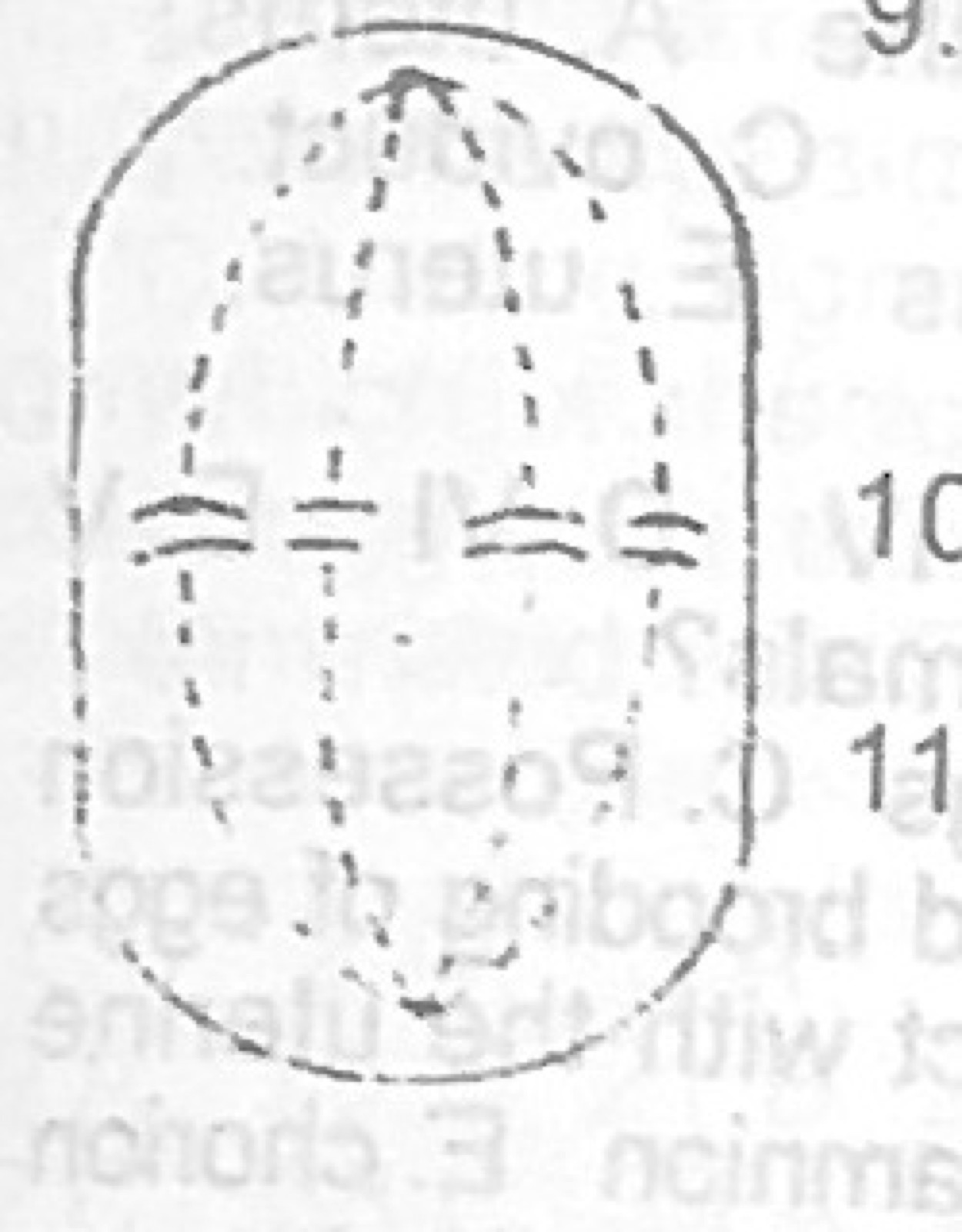
Question 9 Cell Division Below is a drawing of a stage in mitosis. Use it to answer questions 9 and 10.
A. Lining up of the chromosomes at the equatorial plate B. Centromere attaching a pair of chromatids to a spindle fibre C. Chromatids held by centromere D. Absence of nuclear membrane E. Chromatids moving to the poles Show the answer and explanation Answer: E (Chromatids moving to the poles )
Explanation The drawing shows the chromosomes lined up on the equator of the spindle (metaphase); the chromatids have not yet started moving to the poles.
Open this question
Question 10 Cell Division The drawing shows a stage in mitosis (questions 9 and 10).
A. telophase B. metaphase C. anaphase D. interphase E. prophase Show the answer and explanation Answer: B (metaphase )
Explanation The chromosomes are arranged across the equator of the spindle with no nuclear membrane: this is metaphase.
Open this question
Question 11 Support and Movement Which of the following is not a function of the mammalian skeleton? It
A. gives the body its shape B. provides a framework on which internal organs are suspended C. protects soft and delicate parts of the body D. provides attachment for muscles E. contracts and relaxes to bring about movement Show the answer and explanation Answer: E (contracts and relaxes to bring about movement )
Explanation Muscles contract and relax; bones only act as levers for them.
Open this question
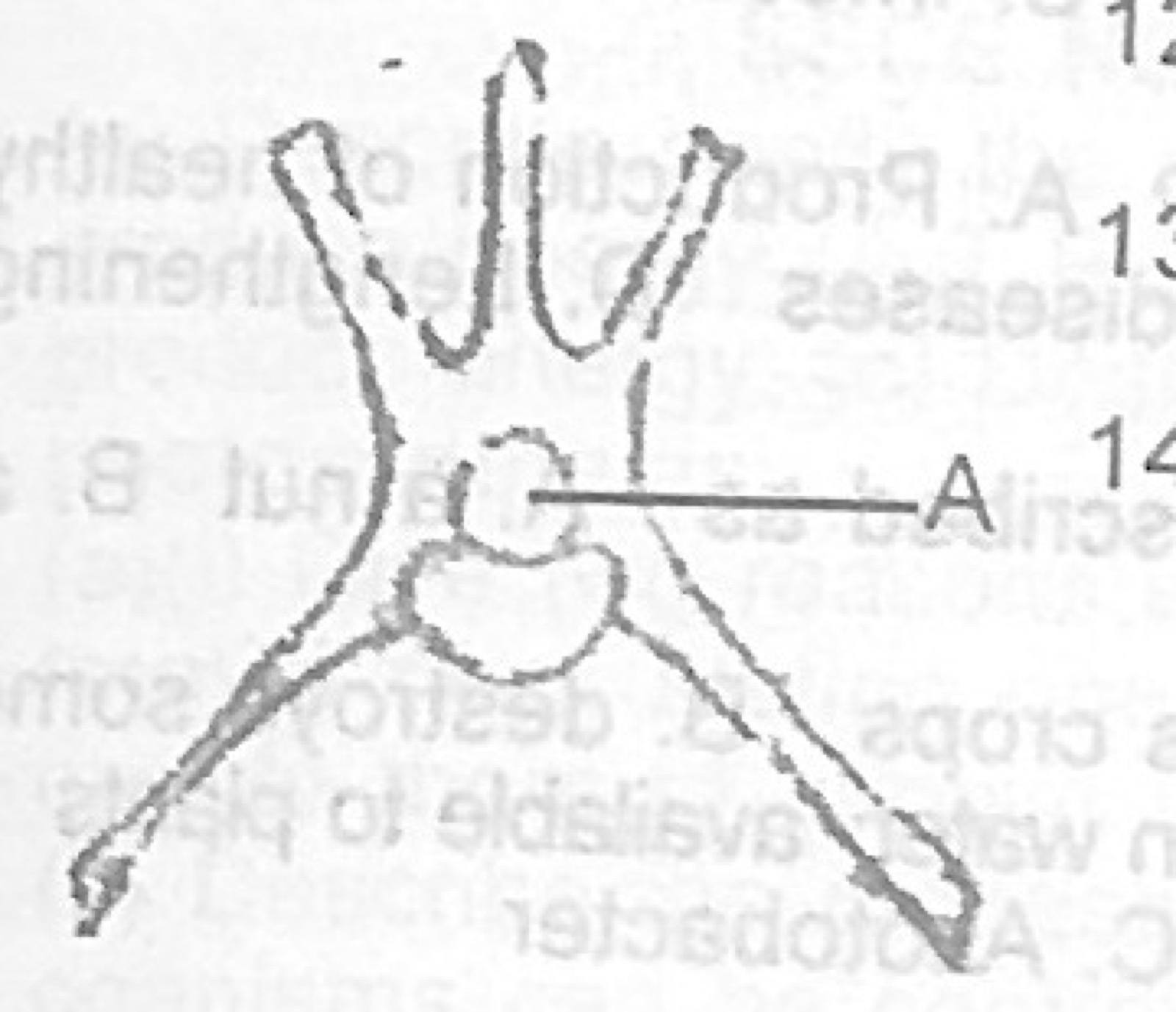
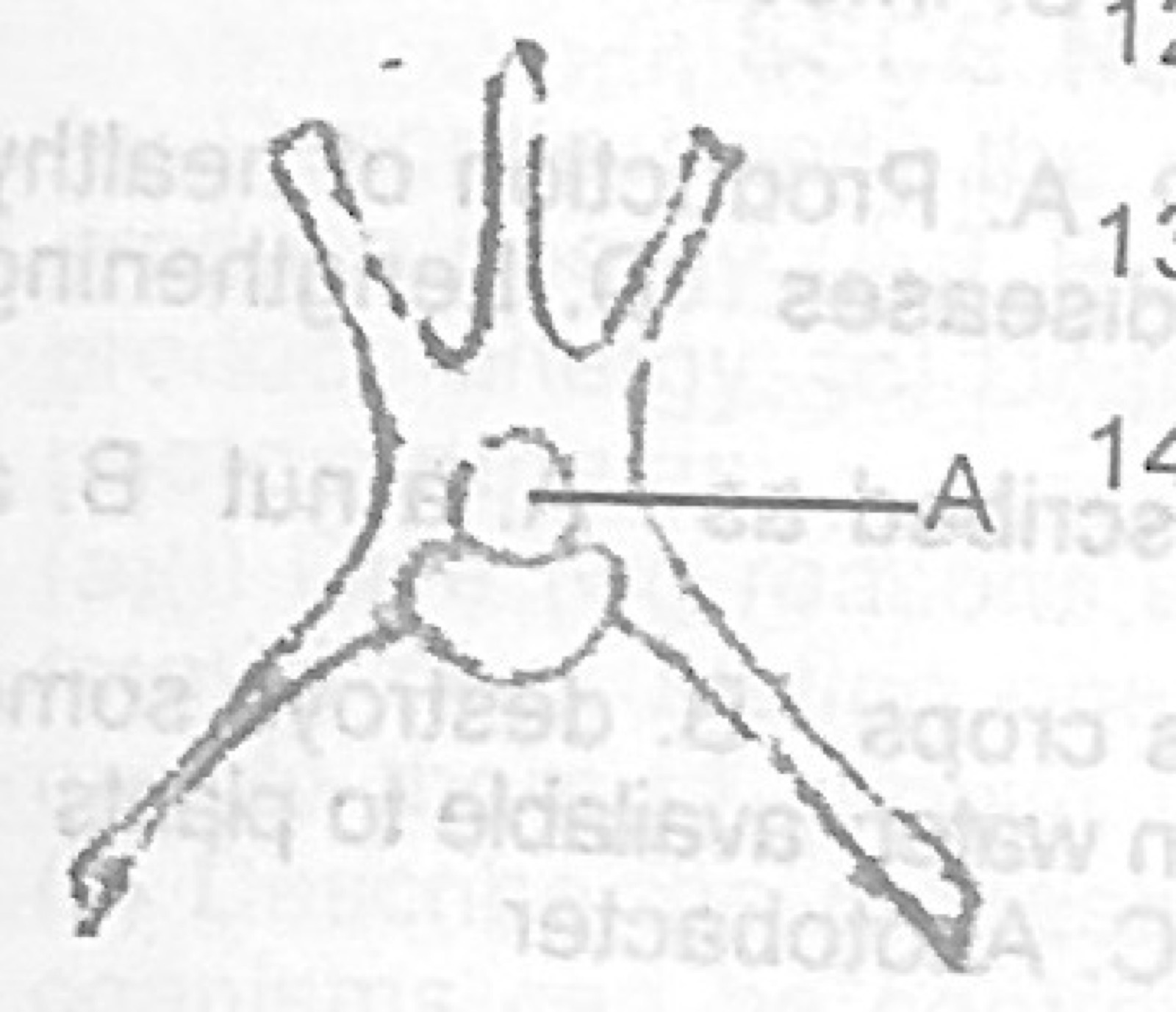
Question 12 Support and Movement Use the diagram below to answer questions 12 and 13.
A. Atlas B. Axis C. Cervical vertebra D. Sacrum E. Lumbar vertebra Show the answer and explanation Answer: E (Lumbar vertebra )
Explanation Its long, broad transverse processes for the back muscles show it is a lumbar vertebra.
Open this question
Question 13 Support and Movement Use the diagram of the vertebra (questions 12 and 13).
A. transverse process B. neural spine C. neural canal D. centrum E. metapophysis Show the answer and explanation Answer: C (neural canal )
Explanation A points to the hole above the centrum through which the spinal cord passes: the neural canal.
Open this question
Question 14 Support and Movement Which of the following statements is not correct about the functions of each group of mammalian vertebrae?
A. Cervical vertebrae support the neck B. Thoracic vertebrae articulate with the ribs C. Lumbar vertebrae provide attachment for abdominal muscles D. Sacral vertebrae support the skull and allow nodding and rotating movements E. Caudal vertebrae support the tail and provide attachment for tail muscle Show the answer and explanation Answer: D (Sacral vertebrae support the skull and allow nodding and rotating movements )
Explanation The skull is supported by the atlas and axis (cervical vertebrae); sacral vertebrae are fused to the pelvic girdle.
Open this question
Question 15 Support and Movement The stems of young herbaceous plants are kept upright mainly by
A. osmotic pressure B. turgor pressure C. transpiration pull D. suction pressure E. root pressure Show the answer and explanation Answer: B (turgor pressure )
Explanation Young stems have little wood; their cells are kept firm by turgor pressure.
Open this question
Question 16 Support and Movement Different tissues in plants contribute to the support of the parts as a result of the following characteristics except
A. malleability B. rigidity C. flexibility D. resilience E. hardness Show the answer and explanation Answer: A (malleability )
Explanation Malleability (being hammered into shape) is a property of metals, not of supporting tissues.
Open this question
Question 17 Transport in Plants Water vapour is lost in plants during transpiration through
A. stomata and lenticels B. xylem and stomata C. sclerenchyma and stomata D. parenchyma and lenticels E. guard cells and lenticels Show the answer and explanation Answer: A (stomata and lenticels )
Explanation Water vapour escapes through stomata on leaves and lenticels on stems (and a little through the cuticle).
Open this question
Question 18 Respiration Gaseous exchange takes place in the adult toad through the
A. buccal cavity, bladder and lungs B. buccal cavity, skin and lungs C. tympanic membrane, lungs and gills D. buccal cavity, skin and spiracle E. gills, skin and buccal cavity Show the answer and explanation Answer: B (buccal cavity, skin and lungs )
Explanation An adult toad breathes through its moist skin, the lining of its mouth (buccal cavity) and its lungs.
Open this question
Question 19 Respiration Breathing movement in mammals is accompanied by regular movements of the diaphragm and the
A. intercostal muscles B. vertebral column C. clavicle D. pleural cavity E. floating ribs Show the answer and explanation Answer: A (intercostal muscles )
Explanation The intercostal muscles move the ribs while the diaphragm contracts and relaxes.
Open this question
Question 20 Excretion Which of the following are components of glomerular filtrate?
A. All the components of blood except mineral salts B. Water and salt only C. All the components of blood except plasma protein and cells D. Plasma proteins, red and white blood cells E. Blood cells, amino acid, salts and nitrogenous wastes Show the answer and explanation Answer: C (All the components of blood except plasma protein and cells )
Explanation Blood cells and plasma proteins are too large to pass through the glomerulus; everything else is filtered.
Open this question
Question 21 Excretion The mechanism by which useful materials in the glomerular filtrate are taken back into the blood is known as
A. filtration B. reabsorption C. haemolysis D. osmosis E. dialysis Show the answer and explanation Answer: B (reabsorption )
Explanation Selective reabsorption in the tubules returns glucose, water and salts to the blood.
Open this question
Question 22 Excretion Which of the following takes place during the process of detoxication in the liver?
A. Poisonous substances in the body are converted into harmless substances B. Fats and oils are broken into finer particles through emulsification C. Excess glucose in the blood are converted into glycogen and stored D. Worn-out red blood cells are broken down E. Enough heat is generated to sustain the activities of the liver Show the answer and explanation Answer: A (Poisonous substances in the body are converted into harmless substances )
Explanation Detoxication means making poisons (e.g. alcohol, drugs) harmless.
Open this question
Question 23 Excretion The cup-shaped part of the Bowman's capsule contains the
A. nephridium B. glomerulus C. loop of Henle D. nephron E. convoluted tubule Show the answer and explanation Answer: B (glomerulus )
Explanation The glomerulus, a knot of capillaries, sits inside the cup of Bowman's capsule.
Open this question
Question 24 Homeostasis The increase in width of blood vessels in the mammalian skin at high temperatures is known as
A. vasolidation B. sweating C. vasoconstriction D. shivering E. evaporation Show the answer and explanation Answer: A (vasolidation )
Explanation Widening of skin blood vessels (vasodilation) brings blood to the surface to lose heat.
Open this question
Question 25 Hormonal Coordination The condition known as cretinism is caused by the deficiency of
A. adrenalin B. vitamin A C. insulin D. thyroxin E. vitamin C Show the answer and explanation Answer: D (thyroxin )
Explanation Too little thyroxin in childhood causes cretinism: stunted body and mental growth.
Open this question
Question 26 Nervous Coordination Which of the following parts of the mammalian brain is involved in taking the decision to run rather than walk?
A. Cerebellum B. Medulla oblongata C. Cranial nerves D. Mid brain E. Cerebrum Show the answer and explanation Answer: E (Cerebrum )
Explanation Voluntary decisions are made in the cerebrum.
Open this question
Question 27 Nervous Coordination The brain and spinal cord make up the
A. peripheral nervous system B. autonomic nervous system C. central nervous system D. somatic nervous system E. sympathetic nervous system Show the answer and explanation Answer: C (central nervous system )
Explanation The brain and spinal cord form the central nervous system.
Open this question
Question 28 Plant Responses and Hormones Which of the following is not true about auxins? They
A. are manufactured by plants B. are used in the site of production C. are normally present in minute quantities in the cells of plants D. regulate growth rate of plants E. regulate direction of growth in plants Show the answer and explanation Answer: B (are used in the site of production )
Explanation Auxins are made at the tips but act further back in the growing region, not where they are made.
Open this question
Question 29 Sense Organs Which of the following stimuli are not perceived through the skin of mammals?
A. Light B. Pressure C. Pain D. Heat E. Cold Show the answer and explanation Answer: A (Light )
Explanation The skin has receptors for touch, pressure, pain, heat and cold; light is detected by the eyes.
Open this question
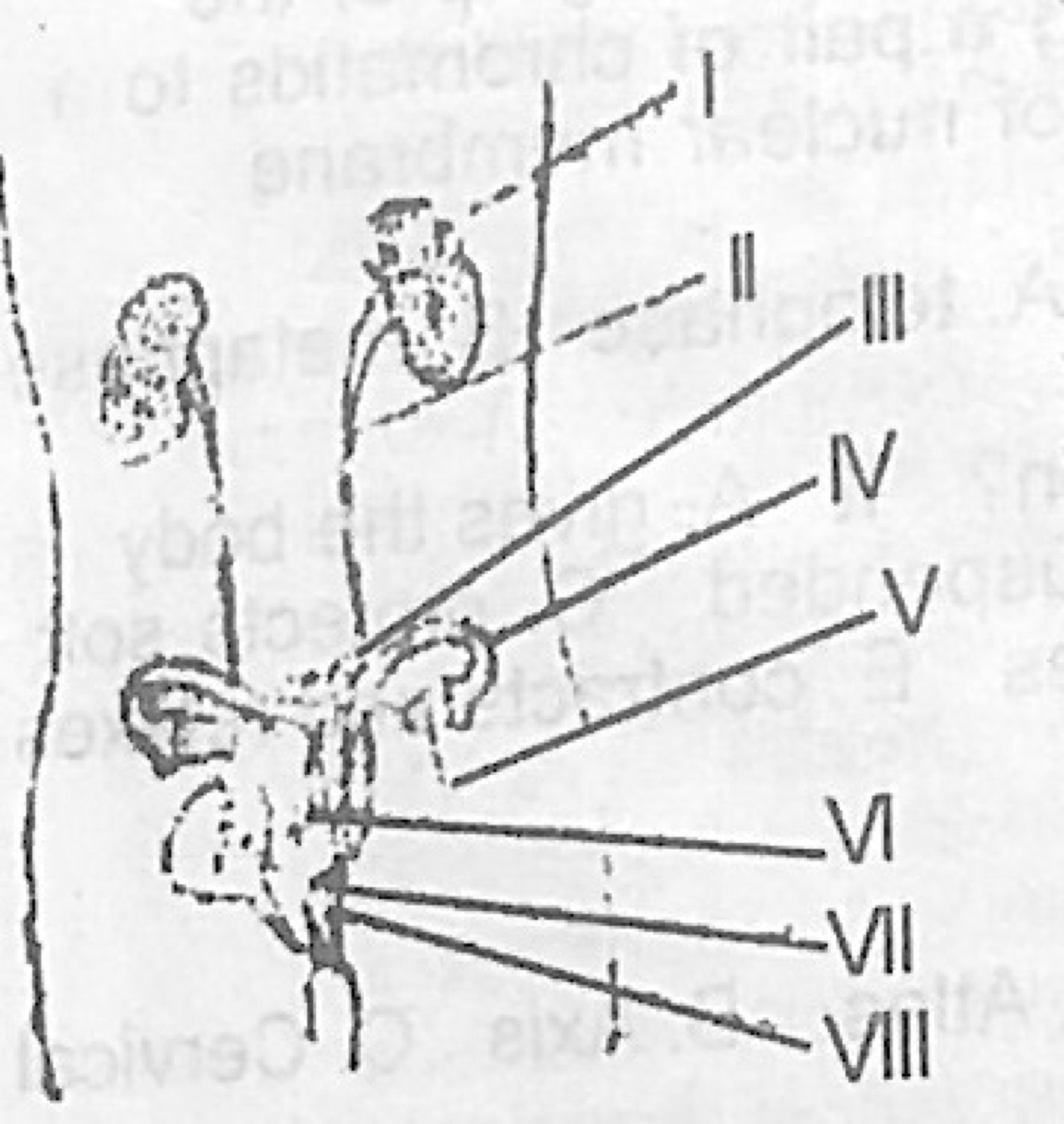
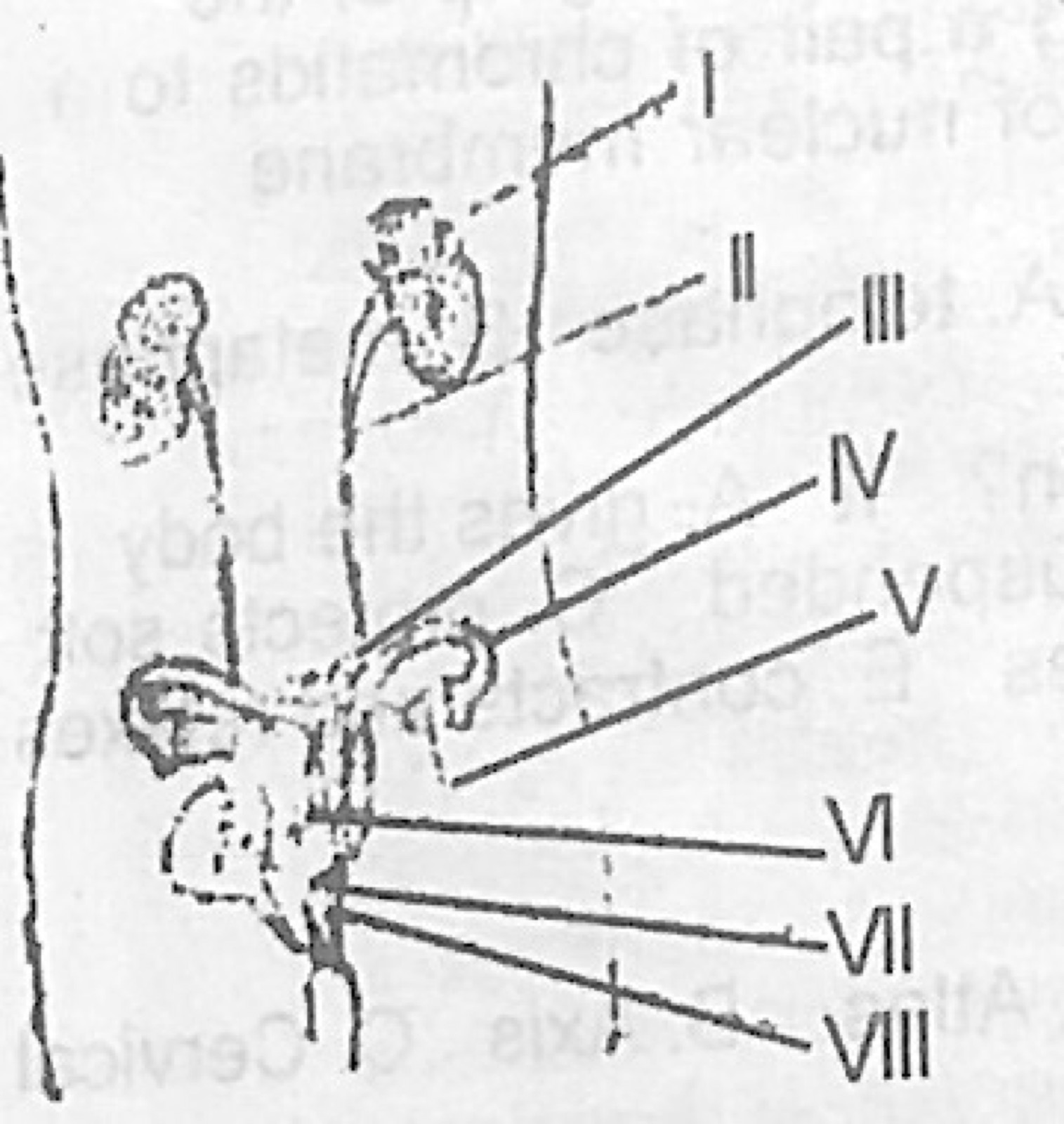
Question 31 Reproduction in Animals Use the diagram below to answer questions 31 and 32.
A. uterus, cervix, oviduct and ureter B. cervix, oviduct, uterus and ureter C. oviduct, uterus, ureter and cervix D. vagina, cervix, oviduct and uterus E. uterus, cervix, ovary and oviduct Show the answer and explanation Answer: A (uterus, cervix, oviduct and ureter )
Explanation Following the labels: III is the uterus, VI the cervix, IV the oviduct and II the ureter from the kidney.
Open this question
Question 32 Reproduction in Animals Use the diagram of the female reproductive system (questions 31 and 32).
A. I B. II C. IV D. VI E. V Show the answer and explanation Answer: E (V )
Explanation The female gamete (ovum) is made in the ovary, labelled V.
Open this question
Question 33 Reproduction in Animals What is the difference between viviparous and oviparous animals?
A. Possession of yolked eggs B. Laying of unfertilized eggs C. Possession of yolkless eggs D. Protection of eggs from predator E. Laying and brooding of eggs Show the answer and explanation Answer: E (Laying and brooding of eggs )
Explanation Oviparous animals lay eggs which develop outside the body; viviparous animals keep the young inside and give birth to live young.
Open this question
Question 34 Reproduction in Animals The structure of the embryo which develops and makes contact with the uterine wall is known as the
A. umbilical cord B. placenta C. allantois D. amnion E. chorion Show the answer and explanation Answer: B (placenta )
Explanation The placenta grows from the embryo's tissues and is attached closely to the uterine wall, where food and oxygen are exchanged.
Open this question
Question 35 Animal Nutrition The organ located in the mammalian abdominal cavity just below the diaphragm and lying on top of the stomach is the
A. bladder B. intestine C. liver D. pancreas E. chorion Show the answer and explanation Answer: C (liver )
Explanation The liver lies just under the diaphragm, partly covering the stomach.
Open this question
Question 36 Mendelian Inheritance Which of the following is the effect of using artificial pollination in plant breeding?
A. Production of healthy crops B. Improvement of the variety of crops C. Making crops susceptible to diseases D. Lengthening the maturity time of crops E. Encouraging competition amongst crops Show the answer and explanation Answer: B (Improvement of the variety of crops )
Explanation Breeders cross chosen parents by hand to combine good characters and improve the crop variety.
Open this question
Question 37 Reproduction in Plants A dry indehiscent fruit containing one seed and possessing a hairy pappus is described as
A. a nut B. a drupe C. a cypsela D. a follicle E. an achene Show the answer and explanation Answer: C (a cypsela )
Explanation A cypsela (e.g. Tridax) is a one-seeded dry fruit that does not split and has a hairy pappus.
Open this question
Question 38 Nutrient Cycling Thunderstorm can be beneficial to plants because it
A. kills the pest that attacks crops B. destroys some of the major crops C. adds nitrates to the soil D. adds lime to the soil E. makes rain water available to plants Show the answer and explanation Answer: C (adds nitrates to the soil )
Explanation Lightning joins nitrogen and oxygen into oxides that rain washes into the soil as nitrates.
Open this question
Question 40 Food Substances and Enzymes Which of the following reagents is used for the test for starch?
A. Millon's reagent B. Fehlings' solution C. Sudan III D. Iodine solution E. Benedict's solution Show the answer and explanation Answer: D (Iodine solution )
Explanation Iodine solution turns blue-black with starch.
Open this question
Question 41 Photosynthesis and Plant Nutrition Which of the followning is an autotrophic mode of nutrition?
A. Chemosynthesis B. Saprophytism C. Parasitism D. Symbiosis E. Commensalism Show the answer and explanation Answer: A (Chemosynthesis )
Explanation Chemosynthetic bacteria make their own food using energy from chemical reactions, so they are autotrophs.
Open this question
Question 42 Pollution Which of the following is not a way of reducing air pollution?
A. Siting factories and power stations away from residential areas B. Building tall factory chimneys C. Passing waste gases through filters and absorbers D. Using lead-free petrol in cars E. Recycling tins, cans and bottles Show the answer and explanation Answer: E (Recycling tins, cans and bottles )
Explanation Recycling tins, cans and bottles reduces land pollution (litter), not air pollution.
Open this question
Question 43 Habitats and Biomes Which of the following factors is not associated with aquatic habitat?
A. Temperature B. Light intensity C. Turbidity D. Wave action E. Humidity Show the answer and explanation Answer: E (Humidity )
Explanation Humidity is moisture in the air, a land-habitat factor.
Open this question
Question 44 Soil Which of the following types of soil has the highest water-retaining capacity?
A. Clay B. Laterite C. Loam D. Gravel E. Sand Show the answer and explanation Answer: A (Clay )
Explanation Clay has the finest particles and smallest pore spaces, so it holds the most water.
Open this question
Question 45 Feeding Relationships and Energy Flow Changes in energy flow between organisms in a habitat can be represented by a
A. pyramid of biomass B. pyramid of numbers C. pyramid of energy D. food chain E. food web Show the answer and explanation Answer: C (pyramid of energy )
Explanation A pyramid of energy shows how much energy passes from one feeding level to the next.
Open this question
Question 46 Nutrient Cycling Which of the following processes is not involved in the carbon cycle?
A. Burning B. Decay C. Transpiration D. Respiration E. Photosynthesis Show the answer and explanation Answer: C (Transpiration )
Explanation Transpiration moves water, not carbon; it belongs to the water cycle.
Open this question
Question 47 Nutrient Cycling Which of the following processes are involved in a water cycle?
A. Evaporation, condensation and precipitation B. Evaporation, percolation and transpiration C. Evaporation and precipitation D. Evaporation and transpiration E. Precipitation and condensation Show the answer and explanation Answer: A (Evaporation, condensation and precipitation )
Explanation Water evaporates, condenses into clouds and falls as rain (precipitation): the full cycle.
Open this question
Question 48 Food Substances and Enzymes Water in the human body is derived from the following sources except through
A. drinking water B. food substances C. cytoplasm of worn-out cells D. respiratory activity E. absorption by the skin Show the answer and explanation Answer: E (absorption by the skin )
Explanation Human skin is waterproof and does not absorb water; we get water from drink, food and respiration.
Open this question
Question 49 Conservation of Natural Resources The conservation of natural resources can be achieved by the following except
A. creation of national parks B. formation of conservation societies and agencies C. establishment of game reserves D. deregulated harvesting E. making laws on conservation Show the answer and explanation Answer: D (deregulated harvesting )
Explanation Harvesting without rules leads to over-exploitation, the opposite of conservation.
Open this question
Question 50 Soil Water rises most rapidly in
A. sandy soil B. clayey soil C. sandy-loam soil D. loamy soil E. humus soil Show the answer and explanation Answer: A (sandy soil )
Explanation Sandy soil has large pores, so water moves up through it fastest (though not as high as in clay).
Open this question
Question 51 Transport in Animals Thrombocytes are blood cells responsible for initiating
A. phagocytosis of bacteria B. synthesis of ribosomes C. clotting of the blood D. immunity to certain infectious diseases E. removal of carbondioxide from tissues Show the answer and explanation Answer: C (clotting of the blood )
Explanation Thrombocytes (platelets) start blood clotting at a wound.
Open this question
Question 52 Mendelian Inheritance When gametes from pure breeding parents with contrasting features such as tallness and shortness are involved in monohybrid cross, the offspring in the first filial generation are usually
A. pure breed B. heterozygous dominant C. homozygous recessive D. mutants E. co-dominant Show the answer and explanation Answer: B (heterozygous dominant )
Explanation TT × tt gives all Tt: heterozygous and showing the dominant character.
Open this question
Question 53 Mendelian Inheritance A pair of genes which controls a trait is described as
A. dominant B. recessive C. allele D. variant E. hybrid Show the answer and explanation Answer: C (allele )
Explanation Alleles are the alternative forms of a gene controlling one trait, found in pairs.
Open this question
Question 55 Transport in Animals The precondition for transfusion of blood to an accident victim is
A. seeking the consent to his parents B. ascertaining the religious belief of the victim C. cross-matching the blood group of the donor with that of the accident victim D. curing the donor of any disease traced in his blood E. rewarding the donor with food and money Show the answer and explanation Answer: C (cross-matching the blood group of the donor with that of the accident victim )
Explanation Donor and receiver blood must be cross-matched so that no agglutination happens.
Open this question
Question 56 Evolution Adaptive radiation as illustrated by the variety of forms in insects can be regarded as
A. a behavioural modification B. a case of rapid population growth C. a physiological process D. an evidence of evolution E. a population control mechanism Show the answer and explanation Answer: D (an evidence of evolution )
Explanation Many different insects developing from a common ancestor to fit different ways of life is evidence of evolution.
Open this question
Question 57 Evolution Which of the following statements about the modifications of pentadactyl fore-limb is not correct?
A. Wings are modified for flying in birds B. Flippers are modified for grasping in sharks C. Legs are modified for walking and running in antelopes D. Arms are adapted for grasping and holding in human beings E. Flippers are modified for swimming in whales Show the answer and explanation Answer: B (Flippers are modified for grasping in sharks )
Explanation Sharks are fish with fins, not pentadactyl limbs, and fins are not for grasping.
Open this question
Question 58 Adaptation The process by which plants and animals are modified in structure, physiology and behaviour in order to survive is known as
A. evolution B. adaptation C. succession D. aggregation E. hibernation Show the answer and explanation Answer: B (adaptation )
Explanation Adaptation is any feature of structure, body working or behaviour that helps an organism survive.
Open this question
Question 59 Behaviour What is the significance of the bee dance to other bees?
A. Warning signal B. Presence of food C. Mating signal by the male D. Scaring the enemies away E. Time for nuptial flight Show the answer and explanation Answer: B (Presence of food )
Explanation A worker bee dances to tell others the direction and distance of a food source.
Open this question
Question 60 Evolution Which of the following statements is not associated with the theory of natural selection?
A. There is a struggle for existence B. There is competition among the offsprings C. The weaker offsprings are eliminated D. Food and other needs are abundant E. Nature selects those that survive to reproduce their kind Show the answer and explanation Answer: D (Food and other needs are abundant )
Explanation Natural selection depends on food and needs being limited, causing a struggle for existence.
Open this question
Theory question 101 Respiration (a) Describe briefly the process involved in the breakdown of glucose in the cell of living organisms to produce energy (A T P).
Show the model answer Model answer (a) Glycolysis in the cytoplasm: glucose (6C) is broken down by enzymes into two pyruvic acid (3C) molecules with a small gain of ATP; no oxygen needed
Explanation In (c), state the test for oxygen (a glowing splint relights).
Open this question
Theory question 102 Behaviour (a)(i) Give two reasons why termites are described as social insects (ii) Name four castes found in the termite nest, stating one role of each caste
Show the model answer Model answer (a)(i) Any two: they live together in large organised colonies; division of labour among castes; individuals are structurally different according to duty; they cooperate and communicate (e.g. by chemicals/pheromones)
Explanation Give one specific role for each caste you name.
Open this question
Theory question 103 Population Ecology (a) Describe the process of succession in an abandoned farm land
Show the model answer Model answer (a) Secondary succession: bare/abandoned farm is first colonised by pioneer weeds and grasses (annuals) from seeds and roots left in the soil
Explanation Describe the stages in the order they happen, ending with the climax.
Open this question
Theory question 104 Mendelian Inheritance (a) Explain briefly how the process of meiotic division contributes to variation in a population
Show the model answer Model answer (a) Crossing over between homologous chromosomes at prophase I exchanges genes; independent (random) assortment of chromosomes at metaphase I gives many combinations; gametes therefore differ, and random fertilisation combines them, giving variation
Explanation In (c) a diagram only is asked for: show parents, gametes and offspring in a Punnett square.
Open this question Sign up free for every GCE Biology year, practice by topic and timed mocks.
Start practising free