Question 1
BearingsThe bearing of F from G is 064°. What is the bearing of G from F?
- A.128°
- B.180°
- C.244°
- D.116°
Show the answer and explanation
Answer: C (244°)
Explanation
The back bearing differs by 180°: 064° + 180° = 244°.
56 questions. Try each one, then open the answer to check yourself and read the explanation.
The bearing of F from G is 064°. What is the bearing of G from F?
Answer: C (244°)
The back bearing differs by 180°: 064° + 180° = 244°.
Ajoke will be 31 years in x years time. If Ajoke is 6 years older than Chioma, find an expression for Chioma's present age.
Answer: A (25 − x)
Ajoke is now 31 − x years old, so Chioma is now 31 − x − 6 = 25 − x.
Two ball bearings have volumes 1.6 cm3 and 5.4 cm3. Find the ratio of their surface areas.
Answer: A (4 : 9)
Volumes are in the ratio 16 : 54 = 8 : 27 = 2³ : 3³, so the radii are 2 : 3 and the surface areas 2² : 3² = 4 : 9.
Given that 215 = 14x, find the value of x.
Answer: D (7)
215 = 10 + 1 = 11, and 14x = x + 4, so x + 4 = 11 and x = 7.
Given that x + y = 1 and x + 3y = 5, find the value of (x2 + 4xy + 3y2).
Answer: B (5)
x² + 4xy + 3y² = (x + y)(x + 3y) = 1 × 5 = 5.
Consider the following statements:
p: The weather is warm.
q: The sun is shining.
Which of the following correctly represents the statement. "The sun is shining if and only if the weather is warm"?
Answer: D (q ⇔ p)
"q if and only if p" is written q ⇔ p.
In a class of 42 students, 21 offer History and 28 offer Government. If each student offers at least one of the two subjects, find the probability that a student selected at random from the class offers Government only.
Answer: C (1/2)
Both subjects: 21 + 28 − 42 = 7. Government only: 28 − 7 = 21, so the probability is 21/42 = ½.
The sets M = {x: 2 ≤ x ≤ 6} and N = {x: 4 ≤ x ≤ 8} are subsets of μ = {x: 1 ≤ x ≤ 10, where x is an integer}. Find M′ ∩ N′
Answer: C ({1, 9, 10})
M′ = {1, 7, 8, 9, 10} and N′ = {1, 2, 3, 9, 10}; the common elements are 1, 9 and 10.
A variable P varies inversely as the square of Q. If P = 5 when Q = 6, find Q when P = 1.8.
Answer: B (10)
P = k/Q²: k = 5 × 36 = 180. Then Q² = 180 ÷ 1.8 = 100, so Q = 10.
A square has diagonal length of 10 cm. Find the perimeter of the square.
Answer: C (20√2 cm)
Side² + side² = 100, so side = √50 = 5√2 cm and perimeter = 4 × 5√2 = 20√2 cm.
Make r the subject of the relation: 1/p = b/t + c/r
Answer: A (r = pct/(t − pb))
c/r = 1/p − b/t = (t − pb)/(pt), so r = pct/(t − pb).
Write 0.0364891 in three significant figures and express the answer in standard form.
Answer: D (3.65 × 10⁻²)
To three significant figures 0.0364891 is 0.0365 (the 4th figure, 8, rounds up), which is 3.65 × 10⁻².
The radius and height of a circular base cylinder are 8 cm and 14 cm respectively. Find its curved surface area. [Take π = 22/7]
Answer: B (704 cm2)
Curved surface area = 2πrh = 2 × 22/7 × 8 × 14 = 704 cm².
A cylinder and a cone have the same volume. If the height of the cone is 24 cm, find the height of the cylinder
Answer: B (8 cm)
Taking the same base radius, πr²h = ⅓πr² × 24, so h = 8 cm.
Given that sin (x − 46)° = cos 62°, find the value of x.
Answer: C (74)
cos 62° = sin 28°, so x − 46 = 28 and x = 74.
The population of a town increases by 2% every year. After 2 years, the population is 83,232. Calculate, correct to the nearest thousand, the original population.
Answer: A (80,000)
Two years of 2% growth multiply the population by 1.02² = 1.0404, so the original population is 83 232 ÷ 1.0404 = 80 000.
Simplify: (2⅓ + 5/2 − 1)/(12 − 11¾)
Answer: B (15⅓)
The top is 7/3 + 5/2 − 1 = 23/6 and the bottom is ¼, so the value is 23/6 × 4 = 46/3 = 15⅓.
Two consecutive odd integers are such that the sum of 5 times the smaller and 3 times the bigger integer is 222. Find the value of the smaller integer.
Answer: C (27)
5x + 3(x + 2) = 222 gives 8x = 216, so x = 27.
Simplify √200 − √72
Answer: B (4√2)
√200 = 10√2 and √72 = 6√2, so the difference is 4√2.
Given that log416 = logy36, find the value of y.
Answer: C (6)
log416 = 2, so y² = 36 and y = 6.
A fair dice is thrown once. Find the probability of obtaining an odd number or a prime number
Answer: C (2/3)
Odd or prime gives {1, 2, 3, 5}: 4 out of 6 outcomes, so 2/3.
The third and ninth terms of an Arithmetic Progression (AP) are 9 and −27 respectively. Find the fifth term.
Answer: C (−3)
6d = −27 − 9 = −36, so d = −6 and a = 21. T5 = 21 + 4(−6) = −3.
A profit of 8% was made when an article was sold for $500.00. At what price should it be sold to make a profit of 16%?
Answer: A ($537.04)
Cost price = 500 ÷ 1.08 = $462.96. For 16% profit: 462.96 × 1.16 ≈ $537.04.
John sold an article for ₦105,000.00 at a loss of 4%. Find the cost price of the article.
Answer: D (₦109,375.00)
At a 4% loss the selling price is 96% of the cost: cost = 105 000 ÷ 0.96 = ₦109,375.
In ΔPQR, |QR| = 2 cm, ∠PRQ = 60° and ∠PQR = 90°. Find |PR|
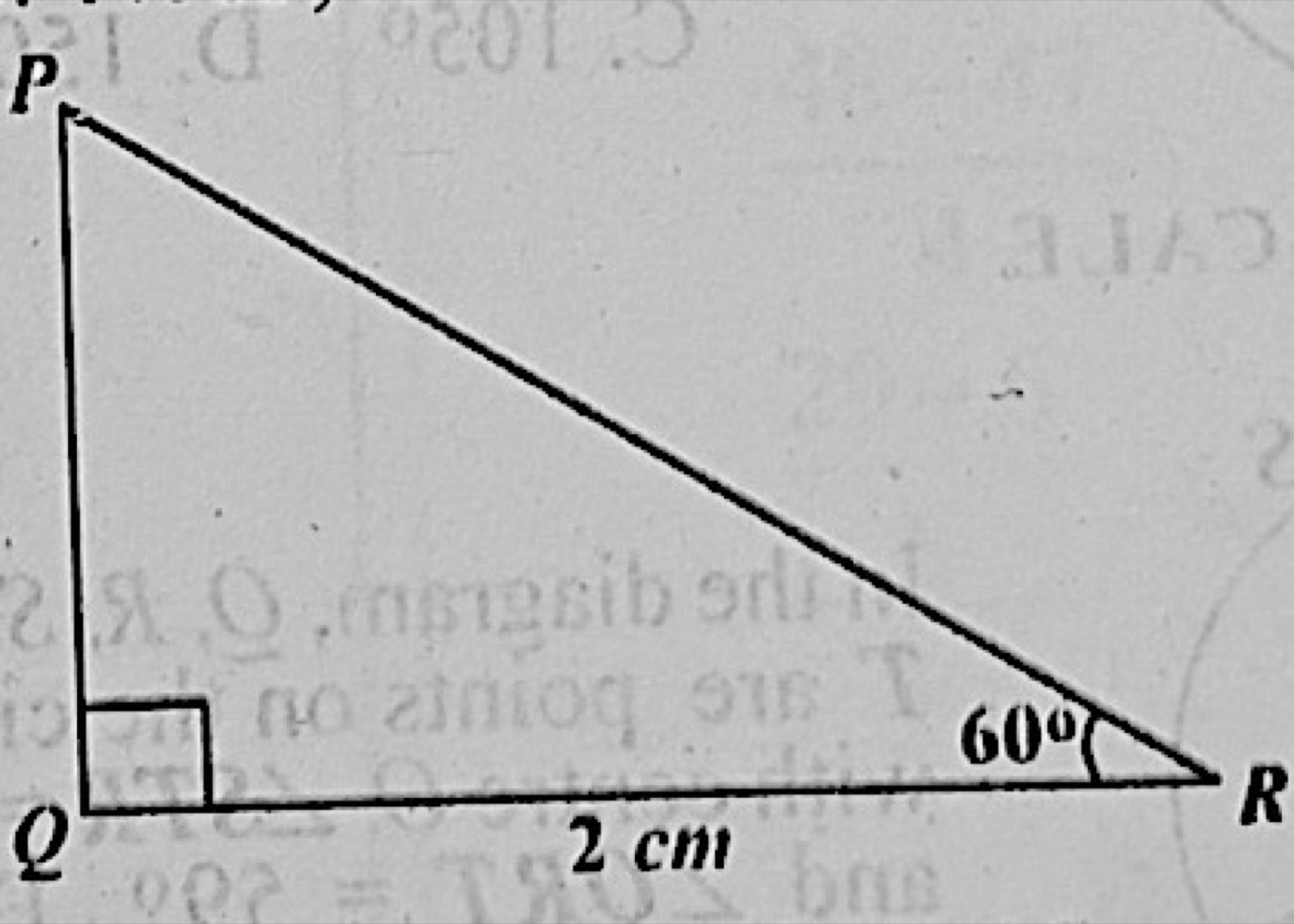
Answer: B (4 cm)
PR is the hypotenuse: cos 60° = QR/PR, so PR = 2 ÷ ½ = 4 cm.
The volume of a cone of height 18 cm is 8,316 cm3. Find the base radius of the cone. [Take π = 22/7]
Answer: A (21 cm)
⅓ × 22/7 × r² × 18 = 8316 gives r² = 441, so r = 21 cm.
Two towns X and Y are located at points (−2, −5) and (3, 7) respectively. Calculate the distance between the two towns.
Answer: C (13 units)
Distance = √(5² + 12²) = √169 = 13 units.
The interior angles of a triangle are in the ratio 2 : 5 : 8. Find the difference between the smallest and largest angles
Answer: D (72°)
The angles are 2/15, 5/15 and 8/15 of 180°: 24°, 60° and 96°. The difference is 96° − 24° = 72°.
Given that (x−n)4 = 1/x6, find the value of n.
Answer: C (3/2)
x−4n = x−6, so 4n = 6 and n = 3/2.
The angle of elevation of the top P of a ladder PQ from its base Q, 12 m away from a wall is 36°. Find, correct to the nearest metre, the length of the ladder.
Answer: C (15 m)
cos 36° = 12/length, so the length = 12 ÷ 0.809 ≈ 14.8 m ≈ 15 m.
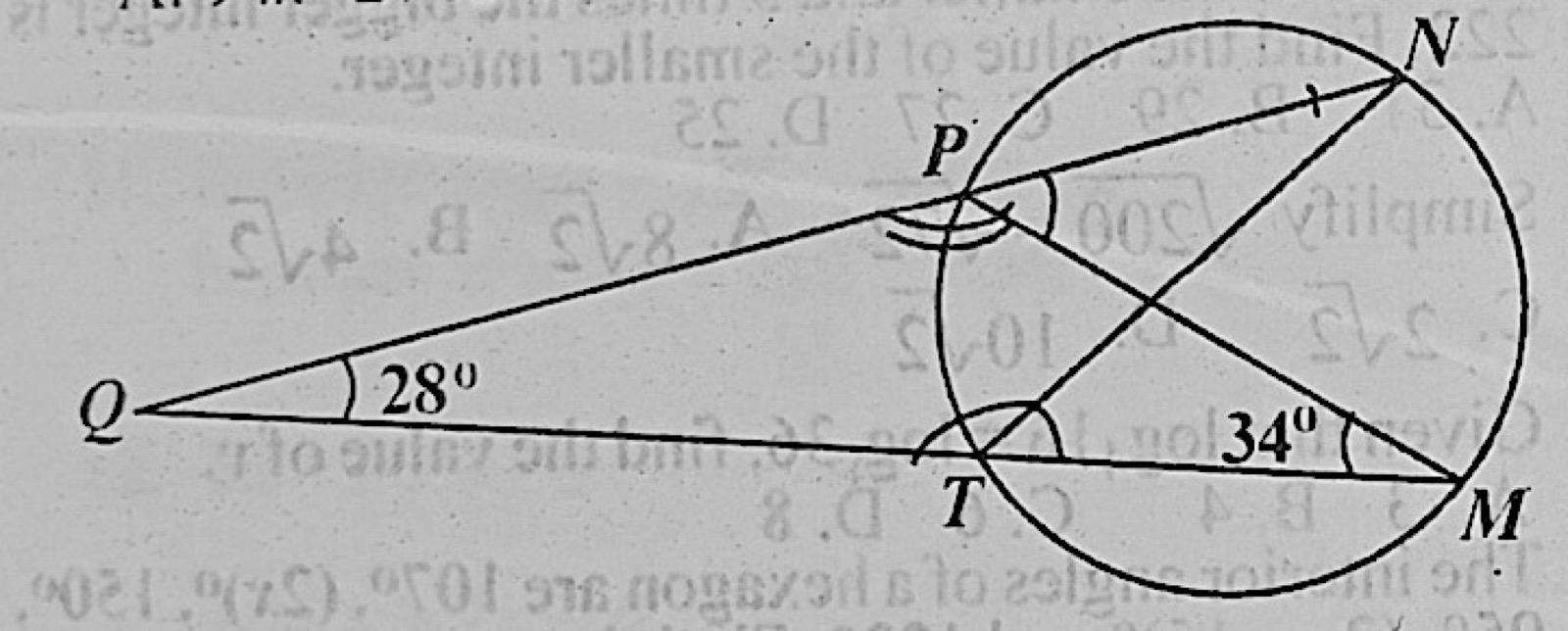
In the diagram, ∠PMQ = 34° and ∠NQM = 28°. Find ∠QTN.

Answer: D (118°)
∠PNT = ∠PMT = 34° (angles in the same segment). In triangle QTN, ∠QTN = 180° − 28° − 34° = 118°.
In the diagram, ∠PMQ = 34° and ∠NQM = 28°. Find ∠MPN.
Answer: A (62°)
∠MPN is an exterior angle of triangle QPM, so it equals 28° + 34° = 62°.
The height of 4 orange seedlings: are 2 cm, 5 cm, 7 cm and 10 cm. Calculate the variance
Answer: C (8.5)
The mean is 24/4 = 6. Squared deviations 16, 1, 1, 16 add to 34, so the variance is 34/4 = 8.5.
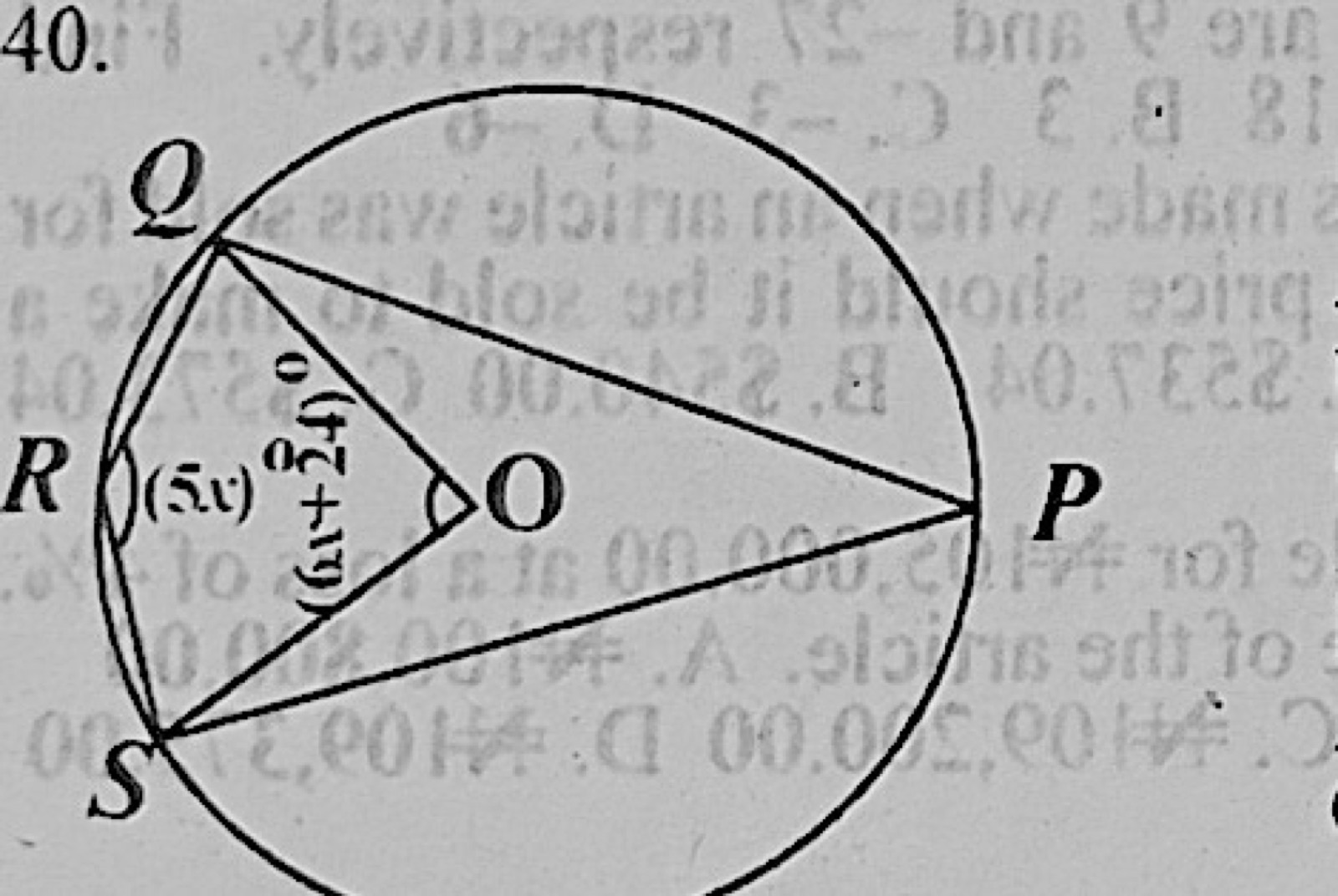
In the diagram, P, Q, R and S are points on the circle with centre O. ∠QRS = (5x)° and ∠QOS = (6x + 24)°. Find ∠QPS.
Answer: A (75°)
∠QPS = ½∠QOS = 3x + 12, and opposite angles of the cyclic quadrilateral give 5x + 3x + 12 = 180, so x = 21. ∠QPS = 3(21) + 12 = 75°.
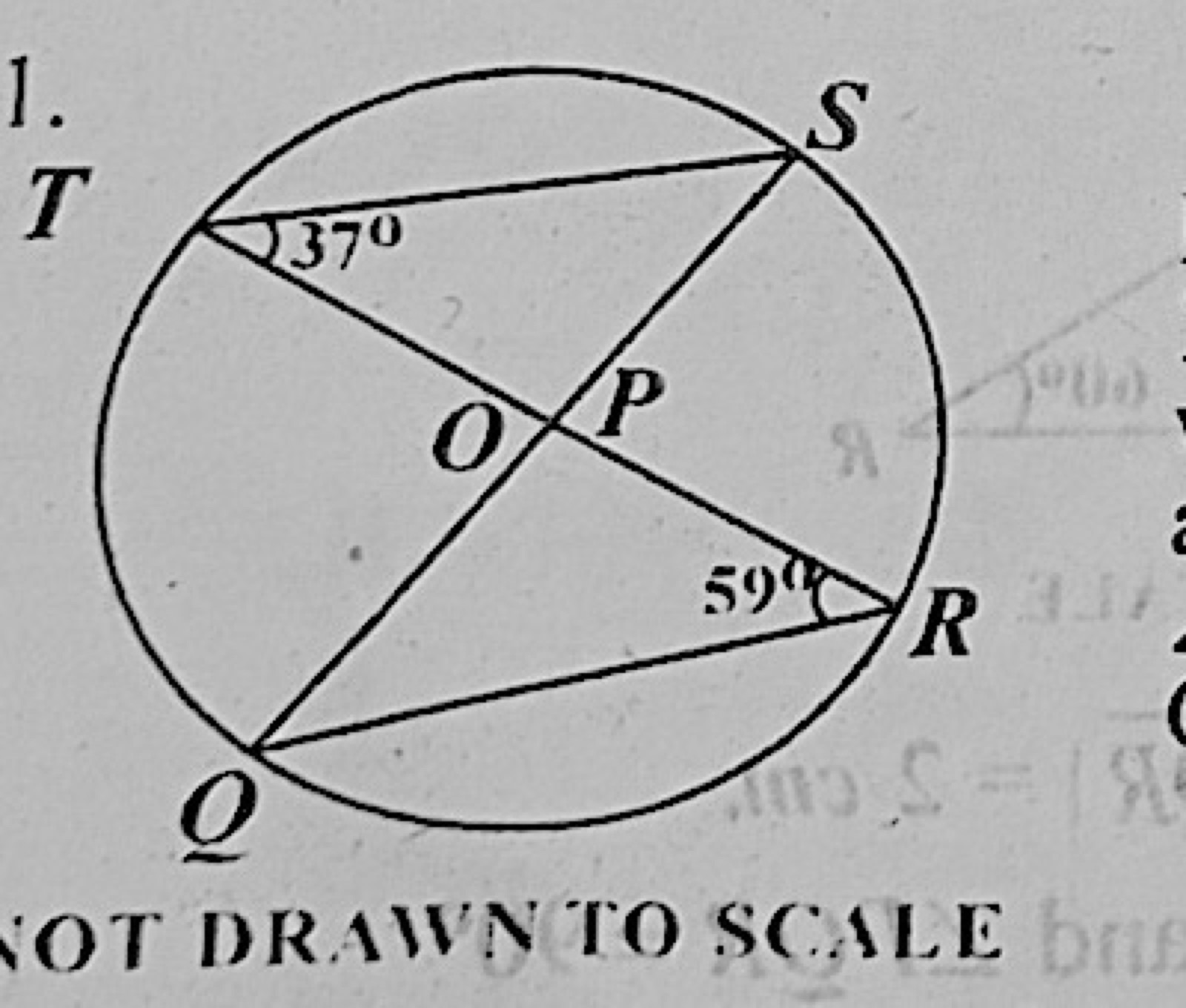
In the diagram, Q, R, S and T are points on the circle with centre O. ∠STR = 37° and ∠QRT = 59°. Find ∠SPR.
Answer: B (96°)
∠SQR = ∠STR = 37° (same segment). ∠SPR is an exterior angle of triangle PQR, so it equals 37° + 59° = 96°.
What is the gradient of the line 7x − 5y + 3 = 0?
Answer: A (7/5)
Rearranged, y = (7/5)x + 3/5, so the gradient is 7/5.
In the diagram SR ∥ UW, ∠WVT = x, ∠VUT = y, ∠RST = 45° and ∠VTU = 20°. Find the angle marked x.

Answer: C (45°)
S, V and T lie on one line and SR ∥ VW, so ∠WVT and ∠RST are corresponding angles: x = 45°.
In the diagram SR ∥ UW, ∠WVT = x, ∠VUT = y, ∠RST = 45° and ∠VTU = 20°. Find the angle marked y.
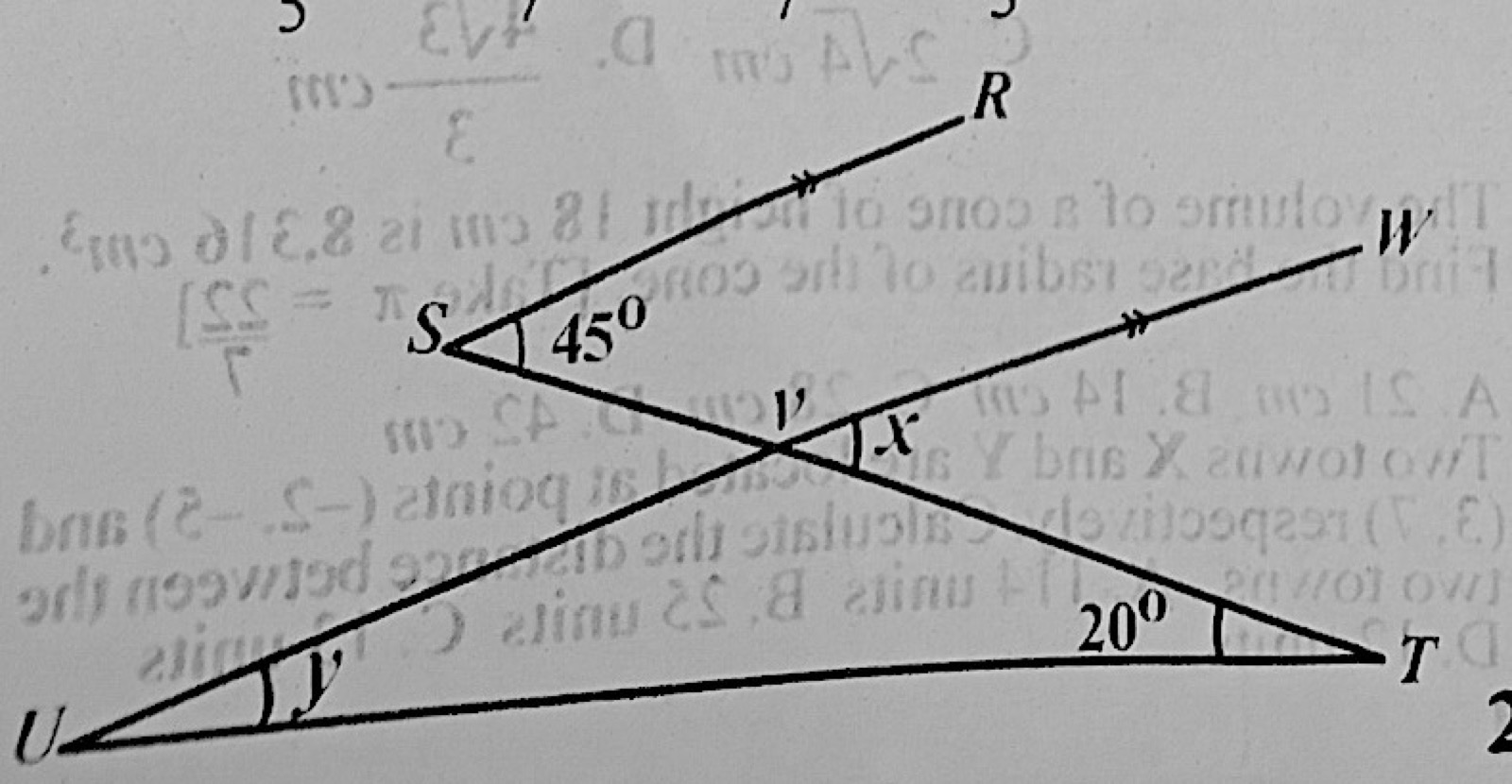
Answer: B (25°)
∠UVT = 180° − 45° = 135° (angles on the straight line UVW). In triangle UVT, y = 180° − 135° − 20° = 25°.
Kwakye, Sabina and Owusu shared an amount of $12,000.00. Kwakye had 20% of the amount and the remaining amount was shared between Sabina and Owusu in the ratio 5 : 3 respectively. How much did Sabina receive?
Answer: C ($6,000.00)
Kwakye gets $2,400, leaving $9,600. Sabina gets 5/8 × 9600 = $6,000.
The Venn diagram illustrates the information about the sets, P = {Pharmacists}, C = {Smart People} and F = {My Friends}. Which of the following is a valid conclusion from the diagram?
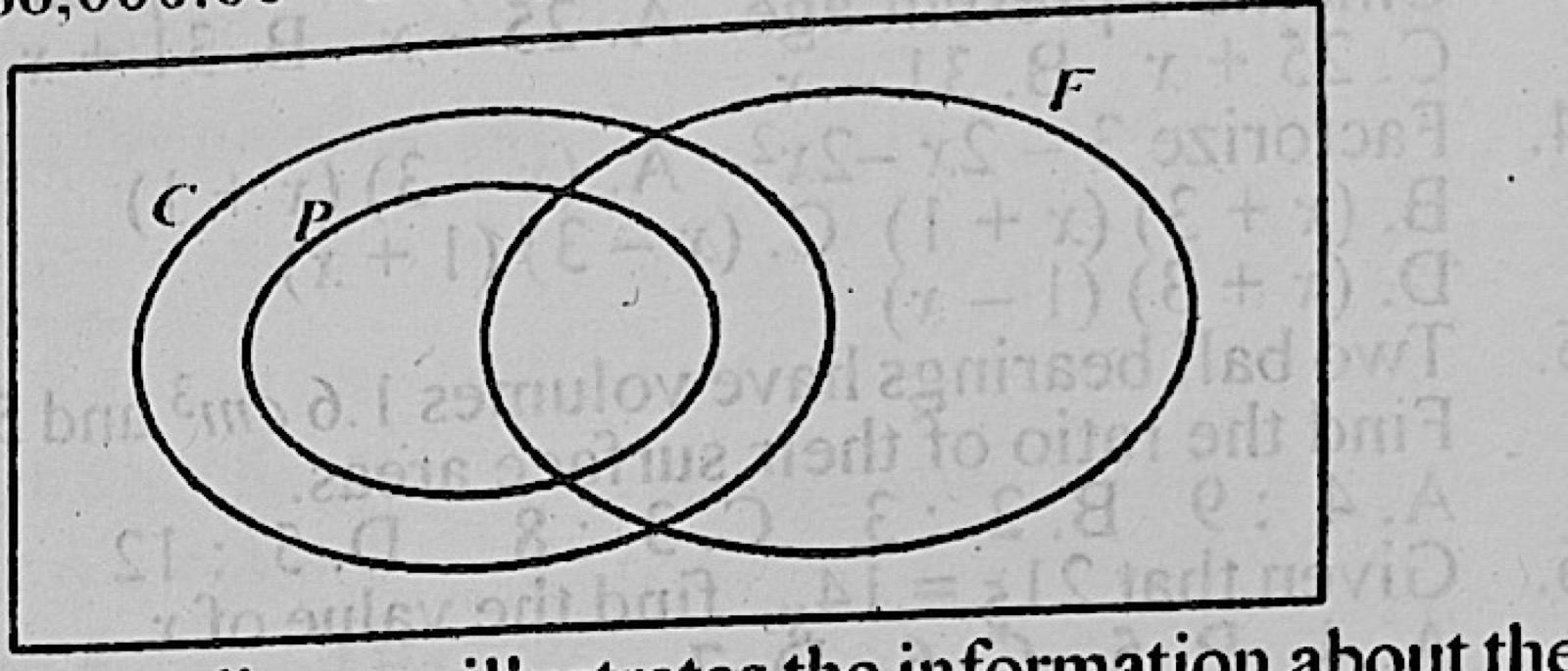
Answer: B (Some of my friends are smart.)
F overlaps C, so some of my friends are smart. P is not wholly inside F and C is not inside F, so A and C are not valid.
The table shows the ages of students in a class.
Age (Years): 13, 14, 15, 16, 17
Number of Students: 3, 14, 13, 8, 3
Find, correct to the nearest whole number, the average age of the students.
Answer: C (15)
Σfx = 39 + 196 + 195 + 128 + 51 = 609 and Σf = 41, so the mean is 609/41 ≈ 14.9 ≈ 15.
The table shows the ages of students in a class.
Age (Years): 13, 14, 15, 16, 17
Number of Students: 3, 14, 13, 8, 3
What is the median age?
Answer: B (15)
With 41 students the median is the 21st. Cumulative frequencies are 3, 17, 30, …, so the 21st student is 15.
Solve: d2 − 4d − 96 = 0.
Answer: C (d = −8, 12)
(d − 12)(d + 8) = 0, so d = 12 or d = −8.
Given that μ = {x: 1 < x < 20, where x is an integer}, P = {x: x is a multiple of 3} and Q = {x: x is a prime number} where P and Q are subsets of μ, find: (a) P ∩ Q′; (b) P′ ∪ Q; (c) (P ∪ Q)′.
μ = {2, 3, …, 19}; P = {3, 6, 9, 12, 15, 18}; Q = {2, 3, 5, 7, 11, 13, 17, 19}
(a) P ∩ Q′ = {6, 9, 12, 15, 18} (3 is prime, so it is not in Q′)
(b) P′ = {2, 4, 5, 7, 8, 10, 11, 13, 14, 16, 17, 19}; P′ ∪ Q = {2, 3, 4, 5, 7, 8, 10, 11, 13, 14, 16, 17, 19}
(c) P ∪ Q = {2, 3, 5, 6, 7, 9, 11, 12, 13, 15, 17, 18, 19}; (P ∪ Q)′ = {4, 8, 10, 14, 16}
List μ, P and Q first; remember 3 is both a multiple of 3 and prime.
The product of the ages of Adu and Tanko is 9 less than Akorfa's age. If Tanko is 4 years older than Adu and Akorfa's age is six times Tanko's age, find Akorfa's age.
Let Adu = x, Tanko = x + 4, Akorfa = 6(x + 4)
x(x + 4) + 9 = 6(x + 4) ⇒ x² − 2x − 15 = 0 ⇒ (x − 5)(x + 3) = 0 ⇒ x = 5
Tanko = 9, so Akorfa = 54 years
Ages are positive, so reject x = −3.
A company installs solar panels in its premises to reduce its electricity cost. The monthly savings on electricity in $, is modelled by S = 200 + 50x − 2x2, where x is the number of months after installation (a) At what time will the savings on electricity stop increasing? (b) Find the maximum savings.
(a) dS/dx = 50 − 4x = 0 ⇒ x = 12.5 months (12½ months after installation)
(b) S = 200 + 50(12.5) − 2(12.5)² = 200 + 625 − 312.5 = $512.50
Savings stop increasing where the gradient dS/dx is zero.
The diagram shows a tower TR and an observer at O. |OR| = 84 m and the angle of elevation of the top of the tower T from O is 57°.
(a) Calculate, correct to three significant figures, the height of the tower.
(b) The observer at O, moved away from the tower in the same straight line until the angle of elevation of T is 49°. Find, correct to two decimal places, how far the observer moved backwards.
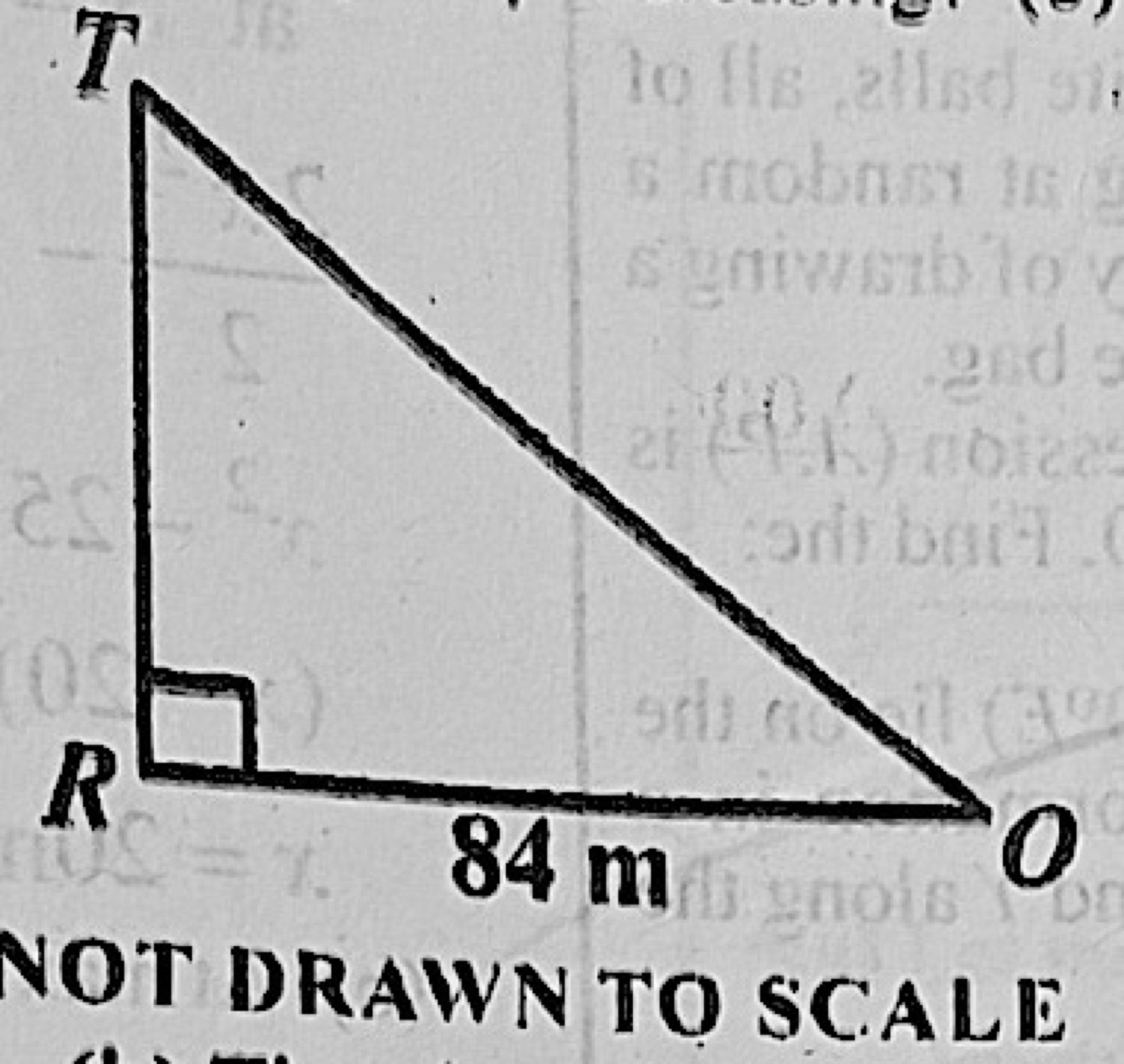
(a) TR = 84 tan 57° ≈ 129.35 m ≈ 129 m (3 s.f.)
(b) New distance from R = 129.35 ÷ tan 49° ≈ 112.44 m
Distance moved = 112.44 − 84 ≈ 28.44 m
Keep the unrounded height for part (b).
The data represent the scores obtained by 9 applicants in an interview arranged in ascending order: (3x + 2), 22, (4x − 2), 23, 25, (5x − 4), 29, 29 and (x2 − 7). (a) Given that the range is 9, find the: (i) value of x; (ii) mean mark of the applicants. (b) If four of the applicants who obtained the highest score were selected, determine the pass mark.
(a)(i) Range: (x² − 7) − (3x + 2) = 9 ⇒ x² − 3x − 18 = 0 ⇒ (x − 6)(x + 3) = 0; x = −3 would make the first score negative, so x = 6
Scores: 20, 22, 22, 23, 25, 26, 29, 29, 29
(ii) Mean = 225 ÷ 9 = 25
(b) The four highest scores are 29, 29, 29 and 26, so the pass mark is 26
Substitute x back in and check the list is in ascending order.
In a certain year, the consumption pattern of electricity charges in a town was as follows: the cost of the first 30 units was $1.00 per unit; the cost of the next 30 units was $7.00 per unit, the cost of each additional unit was $5.00. (a) If Amaka used 420 units of electricity in January that year, calculate the amount paid. (b) If Amaka paid $2,740.00 in the month of February, calculate the number of units of electricity consumed. (c) Find, correct to two decimal places, the percentage change in units of electricity consumed by Amaka in January and February.
(a) 30 × $1 + 30 × $7 + 360 × $5 = 30 + 210 + 1800 = $2,040
(b) Extra = 2740 − 2040 = $700 ⇒ 700 ÷ 5 = 140 more units; units = 420 + 140 = 560
(c) (560 − 420)/420 × 100% ≈ 33.33% increase
Charge each block of units at its own rate.
Yaro drove from a town Gaja to Banga. After 2 hours in the journey, he observed that he had covered 80 km and realized that if he continued driving at same average speed, he would end up being late for 15 minutes. If he decided to increase the average speed by 10 km/h, he would arrive at Banga 36 minutes earlier. Find the distance between Gaja and Banga.
Speed so far = 80 ÷ 2 = 40 km/h. Let the distance be d km and the planned time T h
At 40 km/h: d/40 = T + ¼
At 50 km/h for the rest: 2 + (d − 80)/50 = T − 36/60 = T − 0.6
Subtract: d/40 − 2 − (d − 80)/50 = 0.85 ⇒ d/200 − 0.4 = 0.85 ⇒ d = 250 km
(Check: 250/40 = 6.25 h = 6 h + 15 min; 2 + 170/50 = 5.4 h = 6 h − 36 min)
Use the planned (on-time) journey time as the link between the two cases.
(a) Using a ruler and a pair of compasses only, construct: (i) a quadrilateral PQRS such that |PQ| = 8.5 cm, |QR| = 7.5 cm, ∠QPS = 60°, ∠PQR = 105° and S is a point on the locus, L1, which is equidistant from PQ and QR. (ii) locus L2, of points equidistant from P and Q. (iii) locate the point K, which is the point of intersection of L1 and L2. (b) Measure |KS|
(a)(i) Draw PQ = 8.5 cm; construct ∠PQR = 105° (90° + 15°) and mark QR = 7.5 cm; construct ∠QPS = 60° at P
L1 is the bisector of ∠PQR; S is where it meets the 60° arm from P; join RS
(ii) L2 is the perpendicular bisector of PQ
(iii) K is where L2 meets L1
(b) |KS| ≈ 1.0 cm (accept 0.9 – 1.1 cm)
Points equidistant from two lines lie on the bisector of the angle between them.
(a) Mrs Otoo spends 1/9 of her monthly salary on rent, 1/2 on food, 1/4 on clothes and still had $195.00 left. How much does she earn in a month? (b) A sector of a circle of radius 6 cm subtends an angle of 105° at the centre. Calculate the: (i) perimeter; (ii) area, of the sector [Take π = 22/7]
(a) Spent 1/9 + 1/2 + 1/4 = 31/36, so 5/36 of salary = $195 ⇒ salary = 195 × 36 ÷ 5 = $1,404
(b)(i) Arc = 105/360 × 2 × 22/7 × 6 = 11 cm; perimeter = 6 + 6 + 11 = 23 cm
(ii) Area = 105/360 × 22/7 × 6² = 33 cm²
The perimeter of a sector includes the two radii.
(a) The cost, C, of feeding some students in a class is partly constant and partly varies as the number of students, n, in the class. For 8 students, the cost is $70.00 and for 10 students the cost is $90.00. Find: (i) an expression for C in terms of n; (ii) the cost of feeding 12 students.
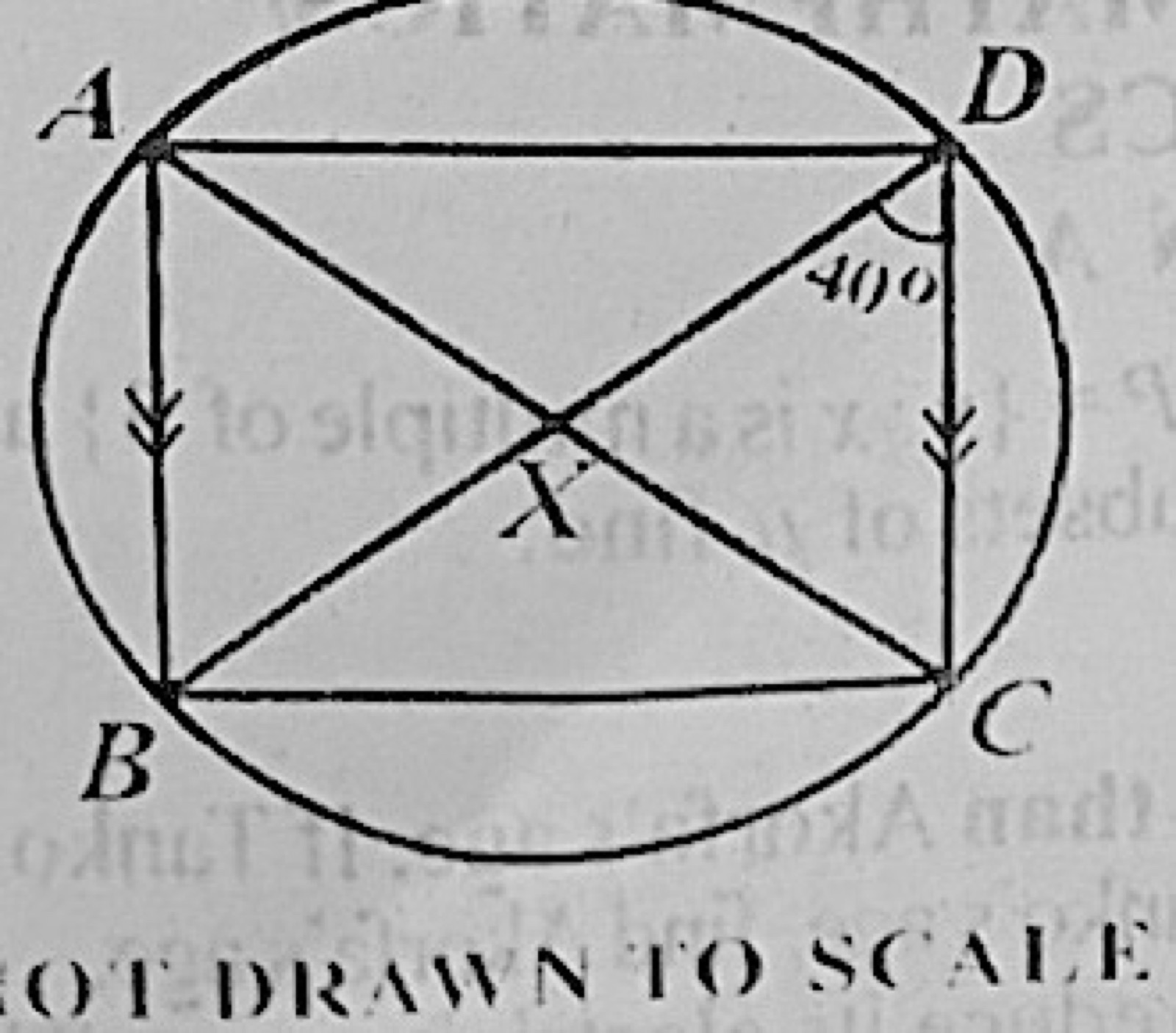
(b) In the diagram. A, B, C and D are points on a circle. AB ∥ DC, AC and BD intersect at X and ∠BDC = 40°. Find: (i) ∠ACD; (ii) ∠AXD
(a)(i) C = a + bn: a + 8b = 70 and a + 10b = 90 ⇒ b = 10, a = −10, so C = 10n − 10
(ii) C = 10(12) − 10 = $110
(b)(i) ∠ABD = ∠BDC = 40° (alternate angles, AB ∥ DC); ∠ACD = ∠ABD = 40° (angles in the same segment)
(ii) ∠AXD is an exterior angle of triangle XDC: ∠AXD = 40° + 40° = 80°
'Partly constant and partly varies' means C = a + bn.
(a) Given that P = (2 4 / −9 1) and Q = (1 −1 / 3 −2), find PQ + 2Q
(b) A bag contains 8 red balls and some white balls, all of the same size. If the probability of drawing at random a white ball from the bag is half the probability of drawing a red ball, find the number of white balls in the bag.
(a) PQ = (2+12 −2−8 / −9+3 9−2) = (14 −10 / −6 7)
2Q = (2 −2 / 6 −4)
PQ + 2Q = (16 −12 / 0 3)
(b) Let w = white balls: w/(8 + w) = ½ × 8/(8 + w) ⇒ w = 4 white balls
Multiply rows of P by columns of Q.
(a) The eighth term of an Arithmetic Progression (A.P) is 46 and the sum of the first eight terms is 200. Find the: (i) first term; (ii) sum of the first 12 terms.
(b) The points X(70°S, 60°E) and Y(7°S, 60°E) lie on the surface of the earth. (i) Illustrate the information in a diagram. (ii) Find the distance between X and Y along the meridian. [Take π = 22/7 and R = 6,400 km]
(a) a + 7d = 46; S8 = 4(2a + 7d) = 200 ⇒ 2a + 7d = 50 ⇒ a = 4, d = 6
(i) First term = 4
(ii) S12 = 6(2 × 4 + 11 × 6) = 6 × 74 = 444
(b)(i) Sketch the earth with the equator and the meridian 60°E; mark Y at 7°S and X at 70°S on it
(ii) Angle between them = 70° − 7° = 63°; distance = 63/360 × 2 × 22/7 × 6400 = 7,040 km
Both points are south, so subtract the latitudes.
The following are the marks scored by 20 students in a test:
15, 11, 17, 25, 13, 15, 16, 22, 24, 27,
20, 22, 15, 16, 15, 19, 22, 24, 22, 11
(a) Prepare a frequency table for the distribution using class intervals 10 − 12, 13 − 15, 16 − 18 … .
(b) Calculate the variance of the distribution.
(c) If the pass mark for the test was 16, find the probability, that a student selected at random from the class failed.
(a) 10–12: 2; 13–15: 5; 16–18: 3; 19–21: 2; 22–24: 6; 25–27: 2 (total 20)
(b) Class marks 11, 14, 17, 20, 23, 26; Σfx = 373, mean = 18.65
Σf(x − x̄)² = 117.05 + 108.11 + 8.17 + 3.65 + 113.54 + 108.05 ≈ 458.55; variance = 458.55 ÷ 20 ≈ 22.93
(c) Students scoring below 16: 11, 11, 13, 15, 15, 15, 15 = 7, so P(failed) = 7/20
Use the class marks (mid-points) as x.