A boy 1.4m tall, stood 10m away from a tree of height 12m. Calculate, correct to the nearest degree, the angle of elevation of the top of the tree from the boy's eyes.
A.71°
B.47°
C.19°
D.8°
Show the answer and explanation
Answer: B (47°)
Explanation
Above eye level the tree rises 12 − 1.4 = 10.6 m. tan θ = 10.6/10 = 1.06, so θ ≈ 47°.
Mrs. Gabriel is pregnant. The probability that she will give birth to a girl is ½ and the probability that the baby will have blue eyes is ¼. What is the probability that she will give birth to a girl with blue eyes?
A.1
B.3/4
C.1/8
D.1/4
Show the answer and explanation
Answer: C (1/8)
Explanation
The two events are independent, so multiply: ½ × ¼ = 1/8.
A local community has two newspapers: the Morning Times and the Evening Dispatch. The Morning Times is read by 45% of households and the Evening Dispatch by 60%. If 20% of the households read both papers, find the probability that a particular household reads at least one paper.
(a) Given that (7 − 2x), 9, (5x + 17) are consecutive terms of a Geometric Progression (G.P.) with common ratio, r > 0, find the values of x. (b) Two positive numbers are in the ratio 3 : 4. The sum of thrice the first number and twice the second is 68. Find the smaller number.
Show the model answer
Model answer
(a) Middle term squared = product of neighbours: 81 = (7 − 2x)(5x + 17) 81 = 35x + 119 − 10x2 − 34x → 10x2 − x − 38 = 0 (10x + 19)(x − 2) = 0 → x = 2 or x = −19/10 Check r > 0: x = 2 gives 3, 9, 27 (r = 3); x = −1.9 gives 10.8, 9, 7.5 (r = 5/6). Both are valid (b) Numbers 3k and 4k: 9k + 8k = 68 → k = 4 Smaller number = 12
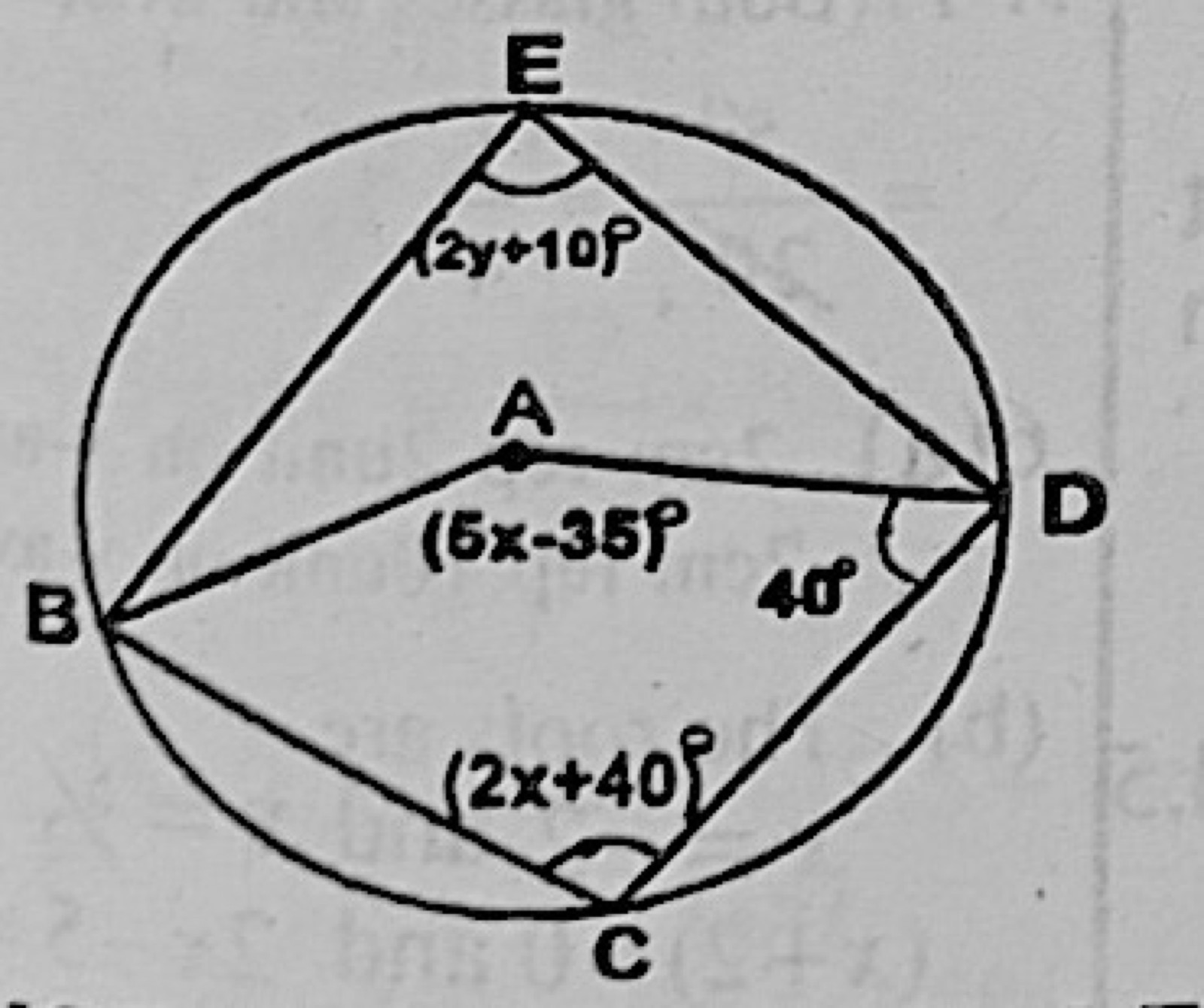
In the diagram BCDE, is a circle with centre A. ∠BCD = (2x + 40°), ∠BAD = (5x − 35)°, ∠BED = (2y + 10°) and ∠ADC = 40°. Find: (a) the values of x and y; (b) ∠ABC
Show the model answer
Model answer
(a) Angle at centre = twice angle at circumference: 5x − 35 = 2(2y + 10) → 5x − 4y = 55 BCDE is cyclic: (2x + 40) + (2y + 10) = 180 → x + y = 65 Solve: 9x = 315 → x = 35, y = 30 (b) ∠BAD = 140°, ∠BCD = 110° Quadrilateral ABCD: ∠ABC = 360° − (140° + 110° + 40°) = 70°
Explanation
Form two equations: one from the angle at the centre, one from the cyclic quadrilateral.
(a) Given that m = tan 30° and n = tan 45°, simplify, without using calculator, (m − n)/(mn), leaving the answer in the form p + √q. (b) There are 20 women in a bus. 15 of them wear glasses and 10 wear wrist watches. If a woman is chosen at random from the bus, find the probability that she wears both glasses and wrist watch.
Show the model answer
Model answer
(a) m = 1/√3, n = 1 (m − n)/(mn) = (1/√3 − 1) ÷ (1/√3) = 1 − √3 So p = 1 and the surd part is −√3 (b) Assume every woman wears at least one: 15 + 10 − x = 20 → x = 5 P(both) = 5/20 = 1/4
Explanation
Dividing by 1/√3 is the same as multiplying by √3.
(a) A man purchased 180 copies of a book at ₦250.00 each. He sold y copies at ₦300.00 each and the rest at the discount of 5 kobo in the Naira of the cost price. If he made a profit of ₦7,125.00, find the value of y. (b) A trader bought x bags of rice at a cost, c = 24x + 103 and sold them at a price, s = 33x − x2/20. (i) Find the expression for the profit. (ii) If 20 bags of rice were sold, calculate the percentage profit.
The table shows the monthly expenditure (in percentage) of Mr. Okafor's salary. Item: Food and drinks, Fuel, Rent, Building Project, Education, Savings Percentage (%): 35, 7.5, 10, 15, 17.5, x (a) Calculate the percentage of Mr. Okafor's salary that was put into savings. (b) Illustrate the information on a pie chart. (c) If Mr Okafor's annual gross salary is $28,800.00 and he pays tax of 12%, calculate: (i) his monthly tax; (ii) amount saved each month.
Show the model answer
Model answer
(a) x = 100 − (35 + 7.5 + 10 + 15 + 17.5) = 15% (b) Angles (× 3.6°): food 126°, fuel 27°, rent 36°, building 54°, education 63°, savings 54°; draw and label the sectors (c)(i) Monthly salary = 28,800 ÷ 12 = $2,400; tax = 12% of 2,400 = $288 (ii) Savings = 15% of $2,400 = $360 a month
(a) Copy and complete the table of values for y = 3 sin x + 7 cos x for 0° ≤ x ≤ 180°. x: 0°, 20°, 40°, 60°, 80°, 100°, 120°, 140°, 160°, 180° y: 7.0, __, __, __, 4.2, __, −0.9, __, __, __ (b) Using a scale of 2cm to 20° on the x-axis and 2cm to 2 units on the y-axis, draw the graph of y = 3 sin x + 7 cos x for 0° ≤ x ≤ 180°. (c) Using the graph, find the: (i) value of y when x = 150°; (ii) range of values of x for which y > 0.
Show the model answer
Model answer
(a) y = 7.0, 7.6, 7.3, 6.1, 4.2, 1.7, −0.9, −3.4, −5.6, −7.0 (b) Plot the points and join with a smooth curve (c)(i) At x = 150°, y ≈ −4.6 (ii) The curve is above the x-axis from x = 0° to where it crosses at about 113°: 0° ≤ x < 113°
Explanation
Use your calculator in degree mode for each value of x.
The table shows the distribution of ages of a number of children in a school. Age (years): 3, 4, 5, 6, 7, 8, 9, 10 Number of Children: 2, 6, 5, x, 6, 9, 8, 5 If the mean of the distribiution is 7, find the: (a) value of x; (b) standard deviation of their ages.
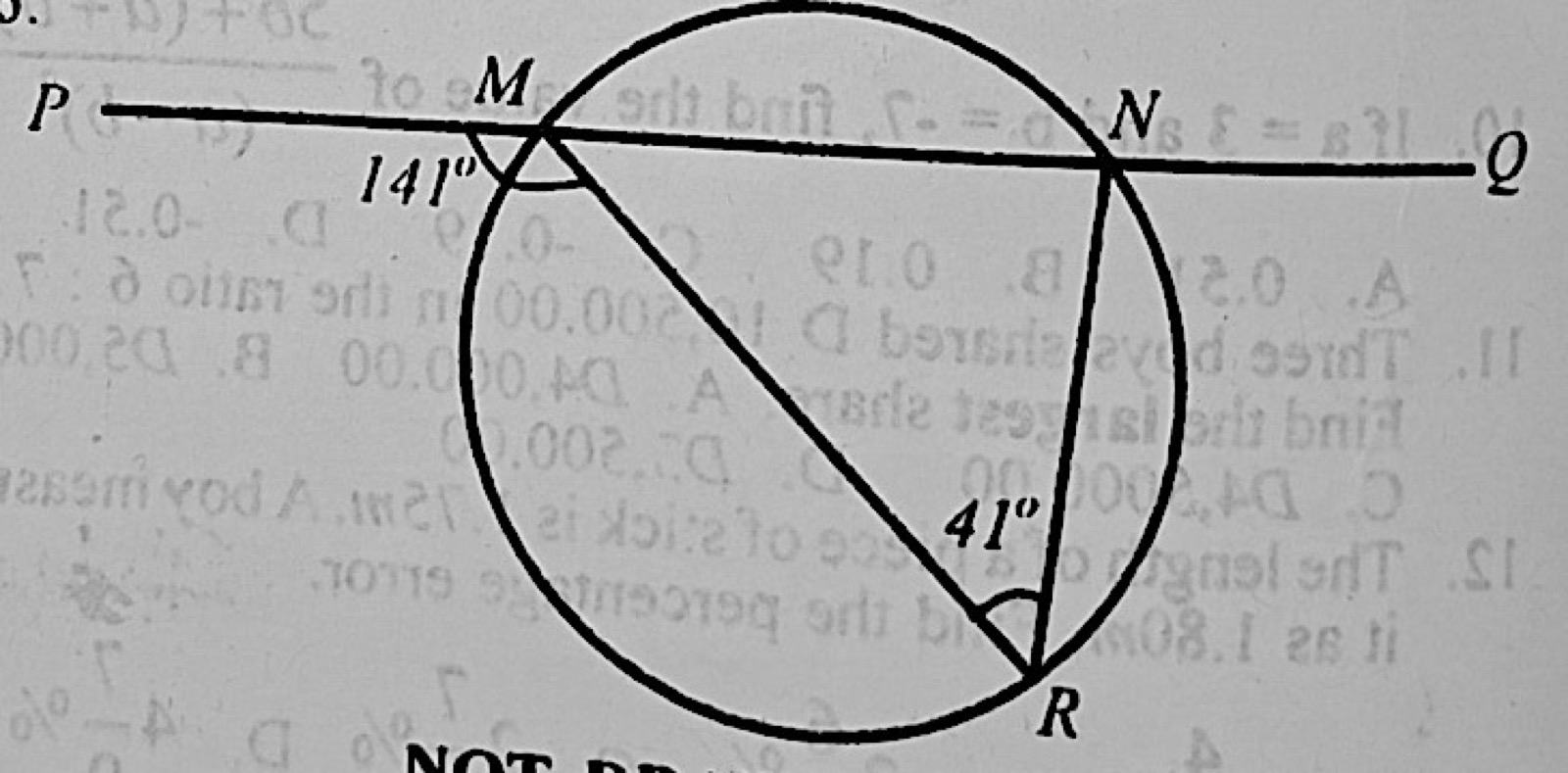
(a) The exterior angles of a polygon are 42°, 38°, 57°, x°, (x + y)°, (2x − 15)° and (3x − y)°. If x is 7° less than y, find the values of x and y. (b) In the diagram, O is the centre of the circle XYZ, ∠ZXO = 34° and ∠XOY = 146°. Find ∠OYZ.
Show the model answer
Model answer
(a) y = x + 7; exterior angles add to 360° 137 + x + (2x + 7) + (2x − 15) + (3x − x − 7) = 360 → 122 + 7x = 360 x = 34, y = 41 (b) ∠XZY = ½ × 146° = 73° (angle at centre) OX = OZ → ∠OZX = 34°, so ∠OZY = 73° − 34° = 39° OY = OZ → ∠OYZ = 39°
(a) The probability that an athlete will not win any of the three races is ¼. If the athlete runs in all the races, what is the probability that the athlete will win: (i) only the second race; (ii) all the three races; (iii) only two of the races? (b) A cone with perpendicular height 24cm has a volume of 24cm3. Find the volume of a cone with same base radius and height 84cm. [Take π = 22/7]
Show the model answer
Model answer
(a) Taking P(lose a race) = ¼ and P(win a race) = ¾ for each race: (i) P(L W L) = ¼ × ¾ × ¼ = 3/64 (ii) P(W W W) = (¾)3 = 27/64 (iii) P(LWW) + P(WLW) + P(WWL) = 3 × (¾ × ¾ × ¼) = 27/64 (b) Same base radius, so volume is proportional to height V = 24 × 84/24 = 84 cm3
Explanation
For (b), keep r fixed: V = ⅓πr2h grows in step with h.
(a) The diameter of a cylinder closed at both ends is 7cm. If the total surface area is 209 cm2, calculate the height. [Take π = 22/7] (b) The points X and Y, 19m apart are on the same side of a tree. The angles of elevation of the top, T, of the tree from X and Y on the horizontal ground with the foot of the tree are 43° and 38° respectively. (i) Illustrate the information in a diagram. (ii) Find, correct to one decimal place, the height of the tree.
Show the model answer
Model answer
(a) r = 3.5 cm; TSA = 2πr(r + h) = 2 × (22/7) × 3.5 × (3.5 + h) = 22(3.5 + h) 22(3.5 + h) = 209 → 3.5 + h = 9.5 → h = 6 cm (b)(i) Tree TB vertical; X nearer (43°), Y 19 m further away (38°), all on a line with B (ii) Let XB = d, height h: h = d tan 43° = (d + 19) tan 38° d(tan 43° − tan 38°) = 19 tan 38° → d ≈ 98.2 m h = 98.2 × tan 43° ≈ 91.5 m
Explanation
The larger angle of elevation belongs to the point nearer the tree.