WAEC Mathematics 2020 past questions and answers

61 questions. Try each one, then open the answer to check yourself and read the explanation.

Question 1

Fractions, Decimals and Approximation

Evaluate, correct to two decimal places, 75.0785 − 34.624 + 9.83

  1. A.30.60
  2. B.50.29
  3. C.50.28
  4. D.30.62
Show the answer and explanation

Answer: C (50.28)

Explanation

75.0785 − 34.624 = 40.4545, and 40.4545 + 9.83 = 50.2845, which is 50.28 to 2 d.p.

Open this question

Question 2

Sets

If X = {x : x < 7} and Y = {y : y is a factor of 24} are subsets of μ = {1, 2, 3, … 10}, find X ∩ Y.

  1. A.{2, 3, 4, 6}
  2. B.{1, 2, 3, 4, 6}
  3. C.{2, 3, 4, 6, 8}
  4. D.{1, 2, 3, 4, 6, 8}
Show the answer and explanation

Answer: B ({1, 2, 3, 4, 6})

Explanation

X = {1, 2, 3, 4, 5, 6} and Y = {1, 2, 3, 4, 6, 8}. The common elements are {1, 2, 3, 4, 6}.

Open this question

Question 4

Modular Arithmetic

Find the least value of x which satisfies the equation 4x = 7 (mod 9)

  1. A.7
  2. B.6
  3. C.5
  4. D.4
Show the answer and explanation

Answer: D (4)

Explanation

Try values: 4 × 4 = 16 = 9 + 7, so 16 ≡ 7 (mod 9). Smaller values 1, 2, 3 give 4, 8, 3, so x = 4 is the least.

Open this question

Question 5

Logarithms

Express 1 + 2 log103 in the form log10q.

  1. A.log1090
  2. B.log1019
  3. C.log109
  4. D.log106
Show the answer and explanation

Answer: A (log1090)

Explanation

1 = log1010 and 2 log103 = log109, so the sum is log10(10 × 9) = log1090.

Open this question

Question 6

Number Bases

If 101two + 12y = 23five, find the value of y.

  1. A.8
  2. B.7
  3. C.6
  4. D.5
Show the answer and explanation

Answer: C (6)

Explanation

101two = 5 and 23five = 13, so 12y = y + 2 = 8, giving y = 6.

Open this question

Question 7

Commercial Arithmetic

An amount of ₦550,000.00 was realised when a principal, x was saved at 2% simple interest for 5 years. Find the value of x.

  1. A.₦470,000.00
  2. B.₦480,000.00
  3. C.₦490,000.00
  4. D.₦500,000.00
Show the answer and explanation

Answer: D (₦500,000.00)

Explanation

Interest = x × 2 × 5/100 = 0.1x, so the amount is 1.1x = 550,000 and x = ₦500,000.

Open this question

Question 8

Surds

Given that (√3 + √5)/√5 = x + y√15, find the value of (x + y).

  1. A.1⅗
  2. B.1⅖
  3. C.1⅕
  4. D.⅕
Show the answer and explanation

Answer: C (1⅕)

Explanation

(√3 + √5)/√5 = √3/√5 + 1 = √15/5 + 1. So x = 1, y = 1/5 and x + y = 1⅕.

Open this question

Question 9

Algebraic Expressions

If x = 3 and y = −1, evaluate 2(x2 − y3).

  1. A.24
  2. B.22
  3. C.20
  4. D.16
Show the answer and explanation

Answer: C (20)

Explanation

x2 = 9 and y3 = −1, so 2(9 − (−1)) = 2 × 10 = 20.

Open this question

Question 10

Linear and Simultaneous Equations

Solve 3x − 2y = 10 and x + 3y = 7 simultaneously.

  1. A.x = −4 and y = 1
  2. B.x = −1 and y = −4
  3. C.x = 1 and y = 4
  4. D.x = 4 and y = 1
Show the answer and explanation

Answer: D (x = 4 and y = 1)

Explanation

From the second equation x = 7 − 3y. Then 3(7 − 3y) − 2y = 10 gives 11y = 11, so y = 1 and x = 4.

Open this question

Question 11

Logic

The implication x ⇒ y is equivalent to

  1. A.~y ⇒ ~x
  2. B.y ⇒ ~x
  3. C.~x ⇒ ~y
  4. D.y ⇒ x
Show the answer and explanation

Answer: A (~y ⇒ ~x)

Explanation

An implication always has the same truth value as its contrapositive: x ⇒ y is equivalent to ~y ⇒ ~x.

Open this question

Question 12

Progressions

The first term of a Geometric Progression (G.P) is 3 and the 5th term is 48. Find the common ratio.

  1. A.2
  2. B.4
  3. C.8
  4. D.16
Show the answer and explanation

Answer: A (2)

Explanation

T5 = ar4, so 3r4 = 48, r4 = 16 and r = 2.

Open this question

Question 14

Algebraic Expressions

Make m the subject of the relation k = √((m − y)/(m + 1))

  1. A.m = (y + k2)/(k2 + 1)
  2. B.m = (y + k2)/(1 − k2)
  3. C.m = (y − k2)/(k2 + 1)
  4. D.m = (y − k2)/(1 − k2)
Show the answer and explanation

Answer: B (m = (y + k2)/(1 − k2))

Explanation

Square: k2(m + 1) = m − y, so k2m + k2 = m − y. Then y + k2 = m − k2m = m(1 − k2), giving m = (y + k2)/(1 − k2).

Open this question

Question 15

Quadratic Equations

Find the quadratic equation whose whose roots are ½ and −⅓.

  1. A.3x2 + x + 1 = 0
  2. B.6x2 + x − 1 = 0
  3. C.3x2 + x − 1 = 0
  4. D.6x2 − x − 1 = 0
Show the answer and explanation

Answer: D (6x2 − x − 1 = 0)

Explanation

The factors are (2x − 1) and (3x + 1). Their product is 6x2 − x − 1 = 0.

Open this question

Question 16

Variation

Given that x is directly proportional to y and inversely proportional to Z, x = 15 when y = 10 and Z = 4, find the equation connecting x, y and Z.

  1. A.x = 6y/Z
  2. B.x = 12y/Z
  3. C.x = 3y/Z
  4. D.x = 3y/(2Z)
Show the answer and explanation

Answer: A (x = 6y/Z)

Explanation

x = ky/Z. Then 15 = 10k/4, so k = 6 and x = 6y/Z.

Open this question

Question 17

Ratio, Percentages and Rates

Two buses start from the same station at 9.00 a.m. and travel in opposite directions along the same straight road. The first bus travels at a speed of 72 km/h and the second at 48 km/h. At what time will they be 240 km apart?

  1. A.1:00 pm
  2. B.12:00 noon
  3. C.11:00 am
  4. D.10:00 am
Show the answer and explanation

Answer: C (11:00 am)

Explanation

Moving apart, the gap grows by 72 + 48 = 120 km each hour. 240 km takes 2 hours, so the time is 11:00 am.

Open this question

Question 18

Mensuration of Solids

A solid cuboid has length 7 cm, width 5 cm and height 4 cm. Calculate its total surface area.

  1. A.280 cm2
  2. B.166 cm2
  3. C.140 cm2
  4. D.83 cm2
Show the answer and explanation

Answer: B (166 cm2)

Explanation

Total surface area = 2(lb + bh + lh) = 2(35 + 20 + 28) = 166 cm2.

Open this question

Question 19

Angles and Polygons

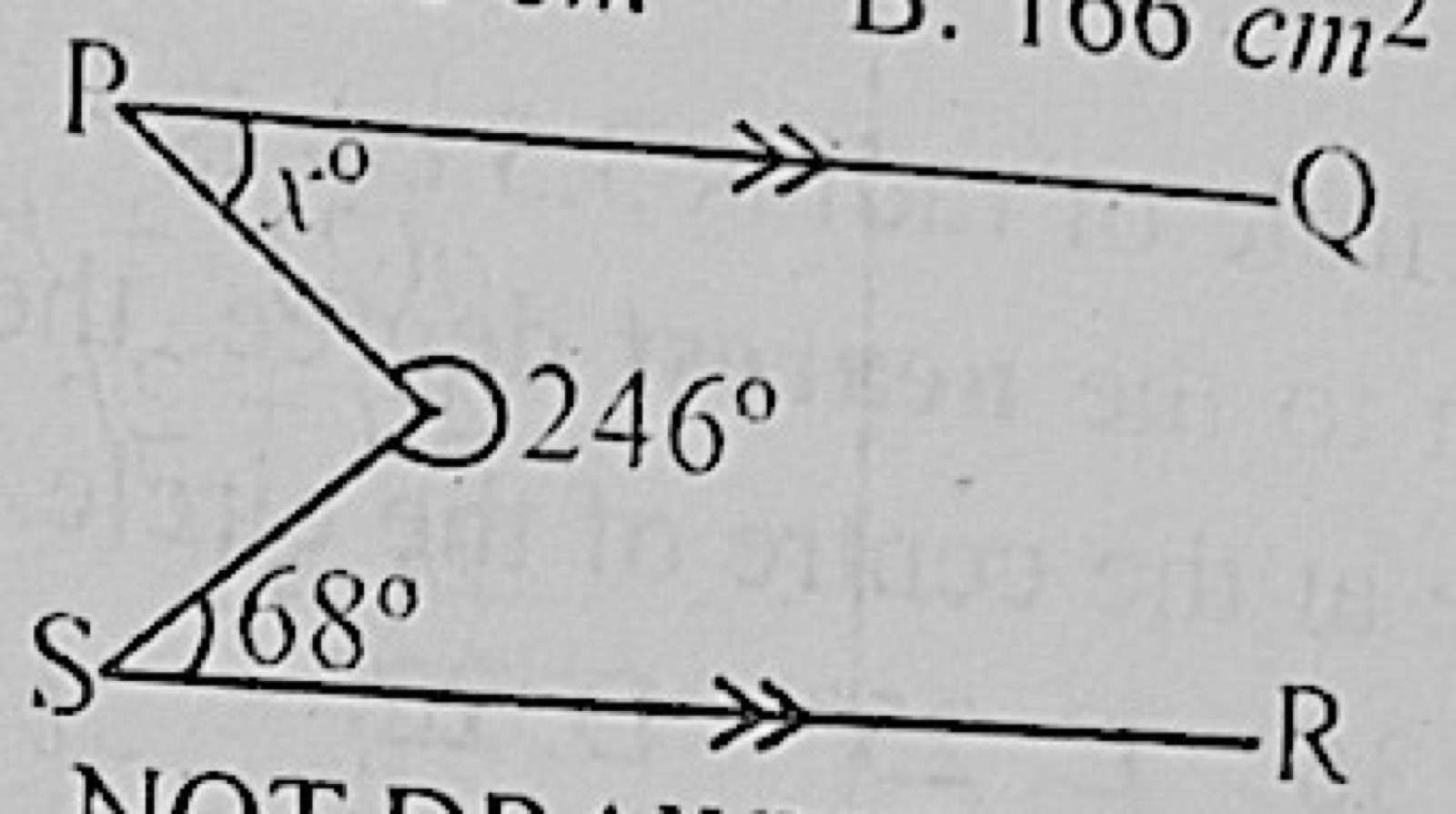
In the diagram, PQ ∥ SR. Find the value of x.

Diagram for this question
  1. A.34
  2. B.46
  3. C.57
  4. D.68
Show the answer and explanation

Answer: B (46)

Explanation

The angle at the middle vertex inside the bend is 360° − 246° = 114°. For parallel lines this angle equals the sum of the other two: x + 68 = 114, so x = 46.

Open this question

Question 20

Coordinate Geometry

Find the equation of the line parallel to 2y = 3(x − 2) and passes through the point (2, 3).

  1. A.y = (3/2)x − 3
  2. B.y = (2/3)x − 2
  3. C.y = (3/2)x
  4. D.y = (−2/3)x
Show the answer and explanation

Answer: C (y = (3/2)x)

Explanation

2y = 3x − 6 has gradient 3/2. Through (2, 3): y − 3 = (3/2)(x − 2), so y = (3/2)x.

Open this question

Question 21

Algebraic Expressions

The expression (5x + 3)/(6x(x + 1)) will be undefined when x equals.

  1. A.{0, 1}
  2. B.{0, −1}
  3. C.{−3, −1}
  4. D.{−3, 0}
Show the answer and explanation

Answer: B ({0, −1})

Explanation

A fraction is undefined when its denominator is zero: 6x(x + 1) = 0 when x = 0 or x = −1.

Open this question

Question 22

Quadratic Equations

A man is five times as old as his son. In four years time, the product of their ages would be 340. If the son's age is y, express the product of their ages in terms of y.

  1. A.5y2 − 16y − 380 = 0
  2. B.5y2 + 24y − 308 = 0
  3. C.5y2 − 16y − 330 = 0
  4. D.5y2 + 24y − 324 = 0
Show the answer and explanation

Answer: D (5y2 + 24y − 324 = 0)

Explanation

In four years the ages are 5y + 4 and y + 4. (5y + 4)(y + 4) = 5y2 + 24y + 16 = 340, so 5y2 + 24y − 324 = 0.

Open this question

Question 23

Algebraic Expressions

Simplify: a/b − b/a − c/b.

  1. A.(a − b + c)/(ab)
  2. B.(ab − bc − ac)/(ab)
  3. C.(a2 − b2 + ac)/(ab)
  4. D.(a2 − b2 − ac)/(ab)
Show the answer and explanation

Answer: D ((a2 − b2 − ac)/(ab))

Explanation

Use the common denominator ab: (a·a − b·b − c·a)/(ab) = (a2 − b2 − ac)/(ab).

Open this question

Question 24

Trigonometry

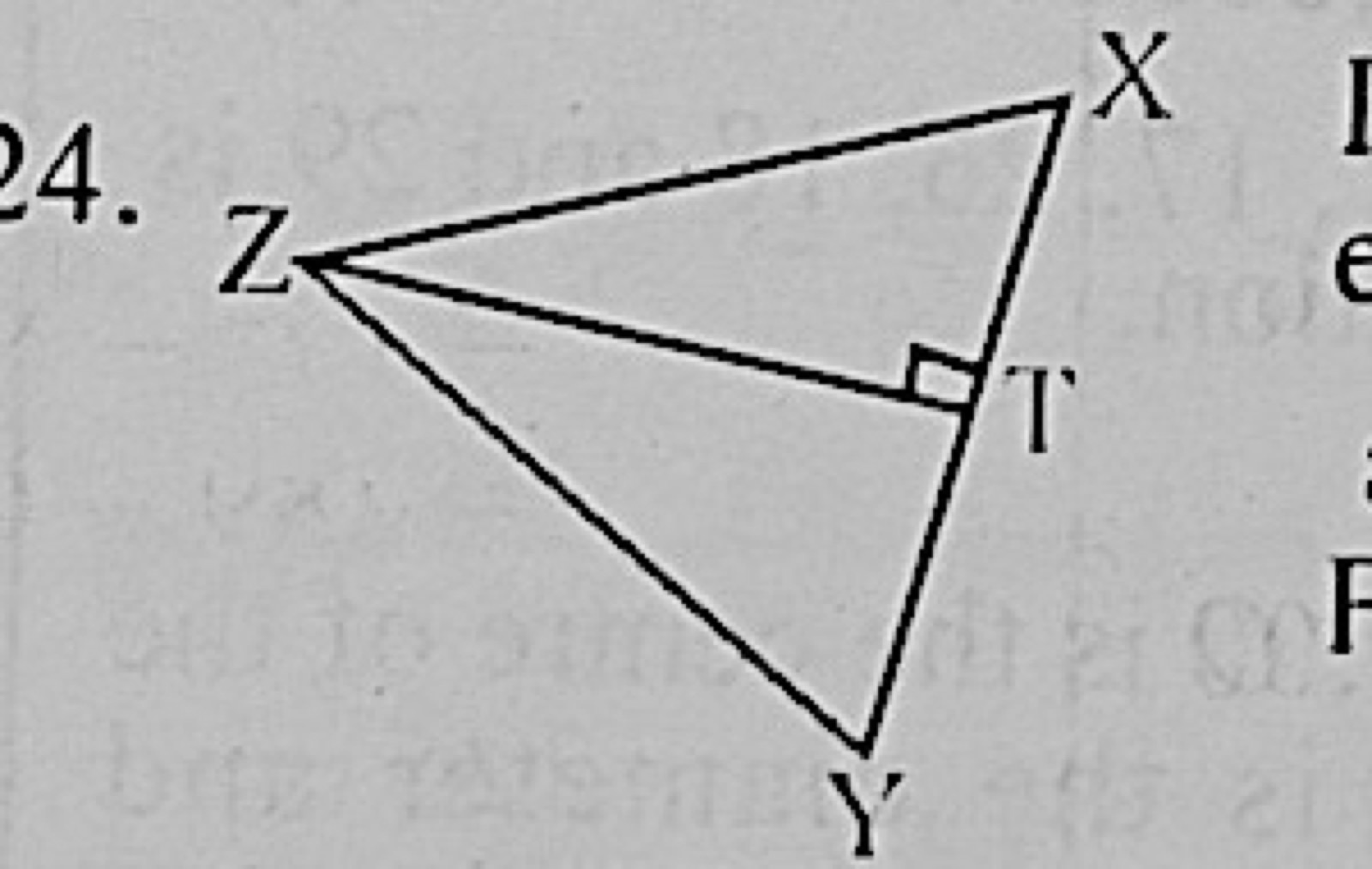
In the diagram, XYZ is an equilateral triangle of side 6 cm and T is the midpoint of XY. Find tan (∠XZT).

Diagram for this question
  1. A.1/√3
  2. B.√3/2
  3. C.√3
  4. D.1/2
Show the answer and explanation

Answer: A (1/√3)

Explanation

ZT bisects the 60° angle at Z, so ∠XZT = 30° and tan 30° = 1/√3.

Open this question

Question 25

Trigonometry

A fence 2.4 m tall, is 10 m away from a tree of height 16 m. Calculate the angle of elevation of the top of the tree from the top of the fence.

  1. A.76.11°
  2. B.53.67°
  3. C.52.40°
  4. D.51.32°
Show the answer and explanation

Answer: B (53.67°)

Explanation

Above the fence top the tree rises 16 − 2.4 = 13.6 m over 10 m. tan θ = 1.36, so θ ≈ 53.67°.

Open this question

Question 26

Commercial Arithmetic

Fati buys milk at ₦x per tin and sells each at a profit of ₦y. If she sells 10 tins of milk, how much does she receive from the sales?

  1. A.₦(xy + 10)
  2. B.₦(x + 10y)
  3. C.₦(10x + y)
  4. D.₦10(x + y)
Show the answer and explanation

Answer: D (₦10(x + y))

Explanation

Each tin sells for ₦(x + y), so 10 tins bring ₦10(x + y).

Open this question

Question 27

Trigonometry

If tan y is positive and sin y is negative, in which quadrant would y lie?

  1. A.First and Third only
  2. B.First and Second only
  3. C.Third only
  4. D.Second only
Show the answer and explanation

Answer: C (Third only)

Explanation

sin is negative in the third and fourth quadrants, and tan is positive in the first and third. Both hold only in the third quadrant.

Open this question

Question 28

Mensuration of Solids

The dimensions of a rectangular base of a right pyramid are 9 cm by 5 cm. If the volume of the pyramid is 105 cm3, how high is the pyramid?

  1. A.10 cm
  2. B.6 cm
  3. C.8 cm
  4. D.7 cm
Show the answer and explanation

Answer: D (7 cm)

Explanation

Volume = ⅓ × base area × height: 105 = ⅓ × 45 × h = 15h, so h = 7 cm.

Open this question

Question 29

Angles and Polygons

Each interior angle of a regular polygon is 168°. Find the number of sides of the polygon.

  1. A.30
  2. B.36
  3. C.24
  4. D.18
Show the answer and explanation

Answer: A (30)

Explanation

Each exterior angle is 180° − 168° = 12°, so the number of sides is 360 ÷ 12 = 30.

Open this question

Question 30

Angles and Polygons

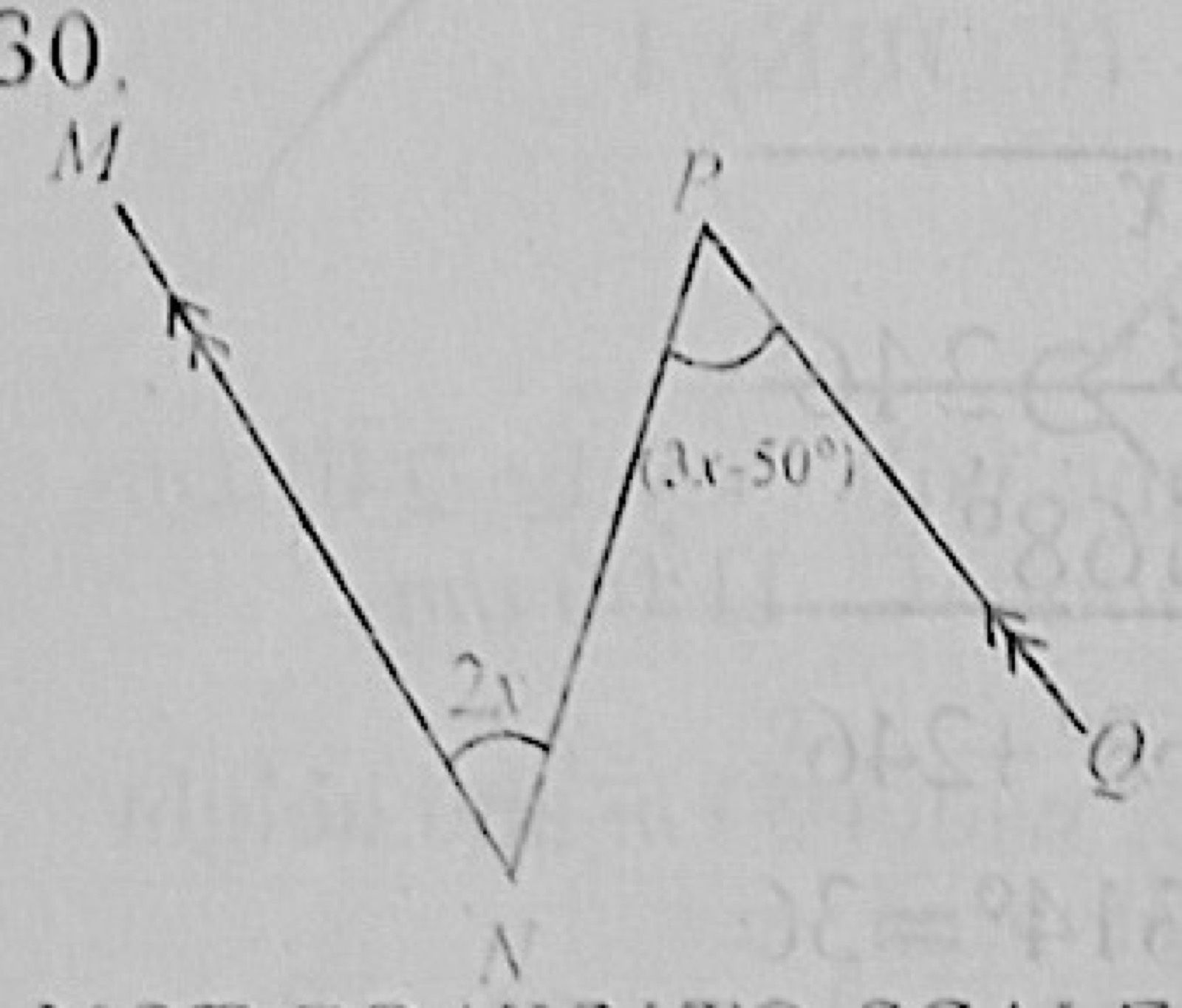
In the diagram, MN ∥ PQ, ∠MNP = 2x, and ∠NPQ = (3x − 50°). Find the value of ∠NPQ.

Diagram for this question
  1. A.200°
  2. B.150°
  3. C.120°
  4. D.100°
Show the answer and explanation

Answer: D (100°)

Explanation

∠MNP and ∠NPQ are alternate angles, so 2x = 3x − 50°, giving x = 50°. Then ∠NPQ = 3(50°) − 50° = 100°.

Open this question

Question 31

Mensuration of Plane Shapes

The length of an arc of a circle of radius 3.5 cm is 1 19/36 cm. Calculate, correct to the nearest degree, the angle subtended by the arc at the centre of the circle. [Take π = 22/7]

  1. A.55°
  2. B.36°
  3. C.25°
  4. D.22°
Show the answer and explanation

Answer: C (25°)

Explanation

The circumference is 2 × (22/7) × 3.5 = 22 cm. θ = (55/36) ÷ 22 × 360° = 25°.

Open this question

Question 32

Mensuration of Plane Shapes

In the diagram, PU ∥ SR, PS ∥ TR, QS ∥ UR, UR = 15 cm, SR = 8 cm, PS = 10 cm and area of ΔSUR = 24 cm2. Calculate the area of PTRS.

Diagram for this question
  1. A.40 cm2
  2. B.48 cm2
  3. C.80 cm2
  4. D.120 cm2
Show the answer and explanation

Answer: B (48 cm2)

Explanation

The height between the parallel lines comes from ΔSUR: ½ × 8 × h = 24, so h = 6 cm. PTRS is a parallelogram on base SR = 8 cm with that height, so its area is 8 × 6 = 48 cm2.

Open this question

Question 33

Circle Theorems

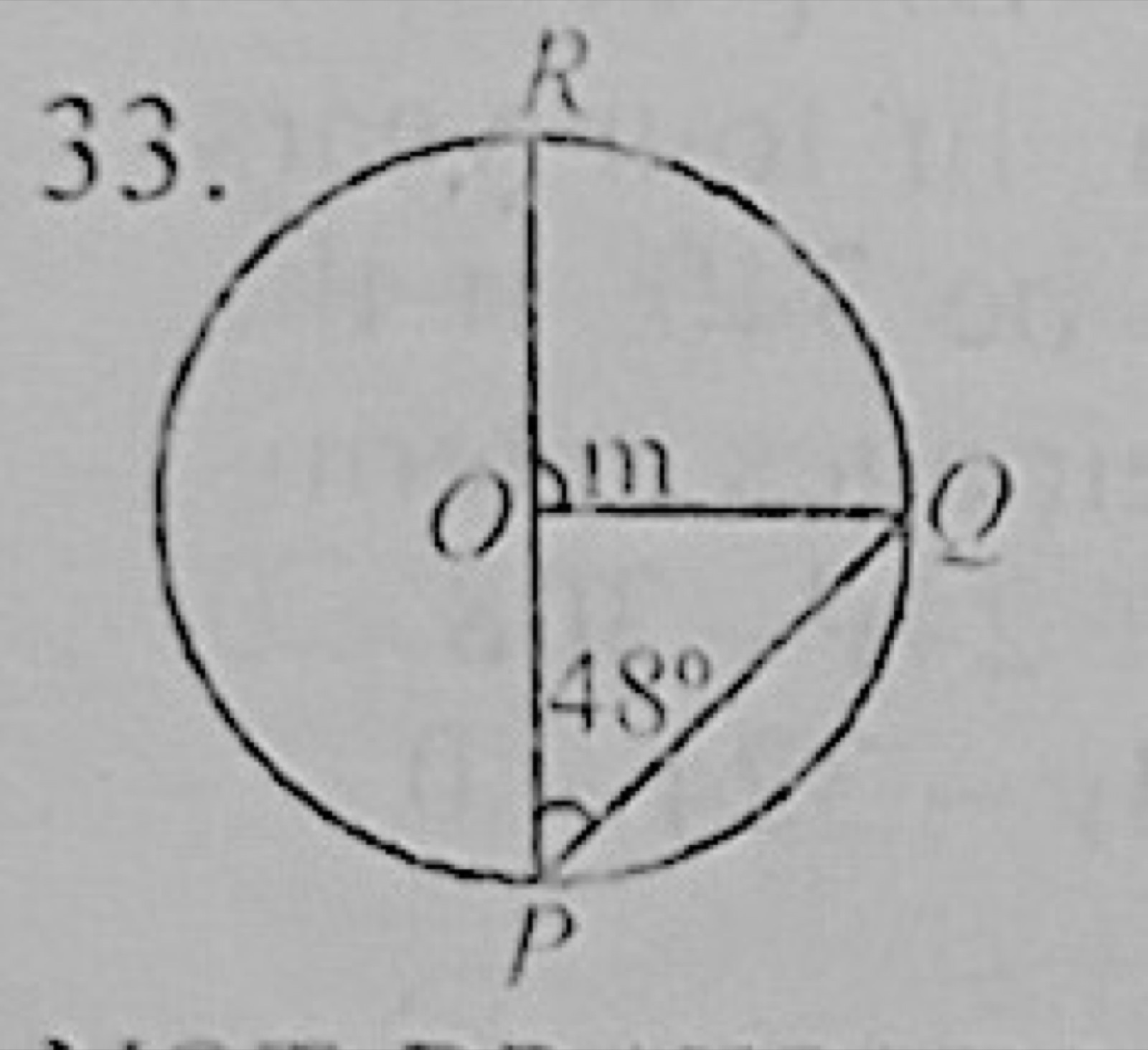
In the diagram, PQR is a circle with centre O. If ∠OPQ = 48°, find the value of m.

Diagram for this question
  1. A.96°
  2. B.90°
  3. C.68°
  4. D.42°
Show the answer and explanation

Answer: A (96°)

Explanation

OP = OQ (radii), so ∠OQP = 48°. Angle m is an exterior angle of triangle OPQ, so m = 48° + 48° = 96°.

Open this question

Question 34

Data Presentation

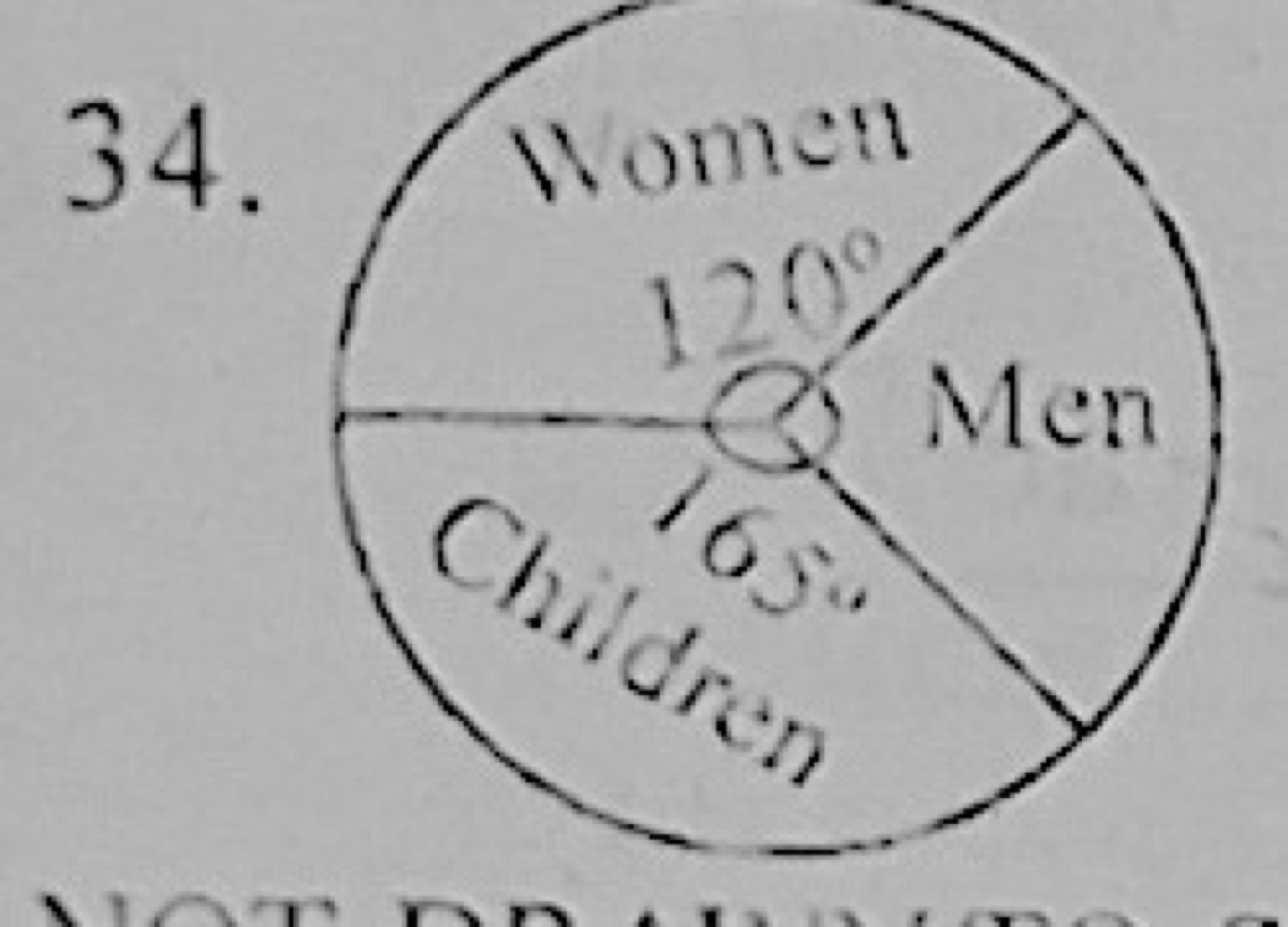
The pie chart shows the population of men, women and children in a city. If the population of the city is 1,800,000, how many men are in the city?

Diagram for this question
  1. A.845,000
  2. B.600,000
  3. C.355,000
  4. D.250,000
Show the answer and explanation

Answer: C (355,000)

Explanation

The men's sector is 360° − (120° + 169°) = 71°. Men = 71/360 × 1,800,000 = 355,000.

Open this question

Question 35

Measures of Dispersion

The mean of the numbers 15, 21, 17, 26, 18 and 29 is 21. Calculate the standard deviation.

  1. A.9
  2. B.6
  3. C.5
  4. D.0
Show the answer and explanation

Answer: C (5)

Explanation

Squared deviations from 21: 36, 0, 16, 25, 9, 64, total 150. Variance = 150/6 = 25, so the standard deviation is 5.

Open this question

Question 36

Circle Theorems

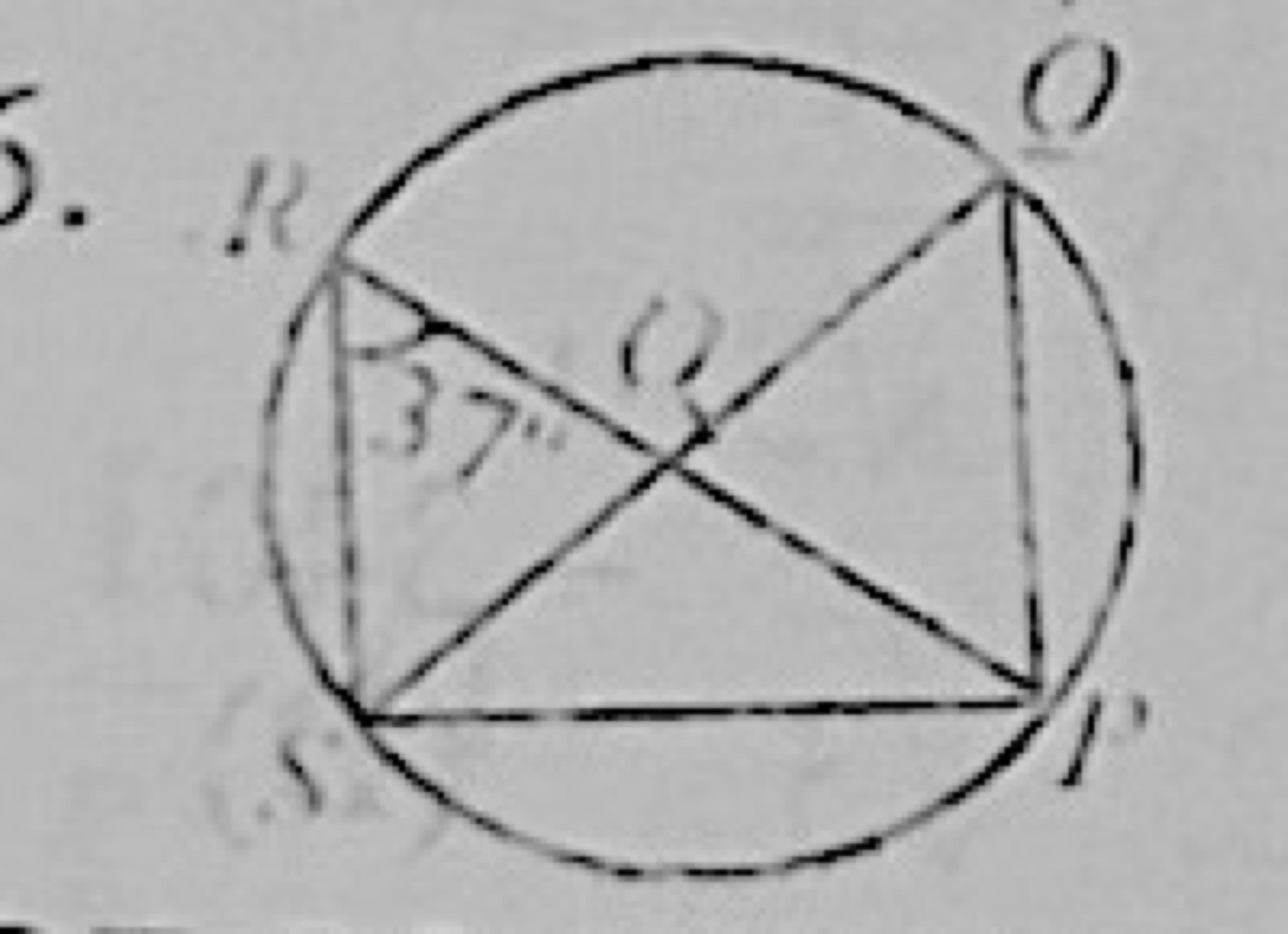
In the diagram, O is the centre of the circle. SOQ is the diameter and ∠SRP = 37°. Find ∠PSQ.

Diagram for this question
  1. A.127°
  2. B.65°
  3. C.53°
  4. D.37°
Show the answer and explanation

Answer: C (53°)

Explanation

∠SQP = ∠SRP = 37° (angles in the same segment) and ∠SPQ = 90° (angle in a semicircle). So ∠PSQ = 180° − 90° − 37° = 53°.

Open this question

Question 37

Angles and Polygons

Find the sum of the interior angles of a pentagom.

  1. A.340°
  2. B.350°
  3. C.540°
  4. D.550°
Show the answer and explanation

Answer: C (540°)

Explanation

Sum of interior angles = (n − 2) × 180° = 3 × 180° = 540°.

Open this question

Question 38

Mensuration of Solids

The diameter of a sphere is 12 cm. Calculate, correct to the nearest cm3, the volume of the sphere. [Take π = 22/7]

  1. A.903 cm3
  2. B.904 cm3
  3. C.905 cm3
  4. D.906 cm3
Show the answer and explanation

Answer: C (905 cm3)

Explanation

r = 6 cm. V = (4/3) × (22/7) × 216 ≈ 905.1, so 905 cm3.

Open this question

Question 39

Probability

A box contains 12 identical balls of which 5 are red, 4 blue and the rest are green. If a ball is selected at random from the box, what is the probability that it is green?

  1. A.3/4
  2. B.1/2
  3. C.1/3
  4. D.1/4
Show the answer and explanation

Answer: D (1/4)

Explanation

There are 12 − 5 − 4 = 3 green balls, so P(green) = 3/12 = 1/4.

Open this question

Question 40

Probability

A box contains 12 identical balls of which 5 are red, 4 blue and the rest are green. If two balls are selected at random one after the other with replacement, what is the probability that both are red?

  1. A.25/144
  2. B.5/33
  3. C.5/6
  4. D.103/132
Show the answer and explanation

Answer: A (25/144)

Explanation

With replacement the chance stays 5/12 each time: (5/12) × (5/12) = 25/144.

Open this question

Question 41

Angles and Polygons

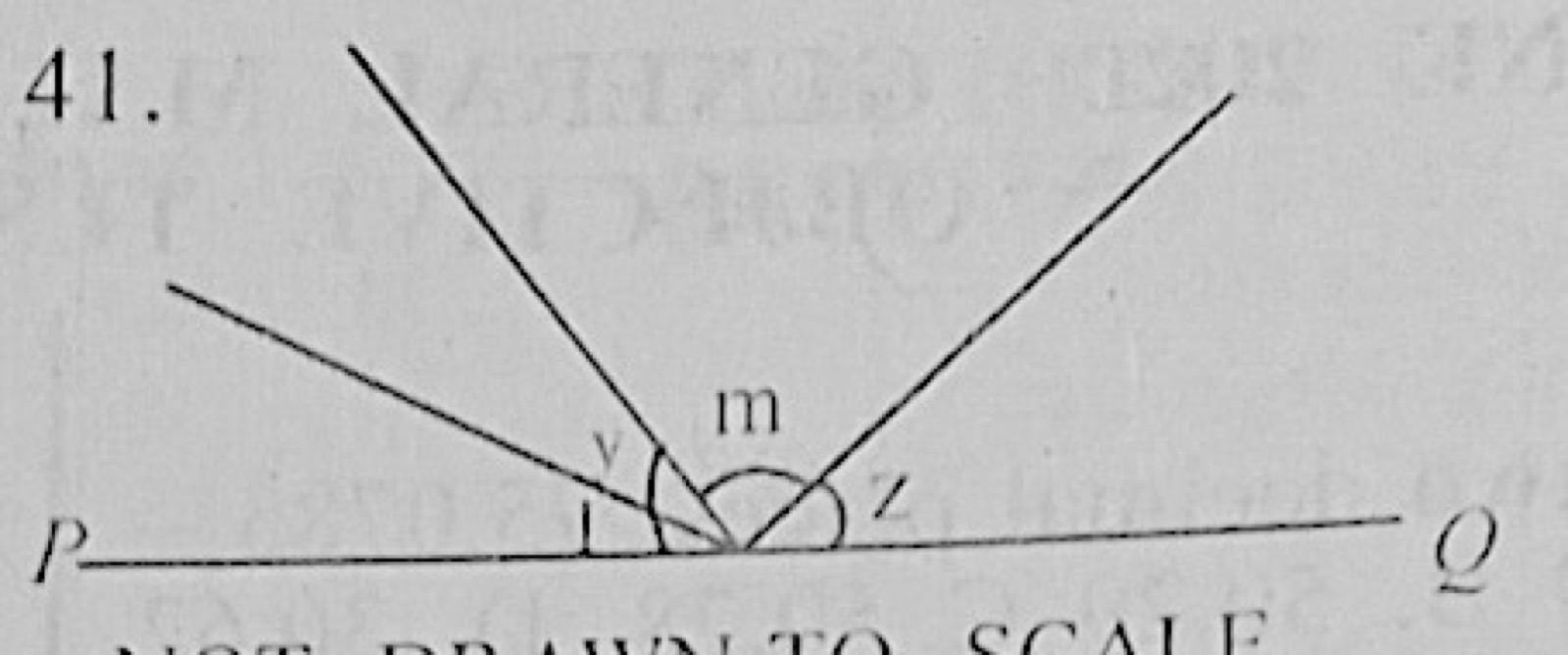
In the diagram, PQ is a straight line. If m = ½(x + y + z), find value of m.

Diagram for this question
  1. A.45°
  2. B.60°
  3. C.90°
  4. D.100°
Show the answer and explanation

Answer: B (60°)

Explanation

Angles on a straight line add to 180°: x + y + z + m = 180°. Since x + y + z = 2m, 3m = 180° and m = 60°.

Open this question

Question 42

Coordinate Geometry

The points on a linear graph are as shown in the table. Find the gradient (slope) of the line.
x: 6.20, 6.85, 7.50
y: 3.90, 5.20, 6.50

  1. A.2½
  2. B.2
  3. C.1
  4. D.½
Show the answer and explanation

Answer: B (2)

Explanation

Gradient = change in y ÷ change in x = (5.20 − 3.90)/(6.85 − 6.20) = 1.30/0.65 = 2.

Open this question

Question 43

Circle Theorems

In the diagram, O is the centre of the circle, PQ and RS are tangents to the circle. Find the value of (m + n).

Diagram for this question
  1. A.120°
  2. B.90°
  3. C.75°
  4. D.60°
Show the answer and explanation

Answer: B (90°)

Explanation

The tangents touch at the ends of a diameter, and the angle at the third point is 90° (angle in a semicircle). Each of m and n is 90° minus the triangle's angle beside it, so m + n = 180° − 90° = 90°.

Open this question

Question 44

Circle Theorems

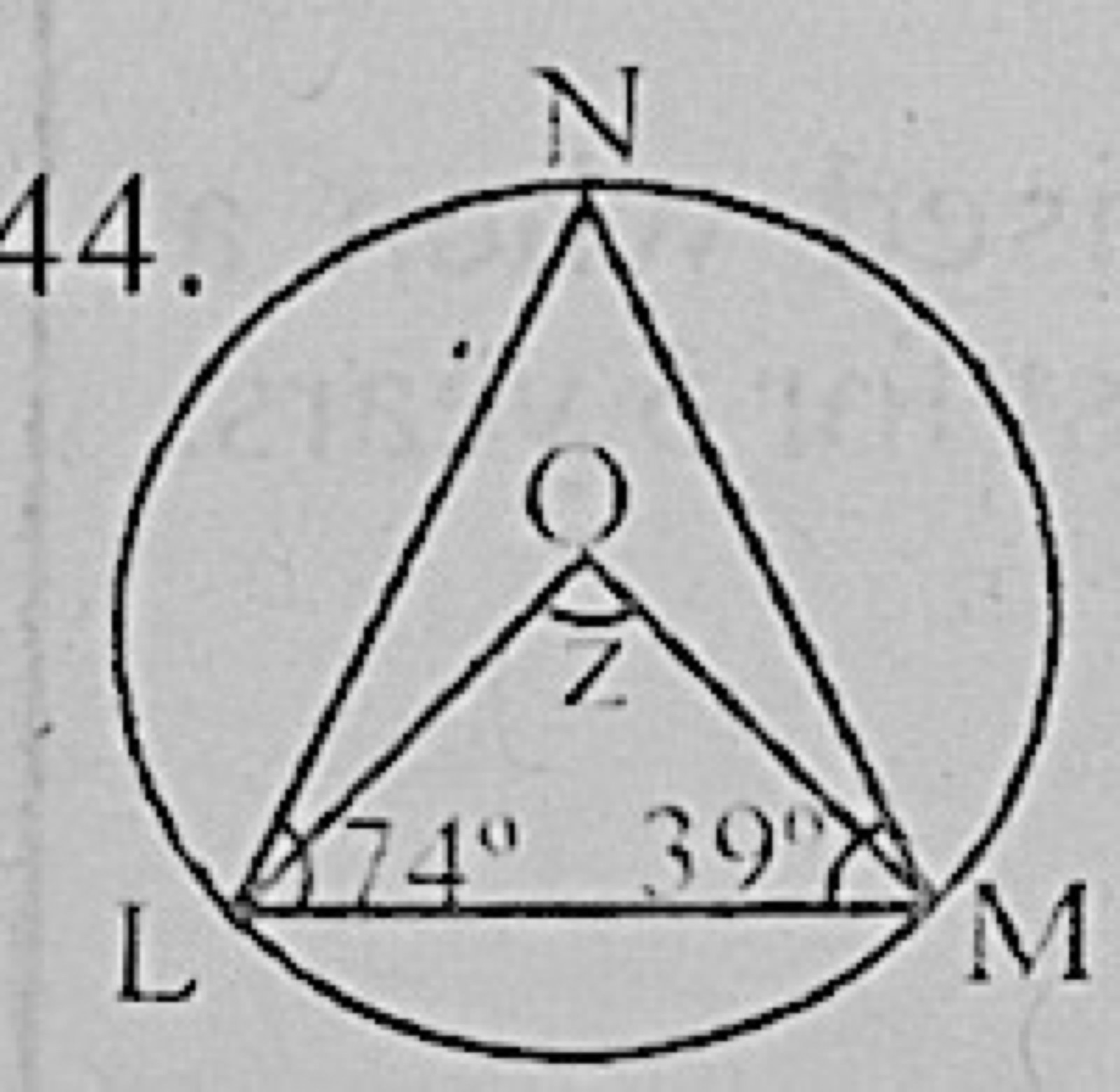
In the diagram, O is the centre of the circle. If ∠NLM = 74°, ∠LMN = 39° and ∠LOM = x, find the value of x.

Diagram for this question
  1. A.134°
  2. B.126°
  3. C.113°
  4. D.106°
Show the answer and explanation

Answer: A (134°)

Explanation

∠LNM = 180° − 74° − 39° = 67°. The angle at the centre is twice that: x = 134°.

Open this question

Question 45

Triangles and Quadrilaterals

Which of the following in not a sufficient condition for two triangles to be congruent?

  1. A.AAS
  2. B.SSS
  3. C.SAS
  4. D.SSA
Show the answer and explanation

Answer: D (SSA)

Explanation

Two sides and a non-included angle (SSA) can fit two different triangles, so it does not prove congruence.

Open this question

Question 46

Commercial Arithmetic

A woman received a discount of 20% on a piece of cloth she purchased from a shop. If she paid $525.00 what was the original price?

  1. A.$675.25
  2. B.$660.25
  3. C.$656.25
  4. D.$616.25
Show the answer and explanation

Answer: C ($656.25)

Explanation

She paid 80% of the price: 525 ÷ 0.8 = $656.25.

Open this question

Question 47

Measures of Dispersion

The interquartile range of a distribution is 7. If the 25th percentile is 16, find the upper quartile.

  1. A.35
  2. B.30
  3. C.23
  4. D.9
Show the answer and explanation

Answer: C (23)

Explanation

Interquartile range = Q3 − Q1, and the 25th percentile is Q1. Q3 = 16 + 7 = 23.

Open this question

Question 48

Graphs of Functions

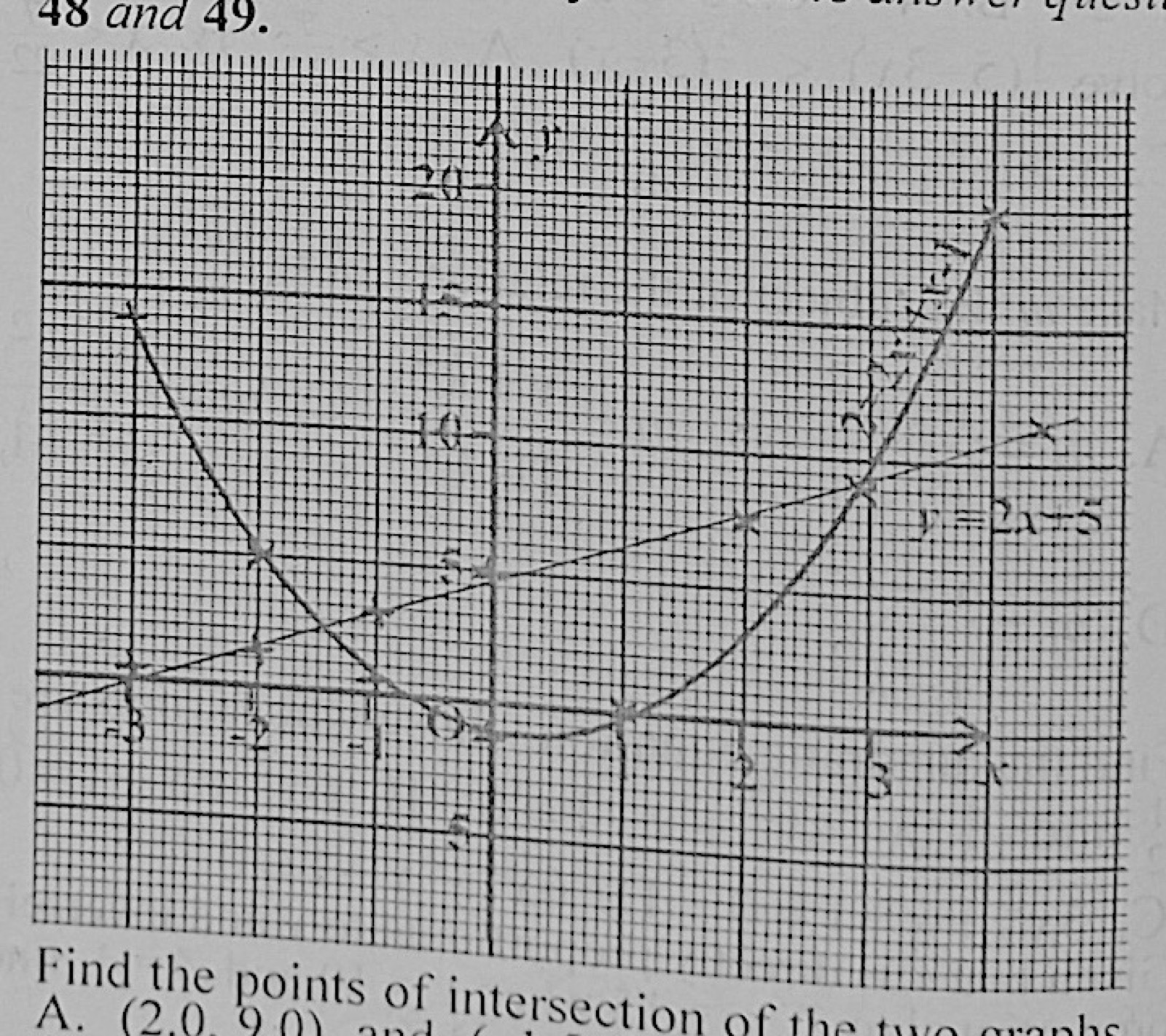
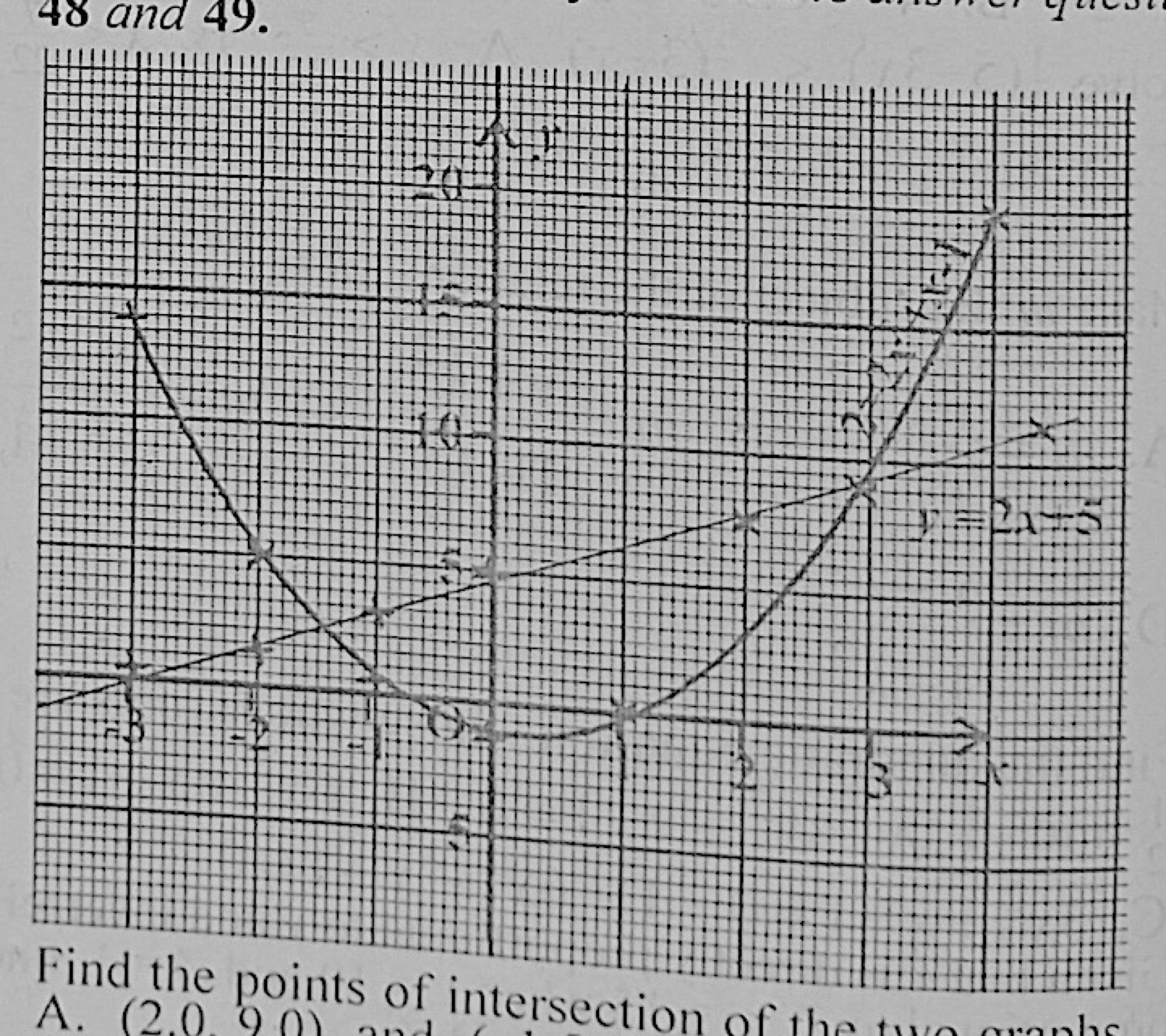
The graphs of the equations y = 2x + 5 and y = 2x2 + x − 1 are shown. Find the points of intersection of the two graphs.

Diagram for this question
  1. A.(2.0, 9.0) and (−1.5, 2.0)
  2. B.(2.0, 8.5) and (−1.5, 2.0)
  3. C.(2.0, 8.0) and (−1.5, 2.5)
  4. D.(2.0, 7.5) and (−1.5, 2.5)
Show the answer and explanation

Answer: A ((2.0, 9.0) and (−1.5, 2.0))

Explanation

Set 2x2 + x − 1 = 2x + 5: 2x2 − x − 6 = 0, (2x + 3)(x − 2) = 0. x = 2 gives y = 9 and x = −1.5 gives y = 2.

Open this question

Question 49

Graphs of Functions

The graphs of the equations y = 2x + 5 and y = 2x2 + x − 1 are shown. If x = −2.5, what is the value of y on the curve?

Diagram for this question
  1. A.y = 8.0
  2. B.y = 8.5
  3. C.y = 9.0
  4. D.y = 9.5
Show the answer and explanation

Answer: C (y = 9.0)

Explanation

On the curve y = 2(−2.5)2 + (−2.5) − 1 = 12.5 − 3.5 = 9.0.

Open this question

Question 50

Polynomials

If (x + 2) is a factor of x2 + Px − 10, find the value of P.

  1. A.3
  2. B.−3
  3. C.7
  4. D.−7
Show the answer and explanation

Answer: B (−3)

Explanation

If (x + 2) is a factor, x = −2 makes the expression zero: 4 − 2P − 10 = 0, so P = −3.

Open this question

Theory question 101

Sets

(a) If A = {multiples of 2}, B = {multiples of 3} and C = {factors of 6} are subsets of μ = {x : 1 ≤ x ≤ 10}, find A′ ∩ B′ ∩ C′.
(b) Tickets for a movie premiere cost $18.50 each while the bulk purchase price for 5 tickets is $80.00. If 4 gentlemen decide to get a fifth person to join them so that they can share the bulk purchase price equally, how much would each person save?

Show the model answer
Model answer

(a) A = {2, 4, 6, 8, 10}, B = {3, 6, 9}, C = {1, 2, 3, 6}
A′ = {1, 3, 5, 7, 9}, B′ = {1, 2, 4, 5, 7, 8, 10}, C′ = {4, 5, 7, 8, 9, 10}
A′ ∩ B′ ∩ C′ = {5, 7}
(b) Bulk share = $80 ÷ 5 = $16 each
Saving per person = $18.50 − $16.00 = $2.50

Explanation

List μ first, then each complement; only elements in all three complements remain.

Open this question

Theory question 102

Algebraic Expressions

(a) Given that P = (rk/Q − ms)2/3, (i) make Q the subject of the relation; (ii) find, correct to two decimal places, the value of Q when P = 3, m = 15, s = 0.2, k = 4 and r = 10.
(b) Given that (x + 2y)/5 = x − 2y, find x : y.

Show the model answer
Model answer

(a)(i) Raise both sides to the power 3/2: P3/2 = rk/Q − ms
rk/Q = P3/2 + ms → Q = rk/(P3/2 + ms)
(ii) Q = 40/(33/2 + 3) = 40/(5.196 + 3) = 40/8.196 ≈ 4.88
(b) x + 2y = 5x − 10y → 12y = 4x
x/y = 3, so x : y = 3 : 1

Explanation

Undo the power 2/3 by raising both sides to 3/2.

Open this question

Theory question 103

Circle Theorems

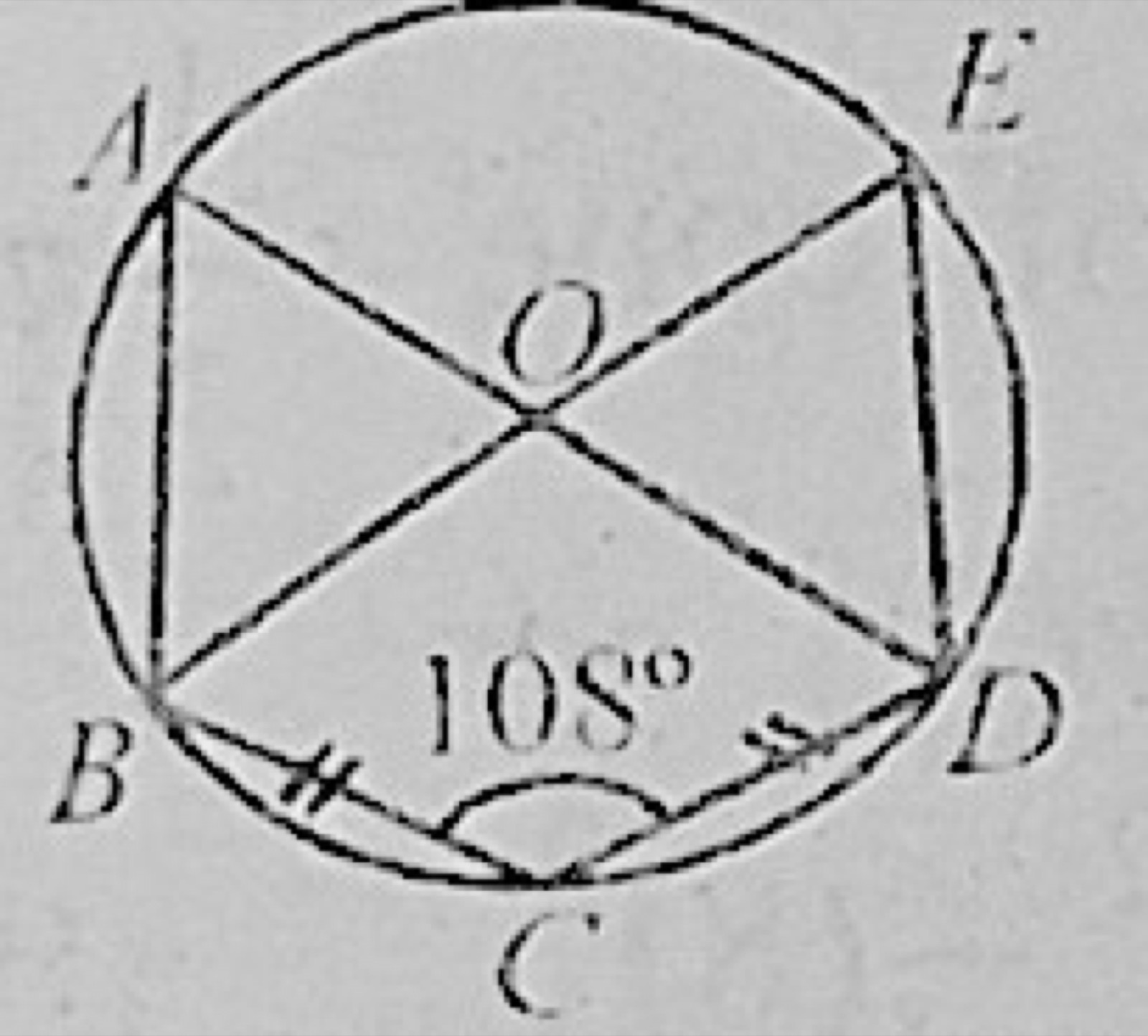
(a) In the diagram, O is the centre of the circle ABCDE, |BC| = |CD| and ∠BCD = 108°. Find ∠CDE.
(b) Given that tan x = √3, 0° ≤ x ≤ 90°, evaluate ((cos x)2 − sin x)/((sin x)2 + cos x).

Diagram for this question
Show the model answer
Model answer

(a) Triangle BCD is isosceles: ∠CDB = (180° − 108°)/2 = 36°
BE is a diameter (passes through O), so ∠BDE = 90° (angle in a semicircle)
∠CDE = 36° + 90° = 126°
(b) x = 60°: cos x = ½, sin x = √3/2
Numerator = ¼ − √3/2 = (1 − 2√3)/4; denominator = ¾ + ½ = 5/4
Value = (1 − 2√3)/5 ≈ −0.49

Explanation

In (a), look for the diameter through O that gives a right angle.

Open this question

Theory question 104

Mensuration of Solids

The total surface area of a cone of slant height l cm and base radius r cm is 224π cm2. If r : l = 2 : 5, find: (a) correct to one decimal place, the value of r; (b) correct to the nearest whole number, the volume of the cone [Take π = 22/7]

Show the model answer
Model answer

(a) l = 5r/2; TSA = πrl + πr2 = π(5r2/2 + r2) = (7/2)πr2
(7/2)r2 = 224 → r2 = 64 → r = 8.0 cm
(b) l = 20 cm; h = √(202 − 82) = √336 ≈ 18.33 cm
V = ⅓ × (22/7) × 64 × 18.33 ≈ 1229 cm3

Explanation

Total surface area of a cone includes the base: πrl + πr2.

Open this question

Theory question 105

Probability

A die was rolled a number of times. The outcomes are as shown in the table.
Number: 1, 2, 3, 4, 5, 6
Outcomes: 32, m, 25, 40, 28, 45
If the probability of obtaining 2 is 0.15, find the: (a) value of m; (b) number of times the die was rolled; (c) probability of obtaining an even number.

Show the model answer
Model answer

(a) m/(170 + m) = 0.15 → m = 25.5 + 0.15m → 0.85m = 25.5 → m = 30
(b) Total = 170 + 30 = 200 rolls
(c) Even outcomes = 30 + 40 + 45 = 115
P(even) = 115/200 = 23/40

Explanation

The known outcomes add up to 170; the total is 170 + m.

Open this question

Theory question 106

Trigonometry

(a) Copy and complete the table of values for the relation y = 3 sin 2x.
x: 0°, 15°, 30°, 45°, 60°, 75°, 90°, 105°, 120°, 135°, 150°
y: 0.0, __, __, __, __, 1.5, __, __, __, __, −2.6
(b) Using a scale of 2 cm to 15° on the x-axis and 2 cm to 1 unit on the y-axis, draw the graph of y = 3 sin 2x for 0° ≤ x ≤ 150°.
(c) Use the graph to find the truth set of: (i) 3 sin 2x + 2 = 0; (ii) (3/2) sin 2x = 0.25.

Show the model answer
Model answer

(a) y = 0.0, 1.5, 2.6, 3.0, 2.6, 1.5, 0.0, −1.5, −2.6, −3.0, −2.6
(b) Plot the points and join with a smooth curve
(c)(i) 3 sin 2x = −2: read where the curve meets y = −2, x ≈ 111°
(ii) Doubling gives 3 sin 2x = 0.5: read where the curve meets y = 0.5, x ≈ 5° and x ≈ 85°

Explanation

Rearrange each equation into the form 3 sin 2x = k, then draw the line y = k.

Open this question

Theory question 107

Mensuration of Solids

(a) The diagram shows a wooden structure in the form of a cone, mounted on a hemispherical base. The vertical height of the cone is 48 m and the base radius is 14 m. Caculate, correct to three significant figures, the surface area of the structure. [Take π = 22/7]
(b) Five years ago, Musah was twice as old as Sesay. If the sum of their ages is 100, find Sesay's present age.

Diagram for this question
Show the model answer
Model answer

(a) Slant height l = √(482 + 142) = √2500 = 50 m
Curved surface of cone = πrl = (22/7) × 14 × 50 = 2200 m2
Curved surface of hemisphere = 2πr2 = 2 × (22/7) × 196 = 1232 m2
Total = 3432 ≈ 3430 m2 (3 s.f.)
(b) M + S = 100 and M − 5 = 2(S − 5) → M = 2S − 5
3S − 5 = 100 → S = 35
Sesay is 35 years old

Explanation

The flat circle where the cone sits on the hemisphere is hidden, so it is not part of the surface.

Open this question

Theory question 108

Commercial Arithmetic

(a) Ms. Maureen spent ¼ of her monthly income at a shopping mall, ⅓ at an open market and 2/5 of the remaining amount at a Mechanic workshop. If she had ₦225,000.00 left, find: (i) her monthly income; (ii) the amount spent at the open market.
(b) The third term of an Arithmetic Progression (A.P.) is 4m − 2n. If the ninth term of the progression is 2m − 8n, find the common difference in terms of m and n.

Show the model answer
Model answer

(a) Let income = x. Mall + market = x/4 + x/3 = 7x/12; remainder = 5x/12
Mechanic = 2/5 × 5x/12 = x/6; left = 5x/12 − x/6 = x/4
(i) x/4 = 225,000 → x = ₦900,000
(ii) Open market = ⅓ × 900,000 = ₦300,000
(b) a + 2d = 4m − 2n and a + 8d = 2m − 8n
Subtract: 6d = −2m − 6n
d = −(m + 3n)/3 = −m/3 − n

Explanation

In (a) the ¼ and ⅓ are fractions of the whole income; only the 2/5 is of the remainder.

Open this question

Theory question 109

Bearings

Two cyclists X and Y leave town Q at the same time. Cyclist X travels at the rate of 5 km/h on a bearing of 049° and cyclist Y travels at the rate of 9 km/h on a bearing of 319°.
(a) Illustrate the information on a diagram.
(b) After travelling for two hours, calculate, correct to the nearest whole number, the: (i) distance between cyclists X and Y; (ii) bearing of cyclist X from Y.
(c) Find the average speed at which cyclist X will get to Y in 4 hours.

Show the model answer
Model answer

(a) Diagram from Q: QX on bearing 049°, QY on bearing 319°; the angle XQY = 360° − 319° + 49° = 90°
(b) After 2 h: QX = 10 km, QY = 18 km
(i) XY = √(102 + 182) = √424 ≈ 20.6 ≈ 21 km
(ii) ∠QYX: tan = 10/18 → 29.1°; bearing of Q from Y = 139°, so bearing of X from Y = 139° − 29.1° ≈ 110°
(c) Speed = 20.6 km ÷ 4 h ≈ 5.1 km/h (about 5 km/h)

Explanation

The two bearings differ by 90°, so the triangle QXY is right-angled at Q.

Open this question

Theory question 110

Data Presentation

The table shows the distribution of marks obtained by students in an examination.
Marks (%): 0-9, 10-19, 20-29, 30-39, 40-49, 50-59, 60-69, 70-79, 80-89, 90-99
Frequency: 7, 11, 17, 20, 29, 34, 30, 25, 21, 6
(a) Construct a cumulative frequency table for the distribution.
(b) Draw the cumulative frequency curve for the distribution.
(c) Using the curve, find correct to one decimal place, the: (i) median mark; (ii) lowest mark for distinction if 5% of the students passed with distinction.

Show the model answer
Model answer

(a) Upper class boundaries 9.5, 19.5, …, 99.5; cumulative frequencies 7, 18, 35, 55, 84, 118, 148, 173, 194, 200
(b) Plot cumulative frequency against upper class boundary and draw a smooth S-curve
(c)(i) Median at the 100th student: ≈ 54.2 (49.5 + 16/34 × 10)
(ii) Top 5% = 10 students, so read the mark at cumulative frequency 190: ≈ 87.6 (79.5 + 17/21 × 10)

Explanation

For the distinction mark, count down from the top: 200 − 10 = 190.

Open this question

Theory question 111

Circle Theorems

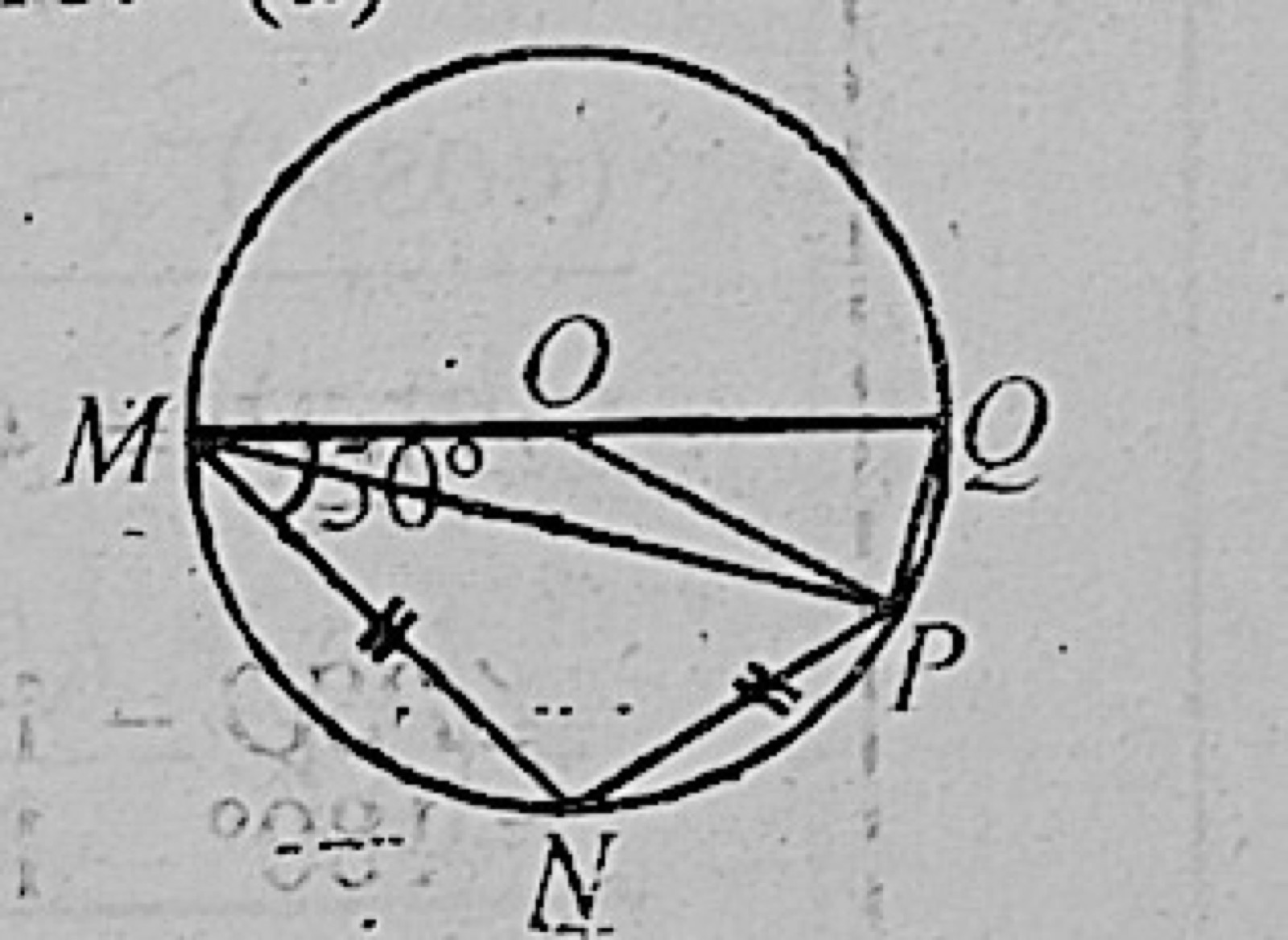
(a) In the diagram, MNPQ is a circle with centre O, |MN| = |NP| and ∠OMN = 50°. Find: (i) ∠MNP; (ii) ∠POQ.
(b) Find the equation of the line which has the same gradient as 8y + 4x = 24 and passes through the point (−8, 12).

Diagram for this question
Show the model answer
Model answer

(a)(i) MQ is a diameter, so ∠MPQ = 90°. In cyclic quadrilateral MNPQ, ∠NPQ = 180° − 50° = 130°, so ∠MPN = 130° − 90° = 40°
MN = NP, so ∠NMP = 40° and ∠MNP = 180° − 80° = 100°
(ii) ∠PMQ = 50° − 40° = 10°; angle at centre ∠POQ = 2 × 10° = 20°
(b) 8y = −4x + 24 → gradient = −½
y − 12 = −½(x + 8) → 2y − 24 = −x − 8
x + 2y − 16 = 0 (or y = −½x + 8)

Explanation

Use the angle in a semicircle and opposite angles of a cyclic quadrilateral.

Open this question

Theory question 112

Mensuration of Plane Shapes

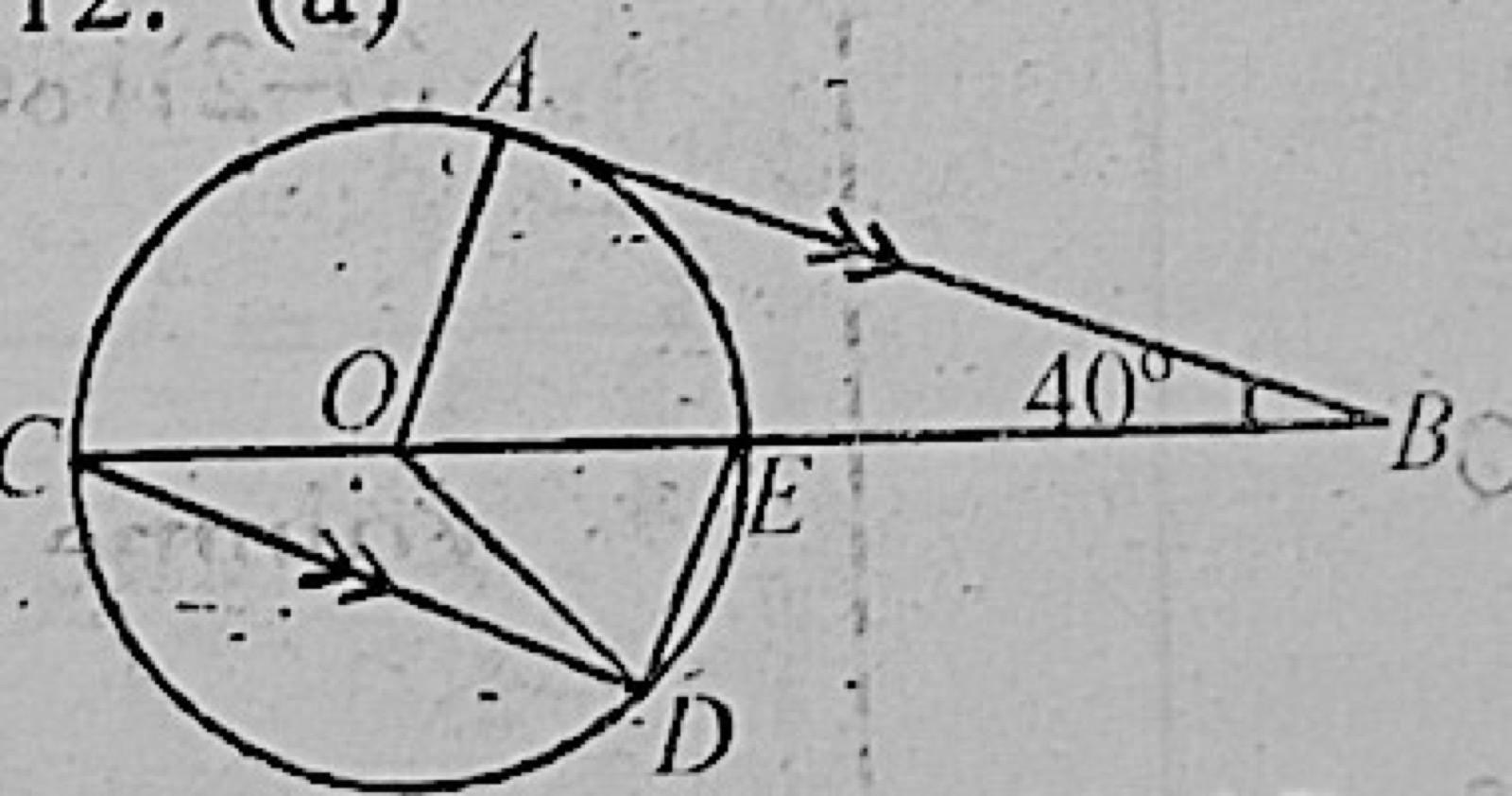
(a) In the diagram, AB is a tangent to the circle with centre O, and COB is a straight line. If CD ∥ AB and ∠ABE = 40°, find: ∠ODE.
(b) ABCD is a parallelogram in which |CD| = 7 cm, |AD| = 5 cm and ∠ADC = 125°. (i) Illustrate the information in a diagram. (ii) Find, correct to one decimal place, the area of the parallelogram.
(c) If x = ½(1 − √2), evaluate (2x2 − 2x).

Diagram for this question
Show the model answer
Model answer

(a) ∠DCO = ∠ABO = 40° (alternate angles, CD ∥ AB)
OC = OD, so ∠ODC = 40° and ∠COD = 100°; ∠DOE = 180° − 100° = 80°
OD = OE, so ∠ODE = (180° − 80°)/2 = 50°
(b)(i) Sketch parallelogram ABCD with CD = 7 cm, AD = 5 cm, ∠ADC = 125°
(ii) Area = 7 × 5 × sin 125° ≈ 28.7 cm2
(c) 2x2 − 2x = 2x(x − 1); x − 1 = −½(1 + √2)
x(x − 1) = −¼(1 − √2)(1 + √2) = −¼(1 − 2) = ¼
2x2 − 2x = ½

Explanation

In (c), factorising first makes the surds cancel neatly.

Open this question

Theory question 113

Constructions

(a) Using a ruler and a pair of compasses only, construct: (i) (α) ΔABC with |AB| = 7.5 cm, |AC| = 13.5 cm and ∠ABC = 120°; (β) locus l1 of points equidistant from A and B; (γ) locus, l2 of points equidistant from B and C. (ii) Using N, the point of intersection of l1 and l2 as centre, draw a circle to pass through points A, B, and C.
(b) Using the method of completing the square, solve, 4x2 − 4√3x + 3 = 0, leaving the answer in surd form.

Show the model answer
Model answer

(a)(i)(α) Draw AB = 7.5 cm; construct 120° at B (60° + 60°); with centre A, radius 13.5 cm, cut the arm at C (BC ≈ 8.1 cm)
(β) l1 = perpendicular bisector of AB; (γ) l2 = perpendicular bisector of BC
(ii) With centre N and radius NA (≈ 7.8 cm) draw the circle through A, B and C
(b) x2 − √3x = −¾
x2 − √3x + ¾ = 0 → (x − √3/2)2 = 0
x = √3/2 (twice)

Explanation

Construction arcs must be left visible; the circle through A, B and C is the circumcircle.
Open this question