WAEC Mathematics 2019 past questions and answers

57 questions. Try each one, then open the answer to check yourself and read the explanation.

Question 1

Fractions, Decimals and Approximation

Express, correct to three significant figures, 0.003597.

  1. A.0.359
  2. B.0.004
  3. C.0.00360
  4. D.0.00359
Show the answer and explanation

Answer: C (0.00360)

Explanation

The first three significant figures are 3, 5, 9 and the next digit is 7, so round 359 up to 360: 0.00360. The final zero must be kept to show three significant figures.

Open this question

Question 2

Indices

Evaluate: (0.064)−1/3

  1. A.5/2
  2. B.2/5
  3. C.−2/5
  4. D.−5/2
Show the answer and explanation

Answer: A (5/2)

Explanation

0.064 = 64/1000, whose cube root is 4/10 = 2/5. The negative power turns it upside down: 5/2.

Open this question

Question 3

Linear and Simultaneous Equations

Solve: (y + 1)/2 − (2y − 1)/3 = 4.

  1. A.y = 19
  2. B.y = −19
  3. C.y = −29
  4. D.y = 29
Show the answer and explanation

Answer: B (y = −19)

Explanation

Multiply by 6: 3(y + 1) − 2(2y − 1) = 24, so 3y + 3 − 4y + 2 = 24, giving −y = 19 and y = −19.

Open this question

Question 4

Fractions, Decimals and Approximation

Simplify, correct to three significant figures, (27.63)2 − (12.37)2.

  1. A.614
  2. B.612
  3. C.611
  4. D.610
Show the answer and explanation

Answer: D (610)

Explanation

Use the difference of two squares: (27.63 + 12.37)(27.63 − 12.37) = 40 × 15.26 = 610.4, which is 610 to 3 s.f.

Open this question

Question 5

Modular Arithmetic

If 7 + y = 4 (mod 8), find the least value of y, 10 ≤ y ≤ 30.

  1. A.11
  2. B.13
  3. C.19
  4. D.21
Show the answer and explanation

Answer: B (13)

Explanation

y = 4 − 7 = −3 ≡ 5 (mod 8), so y can be 5, 13, 21, 29, … The least value from 10 upwards is 13.

Open this question

Question 7

Logarithms

Evaluate: (log39 − log28)/log39

  1. A.−1/3
  2. B.1/2
  3. C.1/3
  4. D.−1/2
Show the answer and explanation

Answer: D (−1/2)

Explanation

log39 = 2 and log28 = 3, so the value is (2 − 3)/2 = −1/2.

Open this question

Question 8

Number Bases

If 23y = 1111two, find the value of y.

  1. A.4
  2. B.5
  3. C.6
  4. D.7
Show the answer and explanation

Answer: C (6)

Explanation

1111two = 8 + 4 + 2 + 1 = 15. So 2y + 3 = 15, giving y = 6.

Open this question

Question 9

Progressions

If 6, P and 14 are consecutive terms in an Arithmetic Progression (A.P), find the value of P.

  1. A.9
  2. B.10
  3. C.6
  4. D.8
Show the answer and explanation

Answer: B (10)

Explanation

The middle term of an A.P. is the average of its neighbours: P = (6 + 14)/2 = 10.

Open this question

Question 10

Surds

Evaluate: 2√28 − 3√50 + √72

  1. A.4√7 − 21√2
  2. B.4√7 − 11√2
  3. C.4√7 − 9√2
  4. D.4√7 + √2
Show the answer and explanation

Answer: C (4√7 − 9√2)

Explanation

2√28 = 4√7, 3√50 = 15√2 and √72 = 6√2. So the result is 4√7 − 15√2 + 6√2 = 4√7 − 9√2.

Open this question

Question 11

Algebraic Expressions

If m : n = 2 : 1, evaluate (3m2 − 2n2)/(m2 + mn)

  1. A.4/3
  2. B.5/3
  3. C.3/4
  4. D.3/5
Show the answer and explanation

Answer: B (5/3)

Explanation

Put m = 2 and n = 1: (12 − 2)/(4 + 2) = 10/6 = 5/3.

Open this question

Question 12

Variation

H varies directly as p and inversely as the square of y. If H = 1, p = 8 and y = 2, find H in terms of p and y.

  1. A.H = p/(4y2)
  2. B.H = 2p/y2
  3. C.H = p/(2y2)
  4. D.H = p/y2
Show the answer and explanation

Answer: C (H = p/(2y2))

Explanation

H = kp/y2. Then 1 = 8k/4, so k = 1/2 and H = p/(2y2).

Open this question

Question 13

Quadratic Equations

Solve 4x2 − 16x + 15 = 0.

  1. A.x = 1½ or x = −2½
  2. B.x = 1½ or x = 2½
  3. C.x = 1½ or x = −1½
  4. D.x = −1½ or x = −2½
Show the answer and explanation

Answer: B (x = 1½ or x = 2½)

Explanation

4x2 − 16x + 15 = (2x − 3)(2x − 5) = 0, so x = 3/2 = 1½ or x = 5/2 = 2½.

Open this question

Question 15

Logarithms

Simplify: log106 − 3log103 + (2/3)log1027

  1. A.3log102
  2. B.log102
  3. C.log103
  4. D.2log103
Show the answer and explanation

Answer: B (log102)

Explanation

Write each term as one log: log 6 − log 27 + log 9 = log(6 × 9/27) = log102.

Open this question

Question 16

Commercial Arithmetic

Bala sold an article for ₦6,900.00 and made a profit of 15%. Calculate his percentage profit if he had sold it for ₦6,600.00.

  1. A.5%
  2. B.10%
  3. C.12%
  4. D.13%
Show the answer and explanation

Answer: B (10%)

Explanation

Cost price = 6,900 ÷ 1.15 = ₦6,000. Selling at ₦6,600 gives a profit of ₦600, which is 600/6,000 × 100 = 10%.

Open this question

Question 17

Linear and Simultaneous Equations

If 3p = 4q and 9p = 8q − 12, find the value of pq.

  1. A.12
  2. B.7
  3. C.−7
  4. D.−12
Show the answer and explanation

Answer: A (12)

Explanation

8q = 2(4q) = 6p, so 9p = 6p − 12, giving p = −4. Then q = 3p/4 = −3, and pq = 12.

Open this question

Question 18

Indices

If (0.25)y = 32, find the value of y.

  1. A.y = −5/2
  2. B.y = −3/2
  3. C.y = 3/2
  4. D.y = 5/2
Show the answer and explanation

Answer: A (y = −5/2)

Explanation

0.25 = 2−2 and 32 = 25, so −2y = 5 and y = −5/2.

Open this question

Question 20

Algebraic Expressions

Simplify: (x2 − 5x − 14)/(x2 − 9x + 14)

  1. A.(x − 7)/(x + 7)
  2. B.(x + 7)/(x − 7)
  3. C.(x − 2)/(x + 4)
  4. D.(x + 2)/(x − 2)
Show the answer and explanation

Answer: D ((x + 2)/(x − 2))

Explanation

Factorise: (x − 7)(x + 2) over (x − 7)(x − 2). Cancel (x − 7) to get (x + 2)/(x − 2).

Open this question

Question 22

Mensuration of Solids

The total surface area of a solid cylinder 165 cm2. If the base diameter is 7 cm, calculate its height. [Take π = 22/7]

  1. A.7.5 cm
  2. B.4.5 cm
  3. C.4.0 cm
  4. D.2.0 cm
Show the answer and explanation

Answer: C (4.0 cm)

Explanation

Total surface area = 2πr2 + 2πrh with r = 3.5: 165 = 77 + 22h, so 22h = 88 and h = 4 cm.

Open this question

Question 23

Indices

If 2a = √64 and b/a = 3, evaluate a2 + b2.

  1. A.250
  2. B.160
  3. C.90
  4. D.48
Show the answer and explanation

Answer: C (90)

Explanation

√64 = 8 = 23, so a = 3 and b = 9. Then a2 + b2 = 9 + 81 = 90.

Open this question

Question 24

Trigonometry

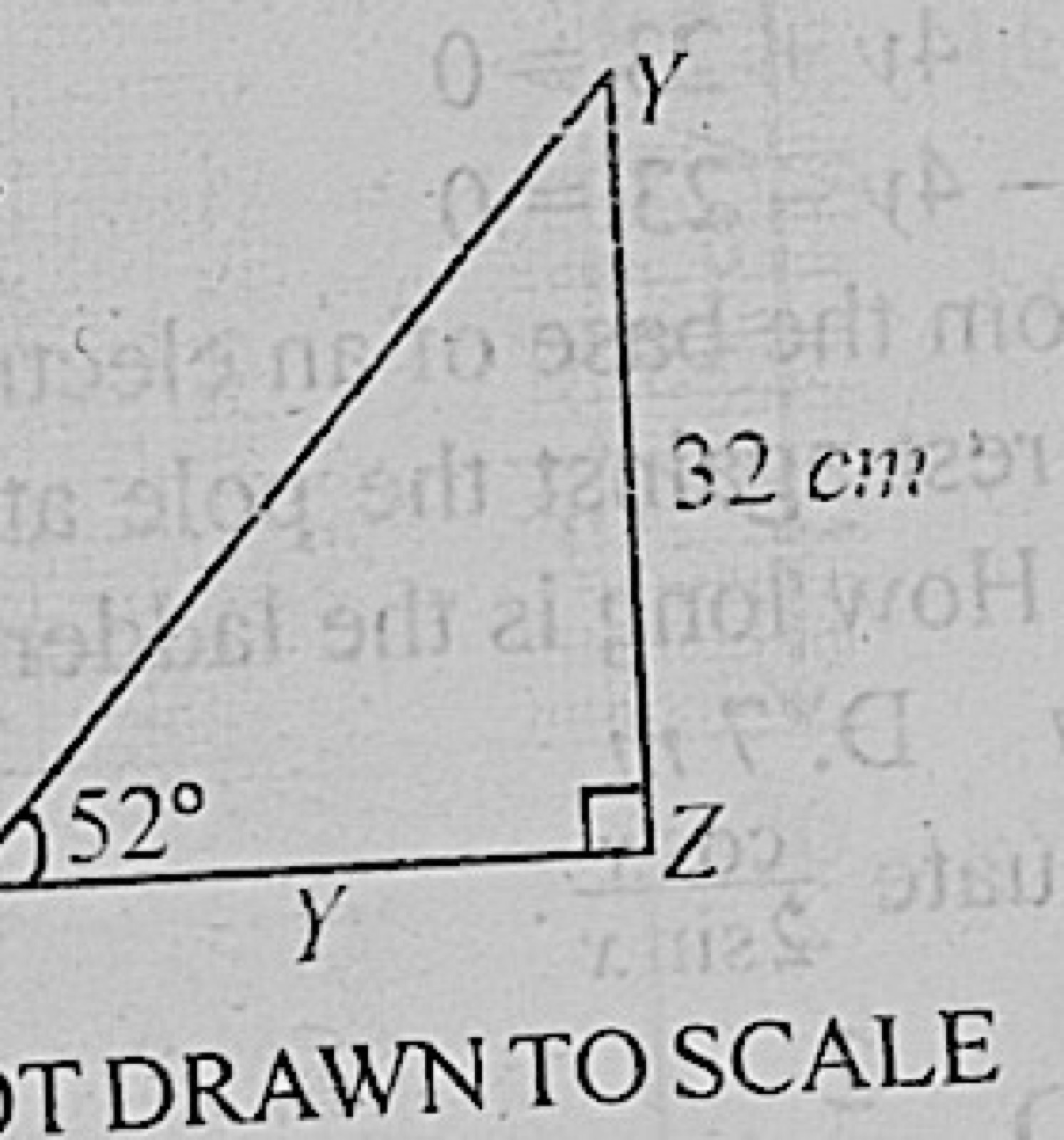
In XYZ, |YZ| = 32 cm, ∠YXZ = 52° and ∠XZY = 90°. Find, correct to the nearest centimetre, |XZ|.

Diagram for this question
  1. A.31 cm
  2. B.25 cm
  3. C.20 cm
  4. D.13 cm
Show the answer and explanation

Answer: B (25 cm)

Explanation

YZ is opposite the 52° angle and XZ is next to it, so tan 52° = 32/|XZ|. |XZ| = 32 ÷ 1.2799 ≈ 25 cm.

Open this question

Question 25

Logarithms

If logx2 = 0.3, evaluate logx8.

  1. A.2.4
  2. B.1.2
  3. C.0.9
  4. D.0.6
Show the answer and explanation

Answer: C (0.9)

Explanation

logx8 = logx23 = 3 logx2 = 3 × 0.3 = 0.9.

Open this question

Question 26

Mensuration of Plane Shapes

An arc subtends an angle of 72° at the centre of a circle. Find the length of the arc if the radius of the circle is 3.5 cm. [Take π = 22/7]

  1. A.6.6 cm
  2. B.8.8 cm
  3. C.4.4 cm
  4. D.2.2 cm
Show the answer and explanation

Answer: C (4.4 cm)

Explanation

Arc length = (72/360) × 2 × (22/7) × 3.5 = (1/5) × 22 = 4.4 cm.

Open this question

Question 27

Algebraic Expressions

Make b the subject of the relation lb = ½(a + b)h.

  1. A.ah/(2l − h)
  2. B.(2l − h)/(al)
  3. C.al/(2l − h)
  4. D.al/(2 − h)
Show the answer and explanation

Answer: A (ah/(2l − h))

Explanation

Multiply by 2: 2lb = ah + bh. Collect b: b(2l − h) = ah, so b = ah/(2l − h).

Open this question

Question 28

Commercial Arithmetic

Eric sold his house through an agent who charged 8% commission on the selling price. If Eric received $117,760.00 after the sale, what was the selling price of the house?

  1. A.$130,000.00
  2. B.$128,000.00
  3. C.$125,000.00
  4. D.$120,000.00
Show the answer and explanation

Answer: B ($128,000.00)

Explanation

Eric kept 92% of the selling price, so the price = 117,760 ÷ 0.92 = $128,000.

Open this question

Question 29

Mensuration of Plane Shapes

Find the angle which an arc of length 22 cm subtends at the centre of a circle of radius 15 cm. [Take π = 22/7]

  1. A.70°
  2. B.84°
  3. C.96°
  4. D.156°
Show the answer and explanation

Answer: B (84°)

Explanation

22 = (θ/360) × 2 × (22/7) × 15, so θ = 22 × 360 × 7/(44 × 15) = 84°.

Open this question

Question 30

Mensuration of Plane Shapes

A rectangular board has length 15 cm and width x cm. If its sides are doubled, find its new area.

  1. A.60x cm2
  2. B.45x cm2
  3. C.30x cm2
  4. D.15x cm2
Show the answer and explanation

Answer: A (60x cm2)

Explanation

The new sides are 30 cm and 2x cm, so the area is 30 × 2x = 60x cm2.

Open this question

Question 32

Algebraic Expressions

Factorize completely: (2x + 2y)(x − y) + (2x − 2y)(x + y).

  1. A.4(x − y)(x + y)
  2. B.4(x − y)
  3. C.2(x − y)(x + y)
  4. D.2(x − y)
Show the answer and explanation

Answer: A (4(x − y)(x + y))

Explanation

Each part is 2(x + y)(x − y), so the sum is 4(x − y)(x + y).

Open this question

Question 33

Angles and Polygons

The interior angles of a polygon are 3x°, 2x°, 4x°, 3x° and 6x°. Find the size of the smallest angle of the polygon.

  1. A.80°
  2. B.60°
  3. C.40°
  4. D.30°
Show the answer and explanation

Answer: B (60°)

Explanation

A 5-sided polygon has angles adding to 540°. 18x = 540, so x = 30 and the smallest angle is 2x = 60°.

Open this question

Question 34

Probability

A box contains 2 white and 3 blue identical balls. If two balls are picked at random from the box, one after the other with replacement, what is the probability that they are of different colours?

  1. A.2/3
  2. B.3/5
  3. C.7/20
  4. D.12/25
Show the answer and explanation

Answer: D (12/25)

Explanation

P(white then blue) + P(blue then white) = (2/5)(3/5) + (3/5)(2/5) = 12/25.

Open this question

Question 35

Coordinate Geometry

Find the equation of a straight line passing through the point (1, −5) and having gradient of 3/4.

  1. A.3x + 4y − 23 = 0
  2. B.3x + 4y + 23 = 0
  3. C.3x − 4y + 23 = 0
  4. D.3x − 4y − 23 = 0
Show the answer and explanation

Answer: D (3x − 4y − 23 = 0)

Explanation

y + 5 = (3/4)(x − 1). Multiply by 4: 4y + 20 = 3x − 3, so 3x − 4y − 23 = 0.

Open this question

Question 36

Trigonometry

The foot of a ladder is 6 m from the base of an electric pole. The top of the ladder rest against the pole at a point 8 m above the ground. How long is the ladder?

  1. A.14 m
  2. B.12 m
  3. C.10 m
  4. D.7 m
Show the answer and explanation

Answer: C (10 m)

Explanation

The ladder is the hypotenuse: √(62 + 82) = √100 = 10 m.

Open this question

Question 37

Trigonometry

If tan x = 3/4, 0 < x < 90°, evaluate cos x/(2 sin x).

  1. A.8/3
  2. B.3/2
  3. C.4/3
  4. D.2/3
Show the answer and explanation

Answer: D (2/3)

Explanation

With sides 3, 4, 5: sin x = 3/5 and cos x = 4/5. So (4/5) ÷ (6/5) = 2/3.

Open this question

Question 38

Trigonometry

From the top of a vertical cliff 20 m high a boat at sea can be sighted 75 m away and on the same horizontal position as the foot of the cliff. Calculate, correct to the nearest degree, the angle of depression of the boat from the top of the cliff.

  1. A.56°
  2. B.75°
  3. C.16°
  4. D.15°
Show the answer and explanation

Answer: D (15°)

Explanation

tan θ = 20/75 = 0.267, so θ ≈ 14.9°, which is 15° to the nearest degree.

Open this question

Question 39

Mensuration of Plane Shapes

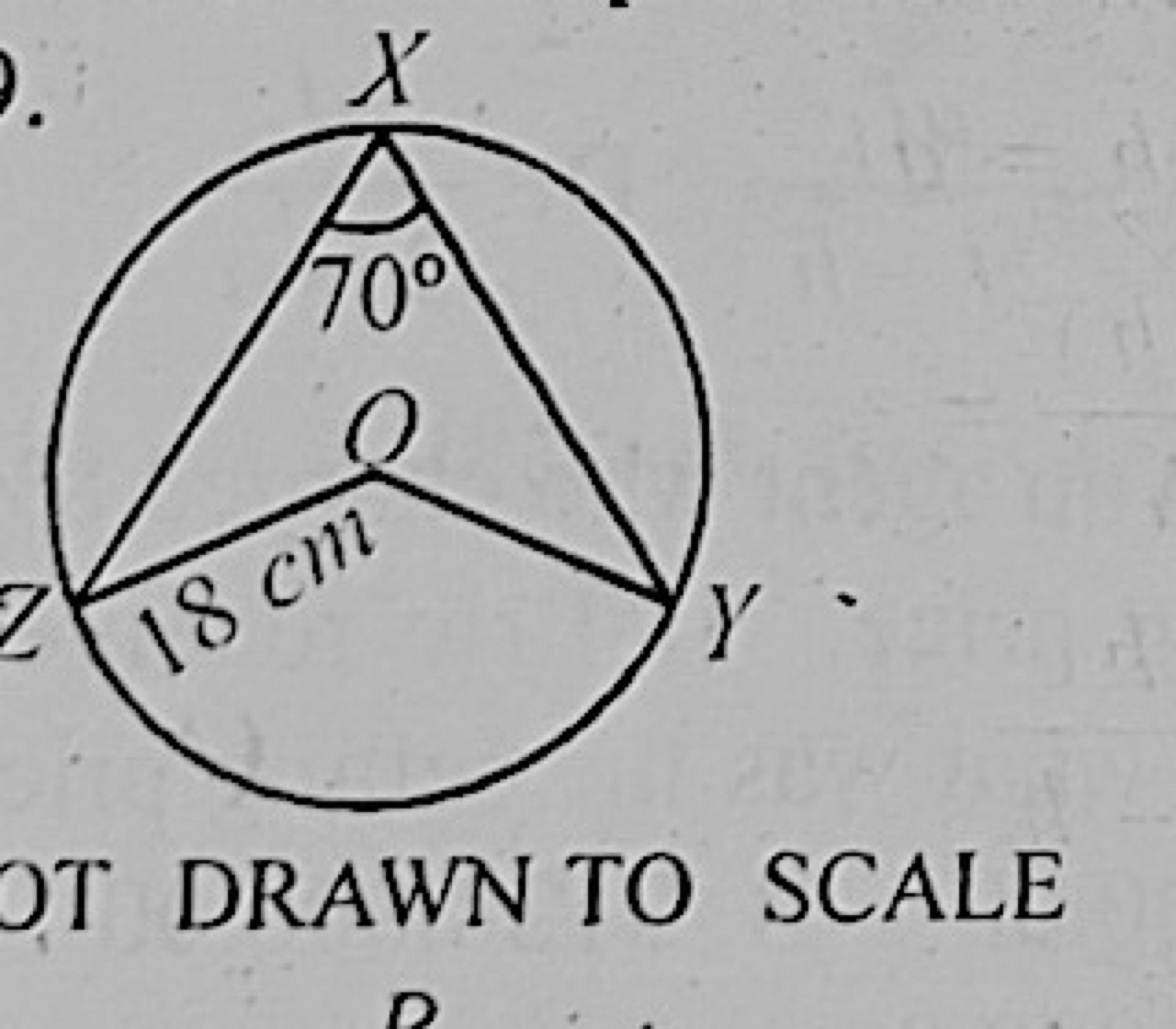
In the diagram, O is the centre of the circle of radius 18 cm. If ∠ZXY = 70°, calculate the length of arc ZY. [Take π = 22/7]

Diagram for this question
  1. A.11 cm
  2. B.22 cm
  3. C.44 cm
  4. D.80 cm
Show the answer and explanation

Answer: C (44 cm)

Explanation

The angle at the centre is twice the angle at the circumference: ∠ZOY = 140°. Arc = (140/360) × 2 × (22/7) × 18 = 44 cm.

Open this question

Question 40

Circle Theorems

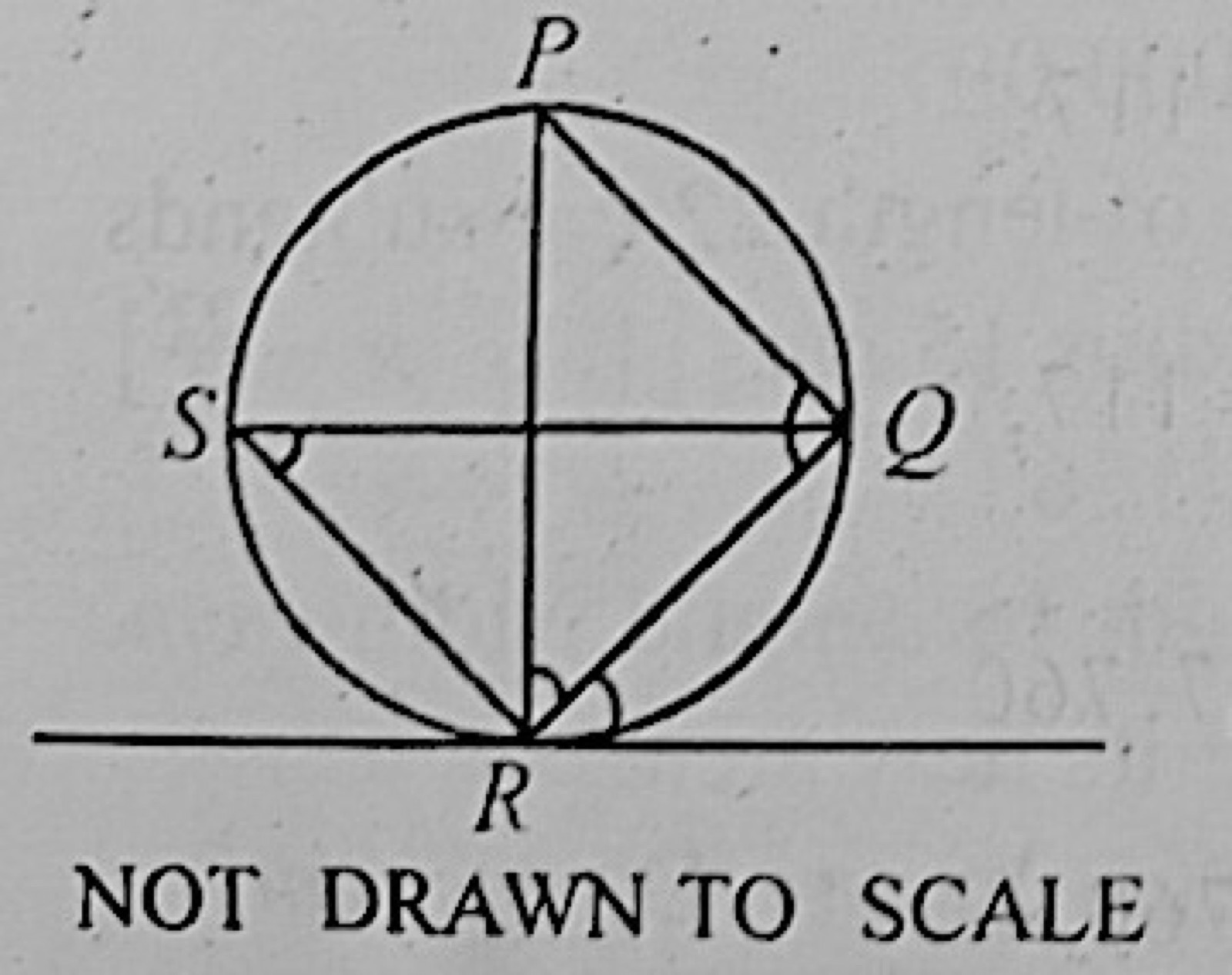
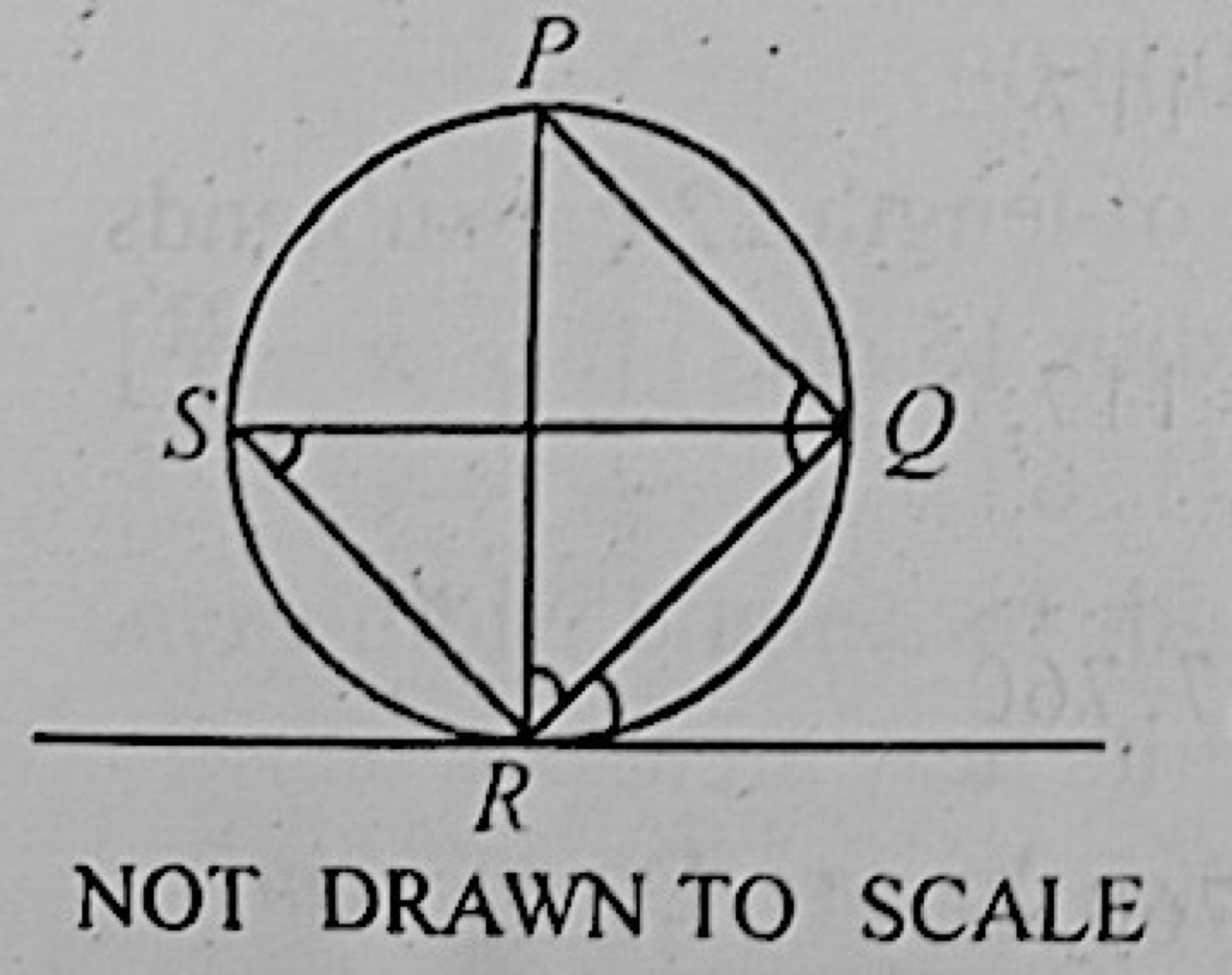
In the diagram, RT is a tangent to the circle at R, ∠PQR = 70°, ∠QRT = 52°, ∠QSR = y and ∠PRQ = x. Find the value of y.

Diagram for this question
  1. A.70°
  2. B.60°
  3. C.52°
  4. D.18°
Show the answer and explanation

Answer: C (52°)

Explanation

The angle between a tangent and a chord equals the angle in the alternate segment, so ∠QSR = ∠QRT = 52°.

Open this question

Question 41

Circle Theorems

In the diagram, RT is a tangent to the circle at R, ∠PQR = 70°, ∠QRT = 52°, ∠QSR = y and ∠PRQ = x. Calculate the value of x.

Diagram for this question
  1. A.70°
  2. B.58°
  3. C.55°
  4. D.48°
Show the answer and explanation

Answer: B (58°)

Explanation

∠QPR = ∠QRT = 52° (alternate segment). In triangle PQR, x = 180° − 70° − 52° = 58°.

Open this question

Question 43

Progressions

The fourth term of an Arithmetic Progression (A.P.) is 37 and the first term is −20. Find the common difference.

  1. A.63
  2. B.57
  3. C.19
  4. D.17
Show the answer and explanation

Answer: C (19)

Explanation

T4 = a + 3d, so −20 + 3d = 37, 3d = 57 and d = 19.

Open this question

Question 44

Angles and Polygons

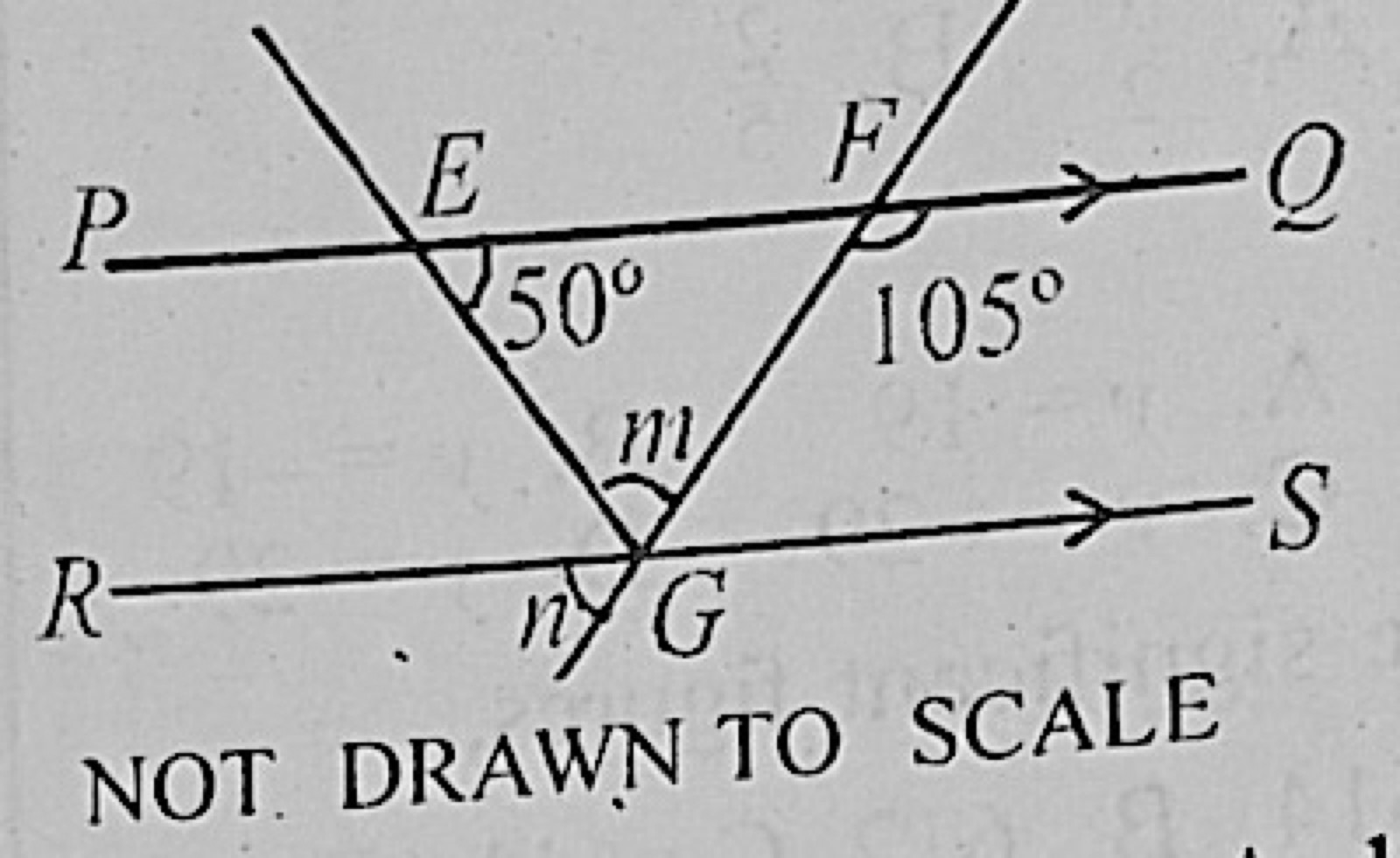
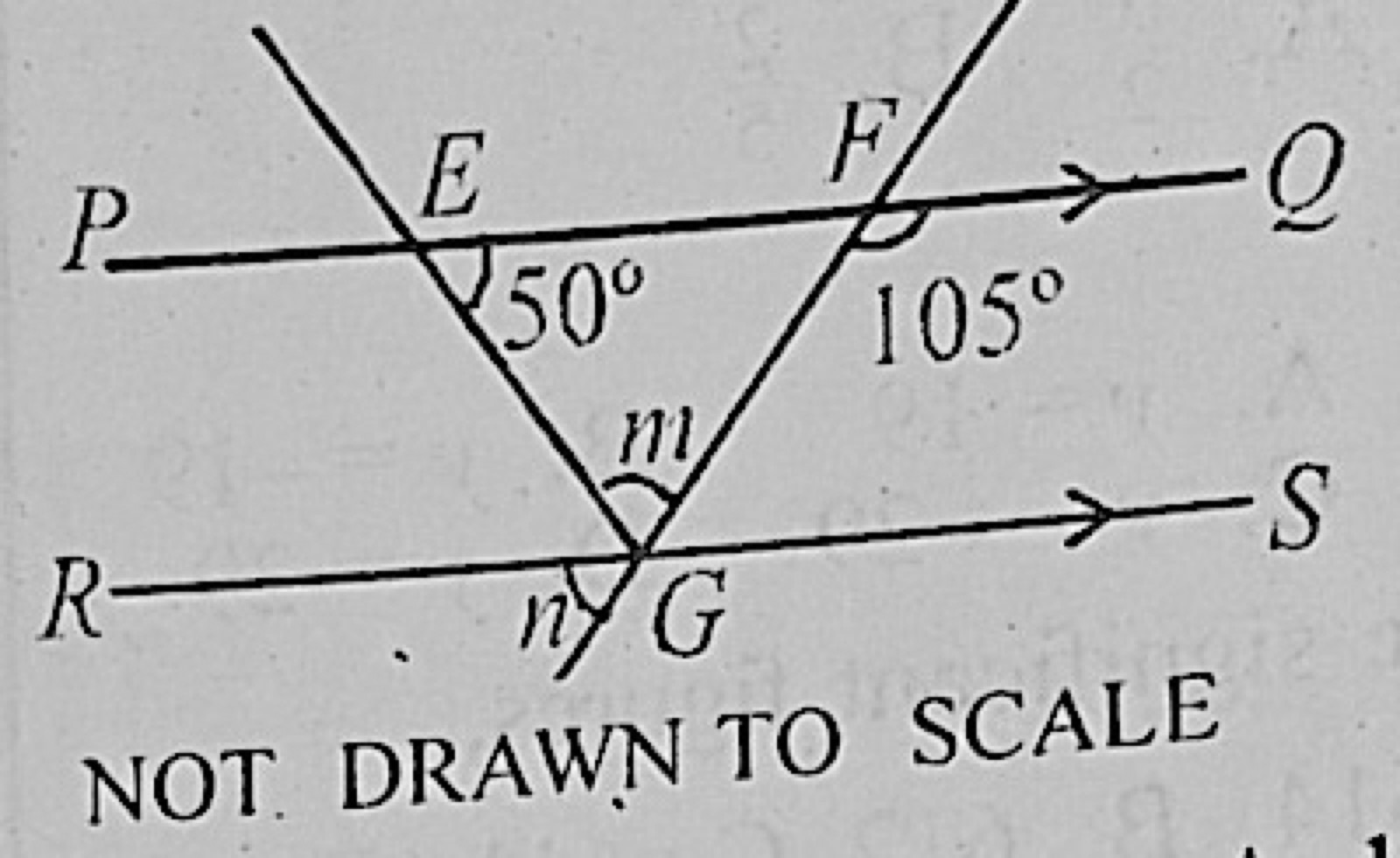
In the diagram, PQ is parallel to RS, ∠QFG = 105° and ∠FEG = 50°. Find the value of m.

Diagram for this question
  1. A.130°
  2. B.105°
  3. C.75°
  4. D.55°
Show the answer and explanation

Answer: D (55°)

Explanation

∠QFG is an exterior angle of triangle EFG, so it equals the two opposite interior angles: 50° + m = 105°, giving m = 55°.

Open this question

Question 45

Angles and Polygons

In the diagram, PQ is parallel to RS, ∠QFG = 105° and ∠FEG = 50°. Find the value of n.

Diagram for this question
  1. A.40°
  2. B.55°
  3. C.75°
  4. D.130°
Show the answer and explanation

Answer: C (75°)

Explanation

∠FGS and ∠QFG are co-interior angles between parallel lines, so ∠FGS = 180° − 105° = 75°. Angle n is vertically opposite ∠FGS, so n = 75°.

Open this question

Question 46

Probability

A box contains 5 red, 6 green and 7 yellow pencils of the same size. What is the probability of picking a green pencil at random?

  1. A.1/6
  2. B.1/4
  3. C.1/3
  4. D.1/2
Show the answer and explanation

Answer: C (1/3)

Explanation

There are 18 pencils and 6 are green: 6/18 = 1/3.

Open this question

Question 47

Data Presentation

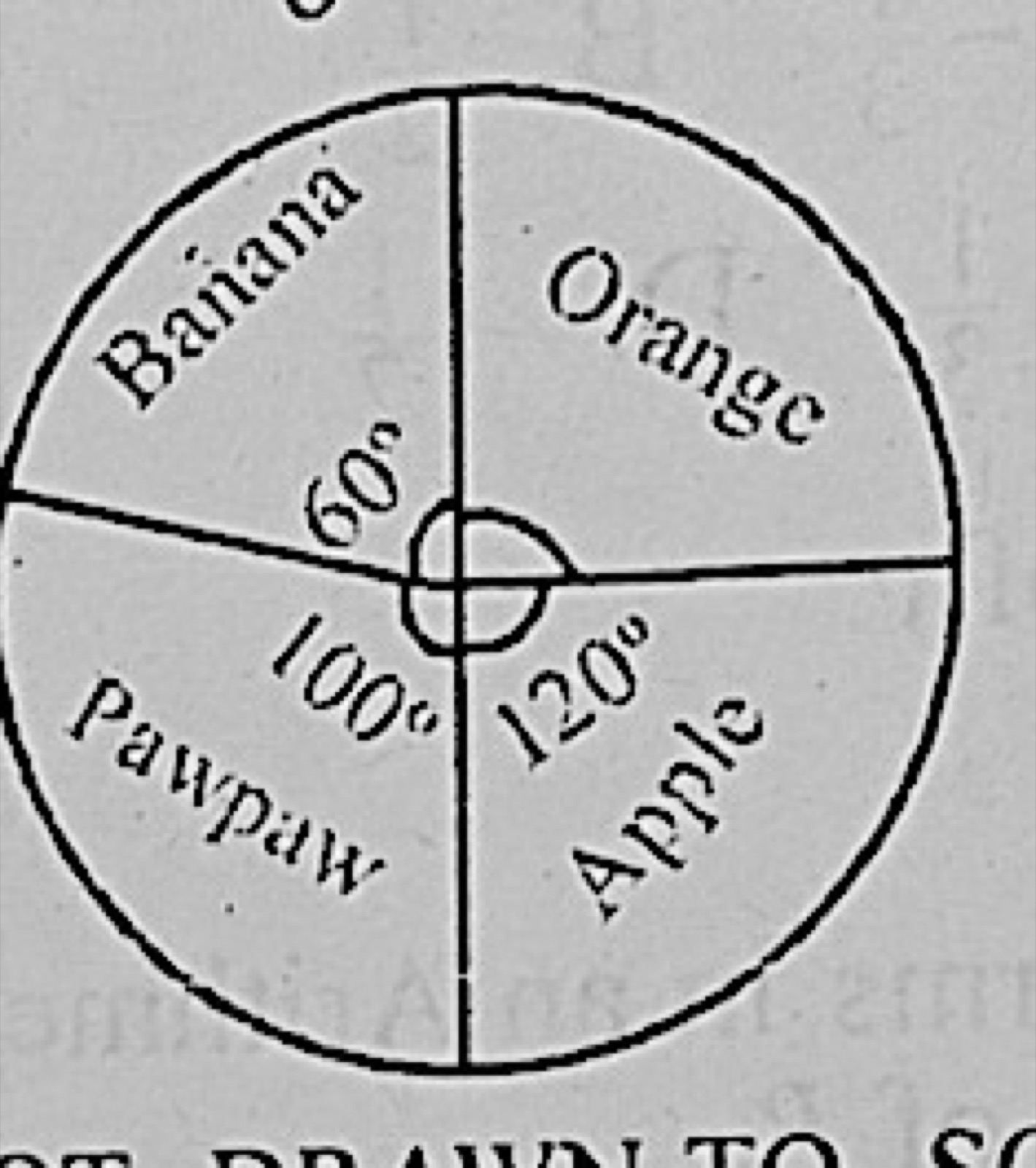
The pie chart represents fruits on display in a grocery shop. If there are 60 oranges on display, how many apples are there?

Diagram for this question
  1. A.90
  2. B.80
  3. C.70
  4. D.40
Show the answer and explanation

Answer: A (90)

Explanation

The orange sector is 360° − (60° + 100° + 120°) = 80°. So 80° stands for 60 fruits and the apple sector of 120° stands for 60 × 120/80 = 90 apples.

Open this question

Question 48

Measures of Central Tendency

The following are scores obtained by some students in a test: 8, 18, 10, 14, 18, 11, 13, 14, 13, 17, 15, 8, 16, 13. Find the mode of the distribution.

  1. A.18
  2. B.14
  3. C.13
  4. D.8
Show the answer and explanation

Answer: C (13)

Explanation

13 appears three times, more than any other score, so the mode is 13.

Open this question

Question 49

Measures of Central Tendency

The following are scores obtained by some students in a test: 8, 18, 10, 14, 18, 11, 13, 14, 13, 17, 15, 8, 16, 13. Find the median score.

  1. A.14.5
  2. B.14.0
  3. C.13.5
  4. D.13.0
Show the answer and explanation

Answer: C (13.5)

Explanation

In order the 14 scores are 8, 8, 10, 11, 13, 13, 13, 14, 14, 15, 16, 17, 18, 18. The middle two are 13 and 14, so the median is 13.5.

Open this question

Question 50

Measures of Central Tendency

The following are scores obtained by some students in a test: 8, 18, 10, 14, 18, 11, 13, 14, 13, 17, 15, 8, 16, 13. How many students scored above the mean score?

  1. A.10
  2. B.9
  3. C.8
  4. D.7
Show the answer and explanation

Answer: D (7)

Explanation

The total is 188, so the mean is 188/14 ≈ 13.4. The scores above it are 14, 14, 15, 16, 17, 18, 18: 7 students.

Open this question

Theory question 101

Number Bases

(a) Given that 110x = 40five, find the value of x.
(b) Simplify 15/√75 + √108 + √432, leaving the answer in the form a√b, where a and b are positive integers.

Show the model answer
Model answer

(a) 110x = x2 + x and 40five = 20
x2 + x − 20 = 0, (x + 5)(x − 4) = 0
A base must be positive, so x = 4
(b) 15/√75 = 15/(5√3) = √3; √108 = 6√3; √432 = 12√3
Sum = 19√3

Explanation

Change both numbers to base ten; reject the negative root because a base is a positive whole number.

Open this question

Theory question 102

Coordinate Geometry

(a) Find the equation of the line which passes through the points A(−2, 7) and B(2, −3).
(b) Given that (5b − a)/(8b + 3a) = 1/5, find, correct to two decimal places, the value of a/b.

Show the model answer
Model answer

(a) Gradient = (−3 − 7)/(2 − (−2)) = −10/4 = −5/2
y − 7 = −5/2(x + 2) → 2y − 14 = −5x − 10
5x + 2y − 4 = 0
(b) Cross-multiply: 5(5b − a) = 8b + 3a → 25b − 5a = 8b + 3a
17b = 8a, so a/b = 17/8 = 2.125 ≈ 2.13

Explanation

For (b), collect the a terms on one side and the b terms on the other, then divide.

Open this question

Theory question 103

Ratio, Percentages and Rates

(a) Ali, Musah and Yusif shared ₦420,000.00 in the ratio 3 : 5 : 8 respectively. Find the sum of Ali and Yusif's shares.
(b) Solve: 2(1/8)x = 32x − 1.

Show the model answer
Model answer

(a) Total parts = 16; Ali = 3/16 × 420,000 = ₦78,750; Yusif = 8/16 × 420,000 = ₦210,000
Sum = ₦288,750 (or 11/16 × 420,000)
(b) Write in base 2: 21 × 2−3x = 25(x − 1)
1 − 3x = 5x − 5 → 8x = 6
x = 3/4

Explanation

Write every number as a power of 2 before equating indices.

Open this question

Theory question 104

Mensuration of Plane Shapes

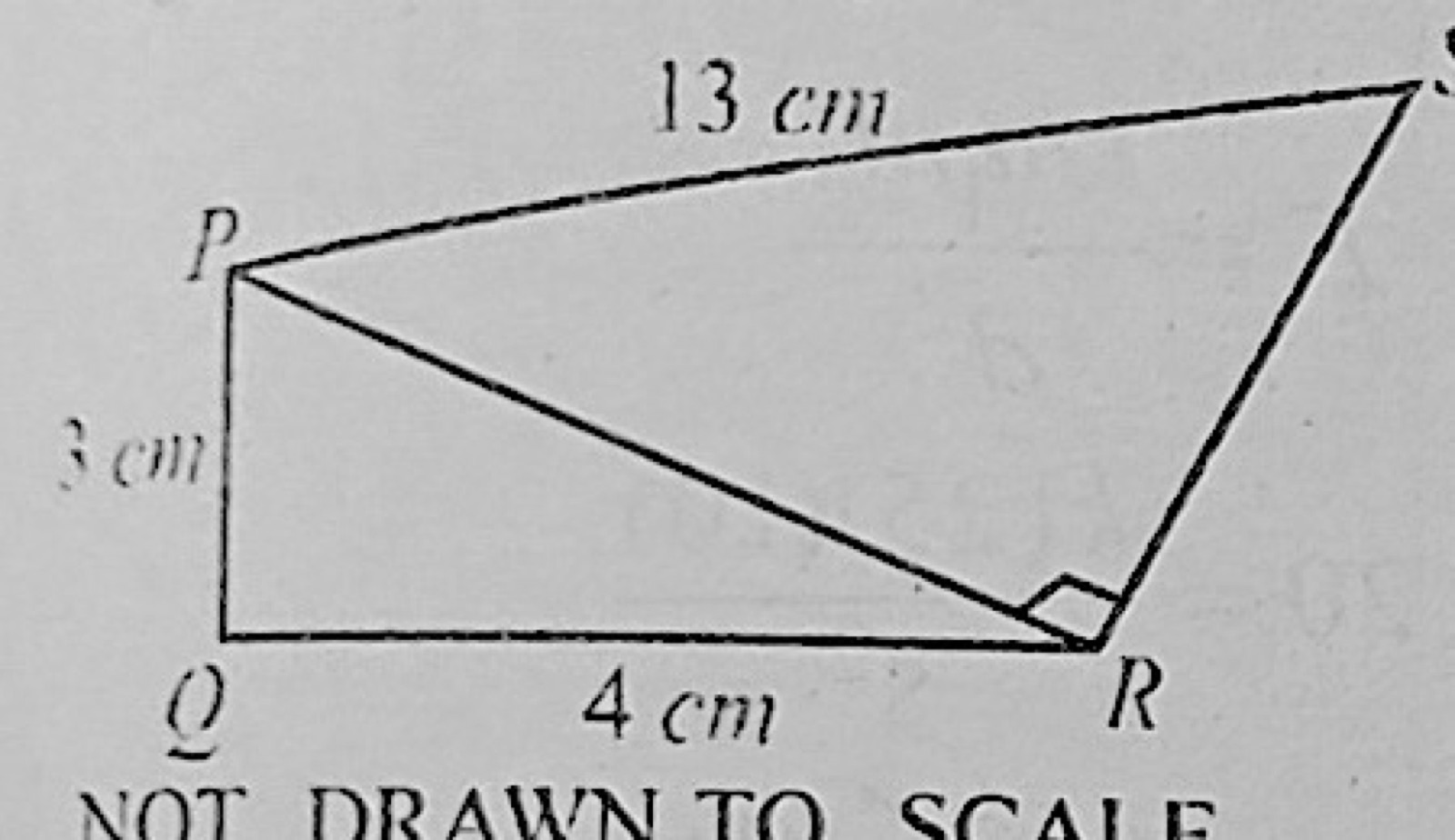
In the diagram, PQRS is a quadrilateral, ∠PQR = ∠PRS = 90°, |PQ| = 3 cm, |QR| = 4 cm and |PS| = 13 cm. Find the area of the quadrilateral.

Diagram for this question
Show the model answer
Model answer

In ΔPQR: |PR| = √(32 + 42) = 5 cm
In ΔPRS: |RS| = √(132 − 52) = √144 = 12 cm
Area = ½ × 3 × 4 + ½ × 5 × 12 = 6 + 30
Area = 36 cm2

Explanation

Split the quadrilateral along PR into two right-angled triangles.

Open this question

Theory question 105

Probability

Three red balls, five green balls and a number of blue balls are put together in a sack. One ball is picked at random from the sack. If the probability of picking a red ball is 1/6, find: (a) the number of blue balls in the sack; (b) the probability of picking a green ball.

Show the model answer
Model answer

(a) Let the number of blue balls be n; total = 8 + n
3/(8 + n) = 1/6 → 8 + n = 18 → n = 10
(b) Total = 18 balls, 5 green
P(green) = 5/18

Explanation

Use P(red) = red balls ÷ total balls to find the total first.

Open this question

Theory question 106

Variation

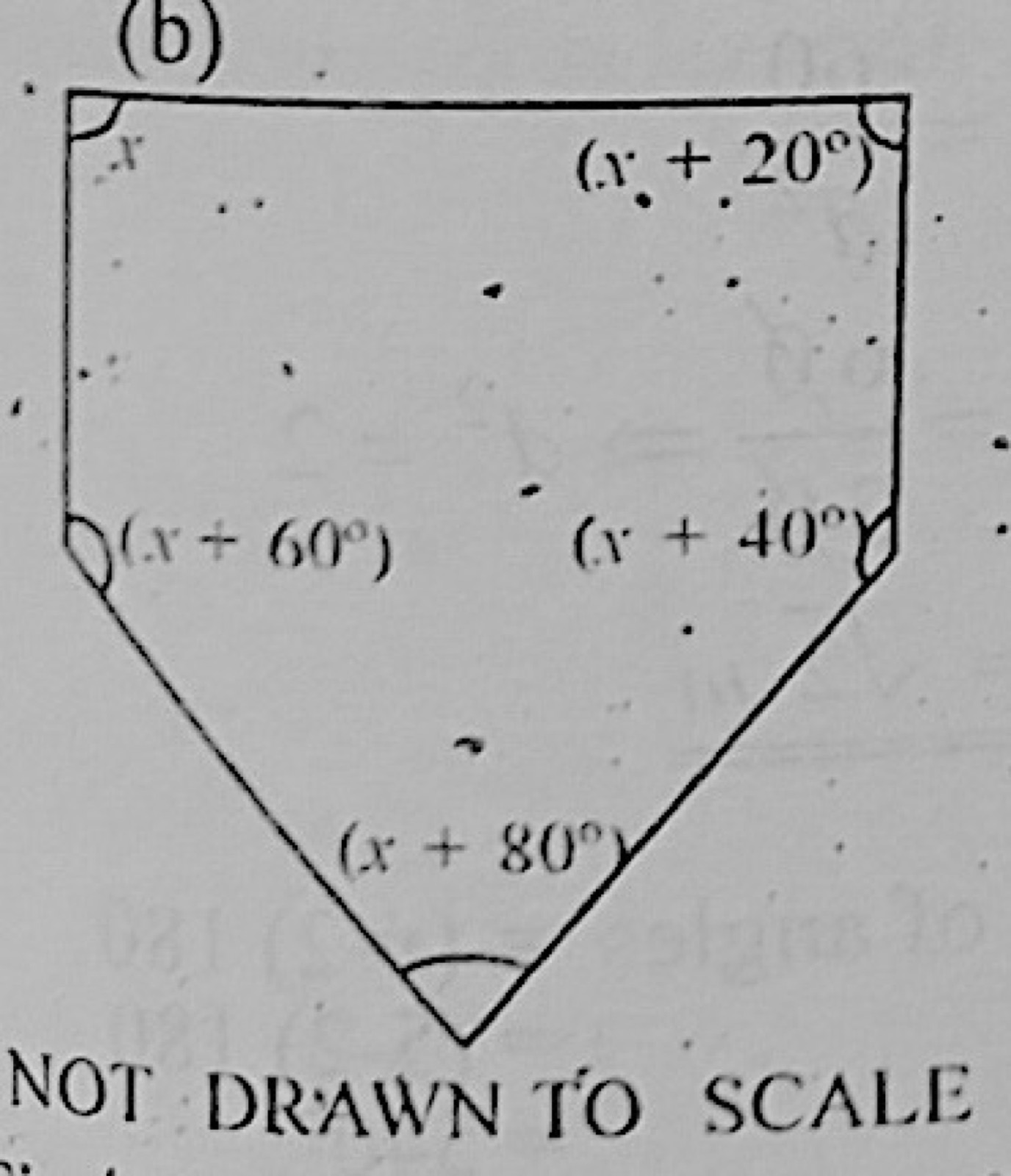
(a) The force of attraction, F, between two bodies varies directly as the product of their masses, m1 and m2 and inversely as the square of the distance, d, between them. Given that F = 20 N, when m1 = 25 kg, m2 = 10 kg and d = 5 m, find: (i) an expression for F in terms of m1, m2 and d; (ii) the distance, d when F = 30 N, m1 = 7.5 kg and m2 = 4 kg.
(b) Find the value of x in the diagram.

Diagram for this question
Show the model answer
Model answer

(a)(i) F = km1m2/d2; 20 = k(25)(10)/25 → k = 2
F = 2m1m2/d2
(ii) 30 = 2(7.5)(4)/d2 = 60/d2 → d2 = 2
d = √2 m ≈ 1.41 m
(b) The figure is a pentagon: angle sum = (5 − 2) × 180° = 540°
x + (x + 20) + (x + 40) + (x + 60) + (x + 80) = 540 → 5x + 200 = 540
x = 68°

Explanation

Find the constant k first, then use the formula with the new values.

Open this question

Theory question 107

Data Presentation

The data show the marks obtained by students in a Biology test.
52 56 25 56 68 73 66 64 56 48
20 39 9 50 46 54 54 40 50 96
36 44 18 97 65 21 60 44 54 32
92 49 37 94 72 88 89 35 59 34
15 88 53 16 84 52 72 46 60 42
(a) Construct a frequency distribution table using the class interval 0 − 9, 10 − 19, 20 − 29, …
(b) Draw a cumulative frequency curve for the distribution.
(c) Use the graph to estimate the: (i) median; (ii) percentage of students who scored at least 66 marks, correct to the nearest whole number.

Show the model answer
Model answer

(a) Frequencies: 0–9: 1; 10–19: 3; 20–29: 3; 30–39: 6; 40–49: 8; 50–59: 12; 60–69: 6; 70–79: 3; 80–89: 4; 90–99: 4 (total 50)
Cumulative: 1, 4, 7, 13, 21, 33, 39, 42, 46, 50
(b) Plot cumulative frequency against upper class boundaries 9.5, 19.5, …, 99.5 and join with a smooth S-shaped curve
(c)(i) Median at the 25th student: about 53 (calculation gives 49.5 + 4/12 × 10 ≈ 52.8)
(ii) About 37 students scored below 65.5, so about 13 scored at least 66
Percentage ≈ 13/50 × 100 ≈ 27% (accept 26–28% from the graph)

Explanation

Plot at the upper class boundaries, not the class limits.

Open this question

Theory question 108

Inequalities

(a) Solve the inequality (1/3)x − (1/4)(x + 2) ≥ 3x − 1⅓.
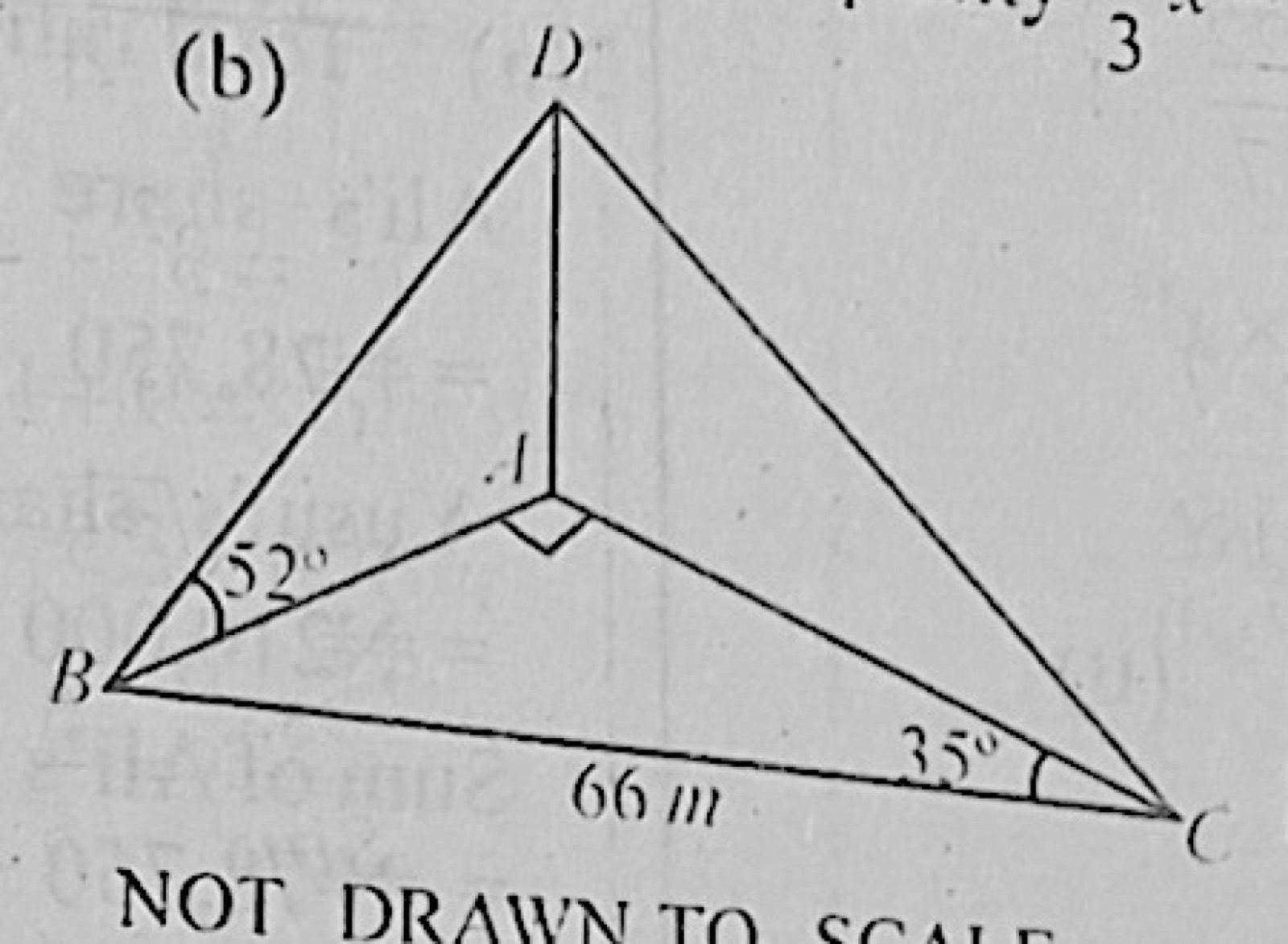
(b) In the diagram, ABC is right-angled triangle on a horizontal ground. |AD| is a vertical tower. ∠BAC = 90°, ∠ACB = 35°, ∠ABD = 52° and |BC| = 66 m. Find, correct to two decimal places: (i) the height of the tower; (ii) the angle of elevation of the top of the tower from C.

Diagram for this question
Show the model answer
Model answer

(a) Multiply by 12: 4x − 3(x + 2) ≥ 36x − 16
x − 6 ≥ 36x − 16 → −35x ≥ −10
x ≤ 2/7 (sign flips when dividing by a negative)
(b)(i) |AB| = 66 sin 35° = 37.86 m; |AD| = |AB| tan 52° = 48.45 m
(ii) |AC| = 66 cos 35° = 54.06 m
tan θ = 48.45/54.06 = 0.8962 → θ = 41.87°

Explanation

Find AB and AC in the flat triangle first, then use the vertical triangles.

Open this question

Theory question 109

Trigonometry

(a) Copy and complete the table of values for y = 2 cos x + 3 sin x for 0° ≤ x ≤ 360°.
x: 0°, 60°, 120°, 180°, 240°, 300°, 360°
y: 2.0, __, __, __, −3.6, __, __
(b) Using a scale of 2 cm to 60° on the x-axis and 2 cm to 1 unit on the y-axis, draw the graph of y = 2 cos x + 3 sin x for 0° ≤ x ≤ 360°.
(c) Using the graph: (i) solve 2 cos x + 3 sin x = −1; (ii) find, correct to one decimal place, the value of y when x = 342°.

Show the model answer
Model answer

(a) y = 2.0, 3.6, 1.6, −2.0, −3.6, −1.6, 2.0
(b) Plot the points with the given scales and join with a smooth curve
(c)(i) Read where the curve meets y = −1: x ≈ 162° and x ≈ 310°
(ii) At x = 342°, y ≈ 1.0

Explanation

At 180°, cos x = −1 and sin x = 0, so y = −2.0.

Open this question

Theory question 110

Commercial Arithmetic

A woman bought 130 kg of tomatoes for ₦52,000.00. She sold half of the tomatoes at a profit of 30%. The rest of the tomatoes began to go bad, she then reduced the selling price per kg by 12%. Calculate:
(a) the new selling price per kg;
(b) the percentage profit on the entire sales if she threw away 5 kg of bad tomatoes.

Show the model answer
Model answer

(a) Cost per kg = 52,000/130 = ₦400; first selling price = 400 × 1.3 = ₦520 per kg
New price = 520 × 0.88 = ₦457.60 per kg
(b) First half: 65 × 520 = ₦33,800
Second half: 65 − 5 = 60 kg × 457.60 = ₦27,456
Total sales = ₦61,256; profit = ₦9,256
Percentage profit = 9,256/52,000 × 100 ≈ 17.8%

Explanation

The 12% cut is on the selling price (₦520), not on the cost price.

Open this question

Theory question 111

Progressions

(a) The third and sixth terms of a Geometric Progression (G.P.) are 1/4 and 1/32 respectively. Find: (i) the first term and the common ratio; (ii) the seventh term.
(b) Given that 2 and −3 are the roots of the equation ax2 + bx + c = 0, find the values of a, b and c.

Show the model answer
Model answer

(a)(i) ar2 = 1/4, ar5 = 1/32; divide: r3 = 1/8 → r = 1/2
a(1/4) = 1/4 → a = 1
(ii) T7 = ar6 = (1/2)6 = 1/64
(b) (x − 2)(x + 3) = 0 → x2 + x − 6 = 0
a = 1, b = 1, c = −6

Explanation

Dividing the two term equations removes a.

Open this question

Theory question 112

Trigonometry

(a) Given that sin y = 8/17, find the value of tan y/(1 + 2 tan y).
(b) An amount of ₦300,000.00 was shared among Otobo, Ada and Adeola. Otobo received ₦60,000.00, Ada received 5/12 of the remainder, while the rest went to Adeola. In what ratio was the money shared?

Show the model answer
Model answer

(a) Adjacent side = √(172 − 82) = 15, so tan y = 8/15
1 + 2 tan y = 1 + 16/15 = 31/15
tan y/(1 + 2 tan y) = (8/15) ÷ (31/15) = 8/31
(b) Remainder = ₦240,000; Ada = 5/12 × 240,000 = ₦100,000; Adeola = ₦140,000
Ratio 60,000 : 100,000 : 140,000 = 3 : 5 : 7

Explanation

Draw a right-angled triangle with opposite 8 and hypotenuse 17.

Open this question

Theory question 113

Circle Theorems

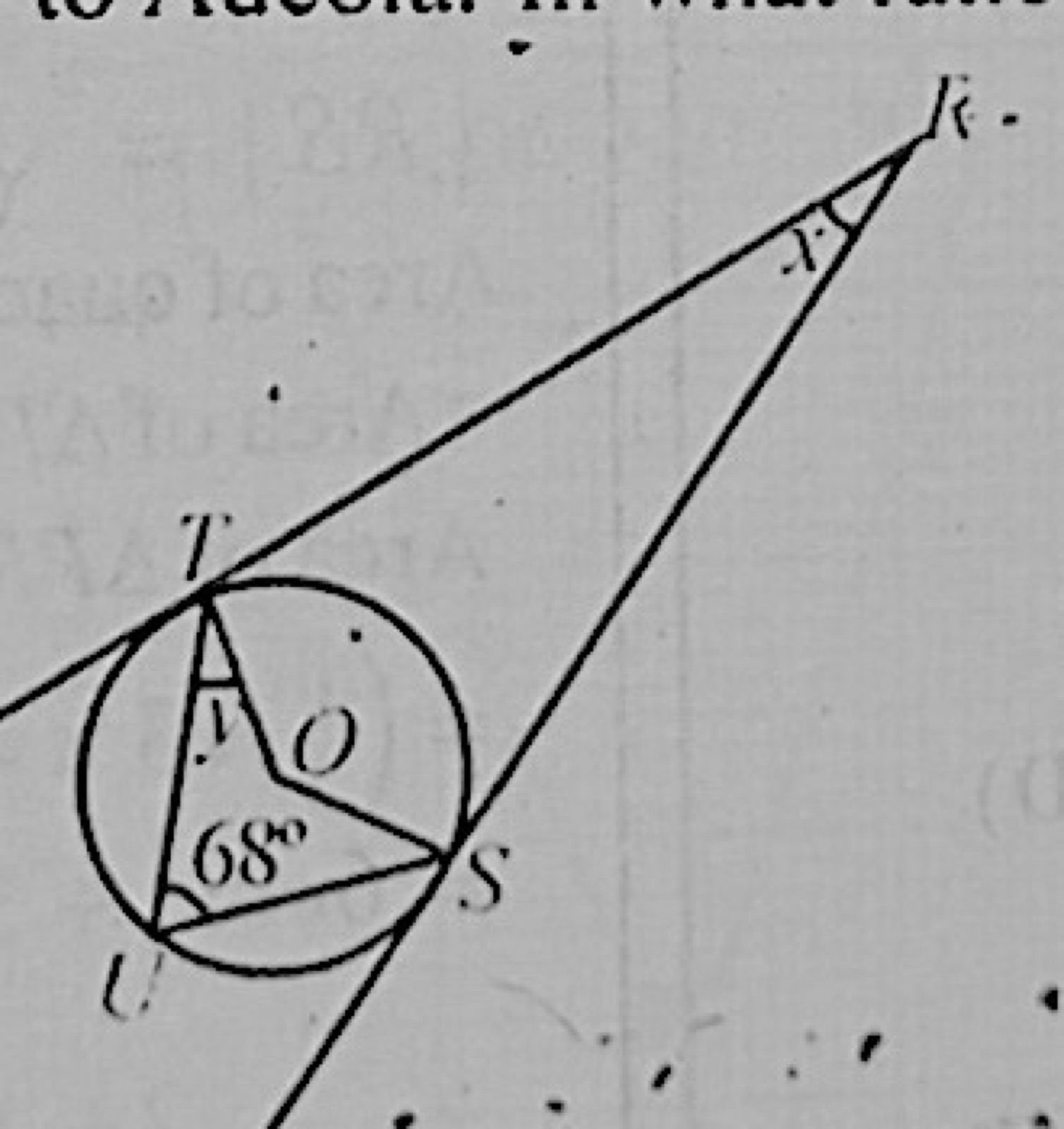
(a) In the diagram, RS and RT are tangent to the circle with centre O. ∠TUS = 68°, ∠SRT = x, and ∠UTO = y. Find the value of x.
(b) Two tanks A and B are filled to capacity with diesel. Tank A holds 600 litres of diesel more than tank B. If 100 litres of diesel was pumped out of each tank, tank A would then contain 3 times as much diesel as tank B. Find the capacity of each tank.

Diagram for this question
Show the model answer
Model answer

(a) ∠TOS = 2 × 68° = 136° (angle at centre)
∠OTR = ∠OSR = 90° (radius ⊥ tangent)
x = 360° − 90° − 90° − 136° = 44°
(b) Let B = x litres, A = x + 600
x + 600 − 100 = 3(x − 100) → x + 500 = 3x − 300 → x = 400
Tank B = 400 litres, Tank A = 1,000 litres

Explanation

In (a), the quadrilateral OTRS has two right angles where the tangents touch the circle.
Open this question