Question 1
SurdsSimplify: √108 + √125 − √75
- A.√3 + 5√5
- B.6√3 − 5√5
- C.6√3 + √2
- D.6√3 − √2
Show the answer and explanation
Answer: A (√3 + 5√5)
Explanation
√108 = 6√3, √125 = 5√5 and √75 = 5√3, so the sum is 6√3 + 5√5 − 5√3 = √3 + 5√5.
58 questions. Try each one, then open the answer to check yourself and read the explanation.
Simplify: √108 + √125 − √75
Answer: A (√3 + 5√5)
√108 = 6√3, √125 = 5√5 and √75 = 5√3, so the sum is 6√3 + 5√5 − 5√3 = √3 + 5√5.
Evaluate: (64½ + 125⅓)2
Answer: C (169)
64½ = 8 and 125⅓ = 5, so (8 + 5)² = 169.
Given that y varies inversely as the square of x. If x = 3 when y = 100, find the equation connecting x and y.
Answer: B (yx2 = 900)
y = k/x², so k = yx² = 100 × 9 = 900 and the equation is yx² = 900.
Find the value of x for which 32four = 22x.
Answer: C (six)
32four = 12 + 2 = 14 and 22x = 2x + 2, so 2x + 2 = 14 and x = 6.
Simplify: 2¼ × 3½ ÷ 4⅜.
Answer: D (1⅘)
9/4 × 7/2 × 8/35 = 504/280 = 9/5 = 1⅘.
There are 250 boys and 150 girls in a school. If 60% of the boys and 40% of the girls play football, what percentage of the school play football?
Answer: D (52.5%)
150 boys + 60 girls = 210 of 400 pupils, i.e. 52.5%.
If log10(6x − 4) − log102 = 1, solve for x.
Answer: C (4)
log10((6x − 4)/2) = 1, so (6x − 4)/2 = 10, 6x = 24 and x = 4.
If F = 9/5 C + 32, find C when F = 98.6
Answer: B (37)
98.6 − 32 = 66.6 = 9C/5, so C = 66.6 × 5/9 = 37.
If x : y : z = 2 : 3 : 4, evaluate (9x + 3y)/(6z − 2y).
Answer: A (1½)
Put x = 2, y = 3, z = 4: (18 + 9)/(24 − 6) = 27/18 = 1½.
A curve is such that when y = 0, x = −2 or x = 3. Find the equation of the curve.
Answer: D (y = x2 − x − 6)
y = (x + 2)(x − 3) = x² − x − 6.
The volume of a cylindrical tank, 10m high is 385m3. Find the diameter of the tank. [Take π = 22/7]
Answer: C (7m)
22/7 × r² × 10 = 385 gives r² = 12.25, r = 3.5 m, so the diameter is 7 m.
The surface area of a sphere is 792/7 cm2. Find, correct to the nearest whole number, its volume [Take π = 22/7]
Answer: A (113 cm3)
4 × 22/7 × r² = 792/7 gives r² = 9, r = 3. Volume = 4/3 × 22/7 × 27 ≈ 113 cm³.
A piece of thread of length 21.4 cm is used to form a sector of a circle of radius 4.2 cm on a piece of cloth. Calculate, correct to the nearest degree, the angle of the sector. [Take π = 22/7]
Answer: B (177°)
Arc = 21.4 − 8.4 = 13 cm. θ/360 × 2 × 22/7 × 4.2 = 13 gives θ = 13 × 360/26.4 ≈ 177°.
In the diargram, which of the following ratios is equal to |PN|/|PQ|?
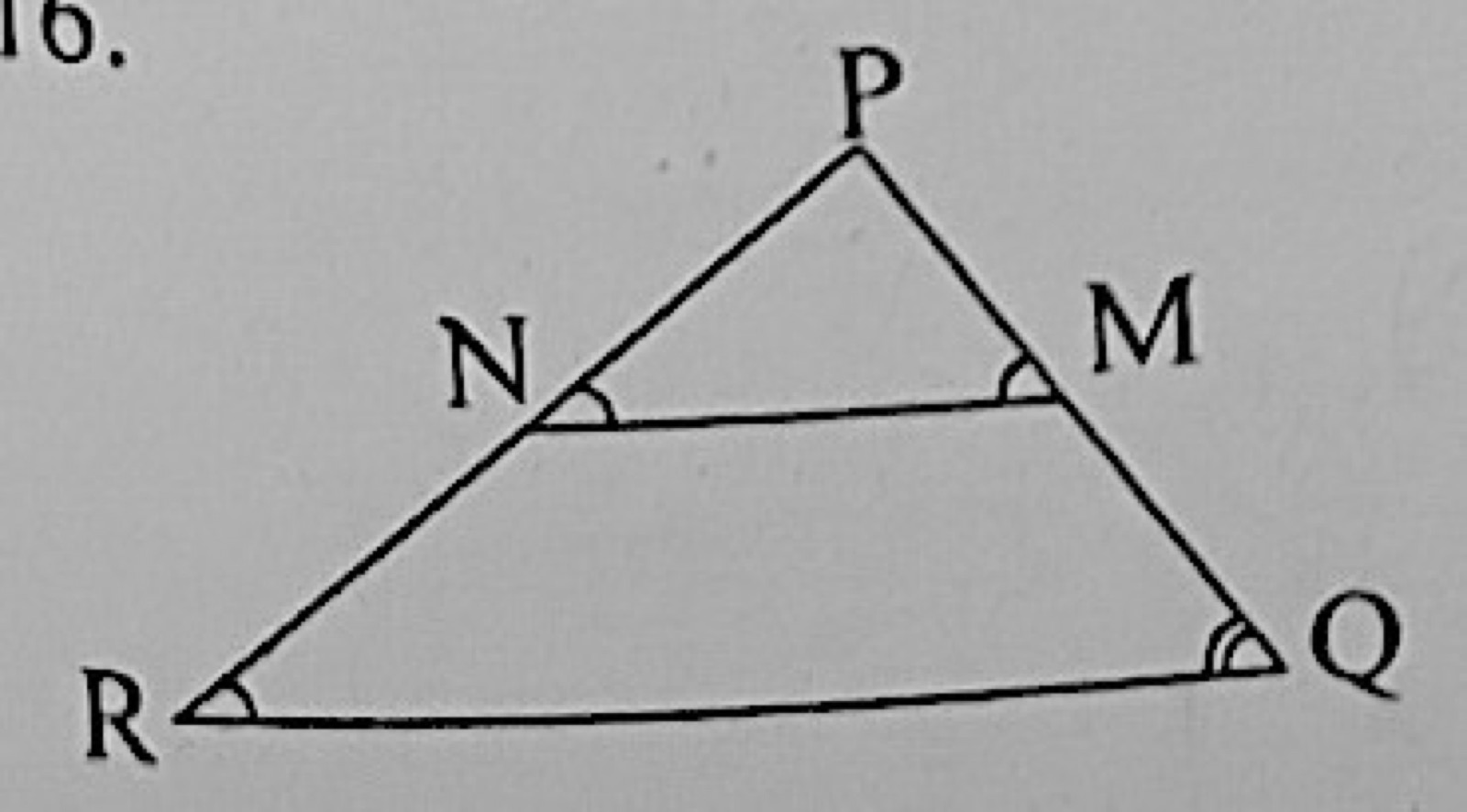
Answer: C (|PM|/|PR|)
The equal-angle marks show triangle PNM is similar to triangle PQR with N matching Q and M matching R, so |PN|/|PQ| = |PM|/|PR|.
In the diagram, PS and RS are targents to the circle centre O. ∠PSR = 70°, ∠POR = m and ∠PQR = n. Find (m + n).
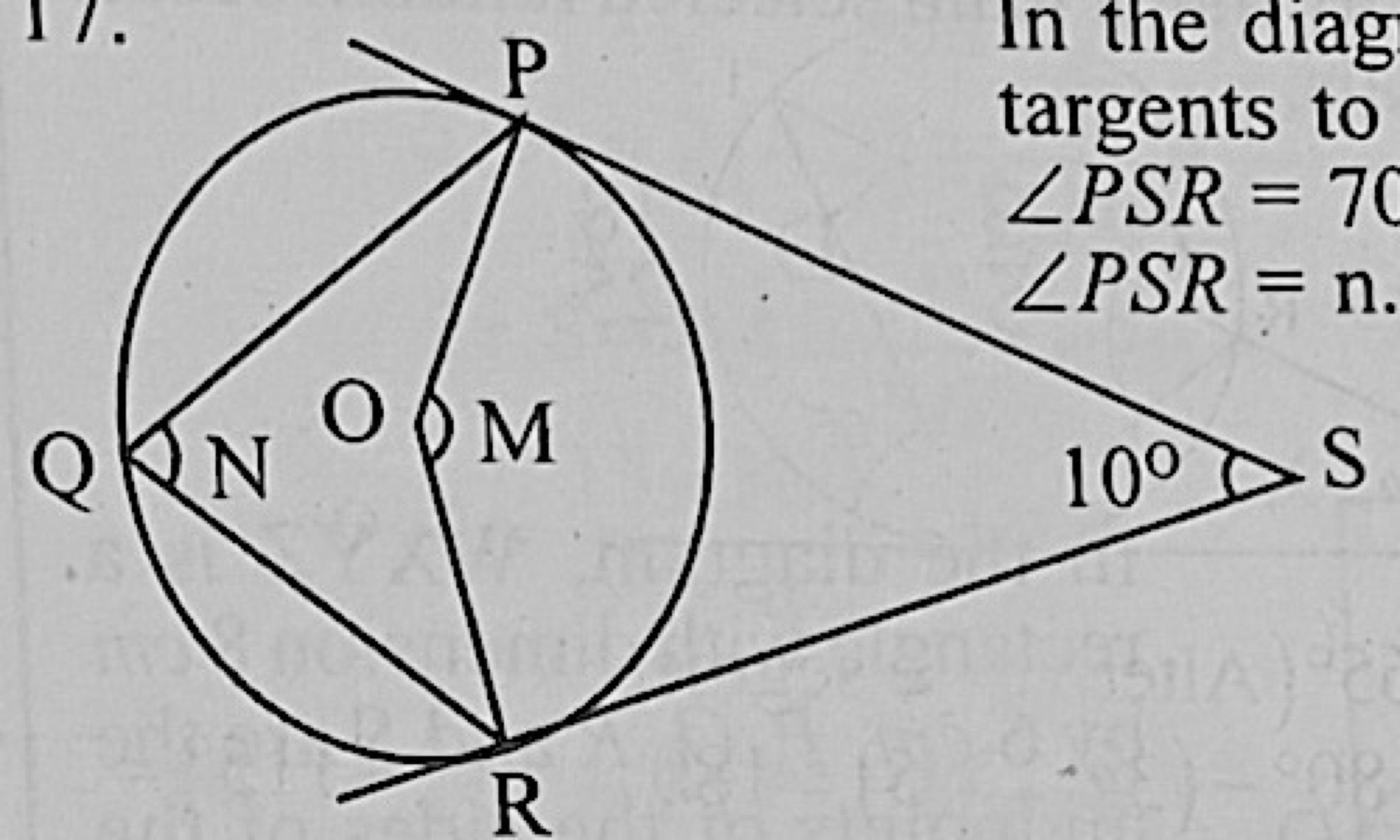
Answer: C (165°)
In quadrilateral OPSR the radii meet the tangents at 90°, so m = 360° − 180° − 70° = 110°. n is the angle at the circumference on the same arc, so n = 55°. m + n = 165°.
Find the value of t in the diagram.
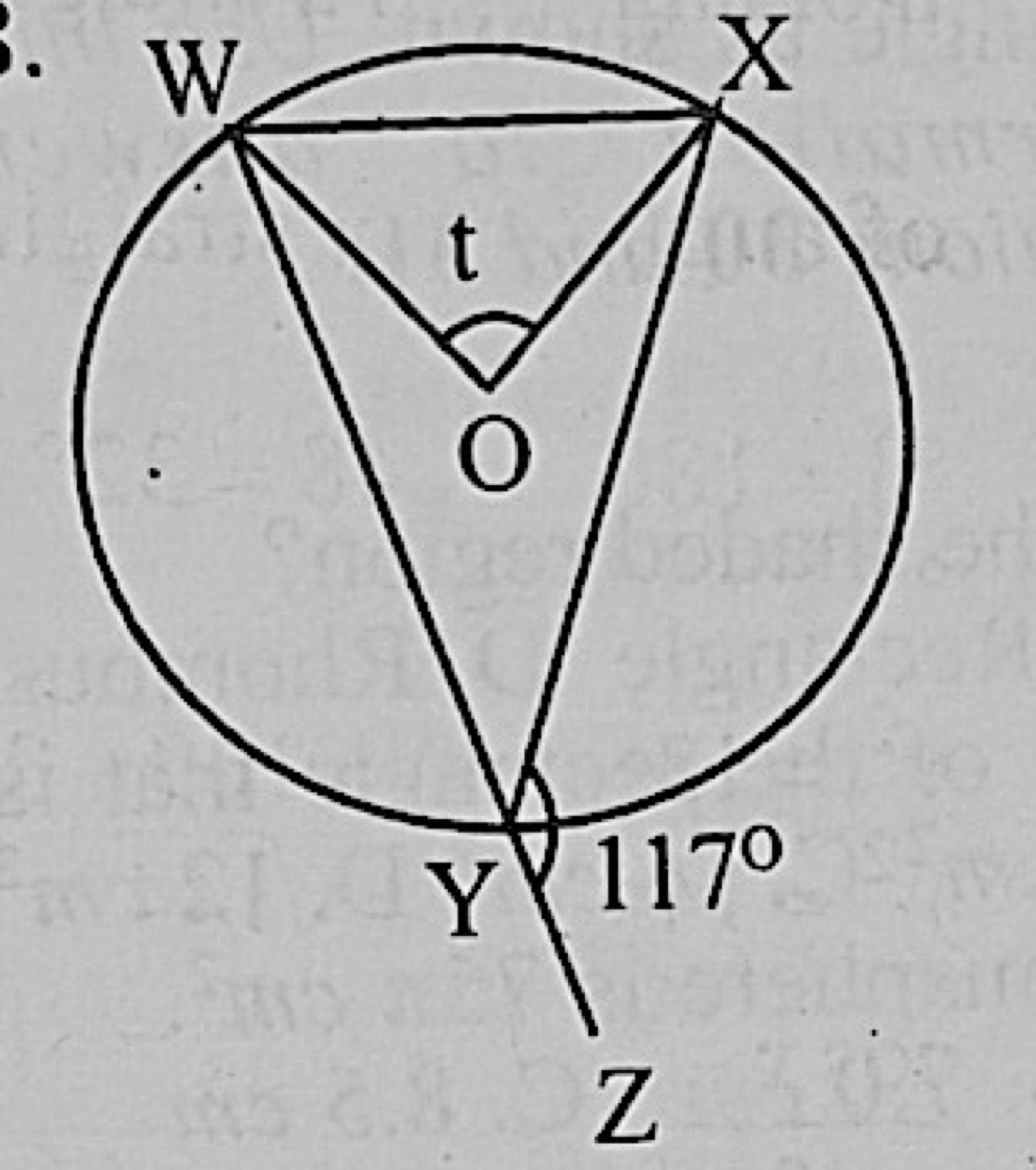
Answer: C (126°)
WYZ is a straight line, so ∠WYX = 180° − 117° = 63°. The angle at the centre is twice that: t = 126°.
In the diagram, PR is a targents to the circle at Q, QT//RS, ∠SQR = 35° and ∠RSQ = 50°. Find the value of ∠QST.
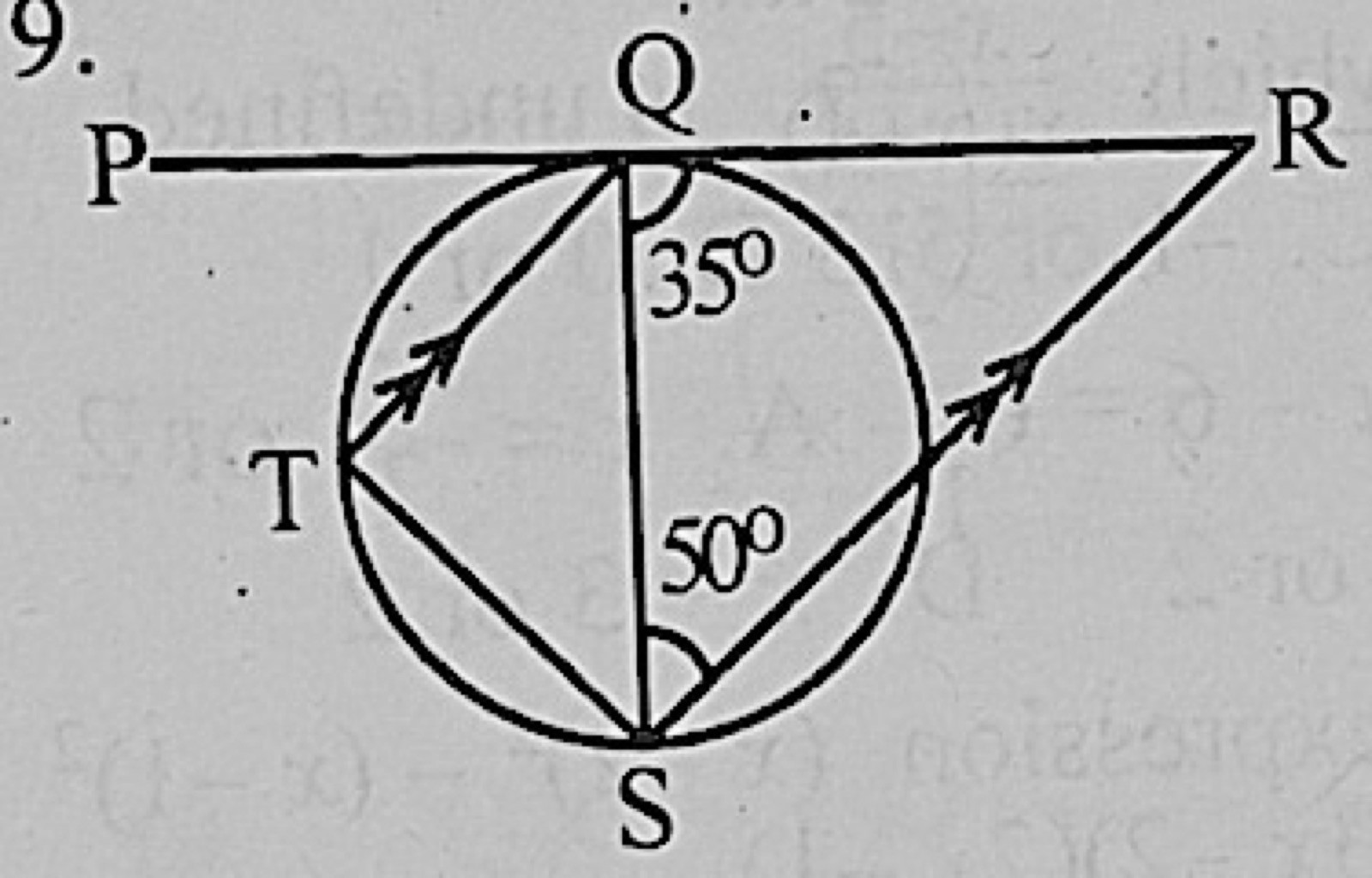
Answer: D (95°)
In triangle QRS, ∠QRS = 95°. QT//RS gives ∠TQR = 180° − 95° = 85°, so ∠TQP = 95°. By the alternate segment theorem ∠QST = ∠TQP = 95°.
If M and N are the points (−3, 8) and (5, −7) respectively, fnd MN.
Answer: D (17 units)
MN = √(8² + 15²) = √289 = 17 units.
The equation of the line through the points (4, 2) and (−8, −2) is 3y = px + q, where p and q are constants. Find the value of p.
Answer: A (1)
Gradient = (−2 − 2)/(−8 − 4) = 1/3. Writing y = x/3 + c as 3y = x + 3c gives p = 1.
The angle of elevation of the top of a tree from a point 27 m away and on the same horizontal ground as the foot of the tree is 30°. Find the height of the tree.
Answer: D (9√3 m)
Height = 27 tan 30° = 27/√3 = 9√3 m.
If tan x = 4/3, 0° < x < 90°, find the value of sin x − cos x.
Answer: B (⅕)
Sides 3, 4, 5: sin x = 4/5, cos x = 3/5, so sin x − cos x = 1/5.
Given that Y is 20 m on a bearing of 300° from X, how far south of Y is X?
Answer: A (10 m)
The line XY makes 60° with the north line (360° − 300°), so the north–south distance is 20 cos 60° = 10 m.
The mean of 1, 3, 5, 7 and x is 4. Find the value of x.
Answer: B (4)
1 + 3 + 5 + 7 + x = 20, so x = 4.
The table shows the distribution of goals scored by 25 teams in a football competition.
Number of goals: 1, 2, 3, 4, 5, 6, 7
Number of teams: 3, 1, 6, 6, 4, 2, 3
Calculate the probability that a team selected at random scored at most 3 goals.
Answer: D (⅖)
3 + 1 + 6 = 10 teams scored 3 or fewer: 10/25 = 2/5.
The table shows the distribution of goals scored by 25 teams in a football competition.
Number of goals: 1, 2, 3, 4, 5, 6, 7
Number of teams: 3, 1, 6, 6, 4, 2, 3
Find the probability that a team selected random scored either 4 or 7 goals.
Answer: A (9/25)
6 teams scored 4 and 3 scored 7: (6 + 3)/25 = 9/25.
In the diagram, WXYZ is a rectangle with dimension 8 cm by 6 cm. P, Q, R and S are the midpoints of the sides of the rectangle as shown. What type of quadrilateral is the shaded region?
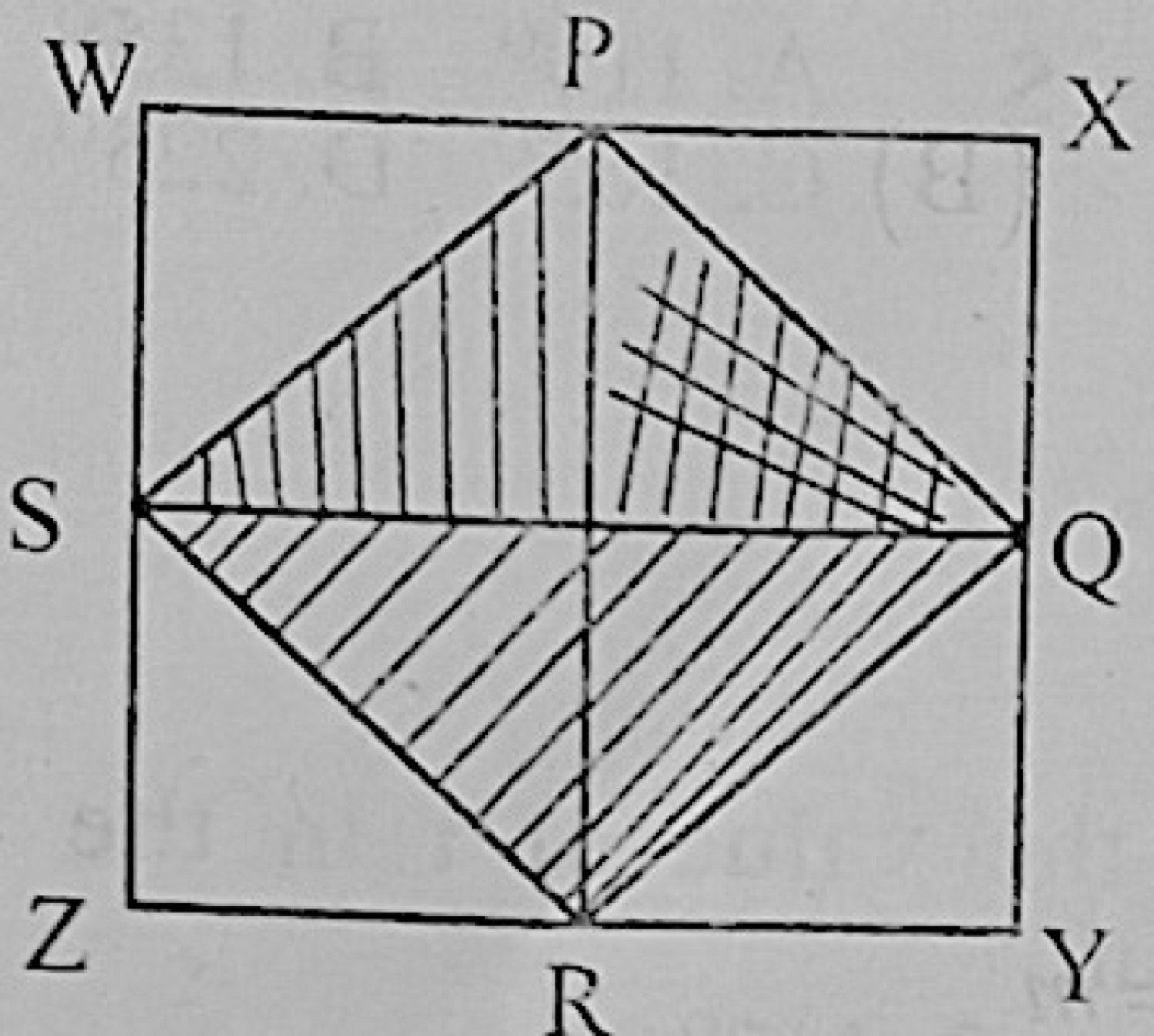
Answer: D (Rhombus)
Joining the midpoints of a rectangle gives four equal sides (each 5 cm) but no right angles: a rhombus.
In the diagram, WXYZ is a rectangle with dimension 8 cm by 6 cm. P, Q, R and S are the midpoints of the sides of the rectangle as shown. Calculate the area of the part of the rectangle that is not shaded.
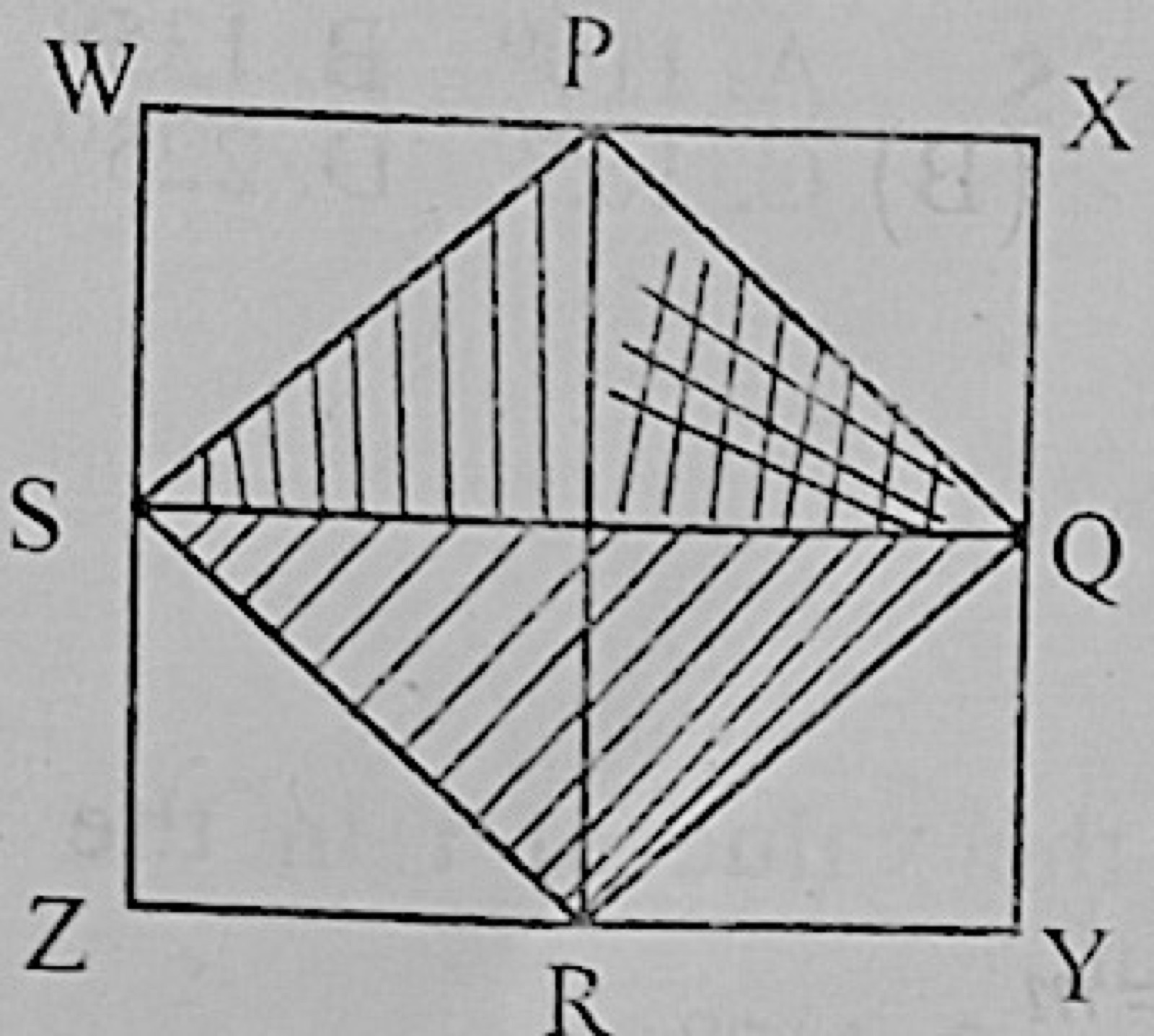
Answer: B (24 cm2)
The four corner triangles each have area ½ × 4 × 3 = 6 cm², so the unshaded part is 24 cm² (half of 48).
The total surface area of a hemisphere is 75π cm2. Find is radius.
Answer: A (5.0 cm)
3πr² = 75π, so r² = 25 and r = 5 cm.
Find the values of x for which (x − 5)/(x(x − 1)) is undefined.
Answer: D (0 or 1)
The fraction is undefined when x(x − 1) = 0, i.e. x = 0 or 1.
Solve the equation 2x2 − x − 6 = 0.
Answer: A (x = −3/2 or 2)
2x² − x − 6 = (2x + 3)(x − 2) = 0, so x = −3/2 or 2.
Find the nth term of the sequence 2 × 3, 4 × 6, 8 × 9, 16 × 12...
Answer: B (2n × 3n)
The first factors are 2, 4, 8, 16 = 2n and the second are 3, 6, 9, 12 = 3n.
If 3x ≡ 4 (mod 5) find the least value of x.
Answer: C (3)
Try values: 3 × 3 = 9 ≡ 4 (mod 5), so x = 3.
The solution of x − 2 ≥ 2x − 1 illustrated on the number line as
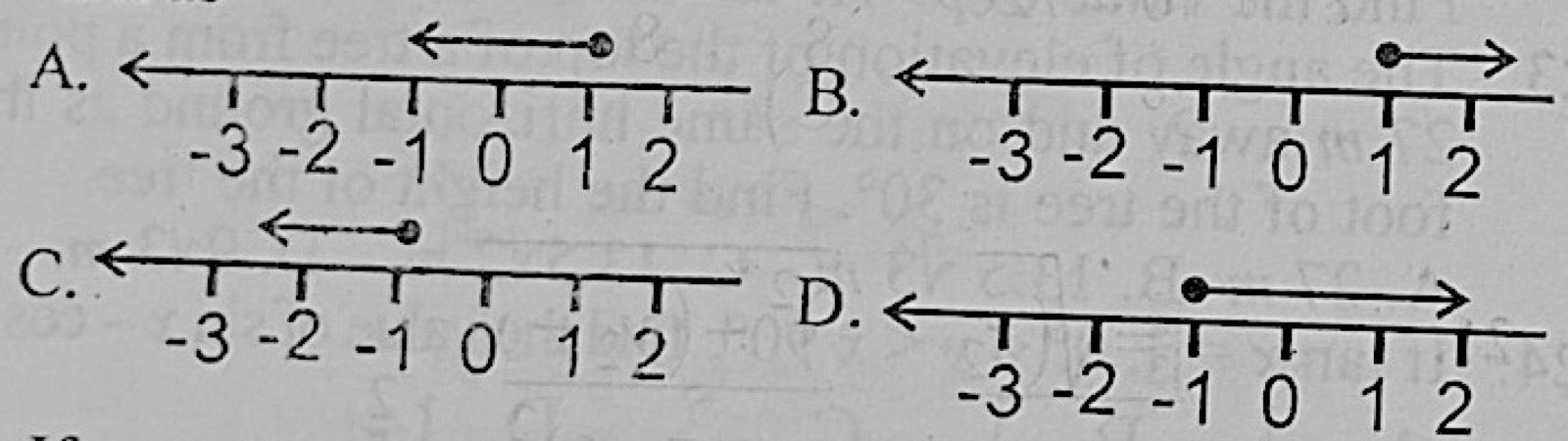
Answer: C (Number line −3 to 2: dot at −1, arrow to the left)
x − 2 ≥ 2x − 1 gives −1 ≥ x, i.e. x ≤ −1: a solid dot at −1 with the arrow to the left.
If p and q are two statements, under what condition would p ⇒ q be false?
Answer: B (If p is true and q is false)
An implication 'if p then q' is false only when p is true and q is false.
The diagram shows a trapezion inscribed in a semi-circle. If O is the mid-point of WZ and |WX| = |XY| = |YZ|, calculate the value of m.
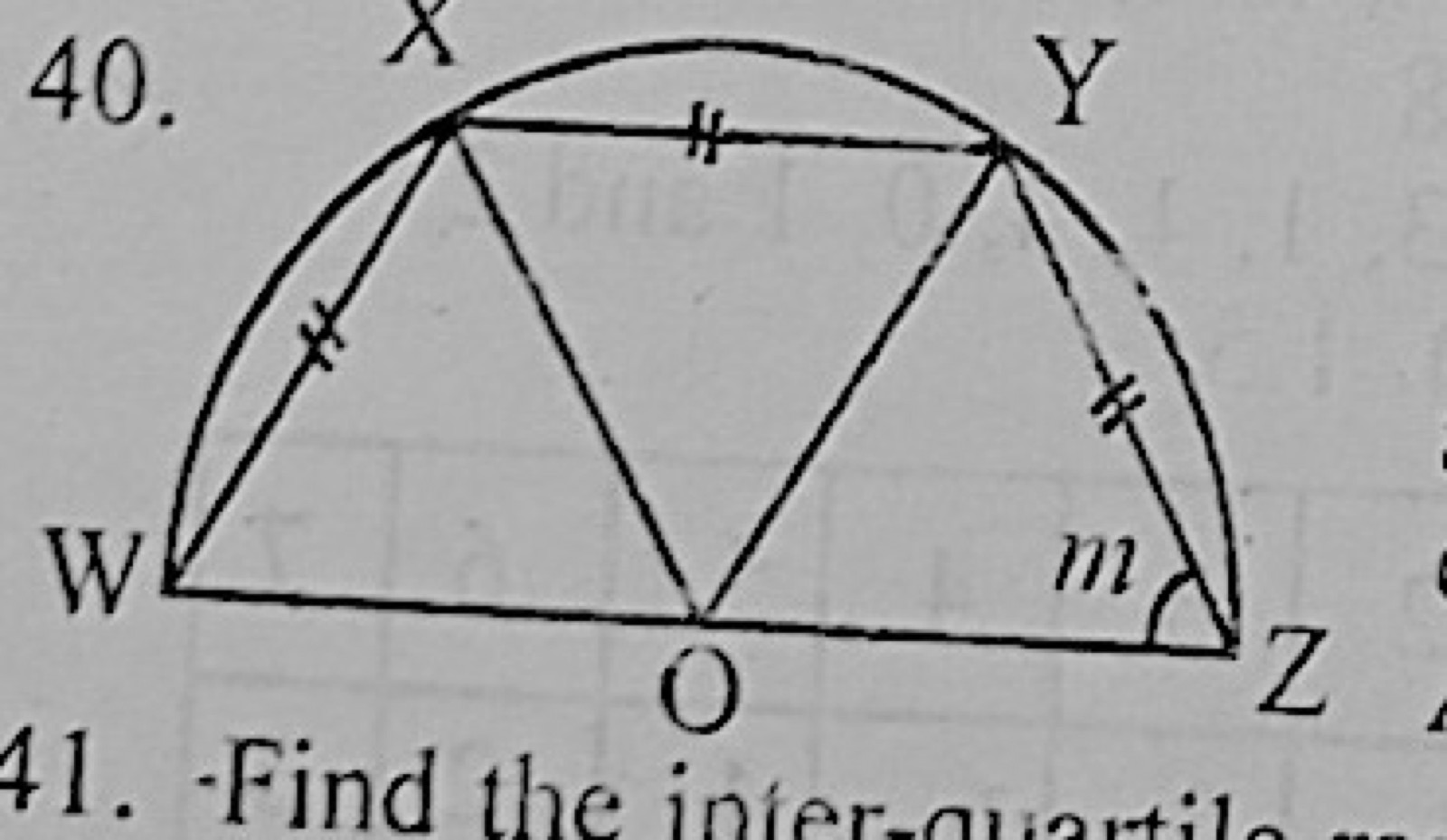
Answer: B (60°)
Equal chords cut equal angles at O, so each is 180° ÷ 3 = 60°. Triangle OYZ is isosceles (radii) with apex angle 60°, so it is equilateral and m = 60°.
Find the inter-quartile range of 1, 3, 4, 5, 8, 9, 10, 11, 12, 14, 16.
Answer: C (8)
With 11 values Q₁ is the 3rd value (4) and Q₃ is the 9th value (12); 12 − 4 = 8.
Donations during the launching of a church project were sent in sealed envelopes. The table shows the distribution of the amount of money in the envelope.
No. of envelopes: 4, 7, 20, 9, 4, 5, 3, 1, 2
Amount (N): 5000, 2000, 1000, 700, 500, 100, 50, 2, 10
How much was the total donation?
Answer: D (N62,972.00)
20 000 + 14 000 + 20 000 + 6 300 + 2 000 + 500 + 150 + 2 + 20 = N62,972.
In the diagram, PQ is a straight line. (m + n) = 110°, (n + r) = 130° and (m + r) = 120°. Find the ratio of m : n : r.
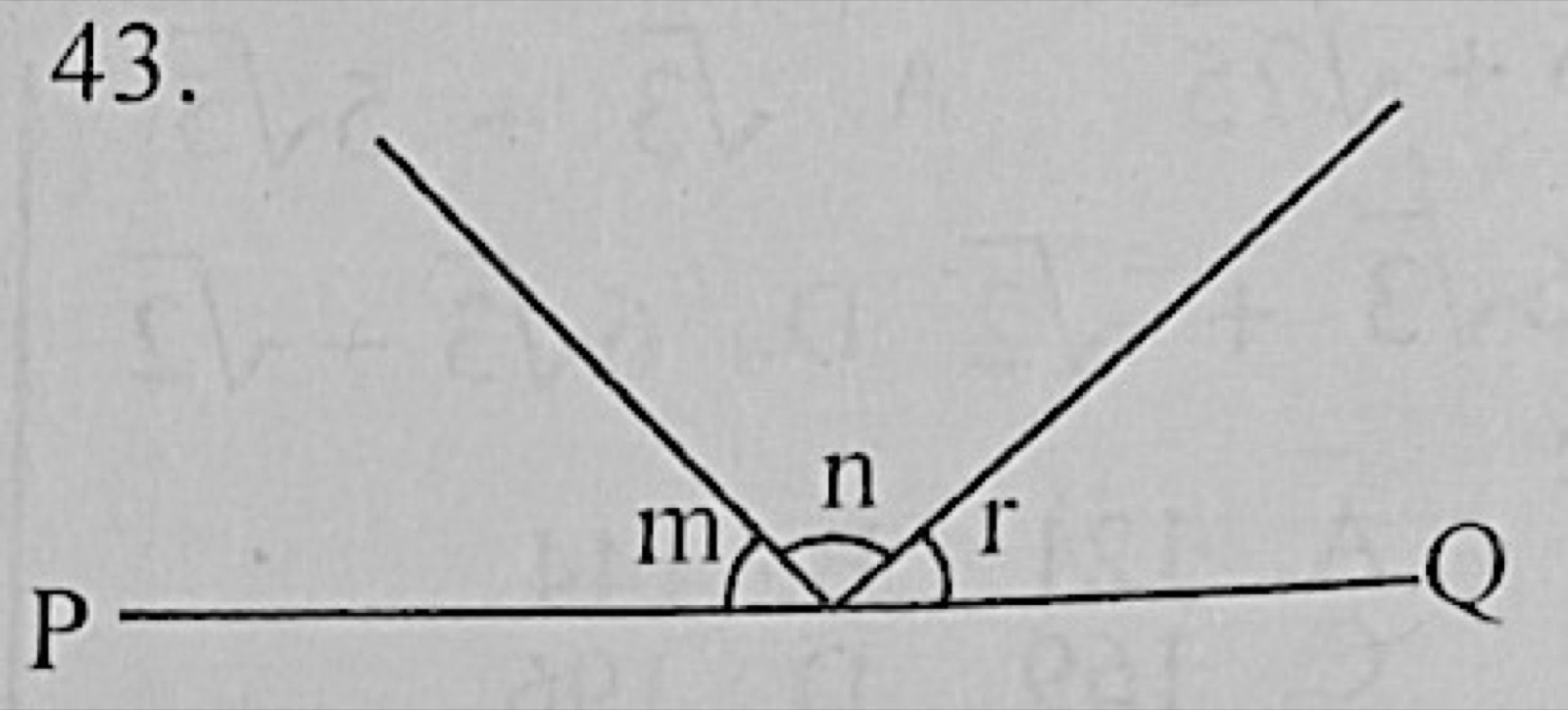
Answer: D (5 : 6 : 7)
m + n + r = 180° (angles on a line). So r = 70°, m = 50° and n = 60°, giving 50 : 60 : 70 = 5 : 6 : 7.
If x : y = ¼ : ⅜ and y : z = ⅓ : 4/9, find x : z.
Answer: D (1 : 2)
x : y = 2 : 3 and y : z = 3 : 4, so x : z = 2 : 4 = 1 : 2.
Find the mean deviation of 20, 30, 25, 40, 35, 50, 45, 40, 20 and 45.
Answer: B (9)
Mean = 350/10 = 35. The distances from 35 add to 15 + 5 + 10 + 5 + 0 + 15 + 10 + 5 + 15 + 10 = 90, so the mean deviation is 9.
M and N are two subsets of the universal set (U). If n(U) = 48, n(M) = 20, n(N) = 30 and n(M ∪ N) = 40, find n(M ∩ N)′.
Answer: D (38)
n(M ∩ N) = 20 + 30 − 40 = 10, so n(M ∩ N)′ = 48 − 10 = 38.
Express 0.612 in the form x/y, where x and y are integers and y ≠ 0.
Answer: A (153/250)
0.612 = 612/1000 = 153/250.
In the diagram. PQ//RS. Find x in terms of y and z.
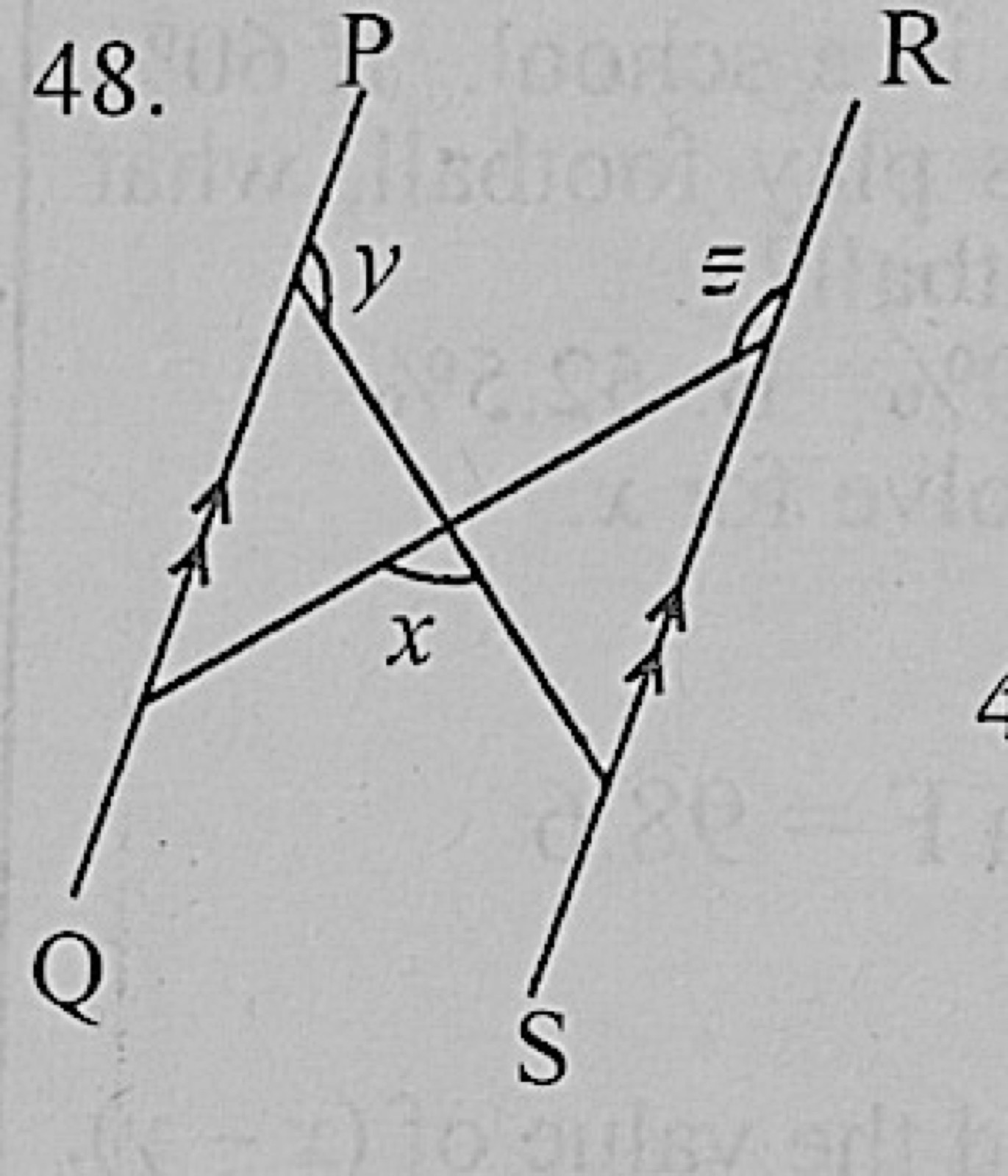
Answer: D (x = 360° − y − z)
Use co-interior angles between the parallel lines on each crossing line, then the angle sum of the triangle containing x: this gives x = 360° − y − z.
The diagonals of a rhombus WXYZ intersect at M. If |MW| = 5 cm and |MX| = 12 cm, caluclate its perimeter.
Answer: C (52 cm)
The diagonals bisect at right angles, so a side is √(5² + 12²) = 13 cm and the perimeter is 52 cm.
The graphs of y = x2 and y = x intersect at which of these points?
Answer: A ((0, 0), (1, 1))
x² = x gives x = 0 or 1, so the points are (0, 0) and (1, 1).
A used car was purchased at N900,000.00. Its value depreciated by 30% in the first year. In each subsequent year, the depreciation was 22% of its value at the beginning of that year. If the car was bought on 1st March, 2011, calculate, correct to the nearest hundred naira, the value of the car on 28th February, 2015.
1 March 2011 to 28 February 2015 is 4 years.
After year 1: 900 000 × 0.70 = N630,000
After 3 more years: 630 000 × 0.78³ = 630 000 × 0.474552 = N298,967.76
Value ≈ N299,000 (nearest hundred naira)
Count the years carefully: the fourth year ends on 28th February 2015.
(a) The graph of y = 2px2 − p2x − 14 passes through the point (3, 10). Find the values of p.
(b) Two lines, 3y − 2x = 21 and 4y + 5x = 5, intersect at the point Q. Find the coordinates of Q.
(a) 10 = 18p − 3p² − 14 → 3p² − 18p + 24 = 0 → p² − 6p + 8 = 0 → (p − 2)(p − 4) = 0
p = 2 or p = 4
(b) ×4 and ×3: 12y − 8x = 84 and 12y + 15x = 15 → 23x = −69 → x = −3
4y − 15 = 5 → y = 5; Q = (−3, 5)
Substitute x = 3 and y = 10 to get a quadratic in p.
(a) The diagonals of a rhombus are 10.2 cm and 9.3 cm long. Calculate, correct to one decimal place, the perimeter of the rhombus.
(b) Given that sin x = ⅗, 0° < x < 90°, find the value of 5 cos x − 4 tan x.
(a) Diagonals bisect at right angles: half-diagonals 5.1 cm and 4.65 cm
Side = √(5.1² + 4.65²) = √47.6325 ≈ 6.902 cm
Perimeter = 4 × 6.902 ≈ 27.6 cm
(b) Sides 3, 4, 5: cos x = 4/5, tan x = 3/4
5 cos x − 4 tan x = 4 − 3 = 1
A rhombus's diagonals cut each other in half at right angles.
(a) In the diagram, QOS is a diameter, ∠RQS = x° and ∠QST = (3x + 15)°. Find: (i) the value of x. (ii) ∠RSQ.
(b) If 2N4seven = 15Nnine, find the value of N.
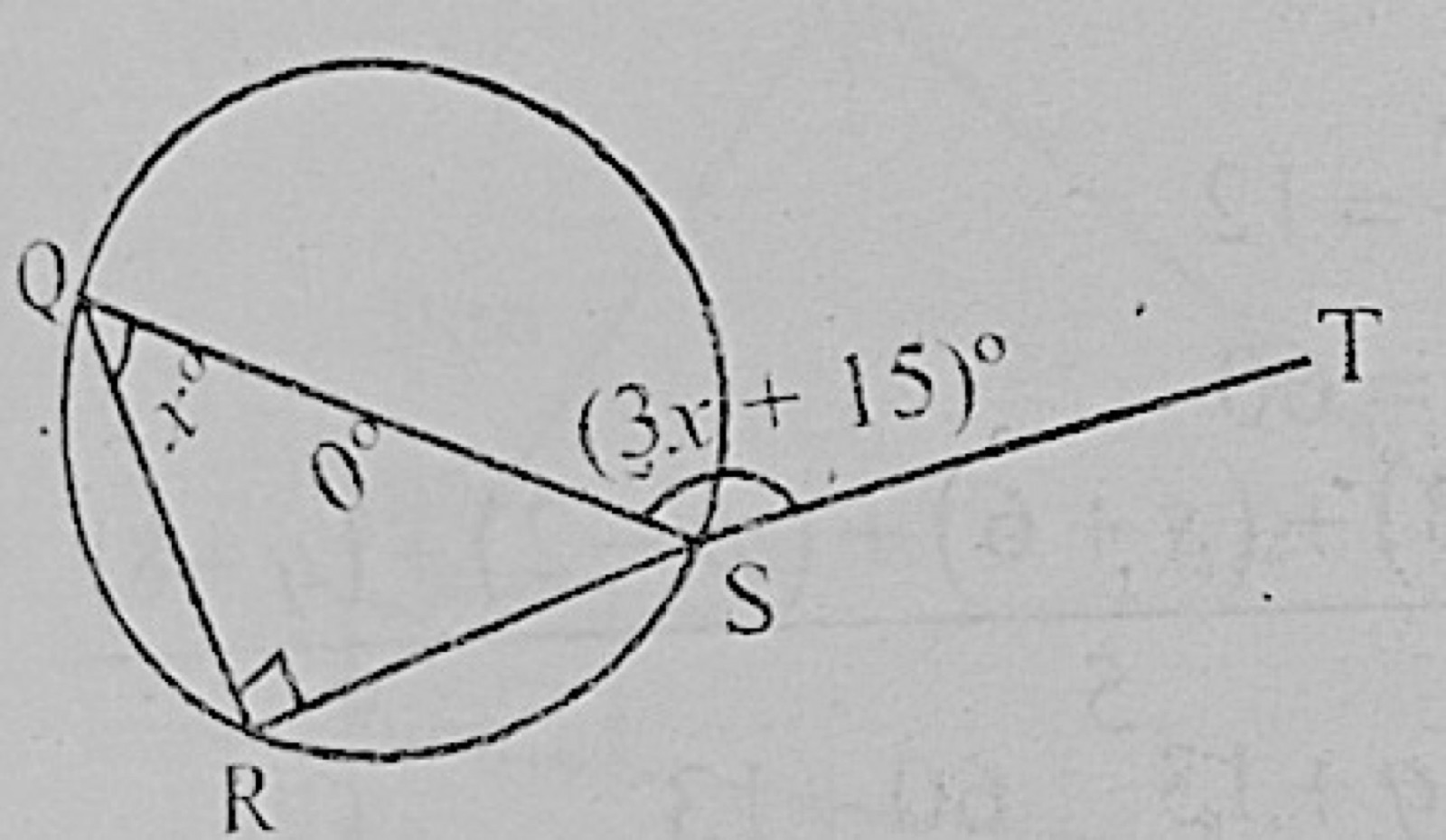
(a)(i) ∠QRS = 90° (angle in a semicircle)
∠QST is an exterior angle of triangle QRS: 3x + 15 = 90 + x → x = 37.5°
(ii) ∠RSQ = 180° − (3 × 37.5 + 15)° = 52.5° (or 90° − 37.5°)
(b) 2 × 49 + 7N + 4 = 81 + 45 + N → 102 + 7N = 126 + N → N = 4
Use the angle in a semicircle and the exterior angle of a triangle.
(a) If the mean of m, n, s, p and q is 12, calculate the mean of (m − 4), (n − 3), (s + 6), (p − 2) and (q − 8).
(b) In a community of 500 people, the 75th percentile age is 65 years while the 25th percentile age is 15 years. How many of the people are between 15 and 65 years?
(a) m + n + s + p + q = 60
New total = 60 − 4 − 3 + 6 − 2 − 8 = 49; new mean = 49/5 = 9.8
(b) 75% − 25% = 50% of the people: 0.5 × 500 = 250 people
Find the total first; adding or subtracting from each value changes the total by the sum of the changes.
In a road worthiness test on 240 cars, 60% passed. The number that failed had faults in Clutch, Brakes and Steering as follows: Clutch only − 28: Clutch and Steering − 14; Clutch, Steering and Brakes − 8: Clutch and Brakes − 20: Brakes and Steering only − 6. The number of cars with faults in Steering only is twice the number of cars with faults in Brakes only. (a) Draw a Venn diagram to illustrate this information. (b) How many cars had: (i) faulty Brakes? (ii) only one fault?
Failed = 40% of 240 = 96
(a) Three circles C, B, S: C only 28; C∩S only 14 − 8 = 6; C∩B only 20 − 8 = 12; all three 8; B∩S only 6; B only x; S only 2x.
28 + 6 + 12 + 8 + 6 + x + 2x = 96 → 3x = 36 → x = 12
(b)(i) Faulty brakes = 12 + 12 + 8 + 6 = 38
(ii) Only one fault = 28 + 12 + 24 = 64
'Clutch and Steering − 14' includes the 8 cars with all three faults.
(a) Find the equation of the line passing through the points (2,5) and (−4, −7).
(b) Three ships P, Q and R are at sea. The bearing of Q from P is 030° and the bearing of P from R is 300°. If |PQ| = 5 km and |PR| = 8 km, (i) illustrate the information in a diagram. (ii) calculate, correct to three significant figures, the: (I) distance between Q and R; (II) bearing of R from Q.
(a) Gradient = (−7 − 5)/(−4 − 2) = 2; y − 5 = 2(x − 2) → y = 2x + 1
(b)(i) R is on a bearing of 120° from P, so ∠QPR = 120° − 30° = 90°.
(ii)(I) QR = √(5² + 8²) = √89 ≈ 9.43 km
(II) tan∠PQR = 8/5 → ∠PQR ≈ 58.0°
Bearing of P from Q = 210°, so bearing of R from Q = 210° − 58.0° ≈ 152°
Turn the back bearing (300° − 180° = 120°) into the bearing of R from P.
(a) Lamin bought a book for N300.00 and sold it to Bola at a profit of x%. Bola then sold the same book to James at a profit of x%. If James paid N(6x + ¾) more for the book than what Lamin paid, find the value of x.
(b) Find the range of values of x which satisfies the inequality 3x − 2 < 10 + x < 2 + 5x.
(a) James paid 300(1 + x/100)²
300(1 + x/100)² − 300 = 6x + ¾ → 6x + 0.03x² = 6x + ¾
0.03x² = 0.75 → x² = 25 → x = 5
(b) 3x − 2 < 10 + x → x < 6; 10 + x < 2 + 5x → x > 2
So 2 < x < 6
Split the double inequality into two and solve each.
In the diagram, |PT| = 4 cm, |TS| = 6 cm |PQ| = 6 cm and ∠SPR = 30°. Calculate, correct to the nearest whole number: (a) |SR|; (b) area of TQRS.
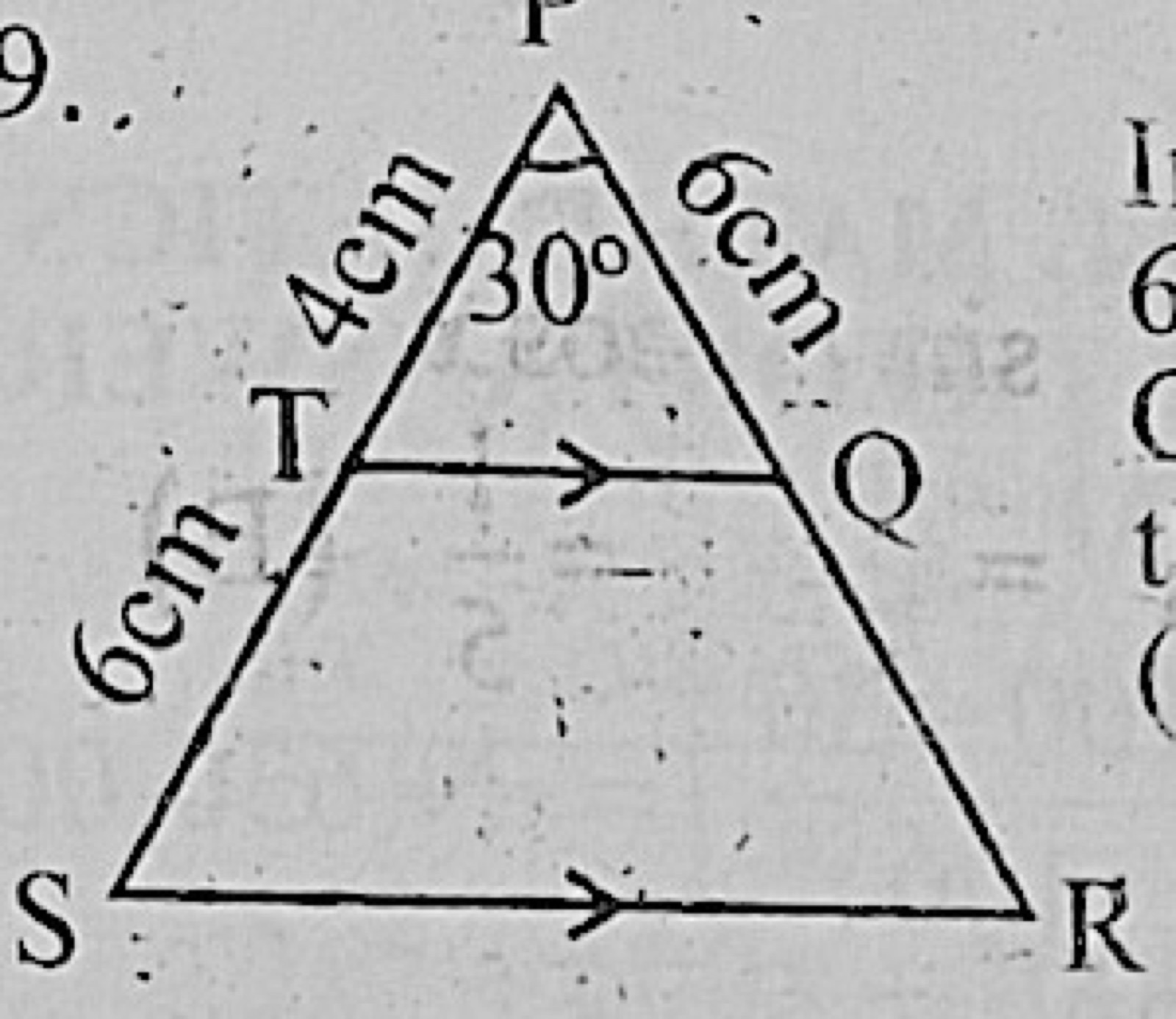
TQ//SR, so triangles PTQ and PSR are similar: |PS| = 10 cm and |PR| = 6 × 10/4 = 15 cm
(a) |SR|² = 10² + 15² − 2 × 10 × 15 cos 30° ≈ 65.19 → |SR| ≈ 8.07 ≈ 8 cm
(b) Area PSR = ½ × 10 × 15 × sin 30° = 37.5 cm²
Area PTQ = ½ × 4 × 6 × sin 30° = 6 cm²
Area TQRS = 37.5 − 6 = 31.5 ≈ 32 cm²
Find |PR| from similar triangles, then use the cosine rule.
(a) In ΔPQS, PQ = 12 cm, PS = 5 cm, ∠SPQ = ∠PRQ = 90°. Find, correct to three significant figures, PR.
(b) The lengths of two ladders, L and M are 10 m and 12 m respectively. They are placed against a wall such that each ladder makes the same angle with the horizontal ground. If the foot of L is 8 m from the foot of the wall, (i) draw a diagram to illustrate this information; (ii) calculate the height at which M touches the wall.
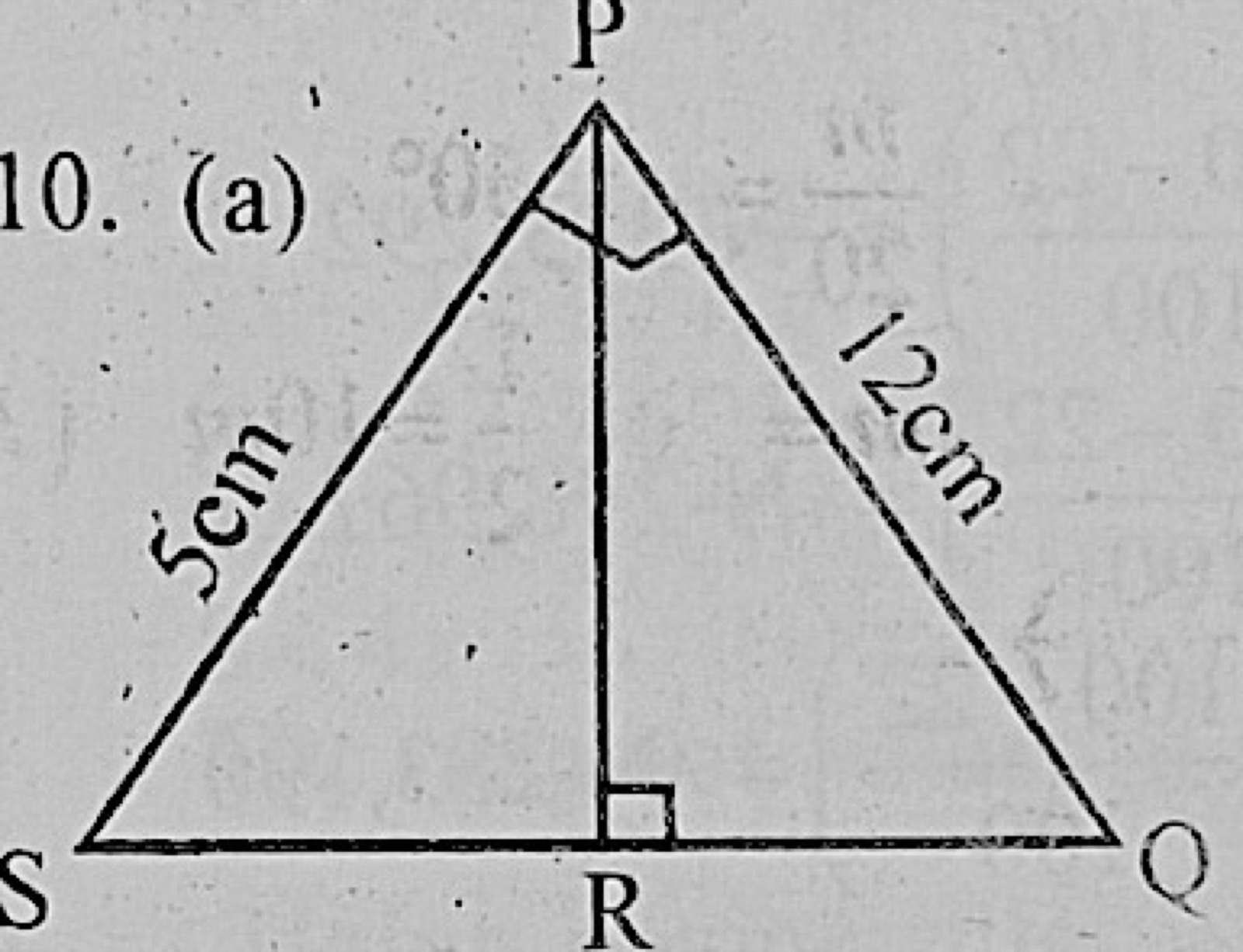
(a) SQ = √(5² + 12²) = 13 cm
Area: ½ × 5 × 12 = ½ × 13 × PR → PR = 60/13 ≈ 4.62 cm
(b)(i) Two right-angled triangles on the same wall and ground, ladders 10 m and 12 m at equal angles θ to the ground.
(ii) cos θ = 8/10, so sin θ = 0.6
Height of M = 12 × 0.6 = 7.2 m
PR is the height of the right-angled triangle PQS onto its hypotenuse.
(a) Copy and complete the table of values for y = 2x2 + x − 10 for −5 ≤ x ≤ 4.
x: −5, −4, −3, −2, −1, 0, 1, 2, 3, 4
y: __, __, 5, __, −9, −10, __, 0, __, __
(b) Using scales of 2 cm to 1 unit on the x-axis and 2 cm to 5 units on the y-axis, draw the graph of y = 2x2 + x − 10 for −5 ≤ x ≤ 4.
(c) Use the graph to find the solution of: (i) 2x2 + x = 10; (ii) 2x2 + x − 10 = 2x.
(a) x = −5: 35; −4: 18; −2: −4; 1: −7; 3: 11; 4: 26
(b) Plot the points and join with a smooth U-shaped curve.
(c)(i) 2x² + x − 10 = 0: where the curve cuts the x-axis, x = −2.5 or x = 2
(ii) Draw the line y = 2x; it meets the curve at x = −2 and x = 2.5
For (c)(ii) draw the straight line y = 2x on the same axes.
(a) If x = (2 / 3), y = (5 / −2) and z = (−4 / 13), find scalars p and q such that px + qy = z.
(b)(i) Using a scale of 2 cm to 2 units on both axes, draw on a graph paper two perpendicular axes Ox and Oy for −5 ≤ x ≤ 5, −5 ≤ y ≤ 5 respectively. (ii) Draw, on the graph paper, indicating clearly the vertices and their coordinates, (I) the quadrilateral WXYZ with W(2, 3), X(4, −1), Y(−3, −4) and Z(−3, 2); (II) the image W1X1Y1Z1 of the quadrilateral WXYZ under an anticlockwise rotation of 90° about the origin where W→W1, X→X1, Y→Y1 and Z→Z1.
(a) 2p + 5q = −4 and 3p − 2q = 13
Solving: 19p = 57 → p = 3, q = −2
(b)(i) Draw and label the axes with the given scale.
(ii)(I) Plot W(2, 3), X(4, −1), Y(−3, −4), Z(−3, 2) and join in order.
(II) Rotation of 90° anticlockwise: (x, y) → (−y, x)
W₁(−3, 2), X₁(1, 4), Y₁(4, −3), Z₁(−2, −3); plot and join.
Column vectors are written (top / bottom).
Marks: 10, 20, 30, 40, 50, 60, 70, 80, 90
Frequency: 1, 1, x, 5, y, 1, 4, 3, 1
The frequency table shows the marks distribution of a class of 30 students in an examination. The mean mark of the distribution is 52. (a) Find the values of x and y. (b) Construct a group frequency distribution table starting with a lower class limit of 1 and a class interval of 10. (c) Draw a histogram for the distribution. (d) Use the histogram to estimate the mode.
(a) 16 + x + y = 30 → x + y = 14
Σfx = 900 + 30x + 50y = 52 × 30 = 1560 → 3x + 5y = 66
Solving: y = 12, x = 2
(b) Classes 1–10, 11–20, …, 81–90 with frequencies 1, 1, 2, 5, 12, 1, 4, 3, 1 (class boundaries 0.5–10.5, …, 80.5–90.5)
(c) Bars on the class boundaries with heights equal to the frequencies.
(d) Modal class 40.5–50.5: draw the crossing lines in the tallest bar; mode ≈ 40.5 + 7/(7 + 11) × 10 ≈ 44.4
In (d) join the top corners of the tallest bar to the neighbouring bars and read where the lines cross.