WAEC Mathematics 2017 past questions and answers

56 questions. Try each one, then open the answer to check yourself and read the explanation.

Question 1

Fractions, Decimals and Approximation

Express 0.0000407, correct to 2 significant figures.

  1. A.0.0
  2. B.0.00004
  3. C.0.000041
  4. D.0.0000407
Show the answer and explanation

Answer: C (0.000041)

Explanation

The first two significant figures are 4 and 0, and the next digit (7) rounds the 0 up to 1: 0.000041.

Open this question

Question 3

Fractions, Decimals and Approximation

Evaluate: (3¼ × 1⅗)/(11⅓ − 5⅓)

  1. A.14/15
  2. B.13/15
  3. C.⅘
  4. D.11/15
Show the answer and explanation

Answer: B (13/15)

Explanation

Numerator = 13/4 × 8/5 = 26/5; denominator = 6. 26/5 ÷ 6 = 26/30 = 13/15.

Open this question

Question 4

Modular Arithmetic

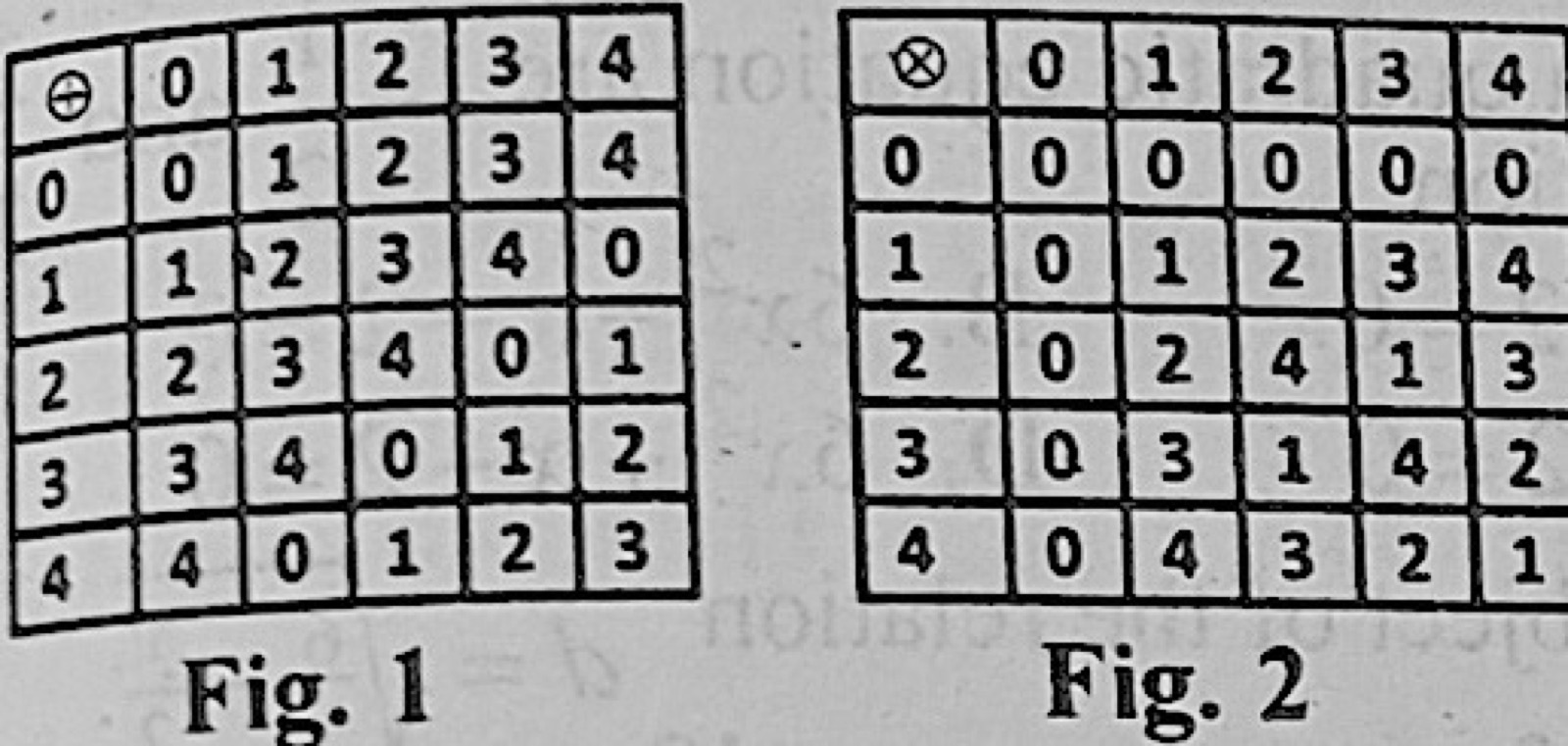
Fig. 1 and Fig. 2 are the addition and multiplication tables respectively in modulo 5. Use these tables to solve the equation (n ⊗ 4) ⊕ 3 = 0(mod 5).

Diagram for this question
  1. A.1
  2. B.2
  3. C.3
  4. D.4
Show the answer and explanation

Answer: C (3)

Explanation

n ⊗ 4 must be 2 (since 2 ⊕ 3 = 0). From the multiplication table, 3 ⊗ 4 = 2, so n = 3.

Open this question

Question 5

Ratio, Percentages and Rates

The ages of Tunde and Ola are in the ratio 1:2. If the ratio of Ola's age to Musa's age is 4:5, what is the ratio of Tunde's age to Musa's age?

  1. A.1:4
  2. B.1:5
  3. C.2:5
  4. D.5:2
Show the answer and explanation

Answer: C (2:5)

Explanation

Tunde : Ola = 4 : 8 and Ola : Musa = 8 : 10, so Tunde : Musa = 4 : 10 = 2 : 5.

Open this question

Question 6

Sets

If M = {x: 3 ≤ x < 8} and N = {x: 8 < x ≤ 12}, which of the following is true? I. 8 ∈ M ∩ N II. 8 ∈ M ∪ N III. M ∩ N = ∅

  1. A.III only
  2. B.I and II only
  3. C.II and III only
  4. D.I, II and III
Show the answer and explanation

Answer: A (III only)

Explanation

8 is in neither set (M stops below 8 and N starts above 8), so I and II are false; the sets share no element, so III is true.

Open this question

Question 7

Logarithms

Given that a = log 7 and b = log 2, express log 35 in terms of a and b.

  1. A.a + b + 1
  2. B.ab − 1
  3. C.a − b + 1
  4. D.b − a + 1
Show the answer and explanation

Answer: C (a − b + 1)

Explanation

log 35 = log(7 × 10/2) = log 7 + log 10 − log 2 = a + 1 − b.

Open this question

Question 8

Algebraic Expressions

If x = ⅔ and y = −6, evaluate xy − y/x.

  1. A.0
  2. B.5
  3. C.8
  4. D.9
Show the answer and explanation

Answer: B (5)

Explanation

xy = −4 and y/x = −6 ÷ ⅔ = −9, so xy − y/x = −4 + 9 = 5.

Open this question

Question 9

Linear and Simultaneous Equations

Solve the equation: 1/5x + 1/x = 3.

  1. A.⅕
  2. B.⅖
  3. C.⅗
  4. D.⅘
Show the answer and explanation

Answer: B (⅖)

Explanation

1/(5x) + 5/(5x) = 6/(5x) = 3, so 15x = 6 and x = ⅖.

Open this question

Question 10

Commercial Arithmetic

A sum of N18,100.00 was shared among 5 boys and 4 girls with each boy taking N20.00 more than each girl. Find a boy's share.

  1. A.N1,820.00
  2. B.N2,000.00
  3. C.N2,020.00
  4. D.N2,040.00
Show the answer and explanation

Answer: C (N2,020.00)

Explanation

If a girl gets g, then 5(g + 20) + 4g = 18 100, so 9g = 18 000, g = 2000 and a boy gets N2,020.

Open this question

Question 11

Algebraic Expressions

One factor of 7x2 + 33x − 10 is

  1. A.7x + 5
  2. B.x − 2
  3. C.7x − 2
  4. D.x − 5
Show the answer and explanation

Answer: C (7x − 2)

Explanation

7x² + 33x − 10 = 7x² − 2x + 35x − 10 = (7x − 2)(x + 5).

Open this question

Question 12

Inequalities

Solve: −¼ < ¾(3x − 2) < ½

  1. A.5/9 < x < 8/9
  2. B.−8/9 < x < 7/9
  3. C.−8/9 < x < 5/9
  4. D.−7/9 < x < 8/9
Show the answer and explanation

Answer: A (5/9 < x < 8/9)

Explanation

Multiply by 4/3: −⅓ < 3x − 2 < ⅔, so 5/3 < 3x < 8/3 and 5/9 < x < 8/9.

Open this question

Question 13

Algebraic Expressions

Simplify: 3x − (p − x) − (r − p)

  1. A.2x − r
  2. B.2x + r
  3. C.4x − r
  4. D.2x − 2p − r
Show the answer and explanation

Answer: C (4x − r)

Explanation

3x − p + x − r + p = 4x − r.

Open this question

Question 14

Mensuration of Plane Shapes

An arc of a circle of radius 7.5 cm is 7.5 cm long. Find, correct to the nearest degree, the angle which the arc subtends at the centre of the circle. [Take π = 22/7]

  1. A.29°
  2. B.57°
  3. C.65°
  4. D.115°
Show the answer and explanation

Answer: B (57°)

Explanation

θ/360 × 2 × 22/7 × 7.5 = 7.5 gives θ = 360 × 7/44 ≈ 57.3°, i.e. 57°.

Open this question

Question 15

Mensuration of Solids

Water flows out of a pipe at a rate of 40π cm3 per second into an empty cylindrical container of base radius 4 cm. Find the height of water in the container after 4 seconds.

  1. A.10 cm
  2. B.14 cm
  3. C.16 cm
  4. D.20 cm
Show the answer and explanation

Answer: A (10 cm)

Explanation

Volume after 4 s = 160π cm³. π × 4² × h = 160π, so h = 10 cm.

Open this question

Question 16

Mensuration of Solids

The dimensions of a water tank are 13 cm, 10 cm and 70 cm. If it is half-filled with water, calculate the volume of water in litres.

  1. A.4.55 litres
  2. B.7.50 litres
  3. C.8.10 litres
  4. D.9.55 litres
Show the answer and explanation

Answer: A (4.55 litres)

Explanation

Full volume = 13 × 10 × 70 = 9100 cm³; half is 4550 cm³ = 4.55 litres (1000 cm³ = 1 litre).

Open this question

Question 17

Mensuration of Solids

If the total surface area of a solid hemisphere is equal to its volume, find the radius.

  1. A.3.0 cm
  2. B.4.5 cm
  3. C.5.0 cm
  4. D.9.0 cm
Show the answer and explanation

Answer: B (4.5 cm)

Explanation

Total surface area = 3πr² and volume = ⅔πr³. 3πr² = ⅔πr³ gives r = 4.5 cm.

Open this question

Question 18

Angles and Polygons

Which of the following is true about parallelograms?

  1. A.Opposite angles are supplementary
  2. B.Opposite angles are complementary
  3. C.Opposite angles are equal
  4. D.Opposite angles are reflex angles
Show the answer and explanation

Answer: C (Opposite angles are equal)

Explanation

In a parallelogram opposite angles are equal (it is adjacent angles that add to 180°).

Open this question

Question 19

Circle Theorems

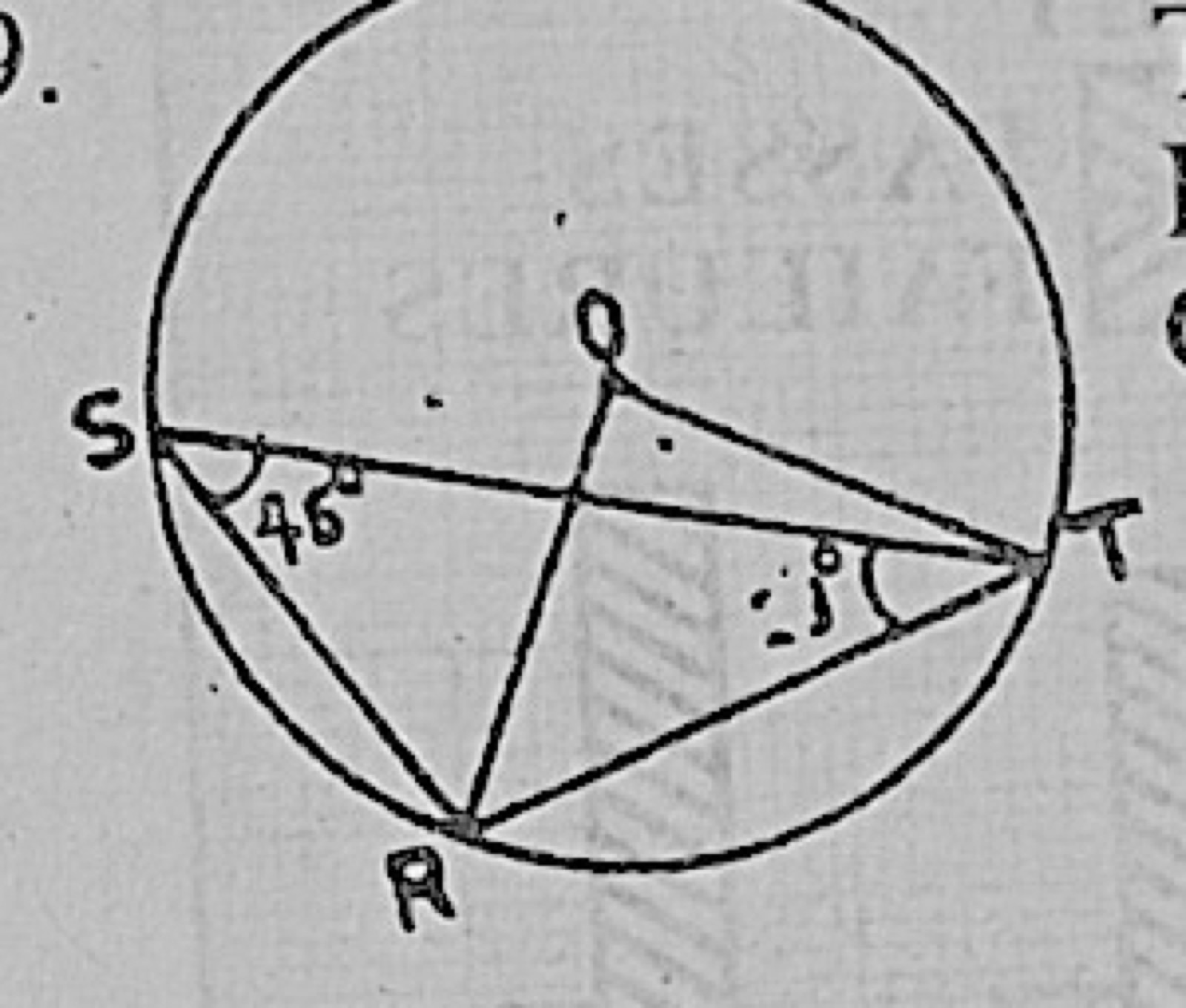
The diagram shows a circle centre O. If ∠STR = 29° and ∠RST = 46°, Calculate the value of ∠STO.

Diagram for this question
  1. A.12°
  2. B.15°
  3. C.29°
  4. D.34°
Show the answer and explanation

Answer: B (15°)

Explanation

∠ROT = 2 × ∠RST = 92° (angle at centre). Triangle ROT is isosceles, so ∠RTO = (180° − 92°)/2 = 44°. ∠STO = 44° − 29° = 15°.

Open this question

Question 20

Angles and Polygons

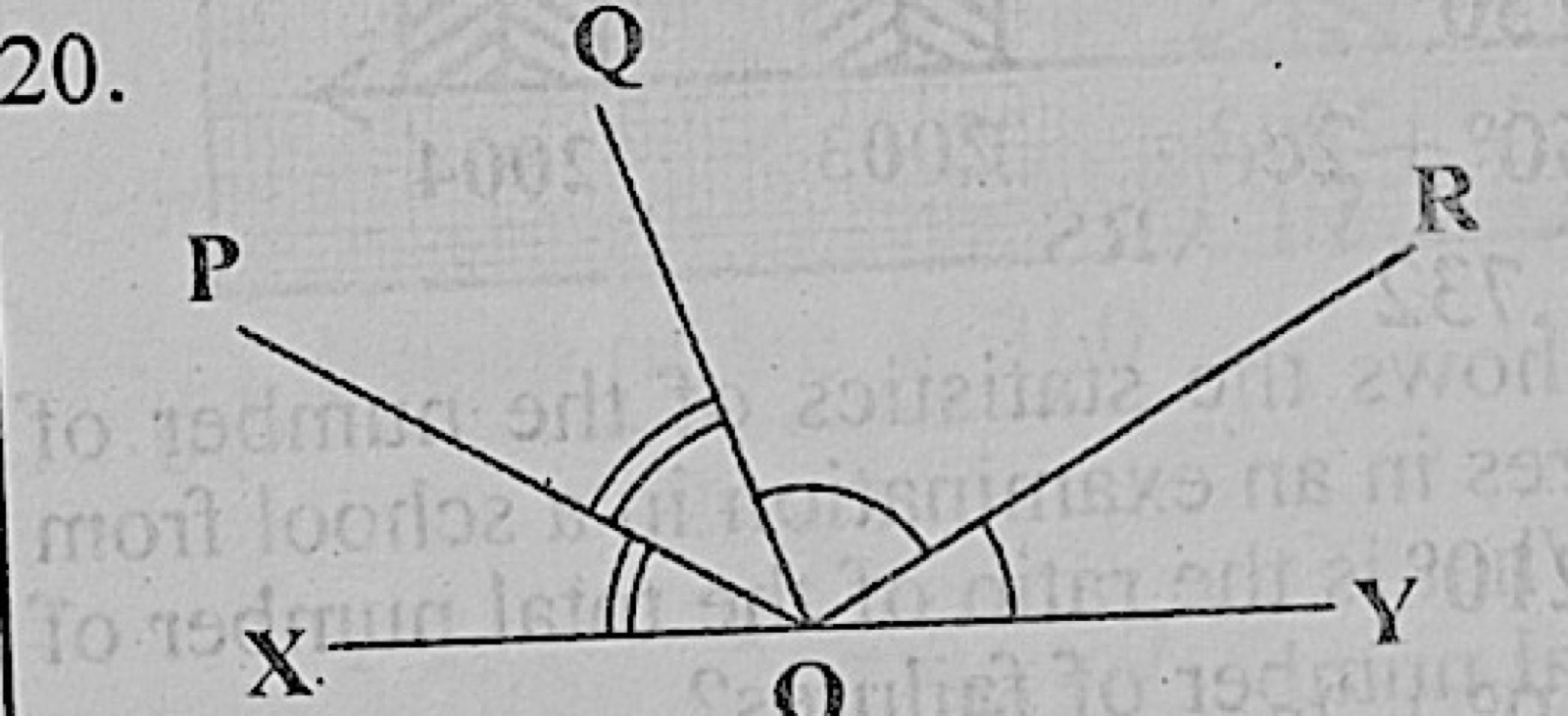
In the diagram, XY is a straight line, ∠POX = ∠POQ and ∠ROY = ∠QOR. Find the value of ∠POQ + ∠ROY.

Diagram for this question
  1. A.60°
  2. B.90°
  3. C.100°
  4. D.120°
Show the answer and explanation

Answer: B (90°)

Explanation

The four angles on line XY add to 180°: 2∠POQ + 2∠ROY = 180°, so ∠POQ + ∠ROY = 90°.

Open this question

Question 21

Circle Theorems

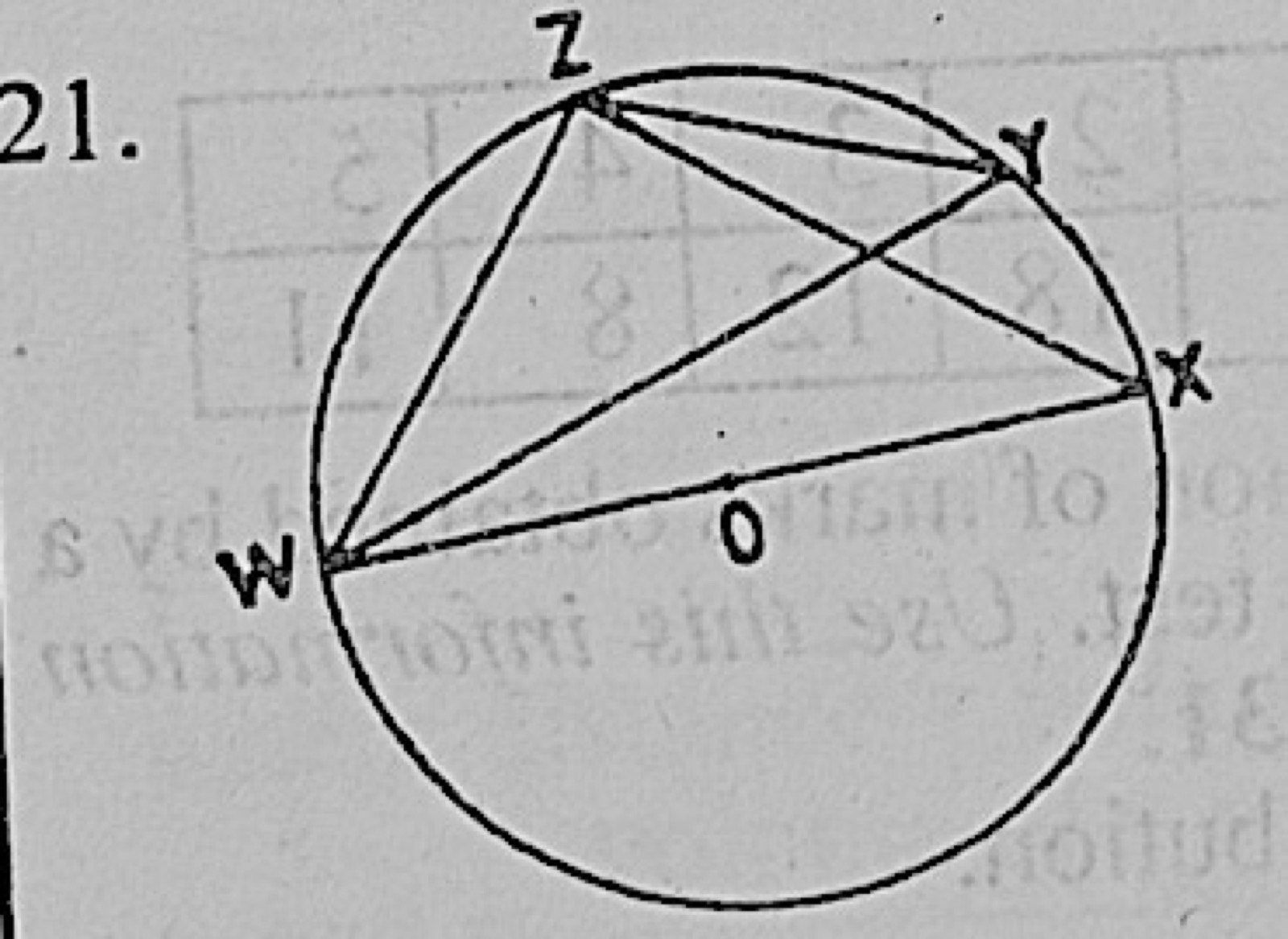
The diagram shows a circle centre O. If ∠ZYW = 33°, find ∠ZWX.

Diagram for this question
  1. A.33°
  2. B.57°
  3. C.90°
  4. D.100°
Show the answer and explanation

Answer: B (57°)

Explanation

WX is a diameter so ∠WZX = 90°; ∠ZXW = ∠ZYW = 33° (same segment). ∠ZWX = 180° − 90° − 33° = 57°.

Open this question

Question 22

Circle Theorems

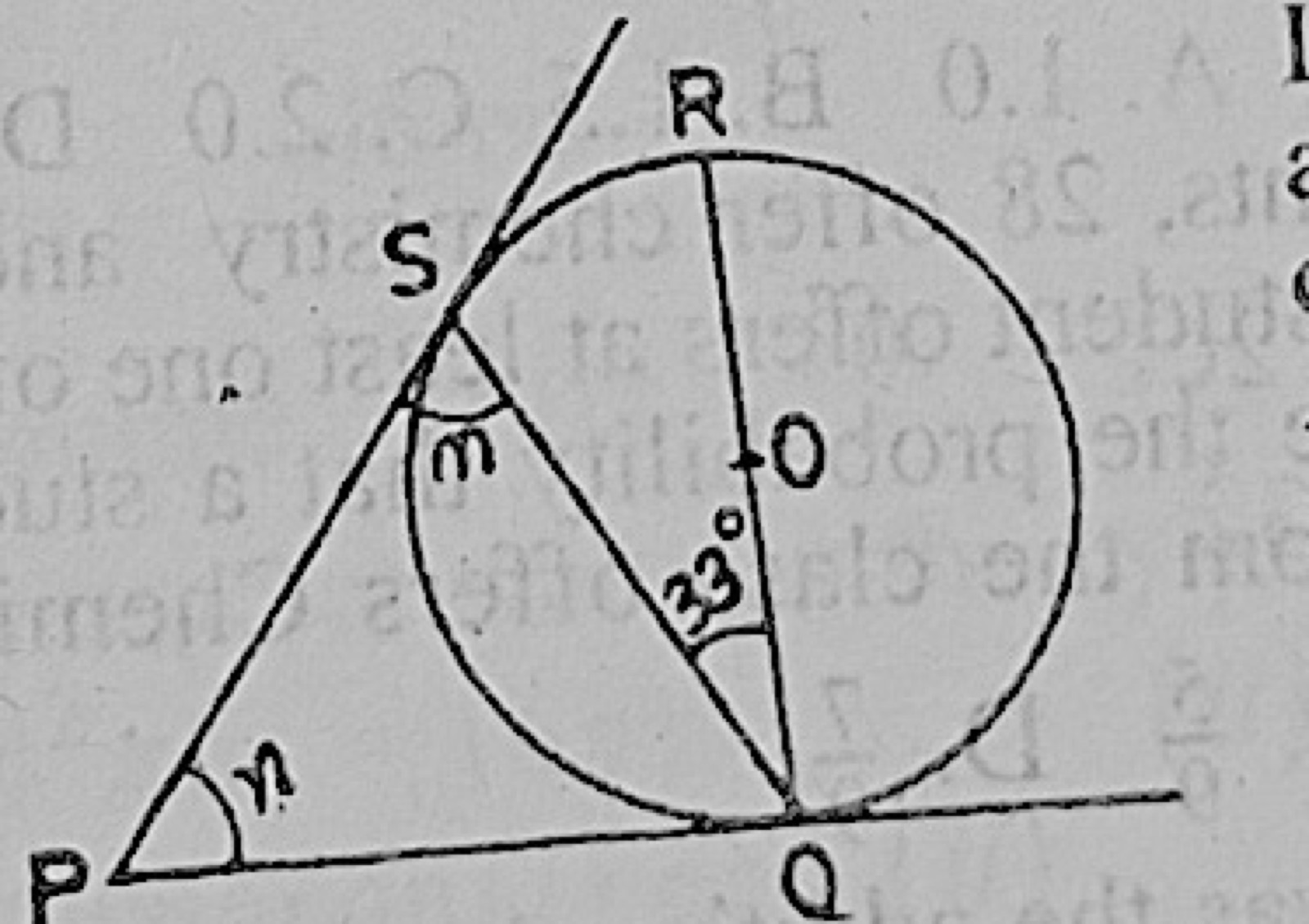
In the diagram, PQ and PS are tangents to the circle centre O. If ∠PSQ = m, ∠SPQ = n and ∠SQR = 33°, find the value of (m + n)

Diagram for this question
  1. A.103°
  2. B.123°
  3. C.133°
  4. D.143°
Show the answer and explanation

Answer: B (123°)

Explanation

QR is a diameter, so the tangent PQ ⟂ QR and ∠PQS = 90° − 33° = 57°. Tangents from P are equal, so m = ∠PSQ = 57° and n = 180° − 114° = 66°. m + n = 123°.

Open this question

Question 23

Coordinate Geometry

Calculate the gradient (slope) of the line joining points (−1, 1) and (2, −2).

  1. A.−1
  2. B.−½
  3. C.½
  4. D.1
Show the answer and explanation

Answer: A (−1)

Explanation

(−2 − 1)/(2 − (−1)) = −3/3 = −1.

Open this question

Question 24

Coordinate Geometry

If P(2, 3) and Q(2, 5) are points on a graph, calculate the length PQ.

  1. A.6 units
  2. B.5 units
  3. C.4 units
  4. D.2 units
Show the answer and explanation

Answer: D (2 units)

Explanation

Both points have x = 2, so PQ = 5 − 3 = 2 units.

Open this question

Question 25

Bearings

A bearing of 320° expressed as a compass bearing is

  1. A.N 50° W
  2. B.N 40° W
  3. C.N 50° E
  4. D.N 40° E
Show the answer and explanation

Answer: B (N 40° W)

Explanation

320° is 40° short of North going clockwise, i.e. 40° west of north: N 40° W.

Open this question

Question 27

Trigonometry

A stationary boat is observed from a height of 100 m. If the horizontal distance between the observer and the boat is 80 m, calculate, correct to two decimal places, the angle of depression of the boat from the point of observation.

  1. A.36.87°
  2. B.39.70°
  3. C.51.34°
  4. D.53.13°
Show the answer and explanation

Answer: C (51.34°)

Explanation

tan θ = 100/80 = 1.25, so θ ≈ 51.34°.

Open this question

Question 28

Measures of Central Tendency

The average age of a group 25 girls is 10 years. If one girl, aged 12 years and 4 months joins the group, find, correct to one decimal place, the new average age of the group.

  1. A.10.1 years
  2. B.9.3 years
  3. C.8.7 years
  4. D.8.3 years
Show the answer and explanation

Answer: A (10.1 years)

Explanation

Total age = 250 + 12⅓ = 262⅓ years for 26 girls; 262⅓ ÷ 26 ≈ 10.1 years.

Open this question

Question 32

Probability

In a class of 45 students, 28 offer chemistry and 25 offer Biology. If each student offers at least one of the two subjects, calculate the probability that a student selected at random from the class offers Chemistry only.

  1. A.2/9
  2. B.4/9
  3. C.5/9
  4. D.7/9
Show the answer and explanation

Answer: B (4/9)

Explanation

Both = 28 + 25 − 45 = 8, so Chemistry only = 20. Probability = 20/45 = 4/9.

Open this question

Question 33

Number Bases

In what number base was the addition 1 + nn = 100, where n > 0, done?

  1. A.n − 1
  2. B.n
  3. C.n + 1
  4. D.n + 2
Show the answer and explanation

Answer: C (n + 1)

Explanation

In base b: 1 + nb + n = b², so n(b + 1) = (b − 1)(b + 1) and b = n + 1.

Open this question

Question 35

Angles and Polygons

Three exterior angles of a polygon are 30°, 40° and 60°. If the remaining exterior angles are 46° each, name the polygon.

  1. A.Decagon
  2. B.Nonagon
  3. C.Octagon
  4. D.Hexagon
Show the answer and explanation

Answer: C (Octagon)

Explanation

Exterior angles add to 360°. 360° − 130° = 230° = 5 × 46°, so there are 3 + 5 = 8 sides: an octagon.

Open this question

Question 36

Angles and Polygons

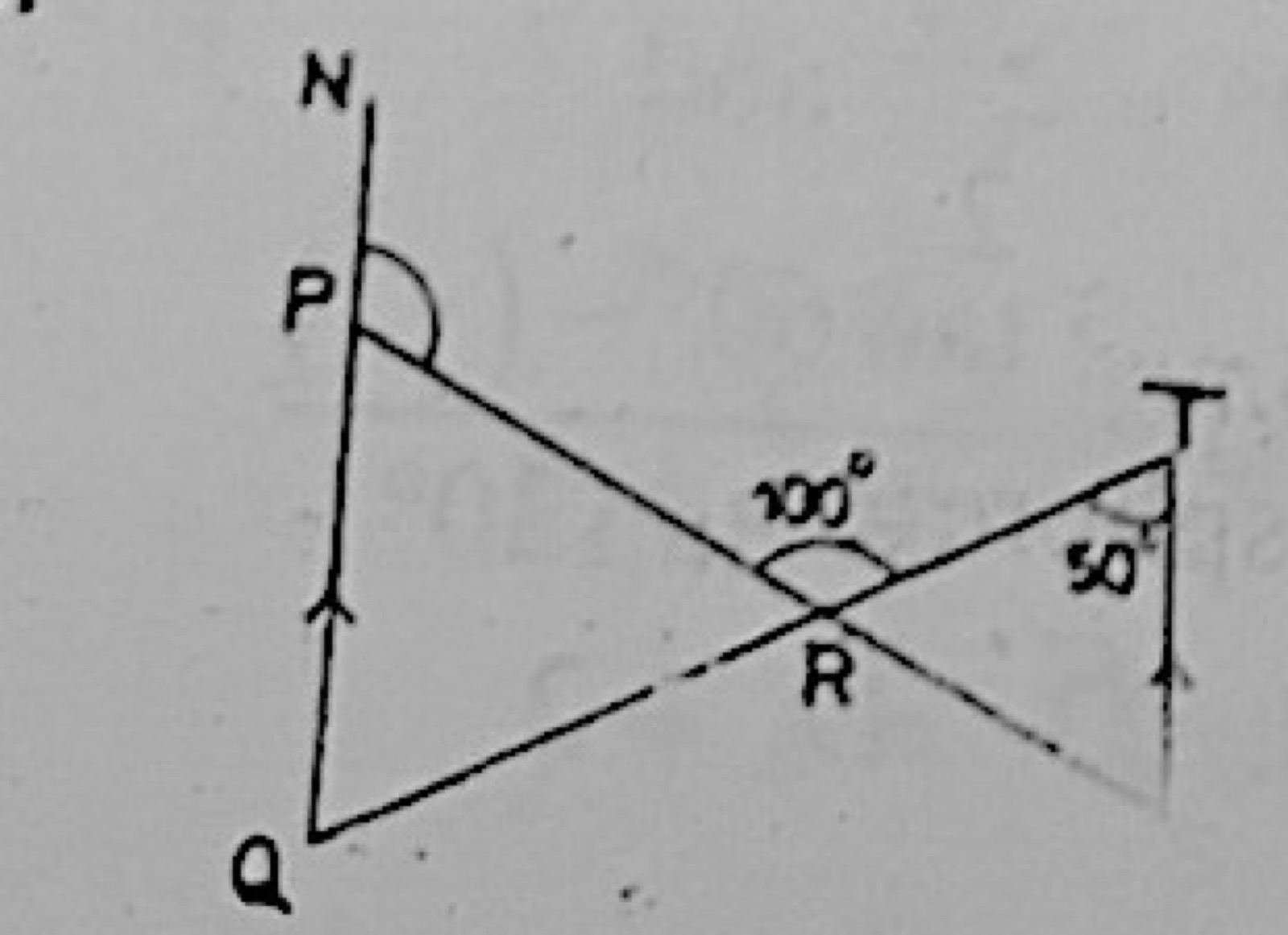
In the diagram, NQ//TS, ∠RTS = 50° and ∠PRT = 100°. Find the value of ∠NPR.

Diagram for this question
  1. A.110°
  2. B.130°
  3. C.140°
  4. D.150°
Show the answer and explanation

Answer: B (130°)

Explanation

∠PRQ = 180° − 100° = 80° and ∠PQR = ∠RTS = 50° (alternate angles). So ∠QPR = 50° and ∠NPR = 180° − 50° = 130°.

Open this question

Question 37

Algebraic Expressions

Simplify the expression (a2b4 − b2a4)/(ab(a + b)).

  1. A.a2 − b2
  2. B.b2 − a2
  3. C.a2b − ab2
  4. D.ab2 − a2b
Show the answer and explanation

Answer: D (ab2 − a2b)

Explanation

Numerator = a²b²(b² − a²) = a²b²(b − a)(b + a). Dividing by ab(a + b) leaves ab(b − a) = ab² − a²b.

Open this question

Question 38

Progressions

Find the 6th term of the sequence: ⅔, 7/15, 4/15,…

  1. A.−⅓
  2. B.−⅕
  3. C.1/15
  4. D.⅕
Show the answer and explanation

Answer: A (−⅓)

Explanation

The terms are 10/15, 7/15, 4/15, so d = −3/15. T₆ = 10/15 + 5 × (−3/15) = −5/15 = −⅓.

Open this question

Question 39

Mensuration of Plane Shapes

The diagonal of a square is 60 cm. Calculate its perimeter.

  1. A.20√2
  2. B.40√2
  3. C.90√2
  4. D.120√2
Show the answer and explanation

Answer: D (120√2)

Explanation

Side = 60/√2 = 30√2 cm, so the perimeter = 4 × 30√2 = 120√2 cm.

Open this question

Question 40

Quadratic Equations

The roots of a quadratic equation are −½ and ⅔. Find the equation.

  1. A.6x2 − x + 2 = 0
  2. B.6x2 − x − 2 = 0
  3. C.6x2 + x − 2 = 0
  4. D.6x2 + x + 2 = 0
Show the answer and explanation

Answer: B (6x2 − x − 2 = 0)

Explanation

(2x + 1)(3x − 2) = 6x² − 4x + 3x − 2 = 6x² − x − 2.

Open this question

Question 41

Algebraic Expressions

Make x the subject of the relation d = √(6/x − y/2).

  1. A.x = 6/d2 + 12/y
  2. B.x = 12/(2d2 − y)
  3. C.x = 12/y − 2d2
  4. D.x = 12/(2d2 + y)
Show the answer and explanation

Answer: D (x = 12/(2d2 + y))

Explanation

d² = 6/x − y/2, so 6/x = (2d² + y)/2 and x = 12/(2d² + y).

Open this question

Question 42

Logic

Consider the statments: p: it is hot. q: it is raining. Which of the following symbols correctly represents the statement "It is raining if and only if it is cold"?

  1. A.p ⇔ ~q
  2. B.q ⇔ p
  3. C.~q ⇔ ~q
  4. D.q ⇔ ~p
Show the answer and explanation

Answer: D (q ⇔ ~p)

Explanation

'It is raining' is q and 'it is cold' is 'not hot', ~p, so the statement is q ⇔ ~p.

Open this question

Question 43

Indices

Given that t = 2−x; find 2x+1 in terms of t.

  1. A.2/t
  2. B.t/2
  3. C.1/2t
  4. D.2t
Show the answer and explanation

Answer: A (2/t)

Explanation

2x = 1/t, so 2x + 1 = 2 × 2x = 2/t.

Open this question

Question 44

Triangles and Quadrilaterals

Find the value of m in the diagram.

Diagram for this question
  1. A.72°
  2. B.68°
  3. C.44°
  4. D.34°
Show the answer and explanation

Answer: C (44°)

Explanation

The exterior angle 2x equals the sum of the opposite interior angles: 2x = 68° + x, so x = 68°. Then m = 180° − 2x = 180° − 136° = 44°.

Open this question

Question 45

Probability

Two bottles are drawn with replacement from a crate containing 8 coke, 12 fanta and 4 sprite bottles. What is the probability that the first is coke and the second is not coke?

  1. A.1/12
  2. B.1/6
  3. C.2/9
  4. D.⅜
Show the answer and explanation

Answer: C (2/9)

Explanation

P(coke) = 8/24 = ⅓ and P(not coke) = 16/24 = ⅔; with replacement the probability is ⅓ × ⅔ = 2/9.

Open this question

Question 46

Commercial Arithmetic

If the simple interest on a certain amount of money saved in a bank for 5 years at 2½% per annum is N500.00, calculate the total amount due after 6 years at the same rate.

  1. A.N2,500.00
  2. B.N2,600.00
  3. C.N4,500.00
  4. D.N4,600.00
Show the answer and explanation

Answer: D (N4,600.00)

Explanation

P × 2.5 × 5/100 = 500 gives P = N4,000. Interest for 6 years = 4000 × 2.5 × 6/100 = N600, so the amount is N4,600.

Open this question

Question 47

Measures of Dispersion

Calculate the variance of 2, 3, 3, 4, 5, 5, 5, 7, 7 and 9.

  1. A.2.2
  2. B.3.4
  3. C.4.0
  4. D.4.2
Show the answer and explanation

Answer: D (4.2)

Explanation

Mean = 50/10 = 5. Squared deviations: 9, 4, 4, 1, 0, 0, 0, 4, 4, 16, total 42. Variance = 42/10 = 4.2.

Open this question

Question 48

Mensuration of Plane Shapes

A circular pond of radius 4 m has a path of width 2.5 m round it. Find, correct to two decimal places, the area of the path. [Take π = 22/7]

  1. A.7.83m2
  2. B.32.29m2
  3. C.50.29m2
  4. D.82.50m2
Show the answer and explanation

Answer: D (82.50m2)

Explanation

Outer radius = 6.5 m. Area = 22/7 × (6.5² − 4²) = 22/7 × 26.25 = 82.50 m².

Open this question

Question 50

Circle Theorems

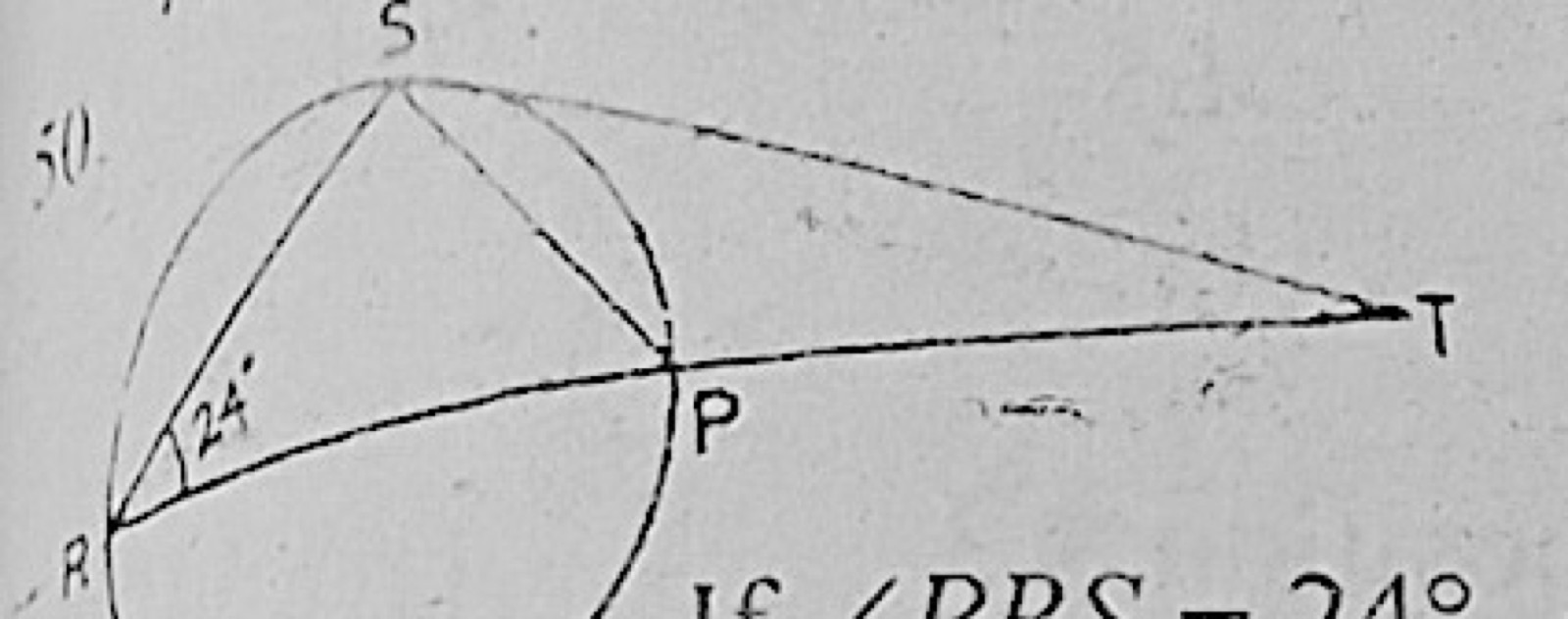
In the diagram, RP is a diameter of circle RSP, RP is produced to T and TS is a tangent to the circle as S. If ∠PRS = 24°, calculate the value of ∠STR.

Diagram for this question
  1. A.24°
  2. B.42°
  3. C.48°
  4. D.66°
Show the answer and explanation

Answer: B (42°)

Explanation

∠RSP = 90° (semicircle) and ∠PST = ∠PRS = 24° (alternate segment), so ∠RST = 114°. In triangle RST, ∠STR = 180° − 24° − 114° = 42°.

Open this question

Theory question 101

Logarithms

(a) If (y − 1) log104 = y log1016, without using mathematical tables or calculator, find the value of y.
(b) When I walk from my house at 4 Km/h, I will get to the office 30 minutes later than when I walk at 5 km/h. Calculate the distance between my house and office.

Show the model answer
Model answer

(a) log 16 = log 4² = 2 log 4
(y − 1) log 4 = 2y log 4 → y − 1 = 2y → y = −1
(b) Let the distance be d km: d/4 − d/5 = ½
d/20 = ½ → d = 10 km

Explanation

Write log 16 as 2 log 4 and divide both sides by log 4.

Open this question

Theory question 102

Linear and Simultaneous Equations

(a) Solve the equation: ⅔(3x − 5) − ⅗(2x − 3) = 3
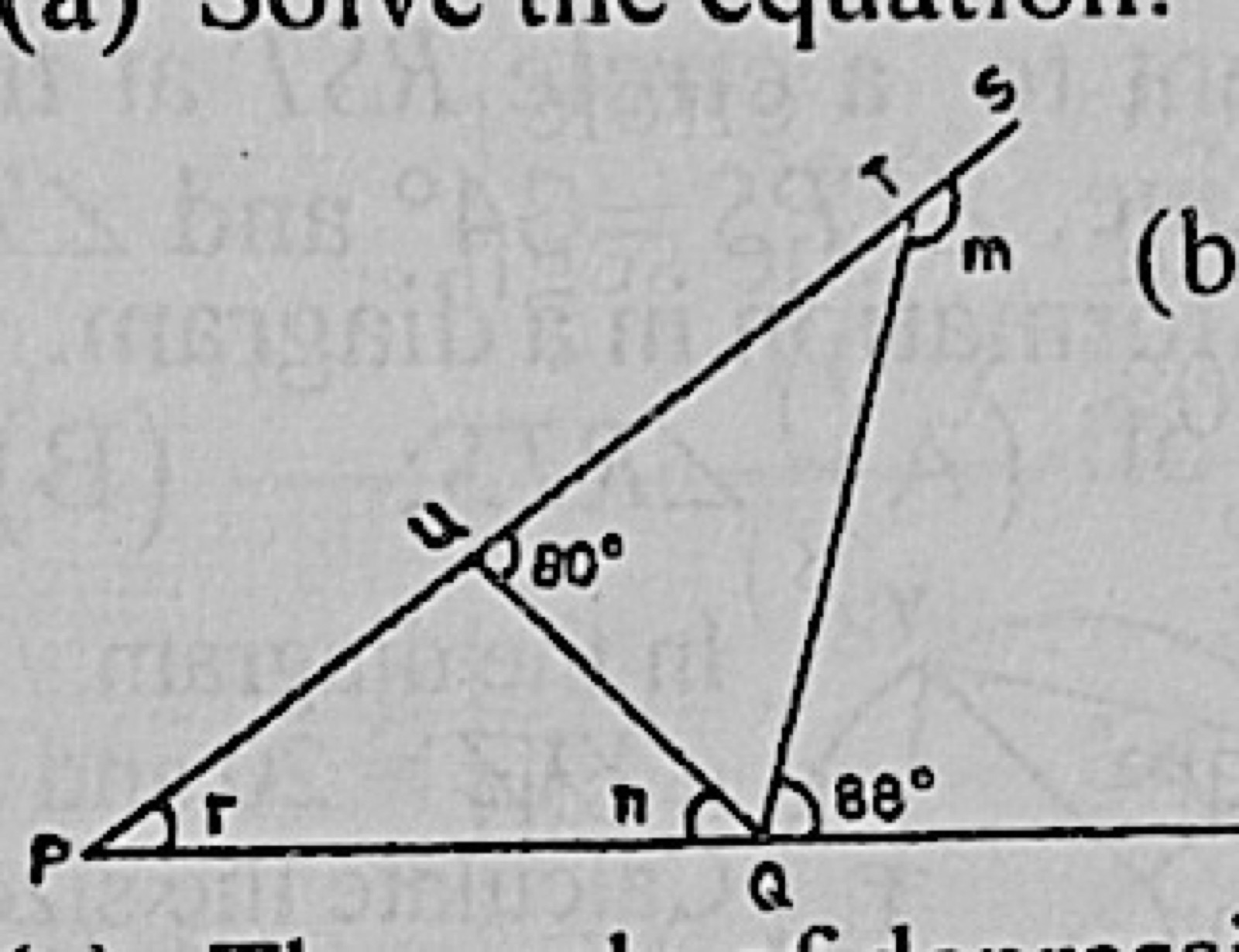
(b) In the diagram, ∠STQ = m, ∠TUQ = 80°, ∠UPQ = r, ∠PQU = n and ∠RQT = 88°. Find the value of (m + n).

Diagram for this question
Show the model answer
Model answer

(a) Multiply by 15: 10(3x − 5) − 9(2x − 3) = 45 → 12x − 23 = 45 → x = 68/12 = 5⅔
(b) ∠UQT = 180° − n − 88° = 92° − n (angles on straight line PQR)
∠UTQ = 180° − m (angles on straight line PUTS)
In triangle UQT: 80° + (92° − n) + (180° − m) = 180° → m + n = 172°

Explanation

Express the angles of triangle UQT in terms of m and n.

Open this question

Theory question 103

Trigonometry

(a) The angle of depression of a point P on the ground from the top T of a building is 23.6°. If the distance from P to the foot of the building is 50 m, calculate, correct to the nearest metre, the height of the building.
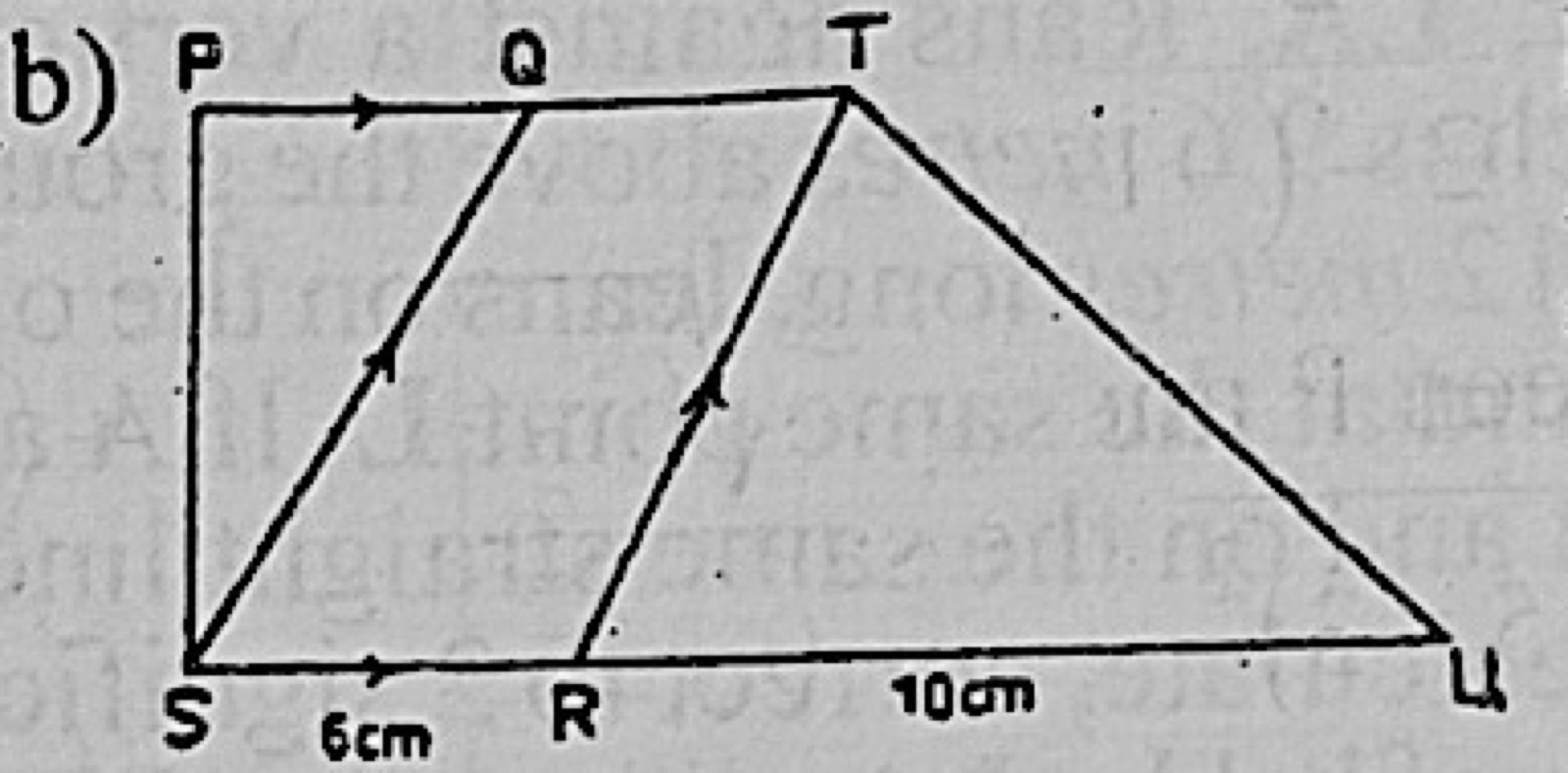
(b) In the diagram, PT//SU, QS//TR, |SR| = 6cm and |RU| = 10cm. If the area of ΔTRU = 45cm2, calculate the area of trapezium QTUS.

Diagram for this question
Show the model answer
Model answer

(a) Angle of elevation of T from P = 23.6°; h = 50 tan 23.6° ≈ 21.8 ≈ 22 m
(b) Area of ΔTRU = ½ × 10 × h = 45 → height h = 9 cm
QSRT is a parallelogram, so |QT| = |SR| = 6 cm; |SU| = 6 + 10 = 16 cm
Area of QTUS = ½(6 + 16) × 9 = 99 cm²

Explanation

The triangle and the trapezium have the same height.

Open this question

Theory question 104

Progressions

If the sixth term of an Arithmetic Progression (A. P.) is 37 and the sum of the first six terms is 147, find the: (a) first term; (b) sum of the first fifteen terms.

Show the model answer
Model answer

a + 5d = 37 and S₆ = 3(2a + 5d) = 147 → 2a + 5d = 49
Subtract: a = 12, so d = 5
(a) First term = 12
(b) S₁₅ = 15/2 (2 × 12 + 14 × 5) = 15/2 × 94 = 705

Explanation

Use Sn = n/2 (2a + (n − 1)d).

Open this question

Theory question 105

Sets

Out of 120 customers in a shop, 45 bought both bags and shoes. If all the customers bought either bags or shoes and 11 more customers bought shoes than bags; (a) illustrate this information in a diagram; (b) find the number of customers who bought shoes; (c) calculate the probability that a customer selected at random bought bags.

Show the model answer
Model answer

(a) Venn diagram: universal set 120, circles B (bags) and S (shoes) overlapping, intersection 45, nothing outside the circles.
(b) Let n(B) = x, n(S) = x + 11: x + x + 11 − 45 = 120 → 2x = 154 → x = 77
Customers who bought shoes = 88
(c) P(bags) = 77/120

Explanation

n(B ∪ S) = n(B) + n(S) − n(B ∩ S).

Open this question

Theory question 106

Commercial Arithmetic

(a) A manufacturing company requires 3 hours of direct labour to process every N87.00 worth of raw materials. If the company uses N30,450.00 worth of raw materials, what amount should it budget for direct labour at N18.25 per hour?
(b) An investor invested Nx in bank M at the rate of 6% simple interest per annum and N y in bank N at the rate of 8 % simple interest per annum. If a total of N8,000,000.00 was invested in two banks and the investor recieved a total of N2,320,000.00 as interest from two banks after 4 years, calculate the: (i) values of x and y; (ii) interest paid by the second bank.

Show the model answer
Model answer

(a) 30 450 ÷ 87 = 350 lots of N87; hours = 350 × 3 = 1050 h
Budget = 1050 × 18.25 = N19,162.50
(b)(i) x + y = 8 000 000; 0.06 × 4x + 0.08 × 4y = 2 320 000 → 0.24x + 0.32y = 2 320 000
0.24(8 000 000 − y) + 0.32y = 2 320 000 → 0.08y = 400 000 → y = N5,000,000, x = N3,000,000
(ii) Interest from bank N = 0.32 × 5 000 000 = N1,600,000

Explanation

Set up one equation for the money and one for the interest.

Open this question

Theory question 107

Graphs of Functions

(a) Copy and complete the table of values for the equation y = 2x2 − 7x − 9 for −3 ≤ x ≤ 6.
x: −3, −2, −1, 0, 1, 2, 3, 4, 5, 6
y: __, 13, __, −9, −14, __, −12, __, 6, __
(b) using scales of 2cm to 1 unit on the x-axis and 2cm to 4 units on the y-axis, draw the graph of y = 2x2 − 7x − 9 for −3 ≤ x ≤ 6.
(c) Use the graph to estimate the: (i) roots of equation 2x2 − 7x = 26; (ii) coordinates of the minimum point of y; (iii) range of values for which 2x2 − 7x < 9.

Show the model answer
Model answer

(a) x = −3: 30; x = −1: 0; x = 2: −15; x = 4: −5; x = 6: 21
(b) Plot the points and join with a smooth U-shaped curve.
(c)(i) 2x² − 7x − 9 = 17: draw y = 17; x ≈ −2.3 and x ≈ 5.8
(ii) Minimum point ≈ (1.75, −15.1)
(iii) 2x² − 7x − 9 < 0 where the curve is below the x-axis: −1 < x < 4.5

Explanation

For (c)(i), rewrite the equation so the left side matches y and draw the horizontal line y = 17.

Open this question

Theory question 108

Measures of Central Tendency

Marks: 1, 2, 3, 4, 5
Number of students: m + 2, m − 1, 2m − 3, m + 5, 3m − 4
The table shows the distribution of marks scored by some students in a test. (a) If the mean mark is 36/23, find the value of m. (b) Find the: (i) interquartile range; (ii) probability of selecting a student who scored at least 4 marks in the test.

Show the model answer
Model answer

(a) Σf = 8m − 1; Σfx = (m + 2) + 2(m − 1) + 3(2m − 3) + 4(m + 5) + 5(3m − 4) = 28m − 9
(28m − 9)/(8m − 1) = 75/23 → 644m − 207 = 600m − 75 → m = 3
(b) Frequencies 5, 2, 3, 8, 5 (23 students); cumulative 5, 7, 10, 18, 23
(i) Q₁ = 6th mark = 2; Q₃ = 18th mark = 4; interquartile range = 4 − 2 = 2
(ii) At least 4 marks: 8 + 5 = 13 students; probability = 13/23

Explanation

Write the mean as an improper fraction 75/23 before cross-multiplying.

Open this question

Theory question 109

Circle Theorems

(a) PQ is a tangent to a circle RST at the point S. PRT is a straight line, ∠TPS = 34° and ∠TSQ = 65°. (i) illustrate the information in a diagram. (ii) Find the value of: (A) ∠RTS; (B) ∠SRP
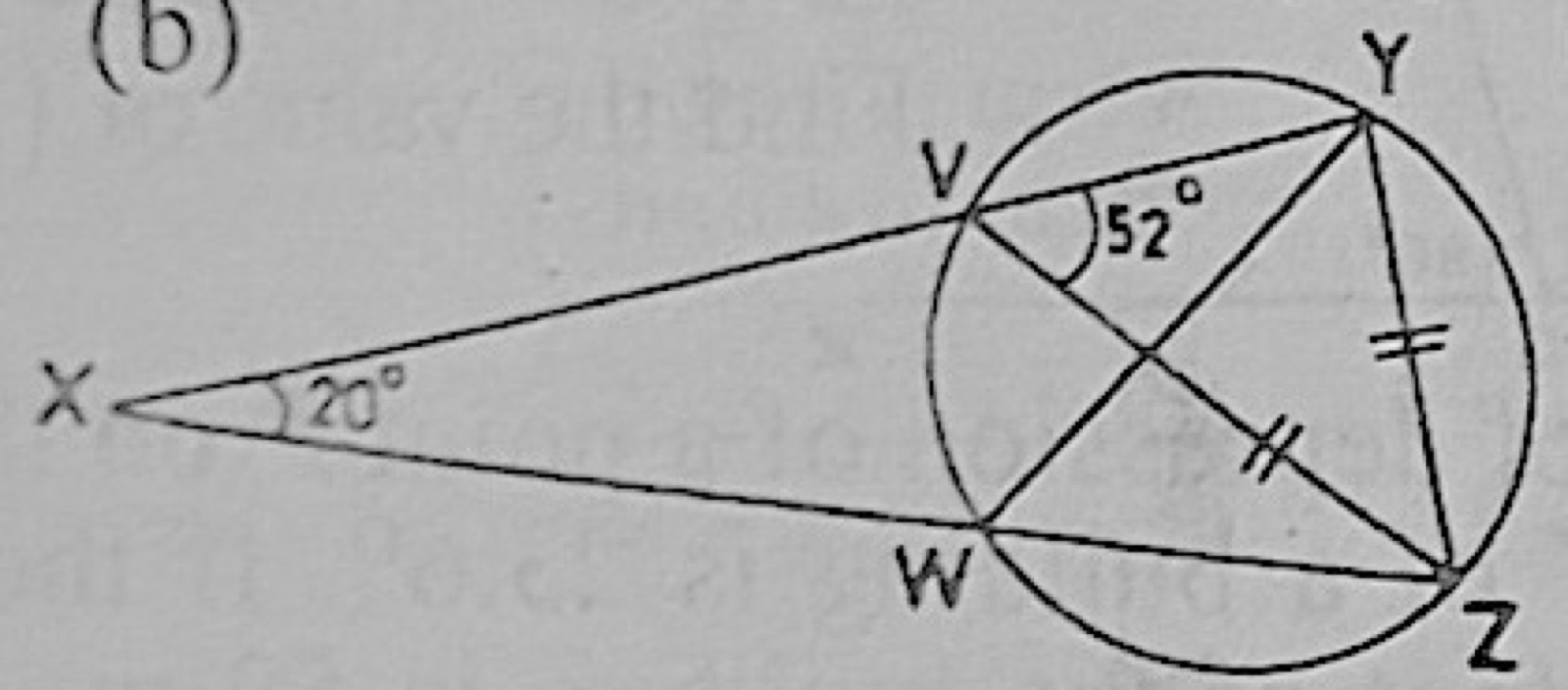
(b) In the diagram, |VZ| = |YZ|, ∠YXZ = 20° and ∠ZVY = 52°. Calculate the size of ∠WYZ.

Diagram for this question
Show the model answer
Model answer

(a)(i) Circle through R, S, T; tangent PSQ at S; P outside the circle with P, R, T on one straight line (R between P and T).
(ii)(A) ∠PST = 180° − 65° = 115°; in triangle PST, ∠RTS = 180° − 34° − 115° = 31°
(B) ∠SRT = ∠TSQ = 65° (alternate segment), so ∠SRP = 180° − 65° = 115°
(b) ∠ZYV = ∠ZVY = 52° (|VZ| = |YZ|)
In triangle XYZ: ∠XZY = 180° − 20° − 52° = 108°
∠YWZ = ∠YVZ = 52° (same segment)
In triangle WYZ: ∠WYZ = 180° − 108° − 52° = 20°

Explanation

Use the alternate segment theorem for the tangent at S.

Open this question

Theory question 110

Trigonometry

(a) Given that sin x = 5/13, 0° < x < 90°, find (cos x − 2 sin x)/(2 tan x).
(b) A ladder, LA, leans against a vertical pole at a point L which is 9.6 metres above the ground. Another ladder, LB, 12 metres long, leans on the opposite side of the pole and at the same point L. If A and B are 10 metres apart and on the same straight line as the foot of the pole, calculate, correct to 2 significant figures, the: (i) length of ladder LA; (ii) angle which LA makes with the ground.

Show the model answer
Model answer

(a) cos x = 12/13, tan x = 5/12
(12/13 − 10/13) ÷ (10/12) = 2/13 × 12/10 = 12/65
(b) Foot of pole to B = √(12² − 9.6²) = √51.84 = 7.2 m; so foot to A = 10 − 7.2 = 2.8 m
(i) LA = √(9.6² + 2.8²) = √100 = 10 m
(ii) tan θ = 9.6/2.8 → θ ≈ 73.7° ≈ 74°

Explanation

Use a right-angled triangle with sides 5, 12, 13 in (a).

Open this question

Theory question 111

Ratio, Percentages and Rates

(a) It takes 8 students two-thirds of an hour to fill 12 tanks with water. How many tanks of water will 4 students fill in one-third of an hour at the same rate?
(b) A chord, 20 cm long, is 12cm from the centre of circle. Calculate, correct to one decimal place, the: (i) angle subtended by the chord at the centre of the circle; (ii) perimeter of minor segment cut off by the chord. [Take π = 3.142]

Show the model answer
Model answer

(a) Half the students for half the time: 12 × ½ × ½ = 3 tanks
(b)(i) Half-angle: tan θ = 10/12 → θ = 39.8°; angle at centre ≈ 79.6°
(ii) Radius = √(10² + 12²) = √244 ≈ 15.62 cm
Arc = 79.61/360 × 2 × 3.142 × 15.62 ≈ 21.7 cm
Perimeter of minor segment ≈ 21.7 + 20 = 41.7 cm

Explanation

The perpendicular from the centre bisects the chord.

Open this question

Theory question 112

Quadratic Equations

(a) Using completing the square method, solve, correct to 2 decimal places, the equation 3y2 − 5y + 2 = 0.
(b) Given that M = (1 2 / 4 3), N = (m x / n y) and MN = (2 1 / 3 4), find the matrix N.

Show the model answer
Model answer

(a) y² − (5/3)y = −⅔ → (y − 5/6)² = 25/36 − 24/36 = 1/36
y − 5/6 = ±1/6 → y = 1.00 or y = 0.67
(b) MN = (m + 2n x + 2y / 4m + 3n 4x + 3y) = (2 1 / 3 4)
m + 2n = 2 and 4m + 3n = 3 → n = 1, m = 0
x + 2y = 1 and 4x + 3y = 4 → y = 0, x = 1
N = (0 1 / 1 0)

Explanation

Matrices are written row by row: (a b / c d) means top row a b, bottom row c d.

Open this question

Theory question 113

Binary Operations

(a) The operation (*) is defined on the set of real numbers, R, by x(*)y = (x + y)/2, x, y ∈ R. (i) Evaluate 3(*)⅖. (ii) If 8(*)y = 8¼, find the value of y.
(b) In ΔABC, AB = (−4 / 6) and AC = (3 / −8). If P is the mid point of AB, express CP as a column.

Show the model answer
Model answer

(a)(i) 3(*)⅖ = (3 + ⅖)/2 = 17/10 = 1.7
(ii) (8 + y)/2 = 8¼ → 8 + y = 16½ → y = 8½
(b) AP = ½AB = (−2 / 3)
CP = CA + AP = −AC + AP = (−3 / 8) + (−2 / 3) = (−5 / 11)
Explanation

Go from C back to A and then along to P.

Open this question