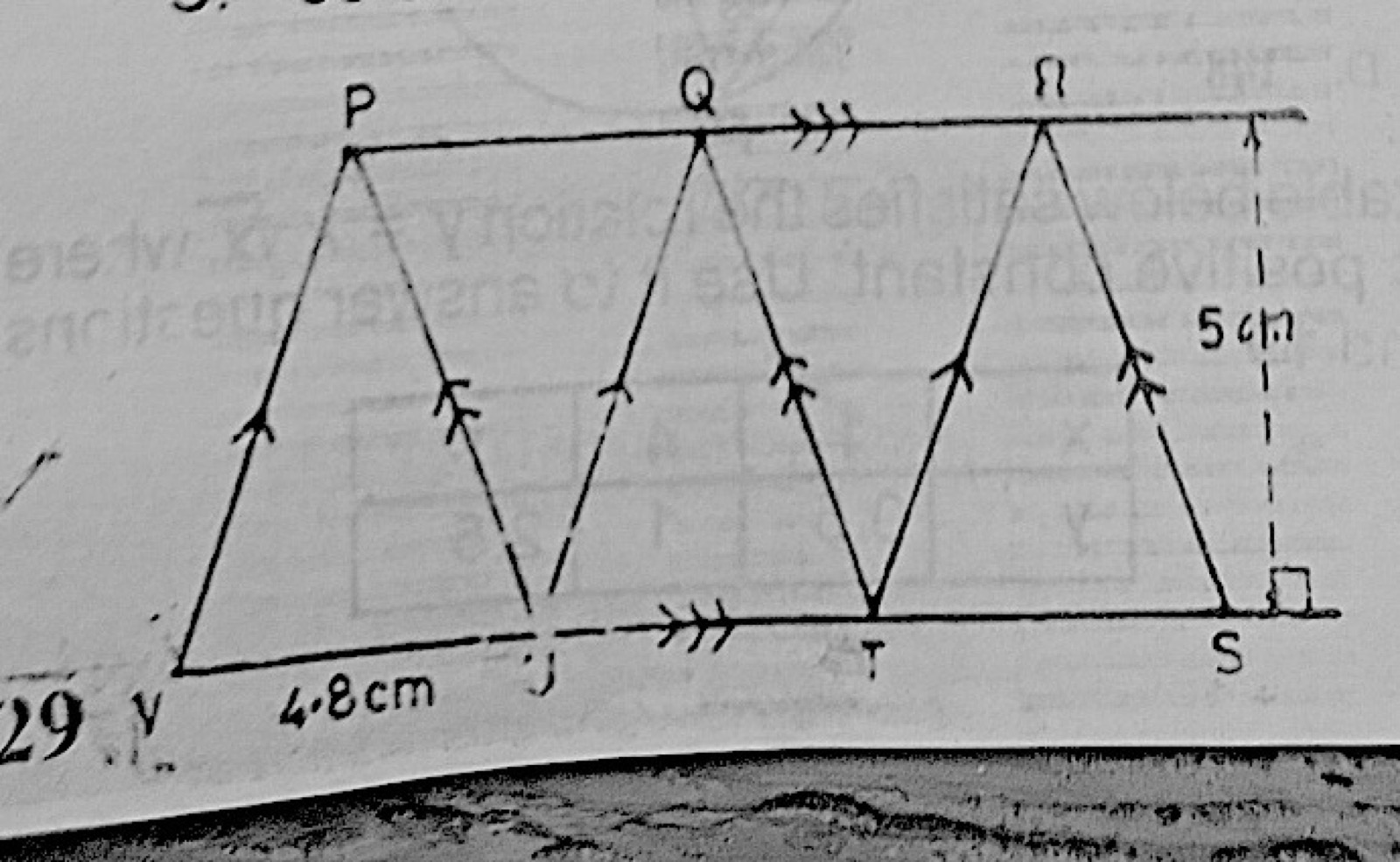
In the diagram, PQUV, PQTU, QRTU and QRST are parallelograms. |UV| = 4.8 cm and the perpendicular distance between PR and VS is 5 cm. Calculate the area of quadrilateral PRSV.
A.96 cm2
B.72 cm2
C.60 cm2
D.24 cm2
Show the answer and explanation
Answer: C (60 cm2)
Explanation
Opposite sides of parallelograms are equal, so PQ = QR = 4.8 cm and VU = UT = TS = 4.8 cm. PRSV is a trapezium with parallel sides 9.6 cm and 14.4 cm: area = ½(9.6 + 14.4) × 5 = 60 cm2.
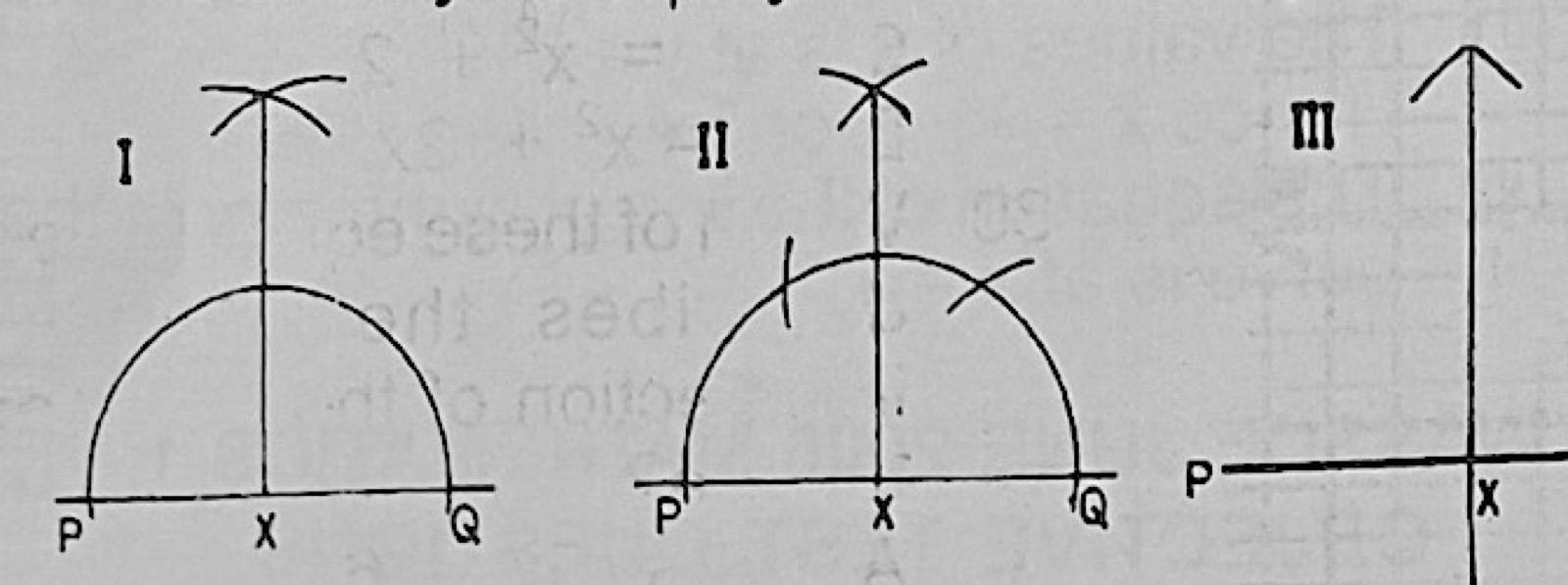
Which of these diagrams show(s) the correct method of constructing a perpendicular line to another line PQ at a given point X on PQ?
A.I only
B.II only
C.I and II only
D.I, II and III
Show the answer and explanation
Answer: C (I and II only)
Explanation
In I, arcs from P and Q (equidistant from X) meet above X, and the line through X and that point is perpendicular. In II, the 60° and 120° marks on the semicircle are used and the angle between them is bisected, which also gives 90°. III shows no construction at all.
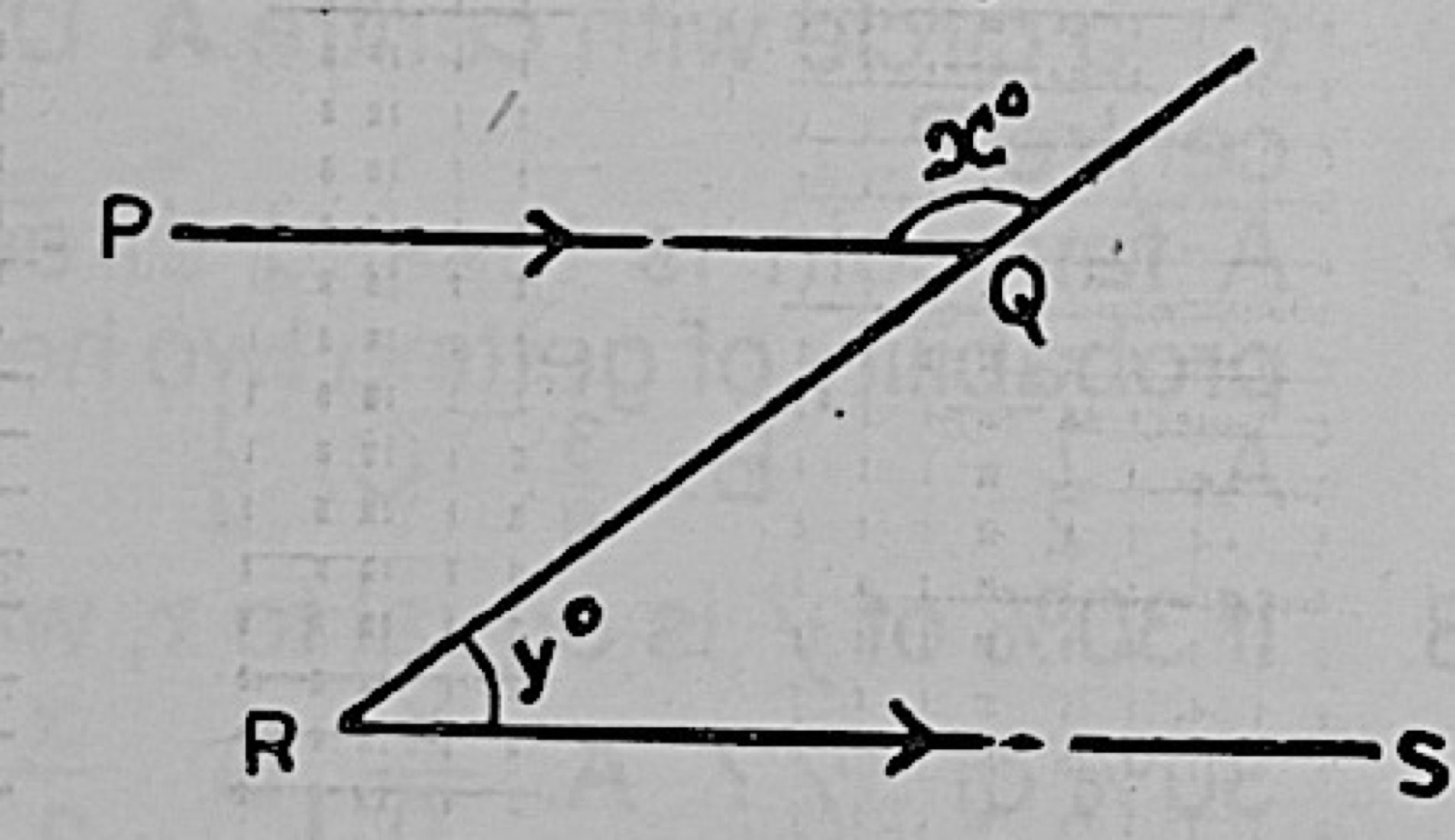
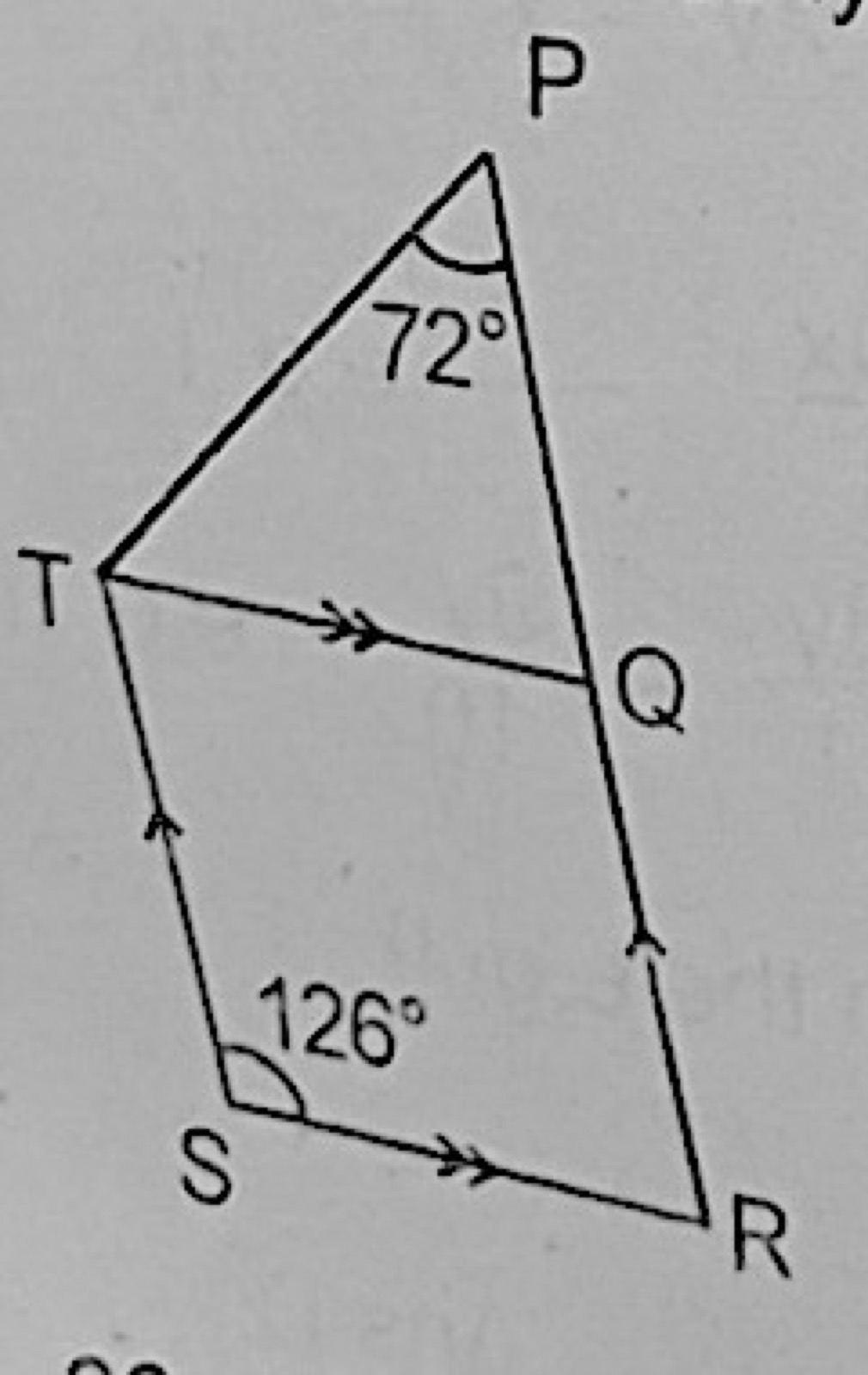
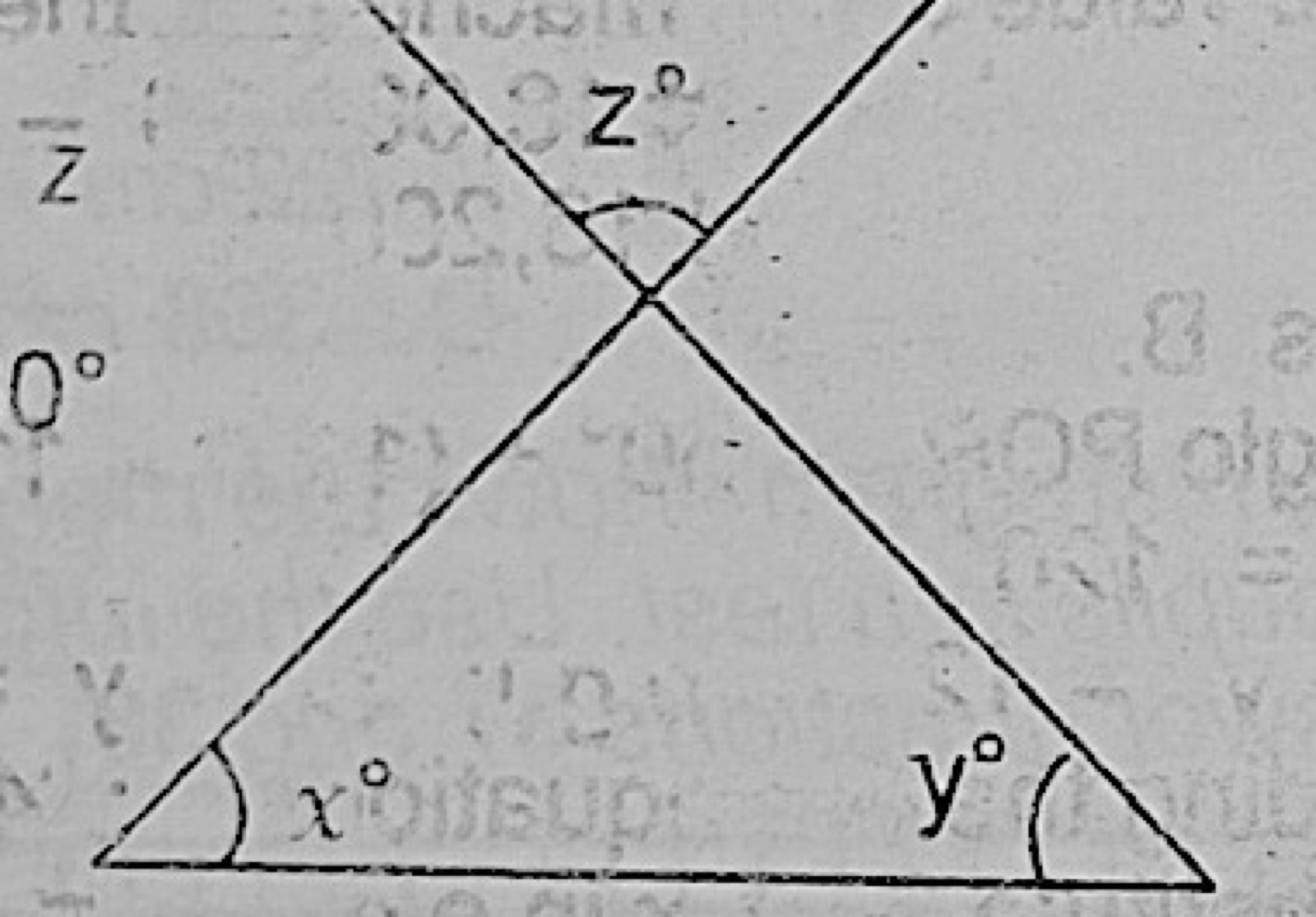
Because PQ is parallel to RS, the angle between RQ produced and the line through Q towards S equals y° (corresponding angles). That angle and x° lie on a straight line, so x° + y° = 180°.
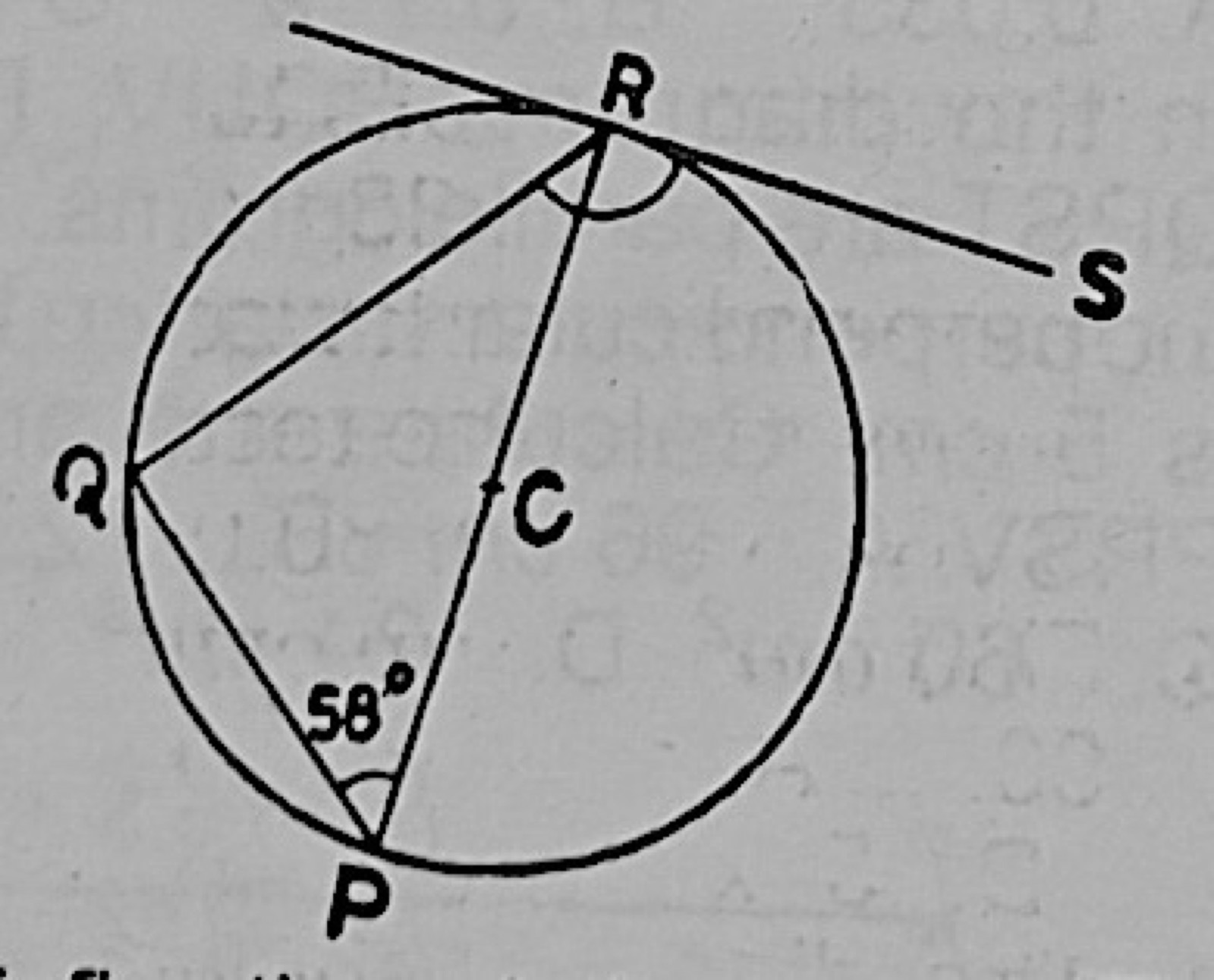
In the diagram, PR is a diameter of the circle centre O. RS is a tangent at R and QP̂R = 58°. Find ∠QRS.
A.112°
B.116°
C.122°
D.148°
Show the answer and explanation
Answer: C (122°)
Explanation
The angle in a semicircle is 90°, so ∠PQR = 90° and ∠QRP = 180° − 90° − 58° = 32°. The tangent is perpendicular to the diameter, so ∠PRS = 90°. ∠QRS = 32° + 90° = 122°.
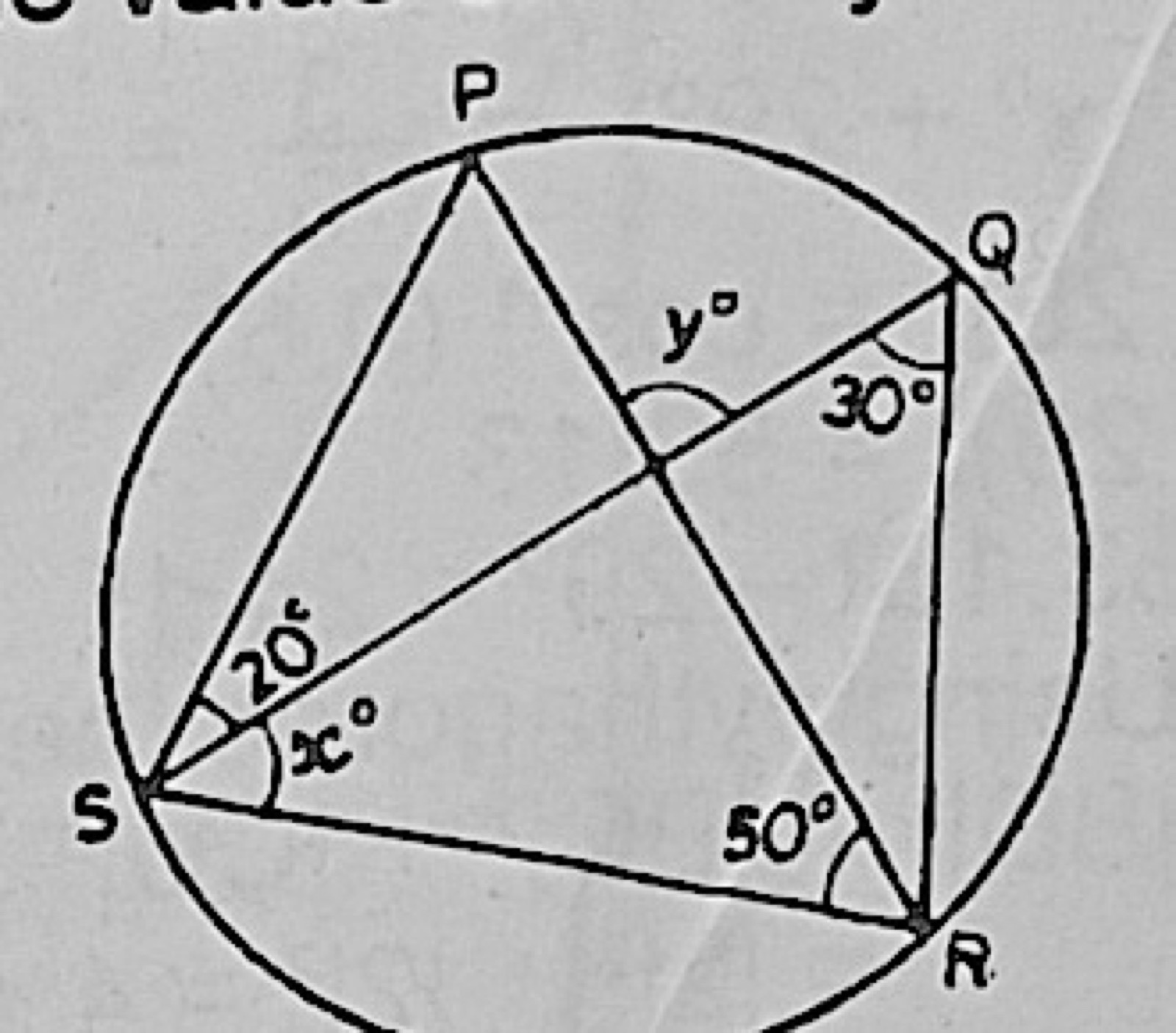
In the diagram P, Q, R, S are points on the circle, RQ̂S = 30°, PR̂S = 50° and PŜQ = 20°. What is the value of x° + y°?
A.260°
B.130°
C.100°
D.80°
Show the answer and explanation
Answer: B (130°)
Explanation
Angles in the same segment: y = ∠PQS = ∠PRS = 50° and ∠SPR = ∠SQR = 30°. In triangle PSR, ∠PSR = 180° − 50° − 30° = 100°, so x = 100° − 20° = 80°. x + y = 130°.
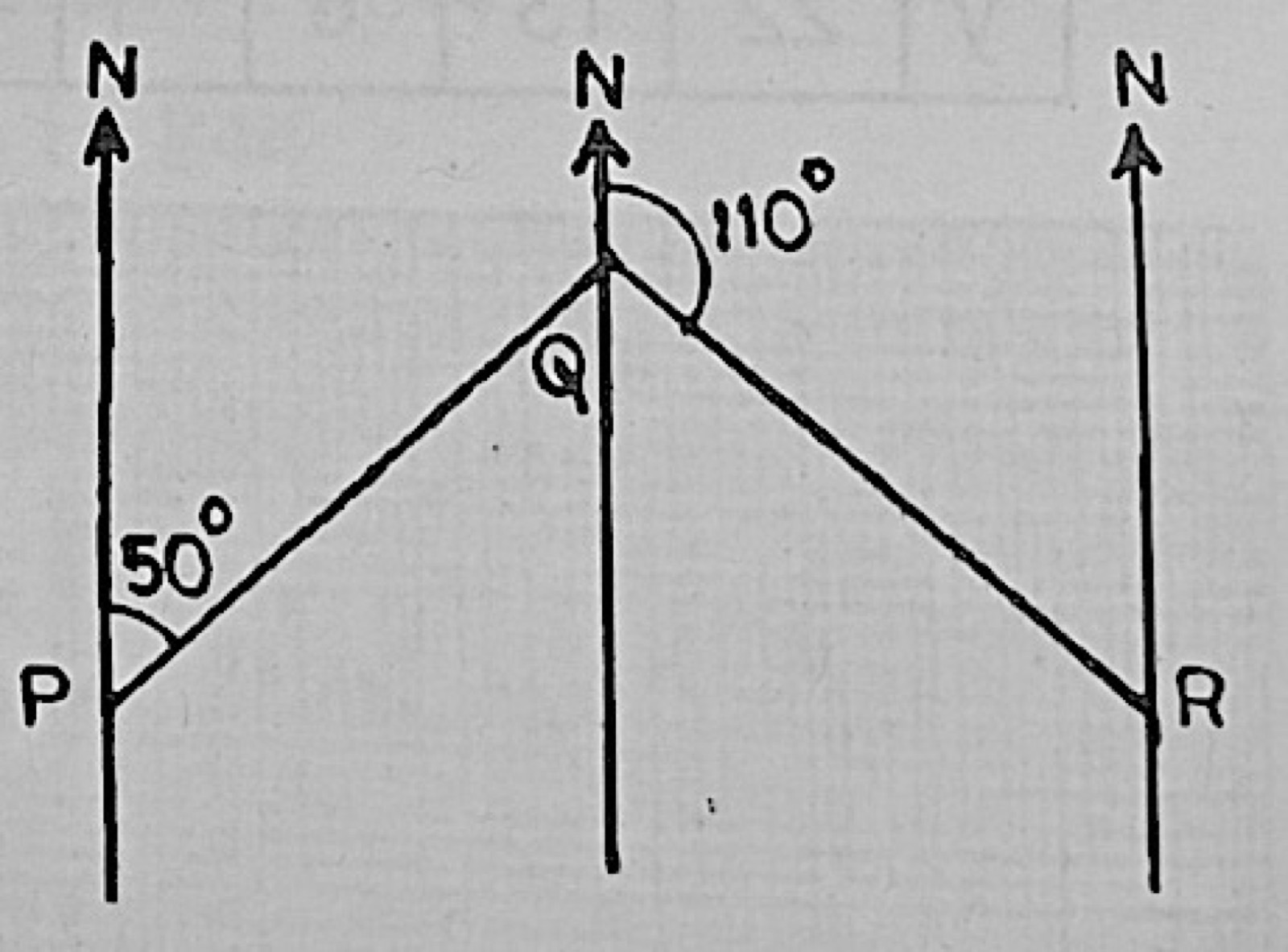
In the diagram, P, Q and R are three points in a plane such that the bearing of R from Q is 110° and the bearing of Q from P is 050°. Find angle PQR.
A.60°
B.70°
C.120°
D.160°
Show the answer and explanation
Answer: C (120°)
Explanation
The north lines are parallel, so the angle between QP and north at Q (measured on the south side) is 50° (alternate angles). ∠PQR = 50° + (180° − 110°) = 50° + 70° = 120°.
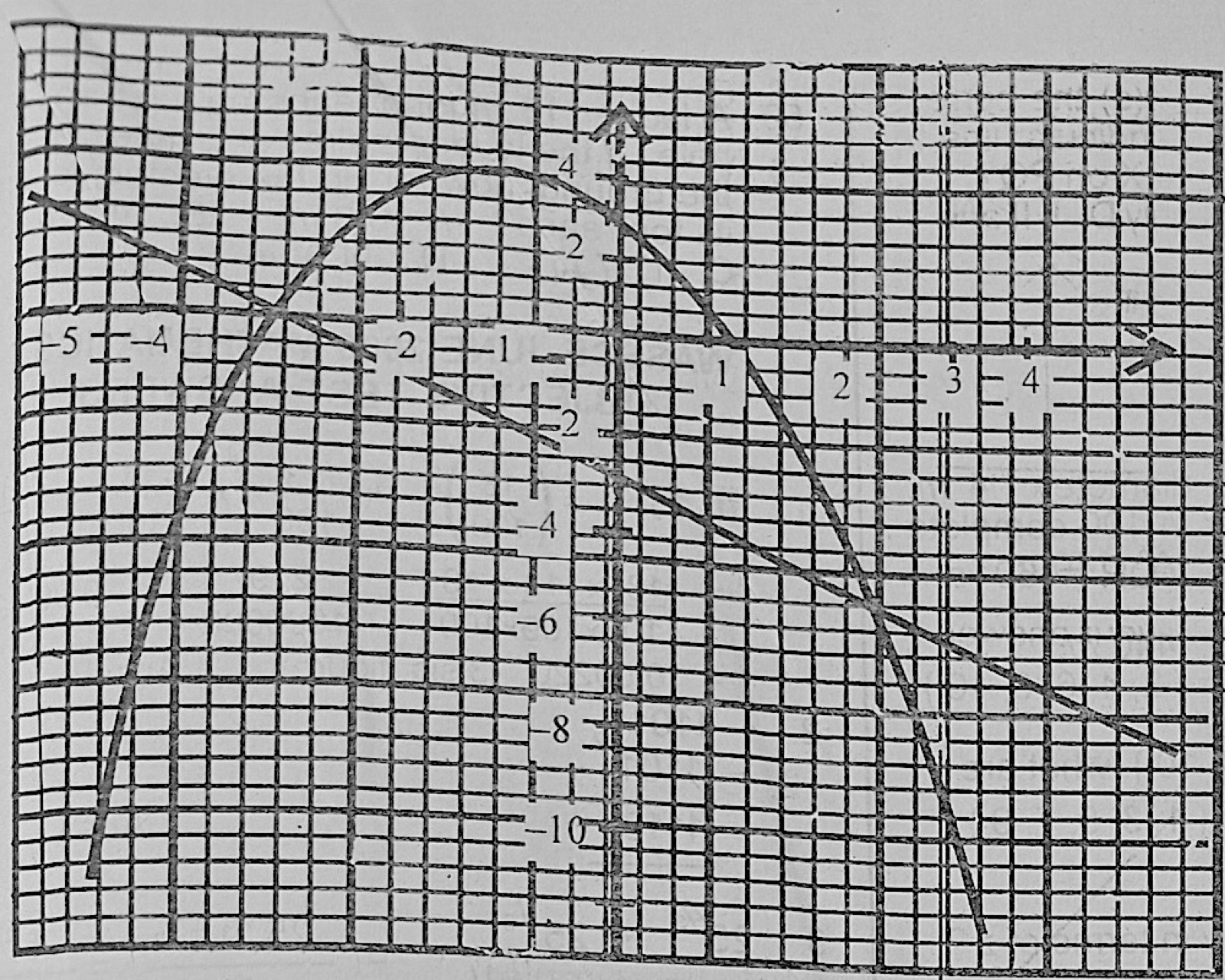
Use the graphs to answer this question. What is the equation of the curve?
A.y = 3 + 2x − x2
B.y = 3 − 2x − x2
C.y = x2 + 2x − 3
D.y = x2 + 2x + 3
Show the answer and explanation
Answer: B (y = 3 − 2x − x2)
Explanation
The curve cuts the x-axis at x = −3 and x = 1 and turns at the top, so y = −(x + 3)(x − 1) = 3 − 2x − x2. Check: at x = −1, y = 3 + 2 − 1 = 4, the highest point on the graph.
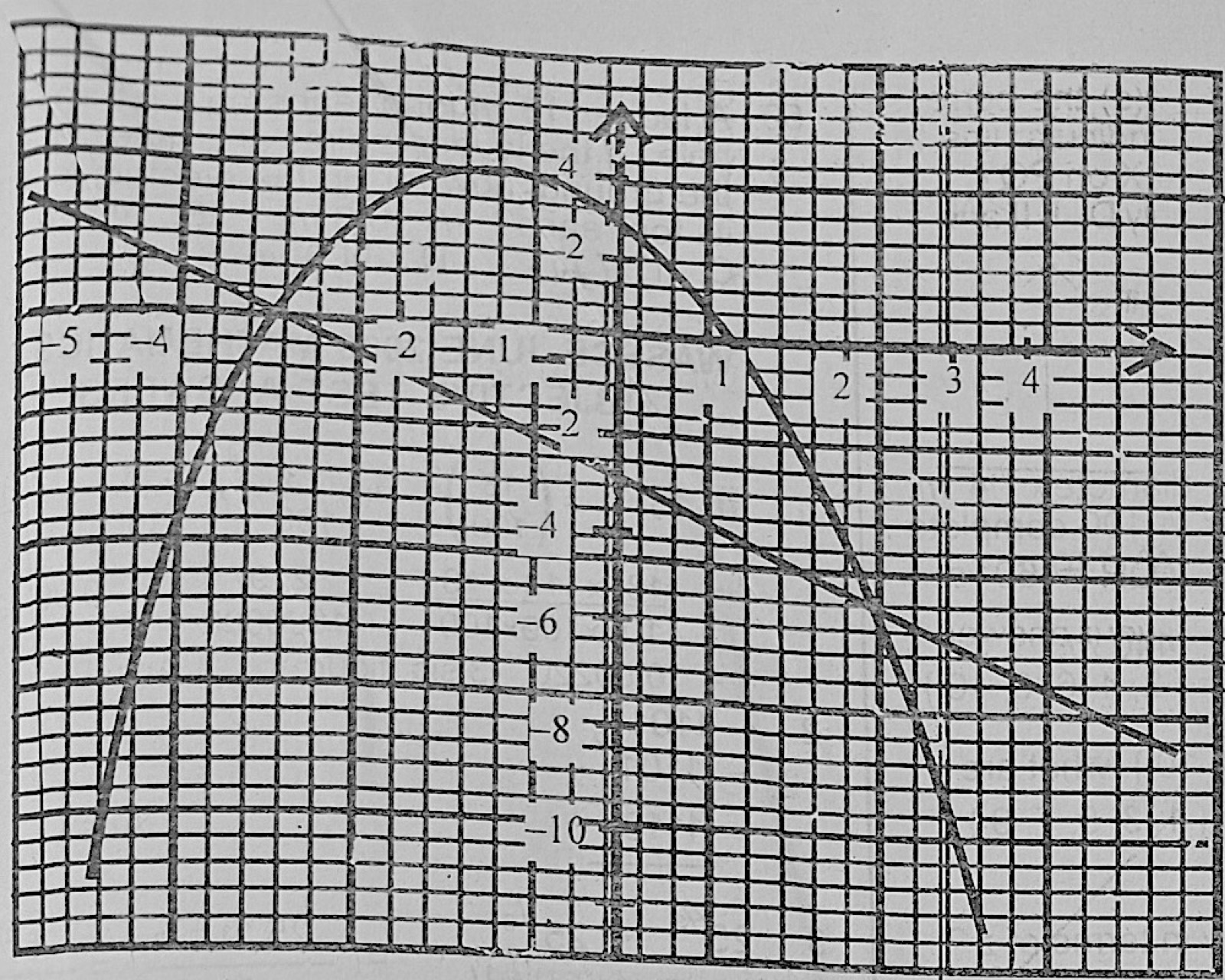
Use the graphs to answer this question. Which of these equations best describes the points of intersection of the curve and the line?
A.x2 + 5x − 6 = 0
B.x2 − 5x − 6 = 0
C.x2 + x − 6 = 0
D.x2 − x − 6 = 0
Show the answer and explanation
Answer: C (x2 + x − 6 = 0)
Explanation
The curve and the line meet at x = −3 and x = 2, so the equation is (x + 3)(x − 2) = 0, i.e. x2 + x − 6 = 0. (Line y = −x − 3 and curve y = 3 − 2x − x2 give the same equation.)
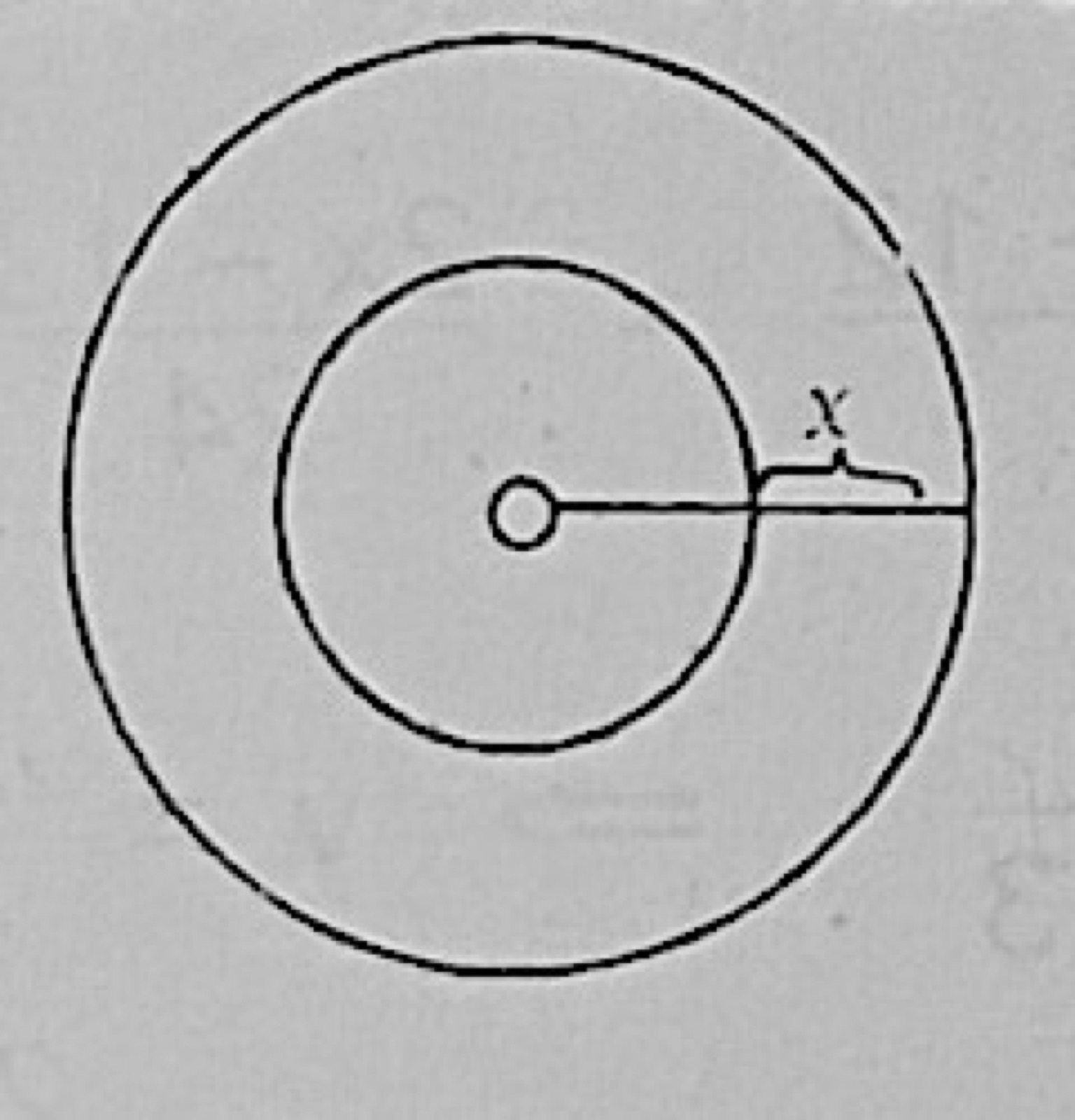
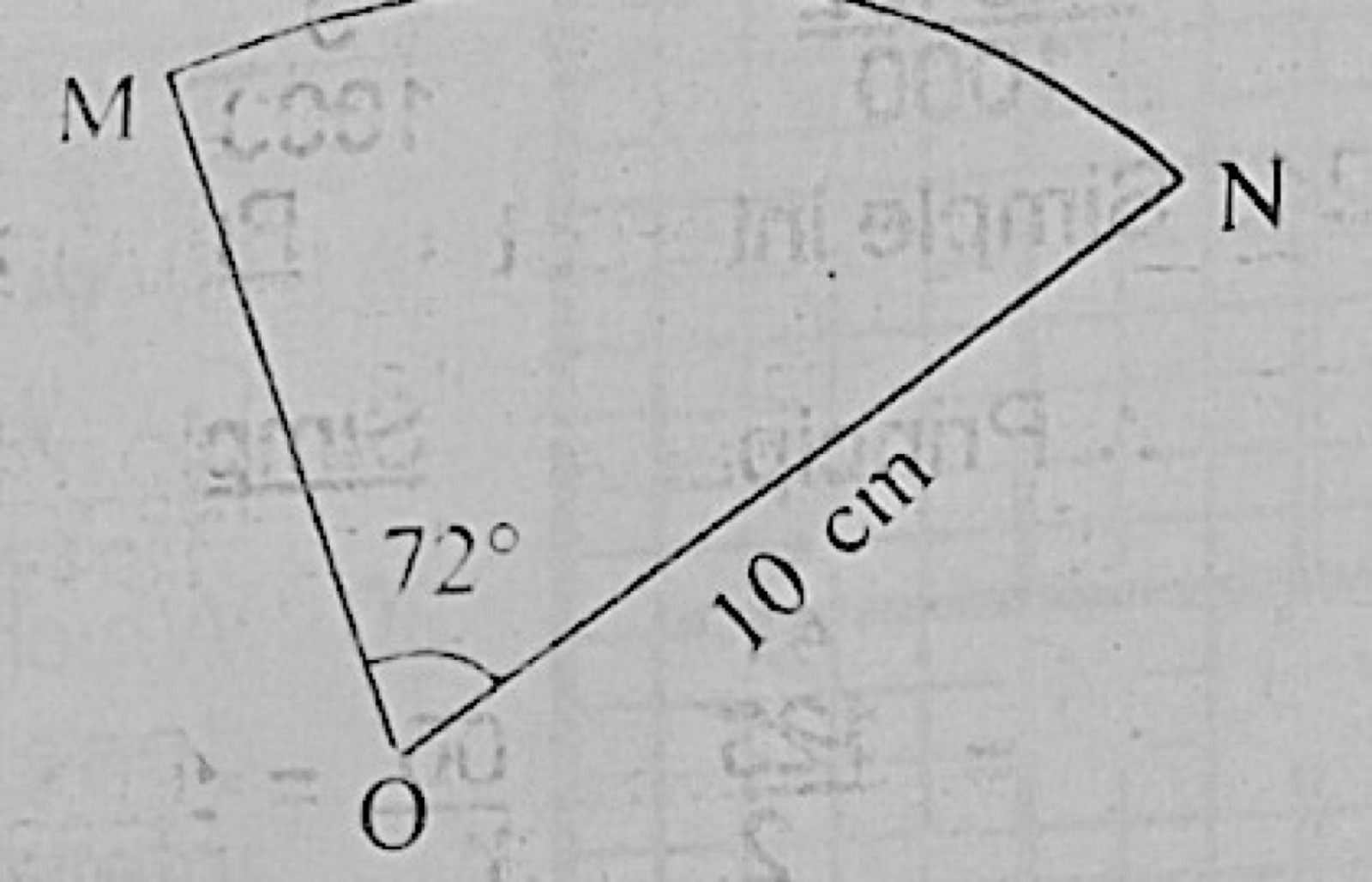
The diagram shows an arc MN of a circle centre O, with radius 10 cm. If ∠MON = 72°, calculate the length of the arc, correct to three significant figures. (Take π = 22/7)
A ladder 16 m long leans against an electric pole. If the ladder makes an angle of 65° with the ground, how far up the electric pole does its top reach?
(a) A dealer sold a car to a man and made a profit of 15%. The man then sold it to a woman for ₦120,175.00 at a loss of 5%. How much did the dealer buy the car? (b) The diameter of the wheel of a car is 36 cm. How many revolutions, correct to three significant figures, will it make to cover a distance of 1.05 km? (Take π = 22/7)
Show the model answer
Model answer
(a) The man sold at 95% of his cost: man's cost = 120,175 × 100/95 = ₦126,500. This is 115% of the dealer's cost: dealer's cost = 126,500 × 100/115 = ₦110,000.00. (b) Circumference = 22/7 × 36 = 792/7 cm ≈ 113.14 cm. 1.05 km = 105,000 cm. Revolutions = 105,000 ÷ 792/7 = 928.03 ≈ 928 (3 s.f.).
Explanation
Work backwards: a 5% loss means selling price = 95% of cost; a 15% profit means selling price = 115% of cost.
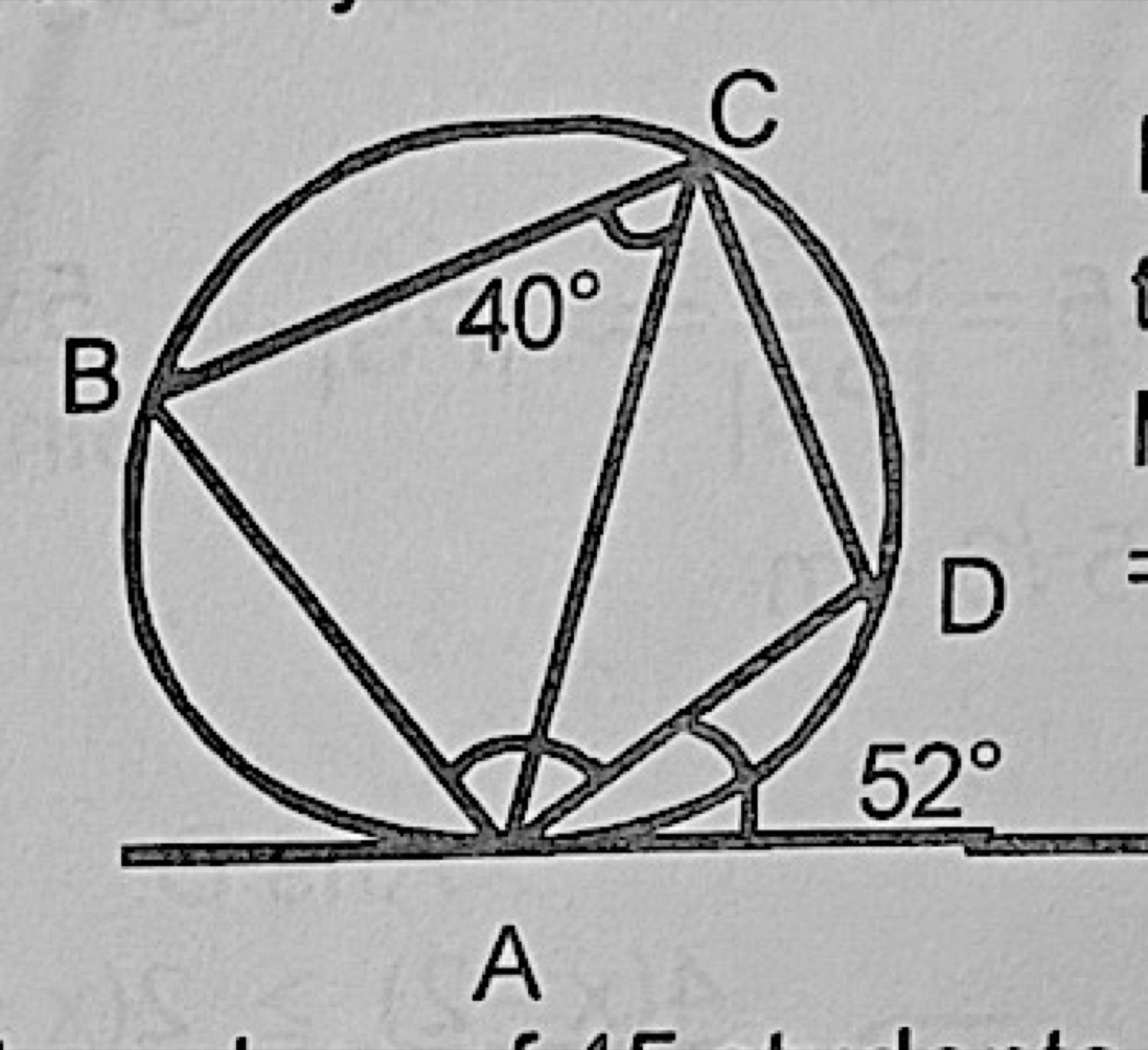
(a) Solve for x and y in the following equations: 2x − y = 9/2; x + 4y = 0 (b) In the diagram, TA is a tangent to the circle at A. If BĈA = 40° and DÂT = 52°, find BÂD.
Show the model answer
Model answer
(a) From x + 4y = 0, x = −4y. Substitute: −8y − y = 9/2, so −9y = 9/2 and y = −½. Then x = 2. (b) Angle in the alternate segment: ∠ACD = ∠DAT = 52°. ∠BCD = 40° + 52° = 92°. ABCD is cyclic, so ∠BAD = 180° − 92° = 88°.
Explanation
Use the alternate segment theorem, then opposite angles of a cyclic quadrilateral.
(a) In a class of 45 students, 32 offered Physics (P), 28 offered Government (G) and 12 did not offer any of the two subjects. (i) Draw the Venn diagram to represent the information. (ii) How many students offered both Physics and Government? (iii) What is n(P∪G)? (b) If p = 2u/(1 − u) and q = (1 + u)/(1 − u), express (p + q)/(p − q) in terms of u.
Show the model answer
Model answer
(a)(i) Two overlapping circles P and G inside U (45): P only = 32 − x, both = x, G only = 28 − x, outside = 12. (ii) (32 − x) + x + (28 − x) + 12 = 45, so 72 − x = 45 and x = 27. (iii) n(P∪G) = 45 − 12 = 33. (b) p + q = (2u + 1 + u)/(1 − u) = (3u + 1)/(1 − u); p − q = (2u − 1 − u)/(1 − u) = (u − 1)/(1 − u). (p + q)/(p − q) = (3u + 1)/(u − 1).
Explanation
Put x in the overlap and add all regions to the total.
Two fair dice are tossed together once. (a) Draw the sample space for the possible outcomes. (b) Find the probability of getting a total: (i) of 7 or 8; (ii) less than 4.
Show the model answer
Model answer
(a) A 6 × 6 table of pairs (1,1) to (6,6), or of totals 2 to 12: 36 equally likely outcomes. (b)(i) Total 7: 6 outcomes; total 8: 5 outcomes. P = 11/36. (ii) Total less than 4 (2 or 3): (1,1), (1,2), (2,1) = 3 outcomes. P = 3/36 = 1/12.
Explanation
Count outcomes from the sample space and divide by 36.
(a) A sector of a circle of radius 8 cm subtends an angle 90° at the centre of the circle. If the sector is folded without overlap to form the curved surface of a cone, find the: (i) base radius; (ii) height; (iii) volume, of the cone. (Take π = 22/7) (b) A map is drawn to a scale of 1:20,000. Use it to calculate the: (i) distance, in kilometres, represented by 4.5 cm on the map; (ii) distance, in metres, on the map, between two towns 16 km apart; (iii) area on the map, of a forest, which covers 85 km2.
Show the model answer
Model answer
(a)(i) Arc length = 90/360 × 2π × 8 = 4π = circumference of base 2πr, so r = 2 cm. (ii) Slant height 8 cm: h = √(82 − 22) = √60 ≈ 7.75 cm. (iii) V = ⅓ × 22/7 × 22 × 7.746 ≈ 32.5 cm3. (b)(i) 4.5 × 20,000 = 90,000 cm = 0.9 km. (ii) 16 km = 1,600,000 cm; 1,600,000 ÷ 20,000 = 80 cm = 0.8 m. (iii) 1 cm represents 200 m, so 1 cm2 represents 0.04 km2. 85 ÷ 0.04 = 2125 cm2.
Explanation
The arc of the sector becomes the circumference of the cone's base; the sector radius becomes the slant height.
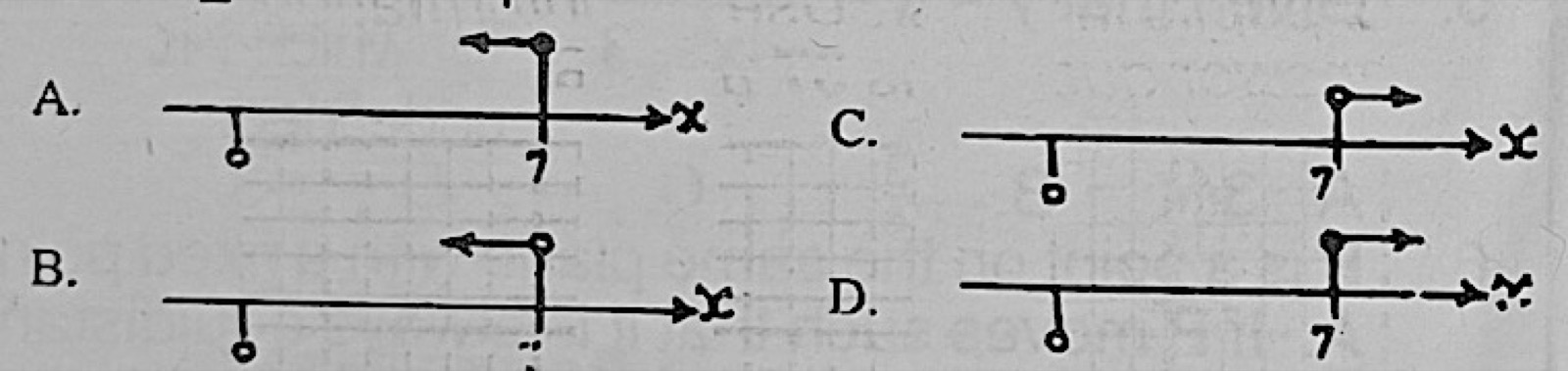
(a)(i) If 4x < 2 + 3x and x − 8 < 3x, what range of values of x satisfies both inequalities? (ii) Represent your result in (i) on the number line. (b) A shop is sending out a bill for an amount less than £100. The accountant interchanges the two digits and so overcharges the customer by £45. Given that the sum of the two digits is 9, find how much the bill should be.
Show the model answer
Model answer
(a)(i) 4x < 2 + 3x gives x < 2. x − 8 < 3x gives −8 < 2x, so x > −4. Together: −4 < x < 2. (ii) Number line with open circles at −4 and 2 and the segment between them marked. (b) Let the bill be 10t + u with t + u = 9. (10u + t) − (10t + u) = 45 gives 9(u − t) = 45, so u − t = 5. Solving: u = 7, t = 2. The bill should be £27.
Explanation
Use open circles because the inequalities are strict.
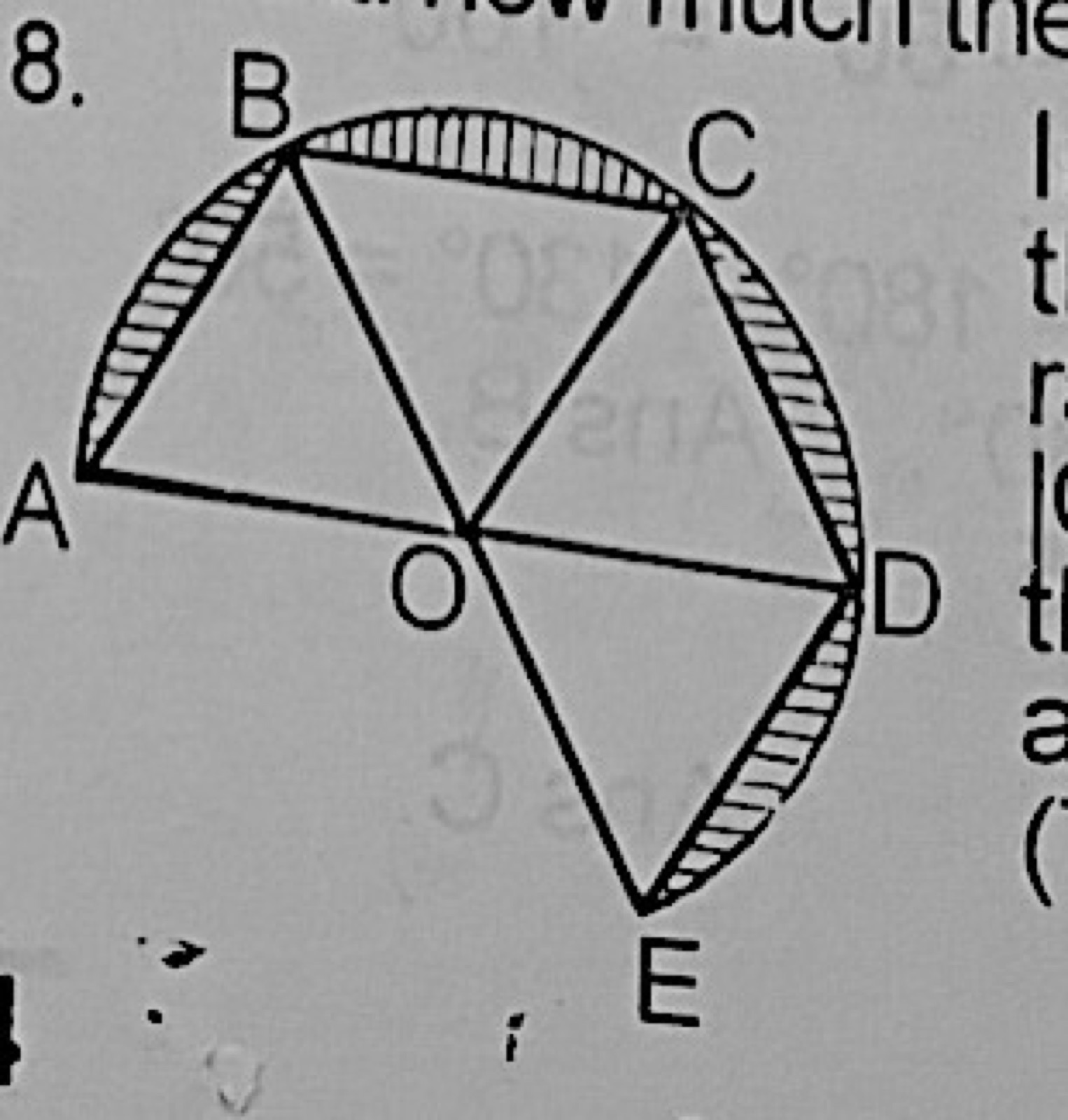
In the diagram, ABCDEO is two-thirds of a circle centre O. The radius AO is 7 cm and |AB| = |BC| = |CD| = |DE|. Calculate, correct to the nearest whole number, the area of the shaded portion. (Take π = 22/7)
Show the model answer
Model answer
Two-thirds of a circle is 240°, shared by 4 equal chords: each chord subtends 60° at O. Area of one sector = 60/360 × 22/7 × 72 = 25.67 cm2. Area of one triangle = ½ × 7 × 7 × sin 60° = 21.22 cm2. Shaded area = 4 × (25.67 − 21.22) = 4 × 4.45 ≈ 17.8 cm2 ≈ 18 cm2.
(a) Using a ruler and a pair of compasses only: (i) construct ΔXYZ such that |XY| = 8 cm and ∠YXZ = ∠ZYX = 45°; (ii) locate a point P inside the triangle equidistant from XY and XZ, and also equidistant from YX and YZ; (iii) construct a circle touching the three sides of the triangle. (iv) measure the radius of the circle. (b) The length of the sides of a hexagon are x − 5, 2x, 2x + 7, 2x and 2x − 1. If the perimeter is 144 cm, find the value of x.
Show the model answer
Model answer
(a)(i) Draw XY = 8 cm; construct 45° at X and at Y (bisect a constructed 90°); the arms meet at Z. (ii) Bisect ∠X and ∠Y; P is where the bisectors meet. (iii) Drop a perpendicular from P to XY; with centre P and that radius draw the inscribed circle. (iv) Radius ≈ 1.7 cm (exact value 4√2 − 4 ≈ 1.66 cm). (b) Perimeter: (x − 5) + 2x + 2x + (2x + 7) + 2x + (2x − 1) = 11x + 1 = 144, so x = 13.
Explanation
The point equidistant from two lines lies on the bisector of the angle between them.
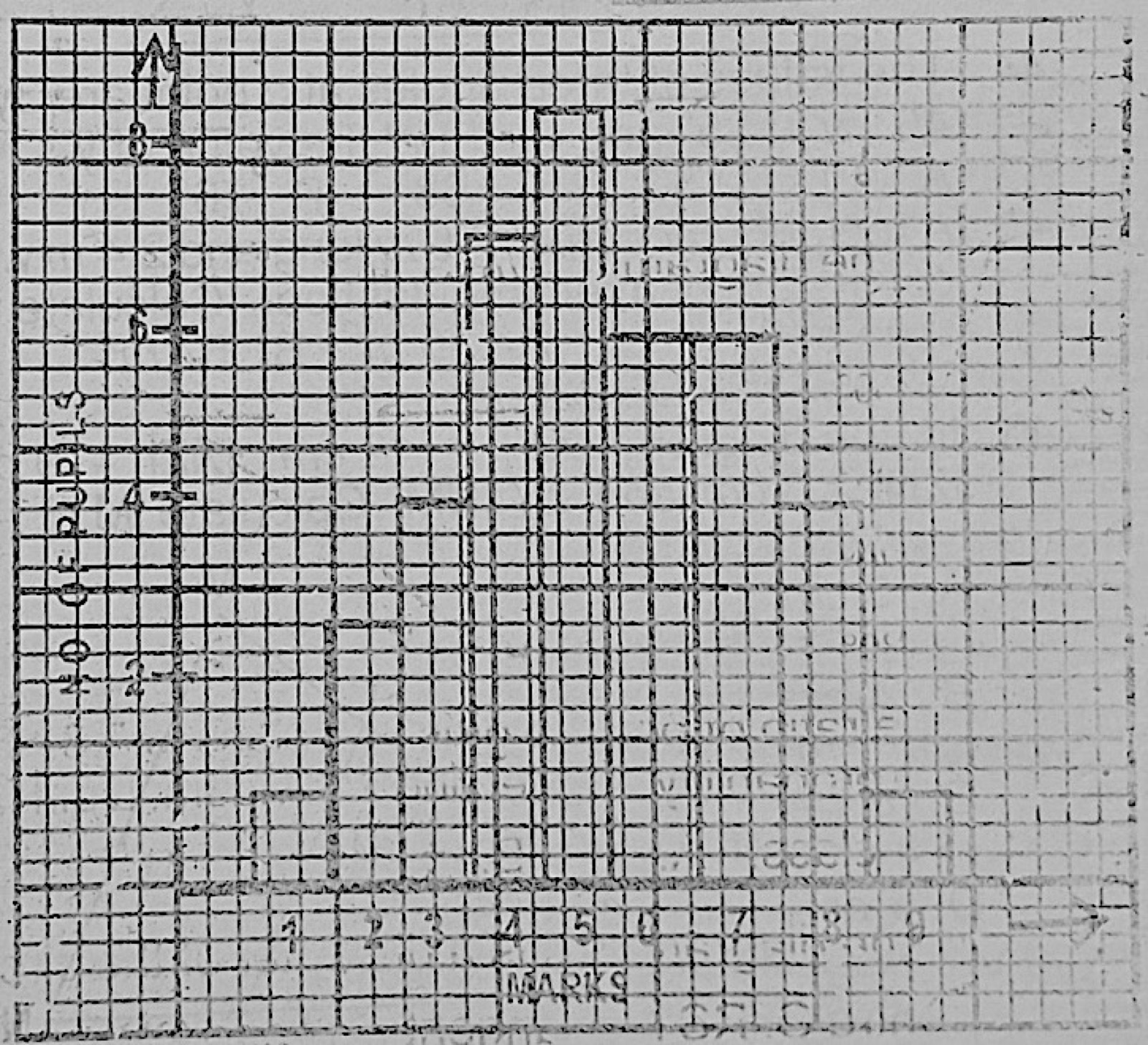
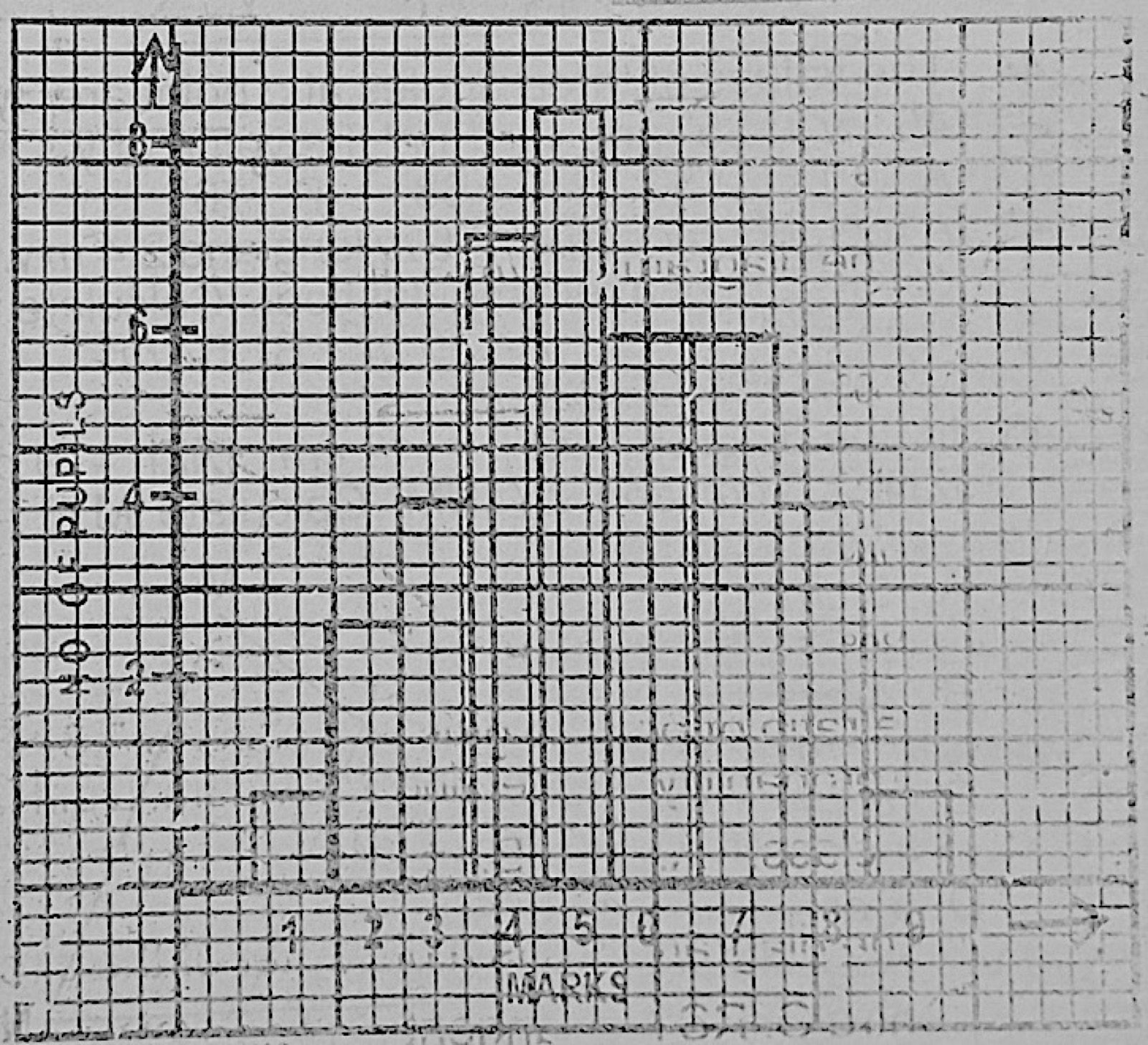
The following table shows the distribution of test scores in a class. Scores: 1, 2, 3, 4, 5, 7, 8, 9, 10 No. of Pupils: 1, 1, 5, 3, k2 + 1, 6, 2, 3, 4 (a) If the mean score of the class is 6, find the: (i) value of k; (ii) median score. (b) Draw a bar chart for the distribution. (c) If a pupil is picked at random from the class, what is the probability that he/she will score less than 6?
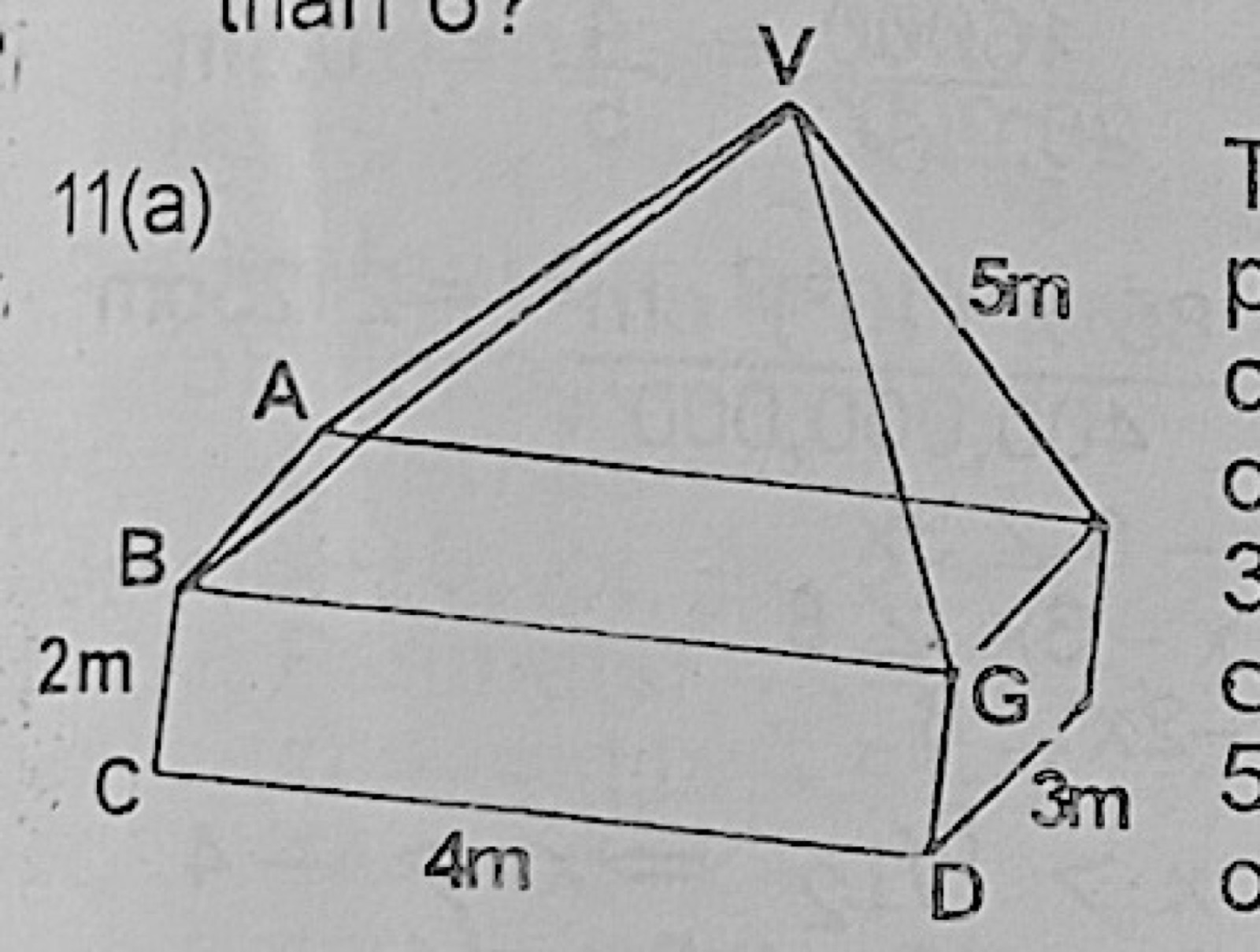
(a) The diagram shows a pyramid standing on a cuboid. The dimensions of the cuboid are 4 m by 3 m by 2 m and the slant edge of the pyramid is 5 m. Calculate the volume of the shape. (b) The 2nd, 3rd and 4th terms of an AP are x − 2, 5 and x + 2 respectively. Calculate the value of x.
Show the model answer
Model answer
(a) Cuboid volume = 4 × 3 × 2 = 24 m3. Diagonal of the 4 m × 3 m top = √(16 + 9) = 5 m, half-diagonal = 2.5 m. Pyramid height = √(52 − 2.52) = √18.75 ≈ 4.33 m. Pyramid volume = ⅓ × 12 × 4.33 ≈ 17.32 m3. Total ≈ 41.3 m3. (b) Common difference: 5 − (x − 2) = (x + 2) − 5, so 7 − x = x − 3 and x = 5.
Explanation
The pyramid's vertex is above the centre of the top face, so use half the diagonal with Pythagoras.
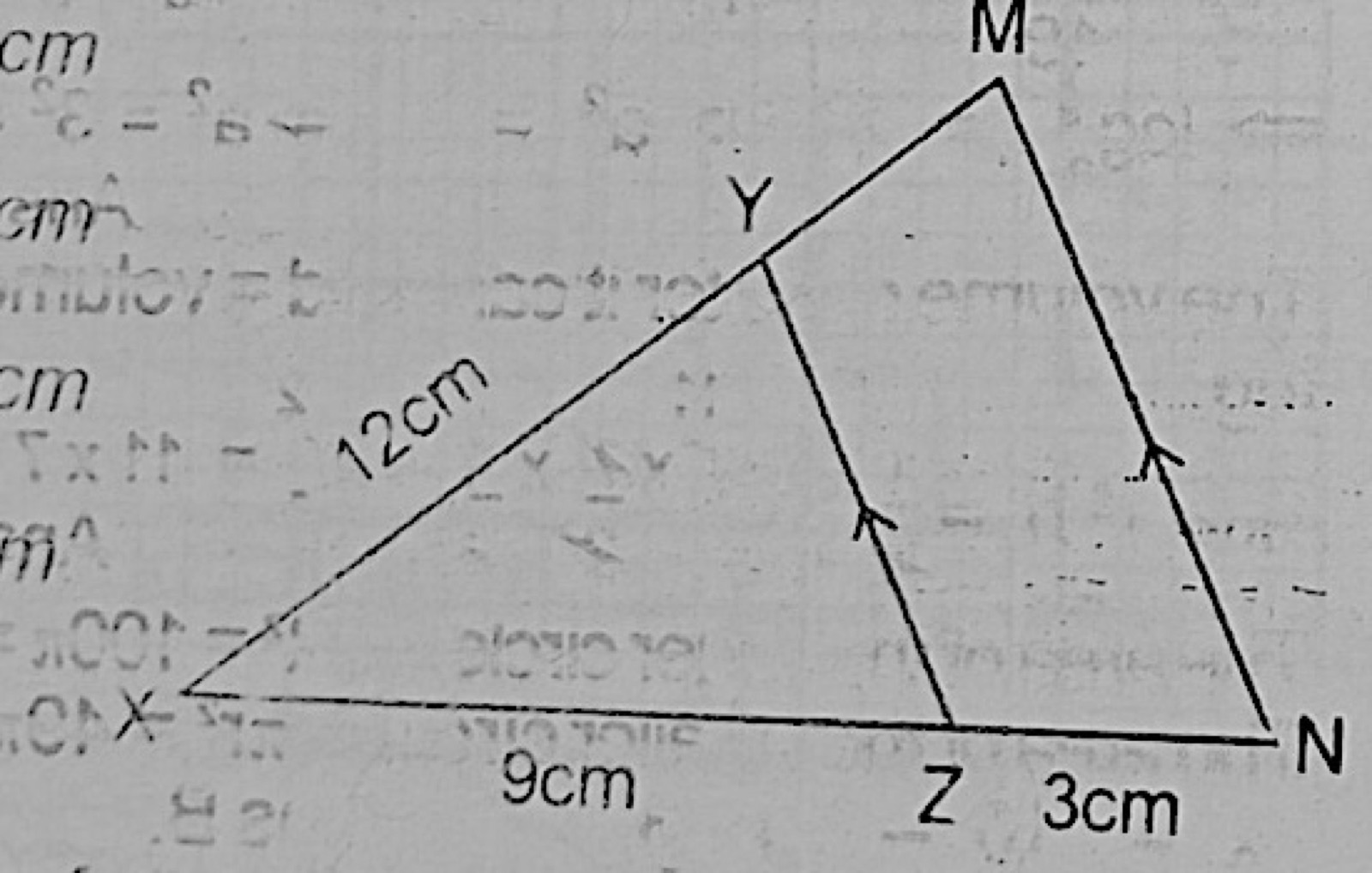
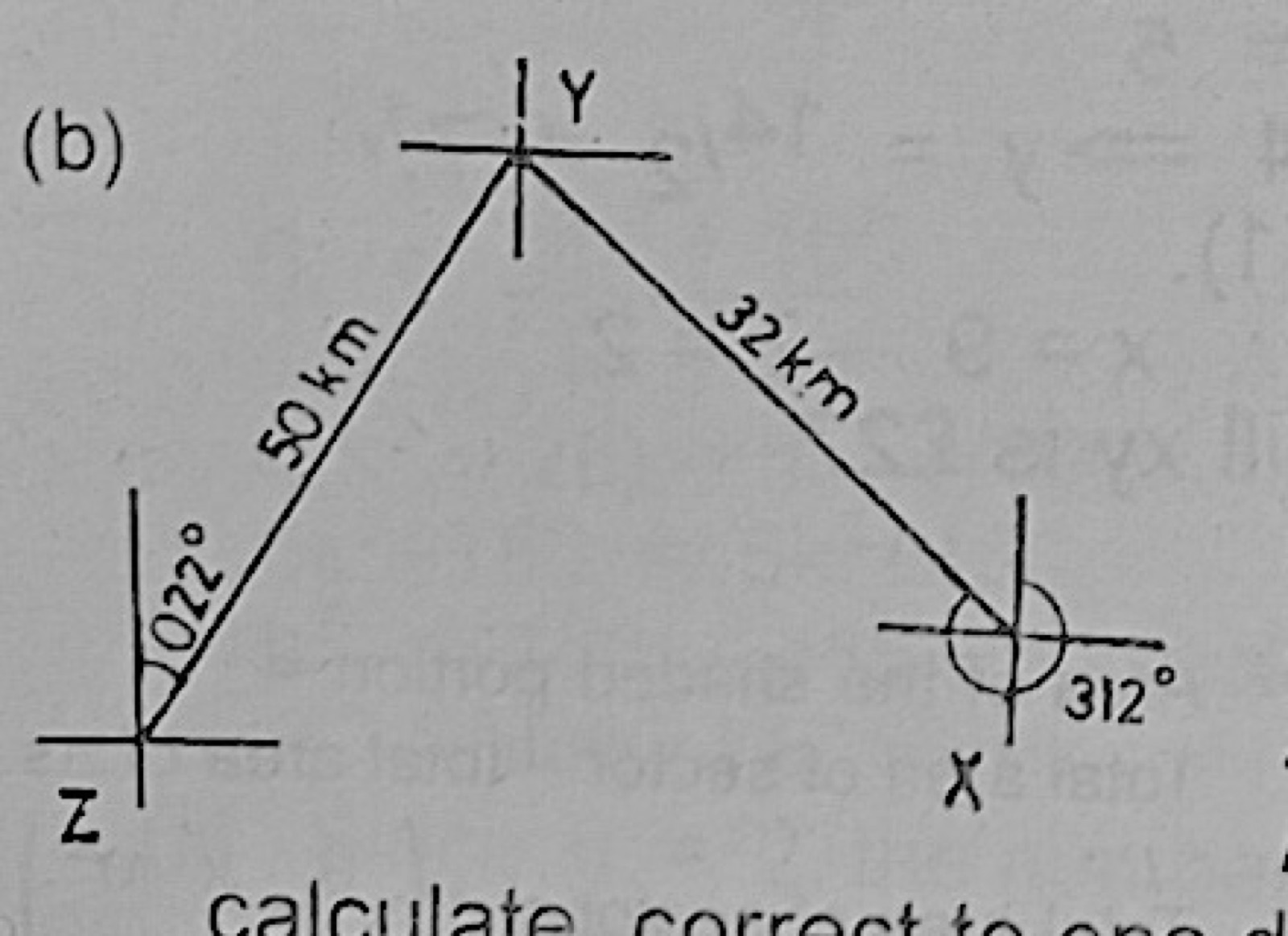
(a) Two lines AB and CD intersect at X such that CÂX is equal to BD̂X. If |AX| = 6 cm, |XB| = 4 cm and |CX| = 3 cm, find |XD|. (b) The diagram shows the positions of three points X, Y and Z on a horizontal plane. The bearing of Y from X is 312° and that of Y from Z is 022°. If |XY| = 32 km and |ZY| = 50 km, calculate, correct to one decimal place: (i) |XZ|; (ii) the bearing of Z from X.
Show the model answer
Model answer
(a) ∠CAX = ∠BDX and ∠AXC = ∠DXB (vertically opposite), so ΔAXC ~ ΔDXB with A↔D, C↔B. AX/DX = CX/BX: 6/|XD| = 3/4, so |XD| = 8 cm. (b)(i) At Y: bearing of X from Y = 132°, bearing of Z from Y = 202°, so ∠XYZ = 70°. |XZ|2 = 322 + 502 − 2(32)(50) cos 70° = 3524 − 1094.5 = 2429.5, so |XZ| ≈ 49.3 km. (ii) sin ∠YXZ = 50 sin 70°/49.29 ≈ 0.9532, ∠YXZ ≈ 72.4°. Bearing of Z from X = 312° − 72.4° = 239.6°.
Explanation
Back bearings differ by 180°: use them to find the angle at Y, then the cosine and sine rules.
(Questions 14 and 15 are for candidates in Ghana, Sierra Leone and The Gambia only.) (a) Using a scale of 2 cm to 2 units on both axes, draw, on a graph paper, two perpendicular axes Ox and Oy for −8 ≤ x ≤ 8 and −8 ≤ y ≤ 8. (b) Draw the ΔPQR with vertices P(2, 5), Q(2, −1) and R(8, 4). (c) Describe fully, two different transformations that map P to Q. (d) Draw the image ΔP1Q1R1 of ΔPQR under a rotation through 90° anticlockwise about O. (e) Find the vector PP1.
Show the model answer
Model answer
(a), (b) Axes drawn to scale; triangle with P(2, 5), Q(2, −1), R(8, 4). (c) Any two of: a reflection in the line y = 2; a translation by the vector (0, −6); a rotation of 180° about (2, 2). (d) Rotation 90° anticlockwise about O maps (x, y) to (−y, x): P1(−5, 2), Q1(1, 2), R1(−4, 8). (e) PP1 = (−5 − 2, 2 − 5) = (−7, −3), written as a column vector.
Explanation
P and Q have the same x-coordinate, so the mirror line is halfway between y = 5 and y = −1.
(a) Under the mapping h(x) = px2 − qx + 2, the image of 3 is 14 and the image of −2 is 24. Find: (i) the values of p and q; (ii) the elements whose image is 4. (b) In the pentagon ABCDE, AE = (2, 0), DE = (−1, 2), DC = (−2, −5) and CB = (−3, 2) (column vectors). Show that ABCD is a parallelogram.
Show the model answer
Model answer
(a)(i) h(3) = 9p − 3q + 2 = 14 gives 3p − q = 4. h(−2) = 4p + 2q + 2 = 24 gives 2p + q = 11. Adding: 5p = 15, p = 3, q = 5. (ii) 3x2 − 5x + 2 = 4 → 3x2 − 5x − 2 = 0 → (3x + 1)(x − 2) = 0, so x = 2 or x = −⅓. (b) AB = AE + ED + DC + CB = (2, 0) + (1, −2) + (−2, −5) + (−3, 2) = (−2, −5). AB = DC = (−2, −5), so AB and DC are equal and parallel; therefore ABCD is a parallelogram.
Explanation
A quadrilateral with one pair of opposite sides equal and parallel is a parallelogram.