Question 1
Poetry: GeneralA short and witty poem is known as
- A.a ballad
- B.an epigram
- C.an epic
- D.a lyric
Show the answer and explanation
Answer: B (an epigram)
Explanation
An epigram is a short, witty poem or saying.
68 questions. Try each one, then open the answer to check yourself and read the explanation.
A short and witty poem is known as
Answer: B (an epigram)
An epigram is a short, witty poem or saying.
A literary work which extols one's virtues and accomplishments is
Answer: A (a eulogy)
A eulogy praises a person's good qualities and achievements, often at a funeral.
George Orwell's Animal Farm is an example of a
Answer: C (satire)
Animal Farm uses animals to ridicule political tyranny: it is a satire (and an allegory).
A poem of lamentation on death is
Answer: D (an elegy)
An elegy laments the dead.
The misuse of words that sound somewhat similar is
Answer: A (malapropism)
A malapropism is the comic misuse of a word for one that sounds like it (e.g. 'allegory' for 'alligator').
The main character in a literary work is the
Answer: B (protagonist)
The protagonist is the main character.
A speech delivered by a character who is alone on the stage is
Answer: A (a soliloquy)
A soliloquy is spoken by a character alone, revealing inner thoughts.
A sonnet may be divided into an octave and a
Answer: C (sestet)
The Petrarchan sonnet has an octave (8 lines) and a sestet (6 lines).
“All hands on deck” is an example of
Answer: D (synecdoche)
'Hands' (a part) stands for the sailors (the whole): synecdoche.
In poetry........... consist of four lines
Answer: B (a quatrain)
A quatrain has four lines.

The dominant device used in the lines above is
Answer: C (pathetic fallacy)
Nature is made to share human sorrow (streams stop flowing, flocks show compassion): pathetic fallacy.
In the above lines, “flow,” and “show”
Answer: C (rhyme)
'Flow' and 'show' end the two lines with the same sound: they rhyme.
The above lines constitute a
Answer: A (couplet)
Two rhyming lines make a couplet.
“I have read Shakespeare” is an example of
Answer: D (metonymy)
'Shakespeare' stands for Shakespeare's works: metonymy.
Twelfth Night is an example of
Answer: B (comedy)
Twelfth Night is a romantic comedy ending in marriages.
In “The fair breeze blew, the white foam flew, The furrow followed free”, the dominant device used is
Answer: C (alliteration)
The repeated 'f' sounds (fair, foam, flew, furrow, followed, free) are alliteration.
An address to an object or person not present is
Answer: A (apostrophe)
Apostrophe is speaking directly to someone absent or to a thing.
The expression “poisonous pleasure of wine” illustrates the use of
Answer: D (oxymoron)
'Poisonous pleasure' joins two opposite ideas side by side: an oxymoron.
A non-verbal story-telling by a character on stage is
Answer: C (mime)
Mime tells a story with gestures, without words.
A character that develops with events and situations in a novel is a ......... character
Answer: B (sound)
A round (dynamic) character changes and develops; a flat character stays the same.
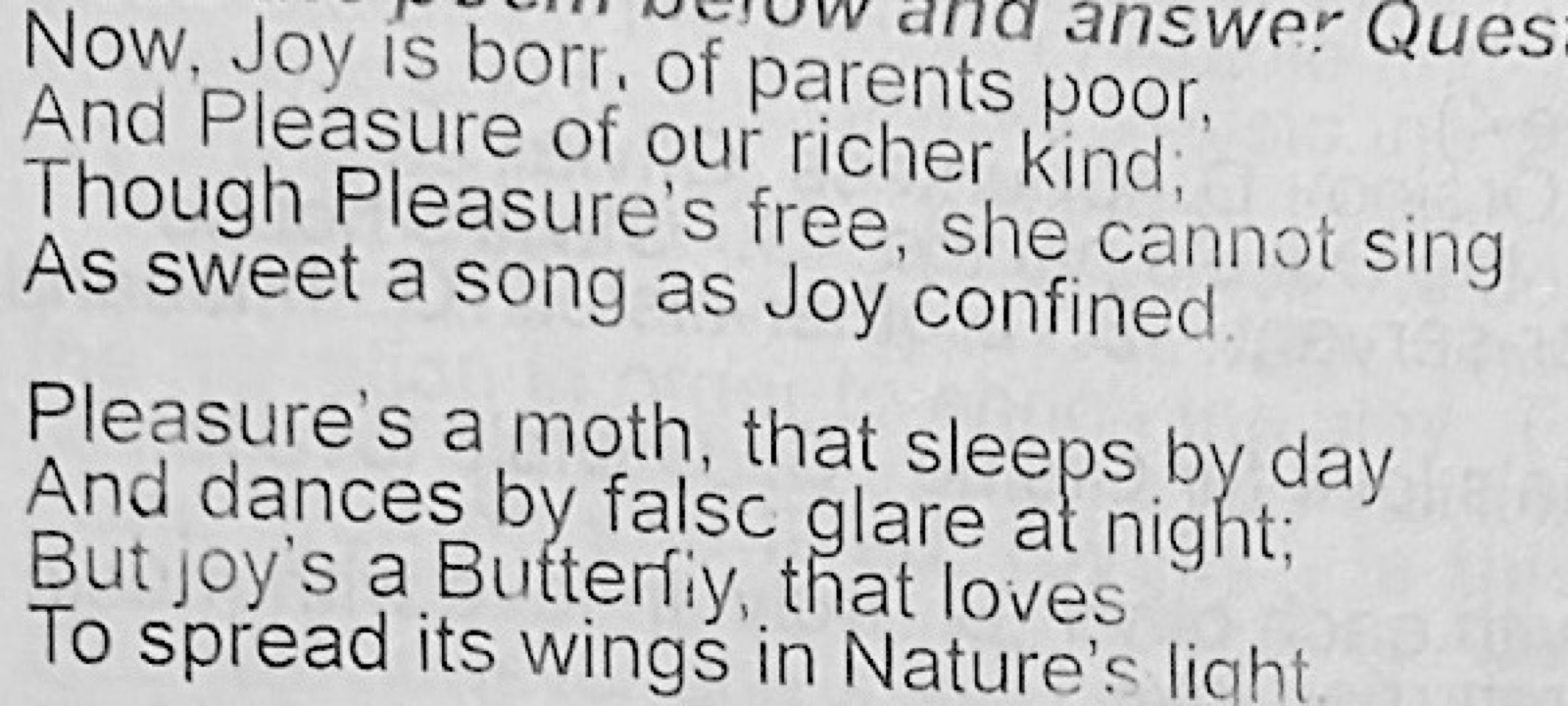
The poem says that “Joy” is
Answer: B (natural and satisfying)
Joy is a butterfly that loves Nature's light and sings sweetly: natural and satisfying.
The dominant device used in presenting “Joy” and “Pleasure” in the first stanza is
Answer: C (personification)
Joy is 'born of parents poor' and Pleasure 'cannot sing': both are treated as persons.
The feelings associated with “Joy” and “Pleasure” are conveyed through the use of
Answer: D (contrast)
The poem sets Joy against Pleasure (butterfly vs moth, day vs night): contrast.
“False glare” refers to
Answer: A (man-made light)
The moth dances at night by artificial light, unlike the butterfly in Nature's light.
“Pleasure's a moth” is an example of a(n)
Answer: C (metaphor)
Pleasure is said to be a moth, without 'like' or 'as': a metaphor.
A suitable title for the passage is the
Answer: B (Agony of War)
The passage shows the many sufferings of a retreating army (cold, hunger, disease, terror): the agony of war.
The writer's mood is one of
Answer: C (pity)
The writer dwells on the soldiers' hunger, cold, disease and weakness in a sympathetic way, so the writer's mood is one of pity. The fear of the French is the soldiers' feeling, not the writer's.
The mood is expressed through the use of
Answer: B (scenery)
The bleak scenery (rain, sleet, snow on the mountain passes) creates the mood.
The device used in the last sentence is
Answer: A (climax)
The sentence builds up hunger, exposure, the sword and finally disease: a climax.
Twelfth Night (William Shakespeare). The speaker is
Answer: C (Valentine)
Valentine reports to Orsino that Olivia will not admit him and will mourn her brother for seven years.
Twelfth Night (William Shakespeare). The report is made to
Answer: D (Orsino)
Valentine brings Olivia's answer back to Duke Orsino.
Twelfth Night (William Shakespeare). The one referred to by the speaker is
Answer: B (Olivia)
'Her face' is Olivia's: she will stay veiled for seven years.
Twelfth Night (William Shakespeare). The message is in connection with
Answer: B (love)
The message answers Orsino's suit: it concerns his love for Olivia.
Twelfth Night (William Shakespeare). The above dialogue is between
Answer: C (Antonio and Sebastian)
In Act II Scene 1 Antonio begs to go with Sebastian, who wants to go alone.
Twelfth Night (William Shakespeare). Speaker B requests Speaker A to
Answer: A (stay behind)
Sebastian asks Antonio's leave to 'bear my evils alone': he wants him to stay behind.
Twelfth Night (William Shakespeare). The underlined sentence means that my
Answer: C (ill-luck may affect you)
'The malignancy of my fate might distemper yours': his bad luck might spread to Antonio.
Twelfth Night (William Shakespeare). The scene of this action is
Answer: B (the sea-coast)
Act II Scene 1 is set on the sea-coast where Sebastian has landed.
Twelfth Night (William Shakespeare). Speaker B is
Answer: D (sad)
Sebastian believes his sister drowned and speaks of his dark fate: he is sad.
Twelfth Night (William Shakespeare). Speaker A is
Answer: C (Duke Orsino)
Orsino asks Cesario how he likes the music and guesses he is in love.
Twelfth Night (William Shakespeare). The two speakers are in
Answer: C (the Duke's palace)
Act II Scene 4 takes place in the Duke's palace.
Twelfth Night (William Shakespeare). The relationship between speaker A and B is
Answer: A (master-servant)
Cesario (Viola) is the Duke's page: master and servant.
Twelfth Night (William Shakespeare). The scene reveals
Answer: B (Viola's love for Orsino)
Viola admits her eye has 'stayed upon' someone she loves, meaning Orsino himself.
Twelfth Night (William Shakespeare). The dialogue shows that the characters are
Answer: D (both victims of unreturned love)
Orsino loves Olivia, who rejects him; Viola loves Orsino, who doesn't know it.
Twelfth Night (William Shakespeare). The speaker is
Answer: D (Sebastian)
Sebastian wants to see the sights of the city (Act III Scene 3).
Twelfth Night (William Shakespeare). The speaker is addressing
Answer: B (Antonio)
Sebastian is speaking to Antonio, who has followed him into the town.
Twelfth Night (William Shakespeare). The person addressed responds to the speaker's request by
Answer: A (declining it)
Antonio declines to walk the streets because he is wanted for fighting the Count's galleys.
Twelfth Night (William Shakespeare). The speaker is
Answer: A (Malvolio)
Malvolio quotes the forged letter ('Cast thy humble slough').
Twelfth Night (William Shakespeare). The letter referred to is from
Answer: B (Maria)
Malvolio thinks it is from Olivia, but Maria actually wrote it in Olivia's handwriting.
Literature 2, Section A: African Drama. Ola Rotimi: The Gods Are Not to Blame
Comment on the significance of the Prologue in the play.
Narrator tells the background: birth of a son to Adetusa and Ojuola, Baba Fakunle's prophecy.
Baby given to Gbonka to kill; survives, raised by Ogundele in Ijekun.
Adetusa's death and Odewale's arrival, victory over Ikolu and crowning; marriage to Ojuola.
Significance: sets up dramatic irony (audience knows the truth); creates suspense about how it will be revealed.
Introduces the theme of fate; adapts Oedipus to Yoruba setting; economy of plot.
Summarise the prologue and explain what it does for the play.
Literature 2, Section A. Ola Rotimi: The Gods Are Not to Blame
“She died as she lived, royally”. Is this statement true of Queen Ojuola?
Ojuola: queen to two kings; dignified, calm, caring mother and wife.
Acts with grace: consoles the people, calms Odewale's anger, defends Aderopo.
Shows respect for the gods and tradition.
On learning the truth she takes her own life privately in her chamber, preserving dignity.
Conclusion: yes, her life and death are royal and dignified (or argue the opposite with reasons).
Take a stand and support it.
Literature 2, Section A. Efua T. Sutherland: The Marriage of Anansewa
“Oh father, there is cunning in your head
You are to be feared”. To what extent is Anansewa's assessment of Ananse's character justified?
Ananse is cunning: sends Anansewa's photograph and letters to four chiefs at once.
Collects gifts from all without commitment.
Manipulates Anansewa into typing letters without knowing their meaning.
Stages her mock death to escape the crisis.
Persuasive, smooth talker; also loving and ambitious for her future.
Conclusion: largely justified; cunning but not wicked.
Assess with incidents.
Literature 2, Section A. Efua T. Sutherland: The Marriage of Anansewa
Discuss the events culminating in the funeral arrangements for Anansewa in the play.
Ananse's poverty and plan; photographs and letters to four chiefs.
Gifts pour in; outdooring ceremony.
Chief-Who-Is-Chief and Togbe Klu both announce coming to perform the marriage rites on the same day.
Ananse trapped; decides Anansewa must 'die'.
He announces her death; mourning and funeral arrangements; messengers come with condolences.
Narrate events in order.
Literature 2, Section B: Non-African Drama. George Bernard Shaw: Arms and the Man
Compare and contrast the characters of Louka and Raina in the play.
Raina: daughter of the Petkoffs; romantic, idealistic, poses; truthful underneath, falls for Bluntschli.
Louka: servant; proud, ambitious, realistic, defiant of her class.
Similar: both young, attractive, both engaged to/involved with Sergius; both deceive.
Contrast: Raina rich and sheltered, Louka poor; Raina romantic, Louka practical.
Ends: Raina with Bluntschli, Louka with Sergius.
Show likenesses and differences with examples.
Literature 2, Section B. George Bernard Shaw: Arms and the Man
Discuss the treatment of love in the play.
Romantic 'higher love' of Raina and Sergius is shown as false.
Sergius flirts with Louka behind Raina's back.
Raina and Bluntschli grow to real love through honesty.
Louka and Nicola: love and class/ambition.
Shaw mocks romantic illusions; realistic love based on understanding wins.
Show how each couple reveals Shaw's view of love.
Literature 2, Section B. Oliver Goldsmith: She Stoops to Conquer
Compare and contrast the characters of Mr. and Mrs. Hardcastle.
Mr Hardcastle: loves old things and country life; kind host; fond of his daughter; honest.
Mrs Hardcastle: vain, follows town fashion, spoils Tony, greedy over Constance's jewels.
Both quarrel; both are fooled (he by Marlow's rudeness, she by Tony's ride).
Contrast: he is sensible and generous; she is foolish and selfish.
Both love their child (he Kate, she Tony).
Compare and contrast with examples.
Literature 2, Section B. Oliver Goldsmith: She Stoops to Conquer
Discuss Tony Lumpkin as a comic hero.
Lovable, mischievous country squire; leader at the Three Pigeons.
His trick (house as inn) sets off the whole comedy.
Comic scenes with his mother: horse-pond ride, jewels.
Helps the lovers and ends happily free to marry whom he likes.
Simple, illiterate yet shrewd; a source of laughter and happy resolution.
Show both 'comic' and 'hero' aspects.
Literature 2, Section C: African Poetry
How does the poet convey the tragedy of prison life in “Letters to Martha 17”?
Dennis Brutus, a political prisoner on Robben Island.
Some prisoners lose their minds: 'some go mad'.
Isolation and boredom; loss of contact with family.
Despair; shows inhumanity of apartheid prisons.
Devices: plain, factual tone; repetition; imagery of madness and loneliness.
Show the sufferings described and how language conveys them.
Literature 2, Section C
Examine the poetic devices used in “Nightfall in Soweto” and “Letters to Martha 17”
Nightfall in Soweto (Mtshali): personification of night as a beast/enemy; similes ('like a dreaded disease'); metaphor of prey; rhetorical questions; imagery of violence.
Letters to Martha (Brutus): simple direct diction; understatement; repetition; images of madness and isolation; conversational letter form.
Effect: both show suffering under apartheid.
Discuss devices in both poems with examples and effects.
Literature 2, Section D: Non-African Poetry
Discuss the dramatic elements in “Mending Wall”
Robert Frost; two characters: the speaker and his neighbour.
Setting: spring, two farms divided by a stone wall.
Conflict: speaker questions the wall; neighbour insists 'Good fences make good neighbours'.
Dialogue and action: walking the wall, replacing stones.
Characterisation: neighbour 'like an old-stone savage armed'.
Ends with repetition of the neighbour's line: unresolved conflict.
Identify each dramatic element with an example.
Literature 2, Section D
Discuss Keats' attitude to the Urn in “Ode on a Grecian Urn”
Admiration: addresses the urn as a bride, foster-child, historian.
Envy of its permanence and frozen happiness.
Awareness of its limits: 'cold pastoral', figures can never fulfil love.
Reverence for art as conveying truth: 'Beauty is truth, truth beauty'.
Mixed attitude: wonder, longing and some irony.
Show how his feelings shift through the poem.
Literature 3, Section A: African Prose. Camara Laye: The African Child
What aspect of Laye's father's personality are revealed in the gold smelting ceremony?
Spiritual: prays, communes with the snake, observes purity (abstains, washes).
Highly skilled, creative craftsman; total concentration.
Respected by the community; enjoys the praise-singer's praise (a little vain).
Calm, dignified, joyful at completing the work.
Shows tradition and magic in his craft.
List traits with details from the ceremony.
Literature 3. Camara Laye: The African Child
Discuss the significance of Laye's encounter with snakes.
First encounter: as a child he plays with a snake; rescued; shows his innocence and the danger.
Second: the little black snake, his father's guiding spirit; respected by all.
Father explains the snake gives foreknowledge and success.
Laye wonders whether he will inherit it; school pulls him away.
Significance: introduces the supernatural, family tradition and the conflict between tradition and modern education.
Explain each encounter and its meaning.
Literature 3. Elechi Amadi: The Concubine
Discuss the contributions of Adaku and Wonuma to the failure of the marriage between Ekwueme and Ahurole.
Adaku (Ekwueme's mother): over-protective; Ekwueme tied to her; Ahurole resents it.
She keeps feeding and fussing over him; he measures women by her.
Wonuma (Ahurole's mother): spoils Ahurole; encourages her suspicion of Ihuoma.
Suggests the love potion, which drives Ekwueme mad.
Both mothers' interference leads to the breakup.
Show each mother's part.
Literature 3. Elechi Amadi: The Concubine
Comment on the character and role of Wodu Wakiri in The Concubine.
Ekwueme's close friend; jovial, witty, talkative, good drummer and singer.
Teases and advises Ekwueme; helps in his courtship of Ihuoma.
Gives comic relief and local colour.
Loyal: stands by Ekwueme in trouble.
Role: confidant through whom we learn Ekwueme's feelings.
Traits with examples, then role.
Literature 3, Section B: Non-African Prose. George Orwell: Animal Farm
Discuss three vices or weaknesses in human society that Orwell satirizes in Animal Farm.
Abuse of power/dictatorship (Napoleon).
Propaganda and lies (Squealer).
Greed and privilege of rulers (pigs take milk, apples, beds, whisky).
Ignorance and gullibility of the masses (sheep, Boxer).
Betrayal of revolutionary ideals; corruption of leaders.
Three vices fully illustrated.
Choose three and illustrate each.
Literature 3. George Orwell: Animal Farm
How does Napoleon systematically amend the original laws of Manor Farm?
Seven Commandments painted after the Rebellion.
Bed rule: 'No animal shall sleep in a bed with sheets'.
Alcohol: 'No animal shall drink alcohol to excess'.
Killing: 'No animal shall kill any other animal without cause'.
Finally all replaced by 'All animals are equal but some are more equal than others'.
Changes done secretly at night by Squealer; explained away.
Show the changes in order and how they were made.
Literature 3. Robert Louis Stevenson: Treasure Island
With close reference to the text, discuss the visits of Black Dog and Pew to Billy Bones at the Benbow Inn, bringing out their effects on him.
Black Dog arrives, waits for Billy; they fight; Black Dog flees wounded.
Billy suffers a stroke; Dr Livesey warns him about rum.
Blind Pew comes, forces Jim to lead him to Billy, delivers the black spot.
Billy has a second stroke and dies.
Effects: fear, drinking, illness and death; leads to the opening of his chest and the map.
Narrate both visits and their effects.
Literature 3. Robert Louis Stevenson: Treasure Island
Examine the character and role of any two of the following in Treasure Island:
(a) Billy Bones (b) Jim Hawkins (c) Ben Gunn
(a) Billy Bones: old sea-dog, Flint's mate; rough, drunken, frightened; his chest holds the map; his death starts the story.
(b) Jim Hawkins: narrator; brave, curious, lucky; overhears the mutiny, cuts the Hispaniola loose, saves the party.
(c) Ben Gunn: marooned pirate; wild, half-mad; found the treasure; helps defeat the pirates.
Two characters covered with traits and roles.
Pick two; give traits and role for each.