WAEC Literature in English 1998 past questions and answers

142 questions. Try each one, then open the answer to check yourself and read the explanation.

Question 1

Literary Terms and Devices

Which of the following is common to all forms of literature?

  1. A.language
  2. B.chorus
  3. C.action
  4. D.narrator
Show the answer and explanation

Answer: A (language)

Explanation

Prose, drama and poetry all use language; a chorus, a narrator or stage action belong only to some forms.

Open this question

Question 2

Literary Terms and Devices

The three major forms of literature are

  1. A.tragedy, comedy, tragi-comedy
  2. B.poetry, drama, folktales
  3. C.drama, lyric, prose fiction
  4. D.poetry, drama, prose.
Show the answer and explanation

Answer: D (poetry, drama, prose.)

Explanation

Literature is divided into three genres: poetry, drama and prose. The other lists mix genres with sub-types.

Open this question

Question 3

Poetry: General

Beauty in poetry depends mainly on

  1. A.expression and rhythm
  2. B.length and theme
  3. C.vowels and consonants
  4. D.mood and verse form
Show the answer and explanation

Answer: A (expression and rhythm)

Explanation

What makes a poem beautiful is chiefly how it says things (expression) and its musical movement (rhythm).

Open this question

Question 4

Literary Appreciation: Prose and Drama
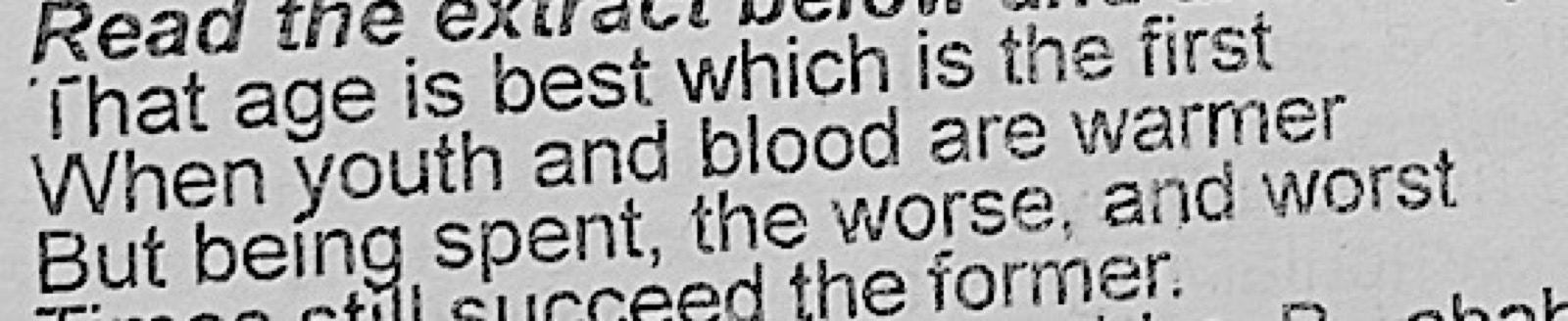
Extract for questions 4–6
The passage, as printed

The predominant figure of speech in the above extract is

  1. A.oxymoron
  2. B.metaphor
  3. C.simile
  4. D.personification.
Show the answer and explanation

Answer: D (personification.)

Explanation

The earth is described as 'tired of sitting' and as 'moving' like a person, so the figure is personification.

Open this question

Question 6

Literary Appreciation: Prose and Drama

The image depicted in the extract is one of

  1. A.destruction
  2. B.merriment
  3. C.happiness
  4. D.admiration.
Show the answer and explanation

Answer: A (destruction)

Explanation

Crumbling houses and 'the work of a million years was lost' create a picture of destruction.

Open this question

Question 7

Literary History

Pick the odd item from the list below

  1. A.Night Rain
  2. B.Things Fall Apart
  3. C.Stanley Meets Mutesa
  4. D.Nightfall in Soweto
Show the answer and explanation

Answer: B (Things Fall Apart)

Explanation

Things Fall Apart is a novel; the other three are poems.

Open this question

Question 8

Literary Appreciation: Poetry
Extract for question 8
The passage, as printed

The poetic device used in the above extract is

  1. A.assonance
  2. B.alliteration
  3. C.metaphor
  4. D.metonymy.
Show the answer and explanation

Answer: A (assonance)

Explanation

The repeated vowel sound in 'fly high' is assonance (repetition of vowel sounds).

Open this question

Question 9

Poetry: General

A poem written or rendered in praise of a person or thing is called

  1. A.a lyric
  2. B.an ode
  3. C.an elegy
  4. D.a panegyric.
Show the answer and explanation

Answer: D (a panegyric.)

Explanation

A panegyric is a poem or speech of praise for a person or thing. An elegy mourns; a lyric expresses personal feeling.

Open this question

Question 10

Drama: General

The basic elements of drama are

  1. A.character, plot, episode
  2. B.dialogue, chorus, plot
  3. C.character, action, setting
  4. D.character, monologue, plot
Show the answer and explanation

Answer: C (character, action, setting)

Explanation

Every play is built on characters, the action they carry out (the plot) and the setting where it happens. 'Episode' and 'monologue' are parts of some plays, not basic elements.

Open this question

Question 11

Literary Terms and Devices

The choice of appropriate words to convey the thoughts of an author is called

  1. A.idiomatic language
  2. B.setting
  3. C.figure of speech
  4. D.diction
Show the answer and explanation

Answer: D (diction)

Explanation

Diction means a writer's choice of words.

Open this question

Question 12

Poetry: General

The state of mind of a poet can be described as

  1. A.style
  2. B.mood
  3. C.setting
  4. D.theme
Show the answer and explanation

Answer: B (mood)

Explanation

Mood is the feeling or state of mind expressed in a poem.

Open this question

Question 13

Literary Terms and Devices

Which of the following is a likely source of traditional oral poetry?

  1. A.theatre
  2. B.fiction
  3. C.books
  4. D.songs
Show the answer and explanation

Answer: D (songs)

Explanation

Oral poetry is passed on by word of mouth, mainly through songs, chants and praise-singing, not through books.

Open this question

Question 14

Literary History

An African author who has written plays, poems and prose is

  1. A.Wole Soyinka
  2. B.Zaynab Alkali
  3. C.Chinua Achebe
  4. D.Flora Nwapa
Show the answer and explanation

Answer: A (Wole Soyinka)

Explanation

Wole Soyinka has written plays (e.g. The Lion and the Jewel), poems (Idanre) and prose (The Interpreters, Aké).

Open this question

Question 15

Literary Terms and Devices

In a novel, the antagonist is

  1. A.a fully developed character
  2. B.a flat character
  3. C.the main female character
  4. D.the archrival of the hero
Show the answer and explanation

Answer: D (the archrival of the hero)

Explanation

The antagonist is the character who opposes the hero (protagonist).

Open this question

Question 16

Literary Appreciation: Poetry
Extract for questions 16 and 17
The passage, as printed

The figure of speech underlined in line 1 is

  1. A.assonance
  2. B.consonance
  3. C.onomatopoeia
  4. D.alliteration.
Show the answer and explanation

Answer: C (onomatopoeia)

Explanation

'Pattering' imitates the sound of rain falling, so it is onomatopoeia.

Open this question

Question 17

Literary Appreciation: Poetry

The underlined expression in line 3 is

  1. A.litotes
  2. B.personification
  3. C.hyperbole
  4. D.synecdoche
Show the answer and explanation

Answer: B (personification)

Explanation

The stream is given human actions: it 'whispers' and 'steals' away. That is personification.

Open this question

Question 18

Poetry: General

In poetry, rhythm is created by the regular pattern of

  1. A.vowels and consonants
  2. B.long and short words
  3. C.stressed and unstressed syllables
  4. D.stressed syllables and rhymes
Show the answer and explanation

Answer: C (stressed and unstressed syllables)

Explanation

Rhythm (metre) comes from the regular arrangement of stressed and unstressed syllables.

Open this question

Question 19

Literary History

Which of the following is an African poet?

  1. A.Dennis Brutus
  2. B.William Wordsworth
  3. C.Rober Frost
  4. D.W.
  5. E.Yeats
Show the answer and explanation

Answer: A (Dennis Brutus)

Explanation

Dennis Brutus was a South African poet; Wordsworth was English, Frost American and Yeats Irish.

Open this question

Question 20

Drama: General

A play that is full of exaggerated ridicule and laughter is called

  1. A.farce
  2. B.comedy
  3. C.tragi-comedy
  4. D.masque.
Show the answer and explanation

Answer: A (farce)

Explanation

A farce is a comedy built on exaggerated, ridiculous situations meant only to cause laughter.

Open this question

Question 21

Drama: General

In a play, a long speech by a single character in the presence of other characters is called

  1. A.soliloquy
  2. B.monologue
  3. C.aside
  4. D.prologue.
Show the answer and explanation

Answer: B (monologue)

Explanation

A monologue is a long speech by one character with others present; a soliloquy is spoken alone.

Open this question

Question 22

Drama: General

Pick the odd item from the list below

  1. A.tragedy
  2. B.comedy
  3. C.epilogue
  4. D.tragi-comedy
Show the answer and explanation

Answer: C (epilogue)

Explanation

Tragedy, comedy and tragi-comedy are types of play; an epilogue is a closing speech, not a type of play.

Open this question

Question 23

Drama: General

A group of actors in a play is called

  1. A.characters
  2. B.cast
  3. C.chorus
  4. D.prompters
Show the answer and explanation

Answer: B (cast)

Explanation

The cast is the whole group of actors performing a play.

Open this question

Question 24

Prose: General

A novel is usually written in

  1. A.prose
  2. B.verse
  3. C.scenes
  4. D.stanzas
Show the answer and explanation

Answer: A (prose)

Explanation

Novels are written in prose, ordinary sentences and paragraphs.

Open this question

Question 25

Drama: General

What distinguishes a novel from a play is

  1. A.characters
  2. B.setting
  3. C.narration
  4. D.theme
Show the answer and explanation

Answer: C (narration)

Explanation

Both have characters, setting and theme, but a novel tells its story through a narrator, while a play uses dialogue and action.

Open this question

Question 26

Literary Terms and Devices

Which of the following best describes Literature? It

  1. A.tells the story of great men and women
  2. B.is a reflection of man's life in society
  3. C.is a record of past events
  4. D.describes what never happened and cannot happen.
Show the answer and explanation

Answer: B (is a reflection of man's life in society)

Explanation

Literature mirrors human life and society; it is not just history or fantasy.

Open this question

Question 27

Figures of Speech

The literary device in the statement — 'Students are to come to class with their Shakespeare' is called

  1. A.metonymy
  2. B.litotes
  3. C.synecdoche
  4. D.personification
Show the answer and explanation

Answer: A (metonymy)

Explanation

'Shakespeare' stands for his books: naming the author for his works is metonymy.

Open this question

Question 28

Prose: General

The first person narrator is usually

  1. A.the protagonist
  2. B.a villain in the novel
  3. C.the antagonist
  4. D.a character in the novel
Show the answer and explanation

Answer: A (the protagonist)

Explanation

A first-person narrator ('I') is usually the main character telling his or her own story.

Open this question

Question 29

Prose: General

Which of the following is closest to the form of the novel?

  1. A.the short story
  2. B.fable
  3. C.tale
  4. D.epic
Show the answer and explanation

Answer: A (the short story)

Explanation

The short story is prose fiction like the novel, only shorter.

Open this question

Question 30

Figures of Speech

“The people's voices rutted like pigs in the mud” is an example of

  1. A.simile
  2. B.metaphor
  3. C.personification
  4. D.metonymy
Show the answer and explanation

Answer: A (simile)

Explanation

The comparison uses 'like', so it is a simile.

Open this question

Question 31

Literary Appreciation: Poetry
Extract for questions 31–33
The passage, as printed

The rhyme scheme is

  1. A.abba
  2. B.abab
  3. C.aabb
  4. D.bbaa
Show the answer and explanation

Answer: B (abab)

Explanation

Line 1 'first' rhymes with line 3 'worst', and line 2 'warmer' with line 4 'former': abab.

Open this question

Question 32

Literary Appreciation: Poetry

This kind of rhyme scheme is known as

  1. A.alternate
  2. B.irregular
  3. C.free verse
  4. D.couplet
Show the answer and explanation

Answer: A (alternate)

Explanation

In abab the rhymes alternate from line to line, so it is alternate rhyme.

Open this question

Question 33

Poetry: General

A poem of four lines is known as a

  1. A.sonnet
  2. B.couplet
  3. C.sestet
  4. D.quatrain
Show the answer and explanation

Answer: D (quatrain)

Explanation

A quatrain is a stanza or poem of four lines.

Open this question

Question 34

Poetry: General

A poem of 14 lines is known as a

  1. A.quatrain
  2. B.octave
  3. C.sestet
  4. D.sonnet
Show the answer and explanation

Answer: D (sonnet)

Explanation

A sonnet has fourteen lines.

Open this question

Question 35

Literary Terms and Devices

Pick the odd item from the list

  1. A.prose
  2. B.poetry
  3. C.drama
  4. D.tragedy
Show the answer and explanation

Answer: D (tragedy)

Explanation

Prose, poetry and drama are the three genres; tragedy is only a type of drama.

Open this question

Question 36

Figures of Speech

A play on words is

  1. A.innuendo
  2. B.humour
  3. C.pun
  4. D.jest
Show the answer and explanation

Answer: C (pun)

Explanation

A pun is a play on words that sound alike or have two meanings.

Open this question

Question 37

Drama: General

A play is fully realized when it is

  1. A.studied
  2. B.memorized
  3. C.acted
  4. D.read
Show the answer and explanation

Answer: C (acted)

Explanation

A play is written to be performed; it comes fully alive on stage.

Open this question

Question 38

Poetry: General

An epitaph is

  1. A.poem of lamentation
  2. B.a poem of fourteen lines
  3. C.an inscription on a tomb
  4. D.the life history of an author
Show the answer and explanation

Answer: C (an inscription on a tomb)

Explanation

An epitaph is the short text written on a tombstone in memory of the dead.

Open this question

Question 39

Drama: General

The essential function of a tragedy is to make people

  1. A.laugh at mankind
  2. B.think and feel more deeply
  3. C.think and laugh
  4. D.know their enemies
Show the answer and explanation

Answer: B (think and feel more deeply)

Explanation

Tragedy moves the audience to pity and fear (catharsis), making them reflect and feel deeply.

Open this question

Question 40

Drama: General

Mime is the art of acting that involves the use of

  1. A.songs only
  2. B.speeches only
  3. C.gestures only
  4. D.dances only
Show the answer and explanation

Answer: C (gestures only)

Explanation

Mime tells a story through gestures and body movement without words.

Open this question

Question 41

Literary Terms and Devices

A short witty statement is called an

  1. A.epigram
  2. B.anecdote
  3. C.epistle
  4. D.analogy
Show the answer and explanation

Answer: A (epigram)

Explanation

An epigram is a short, clever, witty saying.

Open this question

Question 42

Figures of Speech

'Penny wise; pound foolish' is an example of

  1. A.metonymy
  2. B.hyperbole
  3. C.metaphor
  4. D.paradox
Show the answer and explanation

Answer: D (paradox)

Explanation

Being wise and foolish at the same time seems contradictory but makes sense: careful with small sums, careless with big ones. That is a paradox.

Open this question

Question 44

Figures of Speech

Any expression which creates a mental picture is known as

  1. A.paradox
  2. B.exaggeration
  3. C.imagery
  4. D.symbolism
Show the answer and explanation

Answer: C (imagery)

Explanation

Imagery is language that creates pictures in the reader's mind.

Open this question

Question 45

Literary Appreciation: Poetry
Extract for questions 45 and 46
The passage, as printed

The predominant sound device in the extract is

  1. A.assonance
  2. B.consonance
  3. C.onomatopoeia
  4. D.alliteration.
Show the answer and explanation

Answer: C (onomatopoeia)

Explanation

'Buzzing', 'humming', 'cooing', 'chatter' and 'clatter' all imitate sounds: onomatopoeia.

Open this question

Question 46

Literary Appreciation: Poetry

The underlined words in lines 1 and 4 are examples of

  1. A.external rhyme
  2. B.internal rhyme
  3. C.end rhyme
  4. D.alternate rhyme
Show the answer and explanation

Answer: B (internal rhyme)

Explanation

'Chatter' and 'clatter' rhyme inside the lines rather than only at line ends: internal rhyme.

Open this question

Question 47

Prose: General

The omniscient narrator

  1. A.uses flashback
  2. B.knows all about characters and events
  3. C.makes reference to future incidents
  4. D.knows all about the author
Show the answer and explanation

Answer: B (knows all about characters and events)

Explanation

'Omniscient' means all-knowing: such a narrator knows every character's thoughts and all events.

Open this question

Question 48

Drama: General

The main female character in a play is called

  1. A.hero
  2. B.heroine
  3. C.clown
  4. D.antagonist
Show the answer and explanation

Answer: B (heroine)

Explanation

The heroine is the main female character.

Open this question

Question 49

Prose: General

The character that opposses the hero in a novel is called the

  1. A.protagonist
  2. B.antagonist
  3. C.villain
  4. D.clown
Show the answer and explanation

Answer: B (antagonist)

Explanation

The antagonist opposes the hero (protagonist).

Open this question

Question 50

Literary Terms and Devices

Pick the odd item from the list

  1. A.sentence
  2. B.paragraph
  3. C.expression
  4. D.fiction.
Show the answer and explanation

Answer: D (fiction.)

Explanation

Sentence, paragraph and expression are units of language; fiction is a kind of literature.

Open this question

Question 51

Literary Appreciation: Prose and Drama
Unseen prose: questions 51–55
The passage, as printed

The setting of this extract is the

  1. A.field
  2. B.stream
  3. C.farm
  4. D.mountain
Show the answer and explanation

Answer: D (mountain)

Explanation

She digs her heel in for a step, the moss tears and she falls: they are climbing a slope, a mountain.

Open this question

Question 52

Literary Appreciation: Prose and Drama

The mood of the narrator is one of

  1. A.shock
  2. B.indifference
  3. C.happiness
  4. D.kindness
Show the answer and explanation

Answer: A (shock)

Explanation

Joseph runs to her, drops the water and says 'It was too simple, too easy, too quick': he is shocked by the sudden death.

Open this question

Question 53

Literary Appreciation: Prose and Drama

The narrator's companion has just

  1. A.died
  2. B.arrived
  3. C.relaxed
  4. D.collapsed
Show the answer and explanation

Answer: A (died)

Explanation

The position of her neck and 'the grey stealing into her cheeks' show she is dead.

Open this question

Question 54

Literary Appreciation: Prose and Drama

The extract is an example of

  1. A.narrative prose
  2. B.descriptive prose
  3. C.imaginative prose
  4. D.expository prose
Show the answer and explanation

Answer: A (narrative prose)

Explanation

It recounts events one after another in time order, so it is narrative prose.

Open this question

Question 55

Literary Appreciation: Prose and Drama

The underlined expression is an example of

  1. A.hyperbole
  2. B.metaphor
  3. C.simile
  4. D.personification
Show the answer and explanation

Answer: D (personification)

Explanation

'The grey that was stealing into her cheeks' gives grey colour the human action of stealing: personification.

Open this question

Question 56

Literary Appreciation: Prose and Drama

The figure of speech used in the first sentence is

  1. A.personification
  2. B.metaphor
  3. C.simile
  4. D.metonymy
Show the answer and explanation

Answer: C (simile)

Explanation

'Her love ... blossomed like spring flowers' compares with 'like': a simile.

Open this question

Question 57

Literary Appreciation: Prose and Drama

In England, she had loved her husband, in Africa, she

  1. A.resented him
  2. B.accepted him
  3. C.enjoyed her honeymoon
  4. D.encouraged him
Show the answer and explanation

Answer: A (resented him)

Explanation

In Africa her temper grew worse and she drifted away from him: she resented him.

Open this question

Question 58

Literary Appreciation: Prose and Drama

'From that day her world collapsed' shows that the woman is

  1. A.better off
  2. B.wise
  3. C.afraid
  4. D.unhappy
Show the answer and explanation

Answer: D (unhappy)

Explanation

Her world 'collapsing' means her happiness ended: she became unhappy.

Open this question

Question 59

Literary Appreciation: Prose and Drama

What made the woman's world collapse is

  1. A.falling in love with her husband in winter
  2. B.cutting short their honeymoon
  3. C.travelling aboard a ship
  4. D.their movement to Africa
Show the answer and explanation

Answer: D (their movement to Africa)

Explanation

Her world collapsed from the day it was announced the couple would go to Africa.

Open this question

Question 60

Literary Appreciation: Prose and Drama

From the last sentence, it is obvious that the couple

  1. A.is happy
  2. B.is lonely
  3. C.is childless
  4. D.has a child
Show the answer and explanation

Answer: C (is childless)

Explanation

'They never had a child': the couple is childless.

Open this question

Question 63

Literary Appreciation: Poetry

The feeling of the poet is one of

  1. A.anxiety
  2. B.gaiety
  3. C.sadness
  4. D.frustration
Show the answer and explanation

Answer: B (gaiety)

Explanation

The poet sings joyfully of love and of the wedding day: the feeling is gaiety.

Open this question

Question 64

Literary Appreciation: Poetry

The underlined expression contains a

  1. A.simile
  2. B.metaphor
  3. C.personification
  4. D.litotes
Show the answer and explanation

Answer: B (metaphor)

Explanation

'You are the papyrus reed' compares directly, without 'like' or 'as': a metaphor.

Open this question

Question 65

Literary Appreciation: Poetry

The poem is a blank verse because

  1. A.there is no rhyme
  2. B.there is rhyme
  3. C.the rhyme is alternate
  4. D.it contains couplets
Show the answer and explanation

Answer: A (there is no rhyme)

Explanation

The lines do not rhyme, which is why the question calls it blank (unrhymed) verse.

Open this question

Question 66

Literary Appreciation: Poetry

The rhyme scheme of the above extract is

  1. A.alternate
  2. B.irregular
  3. C.free verse
  4. D.couplet
Show the answer and explanation

Answer: A (alternate)

Explanation

Delay/stay and desire/aspire; truth/youth and lives/gives: the rhymes alternate (abab).

Open this question

Question 67

Literary Appreciation: Poetry

The literary device used in line 1 is an example of

  1. A.climax
  2. B.apostrophe
  3. C.metonymy
  4. D.euphemism
Show the answer and explanation

Answer: B (apostrophe)

Explanation

'O stealing time' addresses time directly as if it could hear: apostrophe.

Open this question

Question 68

Literary Appreciation: Poetry

The literary device used in lines 3 & 4 of stanza 1 is

  1. A.paradox
  2. B.antithesis
  3. C.apostrophe
  4. D.rhetorical question
Show the answer and explanation

Answer: D (rhetorical question)

Explanation

The poet asks questions that expect no answer: rhetorical questions.

Open this question

Question 69

Literary Appreciation: Poetry

The predominant figure of speech in stanza II is

  1. A.consonance
  2. B.alliteration
  3. C.personification
  4. D.epigram
Show the answer and explanation

Answer: C (personification)

Explanation

Old age is described as 'wise' and as having 'known' things: it is given human qualities.

Open this question

Question 70

Literary Appreciation: Poetry

The mood of the poet is that of

  1. A.carelessness
  2. B.happiness
  3. C.gaiety
  4. D.helplessness
Show the answer and explanation

Answer: B (happiness)

Explanation

The poet ends by praising old age as wise and honourable, a contented, happy mood.

Open this question

Question 71

Set Text: Twelfth Night

Twelfth Night (William Shakespeare). Speaker A is

  1. A.Maria
  2. B.Olivia
  3. C.Valentine
  4. D.Viola
Show the answer and explanation

Answer: D (Viola)

Explanation

Viola has just survived the shipwreck and asks where she is; her brother Sebastian is feared drowned.

Open this question

Question 72

Set Text: Twelfth Night

Twelfth Night (William Shakespeare). Speaker B is

  1. A.Sir Toby
  2. B.Sir Andrew
  3. C.Captain
  4. D.Olivia
Show the answer and explanation

Answer: C (Captain)

Explanation

The Captain of the wrecked ship tells Viola that this is Illyria.

Open this question

Question 74

Set Text: Twelfth Night

Twelfth Night (William Shakespeare). Why is speaker A afraid the brother might be drowned? It is because

  1. A.the crew was unfaithful
  2. B.the ship captain threw him overboard
  3. C.they fought with pirates
  4. D.they were shipwrecked
Show the answer and explanation

Answer: D (they were shipwrecked)

Explanation

Viola and Sebastian were separated when their ship was wrecked at sea.

Open this question

Question 75

Set Text: Twelfth Night

Twelfth Night (William Shakespeare). The figure of speech underlined in the extract is known as

  1. A.apostrophe
  2. B.alliteration
  3. C.assonance
  4. D.personification
Show the answer and explanation

Answer: A (apostrophe)

Explanation

'O, my poor brother' addresses someone absent: apostrophe.

Open this question

Question 76

Set Text: Twelfth Night

Twelfth Night (William Shakespeare). Speaker A is

  1. A.Sebastian
  2. B.Fabian
  3. C.Duke
  4. D.Sir Andrew
Show the answer and explanation

Answer: C (Duke)

Explanation

Duke Orsino sends 'Cesario' (Viola in disguise) again to woo Olivia for him.

Open this question

Question 77

Set Text: Twelfth Night

Twelfth Night (William Shakespeare). Speaker A's object of love is

  1. A.Maria
  2. B.Olivia
  3. C.Viola
  4. D.Feste
Show the answer and explanation

Answer: B (Olivia)

Explanation

The Duke loves Olivia, the 'sovereign cruelty' who keeps rejecting him.

Open this question

Question 78

Set Text: Twelfth Night

Twelfth Night (William Shakespeare). The hero of the play is

  1. A.Antonio
  2. B.Sebastian
  3. C.Fabian
  4. D.Duke
Show the answer and explanation

Answer: D (Duke)

Explanation

Duke Orsino, ruler of Illyria, is the leading male character; he finally marries Viola.

Open this question

Question 79

Set Text: Twelfth Night

Twelfth Night (William Shakespeare). The mood of Speaker A in the above scene is one of

  1. A.sadness
  2. B.hope
  3. C.joy
  4. D.anxiety
Show the answer and explanation

Answer: D (anxiety)

Explanation

Orsino is restless and anxious with unanswered love, urging Cesario to try again.

Open this question

Question 80

Set Text: Twelfth Night

Twelfth Night (William Shakespeare). The play 'Twelfth Night' is a

  1. A.tragi-comedy
  2. B.farce
  3. C.tragedy
  4. D.comedy
Show the answer and explanation

Answer: D (comedy)

Explanation

It is a romantic comedy of disguise and mistaken identity that ends in marriages.

Open this question

Question 81

Set Text: Twelfth Night

Twelfth Night (William Shakespeare). Speaker A is

  1. A.Sir Andrew
  2. B.Sir Toby
  3. C.Antonio
  4. D.Feste
Show the answer and explanation

Answer: C (Antonio)

Explanation

Antonio, who once fought Orsino's galleys at sea, explains why he is in danger in Illyria.

Open this question

Question 82

Set Text: Twelfth Night

Twelfth Night (William Shakespeare). Speaker B is

  1. A.Olivia
  2. B.Viola
  3. C.Antonio
  4. D.Sebastian
Show the answer and explanation

Answer: D (Sebastian)

Explanation

Sebastian replies 'Belike you slew great number of his people'; Antonio has followed him to Illyria.

Open this question

Question 83

Set Text: Twelfth Night

Twelfth Night (William Shakespeare). The Count referred to in the extract is

  1. A.Orsino
  2. B.Sir Andrew
  3. C.Toby
  4. D.Malvolio
Show the answer and explanation

Answer: A (Orsino)

Explanation

'The Count' is Orsino, whose galleys Antonio fought.

Open this question

Question 84

Set Text: Twelfth Night

Twelfth Night (William Shakespeare). The mood of Speaker A, is that of

  1. A.gaiety
  2. B.courage
  3. C.melancholy
  4. D.fear
Show the answer and explanation

Answer: D (fear)

Explanation

Antonio says he does not walk the streets 'without danger': he fears arrest.

Open this question

Question 85

Set Text: Twelfth Night

Twelfth Night (William Shakespeare). By the offence in the extract, Speaker A is a

  1. A.nuisance,
  2. B.pirate
  3. C.fighter
  4. D.businessman
Show the answer and explanation

Answer: B (pirate)

Explanation

Antonio's offence was fighting the Count's ships at sea; Orsino calls him a pirate.

Open this question

Question 86

Set Text: The Gods Are Not to Blame

The Gods Are Not to Blame (Ola Rotimi). Speaker A is

  1. A.first chief
  2. B.priest
  3. C.Odewale
  4. D.second chief
Show the answer and explanation

Answer: C (Odewale)

Explanation

The king tells the people he is only doing his duty and asks what they have done to help themselves: Odewale.

Open this question

Question 87

Set Text: The Gods Are Not to Blame

The Gods Are Not to Blame (Ola Rotimi). Speaker A is addressing

  1. A.second chief
  2. B.towns people
  3. C.third chief
  4. D.Ojuola
Show the answer and explanation

Answer: B (towns people)

Explanation

Odewale is speaking to the crowd of suffering townspeople who came to beg him.

Open this question

Question 88

Set Text: The Gods Are Not to Blame

The Gods Are Not to Blame (Ola Rotimi). The land is not at peace because of

  1. A.sickness and death
  2. B.famine and war
  3. C.chieftaincy tussle
  4. D.political unrest
Show the answer and explanation

Answer: A (sickness and death)

Explanation

Kutuje is struck by a plague: people are 'ailing and dying'.

Open this question

Question 89

Set Text: The Gods Are Not to Blame

The Gods Are Not to Blame (Ola Rotimi). Speaker A's duty is to

  1. A.cure the people's illness
  2. B.guard the palace
  3. C.visit sick people
  4. D.rule and protect the people
Show the answer and explanation

Answer: D (rule and protect the people)

Explanation

As king, Odewale's duty is to rule and protect his people.

Open this question

Question 90

Set Text: The Gods Are Not to Blame

The Gods Are Not to Blame (Ola Rotimi). Where are Speakers A and B when the above statements are made? They are at

  1. A.Speaker A's clinic
  2. B.the house of Speaker B
  3. C.the farm
  4. D.the palace
Show the answer and explanation

Answer: D (the palace)

Explanation

The townspeople have come to the king's palace with their complaints.

Open this question

Question 91

Set Text: The Gods Are Not to Blame

The Gods Are Not to Blame (Ola Rotimi). 'My Lord' refers to

  1. A.third chief
  2. B.Aderopo
  3. C.Odewale
  4. D.first chief
Show the answer and explanation

Answer: C (Odewale)

Explanation

'My Lord' is the form of address for King Odewale.

Open this question

Question 92

Set Text: The Gods Are Not to Blame

The Gods Are Not to Blame (Ola Rotimi). 'The charges' are made on the basis of

  1. A.treason
  2. B.murder
  3. C.jealousy
  4. D.suspicion
Show the answer and explanation

Answer: D (suspicion)

Explanation

Odewale accuses others of plotting against him without proof: his charges rest on suspicion.

Open this question

Question 93

Set Text: The Gods Are Not to Blame

The Gods Are Not to Blame (Ola Rotimi). 'Bedsharer' implies

  1. A.adultery
  2. B.matrimony
  3. C.divorce
  4. D.separation
Show the answer and explanation

Answer: A (adultery)

Explanation

Baba Fakunle calls Odewale a 'bedsharer', hinting that he shares his mother's bed: forbidden sexual relations (the key's adultery).

Open this question

Question 94

Set Text: The Gods Are Not to Blame

The Gods Are Not to Blame (Ola Rotimi). The 'blind bat' is

  1. A.first chief
  2. B.Odewale
  3. C.third chief
  4. D.Baba Fakunle
Show the answer and explanation

Answer: D (Baba Fakunle)

Explanation

Odewale insults the blind seer Baba Fakunle as a 'blind bat'.

Open this question

Question 95

Set Text: The Gods Are Not to Blame

The Gods Are Not to Blame (Ola Rotimi). Speaker A is

  1. A.first chief
  2. B.Odewale
  3. C.third chief
  4. D.Ojuola
Show the answer and explanation

Answer: D (Ojuola)

Explanation

Queen Ojuola gently tells her husband that he makes charges without grounds.

Open this question

Question 96

Set Text: The Gods Are Not to Blame

The Gods Are Not to Blame (Ola Rotimi). Speaker A is

  1. A.Odewale
  2. B.Iya aburo
  3. C.Ojuola
  4. D.third chief
Show the answer and explanation

Answer: C (Ojuola)

Explanation

She calls Aderopo 'son' and he calls her 'mother': Speaker A is Queen Ojuola.

Open this question

Question 97

Set Text: The Gods Are Not to Blame

The Gods Are Not to Blame (Ola Rotimi). The trouble in the land is

  1. A.an epidemic
  2. B.famine
  3. C.war
  4. D.land dispute
Show the answer and explanation

Answer: A (an epidemic)

Explanation

Kutuje is suffering a deadly sickness, an epidemic.

Open this question

Question 98

Set Text: The Gods Are Not to Blame

The Gods Are Not to Blame (Ola Rotimi). Speaker B is

  1. A.Aderopo
  2. B.Odewale
  3. C.Priest
  4. D.Baba Fakunle
Show the answer and explanation

Answer: A (Aderopo)

Explanation

Aderopo returns from Ife with Ifa's word and is reluctant to say it in public.

Open this question

Question 99

Set Text: The Gods Are Not to Blame

The Gods Are Not to Blame (Ola Rotimi). Ifa oracle is consulted at

  1. A.Ede
  2. B.Osogbo
  3. C.Ife
  4. D.Kutuje
Show the answer and explanation

Answer: C (Ife)

Explanation

Aderopo is sent to Ife, the home of the Ifa oracle.

Open this question

Question 100

Set Text: The Gods Are Not to Blame

The Gods Are Not to Blame (Ola Rotimi). The cause of the trouble is

  1. A.rivalry
  2. B.incest
  3. C.jealousy
  4. D.war
Show the answer and explanation

Answer: B (incest)

Explanation

The plague comes because the murderer of King Adetusa lives in the land, married to his own mother: incest and murder.

Open this question

Question 371

Set Text: She Stoops to Conquer

She Stoops to Conquer (Oliver Goldsmith). 'Them' in line 1 refers to

  1. A.Mr. and Mrs Hardcastle
  2. B.Tony Lumpkin and Diggory
  3. C.The neighbours
  4. D.The two Miss Hoggs and Mrs. Grigsby
Show the answer and explanation

Answer: D (The two Miss Hoggs and Mrs. Grigsby)

Explanation

Mrs Hardcastle has just mentioned the two Miss Hoggs and Mrs Grigsby, who go to town every winter; Hardcastle says they bring back vanity.

Open this question

Question 372

Set Text: She Stoops to Conquer

She Stoops to Conquer (Oliver Goldsmith). Speaker B wishes to take a trip to

  1. A.the countryside
  2. B.France
  3. C.London
  4. D.a village
Show the answer and explanation

Answer: C (London)

Explanation

Mrs Hardcastle complains that they never go to town; she longs to visit London.

Open this question

Question 373

Set Text: She Stoops to Conquer

She Stoops to Conquer (Oliver Goldsmith). Speaker A and B are in

  1. A.a chamber
  2. B.the town
  3. C.London
  4. D.a stage coach
Show the answer and explanation

Answer: A (a chamber)

Explanation

The play opens in a chamber in Hardcastle's old-fashioned country house.

Open this question

Question 374

Set Text: She Stoops to Conquer

She Stoops to Conquer (Oliver Goldsmith). The name of the youngman coming from town is

  1. A.Sir Charles Marlow
  2. B.Tony Lumpkin
  3. C.Diggory
  4. D.Young Marlow
Show the answer and explanation

Answer: D (Young Marlow)

Explanation

Hardcastle has chosen Young Marlow, son of his friend Sir Charles, as Kate's husband.

Open this question

Question 375

Set Text: She Stoops to Conquer

She Stoops to Conquer (Oliver Goldsmith). Speaker A is the father of

  1. A.Kate Hardcastle
  2. B.Tony Lumpkin
  3. C.Hastings
  4. D.Diggory
Show the answer and explanation

Answer: A (Kate Hardcastle)

Explanation

Mr Hardcastle tells his daughter Kate about the suitor.

Open this question

Question 376

Set Text: She Stoops to Conquer

She Stoops to Conquer (Oliver Goldsmith). The news of the suitor's visit makes Speaker B

  1. A.happy
  2. B.sad
  3. C.anxious
  4. D.pessimistic
Show the answer and explanation

Answer: C (anxious)

Explanation

Kate asks 'how shall I behave?' and fears the meeting will be too formal: she is anxious.

Open this question

Question 377

Set Text: She Stoops to Conquer

She Stoops to Conquer (Oliver Goldsmith). The underlined expression reveals that speaker B

  1. A.likes contracted marriages
  2. B.disapproves of contracted marriages,
  3. C.is indifferent to the marriage contract
  4. D.suspects the meeting may not hold
Show the answer and explanation

Answer: B (disapproves of contracted marriages,)

Explanation

Kate dislikes a meeting arranged 'like a thing of business': she disapproves of arranged marriages.

Open this question

Question 378

Set Text: She Stoops to Conquer

She Stoops to Conquer (Oliver Goldsmith). The gentlemen are

  1. A.Mr Hardcastle and Sir Marlow
  2. B.Tony Lumpkin and Landlord
  3. C.Hastings and Diggory
  4. D.Young Marlow and Hastings
Show the answer and explanation

Answer: D (Young Marlow and Hastings)

Explanation

Marlow and Hastings arrive at Hardcastle's house thinking it is an inn.

Open this question

Question 379

Set Text: She Stoops to Conquer

She Stoops to Conquer (Oliver Goldsmith). They are both welcome to the house of Mr. and Mrs.

  1. A.Hardcastle
  2. B.Diggory
  3. C.Hastings
  4. D.Marlow
Show the answer and explanation

Answer: A (Hardcastle)

Explanation

The house belongs to Mr and Mrs Hardcastle.

Open this question

Question 380

Set Text: She Stoops to Conquer

She Stoops to Conquer (Oliver Goldsmith). Speaker A is happy to receive his

  1. A.friends
  2. B.sons-in-law
  3. C.brothers
  4. D.daughter's suitor
Show the answer and explanation

Answer: A (friends)

Explanation

Hardcastle greets the two young men and says he likes to receive his friends with a hearty welcome in the old style, so he is happy to receive his friends.

Open this question

Question 381

Set Text: She Stoops to Conquer

She Stoops to Conquer (Oliver Goldsmith). Speaker B believes Speaker A is

  1. A.a steward
  2. B.the landlord
  3. C.an inn keeper
  4. D.a porter
Show the answer and explanation

Answer: C (an inn keeper)

Explanation

Marlow, tricked by Tony, thinks the house is an inn and Hardcastle its keeper.

Open this question

Question 382

Set Text: She Stoops to Conquer

She Stoops to Conquer (Oliver Goldsmith). Speaker B is

  1. A.Tony Lumpkin
  2. B.Mr. Hardcastle
  3. C.Sir Charles Marlow
  4. D.Young Marlow
Show the answer and explanation

Answer: D (Young Marlow)

Explanation

Young Marlow, believing he is at an inn, speaks aside about the 'landlord' Hardcastle.

Open this question

Question 383

Set Text: She Stoops to Conquer

She Stoops to Conquer (Oliver Goldsmith). The heroine of the play, She Stoops to Conquer is

  1. A.Miss Hardcastle
  2. B.Miss Neville
  3. C.Mrs Hardcastle
  4. D.Mrs. Grigsby
Show the answer and explanation

Answer: A (Miss Hardcastle)

Explanation

Kate Hardcastle 'stoops' by posing as a barmaid to win Marlow.

Open this question

Question 384

Set Text: She Stoops to Conquer

She Stoops to Conquer (Oliver Goldsmith). Mrs. Hardcastle is best described as

  1. A.dumb
  2. B.petty
  3. C.modest
  4. D.vain
Show the answer and explanation

Answer: D (vain)

Explanation

Mrs Hardcastle is vain: she loves fashion, jewels and wants to look young.

Open this question

Question 385

Set Text: She Stoops to Conquer

She Stoops to Conquer (Oliver Goldsmith). Mrs. Hardcastle dotes very much on

  1. A.Kate
  2. B.Tony
  3. C.Neville
  4. D.Marlow
Show the answer and explanation

Answer: B (Tony)

Explanation

She spoils her son Tony Lumpkin.

Open this question

Question 386

Set Text: The Marriage of Anansewa
Efua T. Sutherland: The Marriage of Anansewa
The passage, as printed

The Marriage of Anansewa (Efua T. Sutherland). Speaker A is

  1. A.Aya
  2. B.Christie
  3. C.Ananse
  4. D.Ekuwa
Show the answer and explanation

Answer: C (Ananse)

Explanation

Ananse reminds his daughter that her school fees are owing and he is struggling to find the money.

Open this question

Question 387

Set Text: The Marriage of Anansewa

The Marriage of Anansewa (Efua T. Sutherland). Speaker B is

  1. A.Ekuwa
  2. B.Anansewa
  3. C.Ananse
  4. D.Akosua
Show the answer and explanation

Answer: B (Anansewa)

Explanation

Anansewa has stayed home because her fees are unpaid.

Open this question

Question 391

Set Text: The Marriage of Anansewa

The Marriage of Anansewa (Efua T. Sutherland). The speaker is

  1. A.Chief Sapa
  2. B.Anansewa
  3. C.Ananse
  4. D.Chief who is chief
Show the answer and explanation

Answer: C (Ananse)

Explanation

Ananse writes to a chief after visiting him, promising to keep his daughter safe for him.

Open this question

Question 392

Set Text: The Marriage of Anansewa

The Marriage of Anansewa (Efua T. Sutherland). The 'little affair' is about

  1. A.Ananse
  2. B.Togbe Klu IV
  3. C.Chief Sapa
  4. D.Anansewa
Show the answer and explanation

Answer: D (Anansewa)

Explanation

The 'little affair' discussed with the chief is his interest in marrying Anansewa.

Open this question

Question 393

Set Text: The Marriage of Anansewa

The Marriage of Anansewa (Efua T. Sutherland). 'The object' of interest is

  1. A.Anansewa
  2. B.Ananse
  3. C.chieftaincy
  4. D.marriage
Show the answer and explanation

Answer: A (Anansewa)

Explanation

The chief's 'object of interest' is Anansewa herself.

Open this question

Question 394

Set Text: The Marriage of Anansewa

The Marriage of Anansewa (Efua T. Sutherland). Speaker A is

  1. A.Christie
  2. B.Aya
  3. C.Ananse
  4. D.Anansewa
Show the answer and explanation

Answer: D (Anansewa)

Explanation

Anansewa protests that she will not marry 'some old chief with fifty wives'.

Open this question

Question 395

Set Text: The Marriage of Anansewa

The Marriage of Anansewa (Efua T. Sutherland). Speaker B is

  1. A.Ananse
  2. B.messenger
  3. C.Christie
  4. D.Anansewa
Show the answer and explanation

Answer: A (Ananse)

Explanation

Ananse cunningly paints a handsome picture of the chief to win her over.

Open this question

Question 396

Set Text: The Marriage of Anansewa

The Marriage of Anansewa (Efua T. Sutherland). Speaker A is Speaker B's

  1. A.niece
  2. B.sister
  3. C.daughter
  4. D.father
Show the answer and explanation

Answer: C (daughter)

Explanation

Anansewa is Ananse's daughter.

Open this question

Question 397

Set Text: The Marriage of Anansewa

The Marriage of Anansewa (Efua T. Sutherland). The speaker is

  1. A.Ekuwa
  2. B.Christie
  3. C.Aya
  4. D.Ananse
Show the answer and explanation

Answer: C (Aya)

Explanation

Aya, Anansewa's grandmother, calls for the brass bowl 'for my child'.

Open this question

Question 398

Set Text: The Marriage of Anansewa

The Marriage of Anansewa (Efua T. Sutherland). The brass bowl is meant

  1. A.to collect gifts
  2. B.for food
  3. C.as a gift
  4. D.for rituals
Show the answer and explanation

Answer: A (to collect gifts)

Explanation

The brass bowl is set out to receive gifts for the girl.

Open this question

Question 399

Set Text: The Marriage of Anansewa

The Marriage of Anansewa (Efua T. Sutherland). The above speech is made at the

  1. A.naming ceremony
  2. B.christening ceremony
  3. C.outdooring ceremony
  4. D.chieftaincy ceremony
Show the answer and explanation

Answer: C (outdooring ceremony)

Explanation

Gifts are collected at Anansewa's outdooring (puberty) ceremony, an Akan custom.

Open this question

Question 400

Set Text: The Marriage of Anansewa

The Marriage of Anansewa (Efua T. Sutherland). The suitor who finally marries Anansewa is

  1. A.Chief Sapa
  2. B.Chief who is chief
  3. C.Chief of the mines
  4. D.Togbe Klu IV.
Show the answer and explanation

Answer: B (Chief who is chief)

Explanation

After the mock death, Chief-Who-Is-Chief proves his love and marries Anansewa.

Open this question

Theory question 101

Set Text: The Gods Are Not to Blame

Literature 2, Section A: Drama and Poetry. Ola Rotimi: The Gods Are Not to Blame
Describe the various efforts made by King Odewale to stop sickness and death in Kutuje.

Show the model answer
Model answer

Background: eleven years into Odewale's reign, Kutuje is struck by plague and death.
He visits and comforts the sick and speaks to the people himself; he shows he cares.
He sends Aderopo to Ife to consult the Ifa oracle about the cause.
He sends for the blind seer Baba Fakunle to reveal the murderer of King Adetusa.
He orders herbs to be gathered and boiled for the sick (people told to go to the bush for herbs).
He consults priests and offers sacrifices to the gods.
He curses the unknown murderer and swears to find and punish him.
He investigates the death of Adetusa, questioning Ojuola and the chiefs, until the truth comes out.
Finally he blinds himself and goes into exile so the land can be cleansed.
Good answers refer closely to scenes and show his determination and sincerity.

Explanation

Give at least five efforts in the order they happen in the play.

Open this question

Theory question 102

Set Text: The Gods Are Not to Blame

Literature 2, Section A. Ola Rotimi: The Gods Are Not to Blame
Write short notes on any two of the following:
(a) Baba Fakunle (b) Alaka (c) Gbonka

Show the model answer
Model answer

(a) Baba Fakunle: the blind seer and Ifa priest; predicted the baby would kill his father and marry his mother; brought by a boy; reveals that the murderer is Odewale ('bedsharer'); stands firm and truthful though insulted; represents the voice of the gods/fate.
(b) Alaka: Odewale's old friend from Ijekun Yemoja; arrives with news that Odewale's 'parents' in Ijekun (Ogundele and Mobike) were not his real parents; his disclosures help to reveal Odewale's true identity; loyal and cheerful.
(c) Gbonka: King Adetusa's former bodyguard/messenger; was ordered to kill baby Odewale but gave him to a hunter (Ogundele); later witness to Adetusa's death; his testimony confirms that Odewale is Adetusa's son and killer.
For each: who the character is, what he does in the plot, and his importance.

Explanation

Pick two and cover identity, actions and importance for each.

Open this question

Theory question 103

Set Text: The Marriage of Anansewa

Literature 2, Section A. Efua T. Sutherland: The Marriage of Anansewa
Give an account of the mock funeral of Anansewa, pointing out its relevance to the play.

Show the model answer
Model answer

Ananse has collected gifts from four chiefs who all want to marry Anansewa; two announce they will come for the marriage the same day.
To escape, Ananse makes Anansewa pretend to be dead; he announces her 'death'.
Mourning: Ananse wails, relatives and the storyteller help; messengers of the chiefs arrive.
Each chief's messenger reacts: some only want gifts back or offer small sympathy; Chief-Who-Is-Chief's messenger brings rich funeral gifts and says the chief regarded her as his wife.
Ananse 'calls back' her spirit; Anansewa 'revives' because of the love of Chief-Who-Is-Chief.
Relevance: climax of the plot; resolves Ananse's dilemma; exposes the true lover; shows Ananse's cunning; satire on greed and on marriage customs; leads to the happy ending.

Explanation

Narrate the event, then show what it does for plot, character and theme.

Open this question

Theory question 104

Set Text: The Marriage of Anansewa

Literature 2, Section A. Efua T. Sutherland: The Marriage of Anansewa
With reference to three incidents, show how Ananse deceives the chiefs into parting with their gifts.

Show the model answer
Model answer

He has a photograph of Anansewa taken and sends it with flattering letters to four chiefs (Chief Sapa, Togbe Klu IV, Chief of the Mines, Chief-Who-Is-Chief).
He writes letters (typed by Anansewa) telling each chief that his daughter is reserved for him alone and asking for help with her needs.
He receives money and gifts from each (e.g. for her schooling, clothes) without telling them about the others.
He uses the outdooring ceremony to collect more gifts in the brass bowl.
He plays on each chief's pride and desire, lying to the messengers who visit.
He stages Anansewa's death to escape when they all come for her.
Answer must give three clear incidents and comment on Ananse's cunning and greed.

Explanation

Choose three incidents and explain the trick in each.

Open this question

Theory question 105

Other Set Texts: Non-African Drama

Literature 2, Section B: Non-African Drama. George Bernard Shaw: Arms and the Man
With close reference to the text, compare the characters of the following:
(a) Catherine and Petkoff (b) Louka and Nichola.

Show the model answer
Model answer

(a) Catherine Petkoff: Raina's mother; snobbish, proud of the family's 'library' and electric bell; romantic about war; dominant in the home; quick-witted, helps hide Bluntschli and the coat.
Major Petkoff: her husband; easy-going, simple, rather foolish; proud of rank but not a real soldier; easily deceived (the coat episode).
Comparison: both pretentious and status-conscious; Catherine is cleverer and controls Petkoff.
(b) Louka: bold, ambitious, proud maid; refuses to be servile; flirts with Sergius and ends engaged to him; tells secrets to gain advantage.
Nicola: the cautious, servile manservant; practical and calculating, plans to open a shop; gives Louka up; Bluntschli praises his common sense.
Comparison: Louka rejects her station, Nicola accepts it; both shrewd but opposite in attitude.
Quote or refer to incidents for each.

Explanation

Compare: similarities and differences, with incidents from the play.

Open this question

Theory question 106

Other Set Texts: Non-African Drama

Literature 2, Section B. George Bernard Shaw: Arms and the Man
Examine the significance of Sergius' visit to Raina after the war and its contribution to the development of the play.

Show the model answer
Model answer

Sergius returns as the 'hero' of the cavalry charge; Raina and he exchange 'higher love' speeches.
It reveals the hollowness of their romantic ideals; as soon as Raina leaves, he flirts with Louka.
It exposes his hypocrisy and his six-sided character.
Louka uses it to gain power over him; it starts the Sergius–Louka affair.
He tells the story of the Swiss officer who escaped (Bluntschli), adding comic irony.
It prepares for the breaking of the Raina–Sergius engagement and the final pairing (Raina–Bluntschli, Sergius–Louka).
Shows Shaw's anti-romantic theme on love and war.

Explanation

Explain what happens during the visit and then what it changes in the plot and theme.

Open this question

Theory question 107

Set Text: She Stoops to Conquer

Literature 2, Section B. Oliver Goldsmith: She Stoops to Conquer
Discuss the role of Tony Lumpkin in She Stoops to Conquer.

Show the model answer
Model answer

Mrs Hardcastle's spoilt son and Hardcastle's stepson; loves the alehouse and practical jokes.
At the Three Pigeons he tricks Marlow and Hastings into thinking Hardcastle's house is an inn; this starts the mistakes of the night.
Helps Hastings and Constance Neville to elope, since he does not want to marry Constance.
Steals the jewels for them; drives his mother round in circles and lands her in the horse pond.
Discovers he is of age and refuses to marry Constance, freeing her for Hastings.
Source of much comedy; drives the plot; contrasts with the polished town gentlemen.

Explanation

Show what Tony does at each stage and how it moves the plot.

Open this question

Theory question 108

Set Text: She Stoops to Conquer

Literature 2, Section B. Oliver Goldsmith: She Stoops to Conquer
Do you agree that Mrs. Hardcastle is a woman of questionable character? Support your answer with three examples from the play.

Show the model answer
Model answer

A clear stand (yes, largely).
Vain: dresses in fashion, wants to visit London, lies about her age.
Spoils Tony and blinds herself to his faults.
Greedy and scheming: wants Tony to marry Constance so as to keep her jewels; withholds the jewels.
Deceitful: pretends the jewels are lost.
Snobbish towards country neighbours; quarrelsome with her husband.
Three supported examples are needed.

Explanation

Take a position and back it with three incidents.

Open this question

Theory question 109

African Poetry

Literature 2, Section C: African Poetry
Give an account of 'Salute to the Elephant', bringing out the effectiveness of the literary devices used by the poet.

Show the model answer
Model answer

A traditional Yoruba praise poem (ijala/oriki) to the elephant.
Content: the elephant's size and strength, its destructive power, the hunter's respect and fear; praise names.
Devices: apostrophe ('O elephant'), praise names/epithets ('Ajanaku', 'huge beast'), metaphor ('mountain of flesh'), hyperbole on its size, imagery of destruction, repetition, personification.
Effect of devices: create vivid pictures, show awe, give the chant rhythm and oral flavour.
Mood of admiration mixed with fear.

Explanation

Describe the poem briefly, then name each device with an example and its effect.

Open this question

Theory question 110

African Poetry

Literature 2, Section C. African Poetry
What is the thematic pre-occupation of Mtshali in 'Nightfall in Soweto'?

Show the model answer
Model answer

Theme: fear and insecurity of black people in apartheid South Africa at night.
Night is personified as a 'mortal enemy' and compared to a dreaded disease.
Violence by criminals (and police raids) makes the townships unsafe.
Helplessness: the speaker cannot find refuge ('Where is my refuge?').
Protest against apartheid conditions and dehumanisation of blacks.
Supporting references and comment on imagery.

Explanation

State the theme, then support it with images from the poem.

Open this question

Theory question 111

Non-African Poetry

Literature 2, Section D: Non-African Poetry
Describe aspects of the Airman's character as revealed in the poem, 'An Irish Airman Foresees His Death'.

Show the model answer
Model answer

Poem by W. B. Yeats; an Irish pilot in World War I.
Fatalistic: he knows he will meet his fate in the clouds.
Not driven by hate or love of country: 'Those that I fight I do not hate, those that I guard I do not love'.
Detached from politics; his countrymen (Kiltartan's poor) will be no better or worse off.
Joined for 'a lonely impulse of delight', thrill and adventure, not duty or law.
Reflective, balancing past and future as 'waste of breath'; calm and brave in facing death.

Explanation

Name each trait and support it from the poem.

Open this question

Theory question 112

Non-African Poetry

Literature 2, Section D. Non-African Poetry
Discuss the theme of permanence in 'Ode To a Grecian Urn'.

Show the model answer
Model answer

Poem by John Keats addressed to an ancient urn.
The urn preserves scenes forever: the lovers who never kiss, the piper who never stops, trees that never lose leaves, the procession to the sacrifice.
Art is permanent while human life and passion are brief.
Paradox: the figures can never fulfil their desire, but their joy never fades.
Images: 'unravish'd bride of quietness', 'foster-child of silence and slow time', 'sylvan historian'.
Conclusion: 'Beauty is truth, truth beauty' — art outlasts generations.

Explanation

Explain how the urn's frozen scenes show art lasting beyond human life.

Open this question

Theory question 201

Other Set Texts: African Prose

Literature 3, Section B, Part A: African Prose. Camara Laye: The African Child
Either (a) Describe Laye's experience at school in Kouroussa
Or (b) Discuss the supernatural elements in The African Child

Show the model answer
Model answer

(a) Pleasant side: friendships, his close friend Fanta; good learning.
Hard side: strict discipline and caning; senior boys bully juniors, make them do work and take their food.
The bullying by Himourana; Laye's father and Kouyate's father protest; the headmaster is dismissed.
Ends with Laye's success and move to Conakry.
(b) The little black snake, guiding spirit of his father's family.
His father's magic in gold-smithing (praise-singer, prayers).
His mother's powers: totem crocodile, making a stubborn horse obey, knowing things in advance.
Konden Diara, the 'lion' of the initiation; charms and spells; the harvest rituals.

Explanation

Answer one option only; give concrete episodes.

Open this question

Theory question 202

Other Set Texts: African Prose

Literature 3. Camara Laye: The African Child
Either (a) Discuss the importance of the little black snake to Laye's father
Or (b) Give an account of the initiation and circumcision ceremonies

Show the model answer
Model answer

(a) The snake is the guiding spirit of his father's race; must not be harmed.
Appears in dreams to warn him of visitors and events; gives him foreknowledge.
Source of his success and fame as a goldsmith/blacksmith; brings customers.
Protects the family; father strokes it and it responds.
Shows African belief in totems and ancestral spirits; Laye is unsure he can inherit it.
(b) Initiation (Konden Diara): boys gathered at night, taken to the bush, frightened by roaring of the 'lion', made to stay all night; secret revealed later.
Circumcision: public ceremony and dances (soli/coba) for a week; the operation in the bush; healing period in a hut; return as men.
Meaning: passage from childhood to manhood, courage, separation from mother.

Explanation

Choose one option and give details from the novel.

Open this question

Theory question 203

Other Set Texts: African Prose

Literature 3. Elechi Amadi: The Concubine
Either (a) Comment on the character and role of Ihuoma in the novel
Or (b) Discuss the role of supernatural beings in the novel

Show the model answer
Model answer

(a) Ihuoma: beautiful, gentle, modest, hardworking, respectful; ideal wife of Emenike.
Avoids quarrels (with Madume); keeps up her husband's compound after his death.
Role: central figure; each man who loves her dies (Emenike, Madume, Ekwueme): she is the sea-king's wife.
Shows fate and the power of the gods over human life.
(b) The Sea-King is the jealous husband of Ihuoma in the spirit world; destroys her suitors.
Amadioha, Ojukwu, other gods punish wrongdoing (Madume's blindness by the cobra).
Dibias (Anyika, Agwoturumbe) interpret the gods; attempt to bind the sea-king fails.
Supernatural drives the plot and tragic ending.

Explanation

Choose one and support with incidents.

Open this question

Theory question 204

Other Set Texts: African Prose

Literature 3. Elechi Amadi: The Concubine
Either (a) Discuss The Concubine as a tragedy
Or (b) Describe Ahurole's character and show how she has contributed to Ekwueme's marriage to Ihuoma.

Show the model answer
Model answer

(a) Tragic heroine Ihuoma: good woman doomed by fate; suitors die: Emenike, Madume, Ekwueme.
Fate beyond human control (spirit husband); efforts of dibias fail.
Ekwueme shot by Wolu's arrow at the climax; ends in sorrow.
Pity and fear in the reader; noble characters destroyed.
(b) Ahurole: Ekwueme's betrothed from childhood; moody, cries without cause, childish, sulky, quarrelsome.
Nags Ekwueme; on her mother Wonuma's advice obtains a love potion from a dibia, which makes him ill and mad.
Her bad behaviour drives Ekwueme away, so the marriage breaks and he returns to Ihuoma.

Explanation

Choose one option; give examples from the novel.

Open this question

Theory question 205

Set Text: Animal Farm

Literature 3, Part B: Non-African Prose. George Orwell: Animal Farm
Either (a) Describe the character of Old Major; showing his contributions to the realization of the animals' independence.
Or (b) Describe the role of Boxer and Clover in Animal Farm

Show the model answer
Model answer

(a) Old Major: old, respected prize boar; wise and visionary.
His dream and speech explain the animals' oppression by Man.
Teaches 'Beasts of England'; urges rebellion and equality.
His ideas become Animalism and the Seven Commandments; dies before the rebellion.
(b) Boxer: strong, loyal, hardworking cart-horse ('I will work harder', 'Napoleon is always right'); fights bravely; sold to the knacker when sick.
Clover: motherly mare; caring; senses the commandments are changed but cannot read well; protects weaker animals.
Both represent the loyal working class exploited by the pigs.

Explanation

Choose one option; refer to events.

Open this question

Theory question 206

Set Text: Animal Farm

Literature 3. George Orwell: Animal Farm
Either (a) Discuss the view that Squealer is the brain behind Napoleon's success as a dictator
Or (b) What are the factors responsible for the revolution in Manor Farm?

Show the model answer
Model answer

(a) Squealer, the persuasive pig, propaganda minister.
Justifies the pigs taking milk and apples; explains away Snowball's expulsion.
Rewrites the commandments and history; uses statistics and threats ('Jones will come back').
Lies about Boxer's death; keeps the animals obedient; so Napoleon's power depends on him.
(b) Mr Jones's cruelty, drinking and neglect; animals left unfed.
Old Major's speech and vision; the song 'Beasts of England'.
The pigs' teaching of Animalism; hunger finally triggers the revolt when Jones forgets to feed them.

Explanation

Choose one option and argue it with incidents.

Open this question

Theory question 207

Other Set Texts: Non-African Prose

Literature 3. Robert Stevenson: Treasure Island
Either (a) Describe what you find interesting in the voyage to Treasure Island
Or (b) With close reference to the text, describe the character of Long John Silver

Show the model answer
Model answer

(a) Hiring of the Hispaniola crew; Silver recruits pirates.
Jim in the apple barrel overhears the mutiny plot.
Suspense, sea life, Captain Smollett's suspicions; arrival at the island.
Interesting: danger, secrets, adventure, characters.
(b) Long John Silver: one-legged ship's cook; charming, intelligent, friendly to Jim.
Leader of the pirates; cunning, ruthless (kills Tom), changes sides when it suits him.
Shrewd survivor; escapes at the end with some money.

Explanation

Choose one option.

Open this question

Theory question 208

Other Set Texts: Non-African Prose

Literature 3. Robert Stevenson: Treasure Island
Either (a) Write short notes on any two of the following characters: (i) Squire (ii) Dr. Livesey (iii) Captain Smollet
Or (b) Describe the character of Captain Flint and highlight his contribution to the treasure hunt.

Show the model answer
Model answer

(a) Squire Trelawney: wealthy, generous, talkative; cannot keep a secret; hires the crew carelessly.
Dr Livesey: calm, brave, principled doctor and magistrate; treats even pirates; negotiates with Silver.
Captain Smollett: strict, honest, careful; distrusts the crew; leads the defence of the stockade.
(b) Captain Flint: dead pirate captain, feared and cruel; buried the treasure and killed the six men who helped.
His map (in Billy Bones's chest) starts the hunt; his parrot named after him; the skeleton pointer he left guides the search.


Explanation

Choose one option.

Open this question